Within UFO Identifications
Why a Distant Light Seems to Follow You
A distant fixed light can seem to follow a car or aircraft because its bearing changes little while nearby scenery moves rapidly.
On this page
- Constant bearing and distant objects
- How nearby scenery exaggerates the effect
- Planets and aircraft as common examples
Page outline Jump by section
Introduction
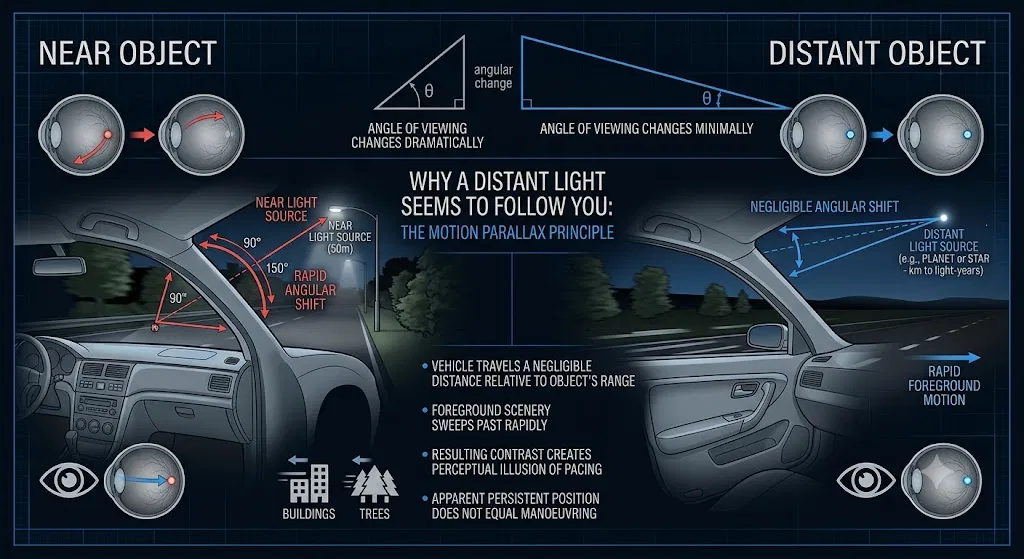
A light seen from a moving car or aircraft can appear to follow the observer even when it is fixed in the sky or moving quite independently. The main reason is geometry: a very distant object changes its bearing only slightly as the observer travels, while nearby trees, buildings, hills and road furniture sweep rapidly across the field of view. The resulting contrast can make the distant light seem to hold station beside the vehicle.
Vision researchers call the underlying depth cue motion parallax. When an observer translates through space, nearby objects shift across the retina faster than distant ones; laboratory and perceptual research treats this relative motion as an important source of information about depth.[PubMed Central (PMC)]nih.govOpen source on nih.gov. In UFO/UAP reports, however, the same geometry can become misleading when the light itself has no obvious scale, distance or surrounding reference points. A planet, distant aircraft light or other remote source may then appear to pace, pursue or accompany the observer without doing so physically.
Constant bearing and distant objects
Imagine looking sideways from a moving car at a lamp only 50 metres away. After the car travels a short distance, the viewing angle to that lamp changes dramatically. Now replace the lamp with something tens or hundreds of kilometres away. The same movement of the car produces only a tiny angular change. For an astronomical object, the observer’s journey by road is effectively negligible compared with the object’s distance.
This is why the Moon provides such an intuitive demonstration. EarthSky notes that buildings, fields and people rush past a moving car while the much more distant Moon remains in nearly the same direction, creating the familiar impression that it is following the vehicle. The same principle applies to bright celestial objects such as Venus.[EarthSky]earthsky.orgOpen source on earthsky.org.
The geometry can be expressed simply. For a small sideways displacement, the change in direction to a distant object is roughly proportional to the observer’s displacement divided by the object’s distance. The farther away the source, the smaller the angular shift. A vehicle therefore does not need to travel beside a light for the light to remain near the same part of the windscreen or side window; distance alone can produce that visual behaviour.
This is closely related to motion parallax, although the phrase “the light followed me” describes the perceptual result rather than a separate optical phenomenon. Scientific accounts of motion parallax describe how translation of the observer causes nearer objects to move faster across the retinal image than more distant ones.[NASA Technical Reports Server]nasa.govOpen source on nasa.gov. The brain normally uses that difference successfully to judge depth. The apparent-pursuit effect arises when the distant object’s own lack of angular movement becomes especially noticeable against a rapidly moving foreground.
A nearly constant bearing is therefore not, by itself, evidence that an unidentified light is manoeuvring to maintain position with a vehicle. What matters is whether the observer can establish the object’s range and actual trajectory, rather than merely its direction in successive views.
How nearby scenery exaggerates the effect
The sense of pursuit becomes stronger because the observer rarely judges the distant light in isolation. The road environment supplies a stream of much closer reference objects: lamp posts cut across the view, trees slide backwards, buildings rotate through large angles and hills shift relative to one another. Against that busy pattern, a distant light may seem strikingly stable.
That contrast is exactly what motion-parallax research predicts. When the observer moves, the retinal images of nearby objects move more quickly than those of distant objects.[PubMed Central (PMC)]nih.govOpen source on nih.gov. A passenger can therefore experience three simultaneous layers of apparent movement: very close objects flash past rapidly, more distant terrain moves slowly, and a sufficiently remote point of light hardly shifts at all. The visual system interprets these differences as depth, but without a clear idea of the light’s distance it is easy to reinterpret its persistent position as purposeful pacing.
Night observation makes the problem harder. Darkness removes many of the cues that would ordinarily reveal an object’s scale and location. The US Federal Aviation Administration warns that darkness and low visibility increase susceptibility to visual error, and that scenes containing isolated ground lights and stars can provide misleading spatial information.[Federal Aviation Administration]faa.govOpen source on faa.gov. An anonymous white point against a dark sky offers few clues as to whether it is a kilometre away, tens of kilometres away or astronomically distant.
A second night-time illusion can sometimes add to the confusion but should not be conflated with the pursuit effect. Autokinesis is the apparent wandering of a stationary light when it is stared at against a dark, featureless background. The FAA specifically warns pilots that a stationary light may seem to move after prolonged fixation.[Federal Aviation Administration]faa.govOpen source on faa.gov. Motion parallax, by contrast, results from a changing viewpoint. In a real observation, both effects can potentially be present: vehicle motion can make a remote light appear to keep pace while autokinesis adds small apparent darts or drifts.
This distinction matters in UFO reporting. A witness may accurately remember that nearby scenery moved dramatically while the light remained alongside the vehicle, and may also accurately remember slight movements of the light. Neither observation, by itself, establishes that the source matched the vehicle’s speed or deliberately changed course.
Planets and aircraft as common examples
Bright astronomical objects are particularly effective at producing “following light” experiences because they are effectively fixed at terrestrial travelling scales. Venus is an important example because it can appear exceptionally bright and conspicuous near the horizon. EarthSky explicitly identifies the same geometry that makes the Moon appear to follow a car as a contributor to UFO reports involving bright sky objects such as Venus.[EarthSky]earthsky.orgOpen source on earthsky.org. Sky & Telescope has likewise described how compelling the apparent movement of Venus can be to an observer who interprets it as an aircraft.[Sky & Telescope]skyandtelescope.orgOpen source on skyandtelescope.org.
This is not merely a modern suggestion. An historical US Air Force UFO fact sheet preserved in the CIA archive stated that Venus, Mars and Jupiter had repeatedly been reported as unusual moving objects, particularly when haze, light fog or moving clouds complicated the view.[CIA]cia.govOpen source on cia.gov. Such conditions can remove stars and other comparison points while leaving a bright planet visible, making its true distance and stationary celestial position even less intuitive.
Aircraft can create a related but less simple effect. An aircraft tens of kilometres away may show little angular displacement for a period, particularly if its course produces only a small change in bearing from the observer’s position. At night, often only its lights are visible, eliminating most size and shape information. The FAA notes more generally that darkness inhibits depth perception and can make the flight path of another aircraft difficult to determine from its lighting alone.[Federal Aviation Administration]faa.govOpen source on faa.gov. A distant aeroplane can therefore appear to hover, pace a vehicle or remain unusually fixed in one direction before its geometry changes enough for its motion to become obvious.
Actual moving aerial objects add an important caution: not every apparently following light is literally stationary. A distant aircraft, balloon or other object can have genuine motion while observer motion dominates the apparent motion seen against the background. The All-domain Anomaly Resolution Office (AARO) explicitly recognises motion parallax as a recurring UAP interpretation problem, explaining that stationary or slow-moving objects may appear to move rapidly when viewed from a fast-moving platform.[AARO]aaro.milOpen source on aaro.mil.
AARO’s reconstruction of the 2013 “Puerto Rico Object” video provides a concrete aviation example. The infrared footage was taken from a moving US Customs and Border Protection aircraft and appeared to show objects travelling rapidly across the landscape. AARO’s later reconstruction assessed that the objects were actually drifting at about 3.6 metres per second, or 8 mph, while the aircraft’s motion, sensor zoom and changing viewing geometry greatly increased their apparent speed.[AARO]aaro.milOpen source on aaro.mil. That case concerns exaggerated apparent speed rather than a classic “light following a car”, but it demonstrates the same central principle: motion seen from a moving platform cannot safely be assigned to the observed object until observer motion and range are accounted for.
Why the impression can persist for kilometres
One feature that often makes a pursuit report seem especially persuasive is duration. If a light remains visible through several turns or for many kilometres, it can feel implausible that an ordinary fixed object could still be involved. For a sufficiently distant source, however, prolonged visibility is exactly what the geometry predicts.
A road may bend repeatedly while still leaving the same planet visible through the passenger-side window or ahead through the windscreen. Each bend changes the vehicle’s heading, so the light may shift from one part of the view to another, but the observer may interpret those changes as the light manoeuvring around the vehicle rather than as the vehicle rotating beneath an essentially fixed sky. Conversely, on a long straight road the bearing can remain so stable that the light seems almost locked to the car.
Terrain can intensify the narrative. A distant light may disappear behind a hill, building, tree line or cloud and then reappear after the vehicle changes position. From inside the moving vehicle this can feel like an object falling back, hiding or returning. Yet foreground occlusion is precisely what should happen when a distant source is successively blocked and uncovered by nearby scenery.
The strongest clue is therefore not simply whether the light “stayed with” the observer. More useful questions concern the viewing geometry: Did its position change relative to stars? Did it remain at the same altitude and compass direction when the vehicle stopped? Did turns in the road predict its movement across the windows? Was there a visible aircraft track or known bright planet in that direction? AARO itself emphasises that useful UAP analysis depends on contextual data such as location, timing and sensor information rather than visual impression alone.[AARO]aaro.milOpen source on aaro.mil.
What the pursuit effect does — and does not — explain
The moving-observer effect offers a straightforward explanation for a specific class of UFO/UAP testimony: a remote light seems to accompany a car or aircraft because its direction changes much less than the nearby environment does. It does not imply that witnesses imagined seeing a light. The light may be entirely real; the mistaken part is the inference that a nearly unchanged bearing means the source is physically keeping pace.
Nor is motion parallax a universal explanation for every report involving apparent pursuit. Evidence of independently measured range changes, a trajectory established from multiple separated observers, radar data, identifiable changes relative to the star field, or manoeuvres that remain after the observer’s own motion is mathematically removed would require additional analysis. Motion parallax is most compelling when the report contains the conditions that produce it naturally: a moving observer, an unresolved distant source, weak distance cues and rapidly shifting foreground scenery.
Within UFO/UAP investigation, this makes “following lights” a useful reminder of the difference between image motion and object motion. A light that remains beside a moving vehicle can feel as though it must be travelling with it. In many cases, however, the opposite is true: the impression is strongest precisely because the source is so distant that the observer’s journey scarcely changes the direction from which its light arrives.
Amazon book picks
Further Reading
Books and field guides related to Why a Distant Light Seems to Follow You. Use these as the next step if you want deeper reading beyond the article.
Sensation and Perception
. Bruce Goldstein's SENSATION AND PERCEPTION, the best-seller which has helped over 150,000 students understand the ties between how we s...
Eye and Brain: The Psychology of Seeing
Since the publication of the first edition in 1966, Eye and Brain has established itself worldwide as an essential introduction to the ba...
Visual Intelligence: How We Create What We See
A unique, illustrated popular study reveals the way the human eye acts on the visual world not just to represent but to create the things...
eBay marketplace picks
Marketplace Samples
Live-tested eBay searches with available results related to this page.
Selected fromUFO poster oneBay.co.uk.

Current eBay listing
VINTAGE UFO FLYING SAUCERS COMIC ADVERTISING A2 POSTER PRINT

Current eBay listing
I Want To Believe UFO Poster Giclée Fine Art Heavyweight Print

Endnotes
1.
Source: cia.gov
Link:https://www.cia.gov/stories/story/how-to-investigate-a-flying-saucer/
2.
Source: aaro.mil
Link:https://www.aaro.mil/UAP-Cases/Official-UAP-Imagery/4/
3.
Source: youtube.com
Title: Why is the moon following me?
Link:https://www.youtube.com/watch?v=UXpmM7BzTfI
Source snippet
Motion Parallax - sensation and perception...
4.
Source: youtube.com
Title: Motion Parallax
Link:https://www.youtube.com/watch?v=RxO3HMCjfQs
Source snippet
Depth Perception (Intro Psych Tutorial #57)...
Additional References
5.
Source: youtube.com
Title: 5 Monocular Cues: Adjusting To Depth Perception Problems
Link:https://www.youtube.com/watch?v=Qi-nHODlQwo
Source snippet
This selection explains how motion parallax causes distant objects like celestial bodies to appear to maintain their bearing and follow a...
6.
Source: youtube.com
Title: The REAL Reason the Moon Follows You!
Link:https://www.youtube.com/watch?v=geuD_rhNbdQ
Source snippet
5 Monocular Cues: Adjusting To Depth Perception Problems...
7.
Source: media.defense.gov
Title: FY24 CONSOLIDATED ANNUAL REPORT ON UAP 508
Link:https://media.defense.gov/2024/Nov/14/2003583603/-1/-1/0/FY24-CONSOLIDATED-ANNUAL-REPORT-ON-UAP-508.PDF
8.
Source: youtube.com
Title: Depth Perception (Intro Psych Tutorial #57)
Link:https://www.youtube.com/watch?v=Qr_yBDMd1Z8
Source snippet
The REAL Reason the Moon Follows You...