Within Night Sightings
When Your Own Motion Makes a UFO Move
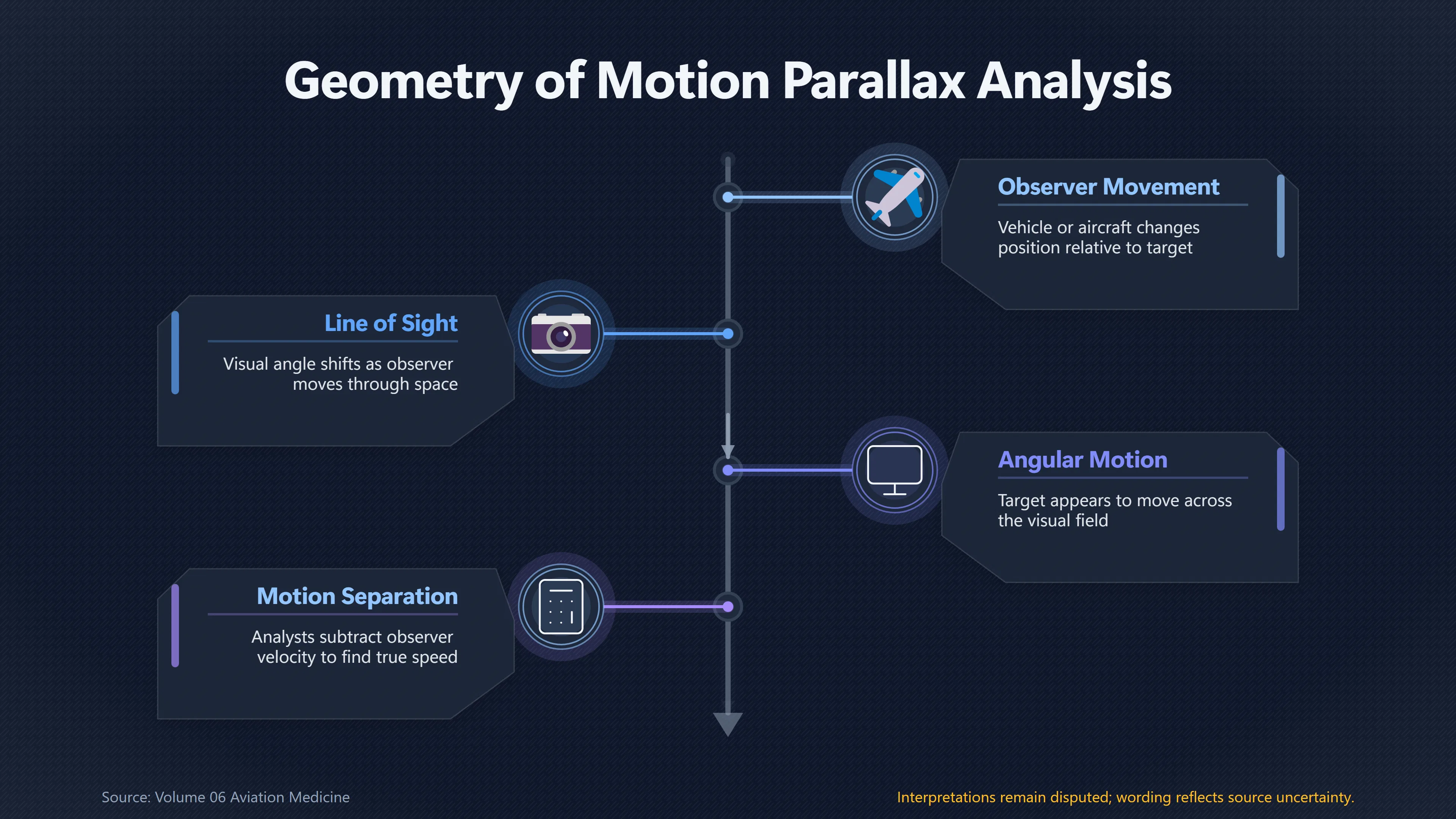
From a car, boat or aircraft, an observer's own movement can make a distant night light seem to move differently from its true path.
On this page
- Why self motion is harder to separate at night
- How cars boats and aircraft change viewing geometry
- What external references can test the apparent movement
Page outline Jump by section
Introduction
A light seen from a moving car, boat or aircraft does not have to move rapidly — or even move at all — to produce convincing apparent motion. As the observer changes position, the line of sight to the light changes too. The visual system therefore receives a mixture of two motions: the target’s real movement and the observer’s own movement. Separating them requires information about distance, direction, speed and the surrounding scene.
At night, much of that information may be missing. A lone light against black sky, dark sea or invisible terrain provides few fixed landmarks against which its path can be judged. Aviation authorities explicitly recognise that isolated lights and degraded external references can produce false perceptions of motion. In UAP investigations, the related geometry of motion parallax has become particularly important because a fast-moving observer or sensor can make a slow object look dramatically fast.[service.gov.uk]assets.publishing.service.gov.ukVolume 06 Aviation MedicineGOV.UKAP3456 - 6-1 - Human PerformanceFebruary 25, 2026…
The practical lesson is not that every report from a moving vehicle is an illusion. It is that apparent motion from such a viewpoint cannot safely be treated as the object’s true motion until the observer’s own movement has been accounted for.
Why self-motion is harder to separate at night
In ordinary daylight, self-motion produces a rich pattern of visual change. Roadside trees sweep past a car faster than distant hills; nearby terrain shifts rapidly against more distant terrain; the horizon remains relatively stable. This phenomenon, motion parallax, is normally useful rather than deceptive. Vision research shows that when an observer translates through the environment, objects at different distances move across the retina at different rates, providing powerful information about depth and the three-dimensional arrangement of the scene.[nih.gov]pmc.ncbi.nlm.nih.govPub Med Central (PMC)Visual Depth from Motion Parallax and Eye PursuitPubMed Central (PMC)Visual Depth from Motion Parallax and Eye Pursuit - PMCJune 22, 2011…
The difficulty arises when the scene does not contain enough objects at known or distinguishable distances. Consider a passenger travelling along a dark road while watching an unidentified light beyond an invisible field. The passenger knows the car is moving, but may not know whether the light is 500 metres away, five kilometres away or tens of kilometres away. Without visible hedges, buildings, hills or clouds around it, the normal parallax pattern that helps establish its distance is largely absent.
That matters because what the observer directly sees is primarily angular motion — a change in where the light lies in the field of view. Angular movement is not the same thing as physical speed. A nearby object can sweep through a large viewing angle after a relatively small displacement, while a very distant object travelling quickly may cross the visual field slowly. The observer’s own displacement also changes that viewing angle. Consequently, an eyewitness impression such as “it suddenly moved to the right” may accurately describe what happened in the observer’s visual field without establishing that the object itself made an equivalent manoeuvre.
Laboratory work demonstrates that the brain normally incorporates information about self-motion when maintaining representations of objects in space. That ability is highly useful in richly structured environments, but it does not supply missing range information by magic. If the relevant reference geometry is unavailable, different combinations of observer movement, target distance and target movement can produce similar visual impressions.[PubMed Central (PMC)]pmc.ncbi.nlm.nih.govPubMed Central (PMC)Motion Parallax Is Computed in the Updating of Human Spatial Memory - PMCSeptember 3, 2003…
Night flying provides an unusually clear demonstration of the vulnerability. The UK Central Flying School’s aviation-medicine guidance says that hovering accurately without instruments requires a stable, discernible ground reference. At night, a single ground light is inadequate for judging height and can produce a false perception of motion; the same guidance warns that moving lights on vehicles or other aircraft can cause errors in judging relative motion.[GOV.UK]assets.publishing.service.gov.ukVolume 06 Aviation MedicineGOV.UKAP3456 - 6-1 - Human PerformanceFebruary 25, 2026…
There is also a separate night-time effect, autokinesis, that should not be confused with motion parallax. The Federal Aviation Administration (FAA) describes how a stationary light stared at against darkness can appear to wander. In a real sighting from a moving vehicle, the observer can therefore face more than one source of uncertainty: genuine geometrical changes caused by self-motion may coexist with perceptual instability caused by the lack of a visual reference frame.[faa.gov]faa.govFederal Aviation AdministrationFAA-H-8083-15B, Instrument Flying HandbookMay 21, 2013…
How cars, boats and aircraft change the viewing geometry
The essential geometry is easiest to understand from a car. Looking sideways from a moving vehicle, nearby posts and trees appear to race backwards while a distant tower moves much more slowly against the horizon. Neither has to be moving. The apparent displacement is produced because the observer has changed position.
Now remove the daylight scenery and leave only one unidentified light. The observer still moves, and therefore still changes the line of sight, but can no longer see enough of the surrounding scene to recognise how much of the apparent movement belongs to the observer. If the vehicle turns, climbs, descends or follows a curved road, the geometry becomes more complicated again.
The same principle applies on water. A boat can translate, turn, pitch and roll while a distant aircraft, shore light, planet or another vessel remains visible against a poorly defined horizon. Maritime navigation formally distinguishes relative motion from true motion for precisely this broader geometrical reason. UK Maritime and Coastguard Agency guidance notes that in relative-motion radar displays the observer’s own vessel remains fixed while other returns display movement resulting from the combined motion of own ship and targets; fixed land or anchored objects can therefore produce apparent relative trails.[GOV.UK]GOV.UKMG N 379 (M+F) Amendment 1: use of electronic navigational aidsMG N 379 (M+F) Amendment 1: use of electronic navigational aids
Aircraft introduce larger observer velocities and three-dimensional manoeuvres. A pilot or airborne camera may be travelling hundreds of miles per hour while banking around a comparatively slow target. AARO, the US Department of Defense’s All-domain Anomaly Resolution Office, specifically warns that parallax can cause inaccurate estimates of a UAP’s size, speed and direction when observations come from a single fast-moving sensor. Its explanation is straightforward: as the observer moves, an object’s projected position against the background changes, creating apparent movement that need not correspond to the object’s true velocity.[AARO]aaro.milEffect of Forced Perspective and Parallax View on UAP ObservationsEffect of Forced Perspective and Parallax View on UAP Observations…
The effect becomes particularly striking when a camera tracks the target. Keeping the light or object near the centre of the frame can hide the motion of the camera’s line of sight. Instead, the background appears to stream past it. Without the aircraft’s position, heading, speed, camera angles, range and field of view, a viewer may intuitively assign much of that relative movement to the target.
This is why “it crossed the background extremely quickly” is not, by itself, a speed measurement. The observed image contains the combined consequences of target motion, observer motion, viewing distance and camera orientation.
GoFast shows how dramatic the error can be
The US Navy’s well-known GoFast recording provides an unusually useful UAP example because the apparent motion can be compared with numerical information associated with the observation. The infrared footage gives a strong visual impression of a small object racing above the ocean while an F/A-18 observes it from the air.
NASA’s UAP Independent Study Team used the case to illustrate why that visual impression cannot simply be converted into physical speed. Its analysis placed the object at about 13,000 feet and calculated that it travelled roughly 390 metres during a 22-second interval, corresponding to about 40 mph. The observing aircraft, meanwhile, was moving at roughly 435 mph. NASA therefore concluded that the impression of extraordinary speed was at least partly produced by the aircraft’s high velocity combined with parallax.[NASA Science]science.nasa.govScience UAPScience UAP
AARO subsequently conducted a more extensive geospatial analysis. Its published work concluded with high confidence that the GoFast object did not display anomalous or exceptional performance. AARO’s modelling found scenarios in which its movement was broadly compatible with the prevailing wind and showed how the F/A-18’s own motion could amplify the target’s apparent speed through parallax.[Project Blue Book Archive]theprojectbluebookarchive.orgProject Blue Book Archive AARO Go Fast Case ResolutionProject Blue Book Archive AARO Go Fast Case Resolution
The important point is narrower than “GoFast was identified”. AARO’s analysis did not require the exact identity of the object to establish that its apparently spectacular speed was misleading. Its assessment separated two questions that are often conflated in UFO discussions:
- What was the object? Its precise identity may remain uncertain.
- Did the video demonstrate extraordinary speed? The available geometry can show that it did not need to.
AARO itself makes this distinction in its public guidance, explaining that stationary or slow-moving objects can appear to move rapidly relative to a fast observer, particularly when the object is comparatively close or the sensor has a narrow field of view.[AARO]aaro.milOpen source on aaro.mil.
GoFast is therefore valuable less as a universal explanation for UAP reports than as a warning about interpretation. A striking apparent trajectory seen from a moving platform can survive casual viewing, repeated replay and experienced observation while still giving a seriously distorted impression of physical velocity.
A moving witness can also make a real motion look smaller
Self-motion does not only exaggerate target movement. Under different geometry it can partly cancel it.
Imagine observing another vehicle travelling in roughly the same direction. If observer and target have similar angular motion from the relevant viewpoint, the target can appear to hang nearly motionless even though both are moving rapidly. Conversely, motion in opposing directions can increase the apparent angular rate.
This is why the problem cannot be reduced to the simple claim that “parallax makes things look faster”. Motion parallax describes how changing viewpoint affects apparent relative positions. Depending on the observer’s path, the object’s distance and the object’s actual trajectory, self-motion can make a target appear faster, slower, stationary or differently directed than it really is. Research on motion parallax treats observer translation as part of the visual information needed to recover three-dimensional structure, rather than assuming image motion belongs wholly to objects in the scene.[PubMed Central (PMC)]pmc.ncbi.nlm.nih.govPub Med Central (PMC)Visual Depth from Motion Parallax and Eye PursuitPubMed Central (PMC)Visual Depth from Motion Parallax and Eye Pursuit - PMCJune 22, 2011…
This distinction matters when evaluating witness language. “It paced us”, “it stopped when we stopped”, “it shot backwards” or “it stayed alongside the aircraft” may be valuable observations, but they do not by themselves establish the corresponding physical manoeuvres. The vehicle’s own speed and direction, changes in heading and the target’s range all have to be reconstructed before relative angular behaviour becomes a reliable statement about true motion.
What external references can test the apparent movement
The strongest way to test a report from a moving observer is to reconstruct the geometry rather than relying on the visual impression alone. AARO explicitly stresses that single-observer reports remain useful, but says additional sensor information can create a more complete picture of an object’s size and speed. Its guidance also identifies metadata such as GPS position and timestamps as valuable evidence.[AARO]aaro.milEffect of Forced Perspective and Parallax View on UAP ObservationsEffect of Forced Perspective and Parallax View on UAP Observations…
For a night sighting, several kinds of reference can materially change the assessment:
- Vehicle track and speed. GPS, navigation logs, flight data or a mapped road can show how far and in what direction the observer moved during the sighting.
- Changes of heading. A turn by a car, boat or aircraft can create an apparent change in a distant light’s direction. Matching the reported manoeuvre to the observer’s turn is therefore an important test.
- Fixed landmarks. A mountain ridge, mast, building, coastline, star field or known horizon can provide an independent angular reference that darkness may have concealed from the witness at the time.
- Range information. Radar, laser ranging or sufficiently reliable sensor data can sharply reduce ambiguity because apparent angular motion has very different implications at different distances.
- Camera metadata. Field of view, zoom, gimbal angles, stabilisation, aircraft attitude and timestamps can reveal movement that is difficult or impossible to infer from the displayed video alone.
- Independent viewpoints. Two sufficiently separated observers can constrain location through triangulation and help distinguish target motion from observer-induced parallax.
The value of these records is that they turn “the light looked as though it accelerated” into a testable geometrical claim. Investigators can ask where the observer was at successive times, where the line of sight pointed, how the viewing platform was moving and what target paths are consistent with those measurements.
AARO’s GoFast analysis illustrates the approach: rather than estimating speed from how rapidly the ocean appears to pass behind the target, analysts reconstructed aircraft motion and viewing geometry and considered possible target trajectories. That produced a markedly less extraordinary interpretation than visual inspection alone.[Project Blue Book Archive]theprojectbluebookarchive.orgProject Blue Book Archive AARO Go Fast Case ResolutionProject Blue Book Archive AARO Go Fast Case Resolution

When apparent motion is still meaningful
Parallax should not become a catch-all dismissal. AARO explicitly states that not all reports of fast-moving UAP can be attributed to forced perspective or parallax. The mechanism is an alternative hypothesis that must fit the geometry, not a label that automatically explains every sighting from a moving vehicle.[AARO]aaro.milEffect of Forced Perspective and Parallax View on UAP ObservationsEffect of Forced Perspective and Parallax View on UAP Observations…
Evidence for genuine target movement becomes stronger when the apparent trajectory remains consistent after observer motion is removed. Multiple separated viewpoints are especially valuable, as are calibrated sensor records giving reliable range and bearing over time. A visible target passing in front of or behind known landmarks can also impose useful distance constraints. Conversely, a single point of light against a featureless night sky, observed from a turning or rapidly moving platform without range data, leaves much greater uncertainty.
This is also why witness expertise does not entirely eliminate the problem. Aviation training explicitly teaches pilots about visual illusions because skilled operators remain human observers working with incomplete sensory information. FAA research on simulated night approaches found substantial visual errors under reduced-cue conditions and specifically investigated the limitations of relative motion parallax as a night-time visual cue.[Federal Aviation Administration]faa.govOpen source on faa.gov.
The fairest assessment of a moving-observer UFO report therefore separates observation from inference. A witness may reliably report that a light swept rapidly across their view. The further conclusion that a distant object physically accelerated across kilometres of sky requires information the eye alone may not possess.
The key question is: what moved relative to what?
A night-time UFO sighting from a car, boat or aircraft is fundamentally an observation from a moving reference frame. The movement seen by the witness is a combination of the observer’s trajectory, the target’s trajectory and their changing geometrical relationship. Darkness makes that separation harder because terrain, horizon, depth and other external references may disappear.
Motion parallax is therefore one of the most important checks on claims of unusual speed or manoeuvring from moving platforms. It can make a slow or stationary object appear to move quickly, and different geometries can also suppress or redirect apparent motion. Aviation research and operational guidance recognise the underlying problem, while modern UAP analysis has demonstrated it quantitatively in cases such as GoFast.[service.gov.uk]assets.publishing.service.gov.ukVolume 06 Aviation MedicineGOV.UKAP3456 - 6-1 - Human PerformanceFebruary 25, 2026…
The decisive evidence is not how dramatic the movement looked, but whether the movement remains dramatic after the observer’s own motion has been reconstructed. For sightings made at night with few external references, that distinction can be the difference between an apparently extraordinary manoeuvre and an ordinary light viewed from a changing position.
Amazon book picks
Further Reading
Books and field guides related to When Your Own Motion Makes a UFO Move. Use these as the next step if you want deeper reading beyond the article.
Sensation and Perception
. Bruce Goldstein's SENSATION AND PERCEPTION, the best-seller which has helped over 150,000 students understand the ties between how we s...
Eye and Brain: The Psychology of Seeing
Since the publication of the first edition in 1966, Eye and Brain has established itself worldwide as an essential introduction to the ba...
Visual Intelligence: How We Create What We See
A unique, illustrated popular study reveals the way the human eye acts on the visual world not just to represent but to create the things...
The Pilot's Handbook of Aeronautical Knowledge
Pilot's Handbook of Aeronautical Knowledge, an official Federal Aviation Administration (FAA) Handbook; provides basic knowledge that is...
eBay marketplace picks
Marketplace Samples
Live-tested eBay searches with available results related to this page.
Selected fromUFO poster oneBay.co.uk.

Current eBay listing
I Want To Believe UFO Poster Giclée Fine Art Heavyweight Print


Current eBay listing
VINTAGE UFO FLYING SAUCERS COMIC ADVERTISING A2 POSTER PRINT
Endnotes
1.
Source: assets.publishing.service.gov.uk
Title: Volume 06 Aviation Medicine
Link:https://assets.publishing.service.gov.uk/government/uploads/system/uploads/attachment_data/file/857304/Volume_06_Aviation_Medicine.pdf
Source snippet
GOV.UKAP3456 - 6-1 - Human PerformanceFebruary 25, 2026...
Published: February 25, 2026
2.
Source: aaro.mil
Title: Effect of Forced Perspective and Parallax View on UAP Observations
Link:https://www.aaro.mil/Portals/136/PDFs/Information%20Papers/AARO_Effect_of_Forced_Perspective_and_Parallax_View_on_UAP_Observations_2024.pdf?ver=WTwJtQaCvC3BkRlBJCGLzg%3D%3D
Source snippet
Effect of Forced Perspective and Parallax View on UAP Observations...
3.
Source: faa.gov
Title: 12 afh ch11
Link:https://www.faa.gov/sites/faa.gov/files/regulations_policies/handbooks_manuals/aviation/airplane_handbook/12_afh_ch11.pdf
Source snippet
Federal Aviation AdministrationAirplane Flying Handbook (FAA-H-8083-3C)...
4.
Source: faa.gov
Link:https://www.faa.gov/sites/faa.gov/files/pilots/FAA-H-8083-15B.pdf
Source snippet
Federal Aviation AdministrationFAA-H-8083-15B, Instrument Flying HandbookMay 21, 2013...
Published: May 21, 2013
5.
Source: assets.publishing.service.gov.uk
Title: Volume 06 Aviation Medicine
Link:https://assets.publishing.service.gov.uk/media/5e18b047ed915d3b0d1b767b/Volume_06_Aviation_Medicine.pdf
Source snippet
GOV.UKAP3456 The Central Flying School (CFS) Manual of Flying: Volume 6: Aviation Medicine...
6.
Source: GOV.UK
Title: MG N 379 (M+F) Amendment 1: use of electronic navigational aids
Link:https://www.gov.uk/government/publications/mgn-379-mf-amendment-1-use-of-electronic-navigational-aids/mgn-379-mf-amendment-1-use-of-electronic-navigational-aids
7.
Source: aaro.mil
Link:https://www.aaro.mil/FAQ/
8.
Source: science.nasa.gov
Title: Science UAP
Link:https://science.nasa.gov/uap/
9.
Source: faa.gov
Link:https://www.faa.gov/data_research/research/med_humanfacs/oamtechreports/1970s/1978/197815
10.
Source: faa.gov
Link:https://www.faa.gov/data_research/research/med_humanfacs/oamtechreports/1970s/1977/197712
11.
Source: science.nasa.gov
Title: hubble glossary
Link:https://science.nasa.gov/mission/hubble/multimedia/hubble-glossary/
12.
Source: warrington.gov.uk
Title: Report a problem with traffic lights | warrington.gov.uk
Link:https://www.warrington.gov.uk/report-problem-traffic-lights
13.
Source: aaro.mil
Link:https://www.aaro.mil/Next-AARO-Home-redesign/Next-Parent/Next-UAP-Report-Documents/
14.
Source: aaro.mil
Link:https://www.aaro.mil/Next-AARO-Home-redesign/Next-Parent/Next-AARO-UAP-Imagery-Acc-Table/
15.
Source: aaro.mil
Link:https://www.aaro.mil/Next-AARO-Home-redesign/Next-Parent/Next-UAP-Report-Documents/poster/
16.
Source: science.nasa.gov
Link:https://science.nasa.gov/uap/faqs/
17.
Source: GOV.UK
Link:https://www.gov.uk/government/publications/mgn-715-mf-recommended-best-practice-for-respectful-and-safe-operation/mgn-715-mf-recommended-best-practice-for-respectful-and-safe-operation-in-shared-spaces
18.
Source: science.nasa.gov
Link:https://science.nasa.gov/universe/glossary/
19.
Source: findajob.dwp.gov.uk
Link:https://findajob.dwp.gov.uk/details/17779299
20.
Source: GOV.UK
Title: www.gov.uk A guide to good practice on port and marine facilities
Link:https://www.gov.uk/government/publications/a-guide-to-good-practice-on-port-marine-operations/a-guide-to-good-practice-on-port-and-marine-facilities
21.
Source: GOV.UK
Title: www.gov.uk Countering drone threats to shipping
Link:https://www.gov.uk/government/publications/countering-drone-threats-to-shipping/countering-drone-threats-to-shipping
22.
Source: GOV.UK
Link:https://www.gov.uk/government/publications/mgn-369-mf-amendment-1-navigation-safety-navigation-practices-relevant-to-restricted-visibility/mgn-369-mf-amendment-1-navigation-safety-navigation-practices-relevant-to-restricted-visibility
23.
Source: GOV.UK
Link:https://www.gov.uk/government/publications/mgn-696-mf-navigation-safety-dynamically-positioned-vessels-undertaking-diving-or-other-subsea-operations/mgn-696-mf-navigation-safety-dynamically-positioned-vessels-undertaking-diving-or-other-subsea-operations
24.
Source: nasa.gov
Title: UPDAT E: NASA Shares UAP Independent Study Report; Names Director
Link:https://www.nasa.gov/news-release/update-nasa-shares-uap-independent-study-report-names-director/
25.
Source: nasa.gov
Title: NAS A to Release, Discuss Unidentified Anomalous Phenomena Report
Link:https://www.nasa.gov/news-release/nasa-to-release-discuss-unidentified-anomalous-phenomena-report/
26.
Source: GOV.UK
Title: www.gov.uk Appendix B: Display of lights
Link:https://www.gov.uk/government/publications/river-thames-navigation-licensing-and-general-byelaws-1993/appendix-b-display-of-lights
27.
Source: GOV.UK
Title: www.gov.uk Sidelights on rescue boats: UK21/L005
Link:https://www.gov.uk/marine-equipment-approved-recommendations/sidelights-on-rescue-boats-uk21-slash-l005
28.
Source: nelincs.gov.uk
Title: [reflections]({{ ‘reflections/’ | relative_url }}) a night time spectacular
Link:https://www.nelincs.gov.uk/reflections-a-night-time-spectacular/
29.
Source: nasa.gov
Title: NAS A Provides Coverage of Unidentified Anomalous Phenomena Meeting
Link:https://www.nasa.gov/news-release/nasa-provides-coverage-of-unidentified-anomalous-phenomena-meeting/
30.
Source: nelincs.gov.uk
Title: the big fin ale myfishgy lights up grimsby
Link:https://www.nelincs.gov.uk/the-big-fin-ale-myfishgy-lights-up-grimsby/
31.
Source: nasa.gov
Title: NAS A Announces Unidentified Aerial Phenomena Study Team Members
Link:https://www.nasa.gov/general/nasa-announces-unidentified-aerial-phenomena-study-team-members/
32.
Source: GOV.UK
Link:https://www.gov.uk/government/publications/mgn-306m-amendment-1-designing-and-operating-smaller-passenger-vessels-guidance-on-meeting-the-needs-of-persons-with-disabilities/designing-and-operating-smaller-passenger-vessels-guidance-on-meeting-the-needs-of-persons-with-reduced-mobility
33.
Source: local.gov.uk
Title: Cumbria County Council: LED streetlights | Local Government Association
Link:https://www.local.gov.uk/case-studies/cumbria-county-council-led-streetlights
34.
Source: ssd.jpl.nasa.gov
Link:https://ssd.jpl.nasa.gov/announcements/an20210929.html
35.
Source: imagine.gsfc.nasa.gov
Link:https://imagine.gsfc.nasa.gov/resources/dictionary.html
36.
Source: nasa.gov
Title: NAS A’s New Horizons Conducts the First Interstellar Parallax Experiment
Link:https://www.nasa.gov/solar-system/nasas-new-horizons-conducts-the-first-interstellar-parallax-experiment/
37.
Source: astrobiology.nasa.gov
Title: know thy star know thy planet
Link:https://astrobiology.nasa.gov/news/know-thy-star-know-thy-planet/
38.
Source: science.nasa.gov
Title: three steps to measuring the hubble constant
Link:https://science.nasa.gov/asset/hubble/three-steps-to-measuring-the-hubble-constant/
39.
Source: faa.gov
Title: Chapter 8. Medical Facts for Pilots
Link:https://www.faa.gov/air_traffic/publications/atpubs/aim/aim0801.html
40.
Source: GOV.UK
Title: www.gov.uk MC A survey of lights and signalling equipment (MSIS 10)
Link:https://www.gov.uk/government/publications/mca-survey-of-lights-and-signalling-equipment-msis-10
41.
Source: science.nasa.gov
Title: hubble stretches stellar tape measure 10 times farther into space
Link:https://science.nasa.gov/missions/hubble/hubble-stretches-stellar-tape-measure-10-times-farther-into-space/
42.
Source: GOV.UK
Title: www.gov.uk Advertisements
Link:https://www.gov.uk/guidance/advertisements
43.
Source: boats.com
Title: The Autokinetic Effect: An Unexpected Danger of Boating at Night
Link:https://www.boats.com/how-to/the-autokinetic-effect-an-unexpected-danger-of-boating-at-night/
44.
Source: GOV.UK
Title: www.gov.uk MG N 357 Night time lookout: photochromic lenses and dark adaptation
Link:https://www.gov.uk/government/publications/mgn-357-night-time-lookout-photocromic-lenses-and-dark-adaptation
45.
Source: science.nasa.gov
Title: depth perception in space
Link:https://science.nasa.gov/resource/depth-perception-in-space/
46.
Source: science.nasa.gov
Title: hubble sees bare neutron star streaking across space
Link:https://science.nasa.gov/missions/hubble/hubble-sees-bare-neutron-star-streaking-across-space/
47.
Source: GOV.UK
Link:https://www.gov.uk/government/publications/mgn-137-look-out-during-periods-of-darkness-restricted-visibility
48.
Source: asrs.arc.nasa.gov
Title: cb 246
Link:https://asrs.arc.nasa.gov/publications/callback/cb_246.htm
49.
Source: ntrs.nasa.gov
Link:https://ntrs.nasa.gov/citations/19980019496
50.
Source: faa.gov
Link:https://www.faa.gov/Air_traffic/publications/atpubs/aim_html/chap8_section_1.html
51.
Source: faa.gov
Link:https://www.faa.gov/data_research/research/med_humanfacs/oamtechreports/1970s/1971/7131
52.
Source: faa.gov
Link:https://www.faa.gov/air_traffic/publications/atpubs/aim_html/chap7_section_6.html
53.
Source: faa.gov
Link:https://www.faa.gov/air_traffic/publications/atpubs/aip_html/chap6_section_3.html
54.
Source: aaro.mil
Link:https://www.aaro.mil/UAP-Cases/Official-UAP-Imagery/4/
55.
Source: aaro.mil
Link:https://www.aaro.mil/
56.
Source: aaro.mil
Link:https://www.aaro.mil/Next-AARO-Home-redesign/Next-Parent/Next-AARO-UAP-Imagery-Fixed-Table/
57.
Source: aaro.mil
Title: UAP Records
Link:https://www.aaro.mil/UAP-Records/
58.
Source: aaro.mil
Title: UAP Imagery UAP Video
Link:https://www.aaro.mil/Next-AARO-Home-redesign/Inactive-Parent/Next-UAP-Imagery-dup/
59.
Source: aaro.mil
Title: AAR O UAP Trends All-domain Anomaly Resolution Office UAP REPORTING TRENDS
Link:https://www.aaro.mil/UAP-Cases/UAP-Reporting-Trends/
60.
Source: aaro.mil
Link:https://www.aaro.mil/Resources/Historical-Record-Reports/Volume-II/
61.
Source: aaro.mil
Link:https://www.aaro.mil/Next-AARO-Home-redesign/Next-Parent/Next-AARO-UAP-Trends/
62.
Source: aaro.mil
Link:https://www.aaro.mil/Next-AARO-Home-redesign/Next-Parent/AARO-UAP-Case-DT/
63.
Source: dartford.gov.uk
Link:https://www.dartford.gov.uk/environmental-services-1/nuisance-artificial-light
64.
Source: local.gov.uk
Link:https://www.local.gov.uk/our-support/partners-care-and-health/autistic-and-learning-disabilities/autistic/housing/sight
65.
Source: lakedistrict.gov.uk
Title: Dark skies and stargazing
Link:https://lakedistrict.gov.uk/explore/things-to-do/beyond-the-trails/dark-skies-and-stargazing/
66.
Source: applytosupply.digitalmarketplace.service.gov.uk
Link:https://www.applytosupply.digitalmarketplace.service.gov.uk/g-cloud/services/666192046625306
67.
Source: dsfire.gov.uk
Link:https://www.dsfire.gov.uk/careers/visual-standards-firefighters
68.
Source: ashingdonparishcouncil.gov.uk
Link:https://ashingdonparishcouncil.gov.uk/history/
69.
Source: starchild.gsfc.nasa.gov
Link:https://starchild.gsfc.nasa.gov/docs/StarChild/questions/parallax.html
70.
Source: nasa.gov
Title: News Release
Link:https://www.nasa.gov/news-release/page/91/
71.
Source: youtube.com
Title: Explained: “[Go Fast]({{ ‘go-fast/’ | relative_url }})” UFO Video
Link:https://www.youtube.com/watch?v=PLyEO0jNt6M
Source snippet
Motion Parallax - Depth Perception - Monocular Cues...
72.
Source: pmc.ncbi.nlm.nih.gov
Title: Pub Med Central (PMC)Visual Depth from Motion Parallax and Eye Pursuit
Link:https://pmc.ncbi.nlm.nih.gov/articles/PMC3348271/
Source snippet
PubMed Central (PMC)Visual Depth from Motion Parallax and Eye Pursuit - PMCJune 22, 2011...
Published: June 22, 2011
73.
Source: pubmed.ncbi.nlm.nih.gov
Title: Pub Med Motion parallax as an independent cue for depth perception
Link:https://pubmed.ncbi.nlm.nih.gov/471676/
Source snippet
Motion parallax as an independent cue for depth perception - PubMed...
74.
Source: pmc.ncbi.nlm.nih.gov
Title: Pub Med Central (PMC)The neural basis of depth perception from motion parallax
Link:https://pmc.ncbi.nlm.nih.gov/articles/PMC4901450/
Source snippet
PubMed Central (PMC)The neural basis of depth perception from motion parallax - PMC...
75.
Source: pmc.ncbi.nlm.nih.gov
Link:https://pmc.ncbi.nlm.nih.gov/articles/PMC6740481/
Source snippet
PubMed Central (PMC)Motion Parallax Is Computed in the Updating of Human Spatial Memory - PMCSeptember 3, 2003...
Published: September 3, 2003
76.
Source: theprojectbluebookarchive.org
Title: [Project Blue Book]({{ ‘blue-book/’ | relative_url }}) Archive AARO Go Fast Case Resolution
Link:https://theprojectbluebookarchive.org/archive/UAP_Electronic_StillPictures_Archives/SecDef-UAP-Records/493468580/08_Go_Fast.pdf
77.
Source: pmc.ncbi.nlm.nih.gov
Link:https://pmc.ncbi.nlm.nih.gov/articles/PMC12289190/
78.
Source: pmc.ncbi.nlm.nih.gov
Link:https://pmc.ncbi.nlm.nih.gov/articles/PMC7862735/
79.
Source: pubmed.ncbi.nlm.nih.gov
Link:https://pubmed.ncbi.nlm.nih.gov/27269599/
80.
Source: pmc.ncbi.nlm.nih.gov
Link:https://pmc.ncbi.nlm.nih.gov/articles/PMC4459088/
81.
Source: pmc.ncbi.nlm.nih.gov
Link:https://pmc.ncbi.nlm.nih.gov/articles/PMC3349336/
82.
Source: psychologicalscience.com
Title: Motion Parallax
Link:https://www.psychologicalscience.com/perception/2011/02/motion-parallax.html
83.
Source: pubmed.ncbi.nlm.nih.gov
Link:https://pubmed.ncbi.nlm.nih.gov/12954876/
84.
Source: trid.trb.org
Link:https://trid.trb.org/View/153263
85.
Source: pubmed.ncbi.nlm.nih.gov
Link:https://pubmed.ncbi.nlm.nih.gov/697665/
86.
Source: trid.trb.org
Link:https://trid.trb.org/View/69988
87.
Source: sciencedirect.com
Title: Motion Parallax
Link:https://www.sciencedirect.com/topics/computer-science/motion-parallax
88.
Source: skybrary.aero
Link:https://skybrary.aero/index.php/articles/visual-illusions
89.
Source: trid.trb.org
Link:https://trid.trb.org/View/116202
Additional References
90.
Source: nature.com
Link:https://www.nature.com/articles/s41598-026-42955-5
91.
Source: ntsb.gov
Link:https://www.ntsb.gov/news/press-releases/Pages/NR20240606.aspx
92.
Source: nature.com
Title: Scene-relative object motion biases depth percepts | Scientific Reports
Link:https://www.nature.com/articles/s41598-022-23219-4
93.
Source: researchgate.net
Link:https://www.researchgate.net/publication/332138280_Proposal_of_Auxiliary_Stern_Light_and_The_Effect_of_the_Auxiliary_Stern_Light_for_Estimating_the_Course_of_Another_Vessel_in_an_Overtaking_Situation
94.
Source: ufopress.com
Link:https://www.ufopress.com/articles/aaro-releases-four-information-papers-on-uap-classification-satellite-flaring-se/
95.
Source: frontiersin.org
Link:https://www.frontiersin.org/journals/psychology/articles/10.3389/fpsyg.2015.00775/full
96.
Source: disclosuremonitor.com
Link:https://disclosuremonitor.com/media/gofast-official-video
97.
Source: scribd.com
Link:https://www.scribd.com/document/671256731/UAP-Independent-Study-Team-Final-Report
98.
Source: nauticalninja.com
Link:https://nauticalninja.com/sailing_guides/voyage_planning/night-sailing
99.
Source: sky-lens.com
Link:https://sky-lens.com/guide