Within UFO Identifications
How Investigators Rebuild a UFO Sighting
Reliable identification depends on combining time, location, weather, viewing direction, imagery and known traffic rather than judging appearance alone.
On this page
- The core facts needed from witnesses
- Combining weather, astronomy and traffic records
- Testing explanations against the full timeline
Page outline Jump by section
Introduction
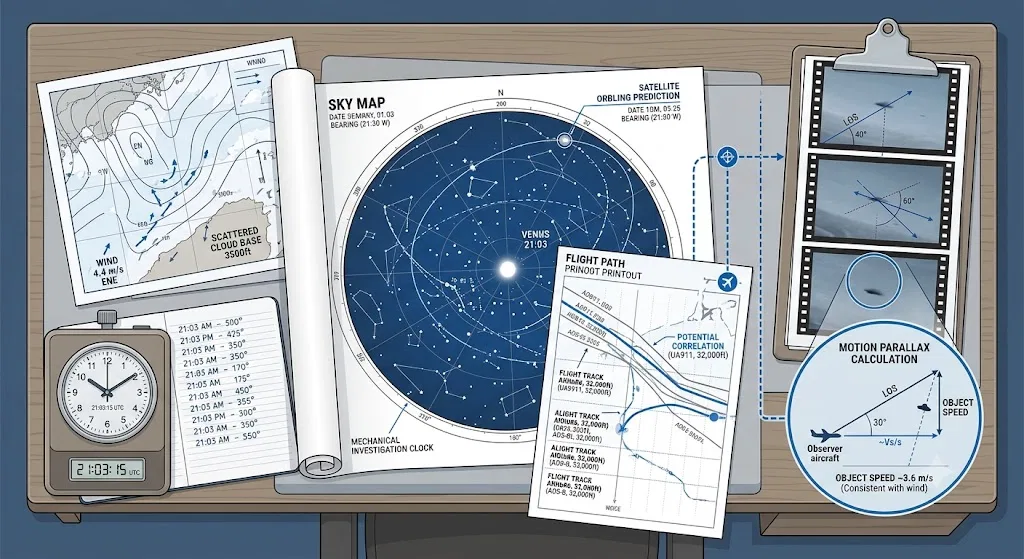
Investigators do not reconstruct a UFO or UAP sighting by asking whether an object looked extraordinary. They rebuild the event: where the witness or sensor was, exactly when the observation occurred, which direction the instrument was pointing, how the observer was moving, what the weather was doing, what aircraft and satellites were nearby, and what the original imagery actually recorded. Only after those pieces are aligned can competing explanations be tested against the same timeline.
That distinction matters because apparent speed, altitude, size and even whether an object seems to pass behind a landmark can change dramatically with viewing geometry. Modern case work by the US All-domain Anomaly Resolution Office (AARO) has resolved apparently dramatic events by reconstructing sensor lines of sight, aircraft trajectories, winds and object paths; equally importantly, it leaves other cases unresolved when those inputs are missing. France’s official GEIPAN investigation service follows the same broader principle: collect a detailed witness account, assemble corroborating data, investigate recognised phenomena and classify a case according to both its residual strangeness and the quality of the available information.[AARO]aaro.milPuerto Rico UAP Case ResolutionPuerto Rico UAP Case Resolution
The core facts needed from witnesses
The most valuable witness statement is not necessarily the most vivid one. For reconstruction, investigators need facts that fix the observation in space and time. GEIPAN, the UAP investigation unit of the French space agency CNES, treats direct testimony as the starting point and requires a technical questionnaire designed to capture information substantial enough to open an investigation. Sketches, photographs, videos and other material can then supplement the account.[Geipan]geipan.frUnderstanding a Phenomenon | GEIPANUnderstanding a Phenomenon | GEIPAN…
In practice, a useful sighting record tries to establish several things as precisely as possible:
- Time and duration. A clock time accurate to minutes — or seconds where possible — allows investigators to compare the event with aircraft tracks, satellite passes, astronomical positions and changing weather.
- Observer position. A precise location is needed because the apparent position of nearby objects and the timing of satellite visibility can change substantially over relatively short distances.
- Viewing direction and elevation. “Over the trees” is much less useful than a compass bearing combined with an estimate of how high above the horizon the object appeared.
- Observer movement. Whether the witness was standing still, driving, aboard an aircraft or turning towards the object can radically change apparent motion.
- Angular behaviour. Investigators want to know how the object moved across the field of view, not simply that it was “fast”. Did it cross half the sky in ten seconds, remain fixed over one landmark, or slowly drift relative to the stars?
- Appearance over time. Changes in brightness, colour, number of lights or apparent shape may correspond to an aircraft turning, a satellite entering shadow, cloud obscuration or a sensor changing gain.
- Independent observations. Witnesses at separated locations can constrain direction and sometimes distance far better than repeated descriptions from people standing together.
The emphasis on geometry is crucial because witnesses normally do not know an object’s true distance. Without distance, its physical size and linear speed cannot be derived from apparent size and angular motion alone. An object appearing to move quickly across the background might be a small nearby object moving slowly, a distant object moving rapidly, or even a nearly stationary object made to appear fast by the observer’s own motion. AARO specifically identifies forced perspective and parallax as recurring sources of exaggerated impressions of size and speed.[AARO]aaro.milUAP Records/Information PapersUAP Records/Information Papers - AAROJuly 8, 2026 — Correlations of Starlink Satellite Flaring with UAP Observations · Animation: The…
Contemporaneous notes are particularly useful. GEIPAN advises witnesses to write down an observation immediately, before later discussion and memory consolidation change the account. The point is not that witnesses are inherently unreliable; it is that reconstruction benefits enormously from preserving the first estimate of time, direction, duration and sequence before those details become mixed with subsequent interpretations.[Geipan]geipan.frUnderstanding a Phenomenon | GEIPANUnderstanding a Phenomenon | GEIPAN…
Combining weather, astronomy and traffic records
Once investigators have a usable time, location and viewing direction, the sighting becomes a correlation problem. The question changes from “What could look like this?” to “What known objects or phenomena were actually in that part of the sky at that time?”
Weather records provide more than a note about whether the night was clear. Wind speed and direction can test balloon hypotheses; cloud layers can explain intermittent visibility; haze and visibility affect apparent brightness and distance; and temperature conditions can alter infrared imagery. In Britain, for example, the Met Office maintains observational records containing wind, visibility, cloud and other parameters, with historical datasets extending far beyond the latest 24-hour observations. Such records let investigators compare a proposed windborne object with the real atmospheric conditions rather than with a generic assumption about how a balloon “ought” to move.[Met Office]metoffice.gov.ukMet OfficeWeather data for businessHistorical and current weather data; Station-dependent (some going back over 100 years) · Model-depen…
The 2013 Puerto Rico case analysed by AARO illustrates how powerful that comparison can be. Infrared footage from a US Customs and Border Protection aircraft appeared to show an object moving quickly near Aguadilla, splitting into two and eventually disappearing near the sea. AARO reconstructed the aircraft’s track and the sensor’s line of sight, concluding that two objects had been travelling together throughout the event and had remained over land. Its modelling put their movement at about 3.6 metres per second, close to the recorded wind speed of 4.4 metres per second from the east-north-east. The apparently high speed resulted largely from motion parallax as the aircraft itself moved around the scene.[AARO]aaro.milPuerto Rico UAP Case ResolutionPuerto Rico UAP Case Resolution
Weather also helped explain why the objects seemed to disappear. AARO found that the aircraft entered scattered cloud, the range to the objects increased substantially and the infrared contrast between target and background could fall low enough for the objects to cease standing out. Rather than treating disappearance on the display as proof that an object had physically vanished or entered the sea, investigators tested whether the sensor could simply have stopped distinguishing it.[AARO]aaro.milPuerto Rico UAP Case ResolutionPuerto Rico UAP Case Resolution
Astronomical checks work in much the same way. The positions of bright planets, stars and satellites can be calculated for a specific place and time. GEIPAN explicitly recommends checking precise sighting times and locations against satellite predictions and sky charts. A bright, apparently stationary light low on the horizon may be Venus or Jupiter; a point moving steadily for several minutes may be a satellite; an abrupt brightening can be a reflection of sunlight from an orbiting spacecraft.[Geipan]geipan.frUnderstanding a Phenomenon | GEIPANUnderstanding a Phenomenon | GEIPAN…
Satellite flares have become particularly important as the number of spacecraft in low Earth orbit has grown. AARO now publishes guidance specifically on Starlink flaring, describing how reflected sunlight can produce bright points whose visibility depends strongly on the geometry connecting the Sun, spacecraft and observer. In its FY2025 annual report, AARO said that three-dimensional modelling and all-source analysis had allowed additional cases to be provisionally attributed with high confidence to satellite flaring.[AARO]aaro.milUAP Records/Information PapersUAP Records/Information Papers - AAROJuly 8, 2026 — Correlations of Starlink Satellite Flaring with UAP Observations · Animation: The…
Aircraft records supply another independent timeline. Modern Automatic Dependent Surveillance–Broadcast, or ADS-B, can provide an aircraft’s position, altitude, ground speed and other data, typically broadcast once per second by equipped aircraft. That allows a reported light to be compared with actual traffic trajectories rather than merely with airport proximity. AARO itself lists aircraft-tracking services among the practical resources relevant to UAP investigation.[Federal Aviation Administration]faa.govFederal Aviation Administration Automatic Dependent SurveillanceFederal Aviation Administration Automatic Dependent Surveillance
There are limits, however. Not every aircraft appears on every public tracking service, historical coverage varies, military traffic may be unavailable, and privacy programmes can restrict what commercial displays show. Absence from a consumer flight-tracking website therefore does not establish that no aircraft was present. Reconstruction is strongest when public tracking data can be supplemented by authoritative aviation records or several independent data sources.[Federal Aviation Administration]faa.govOpen source on faa.gov.
Imagery must be treated as sensor data, not a picture
Video can appear more objective than testimony, but an investigator still has to reconstruct how the camera produced the image. A zoomed infrared display does not directly reveal an object’s range, physical size or speed. Those quantities depend on sensor pointing angles, aircraft motion, field of view, range information and calibration.
AARO’s analysis of the well-known “GoFast” video shows the process clearly. The 2015 recording, made by a US Navy F/A-18F off Florida, gave the impression of a small object racing above the ocean. AARO extracted the target range, sensor azimuth and elevation, aircraft altitude, airspeed and bank angle from the display and used them to estimate the object’s position over time. Its conclusion was that the object was at roughly 13,000 feet rather than skimming the water and that it did not demonstrate anomalous speed. The dramatic apparent motion was largely a parallax effect produced by viewing a relatively distant object from a rapidly moving aircraft.[AARO]aaro.milGo Fast Case ResolutionGo Fast Case Resolution
The case is also a useful warning about uncertainty. AARO did not have the original file and metadata, nor the aircraft’s exact position and heading. It therefore did not claim a single precise trajectory. Instead, it modelled the full range of possible aircraft headings and calculated corresponding ranges of object speed and direction. That is what disciplined reconstruction looks like when information is incomplete: uncertainty becomes an input to the calculation rather than something silently ignored.[AARO]aaro.milGo Fast Case ResolutionGo Fast Case Resolution
This can change the conclusion without necessarily identifying the object itself. AARO assessed “GoFast” with high confidence as showing no anomalous performance, yet said it could not definitively determine what the object was. Those are separate questions. Investigators may be able to establish that an apparent 1,000-kilometre-per-hour manoeuvre never occurred while remaining unable to distinguish between, say, a balloon, bird or small airborne object.[AARO]aaro.milGo Fast Case ResolutionGo Fast Case Resolution
The same distinction appears in the Puerto Rico analysis. AARO assessed with high confidence that the objects did not split, travel at extraordinary speed or enter the sea, but assigned only moderate confidence to the more specific attribution of sky lanterns. The geometry was strongly constrained; the precise identity was less so because the imagery lacked enough detail for categorical recognition.[AARO]aaro.milPuerto Rico UAP Case ResolutionPuerto Rico UAP Case Resolution
Testing explanations against the full timeline
A plausible explanation is not enough. The proposed object must account for the whole observation: where it should have been, how it should have moved, how bright it should have appeared, whether the sensor could detect it, and whether its behaviour remains consistent from the first frame to the last.
That principle eliminates many attractive but incomplete matches. A drone might resemble an infrared blob, for example, but a drone explanation weakens if the object drifts continuously at the measured wind speed and no expected motor heat is visible. In AARO’s Al Taqaddum case, an alternative suggestion that the object might be a quadrotor covered in camouflage material was rejected because its movement tracked the wind and the infrared footage did not show the motor heat expected from such a system. The office instead assessed the object with high confidence as a cluster of partially and fully inflated balloons.[AARO]aaro.milAl Taqaddam Case ResolutionAl Taqaddam Case Resolution
Likewise, an apparently spectacular interaction with the landscape must survive geometrical checking. In the Puerto Rico footage, some frames had been interpreted as showing the objects passing behind a utility pole, which would have forced them to be much closer and faster than AARO’s reconstructed track allowed. Pixel analysis did not support that occlusion. Once the apparent pole crossing was removed, the ordinary wind-drift trajectory remained consistent with the rest of the sequence.[AARO]aaro.milPuerto Rico UAP Case ResolutionPuerto Rico UAP Case Resolution
A convincing reconstruction therefore behaves like a set of linked constraints rather than a resemblance test. Investigators ask, in effect:
- Does the candidate occupy the correct part of the sky at the recorded time?
- Does its predicted motion match the observed direction and angular rate?
- Is its altitude or distance compatible with the imagery?
- Do wind and weather support its movement?
- Does its brightness or infrared signature behave as expected?
- Can apparent accelerations or disappearances be reproduced through observer motion, sensor behaviour or occlusion?
- Does the explanation still work throughout the complete observation rather than only in one striking frame?
This is why a reconstruction can overturn an intuitive reading of a video. A single frame may look exotic; the time series can reveal that nothing extraordinary is required.
When a case should remain unidentified
A rigorous investigation must also recognise when reconstruction is impossible. Missing information is not evidence of extraordinary performance. It is simply a limit on what can be inferred.
NASA’s independent UAP study highlighted precisely this problem, finding that analysis is hindered by poor sensor calibration, missing metadata, insufficient baseline data and a lack of simultaneous measurements from multiple well-calibrated sensors. Without those elements, apparent characteristics may be impossible to convert into reliable physical quantities.[NASA Science]science.nasa.govScience[PDF] Independent Study Team ReportScience[PDF] Independent Study Team Report
AARO’s current case handling reflects the same distinction. In its FY2025 report, it said 114 of 319 reports received during the covered period had been resolved as ordinary objects including balloons, birds, satellites, aircraft and unmanned systems. But 191 were placed in an “active archive” because the evidence was insufficient to determine whether the reported performance was ordinary or exceptional. Those cases remain available for future reassessment if corroborating data or improved analytical methods appear.[AARO]aaro.milAARO FY2025 Consolidated Annual Report on UAPAARO FY2025 Consolidated Annual Report on UAP
GEIPAN makes the distinction explicit in its classification system. A case can remain unidentified because information is inadequate — its category C — or remain unidentified after investigation despite sufficiently substantive information, its category D. The difference prevents a weakly documented sighting from being treated as equivalent to a well-recorded event that has resisted serious testing.[Geipan]geipan.frFAQ | GEIPANFAQ | GEIPAN…
That is the central discipline of UFO reconstruction. Investigators are not trying to force every report into an ordinary category, nor to preserve mystery where ordinary explanations fit. They are trying to determine what the available evidence actually permits. A successful identification occurs when one explanation fits the time, place, geometry, environment, traffic and sensor record better than its alternatives. An unresolved result is justified when those constraints cannot be established. In both outcomes, the decisive ingredient is not how strange the sighting first appeared, but how completely the event can be rebuilt.
Amazon book picks
Further Reading
Books and field guides related to How Investigators Rebuild a UFO Sighting. Use these as the next step if you want deeper reading beyond the article.
The UFO Handbook: A Guide to Investigating, Evaluating, and R...
An explanation of the usual reasons for confusing IFOs (identified flying objects) with UFOs and a survey of the tools used to investigat...
The UFO Experience: A Scientific Inquiry
The author belives that a number of UFO siting are still to be explained.
The Demon-Haunted World: Science as a Candle in the Dark
NEW YORK TIMES BESTSELLER • From the renowned astronomer and author of Cosmos comes a “powerful [and] stirring defense of informed ration...

How to Think About Weird Things: Critical Thinking for a New Age
First published 1994. Subjects: Critical thinking, Curiosities and wonders, Mind, body, spirit: disciplines & techniques, Parapsychology,...
eBay marketplace picks
Marketplace Samples
Live-tested eBay searches with available results related to this page.
Selected fromUFO poster oneBay.co.uk.


Current eBay listing
VINTAGE UFO FLYING SAUCERS COMIC ADVERTISING A2 POSTER PRINT

Current eBay listing
I Want To Believe UFO Poster Giclée Fine Art Heavyweight Print

Endnotes
1.
Source: aaro.mil
Title: Puerto Rico UAP Case Resolution
Link:https://www.aaro.mil/Portals/136/PDFs/case_resolution_reports/AARO_Puerto_Rico_UAP_Case_Resolution.pdf
2.
Source: geipan.fr
Title: FAQ | GEIPAN
Link:https://www.geipan.fr/en/faq-page
Source snippet
FAQ | GEIPAN...
3.
Source: geipan.fr
Title: Understanding a Phenomenon | GEIPAN
Link:https://www.geipan.fr/en/what-did-i-see/step-1
Source snippet
Understanding a Phenomenon | GEIPAN...
4.
Source: aaro.mil
Title: UAP Records/Information Papers
Link:https://www.aaro.mil/UAP-Records/
Source snippet
UAP Records/Information Papers - AAROJuly 8, 2026 — Correlations of Starlink Satellite Flaring with UAP Observations · Animation: The...
Published: July 8, 2026
5.
Source: aaro.mil
Link:https://www.aaro.mil/FAQ/
Source snippet
AARO FAQWhat accounts for UAP that have appeared to observers as very fast moving, but are formally assessed to have been stationary...
6.
Source: aaro.mil
Title: AARO FY2025 Consolidated Annual Report on UAP
Link:https://www.aaro.mil/Portals/136/PDFs/FY25%20UAP%20Annual%20Report/AARO_FY2025_Consolidated_Annual_Report_on_UAP.pdf
7.
Source: aaro.mil
Link:https://www.aaro.mil/Resources/
8.
Source: aaro.mil
Title: [Go Fast]({{ ‘go-fast/’ | relative_url }}) Case Resolution
Link:https://www.aaro.mil/Portals/136/PDFs/case_resolution_reports/AARO_GoFast_Case_Resolution_Card_Methodology_Final.pdf
9.
Source: aaro.mil
Title: Al Taqaddam Case Resolution
Link:https://www.aaro.mil/Portals/136/PDFs/case_resolution_reports/AARO_Al_Taqaddam_Case_Resolution_Final.pdf
10.
Source: science.nasa.gov
Title: Science[PDF] Independent Study Team Report
Link:https://science.nasa.gov/wp-content/uploads/2023/09/uap-independent-study-team-final-report.pdf?emrc=80696d
11.
Source: science.nasa.gov
Title: Science UAP
Link:https://science.nasa.gov/uap/
12.
Source: assets.science.nasa.gov
Title: 08.17 SMDTown Hall Final Tagged
Link:https://assets.science.nasa.gov/content/dam/science/cds/researchers/town-hall-meetings/2022/08.17_SMDTownHall_Final_Tagged.pdf
13.
Source: science.nasa.gov
Title: esac minutesgprama telecon october 2023
Link:https://science.nasa.gov/wp-content/uploads/2024/06/esac-minutesgprama-telecon-october-2023.pdf
Published: october 2023
14.
Source: smd-cms.nasa.gov
Title: 2020 2024 nasa science plan yr 23 update final
Link:https://smd-cms.nasa.gov/wp-content/uploads/2023/09/2020-2024-nasa-science-plan-yr-23-update-final.pdf
15.
Source: nasa.gov
Title: NAS A Announces Unidentified Aerial Phenomena Study Team
Link:https://www.nasa.gov/general/nasa-announces-unidentified-aerial-phenomena-study-team-members/
16.
Source: nasa.gov
Title: nac science committee report august 2022
Link:https://www.nasa.gov/wp-content/uploads/2022/08/nac_science_committee_report_august_2022.pdf
Published: august 2022
17.
Source: aaro.mil
Link:https://www.aaro.mil/
18.
Source: aaro.mil
Link:https://www.aaro.mil/About/Mission-Vision/
19.
Source: aaro.mil
Title: Next UAP Report Documents
Link:https://www.aaro.mil/Next-AARO-Home-redesign/Next-Parent/Next-UAP-Report-Documents/
20.
Source: aaro.mil
Link:https://www.aaro.mil/UAP-Cases/UAP-Reporting-Trends/
21.
Source: aaro.mil
Title: AARO Historical Record Report Vol 1 2024
Link:https://www.aaro.mil/Portals/136/PDFs/AARO_Historical_Record_Report_Vol_1_2024.pdf
22.
Source: aaro.mil
Link:https://www.aaro.mil/UAP-Cases/Official-UAP-Imagery/
23.
Source: aaro.mil
Link:https://www.aaro.mil/UAP-Cases/UAP-Case-Resolution-Reports/
24.
Source: aaro.mil
Link:https://www.aaro.mil/Submit-A-Report/
25.
Source: ntrs.nasa.gov
Link:https://ntrs.nasa.gov/api/citations/19800009719/downloads/19800009719.pdf?attachment=true
26.
Source: ntrs.nasa.gov
Link:https://ntrs.nasa.gov/api/citations/19960008865/downloads/19960008865.pdf
27.
Source: ntrs.nasa.gov
Link:https://ntrs.nasa.gov/api/citations/19940011007/downloads/19940011007.pdf
28.
Source: youtube.com
Link:https://www.youtube.com/watch?v=0fho4YyXWfE
Source snippet
Explained: "Go Fast" UFO Video - Not Low and Not Fast - Like a Balloon...
29.
Source: metoffice.gov.uk
Link:https://www.metoffice.gov.uk/services/data/business-data
Source snippet
Met OfficeWeather data for businessHistorical and current weather data; Station-dependent (some going back over 100 years) · Model-depen...
30.
Source: metoffice.gov.uk
Link:https://www.metoffice.gov.uk/research/climate/maps-and-data/data
Source snippet
Met OfficeDataUK climate datasets. Observations research and development … selection of historic UK observing stations. An open access ar...
31.
Source: weather.metoffice.gov.uk
Link:https://weather.metoffice.gov.uk/guides/observations/latest-weather-observations-guide
Source snippet
Met OfficeLatest weather observations guideThe observation table provides a detailed view of the weather for the last 24 hours. Past weat...
32.
Source: faa.gov
Title: Federal Aviation Administration Automatic Dependent Surveillance
Link:https://www.faa.gov/about/office_org/headquarters_offices/avs/offices/afx/afs/afs400/afs410/ads-b
33.
Source: faa.gov
Title: ins outs
Link:https://www.faa.gov/air_traffic/technology/equipadsb/capabilities/ins_outs
34.
Source: faa.gov
Link:https://www.faa.gov/air_traffic/technology/equipadsb/privacy
35.
Source: faa.gov
Link:https://www.faa.gov/pilots/ladd
36.
Source: metoffice.gov.uk
Link:https://www.metoffice.gov.uk/research/climate/maps-and-data/historic-station-data
37.
Source: library.metoffice.gov.uk
Link:https://library.metoffice.gov.uk/Portal/recordview/index/626310
38.
Source: weather.metoffice.gov.uk
Title: recording observations for over 100 years
Link:https://weather.metoffice.gov.uk/learn-about/how-forecasts-are-made/observations/recording-observations-for-over-100-years
39.
Source: library.metoffice.gov.uk
Link:https://library.metoffice.gov.uk/Portal/recordview/index/626309
40.
Source: library.metoffice.gov.uk
Link:https://library.metoffice.gov.uk/Portal/recordview/index/626296
41.
Source: weather.metoffice.gov.uk
Link:https://weather.metoffice.gov.uk/observations/gcptq81bc
42.
Source: metoffice.gov.uk
Link:https://www.metoffice.gov.uk/services/transport/aviation/regulated/airfield-climate-data
43.
Source: archives.gov
Link:https://www.archives.gov/research/topics/uaps/photographs
44.
Source: adsbperformance.faa.gov
Link:https://adsbperformance.faa.gov/PAPRRequest.aspx
45.
Source: faa.gov
Link:https://www.faa.gov/air_traffic/technology/adsb/faq
46.
Source: faa.gov
Title: ADS B In Strategy
Link:https://www.faa.gov/sites/faa.gov/files/air_traffic/technology/adsb/quicklinks/ADS-B_In_Strategy.pdf
47.
Source: faa.gov
Link:https://www.faa.gov/air_traffic/technology/equipadsb/capabilities/benefits
48.
Source: faa.gov
Title: know adsb system
Link:https://www.faa.gov/air_traffic/technology/equipadsb/installation/know_adsb_system
49.
Source: faa.gov
Link:https://www.faa.gov/air_traffic/technology/equipadsb/resources/faq
50.
Source: play.google.com
Link:https://play.google.com/store/apps/details?hl=es_US&id=com.uap
Additional References
51.
Source: youtube.com
Title: Analyzing “Official” UFO Videos
Link:https://www.youtube.com/watch?v=nwa-yYCEGEc
Source snippet
Mick West UFO reconstruction analysis Missile vs. UFO Video - A Quick Take...
52.
Source: archives.gov
Link:https://www.archives.gov/research/alic/periodicals/nara-citations/modern-army.html
53.
Source: archives.gov
Link:https://www.archives.gov/research/alic/periodicals/nara-citations/old-army.html
54.
Source: war.gov
Link:https://www.war.gov/ufo/
55.
Source: text-message.blogs.archives.gov
Link:https://text-message.blogs.archives.gov/2017/07/05/see-something-say-something-ufo-reporting-requirements-office-of-military-government-for-bavaria-germany-may-1948/
Published: may 1948
56.
Source: buap.mx
Link:https://www.buap.mx/
57.
Source: imdb.com
Link:https://www.imdb.com/title/tt32437324/
58.
Source: wordwebonline.com
Link:https://www.wordwebonline.com/en/IDENTIFY
59.
Source: youtube.com
Title: Gimbal UFO
Link:https://www.youtube.com/watch?v=qsEjV8DdSbs
Source snippet
Analyzing "Official" UFO Videos - Live Talk at UBC Vancouver...
60.
Source: prologue.blogs.archives.gov
Title: saucers over washington the history of [project blue book]({{ ‘blue-book/’ | relative_url }})
Link:https://prologue.blogs.archives.gov/2019/12/19/saucers-over-washington-the-history-of-project-blue-book/