Within Tracking
How a Banking Jet Changes Apparent UFO Motion
A turning aircraft shifts both its position and camera line of sight, so straight-screen motion can emerge from a curved flight path.
On this page
- How bank angle bends the aircraft flight path
- Why a curved viewpoint changes line of sight motion
- How analysts include banking in reconstruction
Page outline Jump by section
Introduction
A banking aircraft does more than tilt the picture. In a normal coordinated turn, banking bends the aircraft’s own flight path, changes its heading continuously and moves the camera through a curved sequence of viewpoints. A tracking sensor must keep adjusting its line of sight from that moving platform. The combined geometry can make a distant object follow a striking path on a stabilised display even when the object itself is moving slowly or approximately straight.

This is a practical issue in UFO/UAP video analysis, not merely a theoretical possibility. In its reconstruction of the 2015 “Go Fast” recording, the US All-domain Anomaly Resolution Office (AARO) explicitly used the F/A-18’s roughly 14° bank to calculate a curved aircraft trajectory. Over just 13 seconds, that turn changed the aircraft’s heading by about 9.6°. Incorporating that curved platform motion was essential to reconstructing the target’s actual displacement.[AARO]aaro.milGo Fast Case Resolution Card Methodology FinalUNCLASSIFIEDMay 10, 2026…
The key analytical rule is therefore straightforward: when the camera aircraft is banking, investigators cannot safely reconstruct UFO motion by treating the camera as travelling along a straight line.
How bank angle bends the aircraft flight path
An aeroplane turns by tilting its lift vector. In a coordinated, level turn, banking creates a horizontal component of lift that accelerates the aircraft sideways and bends its trajectory. The FAA consequently describes bank angle, airspeed, turn rate and turn radius as linked quantities: at a given speed, increasing bank generally increases turn rate and decreases turn radius; at a given bank angle, increasing speed produces a wider turn.[Federal Aviation Administration]faa.govpilot handbook 1Federal Aviation AdministrationFAA-H-8083-25BDIPPilot's HandbookMarch 26, 2026…
For an ideal steady, level coordinated turn, the relationship can be written as:
turn radius = speed² / (gravity × tan(bank angle))[sciencedirect.com]sciencedirect.comBank AngleBank Angle
This matters enormously for airborne imagery because the sensor is attached to the aircraft. If the aeroplane is banking steadily, the camera is not translating along the straight tangent suggested by its initial heading. Its physical position progressively departs from that tangent while its heading rotates around the turn. NASA has used the same relationship between speed, bank angle and turn radius when modelling aircraft trajectories.[NASA]aviationsystems.arc.nasa.govNASA/TP–2004-212828August 29, 2024…
The Go Fast reconstruction provides an unusually concrete example. AARO selected a 13-second section in which the F/A-18 remained at roughly 25,000 feet, about Mach 0.61–0.62 and approximately 14° of bank. Using an average speed of about 190 metres per second, it calculated a turn radius of roughly 14.76 kilometres. The aircraft travelled about 2.47 kilometres along that curved path during the interval.[Project Blue Book Archive]theprojectbluebookarchive.orgProject Blue Book Archive AARO Go Fast Case ResolutionProject Blue Book Archive AARO Go Fast Case Resolution
That shallow-looking 14° bank was enough to change the aircraft’s heading by approximately 9.6° in 13 seconds. Relative to a hypothetical straight continuation of its initial course, the aircraft ended the interval about 207 metres laterally displaced while advancing roughly 2,461 metres. Those are not negligible differences when investigators are using changes of only a few degrees in camera azimuth and elevation to infer a target’s trajectory.[Project Blue Book Archive]theprojectbluebookarchive.orgProject Blue Book Archive AARO Go Fast Case ResolutionProject Blue Book Archive AARO Go Fast Case Resolution
This is why “the aircraft was only banking slightly” is not a sufficient reason to ignore bank. The relevant quantity is not how dramatic the manoeuvre looks to a viewer. It is how far the moving sensor changes position and orientation during the observation.
Why a curved viewpoint changes line-of-sight motion
A tracking camera measures a line of sight (LOS): the direction from the sensor to the target. That direction is relative to the aircraft and sensor system, not automatically a fixed direction in geographical space.
Suppose a distant object travels steadily while an aircraft turns around it. At each instant the camera occupies a slightly different point on the aircraft’s curved path. At the same time, the aircraft’s forward axis rotates with the turn. The gimbal therefore has to keep changing its pointing direction to maintain the object in the tracked portion of the image.
Three motions are now entangled:
- the object’s real motion;[www1.grc.nasa.gov]www1.grc.nasa.govgeneral aircraft motiongeneral aircraft motion
- the aircraft’s translation along a curved path;
- the changing orientation and pointing direction of the aircraft-camera system.
A stabilised display can hide much of that complexity. The tracker may hold the target near the centre while the background shifts, rotates or sweeps behind it. What looks like a simple screen-space trajectory is therefore not a direct plot of the object’s trajectory through the atmosphere.
AARO’s Go Fast calculation demonstrates the distinction numerically. Between its two selected frames, the sensor azimuth changed from about 49° left to 57° left and its elevation from approximately −29° to −35°. But the aircraft was simultaneously turning. AARO therefore applied the sensor pointing angles together with the aircraft’s changing attitude and heading rather than interpreting the changing camera angles as target motion alone.[Project Blue Book Archive]theprojectbluebookarchive.orgProject Blue Book Archive AARO Go Fast Case ResolutionProject Blue Book Archive AARO Go Fast Case Resolution
This produces an initially counter-intuitive result. At the first analysed point, AARO calculated the target as roughly 4,251 metres ahead, 4,890 metres to the aircraft’s left and 3,591 metres below it. Thirteen seconds later, after accounting for both the aircraft’s curved displacement and its changed heading, the reconstructed target position was only about 265 metres from its first position. That corresponds to roughly 20 metres per second, or 45 mph, in the simplified endpoint calculation—even though the observing F/A-18 itself had travelled almost 2.5 kilometres during the same interval.[Project Blue Book Archive]theprojectbluebookarchive.orgProject Blue Book Archive AARO Go Fast Case ResolutionProject Blue Book Archive AARO Go Fast Case Resolution
That contrast captures the mechanism particularly well. Large changes in viewpoint and sensor pointing do not necessarily require a large displacement by the tracked object.
Why straight-line reconstruction can create false UFO manoeuvres
The most important analytical error is to subtract target angles from an incorrectly modelled observer trajectory. If an analyst assumes that a banking aircraft continued straight ahead, every later camera ray originates from the wrong place and is oriented against the wrong aircraft heading.
The resulting error is systematic rather than random. As the real aircraft curves farther away from the assumed straight path, the discrepancy accumulates. A reconstruction may then assign some of the aircraft’s turning motion to the target.
Depending on the geometry, that can distort several properties at once. The inferred target may appear to move faster, follow a curved course, change direction, accelerate or occupy a different altitude from the solution obtained with the aircraft’s real trajectory. In short clips, even modest observer-position errors matter because target displacement may itself be relatively small.
The Go Fast case again supplies a useful scale. During AARO’s 13-second reconstruction, the aircraft’s heading rotated about 9.6° and its lateral displacement reached roughly 207 metres. Meanwhile, the reconstructed target displacement between the endpoints was about 265 metres. Ignoring the turn would therefore discard a platform-motion term comparable in scale to the very target displacement being estimated.[Project Blue Book Archive]theprojectbluebookarchive.orgProject Blue Book Archive AARO Go Fast Case ResolutionProject Blue Book Archive AARO Go Fast Case Resolution
There is a second complication: sensor angles normally belong to an aircraft-relative coordinate system. AARO defined longitudinal, transverse and vertical aircraft axes, constructed a line-of-sight vector from the measured range, and rotated that vector according to the relevant sensor and aircraft angles. It specifically cautioned that simply adding platform and sensor angles can be incorrect when aircraft roll and pitch are present.[Project Blue Book Archive]theprojectbluebookarchive.orgProject Blue Book Archive AARO Go Fast Case ResolutionProject Blue Book Archive AARO Go Fast Case Resolution
That distinction is easy to miss when working from a publicly released video. A number printed beside an infrared image may look like an ordinary compass bearing or angle to the horizon. In reality, analysts need to know what coordinate frame the telemetry uses before converting it into a geographical trajectory.
How analysts include banking in reconstruction
A credible reconstruction starts with the observing platform, not with the apparent motion of the dot. Where sufficient telemetry exists, the analyst estimates the aircraft’s position and orientation at each relevant moment and only then projects the camera line of sight into three-dimensional space.
A practical reconstruction therefore needs, as far as the available data permit, the aircraft’s speed, altitude, heading, bank or roll, pitch and position, together with the sensor’s azimuth, elevation, range information and timing. When some variables are missing, the result should be expressed as a range of possible solutions rather than a falsely precise trajectory.
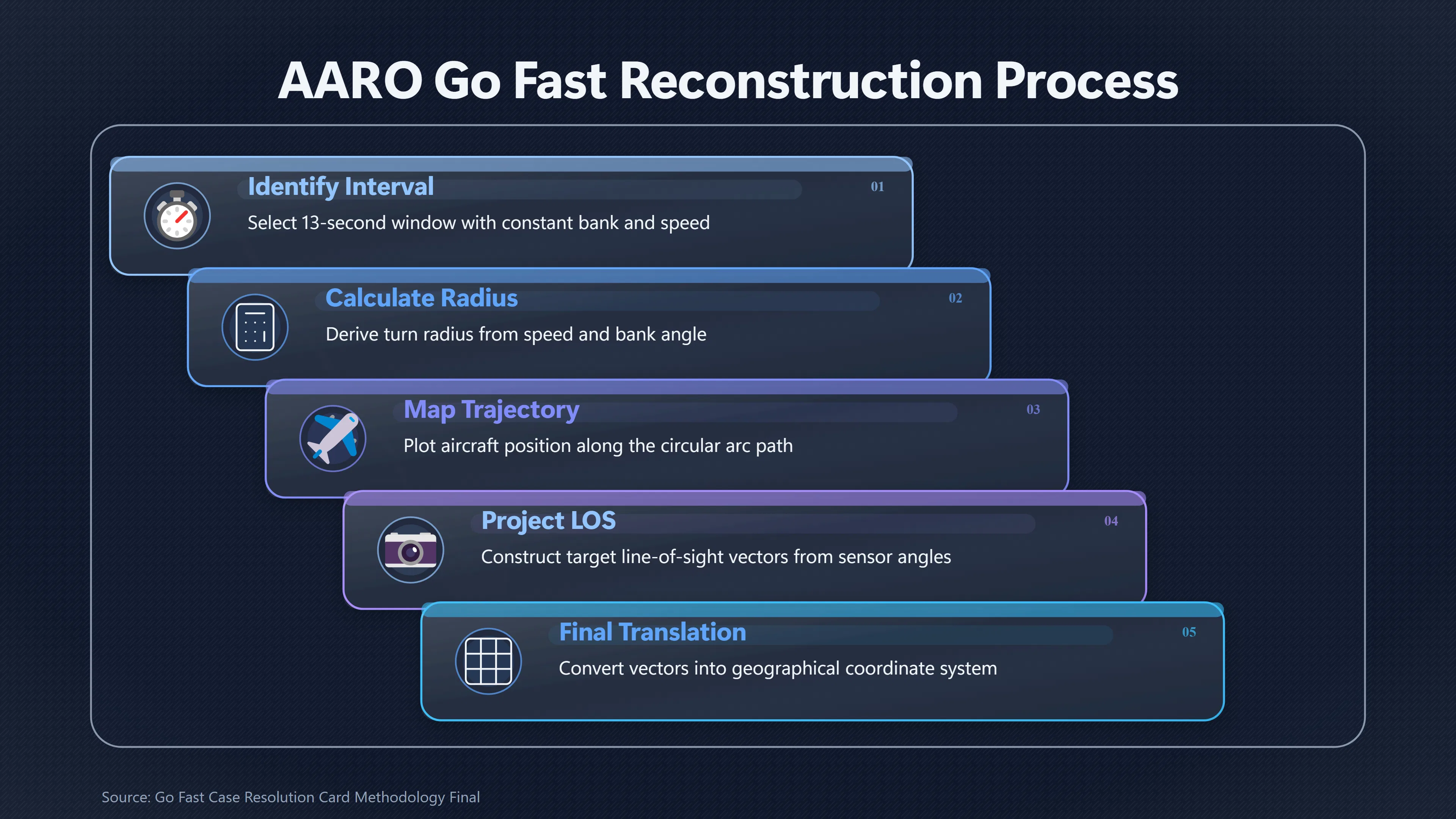
AARO’s Go Fast methodology illustrates the process particularly clearly. It first identified an interval in which bank angle, altitude and speed were nearly constant, reducing the number of changing variables. It estimated the aircraft’s turn radius from speed and bank, calculated its position and changing heading along the resulting circular arc, constructed target line-of-sight vectors from range and sensor angles, transformed those vectors into the reconstruction coordinate system, and repeated the procedure through the sequence.[Project Blue Book Archive]theprojectbluebookarchive.orgProject Blue Book Archive AARO Go Fast Case ResolutionProject Blue Book Archive AARO Go Fast Case Resolution
The calculations also show why telemetry quality matters. AARO worked from a publicly available compressed video because the original Go Fast file and accompanying metadata were unavailable. It noted that such footage was not necessarily intended to provide the full metadata required for rigorous full-motion-video analysis. The displayed sensor values were also rounded, so AARO estimated intermediate values by identifying frames where readings changed and fitting curves through those observations.[Project Blue Book Archive]theprojectbluebookarchive.orgProject Blue Book Archive AARO Go Fast Case ResolutionProject Blue Book Archive AARO Go Fast Case Resolution
The same principle appears in another official UAP reconstruction. For the 2013 Puerto Rico infrared recording, AARO and an Intelligence Community partner reconstructed the observing aircraft’s flight path and the sensor’s changing look angle rather than reading apparent image motion as literal object motion. AARO concluded that the tracked objects moved in a straight line at about 3.6 metres per second, close to the recorded wind speed, while the aircraft and viewing geometry produced a much more dramatic visual impression.[AARO]aaro.milPuerto Rico UAP Case ResolutionAARO Puerto Rico UAP Case ResolutionMarch 19, 2025…
That case is not identical to Go Fast, but it reinforces the methodological point: airborne tracking footage is a moving-camera geometry problem before it is a target-kinematics problem.
Banking does not automatically explain an unusual object
Recognising the effect of aircraft banking should not become a universal dismissal of UAP footage. A banking aircraft does not prove that the target was stationary, a balloon, a bird or another ordinary object. It establishes a variable that must be included before strong claims about target motion can be made.
There can also be genuine ambiguity when essential data are unavailable. In Go Fast, for example, the aircraft’s absolute geographical heading was not present in the public video. AARO therefore could not derive one unique geographical heading and speed for the object; it explored possible aircraft headings and wind relationships instead. Its broader analysis nevertheless concluded with high confidence that the object showed no anomalous speed, estimating an altitude near 13,000 feet and a wind-compensated speed range of roughly 5–92 mph depending on the assumed geometry.[Project Blue Book Archive]theprojectbluebookarchive.orgProject Blue Book Archive AARO Go Fast Case ResolutionProject Blue Book Archive AARO Go Fast Case Resolution
Other UAP reconstructions remain disputed precisely because distance, aircraft state or sensor interpretation is uncertain. A 2023 paper reconstructing possible trajectories for the separate 2015 “Gimbal” incident, for example, found substantially different target paths depending on assumed range and argued for an anomalous close-range solution, while also discussing a much more distant conventional-aircraft hypothesis. The disagreement illustrates why a two-dimensional tracking video rarely fixes a unique three-dimensional trajectory without adequate range and platform information.[arXiv]arxiv.orgReconstruction of Potential Flight Paths for the January 2015 Gimbal UAPJune 15, 2023…
Banking is therefore best understood as a geometrical correction, not an identification. It tells analysts how the observing platform moved and how its reference frame changed. Once that contribution is removed, whatever motion remains can be attributed more confidently to the target.
The practical takeaway
For tracked UFO footage recorded from an aircraft, the visible path on the screen is several transformations removed from the object’s physical path through space. Banking changes the aircraft’s heading and bends its trajectory; that curved trajectory changes the camera’s position; the tracking system then changes its line of sight to keep following the target. Stabilisation can conceal much of this movement from the eventual viewer.
The Go Fast reconstruction shows how large the consequence can be even in a shallow turn. With approximately 14° of bank, the F/A-18 changed heading by about 9.6° and shifted more than 200 metres sideways relative to its initial course in only 13 seconds. Accounting for that geometry helped produce a reconstructed target displacement of only about 265 metres during the same interval.[Project Blue Book Archive]theprojectbluebookarchive.orgProject Blue Book Archive AARO Go Fast Case ResolutionProject Blue Book Archive AARO Go Fast Case Resolution
For UFO/UAP analysis, that means apparent straight-screen motion, rapid background sweep or changing sensor angles cannot by themselves establish extraordinary target speed or manoeuvring. Before interpreting what the object did, the reconstruction has to establish what the camera aircraft did—and a banking aircraft is travelling through a curved, continuously rotating geometry rather than carrying the camera along a simple straight line.
Amazon book picks
Further Reading
Books and field guides related to How a Banking Jet Changes Apparent UFO Motion. Use these as the next step if you want deeper reading beyond the article.
Flight Dynamics Principles
Flight dynamicists today need not only a thorough understanding of the classical stability and control theory of aircraft, but also a wor...
Aircraft Control and Simulation
This second edition covers aerodynamics, the control systems and the mathematics involved in analysing the performance of aircraft not on...
Computer Vision: Algorithms and Applications
Computer Vision: Algorithms and Applications explores the variety of techniques used to analyze and interpret images. It also describes c...
Multiple View Geometry in Computer Vision
A basic problem in computer vision is to understand the structure of a real world scene given several images of it. Techniques for solvin...
eBay marketplace picks
Marketplace Samples
Live-tested eBay searches with available results related to this page.
Selected fromUFO poster oneBay.co.uk.

Current eBay listing
VINTAGE UFO FLYING SAUCERS COMIC ADVERTISING A2 POSTER PRINT

Current eBay listing
I Want To Believe UFO Poster Giclée Fine Art Heavyweight Print


Endnotes
1.
Source: aaro.mil
Title: Go Fast Case Resolution Card Methodology Final
Link:https://www.aaro.mil/Portals/136/PDFs/case_resolution_reports/AARO_GoFast_Case_Resolution_Card_Methodology_Final.pdf?ver=qXvjrruO_0MgtnTsfYnCEQ%3D%3D
Source snippet
UNCLASSIFIEDMay 10, 2026...
Published: May 10, 2026
2.
Source: faa.gov
Title: pilot handbook 1
Link:https://www.faa.gov/sites/faa.gov/files/pilot_handbook_1.pdf
Source snippet
Federal Aviation AdministrationFAA-H-8083-25BDIPPilot's HandbookMarch 26, 2026...
Published: March 26, 2026
3.
Source: faa.gov
Title: Order 8260.58C
Link:https://www.faa.gov/documentLibrary/media/Order/Order_8260.58C.pdf
Source snippet
Federal Aviation AdministrationFAA Order 8260.58C (Eff 15SEP22)...
4.
Source: aviationsystems.arc.nasa.gov
Link:https://aviationsystems.arc.nasa.gov/publications/tactical/NASA-TP-2004-212828.pdf
Source snippet
NASA/TP–2004-212828August 29, 2024...
Published: August 29, 2024
5.
Source: aaro.mil
Title: Puerto Rico UAP Case Resolution
Link:https://www.aaro.mil/Portals/136/PDFs/case_resolution_reports/AARO_Puerto_Rico_UAP_Case_Resolution.pdf
Source snippet
AARO Puerto Rico UAP Case ResolutionMarch 19, 2025...
Published: March 19, 2025
6.
Source: aaro.mil
Title: UAP Imagery
Link:https://www.aaro.mil/UAP-Cases/Official-UAP-Imagery/ftag/MSF0951a18/
Source snippet
AARO UAP Imagery...
7.
Source: arxiv.org
Link:https://arxiv.org/abs/2306.08773
Source snippet
Reconstruction of Potential Flight Paths for the January 2015 Gimbal UAPJune 15, 2023...
Published: June 15, 2023
8.
Source: science.nasa.gov
Link:https://science.nasa.gov/uap/faqs/
9.
Source: aaro.mil
Link:https://www.aaro.mil/Next-AARO-Home-redesign/Next-Parent/Next-AARO-UAP-Imagery-Acc-Table/
10.
Source: aaro.mil
Link:https://www.aaro.mil/Next-AARO-Home-redesign/Next-Parent/Next-UAP-Report-Documents/poster/dividLink/
11.
Source: science.nasa.gov
Link:https://science.nasa.gov/uap/
12.
Source: science.nasa.gov
Title: spacecraft meet europa clipper
Link:https://science.nasa.gov/mission/europa-clipper/spacecraft-meet-europa-clipper/
13.
Source: aaro.mil
Link:https://www.aaro.mil/Next-AARO-Home-redesign/Next-Parent/Presidential-UAP-Transparency-Initiative/
14.
Source: science.nasa.gov
Title: second stage fueling underway
Link:https://science.nasa.gov/blogs/imap/2025/09/24/second-stage-fueling-underway/
15.
Source: science.nasa.gov
Title: caldwell 86
Link:https://science.nasa.gov/mission/hubble/science/explore-the-night-sky/hubble-caldwell-catalog/caldwell-86/
16.
Source: science.nasa.gov
Title: s webb exposes complex atmosphere of starless super jupiter
Link:https://science.nasa.gov/missions/webb/nasas-webb-exposes-complex-atmosphere-of-starless-super-jupiter/
17.
Source: aaro.mil
Link:https://www.aaro.mil/Next-AARO-Home-redesign/Next-Parent/Presidential-UAP-Transparency-Initiative/videoid/1006080/dvpmoduleid/77396/
18.
Source: faa.gov
Title: Airplane Flying Handbook | Federal Aviation Administration
Link:https://www.faa.gov/regulations_policies/handbooks_manuals/aviation/airplane_handbook
19.
Source: nasa.gov
Title: X-29 Advanced Technology Demonstrator Aircraft
Link:https://www.nasa.gov/aeronautics/nasa-aircraft/x-29-demonstrator/
20.
Source: faa.gov
Link:https://www.faa.gov/air_traffic/publications/atpubs/aim/aim0503.html
21.
Source: science.nasa.gov
Title: hubble stretches stellar tape measure 10 times farther into space
Link:https://science.nasa.gov/missions/hubble/hubble-stretches-stellar-tape-measure-10-times-farther-into-space/
22.
Source: nasa.gov
Title: ‘Thinking Obliquely’ Tells Story of NASA’s Scissors Wing Airplane
Link:https://www.nasa.gov/aeronautics/thinking-obliquely-tells-story-of-nasas-scissors-wing-airplane/
23.
Source: science.nasa.gov
Title: stellar [parallax]({{ ‘parallax/’ | relative_url }})
Link:https://science.nasa.gov/asset/hubble/stellar-parallax/
24.
Source: science.nasa.gov
Title: titan flyby t 89 cassinis continuing search for subsurface oceans
Link:https://science.nasa.gov/missions/cassini/titan-flyby-t-89-cassinis-continuing-search-for-subsurface-oceans/
25.
Source: science.nasa.gov
Title: titan flyby t 83 looking at lakes again
Link:https://science.nasa.gov/missions/cassini/titan-flyby-t-83-looking-at-lakes-again/
26.
Source: science.nasa.gov
Title: mars odyssey all stars noctis canyon
Link:https://science.nasa.gov/photojournal/mars-odyssey-all-stars-noctis-canyon/
27.
Source: science.nasa.gov
Title: depth perception in space
Link:https://science.nasa.gov/resource/depth-perception-in-space/
28.
Source: ntrs.nasa.gov
Link:https://ntrs.nasa.gov/archive/nasa/casi.ntrs.nasa.gov/19950016389.pdf
29.
Source: ntrs.nasa.gov
Link:https://ntrs.nasa.gov/citations/19860020761
30.
Source: ntrs.nasa.gov
Link:https://ntrs.nasa.gov/citations/19760021118
31.
Source: faa.gov
Link:https://www.faa.gov/air_traffic/publications/atpubs/aip_html/part2_enr_section_1.5.html
32.
Source: faa.gov
Link:https://www.faa.gov/air_traffic/publications/atpubs/aip_html/chap5_section_3.html
33.
Source: www1.grc.nasa.gov
Title: banking turns
Link:https://www1.grc.nasa.gov/beginners-guide-to-aeronautics/banking-turns/
34.
Source: www1.grc.nasa.gov
Title: aircraft motion turns
Link:https://www1.grc.nasa.gov/beginners-guide-to-aeronautics/aircraft-motion-turns/
35.
Source: grc.nasa.gov
Link:https://www.grc.nasa.gov/WWW/k-12/VirtualAero/BottleRocket/airplane/turns.html
36.
Source: www1.grc.nasa.gov
Title: general aircraft motion
Link:https://www1.grc.nasa.gov/beginners-guide-to-aeronautics/general-aircraft-motion/
37.
Source: technology.nasa.gov
Title: TOP2 303
Link:https://technology.nasa.gov/patent/TOP2-303
38.
Source: grc.nasa.gov
Link:https://www.grc.nasa.gov/www/k-12/VirtualAero/BottleRocket/airplane/geom.html
39.
Source: www1.grc.nasa.gov
Title: wing warping interactive
Link:https://www1.grc.nasa.gov/beginners-guide-to-aeronautics/wing-warping-interactive/
40.
Source: aaro.mil
Title: AAR O UAP Trends All-domain Anomaly Resolution Office UAP REPORTING TRENDS
Link:https://www.aaro.mil/UAP-Cases/UAP-Reporting-Trends/
41.
Source: aaro.mil
Link:https://www.aaro.mil/Next-AARO-Home-redesign/Next-Parent/Next-AARO-UAP-Trends/
42.
Source: aaro.mil
Link:https://www.aaro.mil/UAP-Cases/Official-UAP-Imagery/4/
43.
Source: aaro.mil
Link:https://www.aaro.mil/Next-AARO-Home-redesign/Next-Parent/Next-AARO-UAP-Imagery-Fixed-Table/
44.
Source: aaro.mil
Link:https://www.aaro.mil/Next-AARO-Home-redesign/Next-Parent/AARO-UAP-Case-Resolution-DT/
45.
Source: aaro.mil
Link:https://www.aaro.mil/Next-AARO-Home-redesign/Next-Parent/Next-UAP-Case-RR-Data-Table/
46.
Source: aaro.mil
Link:https://www.aaro.mil/Next-AARO-Home-redesign/Bruce-working/Next-AARO-UAP-Trends-Charts/
47.
Source: aaro.mil
Link:https://www.aaro.mil/
48.
Source: aaro.mil
Link:https://www.aaro.mil/Next-AARO-Home-redesign/Inactive-Parent/Next-UAP-Imagery-dup/
49.
Source: theprojectbluebookarchive.org
Title: [Project Blue Book]({{ ‘blue-book/’ | relative_url }}) Archive AARO Go Fast Case Resolution
Link:https://theprojectbluebookarchive.org/archive/UAP_Electronic_StillPictures_Archives/SecDef-UAP-Records/493468580/08_Go_Fast.pdf
50.
Source: uffo.com.br
Title: arxiv reconstruction of potential flight paths for the january 2015 gimbal uap
Link:https://uffo.com.br/arxiv-reconstruction-of-potential-flight-paths-for-the-january-2015-gimbal-uap
Published: january 2015
51.
Source: metabunk.org
Title: Go Fast
Link:https://www.metabunk.org/threads/go-fast-balloon-theory.12781/page-2
52.
Source: zenodo.org
Link:https://zenodo.org/records/7844175
53.
Source: sciencedirect.com
Title: Bank Angle
Link:https://www.sciencedirect.com/topics/engineering/bank-angle
54.
Source: ufotransparency.com
Link:https://ufotransparency.com/takeaways/all
Additional References
55.
Source: sciencedirect.com
Link:https://www.sciencedirect.com/science/article/pii/S0376042126000679
Source snippet
ELECTRO-OPTICAL/INFRARED CAMERAS In contrast to the active ranging sensors discussed above, EO/IR sensing is fundamentally passive. Rathe...
56.
Source: youtube.com
Title: Breakdown of the Pentagon UFO videos with Mick West
Link:https://www.youtube.com/watch?v=Le7Fqbsrrm8
Source snippet
Raytheon ATFLIR expert discusses Navy gimbal UFO/UAP video with Mick West...
57.
Source: youtube.com
Title: The SHOCKING Math Error Behind Viral UFO Videos | Mick West
Link:https://www.youtube.com/watch?v=ypfbhfEXnBo
Source snippet
GOFAST UFO Analysis (yeah no, probably just a balloon)...
58.
Source: youtube.com
Title: GOFAST UFO Analysis (yeah no, probably just a balloon)
Link:https://www.youtube.com/watch?v=-3NYowlCoDc
Source snippet
Breakdown of the Pentagon UFO videos with Mick West...
59.
Source: metabunk.org
Link:https://www.metabunk.org/threads/go-fast-footage-from-tom-delonges-to-the-stars-academy-bird-balloon.9569/page-14
60.
Source: researchgate.net
Link:https://www.researchgate.net/publication/222304264_A_Probabilistic_Model_for_Recovering_Camera_Translation
61.
Source: researchgate.net
Link:https://www.researchgate.net/publication/224155817_Autonomous_flight_at_low_altitude_with_vision-based_collision_avoidance_and_GPS-based_path_following
62.
Source: researchgate.net
Link:https://www.researchgate.net/publication/4043880_Flight_path_following_guidance_for_unmanned_air_vehicles_with_pan-tilt_camera_for_target_observation
63.
Source: researchgate.net
Link:https://www.researchgate.net/publication/375293794_Research_on_the_Influence_of_the_Disturbance_Rejection_Rate_of_a_Roll-Pitch_Seeker_on_Stable_Tracking_Characteristics
64.
Source: researchgate.net
Link:https://www.researchgate.net/publication/280131343_Tracking_objects_with_fixed-wing_UAV_using_model_predictive_control_and_machine_vision