Within Formations
When Military Flares Look Like a Hovering Craft
Parachute illumination flares can descend so slowly at long range that several separate lights seem to hover in a stable formation.
On this page
- How parachute flares move and remain visible
- Why distance makes descent hard to notice
- Patterns that can mimic lines arcs and large craft
Page outline Jump by section
Introduction
Parachute illumination flares can produce one of the more convincing forms of an apparent night-time UFO formation: several bright lights arranged in a line, shallow arc or loose geometric pattern that seem to hang almost motionless in the sky. The effect follows directly from the way illumination flares are designed. After release, a parachute slows each flare’s fall while a powerful pyrotechnic candle burns for several minutes. At a sufficiently long viewing distance, the remaining downward motion occupies such a small angle in the observer’s field of view that it can be difficult to perceive at all.[U.S. Marine Corps]marines.milU.S. Marine CorpsVMGR-352 lights up night sky for battlefield illumination mission > United States Marine Corps Flagship > News DisplayJu…
When several flares are released during the same illumination mission, their spacing can make the separate lights look like parts of a coherent structure. The well-known later phase of the 1997 Phoenix Lights is a particularly useful example: military parachute flares seen from many kilometres away produced a prominent arrangement of bright lights, demonstrating how a formation can appear impressive even when no physical craft connects its individual points.[Phoenix New Times]phoenixnewtimes.comPhoenix New Times Phoenix Lights UFO mystery explanations | Phoenix New TimesPhoenix New TimesPhoenix Lights UFO mystery explanations | Phoenix New TimesJune 3, 2024…
How parachute flares stay in the sky
An illumination flare is quite different from the brief defensive flares commonly seen streaming behind military aircraft. Countermeasure flares are intended to distract heat-seeking weapons; battlefield illumination flares are designed to remain aloft and cast light over an area below. Confusing the two can lead to the mistaken objection that a flare could not possibly remain visible for several minutes.
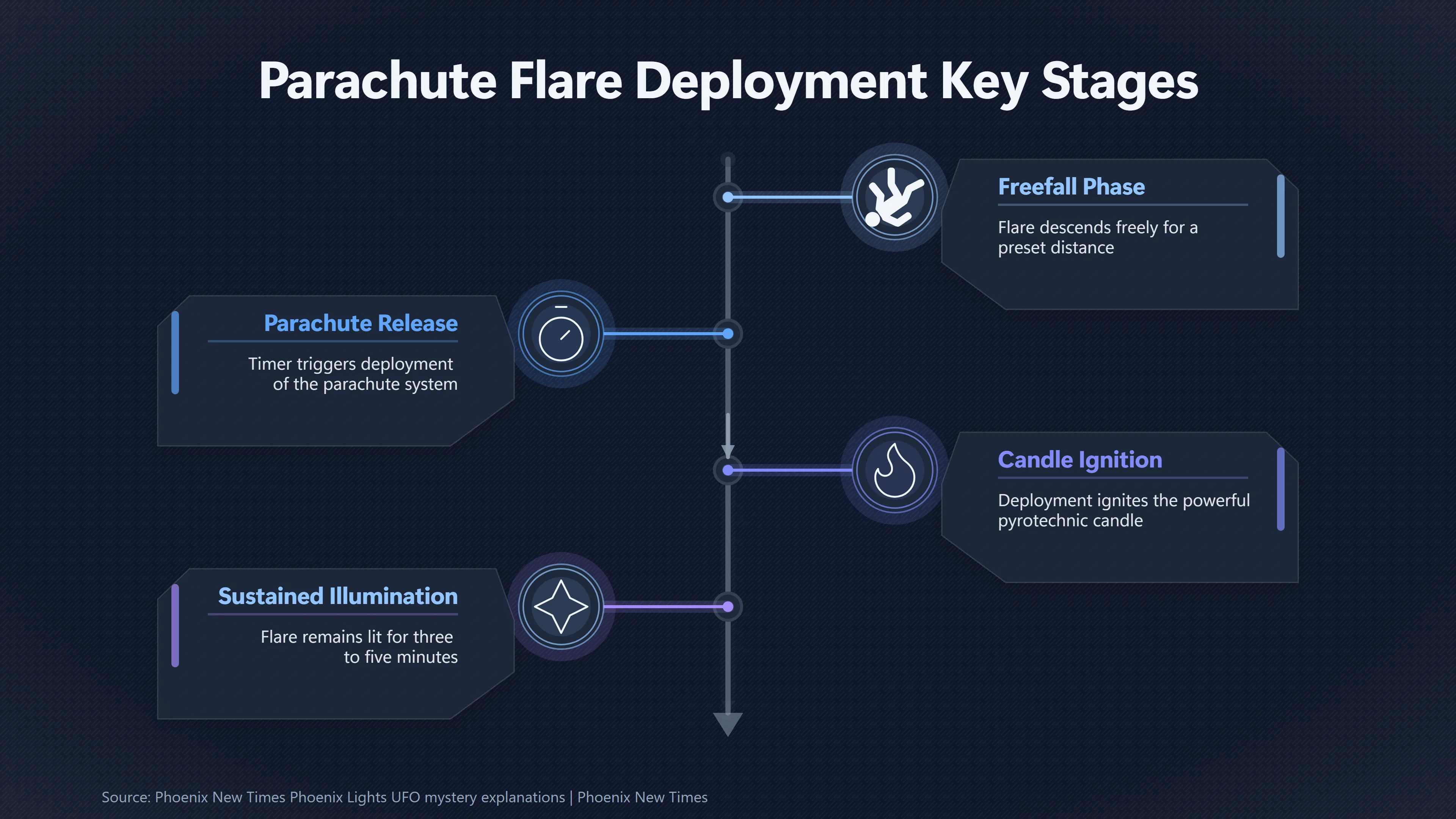
The parachute is central to the illusion. A US Marine Corps description of an airborne battlefield-illumination mission explains that a flare can first fall freely for a preset distance. A timer then releases its parachute, and parachute deployment ignites the illumination candle. The same account states that visible flares used in that mission remained lit for about four minutes. Another Marine Corps account describes illuminating flares burning for three to four minutes after deployment.[U.S. Marine Corps]marines.milU.S. Marine CorpsVMGR-352 lights up night sky for battlefield illumination mission > United States Marine Corps Flagship > News DisplayJu…
Other illumination flares have comparable or longer endurance. The US National Museum of the Air Force describes the historical AN-M26 as descending beneath a parachute and burning for about three minutes at roughly 800,000 candlepower. Technical information for the LUU-2 family, an aircraft-deployed illumination flare associated with the Phoenix explanation, gives an approximate five-minute burn time and an output around 1.8 million candlepower.[Air Force Museum]nationalmuseum.af.milOpen source on af.mil.
That combination matters for UFO identification. A brilliant source that remains airborne for several minutes gives an observer plenty of time to notice it, call other people outside and record it. Yet the light itself reveals little about the parachute or flare casing supporting it. From long range, those comparatively small components disappear below visual resolution, leaving what looks simply like an isolated luminous orb.
Flares also need not illuminate simultaneously. Their ignition can be delayed after release, and multiple flares may be deployed during the same operation. The result can therefore be a sequence in which one light appears, another appears nearby, several coexist for a time, and then individual lights fade or disappear.[U.S. Marine Corps]marines.milU.S. Marine CorpsVMGR-352 lights up night sky for battlefield illumination mission > United States Marine Corps Flagship > News DisplayJu…
Why a descending flare can look stationary
The apparent hovering is largely a problem of angular scale. What the eye detects is not a flare’s descent in metres but the change in its position against the observer’s field of view. The same physical movement becomes progressively less conspicuous as distance increases.
Consider the geometry rather than any particular flare model. A light descending 100 metres while only 2 kilometres away changes its elevation by an easily noticeable amount. Put the same 100-metre descent 50 kilometres away and the angular change is only about 0.11 degrees. Spread that movement over a minute or more, without a nearby building, mountain or other sharply visible reference against which to compare it, and the light can plausibly appear to be hanging in essentially the same part of the sky.
Distance also makes sideways separation deceptive. Several flares can be distributed across kilometres of real airspace while appearing relatively close together in angular terms. Conversely, a modest angular gap between lights can be interpreted as an enormous physical span if the observer assumes that the sources are nearby. With no visible connecting structure and no reliable range estimate, the apparent dimensions of a supposed “craft” are therefore highly uncertain.
Wind complicates the picture further. Parachutes drift with the surrounding air, and different flares may encounter somewhat different winds because they occupy different positions and altitudes. Consequently, a flare formation need not descend rigidly. Small changes in spacing, gradual lateral drift or one light moving slightly differently from its neighbours are compatible with separate suspended sources rather than a single object.
This is why the most useful question is not simply whether the lights “moved”. Investigators need to ask whether their angular motion is consistent with distant sources descending and drifting slowly. A few minutes of apparently modest motion does not, by itself, establish hovering or powered flight.
How separate flares become a line or arc
Multiple illumination flares naturally create patterns because they are released as part of organised military activity rather than appearing randomly throughout the entire sky. Aircraft can deploy successive flares while travelling along a route, while battlefield-illumination missions may use more than one source to illuminate an operating area. Marine Corps accounts explicitly describe aircraft crews preparing and dropping multiple illumination flares during training and operational missions.[U.S. Marine Corps]marines.milU.S. Marine CorpsVMGR-352 lights up night sky for battlefield illumination mission > United States Marine Corps Flagship > News DisplayJu…
From a distant viewpoint, that three-dimensional distribution is compressed into two dimensions. Several flares at different distances and heights can therefore project as a remarkably tidy line. Differences in altitude or perspective can turn that line into a shallow curve. Add one or two appropriately placed lights and the eye may instead perceive the edge of a triangle, boomerang or much larger object.
The important distinction is between a pattern of lights and a physical structure connecting those lights. Flares can unquestionably produce the first. Seeing a clean arc does not supply evidence for the second.
Several features can strengthen the illusion:
- Similar appearance: the lights have comparable colour and brightness because they are the same or similar pyrotechnic devices.
- Common general motion: parachute-supported sources released into the same region can all drift and descend slowly.
- Long overlap: burn times of several minutes allow multiple lights to remain visible together rather than flashing briefly and disappearing.[Global Security]globalsecurity.orgGlobal Security LUU-2 FlareGlobal SecurityLUU-2 Flare - Dumb Bombs…
- Dark surroundings: without a visible landscape behind the lights, there may be no obvious reference showing their descent.
- Sequential extinction: lights fading or becoming hidden one after another can resemble lamps switching off across a large craft.
None of those properties requires the lights to be physically joined. Indeed, the combination of similarity, spacing and slow common movement is precisely what makes multiple ordinary sources so easy to interpret as one formation.

The Phoenix Lights show the mechanism clearly
The later lights seen around Phoenix, Arizona, on 13 March 1997 provide a particularly valuable case because an extraordinary-looking formation coincided with a documented source of illumination flares. This example needs to be handled carefully because “the Phoenix Lights” refers to more than one reported episode that evening. The flare explanation discussed here concerns the later group of bright, apparently hovering lights around 10 p.m.; it should not simply be applied indiscriminately to every earlier report. Contemporary and later reporting distinguishes the later flare event from the earlier moving formation.[Phoenix New Times]phoenixnewtimes.comPhoenix New Times Phoenix Lights UFO mystery explanations | Phoenix New TimesPhoenix New TimesPhoenix Lights UFO mystery explanations | Phoenix New TimesJune 3, 2024…
The later lights were associated with A-10 aircraft from the Maryland Air National Guard conducting training at the Barry M. Goldwater range south-west of Phoenix. Lieutenant Colonel Ed Jones subsequently confirmed that he had been among the pilots involved in the flare drop. The aircraft released parachute-equipped illumination flares, producing the conspicuous lights recorded from the Phoenix area.[Phoenix New Times]phoenixnewtimes.comPhoenix New Times Phoenix Lights UFO mystery explanations | Phoenix New TimesPhoenix New TimesPhoenix Lights UFO mystery explanations | Phoenix New TimesJune 3, 2024…
What makes the episode especially relevant is its appearance. Reports and video showed brilliant lights apparently suspended in an extended arrangement rather than something that obviously resembled falling pyrotechnics. Reporting on the case describes the flares descending in an arc and disappearing behind the Estrella Mountains. From the observers’ side of the mountains, the dark terrain could remove a descending flare from view while leaving no obvious visual indication that an intervening ridge had hidden it.[The Village Voice]villagevoice.comThe Village Voice New 'Phoenix Lights': A Hoax By Some Joker With FlaresThe Village VoiceNew 'Phoenix Lights': A Hoax By Some Joker With Flares - The Village Voice…
The event therefore combines several ingredients that make parachute flares deceptive: great distance, extremely bright point sources, several lights visible together, slow descent and terrain that could conceal the lower portion of their trajectories. The result looked much more like a formation suspended over the horizon than most people’s everyday idea of a “flare”.
It is also a useful warning against judging the mechanism from a famous still image. A photograph capturing several lights at one instant freezes their descent and drift completely. What was already slow motion becomes no motion at all, and a temporary arrangement becomes a seemingly precise geometric formation. Without the surrounding sequence, the image supplies almost no information about whether the points were maintaining fixed positions, descending independently or appearing and disappearing at different times.
Terrain can make lights seem to switch off in mid-air
A particularly misleading feature of distant flare observations is sudden disappearance. If an observer expects a burning object to fall visibly towards the ground, a light that instead vanishes while apparently high in the sky can seem inconsistent with a flare.
An unseen horizon can produce exactly that effect. At night, a mountain ridge tens of kilometres away may be effectively invisible against the sky. A flare descending on the far side remains visible only until its line of sight intersects the ridge. To the observer, the bright point then seems to extinguish in empty sky even though it may still be burning behind the terrain.
The Phoenix case illustrates why this matters. Accounts of the later event describe flares disappearing behind the Estrella Mountains as they descended. Because the mountain silhouette was difficult to see at night, viewers could perceive the lights as suspended above an apparently unobstructed horizon.[The Village Voice]villagevoice.comThe Village Voice New 'Phoenix Lights': A Hoax By Some Joker With FlaresThe Village VoiceNew 'Phoenix Lights': A Hoax By Some Joker With Flares - The Village Voice…
Irregular terrain can make the sequence even less intuitive. Different lines of sight encounter different ridge elevations, so the order in which lights disappear need not exactly match the order in which they were released or their apparent heights relative to one another. A row of lights can therefore seem to wink out individually rather than simply sink beneath one obvious horizontal boundary.
What makes the flare explanation testable
Calling unidentified lights “flares” solely because they are bright and slow-moving is not enough. Illumination flares have physical and operational constraints, so the explanation becomes stronger when several independent observations agree.
Duration is one useful check. Different flare types have different specifications, but documented visible aircraft illumination systems commonly burn for several minutes, not indefinitely. A claimed single light remaining continuously luminous far beyond the relevant munition’s plausible burn time would require another explanation or evidence that successive flares were being mistaken for one source.[Global Security]globalsecurity.orgGlobal Security LUU-2 FlareGlobal SecurityLUU-2 Flare - Dumb Bombs…
Motion is another. A parachute flare should ultimately behave like an object suspended in the atmosphere: predominantly descending, with wind-driven drift rather than sustained manoeuvring characteristic of a powered aircraft. Long, stabilised video containing foreground or terrain references is consequently much more informative than a short handheld clip.
Location and timing are particularly important. Nearby military ranges, night exercises, aircraft tracks and confirmation of illumination activity can turn a generic possibility into a specific explanation. Conversely, investigators should not assume military flares merely because a sighting occurred somewhere near a military installation.
Terrain provides an additional geometrical test. If lights disappear at positions corresponding to a distant ridgeline from the camera’s known location, that is much more informative than simply noting that they “went out”. Reconstructing the observer’s line of sight in daylight can reveal a horizon that was effectively invisible when the footage was recorded.
Finally, individual behaviour matters. A supposed rigid craft should ordinarily preserve the relationships among lights attached to it. Separate parachute flares can drift, brighten, flicker, descend or disappear independently. GlobalSecurity’s description of the LUU-2 notes that uneven burning can cause fluctuations in brightness, another behaviour that can make individual lights change without requiring the entire apparent formation to change.[Global Security]globalsecurity.orgGlobal Security LUU-2 FlareGlobal SecurityLUU-2 Flare - Dumb Bombs…
The key identification lesson
Illumination flares are unusually effective UFO lookalikes because their intended engineering characteristics reproduce several features witnesses often regard as extraordinary. They are exceptionally bright, they remain visible for minutes, parachutes greatly slow their descent, and military operations can put several into the same portion of sky. Seen from far away, those independent sources can become a stable-looking line or arc whose downward motion is barely perceptible.[Air Force Museum]nationalmuseum.af.milOpen source on af.mil.
The strongest clue is therefore not the apparent shape itself. A line, arc or triangle tells an observer how the lights are projected onto the sky, but not whether anything solid occupies the darkness between them. The more diagnostic evidence comes from the lights’ individual histories: gradual descent, slight independent drift, sequential ignition or disappearance, several-minute lifetimes, flickering, terrain occultation and a match with documented illumination activity.
That distinction explains how several ordinary lights can convincingly resemble one hovering craft. With parachute illumination flares, the apparent formation can be real as a visual pattern while the enormous object implied by that pattern exists only in the observer’s interpretation.
Amazon book picks
Further Reading
Books and field guides related to When Military Flares Look Like a Hovering Craft. Use these as the next step if you want deeper reading beyond the article.
Fireworks: Principles and Practice
Contents - 1 The History of Fireworks - 2 Firework Material - 3 General Pyrotechnic Principles - 4 Mixing and Charging - 5 Containers - 6...
The Report on Unidentified Flying Objects
Edward J. Ruppelt's "The Report on Unidentified Flying Objects" serves as a pivotal text in the study of UFO phenomena, blending personal...
The Chemistry of Fireworks
"Aimed A level students, this book discusses the theory of fireworks in terms of well-known scientific concepts wherever possible, in a c...
The UFO Files: The Inside Story of Real-life Sightings
'What does all this stuff about flying saucers amount to? What can it mean? What is the truth?' Winston Churchill, prime minister's perso...
eBay marketplace picks
Marketplace Samples
Live-tested eBay searches with available results related to this page.
Selected fromUFO poster oneBay.co.uk.
Current eBay listing
VINTAGE UFO FLYING SAUCERS COMIC ADVERTISING A2 POSTER PRINT

Current eBay listing
I Want To Believe UFO Poster Giclée Fine Art Heavyweight Print

Endnotes
1.
Source: marines.mil
Link:https://www.marines.mil/News/News-Display/Article/535398/vmgr-352-lights-up-night-sky-for-battlefield-illumination-mission/
Source snippet
U.S. Marine CorpsVMGR-352 lights up night sky for battlefield illumination mission > United States Marine Corps Flagship > News DisplayJu...
2.
Source: nationalmuseum.af.mil
Link:https://www.nationalmuseum.af.mil/Visit/Museum-Exhibits/Fact-Sheets/Display/Article/196232/USAFmuseum/an-m26-parachute-flares/
3.
Source: phoenixnewtimes.com
Title: Phoenix New Times Phoenix Lights UFO mystery explanations | Phoenix New Times
Link:https://www.phoenixnewtimes.com/arts-culture/phoenix-lights-ufo-mystery-explanations-19105870/
Source snippet
Phoenix New TimesPhoenix Lights UFO mystery explanations | Phoenix New TimesJune 3, 2024...
Published: June 3, 2024
4.
Source: villagevoice.com
Title: The Village Voice New ‘Phoenix Lights’: A Hoax By Some Joker With Flares
Link:https://www.villagevoice.com/new-phoenix-lights-a-hoax-by-some-joker-with-flares/
Source snippet
The Village VoiceNew 'Phoenix Lights': A Hoax By Some Joker With Flares - The Village Voice...
5.
Source: marines.mil
Title: U.S. Marine Corps A VMM’s light in dark of night
Link:https://www.marines.mil/Photos/igphoto/2000712972/
6.
Source: globalsecurity.org
Title: Global Security LUU-2 Flare
Link:https://www.globalsecurity.org/military/systems/munitions/luu2.htm
Source snippet
Global SecurityLUU-2 Flare - Dumb Bombs...
7.
Source: timecyclopedia.com
Title: phoenix lights
Link:https://timecyclopedia.com/entry/phoenix-lights
8.
Source: thisunexplaineduniverse.com
Title: phoenix lights
Link:https://www.thisunexplaineduniverse.com/articles/phoenix-lights
9.
Source: phoenixnewtimes.com
Link:https://www.phoenixnewtimes.com/arts-culture/the-phoenix-lights-ufo-sightings-in-1997-an-oral-history-25th-anniversary-13176244/
10.
Source: af.mil
Title: Lighting up the night
Link:https://www.af.mil/News/Photos/igphoto/2003195808/
11.
Source: metabunk.org
Title: Phoenix Lights | Metabunk
Link:https://www.metabunk.org/threads/phoenix-lights.11938/
12.
Source: stampaday.wordpress.com
Title: the phoenix lights
Link:https://stampaday.wordpress.com/2019/03/13/the-phoenix-lights/
13.
Source: ufoinsight.com
Title: 1997 phoenix lights
Link:https://www.ufoinsight.com/ufos/sightings/1997-phoenix-lights
14.
Source: 3rdmaw.marines.mil
Title: mil VMG R-352 battlefield illumination training
Link:https://www.3rdmaw.marines.mil/Media-Room/Photos/igphoto/2001829530/
15.
Source: unexplained-mysteries.com
Title: The Phoenix lights
Link:https://www.unexplained-mysteries.com/forum/topic/305172-the-phoenix-lights/page/9/
16.
Source: marines.mil
Link:https://www.marines.mil/News/News-Display/Article/625633/recon-falls-into-action-marines-execute-parachute-ops/
17.
Source: nationalmuseum.af.mil
Link:https://www.nationalmuseum.af.mil/Visit/Museum-Exhibits/Fact-Sheets/Display/Article/196232/an-m26-parachute-flares/
18.
Source: nationalmuseum.af.mil
Title: mil Fact Sheets
Link:https://www.nationalmuseum.af.mil/Visit/MuseumExhibits/FactSheets/tabid/473/Page/159/Default.aspx
19.
Source: marines.mil
Link:https://www.marines.mil/News/News-Display/Article/500100/marsoc-marines-take-to-the-air-acquire-haho-insert-capability/
20.
Source: imef.marines.mil
Title: mil VMG R-352 lights up night sky for battlefield illumination mission
Link:https://www.imef.marines.mil/Photos/igphoto/2000807456/
21.
Source: yumpu.com
Title: The Phoenix Lights
Link:https://www.yumpu.com/en/document/view/51064289/the-phoenix-lights-the-real-investigation-richard-motzer-nicap
22.
Source: phoenixnewtimes.com
Title: the phoenix lights are no mystery 6661825
Link:https://www.phoenixnewtimes.com/arts-culture/the-phoenix-lights-are-no-mystery-6661825/
23.
Source: thinkaboutitdocs.com
Title: 1997 phoenix lights
Link:https://thinkaboutitdocs.com/1997-phoenix-lights/
24.
Source: unexplained-mysteries.com
Title: Phoenix Lights
Link:https://www.unexplained-mysteries.com/forum/topic/210537-phoenix-lights/
25.
Source: ufology.wikidot.com
Title: phoenix lights
Link:https://ufology.wikidot.com/phoenix-lights
26.
Source: 15thmeu.marines.mil
Link:https://www.15thmeu.marines.mil/Media-Room/Photos/igphoto/213606/
27.
Source: phoenixnewtimes.com
Title: The Hack and the Quack | Phoenix New Times
Link:https://www.phoenixnewtimes.com/news/the-hack-and-the-quack-6445593/
28.
Source: nuforc.org
Link:https://nuforc.org/phoenix/
29.
Source: ufo-books.com
Title: phoenix lights
Link:https://ufo-books.com/incidents/phoenix-lights
30.
Source: af.mil
Link:https://www.af.mil/News/Photos/igsearch/flare/
31.
Source: af.mil
Link:https://www.af.mil/News/Photos/igpage/7/igsearch/flare/
32.
Source: nationalmuseum.af.mil
Title: early years 1961 1964
Link:https://www.nationalmuseum.af.mil/Visit/Museum-Exhibits/Fact-Sheets/Display/Article/195676/early-years-1961-1964/
33.
Source: af.mil
Link:https://www.af.mil/News/Photos/igpage/2/igsearch/flare/
34.
Source: af.mil
Link:https://www.af.mil/News/Photos/igphoto/2000684964/
35.
Source: af.mil
Link:https://www.af.mil/News/Photos/igpage/7/igsearch/Flares/igsort/PhotoDate/
36.
Source: kb42.info
Title: Phoenix Lights
Link:https://kb42.info/index.php?title=Phoenix_Lights
37.
Source: marines.mil
Link:https://www.marines.mil/News/News-Display/Article/549002/a-vmms-light-in-dark-of-night/
38.
Source: marsoc.marines.mil
Link:https://www.marsoc.marines.mil/Media-Room/Stories/Article/Article/513735/3d-msob-marines-conduct-haho-training/
39.
Source: mcasyuma.marines.mil
Title: mil Videos VIDEO S Light ‘em Up Marine Corps Air Station Yuma
Link:https://www.mcasyuma.marines.mil/News/Videos/videoid/343901/
40.
Source: imef.marines.mil
Link:https://www.imef.marines.mil/Units/MEB-A/videoid/352205/
41.
Source: marines.mil
Title: Explore Photos
Link:https://www.marines.mil/Photos/igpage/6/?igsearch=C-130+Dragon+Spear
42.
Source: thestatefiles.com
Title: The Phoenix Lights
Link:https://thestatefiles.com/the-phoenix-lights/
43.
Source: theufotimes.com
Title: phoenix lights
Link:https://theufotimes.com/articles/phoenix-lights
44.
Source: youtube.com
Link:https://www.youtube.com/watch?v=bvKLeaPWPyw
Source snippet
The Phoenix Lights - 17 years later...
Published: March 13, 1997
45.
Source: youtube.com
Title: The Phoenix Lights
Link:https://www.youtube.com/watch?v=8SUJTh6Hs-I
Source snippet
Nearly 30 years later, the Phoenix Lights phenomenon still captivates...
Additional References
46.
Source: scribd.com
Title: Air-to-Air and Air-to-Surface Munitions Manual | PDF | Military Technology
Link:https://www.scribd.com/document/793762586/TO-1-1M-34
Source snippet
Air-to-Air and Air-to-Surface Munitions Manual | PDF | Military Technology...
47.
Source: wikidisc.org
Title: Phoenix Lights 1997
Link:https://www.wikidisc.org/wiki/Phoenix_Lights_1997
Source snippet
July 2, 2026 — INVESTIGATION[EDIT | EDIT SOURCE] INITIAL OFFICIAL RESPONSE[EDIT | EDIT SOURCE] In the immediate aftermath of the...
Published: July 2, 2026
48.
Source: gao.gov
Link:https://www.gao.gov/products/ogc
49.
Source: gao.gov
Link:https://www.gao.gov/assets/a300279.html
50.
Source: gao.gov
Link:https://www.gao.gov/assets/a240791.html
51.
Source: projectunredacted.com
Title: phoenix lights 1997
Link:https://www.projectunredacted.com/cases/phoenix-lights-1997
Source snippet
Project UnredactedThe Phoenix Lights (1997) — UFO sighting Explained | Project Unredacted...
52.
Source: youtube.com
Title: British army deploy flares during night training in stunning video
Link:https://www.youtube.com/watch?v=GEX0YFex3kw
Source snippet
Canadian Forces - Safe Use of Pyrotechnics...
53.
Source: gao.gov
Link:https://www.gao.gov/assets/a278502.html
54.
Source: navy.mil
Link:https://www.navy.mil/Press-Office/News-Stories/display-news/Article/2260445/band-of-brothers-wwii-veteran-speaks-to-eod-mdsu-sailors/
55.
Source: aaro.mil
Link:https://www.aaro.mil/FAQ/