Within Compression
Why Zooming In Can Make UFO Detail Worse
Zooming compressed footage enlarges existing pixels and artefacts rather than recovering lost detail, making block edges and halos easier to mistake for
On this page
- What digital enlargement actually adds
- How blocks and halos become visually dominant
- Why repeated re encoding can further weaken fine detail
Page outline Jump by section
Introduction
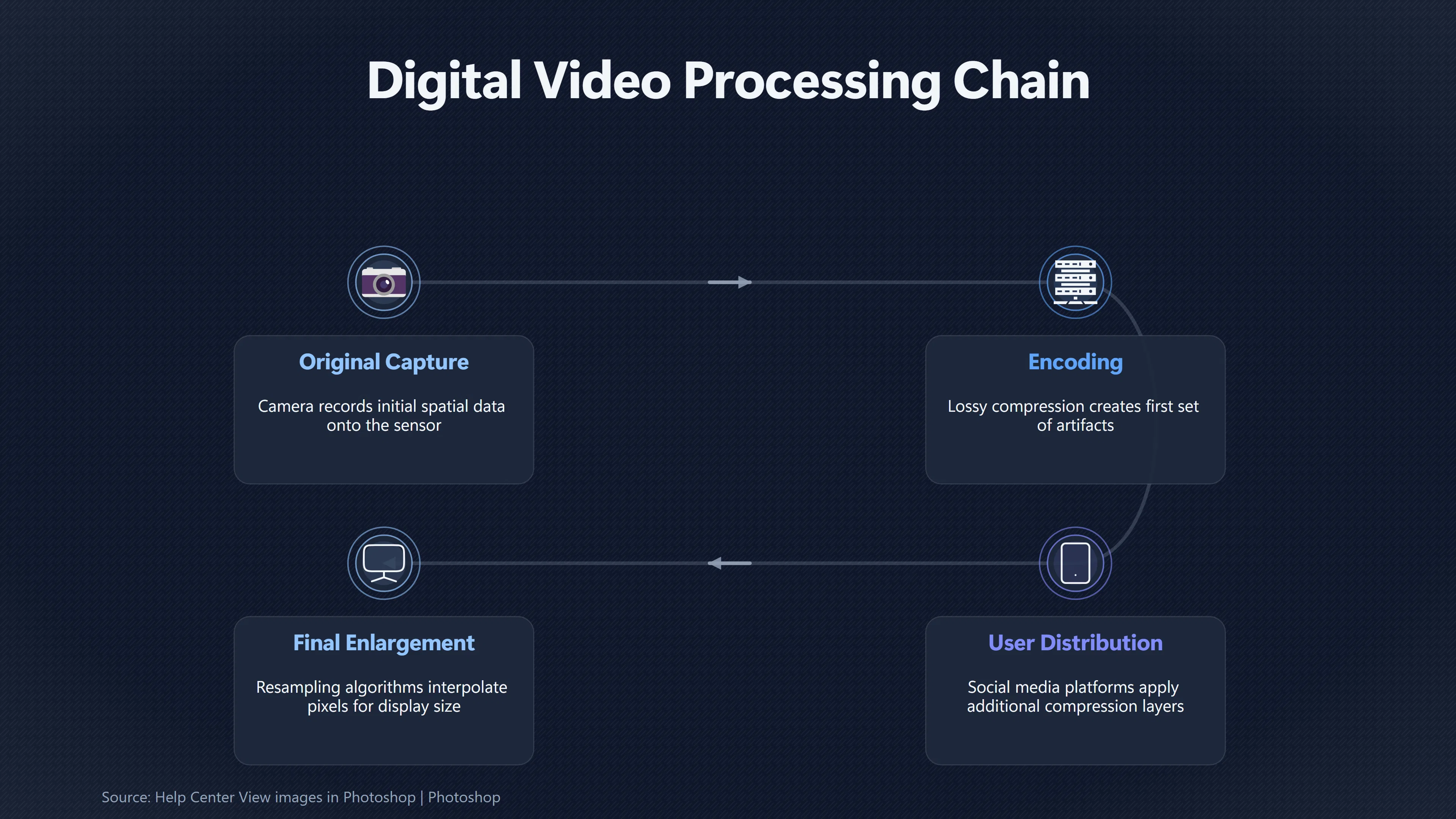
Zooming into a compressed UFO or UAP video can make the object look more detailed while providing little or no new evidence about its physical structure. Ordinary digital enlargement does not recover detail that the camera or codec failed to preserve. It takes the pixels already present and displays them at a larger size, either by replicating them or by calculating intermediate values from neighbouring pixels. Adobe notes that a 100% view is the most direct pixel-to-pixel display; at other magnifications, image pixels are interpolated across display pixels.[Adobe Help Center]helpx.adobe.comHelp Center View images in Photoshop | PhotoshopAdobe Help CenterView images in Photoshop | PhotoshopSeptember 8, 2018…
That distinction becomes especially important when a distant object occupies only a few pixels. Compression blocks, ringing around edges and blurred boundaries may be barely noticeable at normal viewing size. Enlarge the same region several times, however, and those distortions become prominent shapes: apparent straight sides, rims, lobes, dark notches or glowing outlines. The picture is bigger, but its apparent structural complexity can be misleading.
What digital enlargement actually adds
There is an important difference between optical magnification before capture and digital enlargement after capture. A longer focal length can project a larger image of a distant object onto the sensor and potentially record additional spatial information. Enlarging an already recorded frame cannot go back and obtain those missing measurements.
Basic digital enlargement instead performs resampling. With nearest-neighbour scaling, an original pixel can simply become a larger group of identical pixels. Bilinear, bicubic and Lanczos methods calculate new pixel values from the existing neighbourhood. OpenCV’s technical documentation, for example, describes nearest-neighbour, bilinear, bicubic and Lanczos interpolation as different methods for constructing the resized image from the source samples.[OpenCV]opencv.orgresizing and rescaling images with opencvResizing and Rescaling Images with OpenCVMarch 10, 2025…
The distinction matters because interpolated pixels are not independent observations of the object. Research in digital-image forensics actually exploits the statistical correlations introduced by resampling as evidence that an image has been resized or geometrically transformed.[PubMed]pubmed.ncbi.nlm.nih.govPub Med Image re-sampling detection through a novel interpolation kernelImage re-sampling detection through a novel interpolation kernel - PubMedMarch 27, 2018…
Imagine that a distant target is only six pixels across in the source video. Enlarging it tenfold may produce an image roughly 60 pixels across on screen, but it has not magically turned six independently measured samples into 60. The enlargement algorithm has constructed the additional display samples from those six and their surroundings.
This creates an easy perceptual trap in UAP footage. At normal size, viewers recognise that they are looking at an indistinct dot. At 500 or 1,000 per cent magnification, they are presented with something large enough to inspect as though it were a resolved object. Human attention naturally shifts to its apparent outline, corners and internal variations even though those features may originate in interpolation, compression or noise.
For analysis, therefore, display size should never be confused with source resolution. A useful description of an enlarged UAP image should retain the dimensions of the original target region: for example, that the displayed 300-pixel-wide object derives from an object only a few tens — or perhaps only a few — pixels wide in the underlying frame.
Why blocks and halos start looking like structure
Compression makes this problem more serious because the pixels being enlarged may already contain distortions.
Lossy image and video coding is well known to produce blocking, blurring and ringing. These are sufficiently important technical problems that a substantial research literature is devoted specifically to reducing them.[ScienceDirect]sciencedirect.comAdaptive post-filtering for reducing blocking and ringing artifacts in low bit-rate video coding - ScienceDirect… Mozilla’s video-codec guide similarly describes ringing as contamination around object boundaries produced by lossy compression and notes that compression artefacts can persist across video frames.[MDN Web Docs]developer.mozilla.orgMDN Web Docs Web video codec guideMDN Web DocsWeb video codec guide - Media | MDNMay 4, 2026…
Magnification changes how visually important these defects become.
Block boundaries can resemble straight geometry. Block-based processing can leave discontinuities that follow regular horizontal or vertical boundaries. When a tiny target is enlarged, a boundary affecting only a few source pixels can become a conspicuous straight edge. A rounded or irregular object may consequently appear more rectangular, faceted or mechanically defined than the surviving image information warrants.
Ringing can resemble an outline or appendage. Compression near a high-contrast boundary can produce light or dark bands beside the real edge. Enlarged around a bright object against a dark sky — or a hot infrared target against a cooler background — these bands can look like a rim, aura, trailing feature or separate layer around the target. Research on block-based compression specifically identifies ringing as a problem around strong edges and outlines.[Monash University]research.monash.eduMonash UniversityA Training-Based Method for Reducing Ringing Artifact in BDCT-Encoded Images - Monash UniversityOctober 27, 2004…
Interpolation can make the artefact look smoother. A blocky source enlarged with nearest-neighbour scaling remains obviously pixelated. Bicubic or other interpolation methods can make it more visually pleasing by blending values between samples. That may be desirable for ordinary viewing, but smoothness is not the same thing as recovered evidence. A jagged compression boundary can become a smooth-looking curve; a small brightness discontinuity can become a gradual-looking halo.
This produces a counter-intuitive result: a nicer-looking enlargement can sometimes make evidential interpretation harder. The image appears less pixelated and therefore more photograph-like, while the viewer becomes less conscious of how little independent information supports its apparent contours.
The danger is particularly acute when investigators crop tightly around the UAP. Once the surrounding scene and original pixel scale disappear, a tiny codec-distorted target can fill an entire screen. Nothing in the enlarged presentation immediately reminds the viewer that a seemingly substantial feature may correspond to only one or two source pixels.
A real UAP lesson: apparent features can belong to the video
The US All-domain Anomaly Resolution Office (AARO) provides a useful real-world warning about treating conspicuous video features as physical structure. In its South Asian “Atmospheric Wake” case, an MQ-9 infrared recording appeared to show an object with a trailing feature. After examining full-motion video, additional footage with a longer focal length and commercial flight information, AARO assessed the object as probably a commercial aircraft and the apparent trailing feature as a sensor artefact resulting from video compression.[AARO]aaro.milUAP ImageryUAP Imagery
The case does not establish that every halo or tail in UAP footage is a compression artefact. Its relevance is narrower and more important: a visually coherent feature adjacent to a target need not correspond to anything physically adjacent to that target.
Digital enlargement cannot resolve that ambiguity by itself. If the alleged wake, rim or protrusion already arises from compression, enlarging it merely makes the compression-generated feature easier to see.
A similar caution appears in independent discussion of the 2004 Nimitz “FLIR1” footage. Analysis on Metabunk emphasised that the target occupied relatively few useful pixels and that compression artefacts complicated attempts to infer physical detail from its fuzzy boundary.[Metabunk]metabunk.orgOpen source on metabunk.org. Metabunk is not an official adjudicating body, so such case interpretations should not be treated as authoritative resolutions. It is nevertheless a useful example of the precise analytical problem: observers can disagree about the meaning of subtle brightness variations when the source contains very little spatial information.
The stronger general principle comes from forensic practice. The UK’s Forensic Science Regulator requires practitioners to understand the purpose and possible data losses associated with image enhancement and states that material too poor for reliable enhancement may need to be identified as such.[GOV.UK]GOV.UKForensic science activities: statutory code of practiceForensic science activities: statutory code of practice Enlargement is useful for seeing the recorded samples; it does not remove the information limits imposed by those samples.
Re-encoding can make the enlarged evidence weaker
Online UAP clips frequently have a longer processing history than their presentation suggests. A camera may first encode the original recording. Someone then exports or edits it, a messaging or social-media service creates another compressed copy, another user downloads or screen-records that version, and a later compilation may encode it yet again.
Those stages matter because lossy compression is not automatically reversible. Research on video transcoding has measured additional quality degradation when already compressed video is decoded and encoded again, compared with directly encoding the original source to the same target bitrate.[arXiv]arxiv.orgarXiv Analysis of video quality losses in the homogenous HEVC video transcodingarXiv Analysis of video quality losses in the homogenous HEVC video transcoding Earlier research into repeated MPEG coding likewise identified quality degradation across multiple compression/decompression generations.[CiNii Research]cir.nii.ac.jpCi Nii Research25-7 MPEG符号化繰り返し時の画質劣化特性の検討 | Ci Nii ResearchCi Nii Research25-7 MPEG符号化繰り返し時の画質劣化特性の検討 | Ci Nii Research
This means a viral clip can contain several overlapping layers of processing history:
- limitations of the camera’s original sampling;
- artefacts introduced by the first lossy encode;
- resizing or cropping;[helpx.adobe.com]helpx.adobe.comadvanced cropping resizing resampling photoshopadvanced cropping resizing resampling photoshop
- interpolation from enlargement;
- additional quantisation during export or transcoding;
- platform compression; and
- possibly another enlargement of the resulting copy.
The later stages cannot reconstruct details discarded by the earlier ones. They can, however, modify the appearance of the surviving boundaries.
Repeated processing also helps explain why two online copies of the same UAP footage can display slightly different apparent “details”. A faint notch may become stronger in one encoding and disappear in another; an edge may acquire different ringing; a small target may change by a pixel as frames are resized. Such differences should be investigated as properties of the processing chain before they are interpreted as physical changes in the object.
Modern research continues to find that aggressive video compression can produce unstable textures, flicker and frame-to-frame inconsistencies, rather than merely reducing sharpness uniformly.[arXiv]arxiv.orgOpen source on arxiv.org. For a large foreground object these distortions may be relatively easy to recognise. For a UAP occupying very few pixels, an artefact changing by one pixel can alter a substantial fraction of the apparent silhouette.
The safest way to inspect a magnified UAP clip
Zooming is still useful. Analysts often need enlargement simply to see which pixels are changing. The mistake is treating the enlarged result as though it were a higher-resolution photograph.
A more defensible examination keeps the enlargement tied to its source. The original frame should be retained alongside the crop, with the crop’s original pixel dimensions recorded. Where possible, the earliest available file should be examined rather than a social-media repost, screen recording or edited compilation. Different interpolation methods can also be compared: if a supposedly physical corner, rim or appendage changes substantially when the same source pixels are enlarged differently, confidence in that feature should fall.
It is also useful to examine consecutive frames rather than selecting the single frame in which a suggestive shape looks clearest. Video compression operates across time as well as space, and artefacts can linger or change between frames. Mozilla’s codec documentation notes that predictive video coding can allow errors and artefacts to persist until later frames repair or replace the affected image information.[MDN Web Docs]developer.mozilla.orgMDN Web Docs Web video codec guideMDN Web DocsWeb video codec guide - Media | MDNMay 4, 2026…
Most importantly, analysts should distinguish between two very different claims:
- “The source pixels contain this pattern.” Enlargement can demonstrate this.
- “The physical object had this structure.” Enlargement alone cannot demonstrate this.
The second claim requires confidence that the camera resolved the feature and that it survives plausible alternatives involving focus, noise, sensor processing, compression and resampling.
Bigger pixels are not better evidence
Digital enlargement has an entirely legitimate role in UAP analysis: it makes small recorded patterns easier to inspect. What it does not do is turn poorly resolved footage into a new observation.
That limitation becomes especially consequential after compression. A block boundary can grow into an apparent straight side; ringing can grow into a rim or halo; a few uneven pixels can become a seemingly intricate silhouette. Smoother interpolation may make those patterns look more natural without making them more authentic. Re-encoding can then modify the same marginal features again.
The practical lesson is not that magnified UFO footage is useless. It is that structural claims should be traced back to the scale of the original data. If an alleged wing, dome, notch, tail or geometric edge exists only as a tiny arrangement of pixels in a compressed source, displaying those pixels twenty times larger does not strengthen the evidence that the feature existed on the object. It mainly strengthens the viewer’s ability to see — and potentially overinterpret — the image-processing artefacts that were already there.
Amazon book picks
Further Reading
Books and field guides related to Why Zooming In Can Make UFO Detail Worse. Use these as the next step if you want deeper reading beyond the article.
Digital Image Processing
This is the eBook of the printed book and may not include any media, website access codes, or print supplements that may come packaged wi...
Fundamentals of Digital Image Processing
Two-Dimensional Systems and Mathematical Preliminaries - Image Perception - Image Sampling and Quantization - Image Transforms - Image Re...
Digital Video and HD: Algorithms and Interfaces
& Quot;Digital Video and HDTV Algorithms and Interfaces covers the theory and engineering of digital video systems in a manner that is eq...
H.264 and MPEG-4 Video Compression: Video Coding for Next-gen...
Following on from the successful MPEG-2 standard, MPEG-4 Visual is enabling a new wave of multimedia applications from Internet video str...
eBay marketplace picks
Marketplace Samples
Live-tested eBay searches with available results related to this page.
Selected fromUFO poster oneBay.co.uk.

Current eBay listing
VINTAGE UFO FLYING SAUCERS COMIC ADVERTISING A2 POSTER PRINT



Current eBay listing
I Want To Believe UFO Poster Giclée Fine Art Heavyweight Print
Endnotes
1.
Source: helpx.adobe.com
Title: Help Center View images in Photoshop | Photoshop
Link:https://helpx.adobe.com/in/photoshop/using/viewing-images.html
Source snippet
Adobe Help CenterView images in Photoshop | PhotoshopSeptember 8, 2018...
Published: September 8, 2018
2.
Source: docs.opencv.org
Link:https://docs.opencv.org/2.4.7/modules/imgproc/doc/geometric_transformations.html
3.
Source: opencv.org
Title: resizing and rescaling images with opencv
Link:https://opencv.org/resizing-and-rescaling-images-with-opencv/
Source snippet
Resizing and Rescaling Images with OpenCVMarch 10, 2025...
Published: March 10, 2025
4.
Source: sciencedirect.com
Link:https://www.sciencedirect.com/science/article/pii/S0923596502000267
Source snippet
Adaptive post-filtering for reducing blocking and ringing artifacts in low bit-rate video coding - ScienceDirect...
5.
Source: arxiv.org
Title: arXiv Compression Artifacts Reduction by a Deep Convolutional Network
Link:https://arxiv.org/abs/1504.06993
6.
Source: developer.mozilla.org
Title: MDN Web Docs Web video codec guide
Link:https://developer.mozilla.org/en-US/docs/Web/Media/Guides/Formats/Video_codecs
Source snippet
MDN Web DocsWeb video codec guide - Media | MDNMay 4, 2026...
Published: May 4, 2026
7.
Source: research.monash.edu
Link:https://research.monash.edu/en/publications/a-training-based-method-for-reducing-ringing-artifact-in-bdct-enc/
Source snippet
Monash UniversityA Training-Based Method for Reducing Ringing Artifact in BDCT-Encoded Images - Monash UniversityOctober 27, 2004...
Published: October 27, 2004
8.
Source: aaro.mil
Title: UAP Imagery
Link:https://www.aaro.mil/UAP-Cases/Official-UAP-Imagery/4/
9.
Source: metabunk.org
Link:https://www.metabunk.org/posts/223187/
10.
Source: GOV.UK
Title: Forensic science activities: statutory code of practice
Link:https://www.gov.uk/government/publications/forensic-science-activities-statutory-code-of-practice-version-2/forensic-science-activities-statutory-code-of-practice-version-2-accessible
11.
Source: arxiv.org
Title: arXiv Analysis of video quality losses in the homogenous HEVC video transcoding
Link:https://arxiv.org/abs/1702.07548
12.
Source: arxiv.org
Link:https://arxiv.org/abs/2605.18378
13.
Source: aaro.mil
Link:https://www.aaro.mil/Next-AARO-Home-redesign/Next-Parent/Next-AARO-UAP-Imagery-Acc-Table/
14.
Source: aaro.mil
Link:https://www.aaro.mil/Next-AARO-Home-redesign/Next-Parent/Next-UAP-Report-Documents/poster/dividLink/
15.
Source: helpx.adobe.com
Title: resize images
Link:https://helpx.adobe.com/photoshop/desktop/crop-resize-transform/resize-adjust-resolution/resize-images.html?gspk=NjE0OTI5ZTJlZmNl&gsxid=Bm3AKQeIOPHC8N&ps_partner_key=NjE0OTI5ZTJlZmNl&ps_xid=Bm3AKQeIOPHC8N&pscd=partnerstack.teachable.com
16.
Source: helpx.adobe.com
Title: resampling options
Link:https://helpx.adobe.com/photoshop/desktop/crop-resize-transform/resize-adjust-resolution/resampling-options.html
17.
Source: metabunk.org
Title: P R051
Link:https://www.metabunk.org/threads/pr051-syria-uap-2021-apparent-instantaneous-acceleration.14733/page-3
18.
Source: aaro.mil
Link:https://www.aaro.mil/Next-AARO-Home-redesign/Next-Parent/Presidential-UAP-Transparency-Initiative/
19.
Source: docs.opencv.org
Title: group imgproc transform
Link:https://docs.opencv.org/4.13.0/da/d54/group__imgproc__transform.html
20.
Source: helpx.adobe.com
Title: printed image resolution
Link:https://helpx.adobe.com/uk/photoshop/desktop/crop-resize-transform/resize-adjust-resolution/printed-image-resolution.html
21.
Source: helpx.adobe.com
Title: image size resolution
Link:https://helpx.adobe.com/africa/photoshop/using/image-size-resolution.html
22.
Source: cps.gov.uk
Title: Expert Evidence | The Crown Prosecution Service
Link:https://www.cps.gov.uk/prosecution-guidance/expert-evidence
23.
Source: metabunk.org
Title: UAP Hearing New Video
Link:https://www.metabunk.org/threads/uap-hearing-new-video-yemen-orb.14427/page-4
24.
Source: developer.mozilla.org
Title: image formats pixels graphics
Link:https://developer.mozilla.org/en-US/blog/image-formats-pixels-graphics/
25.
Source: sciencedirect.com
Link:https://www.sciencedirect.com/science/article/pii/S1051200425002404
26.
Source: metabunk.org
Link:https://www.metabunk.org/threads/pr055-corbells-u-s-military-films-huge-disc-hiding-in-the-clouds-new-video-06-17-25.14289/
27.
Source: GOV.UK
Title: www.gov.uk Draft code of practice (accessible)
Link:https://www.gov.uk/government/consultations/forensic-science-code-of-practice-version-2/draft-code-of-practice-accessible
28.
Source: docs.opencv.org
Title: group gapi transform
Link:https://docs.opencv.org/4.11.0/d6/d91/group__gapi__transform.html
29.
Source: aaro.mil
Link:https://www.aaro.mil/Next-AARO-Home-redesign/Next-Parent/Presidential-UAP-Transparency-Initiative/videoid/1006079/dvpcc/false/
30.
Source: aaro.mil
Link:https://www.aaro.mil/Next-AARO-Home-redesign/Next-Parent/Presidential-UAP-Transparency-Initiative/videoid/1006078/dvpcc/false/
31.
Source: aaro.mil
Link:https://www.aaro.mil/Next-AARO-Home-redesign/Next-Parent/Presidential-UAP-Transparency-Initiative/videoid/1006074/dvpcc/false/
32.
Source: metabunk.org
Title: Deinterlacing The Navy UAP Videos | Metabunk
Link:https://www.metabunk.org/threads/deinterlacing-the-navy-uap-videos.13439/
33.
Source: GOV.UK
Title: www.gov.uk Helping police redact sensitive information in media files
Link:https://www.gov.uk/government/case-studies/helping-police-redact-sensitive-information-in-media-files
34.
Source: GOV.UK
Title: www.gov.uk Digital imaging, CCTV and video based evidence
Link:https://www.gov.uk/government/collections/digital-imaging-cctv-and-video-based-evidence
35.
Source: GOV.UK
Title: www.gov.uk[Withdrawn] Forensic Science Regulator: Code of Practice (accessible)
Link:https://www.gov.uk/government/publications/statutory-code-of-practice-for-forensic-science-activities/forensic-science-regulator-code-of-practice-accessible
36.
Source: aaro.mil
Link:https://www.aaro.mil/Next-AARO-Home-redesign/Next-Parent/Presidential-UAP-Transparency-Initiative/videoid/1007720/dvpcc/false/
37.
Source: docs.opencv.org
Title: group gapi transform
Link:https://docs.opencv.org/4.7.0/d6/d91/group__gapi__transform.html
38.
Source: helpx.adobe.com
Title: advanced cropping resizing resampling photoshop
Link:https://helpx.adobe.com/id_en/photoshop/kb/advanced-cropping-resizing-resampling-photoshop.html
39.
Source: helpx.adobe.com
Title: viewing images
Link:https://helpx.adobe.com/my_ms/photoshop/using/viewing-images.html
40.
Source: helpx.adobe.com
Title: advanced cropping resizing resampling photoshop
Link:https://helpx.adobe.com/ie/photoshop/kb/advanced-cropping-resizing-resampling-photoshop.html
41.
Source: helpx.adobe.com
Link:https://helpx.adobe.com/si/lightroom-classic/lightroom-key-concepts/resample.html
42.
Source: helpx.adobe.com
Link:https://helpx.adobe.com/bg/lightroom-classic/lightroom-key-concepts/resample.html
43.
Source: GOV.UK
Title: www.gov.uk Recovery and Acquisition of Video Evidence v3.0
Link:https://www.gov.uk/government/publications/recovery-and-acquisition-of-video-evidence/recovery-and-aquisition-of-video-evidence-v30
44.
Source: GOV.UK
Title: www.gov.uk Recovery and acquisition of video evidence
Link:https://www.gov.uk/government/publications/recovery-and-acquisition-of-video-evidence
45.
Source: helpx.adobe.com
Link:https://helpx.adobe.com/dk/photoshop-elements/desktop/fixing-and-enhancing-photos/resizing.html
46.
Source: metabunk.org
Title: Gimbal UFO
Link:https://www.metabunk.org/threads/gimbal-ufo-a-new-analysis.12333/
47.
Source: GOV.UK
Title: www.gov.uk Digital investigations: Digital imaging and multimedia procedure
Link:https://www.gov.uk/government/publications/digital-investigations-digital-imaging-and-multimedia-procedure
48.
Source: GOV.UK
Title: www.gov.uk Digital Imaging and Multimedia Procedure v3.0
Link:https://www.gov.uk/government/publications/digital-investigations-digital-imaging-and-multimedia-procedure/digital-imaging-and-multimedia-procedure-v30
49.
Source: aaro.mil
Link:https://www.aaro.mil/Next-AARO-Home-redesign/Next-Parent/Presidential-UAP-Transparency-Initiative/videoid/1007707/dvpcc/false/
50.
Source: aaro.mil
Link:https://www.aaro.mil/Next-AARO-Home-redesign/Next-Parent/Presidential-UAP-Transparency-Initiative/videoid/1006104/dvpmoduleid/77396/
51.
Source: GOV.UK
Title: www.gov.uk Image enhancement and image comparison: provision of opinion
Link:https://www.gov.uk/government/publications/image-enhancement-and-image-comparison-provision-of-opinion
52.
Source: metabunk.org
Title: Simulating the Nimitz UFO video as a blurry plane | Metabunk
Link:https://www.metabunk.org/threads/simulating-the-nimitz-ufo-video-as-a-blurry-plane.10794/
53.
Source: metabunk.org
Title: Utah Drone video of UFO [Probably an Insect Zip-By] | Metabunk
Link:https://www.metabunk.org/threads/utah-drone-video-of-ufo-probably-an-insect-zip-by.10370/
54.
Source: docs.opencv.org
Title: group imgproc transform
Link:https://docs.opencv.org/3.3.0/da/d54/group__imgproc__transform.html
55.
Source: helpx.adobe.com
Title: viewing images
Link:https://helpx.adobe.com/lt/photoshop/using/viewing-images.html
56.
Source: docs.opencv.org
Title: group imgproc transform
Link:https://docs.opencv.org/3.0.0/da/d54/group__imgproc__transform.html
57.
Source: GOV.UK
Link:https://www.gov.uk/government/publications/forensic-image-comparison-and-interpretation-evidence-guidance-for-prosecutors-and-investigators
58.
Source: docs.opencv.org
Link:https://docs.opencv.org/java/2.4.7/org/opencv/imgproc/Imgproc.html
59.
Source: docs.opencv.org
Title: geometric transformations
Link:https://docs.opencv.org/2.4.0/modules/imgproc/doc/geometric_transformations.html
60.
Source: docs.opencv.org
Link:https://docs.opencv.org/2.3/doc/tutorials/imgproc/imgtrans/remap/remap.html
61.
Source: research.monash.edu
Title: deringing cartoons by image analogies
Link:https://research.monash.edu/en/publications/deringing-cartoons-by-image-analogies/
62.
Source: docs.opencv.org
Link:https://docs.opencv.org/5.0/extra_modules/namespace_cv__gapi.html
63.
Source: docs.opencv.org
Link:https://docs.opencv.org/3.4.20/javadoc/org/opencv/imgproc/Imgproc.html
64.
Source: sciencedirect.com
Title: Blocking Artifact
Link:https://www.sciencedirect.com/topics/engineering/blocking-artifact
65.
Source: sciencedirect.com
Link:https://www.sciencedirect.com/science/article/abs/pii/S1742287618303219
66.
Source: sciencedirect.com
Title: Perceivable artifacts in compressed video and their relation to video quality
Link:https://www.sciencedirect.com/science/article/abs/pii/S0923596509000423
67.
Source: sciencedirect.com
Title: Image re-sampling detection through a novel interpolation kernel
Link:https://www.sciencedirect.com/science/article/pii/S037907381830121X
68.
Source: sciencedirect.com
Link:https://www.sciencedirect.com/science/article/pii/S0923596525001183
69.
Source: sciencedirect.com
Link:https://www.sciencedirect.com/science/article/pii/S0167404826000404
70.
Source: aaro.mil
Link:https://www.aaro.mil/Next-AARO-Home-redesign/Next-Parent/Next-AARO-UAP-Imagery-Fixed-Table/
71.
Source: aaro.mil
Title: Next UAP Imagery dup
Link:https://www.aaro.mil/Next-AARO-Home-redesign/Inactive-Parent/Next-UAP-Imagery-dup/
72.
Source: pubmed.ncbi.nlm.nih.gov
Title: Pub Med Image re-sampling detection through a novel interpolation kernel
Link:https://pubmed.ncbi.nlm.nih.gov/29626839/
Source snippet
Image re-sampling detection through a novel interpolation kernel - PubMedMarch 27, 2018...
Published: March 27, 2018
73.
Source: cir.nii.ac.jp
Title: Ci Nii Research25-7 MPEG符号化繰り返し時の画質劣化特性の検討 | Ci Nii Research
Link:https://cir.nii.ac.jp/crid/1390282679427904000
74.
Source: swgde.org
Link:https://www.swgde.org/documents/published-by-committee/video/
75.
Source: pmc.ncbi.nlm.nih.gov
Link:https://pmc.ncbi.nlm.nih.gov/articles/PMC10221848/
76.
Source: pubmed.ncbi.nlm.nih.gov
Link:https://pubmed.ncbi.nlm.nih.gov/32886610/
77.
Source: pmc.ncbi.nlm.nih.gov
Link:https://pmc.ncbi.nlm.nih.gov/articles/PMC4447737/
78.
Source: pmc.ncbi.nlm.nih.gov
Link:https://pmc.ncbi.nlm.nih.gov/articles/PMC4210356/
79.
Source: pmc.ncbi.nlm.nih.gov
Link:https://pmc.ncbi.nlm.nih.gov/articles/PMC3589112/
80.
Source: pubmed.ncbi.nlm.nih.gov
Link:https://pubmed.ncbi.nlm.nih.gov/18237958/
81.
Source: pubmed.ncbi.nlm.nih.gov
Link:https://pubmed.ncbi.nlm.nih.gov/18237959/
82.
Source: researchers.westernsydney.edu.au
Link:https://researchers.westernsydney.edu.au/en/publications/a-pocs-based-method-for-reducing-artifacts-in-bdct-compressed-ima/
Additional References
83.
Source: onlinelibrary.wiley.com
Title: Online Library An Overview on Image Forensics
Link:https://onlinelibrary.wiley.com/doi/abs/10.1155/2013/496701
Source snippet
Wiley Online LibraryAn Overview on Image Forensics - Piva - 2013 - International Scholarly Research Notices - Wiley Online Library...
84.
Source: nist.gov
Link:https://www.nist.gov/publications/evaluating-texture-compression-masking-effects-using-objective-image-quality-assessment
85.
Source: youtube.com
Title: Explained: New Navy UFO Videos
Link:https://www.youtube.com/watch?v=Q7jcBGLIpus
Source snippet
Mick West pixel zoom image analysis UFO Robert Powell and Mick West on The Nimitz UFO Encounter...
86.
Source: researchgate.net
Link:https://www.researchgate.net/publication/3308441_Blocking_artifact_detection_and_reduction_in_compressed_data
87.
Source: researchgate.net
Link:https://www.researchgate.net/publication/220736214_Idempotent_H264_intraframe_multi-generation_coding
88.
Source: researchgate.net
Link:https://www.researchgate.net/publication/224158932_Impact_of_video_transcoding_artifacts_on_the_subjective_quality
89.
Source: researchgate.net
Link:https://www.researchgate.net/publication/271157323_Resampling_Detection_in_Digital_Images_A_Survey
90.
Source: mufon.com
Link:https://mufon.com/2026/02/13/a-mufon-photo-analysis-is-this-green-orb-communicating-a-forensic-image-analysis-of-a-viral-uap-claim-by-seth-h-feinstein-mufon-photo-analyst/
91.
Source: mdpi.com
Link:https://www.mdpi.com/1424-8220/26/11/3494
92.
Source: ufouap.net
Link:https://www.ufouap.net/en/explainers/common-ufo-misidentifications