Within UFO Identifications
Can a Mirage Really Create a UFO?
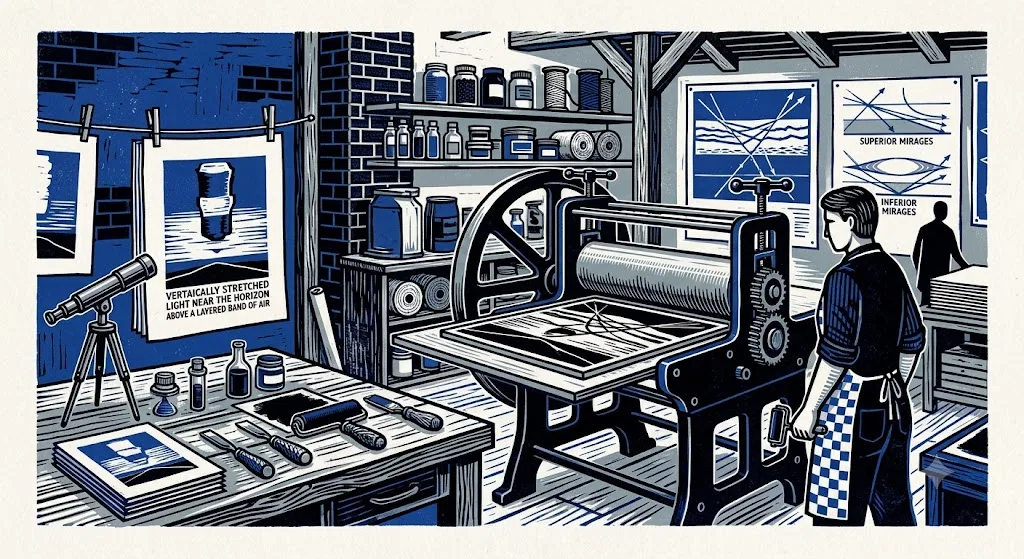
Atmospheric refraction can shift, stretch or multiply distant lights and objects when temperature layers bend incoming light.
On this page
- How atmospheric refraction bends light
- When distant objects become displaced or distorted
- Weather evidence needed to test a mirage explanation
Page outline Jump by section
Introduction
Yes. A mirage can make an ordinary distant object look sufficiently displaced, stretched, duplicated or detached from its surroundings to prompt a UFO or UAP report. The effect is most important close to the horizon, where light may travel for kilometres through layers of air with sharply different temperatures. Those layers alter the air’s refractive index and bend the light before it reaches the observer. Under the right geometry, a ship, aircraft, coastline, bright light or astronomical source can appear higher or lower than its true position, elongated into an unfamiliar shape, split into multiple images or seemingly suspended in empty sky.[NCAS Files]files.ncas.orgFiles Condon Report, Sec VI, Chapter 4: Optical MirageNCAS FilesCondon Report, Sec VI, Chapter 4: Optical Mirage…
That does not mean a temperature inversion automatically explains an unusual sighting. Strong refraction requires the right vertical temperature structure, source position, viewing height and shallow line of sight. A convincing mirage explanation therefore depends on reconstructing the atmosphere and geometry at the time, rather than merely noting that an inversion was present.[NCAS Files]files.ncas.orgFiles Condon Report, Sec VI, Chapter 4: Optical MirageNCAS FilesCondon Report, Sec VI, Chapter 4: Optical Mirage…
How atmospheric refraction bends light
Air does not have exactly the same optical density everywhere. Temperature, pressure and, to a lesser extent for visible light, humidity change with height, producing small changes in refractive index. A light ray travelling through such a gradient follows a slightly curved path rather than the perfectly straight line assumed by ordinary vision. The observer nevertheless interprets the arriving ray as though it had travelled straight, so the source is perceived in the wrong direction.[A Green Flash Page]aty.sdsu.eduA Green Flash Page Understanding atmospheric refraction: Basic PrinciplesA Green Flash Page Understanding atmospheric refraction: Basic Principles
Usually this effect is modest. A fairly smooth density gradient can shift an entire distant image without greatly deforming it. More conspicuous mirages occur when the temperature gradient itself changes sharply with height, causing rays from different parts of an object to bend by different amounts. That differential bending can vertically compress an image, stretch sections of it, turn sections upside down or place more than one image of the same source in view.[A Green Flash Page]aty.sdsu.eduA Green Flash Page Understanding atmospheric refraction: Basic PrinciplesA Green Flash Page Understanding atmospheric refraction: Basic Principles
For UFO identification, the most relevant arrangement is often the superior mirage. It develops when relatively cold, dense air lies beneath warmer air — a temperature inversion. Light can then curve downwards towards the denser layer, while the observer perceives the source as being higher than it really is. Such conditions commonly develop over cold water or ice and can make objects close to the horizon appear elevated.[The Guardian]theguardian.comThe GuardianWalker 'stunned' to see ship hovering high above sea off…March 5, 2021 — 5 Mar 2021 — The inversion in Cornwall was caused…
The familiar hot-road mirage is the opposite family of effect. Strong heating near the surface produces a steep temperature decrease with height and an inferior image below the true object. Although this explains the apparent pools of water seen over roads, superior mirages are generally more relevant when an observer reports an apparently airborne object that could actually originate near the surface or horizon. The Condon UFO study similarly distinguished superior mirages associated with inversions from inferior mirages associated with very steep temperature lapse rates.[NCAS Files]files.ncas.orgFiles Condon Report, Sec VI, Chapter 4: Optical MirageNCAS FilesCondon Report, Sec VI, Chapter 4: Optical Mirage…
Crucially, an inversion alone is not enough. The Condon study’s technical treatment found that the illuminating rays also need to meet the strongly refracting layer at a very shallow, near-grazing angle. That greatly favours sources close to the observer’s apparent horizon or sources lying close to the refracting layer itself.[NCAS Files]files.ncas.orgFiles Condon Report, Sec VI, Chapter 4: Optical MirageNCAS FilesCondon Report, Sec VI, Chapter 4: Optical Mirage…
When distant objects become displaced or distorted
A mirage need not manufacture a wholly fictitious object. More often it presents a genuine source in a form that no longer resembles what the observer expects.
A simple refractive displacement can raise a distant target relative to the horizon. The effect known as looming extends the apparent range of vision by raising distant scenery or objects that would otherwise sit lower or partly below the normal horizon. If the refractive gradient varies rapidly with height, different portions of the same object can be shifted by different amounts.[A Green Flash Page]aty.sdsu.eduA Green Flash Page Understanding atmospheric refraction: Basic PrinciplesA Green Flash Page Understanding atmospheric refraction: Basic Principles
This is where apparently exotic shapes emerge. Atmospheric-optics analysis describes several characteristic transformations:
- Vertical stretching or “towering” can make a small distant feature look disproportionately tall.
- Compression or “stooping” can flatten parts of an object until its familiar proportions disappear.
- Inversion can turn one portion upside down.
- Multiple imaging can create alternating upright and inverted copies.
- Atmospheric ducting can produce discontinuous or stacked images under especially strong refractive conditions.[A Green Flash Page]aty.sdsu.eduA Green Flash Page Understanding atmospheric refraction: Basic PrinciplesA Green Flash Page Understanding atmospheric refraction: Basic Principles
A particularly elaborate superior mirage is commonly called a Fata Morgana. It can contain alternating compressed and enlarged zones and multiple images that change as the atmospheric layers evolve. The World Meteorological Organization attributes such strong mirage effects to pronounced refraction associated with temperature inversions and optical ducting.[International Cloud Atlas]cloudatlas.wmo.intInternational Cloud AtlasMirageIt is caused by strong refraction of sunlight through a large-scale temperature inversion with a sharp the…
The practical consequence is that a distant ship or aircraft may cease to look recognisably like one. A narrow section may be magnified while another is compressed out of sight; separated image fragments may resemble independent lights or structures. Because the exact ray paths change when the temperature profile changes, the apparent shape can also vary without corresponding movement by the source.
Why “floating ships” are a useful UFO analogue
Photographs of ships apparently hovering above the sea provide an unusually clear demonstration because the real source can often still be identified.
In March 2021, for example, a ship photographed off Cornwall appeared visually detached from the sea. Meteorological explanation centred on a temperature inversion: colder air lay close to the relatively cold sea while warmer air sat above it, bending light from the distant vessel towards the observer. The result was the appearance of a ship suspended above the horizon.[The Guardian]theguardian.comThe GuardianWalker 'stunned' to see ship hovering high above sea off…March 5, 2021 — 5 Mar 2021 — The inversion in Cornwall was caused…
Such examples matter to UFO analysis not because ships account for large numbers of sightings, but because they show how normal objects can acquire apparently impossible positions without actually leaving their ordinary environment. Replace a recognisable daytime hull with one or two lights at night, remove the visible horizon and deny the observer a reliable sense of distance, and identification becomes substantially harder.
A distant aircraft can be affected for the same optical reason if its light reaches the observer through an appropriate refractive layer. The Condon investigation explicitly considered the possibility that a very distant aircraft near an inversion could produce a displaced optical image in one radar-visual UFO case, although that particular reconstruction required several assumptions and was presented as one possible explanation rather than a demonstrated identification.[NCAS Files]files.ncas.orgFiles Condon Report, Sec III, Chapter 5: Optical & Radar AnalysisNCAS FilesCondon Report, Sec III, Chapter 5: Optical & Radar Analysis…
That distinction is important. Mirages are physically capable of producing extraordinary appearances, but an investigator should not use that capability as a catch-all explanation.
Why lights near the horizon can look especially strange
At night, there is often much less visual information available to expose the original source. A hull, fuselage, terrain feature or horizon line may disappear into darkness, leaving only a bright point or small luminous patch.
Refraction can then combine with other low-angle atmospheric effects. In one set of historical UFO cases analysed by the Condon project, investigators found that stars viewed through strong inversion layers could show pronounced scintillation, colour changes and image deformation. In a Lake Superior-area case, the report described red-green scintillation, an oval or stretched appearance and a coloured fringe that investigators considered compatible with irregular refraction in one or more inversion layers.[NCAS Files]files.ncas.orgFiles Condon Report, Sec III, Chapter 5: Optical & Radar AnalysisNCAS FilesCondon Report, Sec III, Chapter 5: Optical & Radar Analysis…
Another investigated case involved a bright low-altitude object described as larger than a normal star. The Condon analysis identified a bright star at the appropriate azimuth and argued that a sharp inversion could have enlarged or displaced its apparent image while observers also overestimated its elevation above the horizon.[NCAS Files]files.ncas.orgFiles Condon Report, Sec III, Chapter 5: Optical & Radar AnalysisNCAS FilesCondon Report, Sec III, Chapter 5: Optical & Radar Analysis…
These cases illustrate a recurrent identification problem. A point source contains almost no inherent information about its size or distance. If atmospheric refraction shifts it upwards, spreads it into a short bar or oval, produces colour fringes, or briefly splits it, the witness may perceive a structured aerial object rather than a distorted image of a remote source.
Apparent motion must also be treated cautiously. A changing refractive layer can alter an image while the physical source remains nearly fixed. Irregular atmospheric structure can therefore contribute to apparent fluttering, enlargement, fading or modest positional changes. It is much harder, however, for a simple optical mirage to reproduce an accurately measured object moving through a large angle of sky far from the refracting geometry near the horizon. That is one reason the reported elevation and actual angular track are decisive evidence.
A mirage should predict the sighting, not merely be possible
The weakest form of a mirage explanation is: “There was a temperature inversion, so the UFO was probably a mirage.” Atmospheric optics does not justify that shortcut.
The Condon study stressed that a large temperature gradient is necessary for some mirage configurations but is not sufficient. The light source, observer and refracting layer must also occupy the correct geometry. Its calculations emphasised grazing incidence: strong mirage formation is favoured when incoming light lies very close to horizontal.[NCAS Files]files.ncas.orgFiles Condon Report, Sec VI, Chapter 4: Optical MirageNCAS FilesCondon Report, Sec VI, Chapter 4: Optical Mirage…
Modern atmospheric-optics treatments make the same general point. The strongest refractive distortions tend to depend on the lower atmosphere and the observer’s relation to the refracting structure. A measurement showing an inversion thousands of metres above or far from the actual line of sight is not automatically evidence that it produced the observed image.[A Green Flash Page]aty.sdsu.eduA Green Flash Page Understanding atmospheric refraction: Basic PrinciplesA Green Flash Page Understanding atmospheric refraction: Basic Principles
A strong mirage hypothesis should therefore explain several things at once:
- A plausible source. There should be a ship, aircraft, bright astronomical object, ground light, coastline or other candidate in approximately the required direction.
- Appropriate angular geometry. The source should ordinarily lie near the relevant horizon or refracting layer.
- A suitable vertical temperature structure. Observations should indicate an inversion or sufficiently strong lapse-rate structure capable of generating the proposed refraction.
- The reported deformation. The hypothesis should account for elevation, stretching, duplication, inversion or other observed features rather than merely explaining that refraction was possible.
- Timing. The atmospheric structure and candidate source must coexist during the actual observation.
- Consistency between observers. Differences in observer position or altitude should make optical sense if several witnesses saw the phenomenon.
The more accurately these predictions match the report, the stronger the explanation becomes.
What weather evidence is needed to test a mirage explanation?
The key evidence is the vertical profile of the atmosphere along or near the actual sightline, not simply the surface weather.
A radiosonde — a balloon-borne instrument that measures temperature, pressure and humidity as it ascends — can reveal inversions and other vertical structures that surface observations cannot. Radiosondes can also provide winds when their motion is tracked.[National Weather Service]forecast.weather.govNational Weather Service NOAA's National Weather ServiceNational Weather ServiceNOAA's National Weather Service - Glossary…
For a historical or recent UFO report, useful material includes:
- radiosonde temperature and humidity profiles from the nearest stations;
- launch times bracketing the sighting;
- surface air and sea or ground temperatures;
- wind direction and speed at relevant heights;
- fog, haze or low-cloud observations that may mark stable layers;
- observer altitude and exact location;
- azimuth and elevation of the reported object;
- candidate aircraft, vessel or astronomical positions;
- photographs or video retaining a visible horizon or fixed landmarks.
Even then, caution is necessary. A radiosonde records conditions along one balloon trajectory at one time. A sharp inversion over cold coastal water, for example, may vary significantly across tens of kilometres or evolve between routine balloon launches. The absence of an inversion in a distant or poorly timed sounding therefore does not prove that no local refractive layer existed; equally, finding an inversion at the nearest weather station does not prove that it crossed the relevant line of sight.
This is why detailed geometry can be more discriminating than a generic weather label. Atmospheric-optics analysis shows that unusually strong mirages arise from particular gradients at particular heights relative to the observer. Reconstructing the likely ray path is much stronger evidence than simply finding the word “inversion” in a meteorological record.[NCAS Files]files.ncas.orgFiles Condon Report, Sec VI, Chapter 4: Optical MirageNCAS FilesCondon Report, Sec VI, Chapter 4: Optical Mirage…
Optical mirages and radar anomalies are related but not identical
UFO literature sometimes treats “temperature inversion” as though it produced the same phenomenon in the eye and on radar. That is too simple.
Optical mirages involve refraction of visible light. Radar can also be refracted by abnormal atmospheric gradients, but its behaviour depends strongly on both temperature and moisture because these affect radio refractivity. The National Weather Service calls non-standard radar propagation anomalous propagation, or AP. Strong downward refraction can make a radar beam strike the ground at unexpected distances and generate false or displaced echoes.[National Weather Service]forecast.weather.govNational Weather Service NOAA's National Weather ServiceNational Weather ServiceNOAA's National Weather Service - Glossary…
Historical UFO investigations sometimes found both kinds of effect in the same stable atmosphere. The Condon project analysed several radar-visual incidents in which strong inversions or super-refractive layers could plausibly distort low-angle optical targets while simultaneously producing anomalous radar returns. In the Rapid City–Bismarck reports of August 1953, for example, investigators attributed important elements to stars viewed through inversion layers alongside anomalous radar propagation and at least one meteor.[NCAS Files]files.ncas.orgFiles Condon Report, Sec III, Chapter 5: Optical & Radar AnalysisNCAS FilesCondon Report, Sec III, Chapter 5: Optical & Radar Analysis…
But simultaneous radar and visual anomalies do not automatically prove that one refracted physical object caused both. A radar echo may arise from abnormal propagation towards the ground while the visible “object” is a separately refracted star or distant light. Establishing correlation therefore requires matching time, bearing, elevation and range rather than treating “radar confirmation” as sufficient by itself.
Where the mirage explanation becomes weak
Atmospheric refraction is most persuasive when the reported phenomenon stays close to a horizon, has a plausible distant source and shows exactly the kinds of vertical displacement or deformation that refractive optics predicts.
It becomes much less persuasive when the geometry does not fit. A purported object repeatedly passing high overhead, traversing a large portion of the sky with measured angular motion, or being observed from widely separated locations in a way incompatible with one refracted source would require a different explanation unless a specific optical model could reproduce the observations.
Historical investigators recognised this limitation. In its discussion of the well-known Bentwaters–Lakenheath radar-visual case, for example, the Condon analysis judged a visual mirage explanation implausible in part because observations were made from both the ground and an aircraft and the airborne observer reportedly saw the object below the aircraft. Whatever one makes of the unresolved case as a whole, it demonstrates an important methodological rule: refraction should be rejected when the observed geometry contradicts the mechanism.[NCAS Files]files.ncas.orgFiles Condon Report, Sec III, Chapter 5: Optical & Radar AnalysisNCAS FilesCondon Report, Sec III, Chapter 5: Optical & Radar Analysis…
Nor does every distorted low-altitude image qualify as a true mirage in the strict optical sense. Ordinary atmospheric refraction can displace or squash an image without producing the ray-crossing and inverted images characteristic of a fully developed mirage. For practical UFO investigation, that distinction matters less than reconstructing exactly what the atmosphere could have done, but it prevents “mirage” from becoming an imprecise synonym for any strange appearance near the horizon.[A Green Flash Page]aty.sdsu.eduA Green Flash Page Understanding atmospheric refraction: Basic PrinciplesA Green Flash Page Understanding atmospheric refraction: Basic Principles
The key diagnostic lesson for UFO reports
Mirages are a credible IFO mechanism because they alter the information observers use to identify objects: position, shape, apparent altitude and sometimes the number of visible images. Under strong inversion conditions, a mundane source on or near the horizon can genuinely look detached from its surroundings or transformed into an unfamiliar aerial form. The observer is seeing real light from a real source; the misleading part is the path that light has taken through the atmosphere.
The strongest cases for atmospheric refraction therefore combine a suitable weather profile with a specific source and a geometrically plausible line of sight. Reports involving low elevations, distant lights, cold water or ice, unusually stable air, visible stretching or stacking, and rapid changes in shape deserve particular scrutiny.
Conversely, merely discovering that a temperature inversion existed is not an identification. The evidential standard should be whether refraction explains where the object appeared, how it looked, how it changed and what source supplied the light. Used that way, mirage analysis is not a convenient dismissal of UFO reports but a testable reconstruction of one of the atmosphere’s most deceptive ways of making ordinary distant objects appear airborne and extraordinary.
Amazon book picks
Further Reading
Books and field guides related to Can a Mirage Really Create a UFO?. Use these as the next step if you want deeper reading beyond the article.
Light and Color in the Outdoors
All of science springs from the observation of nature. In this classic book, the late Professor Minnaert accompanies the reader on a tour...
Color and Light in Nature
We live in a world of optical marvels - from the commonplace but beautiful rainbow, to the rare and eerie superior mirage. But how many o...

Rainbows, Halos, and Glories
First published 1980. Subjects: Halos (Meteorology), Meteorological optics, Rainbow, Rainbows.
eBay marketplace picks
Marketplace Samples
Live-tested eBay searches with available results related to this page.
Selected fromUFO poster oneBay.co.uk.

Current eBay listing
I Want To Believe UFO Poster Giclée Fine Art Heavyweight Print

Current eBay listing
VINTAGE UFO FLYING SAUCERS COMIC ADVERTISING A2 POSTER PRINT
Endnotes
1.
Source: files.ncas.org
Title: Files Condon Report, Sec VI, Chapter 4: Optical Mirage
Link:https://files.ncas.org/condon/text/s6chap04.htm
Source snippet
NCAS FilesCondon Report, Sec VI, Chapter 4: Optical Mirage...
2.
Source: files.ncas.org
Title: Files Condon Report, Sec III, Chapter 5: Optical & Radar Analysis
Link:https://files.ncas.org/condon/text/s3chap05.htm
Source snippet
NCAS FilesCondon Report, Sec III, Chapter 5: Optical & Radar Analysis...
3.
Source: forecast.weather.gov
Title: National Weather Service NOAA’s National Weather Service
Link:https://forecast.weather.gov/glossary.php?word=RA
Source snippet
National Weather ServiceNOAA's National Weather Service - Glossary...
4.
Source: forecast.weather.gov
Title: National Weather Service NOAA’s National Weather Service
Link:https://forecast.weather.gov/glossary.php?word=AP
Source snippet
National Weather ServiceNOAA's National Weather Service - Glossary...
5.
Source: weather.gov
Title: Met Tutorial
Link:https://www.weather.gov/media/zhu/ZHU_Training_Page/Met_Tutorials/Met_Tutorial.pdf
Source snippet
Aerographer's Mate 1 & C7 Sept 1995 — THE COURSE: This self-study course is organized into subject matter areas, each containing learning...
6.
Source: weather.gov
Link:https://www.weather.gov/arx/why_halos_sundogs_pillars
7.
Source: weather.gov
Link:https://www.weather.gov/media/sgx/documents/The_Weather_Guide.pdf
8.
Source: weather.gov
Link:https://www.weather.gov/iwx/wsr_88d
9.
Source: weather.gov
Link:https://www.weather.gov/source/zhu/ZHU_Training_Page/convective_parameters/skewt/skewtinfo.html
10.
Source: weather.gov
Title: NOA A’s National Weather Service
Link:https://www.weather.gov/glossary/glossary.php?word=s
11.
Source: forecast.weather.gov
Link:https://forecast.weather.gov/glossary.php?word=A
12.
Source: weather.gov
Title: TA 1201
Link:https://www.weather.gov/media/crh/publications/TA/TA_1201.pdf
13.
Source: weather.gov
Title: Full Weather Glossary INVERSION
Link:https://www.weather.gov/otx/full_weather_glossary
14.
Source: forecast.weather.gov
Link:https://forecast.weather.gov/glossary.php?word=D
15.
Source: forecast.weather.gov
Link:https://forecast.weather.gov/glossary.php?word=b
16.
Source: weather.gov
Link:https://www.weather.gov/tsa/weather_glossary
17.
Source: youtube.com
Title: Fata Morgana (Mirage)
Link:https://www.youtube.com/watch?v=yyLc7e4eEew
18.
Source: youtube.com
Link:https://www.youtube.com/watch?v=k46sNJFAzzg
Source snippet
Why is this SHIP FLOATING In The Air...
19.
Source: aty.sdsu.edu
Title: A Green Flash Page Understanding atmospheric refraction: Basic Principles
Link:https://aty.sdsu.edu/explain/principles.html
20.
Source: theguardian.com
Link:https://www.theguardian.com/science/2021/mar/05/ship-hovering-above-sea-cornwall-optical-illusion
Source snippet
The GuardianWalker 'stunned' to see ship hovering high above sea off...March 5, 2021 — 5 Mar 2021 — The inversion in Cornwall was caused...
Published: March 5, 2021
21.
Source: cloudatlas.wmo.int
Link:https://cloudatlas.wmo.int/mirage.html
Source snippet
International Cloud AtlasMirageIt is caused by strong refraction of sunlight through a large-scale temperature inversion with a sharp the...
22.
Source: hyperphysics.phy-astr.gsu.edu
Link:https://hyperphysics.phy-astr.gsu.edu/hbase/atmos/mirage.html
23.
Source: digital.nmla.metoffice.gov.uk
Link:https://digital.nmla.metoffice.gov.uk/download/file/IO_31ea0d19-1cd8-4476-abcd-0c53e045f2a6
24.
Source: dictionary.cambridge.org
Link:https://dictionary.cambridge.org/dictionary/english/atmospheric
25.
Source: dictionary.cambridge.org
Link:https://dictionary.cambridge.org/us/dictionary/english/atmospheric
26.
Source: jstor.org
Link:https://www.jstor.org/stable/1725090
27.
Source: Wikipedia
Link:https://en.wikipedia.org/wiki/Mirage
28.
Source: Wikipedia
Link:https://en.wikipedia.org/wiki/Atmosphere
29.
Source: Wikipedia
Title: Atmospheric refraction
Link:https://en.wikipedia.org/wiki/Atmospheric_refraction
30.
Source: ebsco.com
Link:https://www.ebsco.com/research-starters/science/mirage
31.
Source: mitsubishi-motors.com.ph
Link:https://www.mitsubishi-motors.com.ph/cars/mirage
Additional References
32.
Source: youtube.com
Title: View of “Marfa Mystery Lights” www.darack.com/refraction
Link:https://www.youtube.com/watch?v=3KzO5W-ys2I
Source snippet
What is Superior Mirage? Why the Ship looks Floating?...
33.
Source: researchgate.net
Link:https://www.researchgate.net/publication/307531122_ESTIMATION_OF_THE_ATMOSPHERIC_REFRACTION_EFFECT_IN_AIRBORNE_IMAGES_USING_RADIOSONDE_DATA
34.
Source: reddit.com
Link:https://www.reddit.com/r/opticalillusions/comments/lyfcol/a_superior_mirage_photographed_off_the_coast_of/
35.
Source: facebook.com
Link:https://www.facebook.com/mattykjordan/posts/a-fata-morgana-mirage-is-an-optical-illusion-caused-by-the-bending-of-light-rays/10159801582411659/
36.
Source: facebook.com
Link:https://www.facebook.com/groups/511792402341480/posts/3101599730027388/
37.
Source: facebook.com
Link:https://www.facebook.com/cornwalllivenews/posts/a-baffling-sight-off-st-ives-as-a-ship-appears-to-float-above-the-horizonthe-dra/1423568099796506/
38.
Source: facebook.com
Link:https://www.facebook.com/cornwalllivenews/posts/a-mysterious-mirage-caused-giant-figures-to-appear-above-the-sea-off-the-cornish/1402603508559632/
39.
Source: merriam-webster.com
Link:https://www.merriam-webster.com/dictionary/atmospheric
40.
Source: atoptics.co.uk
Link:https://atoptics.co.uk/blog/page/4/
41.
Source: atoptics.co.uk
Link:https://atoptics.co.uk/blog/page/50/