Within Autokinesis
How Do You Verify That a UFO Light Moved?
A moving-light report becomes more reliable when investigators compare it with fixed landmarks, multiple observers, imagery or independent tracking data.
On this page
- Establishing fixed angular reference points
- Separating witness impression from independent measurement
- Cross checking multiple observers, images and instruments
Page outline Jump by section
Introduction
A report that a UFO or UAP light “moved” is not, by itself, proof that the light changed position. At night, an isolated point of light can appear to wander because of autokinesis, while camera shake, zoom, a moving observer and motion parallax can create additional apparent movement. Investigators therefore try to convert the witness’s impression — “it drifted left, then shot away” — into a testable question: did the light change its angular position relative to something independently measurable? The Federal Aviation Administration explicitly recognises autokinesis as an illusion in which a static light appears to move in darkness.[Federal Aviation Administration]faa.govFederal Aviation Administration Chapter 8. Medical Facts for PilotsFederal Aviation Administration Chapter 8. Medical Facts for Pilots
The strongest tests introduce references that perception alone lacks: a horizon or landmark, measured azimuth and elevation, independently recorded imagery, observers at different locations, or radar and other tracking data. This distinction matters because a sincere and vivid impression of motion can survive even when later measurements show that the source was stationary, slow-moving or moving quite differently from the way it appeared.
First ask: what moved relative to what?
The most useful question is not simply “Did it move?” but “What fixed reference did it move against?” Autokinesis is most troublesome precisely when that answer is “none”: a bright point against an otherwise dark field. Aviation guidance makes the same underlying distinction. The FAA advises that spatial-disorientation illusions are countered by reference to reliable fixed points or flight instruments rather than by trusting the unsupported visual impression.[FAASafety]faasafety.govResources - Learning Center Library Contents - FAA - FAASTeam - FAASafety.gov…
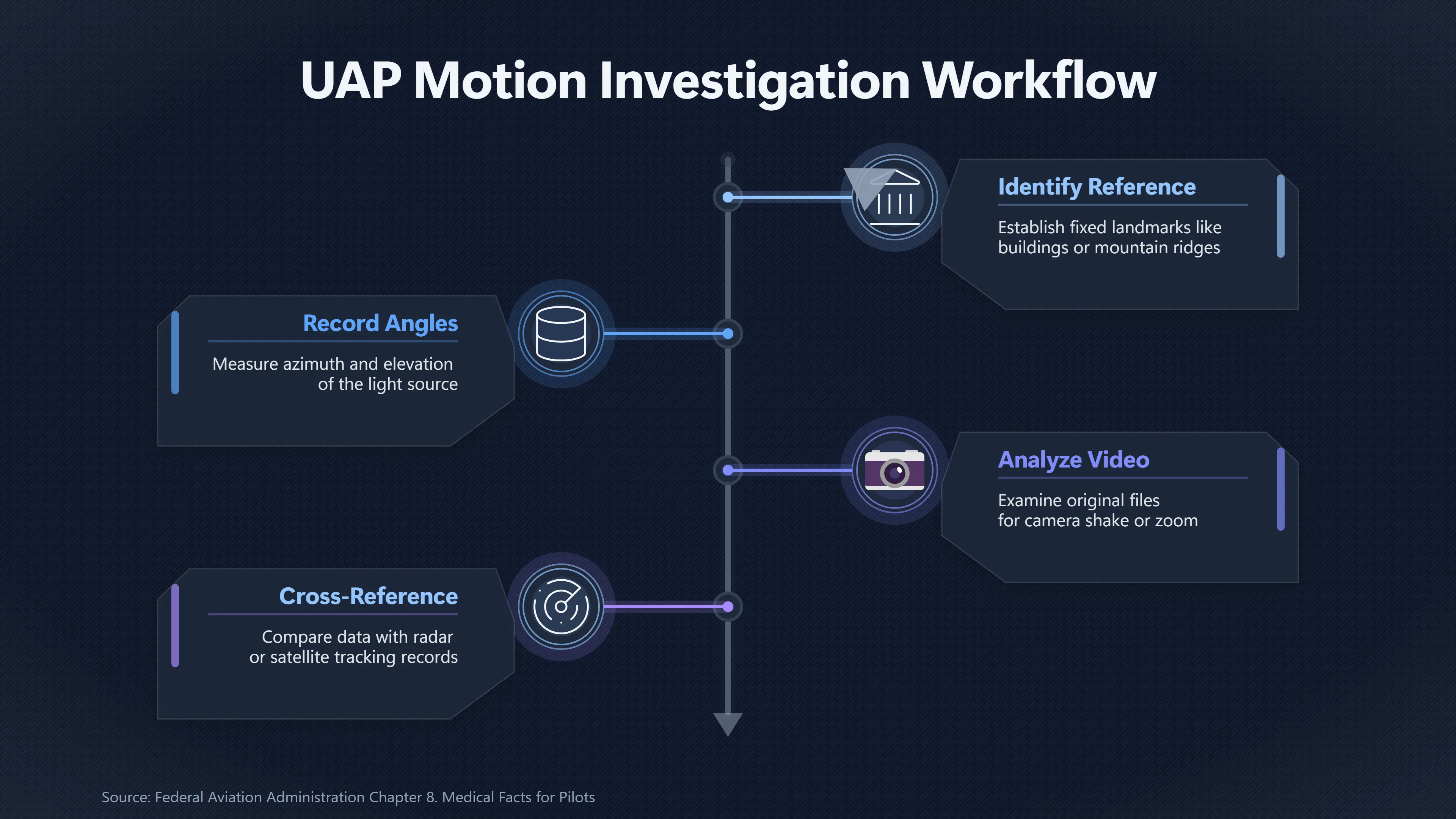
For a ground investigation, a building edge, mountain ridge, tree, mast, horizon, Moon or recognisable star field can provide an angular reference. If a witness says that a light moved from directly above one chimney to above another, for example, investigators can return to the observation site, establish the viewing position and measure the two directions. The claim has then become geometrical rather than purely descriptive.
Two measurements are particularly useful:
- Azimuth is the horizontal direction around the observer, conventionally measured in degrees from north.
- Elevation is the angle above the horizon.
Recording both at different times gives investigators an angular track. Even when the object’s distance is unknown, this can establish whether its line of sight actually changed. What it cannot automatically provide is the object’s true speed. A small angular displacement could represent a nearby slow object or a much more distant fast one; range must be established separately before converting angles into metres and velocities.
France’s official GEIPAN UAP investigation programme illustrates the value of this approach. Its published case records routinely compare witness directions and elevations with calculated positions of astronomical objects. In a September 2024 case at Saint-Urcize, for instance, investigators calculated Arcturus at about 287° azimuth and 9° elevation and compared that position with the witness’s estimated direction. GEIPAN noted both the difficulty of estimating direction in darkness and the witness’s impression that the light moved, ultimately identifying the source as Arcturus.[Geipan]geipan.frSAINT-URCIZE (15) 20.09.2024 | GEIPANSeptember 20, 2024…
This also shows why investigators should record the witness’s original references before supplying possible explanations. “Low above that hill” can sometimes be more useful than a retrospectively estimated angle, because the hill can be surveyed later. The aim is not to replace testimony but to attach the testimony to a coordinate system.
A fixed camera can turn apparent wandering into a measurement
Video seems at first to settle the question: if the light moves across the screen, surely it moved. Unfortunately, motion within a video frame is not the same thing as motion through the sky. The camera itself may pan, shake or rotate; digital or optical zoom magnifies small hand movements; stabilisation can transform the apparent relationship between target and background.
GEIPAN has documented exactly this problem. In its Saint-Urcize investigation, the witness’s highly zoomed smartphone footage seemed to show movement, but the agency noted that minute movements of the hand become conspicuous at high magnification. Crucially, the videos contained no landscape reference against which the supposed displacement could be checked. GEIPAN reached a similar conclusion in another 2024 case involving Capella: the lack of a visible reference point made hand-induced motion difficult to distinguish from target motion.[Geipan]geipan.frSAINT-URCIZE (15) 20.09.2024 | GEIPANSeptember 20, 2024…
A stronger recording therefore keeps the camera fixed, or at least preserves enough stationary background to reconstruct its pointing. A wide shot can sometimes be more valuable for motion analysis than a dramatic close-up. A tiny light occupying only a few pixels may reveal little about shape, but if the frame also contains a roofline, stars or terrain, investigators can ask whether its angular relationship to those features changes consistently from frame to frame.
Original files matter as well. Metadata can help establish when an image was made and, depending on the equipment, other information about the recording. In a 2025 GEIPAN investigation in Guadeloupe, analysis of the original smartphone video’s metadata helped confirm the recording time; investigators then compared the reported trajectory and angular positions with astronomical and space-tracking information and identified the moving source as the International Space Station.[Geipan]geipan.frSAINT-FRANCOIS (971) 06.09.2025 | GEIPANSeptember 6, 2025…
Timing errors can materially change such reconstructions. In an earlier GEIPAN investigation at Loyettes, investigators determined that a witness’s phone clock was 13 minutes slow by using an aircraft appearing in a photograph as an independent timing reference. They then compared the sky photograph with astronomical positions and identified the principal light as Jupiter; an apparent sudden L-shaped movement was attributed to movement of the phone during photography.[Geipan]geipan.frLOYETTES (01) 18.06.2019 | GEIPANJune 18, 2019…
The practical lesson is counter-intuitive: investigators generally want the least processed original recording, with its original timing and context, rather than only a cropped, stabilised or enlarged copy that makes the light easier to see.
Multiple witnesses help only when their observations are independent
Several people saying “we saw it move” is stronger evidence that an event was noticed, but it does not automatically establish the light’s physical trajectory. Witnesses standing together share almost the same line of sight and can influence one another’s descriptions. GEIPAN explicitly takes such dependence into account: in a 2014 unresolved case involving two witnesses, it noted that they immediately discussed what they were seeing, reducing their independence as separate observations.[Geipan]geipan.frETRELLES (35) 01.06.2014 | GEIPANJune 1, 2014…
The more powerful situation is spatially separated observation. Suppose two observers several kilometres apart record the same light at the same time and each can determine its direction against known references. Their sightlines can then potentially constrain the target’s position by triangulation. Repeating the calculation over time can yield a physical trajectory rather than merely an angular track.
That distinction is fundamental. One observer can often measure direction; two suitably separated and accurately synchronised observing stations may also constrain distance. Once position and distance are known at successive times, estimates of speed and acceleration become far more meaningful.
But triangulation has demanding requirements. Investigators need accurate observer locations, synchronised times, correctly calibrated camera orientations or reliable angular measurements, and confidence that both observations show the same target. Small angular errors become increasingly serious for distant objects because the sightlines become nearly parallel.
This is why modern scientific proposals for studying UAP emphasise calibrated, multi-sensor observations rather than simply collecting larger numbers of eyewitness accounts. NASA’s UAP independent study concluded that rigorous work requires systematic calibration, multiple measurements and adequate sensor metadata, and specifically stressed the importance of detecting phenomena with multiple well-calibrated sensors.[NASA]nasa.govUPDATE: NASA Shares UAP Independent Study Report; Names DirectorUPDATE: NASA Shares UAP Independent Study Report; Names Director - NASASeptember 14, 2023…
The observer’s own motion must be reconstructed
A particularly important trap appears when the witness or camera is moving. Looking from an aircraft, car or boat can make a distant object appear to sweep rapidly across the background even when its own speed is modest. This is motion parallax: apparent angular motion produced partly or largely by the changing position of the observer.
Investigators therefore reconstruct both sides of the geometry:
- where the observer or sensor was;
- which direction it was looking;
- how that viewing direction changed;
- where the candidate object could have been; and
- what combinations of range and motion reproduce the observation.
The Pentagon’s All-domain Anomaly Resolution Office (AARO) has applied this principle to several prominent UAP videos. Its analysis of the 2015 “GoFast” footage concluded with high confidence that the object did not display anomalous or exceptional behaviour. AARO modelled the aircraft’s motion and viewing geometry and found that parallax could amplify the impression of high speed. The agency also cautioned that incomplete data prevented a unique solution for the object’s exact position, speed and heading — an important distinction between disproving an extraordinary speed claim and identifying every parameter of the object’s motion.[AARO]aaro.milGo Fast Case Resolution Card Methodology FinalGo Fast Case Resolution Card Methodology Final
The 2013 Puerto Rico infrared case provides an even clearer example. The footage appeared to show a fast object, apparently splitting and even entering the sea. AARO reported that reconstruction using the aircraft’s position and sensor parameters — including azimuth, elevation and viewing geometry — instead indicated two nearby objects moving in a straight line at roughly wind speed. The apparent high velocity was attributed to motion parallax.[AARO]aaro.milPuerto Rico UAP Case ResolutionPuerto Rico UAP Case Resolution
These examples concern instrument imagery rather than autokinesis itself, but they expose the same investigative principle: movement on the retina or screen is not yet movement of the target in physical space.
Independent tracking can break the ambiguity
The best moving-light investigations do not rely exclusively on the same visual record that produced the mystery. Investigators look for independent systems that can confirm or contradict the proposed track.
Aircraft are especially testable because commercial tracking records can sometimes provide time, position, altitude and heading. AARO’s investigation of lights reported over the western United States combined full-motion imagery with commercial flight information. Radar tracks of three distant commercial aircraft aligned with the observed lights, leading AARO to assess that the supposed UAP were those aircraft seen as small points because of their distance.[AARO]aaro.milUAP ImageryUAP Imagery
Satellite cases can be approached similarly. A 2024 study examined an August 2022 event reported by five pilots aboard two commercial flights over the Pacific. The researchers combined the witnesses’ photographs and video with aircraft Automatic Dependent Surveillance–Broadcast (ADS-B) tracking data and orbital information for recently launched Starlink satellites. Reconstructing the observers’ positions and the satellites’ expected appearance supported the satellite interpretation.[arXiv]arxiv.orgOpen source on arxiv.org.
Weather information can provide another independent constraint. If a supposed object’s reconstructed trajectory matches wind direction and speed, a balloon or lantern hypothesis becomes testable rather than merely speculative. AARO’s Mt Etna analysis, for example, assessed that an object which appeared to perform unusually near the volcanic plume was probably a balloon roughly 170 kilometres from the caldera travelling with the wind; atmospheric optical effects affected how its relationship to the plume appeared in the imagery.[AARO]aaro.milOpen source on aaro.mil.
No single auxiliary source is automatically decisive. Aircraft databases can be incomplete, orbital predictions depend on accurate times and positions, weather varies with altitude, and radar has detection limits. Their value lies in independence: they provide positional or physical constraints not derived solely from the witness’s perception of the light.
What makes a motion claim stronger?
A useful investigation effectively moves a report up a ladder from impression to measurement.
Weakest: “The light seemed to drift around.”
With no horizon, landmark, image or independent observation, this remains highly vulnerable to autokinesis.
Better: “It moved from above this tree to beside that mast.”
Fixed references allow the claimed angular displacement to be reconstructed.
Better still: “A fixed recording shows the light changing position against the landscape or stars.”
The motion can now be measured frame by frame, provided camera movement and image processing are accounted for.
Stronger: “Separated observers recorded compatible angular tracks at synchronised times.”
Independent sightlines may constrain range and three-dimensional motion.
Strongest: “The visual track is corroborated by independent positional data.”
Radar, aircraft telemetry, satellite ephemerides or another calibrated sensor can establish whether a physical object occupied the corresponding place and how it moved.
NASA’s UAP study highlighted why this hierarchy matters. It found that existing UAP analysis is often hindered by poor calibration, missing metadata and insufficient multiple measurements. Calibration and metadata are not technical niceties: without knowing when, where and how a sensor was observing, investigators can easily mistake properties of the observing system for properties of the object.[NASA Science]smd-cms.nasa.govScience NASAUNIDENTIFIED ANOMALOUS PHENOMENA Independent…
When the right conclusion is “motion not established”
An investigation does not have to identify the light in order to test the movement claim. These are separate questions. A source can remain unidentified while evidence for its alleged extraordinary movement disappears.
AARO makes this distinction in some of its public material: an object may remain unidentified even when analysis finds no anomalous behaviour. Conversely, apparently spectacular motion may become ordinary once observer movement, range or sensor behaviour is reconstructed.[AARO]aaro.milOpen source on aaro.mil.
That distinction is particularly important where autokinesis is plausible. If a lone witness watched a point-like light against a dark, featureless sky and reported wandering but supplied no fixed reference, an investigator cannot reliably reconstruct the claimed path afterwards. The responsible conclusion is not necessarily “the light was stationary”. It is narrower: the available evidence does not independently establish that it moved as perceived.
Likewise, a shaky smartphone clip with no background may confirm that a luminous source was recorded without establishing its trajectory. A group of witnesses standing together may confirm that several people perceived the event without providing independent geometry. Even sophisticated infrared footage may remain ambiguous if the sensor’s position, pointing, zoom or range information is missing.
This is why the most useful investigative response to a strange moving light is not to debate how convincing the movement looked. It is to recover the geometry: exact time, observer position, azimuth and elevation, fixed landmarks, original imagery, camera behaviour and independent tracks. Autokinesis makes unsupported night-time motion impressions uncertain; independent positional evidence is what turns a perceived movement into a demonstrable one.
Amazon book picks
Further Reading
Books and field guides related to How Do You Verify That a UFO Light Moved?. Use these as the next step if you want deeper reading beyond the article.
The UFO Handbook
An explanation of the usual reasons for confusing IFOs (identified flying objects) with UFOs and a survey of the tools used to investigat...
UFOs: Generals, Pilots, and Government Officials Go on the Re...
NEW YORK TIMES BESTSELLER • Impeccably researched, this riveting journalistic investigation separates fact from fiction, and documents th...
Sensation and Perception
. Bruce Goldstein's SENSATION AND PERCEPTION, the best-seller which has helped over 150,000 students understand the ties between how we s...
Visual Perception: Physiology, Psychology, and Ecology
This edition contains over 460 additional references and the treatment of visual psychology in the early chapters has been extensively re...
eBay marketplace picks
Marketplace Samples
Live-tested eBay searches with available results related to this page.
Selected fromUFO poster oneBay.co.uk.



Current eBay listing
VINTAGE UFO FLYING SAUCERS COMIC ADVERTISING A2 POSTER PRINT

Current eBay listing
I Want To Believe UFO Poster Giclée Fine Art Heavyweight Print
Endnotes
1.
Source: faa.gov
Title: Federal Aviation Administration Chapter 8. Medical Facts for Pilots
Link:https://www.faa.gov/Air_traffic/publications/atpubs/aim_html/chap8_section_1.html
2.
Source: faasafety.gov
Link:https://www.faasafety.gov/gslac/ALC/libview_chapter.aspx?chapter=Illusions+-+Have+I+Considered+Them%3F&id=6580
Source snippet
Resources - Learning Center Library Contents - FAA - FAASTeam - FAASafety.gov...
3.
Source: geipan.fr
Link:https://geipan.fr/fr/cas/2024-09-51582
Source snippet
SAINT-URCIZE (15) 20.09.2024 | GEIPANSeptember 20, 2024...
Published: September 20, 2024
4.
Source: geipan.fr
Link:https://www.geipan.fr/fr/cas/2024-09-51581
Source snippet
BANNE (07) 23.09.2024 | GEIPAN...
5.
Source: geipan.fr
Link:https://www.geipan.fr/fr/cas/2025-09-51693
Source snippet
SAINT-FRANCOIS (971) 06.09.2025 | GEIPANSeptember 6, 2025...
Published: September 6, 2025
6.
Source: geipan.fr
Link:https://geipan.fr/fr/cas/2019-06-50769
Source snippet
LOYETTES (01) 18.06.2019 | GEIPANJune 18, 2019...
Published: June 18, 2019
7.
Source: geipan.fr
Link:https://www.geipan.fr/fr/cas/2014-06-50078
Source snippet
ETRELLES (35) 01.06.2014 | GEIPANJune 1, 2014...
Published: June 1, 2014
8.
Source: nasa.gov
Title: UPDATE: NASA Shares UAP Independent Study Report; Names Director
Link:https://www.nasa.gov/news-release/update-nasa-shares-uap-independent-study-report-names-director/
Source snippet
UPDATE: NASA Shares UAP Independent Study Report; Names Director - NASASeptember 14, 2023...
Published: September 14, 2023
9.
Source: smd-cms.nasa.gov
Title: Science NASA
Link:https://smd-cms.nasa.gov/wp-content/uploads/2023/09/uap-independent-study-team-final-report.pdf
Source snippet
UNIDENTIFIED ANOMALOUS PHENOMENA Independent...
10.
Source: aaro.mil
Title: [Go Fast]({{ ‘go-fast/’ | relative_url }}) Case Resolution Card Methodology Final
Link:https://www.aaro.mil/Portals/136/PDFs/case_resolution_reports/AARO_GoFast_Case_Resolution_Card_Methodology_Final.pdf?ver=qXvjrruO_0MgtnTsfYnCEQ%3D%3D
11.
Source: aaro.mil
Title: Puerto Rico UAP Case Resolution
Link:https://www.aaro.mil/Portals/136/PDFs/case_resolution_reports/AARO_Puerto_Rico_UAP_Case_Resolution.pdf
12.
Source: aaro.mil
Link:https://www.aaro.mil/Portals/136/PDFs/SASC_AARO_Open_Hearing_Case_Slides_19Nov2024.pdf?ver=Hec1SwKwP-4zSRJwIEIlJw%3D%3D
13.
Source: aaro.mil
Title: UAP Imagery
Link:https://www.aaro.mil/UAP-Cases/Official-UAP-Imagery/4/
14.
Source: aaro.mil
Link:https://www.aaro.mil/Next-AARO-Home-redesign/Next-Parent/Next-AARO-UAP-Imagery-Acc-Table/
15.
Source: arxiv.org
Link:https://arxiv.org/abs/2403.08155
16.
Source: aaro.mil
Link:https://www.aaro.mil/Next-AARO-Home-redesign/Next-Parent/Next-AARO-UAP-Imagery-Fixed-Table/
17.
Source: earth.gsfc.nasa.gov
Title: biosphere instrument calibration
Link:https://earth.gsfc.nasa.gov/bio/research/biosphere-instrument-calibration
18.
Source: science.nasa.gov
Title: satellite data evaluation
Link:https://science.nasa.gov/earth-science/csda/satellite-data-evaluation/
19.
Source: science.nasa.gov
Title: a full moon checkup
Link:https://science.nasa.gov/earth/earth-observatory/a-full-moon-checkup/
20.
Source: science.nasa.gov
Title: data overview
Link:https://science.nasa.gov/mission/landsat/data-overview/
21.
Source: science.nasa.gov
Title: clarreo pathfinder
Link:https://science.nasa.gov/mission/clarreo-pathfinder/
22.
Source: science.nasa.gov
Title: science overview
Link:https://science.nasa.gov/mission/clarreo-pathfinder/science-overview/
23.
Source: aaro.mil
Link:https://www.aaro.mil/Next-AARO-Home-redesign/Next-Parent/Next-UAP-Report-Documents/poster/dividLink/
24.
Source: science.nasa.gov
Title: calibration overview
Link:https://science.nasa.gov/mission/clarreo-pathfinder/calibration-overview/
25.
Source: science.nasa.gov
Title: roman for scientists
Link:https://science.nasa.gov/mission/roman-space-telescope/roman-for-scientists/
26.
Source: science.nasa.gov
Title: csda quality assessment report evaluates satellogic newsat data
Link:https://science.nasa.gov/uncategorized/csda-quality-assessment-report-evaluates-satellogic-newsat-data/
27.
Source: science.nasa.gov
Link:https://science.nasa.gov/uap/
28.
Source: aaro.mil
Title: AAR O UAP Records
Link:https://www.aaro.mil/UAP-Records/fbclid/IwZXh0bgNhZW0CMTEAAR0F9nbI4TTQyu8d96BuOtBb1uVQuvapZEvLug7mWxQC4ZqlNDrM5_ejMt4_aem_q0czZMebJdVWJ-6XDLdWAA/
29.
Source: science.nasa.gov
Title: tsis 1
Link:https://science.nasa.gov/mission/tsis-1/
30.
Source: aaro.mil
Link:https://www.aaro.mil/Next-AARO-Home-redesign/Next-Parent/Presidential-UAP-Transparency-Initiative/dvpmoduleid/77396/
31.
Source: aaro.mil
Link:https://www.aaro.mil/Next-AARO-Home-redesign/Next-Parent/Presidential-UAP-Transparency-Initiative/
32.
Source: science.nasa.gov
Link:https://science.nasa.gov/mission/clarreo-pathfinder/publications/
33.
Source: geipan.fr
Link:https://www.geipan.fr/fr/cas/2025-10-51704
34.
Source: science.nasa.gov
Title: calibration and validation
Link:https://science.nasa.gov/mission/nisar/calibration-and-validation/
35.
Source: aaro.mil
Link:https://www.aaro.mil/Next-AARO-Home-redesign/Next-Parent/Presidential-UAP-Transparency-Initiative/videoid/1010269/dvpcc/false/
36.
Source: geipan.fr
Link:https://www.geipan.fr/fr/cas/2025-05-51649
37.
Source: geipan.fr
Link:https://www.geipan.fr/fr/cas/2025-01-51722
38.
Source: aaro.mil
Link:https://www.aaro.mil/Next-AARO-Home-redesign/Next-Parent/Presidential-UAP-Transparency-Initiative/videoid/1006159/dvpmoduleid/77396/
39.
Source: aaro.mil
Link:https://www.aaro.mil/Next-AARO-Home-redesign/Next-Parent/Presidential-UAP-Transparency-Initiative/videoid/1006159/dvpcc/false/
40.
Source: aaro.mil
Link:https://www.aaro.mil/Next-AARO-Home-redesign/Next-Parent/Presidential-UAP-Transparency-Initiative/videoid/1006078/dvpcc/false/
42.
Source: geipan.fr
Link:https://www.geipan.fr/fr/cas/2024-08-51565?field_date_value=2004-04-23&field_is_new_value=1&order=title&page=23&sort=desc
43.
Source: geipan.fr
Link:https://www.geipan.fr/fr/cas/2024-08-51553
44.
Source: geipan.fr
Link:https://www.geipan.fr/fr/temoignage/10367
45.
Source: aaro.mil
Link:https://www.aaro.mil/Next-AARO-Home-redesign/Next-Parent/Presidential-UAP-Transparency-Initiative/videoid/1006110/dvpmoduleid/77396/
46.
Source: aaro.mil
Link:https://www.aaro.mil/Next-AARO-Home-redesign/Next-Parent/Presidential-UAP-Transparency-Initiative/videoid/1006110/dvpcc/false/
47.
Source: aaro.mil
Link:https://www.aaro.mil/Next-AARO-Home-redesign/Next-Parent/Presidential-UAP-Transparency-Initiative/videoid/1014099/dvpcc/false/
48.
Source: aaro.mil
Link:https://www.aaro.mil/Next-AARO-Home-redesign/Next-Parent/Presidential-UAP-Transparency-Initiative/videoid/1014097/dvpcc/false/
49.
Source: geipan.fr
Link:https://www.geipan.fr/fr/cas/2023-12-51505
50.
Source: ntrs.nasa.gov
Link:https://ntrs.nasa.gov/citations/20230015735
51.
Source: geipan.fr
Link:https://www.geipan.fr/fr/cas/2023-10-51523
52.
Source: aaro.mil
Link:https://www.aaro.mil/Next-AARO-Home-redesign/Next-Parent/Presidential-UAP-Transparency-Initiative/videoid/1006067/dvpmoduleid/77396/
53.
Source: nasa.gov
Title: NAS A to Release, Discuss Unidentified Anomalous Phenomena Report
Link:https://www.nasa.gov/news-release/nasa-to-release-discuss-unidentified-anomalous-phenomena-report/
54.
Source: geipan.fr
Link:https://www.geipan.fr/en/node/60583?field_date_value=2020-11-18&field_is_new_value=1&page=4
55.
Source: geipan.fr
Link:https://geipan.fr/fr/cas/2023-07-51458
56.
Source: geipan.fr
Link:https://www.geipan.fr/fr/node/60801
57.
Source: geipan.fr
Link:https://www.geipan.fr/fr/cas/2023-05-51443?field_agregation_index_value=&field_date_d_observation_value%5Bmax%5D=&field_date_d_observation_value%5Bmin%5D=&field_date_value=2023-08-04&field_departement_target_id=&field_document_existe_ou_pas_value=All&field_is_new_value=1&field_is_revisited_value=All&field_latitude_value%5Bmax%5D=&field_latitude_value%5Bmin%5D=&field_longitude_value%5Bmax%5D=&field_longitude_value%5Bmin%5D=&field_phenomene_target_id=&field_type_de_cas_target_id=All&order=field_date_d_observation&page=%2C9&sort=asc
58.
Source: nasa.gov
Title: NAS A Provides Coverage of Unidentified Anomalous Phenomena Meeting
Link:https://www.nasa.gov/news-release/nasa-provides-coverage-of-unidentified-anomalous-phenomena-meeting/
59.
Source: aaro.mil
Link:https://www.aaro.mil/Next-AARO-Home-redesign/Next-Parent/Presidential-UAP-Transparency-Initiative/videoid/988673/dvpcc/false/
60.
Source: aaro.mil
Link:https://www.aaro.mil/Next-AARO-Home-redesign/Next-Parent/Presidential-UAP-Transparency-Initiative/videoid/1010276/dvpcc/false/
61.
Source: aaro.mil
Link:https://www.aaro.mil/Next-AARO-Home-redesign/Next-Parent/Presidential-UAP-Transparency-Initiative/videoid/1010272/dvpcc/false/
62.
Source: nasa.gov
Title: NAS A Announces Unidentified Aerial Phenomena Study Team Members
Link:https://www.nasa.gov/general/nasa-announces-unidentified-aerial-phenomena-study-team-members/
63.
Source: geipan.fr
Link:https://www.geipan.fr/fr/node/61265
64.
Source: geipan.fr
Link:https://www.geipan.fr/en/node/61265?field_classification_des_cas_target_id%5B0%5D=14
65.
Source: geipan.fr
Link:https://www.geipan.fr/fr/cas/2022-09-51495
66.
Source: geipan.fr
Link:https://www.geipan.fr/en/node/61362
67.
Source: aaro.mil
Link:https://www.aaro.mil/Next-AARO-Home-redesign/Next-Parent/Presidential-UAP-Transparency-Initiative/videoid/1006056/dvpcc/false/
68.
Source: geipan.fr
Link:https://geipan.fr/fr/cas/2022-03-51314
69.
Source: geipan.fr
Link:https://www.geipan.fr/fr/cas/2021-11-51286?field_classification_des_cas_target_id%5B0%5D=11&page=%2C17
70.
Source: geipan.fr
Link:https://www.geipan.fr/fr/cas/2021-10-51269?field_date_value=2004-04-23&field_is_new_value=1&page=%2C32
71.
Source: aaro.mil
Link:https://www.aaro.mil/Next-AARO-Home-redesign/Next-Parent/Presidential-UAP-Transparency-Initiative/videoid/1007740/dvpcc/false/
72.
Source: geipan.fr
Link:https://www.geipan.fr/fr/cas/2020-11-51127
73.
Source: geipan.fr
Link:https://www.geipan.fr/en/node/60442?field_classification_des_cas_target_id%5B0%5D=11&page=%2C30
74.
Source: geipan.fr
Link:https://www.geipan.fr/fr/cas/2019-11-50866
75.
Source: geipan.fr
Link:https://www.geipan.fr/fr/cas/2019-04-50744
76.
Source: geipan.fr
Link:https://www.geipan.fr/fr/cas/1978-11-00569
77.
Source: geipan.fr
Link:https://www.geipan.fr/fr/cas/2017-01-09646
78.
Source: geipan.fr
Link:https://geipan.fr/fr/cas/2016-10-09569
79.
Source: geipan.fr
Link:https://geipan.fr/en/node/57750?field_is_revisited_value=All&field_type_de_cas_target_id=All&order=field_date&page=%2C108&sort=asc
80.
Source: ntrs.nasa.gov
Link:https://ntrs.nasa.gov/citations/20160008906
81.
Source: geipan.fr
Link:https://www.geipan.fr/fr/cas/2015-03-09172
82.
Source: faa.gov
Title: Chapter 8. Medical Facts for Pilots
Link:https://www.faa.gov/air_traffic/publications/atpubs/aim/aim0801.html
83.
Source: faa.gov
Link:https://www.faa.gov/air_traffic/publications/atpubs/AIM/aim0504.html
84.
Source: geipan.fr
Link:https://geipan.fr/en/node/60965
85.
Source: geipan.fr
Link:https://www.geipan.fr/fr/cas/2012-04-08228
86.
Source: geipan.fr
Link:https://geipan.fr/en/node/53632
87.
Source: cddis.nasa.gov
Link:https://cddis.nasa.gov/926/egm96/calibsat.html
88.
Source: geipan.fr
Link:https://www.geipan.fr/fr/cas/2004-05-01626
89.
Source: ntrs.nasa.gov
Link:https://ntrs.nasa.gov/citations/20020081278
90.
Source: ntrs.nasa.gov
Link:https://ntrs.nasa.gov/citations/20000013442
91.
Source: ntrs.nasa.gov
Link:https://ntrs.nasa.gov/citations/19990058149
92.
Source: ntrs.nasa.gov
Link:https://ntrs.nasa.gov/citations/19990009122
93.
Source: geipan.fr
Link:https://www.geipan.fr/fr/cas/1997-09-01474
94.
Source: ntrs.nasa.gov
Link:https://ntrs.nasa.gov/citations/19940023380
95.
Source: ntrs.nasa.gov
Link:https://ntrs.nasa.gov/citations/19920000353
96.
Source: ntrs.nasa.gov
Link:https://ntrs.nasa.gov/citations/19890016934
97.
Source: geipan.fr
Link:https://www.geipan.fr/fr/cas/1984-01-01016
98.
Source: geipan.fr
Link:https://www.geipan.fr/fr/cas/1980-04-00760?field_classification_des_cas_target_id%5B0%5D=11&page=%2C135
99.
Source: geipan.fr
Link:https://www.geipan.fr/fr/cas/1979-06-00635
100.
Source: geipan.fr
Link:https://geipan.fr/fr/cas/1971-11-08602?field=&field_agregation_index_value=&field_date_d_observation_value%5Bmax%5D=&field_date_d_observation_value%5Bmin%5D=&field_date_value=&field_departement_target_id=&field_document_existe_ou_pas_value=All&field_is_new_value=All&field_is_revisited_value=All&field_latitude_value%5Bmax%5D=&field_latitude_value%5Bmin%5D=&field_longitude_value%5Bmax%5D=&field_longitude_value%5Bmin%5D=&field_phenomene_target_id=&field_type_de_cas_target_id=All&order=field_date_d_observation&page=%2C527&sort=asc
101.
Source: aaro.mil
Link:https://www.aaro.mil/FAQ/
102.
Source: aaro.mil
Link:https://www.aaro.mil/
103.
Source: aaro.mil
Link:https://www.aaro.mil/Next-AARO-Home-redesign/Next-Parent/Next-UAP-Case-RR-Data-Table/
104.
Source: aaro.mil
Link:https://www.aaro.mil/UAP-Cases/Official-UAP-Imagery/ftag/MSF0951a18/
105.
Source: aaro.mil
Link:https://www.aaro.mil/Next-AARO-Home-redesign/Next-Parent/AARO-UAP-Case-Resolution-DT/
106.
Source: aaro.mil
Title: UAP Imagery* “Go Fast” Object NAVAIR
Link:https://www.aaro.mil/Next-AARO-Home-redesign/Inactive-Parent/Next-UAP-Imagery-dup/
107.
Source: aaro.mil
Title: AAR O UAP Trends All-domain Anomaly Resolution Office UAP REPORTING TRENDS
Link:https://www.aaro.mil/UAP-Cases/UAP-Reporting-Trends/
108.
Source: aaro.mil
Link:https://www.aaro.mil/Next-AARO-Home-redesign/Inactive-Parent/FAQ-Datatable/
109.
Source: aaro.mil
Link:https://www.aaro.mil/UAP-Records/-1/
110.
Source: aaro.mil
Link:https://www.aaro.mil/Next-AARO-Home-redesign/Inactive-Parent/AARO-Records-Tabs/
111.
Source: aaro.mil
Link:https://www.aaro.mil/Resources/Historical-Record-Reports/Volume-II/
112.
Source: geipan.fr
Link:https://geipan.fr/en/what-did-i-see/step-1
113.
Source: geipan.fr
Link:https://www.geipan.fr/en/faq-page?_x_tr_hl=en&_x_tr_sl=fr&_x_tr_tl=en
114.
Source: geipan.fr
Link:https://www.geipan.fr/en/node/58792
115.
Source: geipan.fr
Link:https://www.geipan.fr/en/node?page=0
116.
Source: geipan.fr
Link:https://geipan.fr/en/node/60361
117.
Source: geipan.fr
Link:https://www.geipan.fr/en/node/440
118.
Source: geipan.fr
Link:https://www.geipan.fr/en/faq-page
120.
Source: faa.gov
Link:https://www.faa.gov/air_traffic/publications/atpubs/aim_html/chap7_section_6.html
121.
Source: faa.gov
Link:https://www.faa.gov/air_traffic/publications/atpubs/aip_html/chap7_section_6.html
122.
Source: pubs.usgs.gov
Link:https://pubs.usgs.gov/publication/ofr20231033/full
123.
Source: media.nationalarchives.gov.uk
Title: nationalarchives.gov.uk The Cold War and UFOs | The National Archives
Link:https://media.nationalarchives.gov.uk/index.php/cold-war-ufos/
124.
Source: newworldencyclopedia.org
Link:https://www.newworldencyclopedia.org/entry/Autokinesis
Additional References
125.
Source: youtube.com
Title: Explained: “Go Fast” UFO Video
Link:https://www.youtube.com/watch?v=PLyEO0jNt6M
Source snippet
Public Meeting on Unidentified Anomalous Phenomena (Official NASA Broadcast)...
126.
Source: youtube.com
Title: Public Meeting on Unidentified Anomalous Phenomena (Official NASA Broadcast)
Link:https://www.youtube.com/watch?v=bQo08JRY0iM
Source snippet
Did the FLIR1 UFO actually make sudden moves? (Underwood Response)...
127.
Source: youtube.com
Title: Gimbal UFO
Link:https://www.youtube.com/watch?v=qsEjV8DdSbs
Source snippet
Mick West's "Go Fast" Analysis is relevant because it uses trigonometric calculations and sensor azimuth/elevation tracking data to test...
128.
Source: archives.gov
Link:https://www.archives.gov/research/catalog/catalog-bulk-downloads/uap-bulk-download
129.
Source: defense.gov
Link:https://www.defense.gov/News/News-Stories/Article/Article/3965403/dod-examining-unidentified-anomalous-phenomena/
130.
Source: defense.gov
Link:https://www.defense.gov/News/News-Stories/Article/Article/3701297/dod-report-discounts-sightings-of-extraterrestrial-technology/
131.
Source: archives.gov
Link:https://www.archives.gov/news/articles/[project-blue-book
132.
Source: archives.gov
Link:https://www.archives.gov/research/topics/uaps/publications
133.
Source: archives.gov
Link:https://www.archives.gov/research/topics/uaps/textual-and-microfilm
134.
Source: archives.gov
Link:https://www.archives.gov/research/guide-fed-records/groups/341.html