Within False Horizons
When Sloping Clouds Become the Horizon
A tilted cloud layer can become a convincing false horizon, making an ordinary aircraft appear to climb, descend or sit at the wrong altitude.
On this page
- Why broad cloud tops can replace the true horizon
- How a tilted reference changes apparent target altitude
- Conditions that make cloud based false horizons convincing
Page outline Jump by section
Introduction
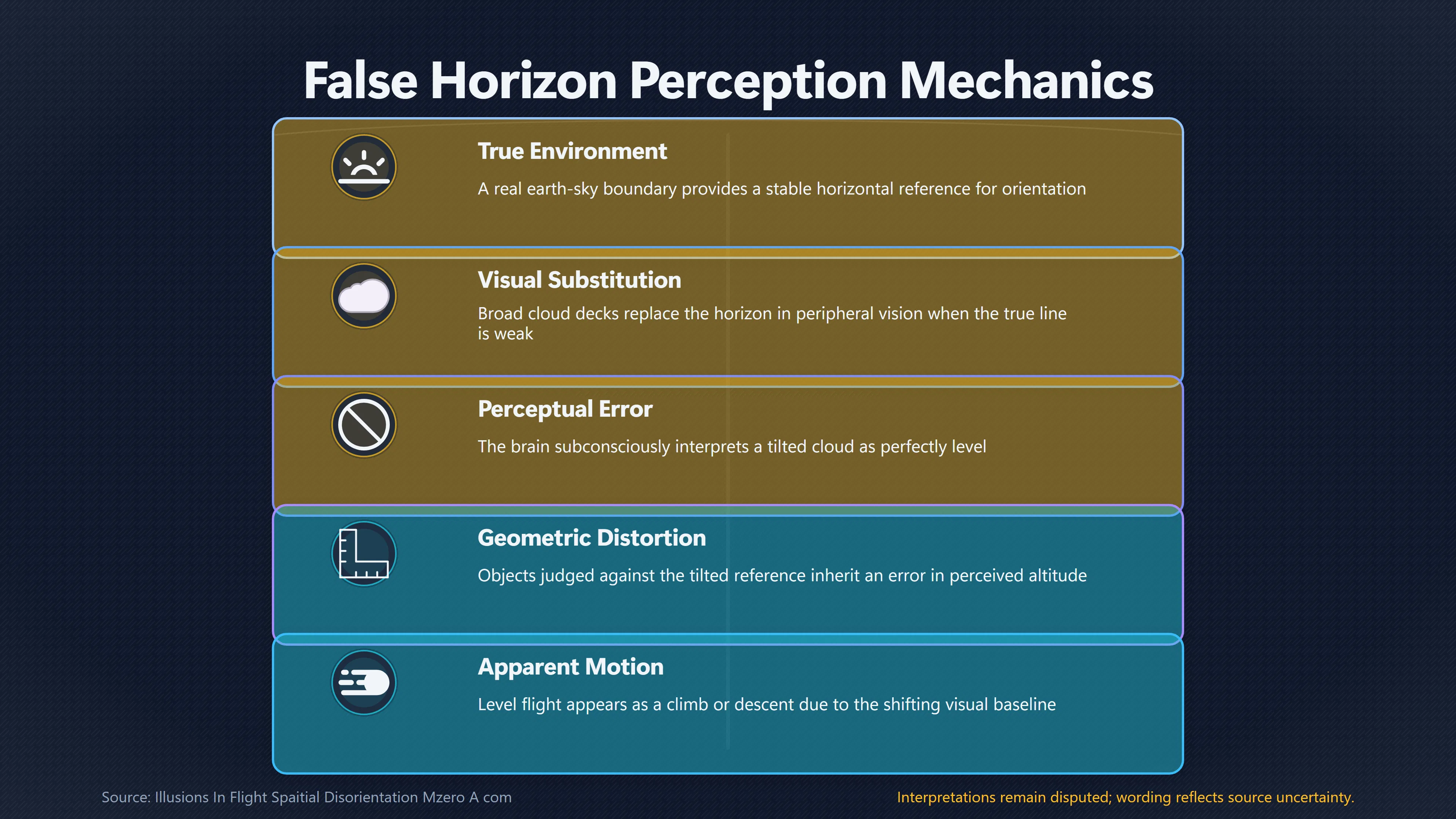
A sloping cloud deck can make perfectly ordinary level flight look wrong. When the true earth–sky horizon is weak, hidden or visually unconvincing, a broad cloud top or cloud boundary can become the observer’s substitute for level. If that cloud line is actually tilted, every object judged against it inherits the error: another aircraft or distant light may seem unusually high or low, or appear to climb or descend as it crosses the view even when its real flight path is comparatively steady.
This is a recognised aviation illusion, not merely a theoretical possibility. The US Federal Aviation Administration (FAA) explicitly lists sloping cloud formations as a cause of false-horizon illusions, while aviation training guidance stresses that a cloud deck extending far into peripheral vision can be especially persuasive. Simulator research with military pilots has also demonstrated measurable flight-performance changes when a sloping cloud is introduced into the visual scene.[faa.gov]faa.govOpen source on faa.gov.
For UFO/UAP assessment, the important point is narrower than general spatial disorientation: a witness can accurately see a real airborne light yet misjudge its altitude or motion because the visual reference against which that light is being measured is tilted.
Why broad cloud tops can replace the true horizon
The visual system normally has a powerful environmental reference available: the real horizon. It provides a long, approximately horizontal boundary against which the orientation of the observer, aircraft and surrounding scene can be organised. Problems arise when cloud, darkness, haze or other conditions weaken that reference while leaving another prominent boundary visible.
A broad cloud deck is particularly effective because it has several characteristics expected of a horizon. It can be long, continuous, distant-looking and spread across much of the visual field. The Aircraft Owners and Pilots Association describes the problem directly: when the most distinct reference is a cloud formation it can be confused with the horizon, and a sloping cloud deck extending into peripheral vision may appear horizontal. A cloud bank below the aircraft can similarly be perceived as horizontal even though it is not level relative to the ground.[AOPA]aopa.orgOpen source on aopa.org.
Older US Army aeromedical guidance gives an unusually clear description of the mechanism. It says that an aviator may subconsciously select the only available reference for orientation, and that a sloping cloud deck extending a considerable distance through peripheral vision can be difficult to perceive as anything other than horizontal. The resulting error can be insidious: the pilot may actually place the aircraft parallel to the cloud bank before recognising the discrepancy and reverting to instruments.[Aviation Assets]aviation-assets.infoOpen source on aviation-assets.info.
That distinction matters. The illusion need not look like an obviously crooked cloud layer that the observer consciously decides to treat as level. The scene itself can feel correctly orientated. In other words, the mistake occurs in the reference frame used to interpret what is seen.
The FAA consequently treats sloping clouds alongside an obscured horizon, confusing mixtures of ground lights and stars, and misleading patterns of ground illumination. All share the same essential failure: a visually plausible feature is being used to define horizontal when it does not correspond to the real terrestrial horizon.[Federal Aviation Administration]faa.govOpen source on faa.gov.
How a tilted reference changes apparent target altitude
Consider an observer looking towards a distant aircraft that is maintaining roughly level flight. Suppose the visible top of a cloud deck rises five degrees from left to right, but the observer unconsciously perceives that cloud boundary as horizontal.
Relative to the real world, the target may be travelling almost level. Relative to the perceived horizon, however, its path is tilted by roughly the opposite amount. As it moves across the scene, the changing separation between the target and the cloud boundary can therefore look like vertical motion.
This produces several potentially misleading impressions:
- A level target crossing towards the higher end of the cloud deck can appear to descend towards the perceived horizon.
- Crossing in the opposite direction can create an apparent climb.
- A stationary-looking or slowly moving distant light can appear to occupy an implausibly high or low position because its angular altitude is being judged from the wrong baseline.
- If the observer’s own aircraft also banks in response to the false horizon, the geometry changes again, potentially making the target’s apparent path more complicated.
The last point is important when interpreting an airborne report after the fact. There are potentially two transformations occurring at once: the cloud line can distort the observer’s visual coordinate system, while the observer’s aircraft can itself change attitude. A witness may consequently describe genuine apparent motion without the observed object having performed the corresponding manoeuvre in an earth-fixed frame.
This does not mean that any unexplained climb, descent or unusual trajectory reported near cloud can automatically be dismissed as a false horizon. The mechanism is most relevant when the true horizon was unavailable or poorly defined and a substantial tilted cloud boundary occupied the visual field. Without those conditions, the explanation loses much of its force.

Pilots are measurably susceptible
Experimental work strengthens the case beyond aviation-handbook warnings. A 2013 study placed 66 military pilots in a flight simulator and examined performance under a false-horizon illusion produced by a sloping cloud. The researchers reported that all of the participating pilots succumbed to the illusion to some degree, although its effect varied with perceptual style; pilots classed as more field-dependent were particularly affected.[Taylor & Francis Online]tandfonline.comOpen source on tandfonline.com.
A later study by Hanna Bednarek, Michał Janewicz and Magdalena Przedniczek again used 66 pilots and specifically compared differently orientated sloping-cloud displays. The researchers found that the cloud sloping in one direction — described in the published results as the right-sloping condition — had a greater effect on pilot behaviour than the opposite orientation. They also found significant differences associated with cognitive style, with field-dependent pilots showing greater susceptibility to the visual illusion.[ijomeh.eu]ijomeh.euOpen source on ijomeh.eu.
The directional asymmetry is interesting, but it should not be turned into a universal rule for analysing sightings. It comes from a particular simulator experiment and participant population. The more robust lesson is that experienced military pilots were not simply immune because they knew how aircraft should behave. A misleading environmental reference produced measurable changes in their flight performance.[PubMed]nih.govOpen source on nih.gov.
More recent research examining several forms of spatial-disorientation cue found that a simulated false horizon significantly changed pilots’ gaze behaviour. Across the broader spatial-disorientation conditions, pilots devoted a greater proportion of gaze time to the attitude indicator than in corresponding control conditions. That is consistent with the practical aviation response to unreliable outside references: resolve the conflict using dependable aircraft attitude information rather than continuing to infer level from the visual scene.[PubMed]nih.govOpen source on nih.gov.
When sloping clouds become especially convincing
A cloud deck does not automatically produce a false horizon merely because it is tilted. The illusion becomes much more plausible when the surrounding scene removes competing information.
The real horizon is obscured. If terrain or a clear earth–sky boundary remains visible, the observer has a powerful independent reference against which the cloud’s slope can be recognised. Cloud, darkness and reduced visibility remove that check. The FAA specifically couples sloping clouds with obscured-horizon conditions in its warning about false horizons.[Federal Aviation Administration]faa.govOpen source on faa.gov.
The cloud boundary occupies a wide visual angle. A small isolated cloud is unlikely to function as the world’s reference line. A broad deck stretching through peripheral vision is different. Both AOPA and US Army guidance emphasise the significance of an extended cloud formation, because it supplies the large-scale orientation cue normally provided by the true horizon.[AOPA]aopa.orgOpen source on aopa.org.
There are few contradictory features. Mountains, coastlines, a clearly visible ground surface or a well-defined true horizon can expose the discrepancy. Over featureless terrain, water, darkness or extensive cloud, there may be little else with which to compare the apparent horizon. Research on degraded visual environments similarly identifies loss of the horizon and peripheral visual references as important contributors to impaired spatial orientation and increased workload.[Iowa Research Online]uiowa.eduOpen source on uiowa.edu.
Attention has been elsewhere. Army aeromedical guidance notes that the illusion can arise when a pilot looks outside after prolonged attention to an inside-cockpit task. The visual system is then required to establish the orientation of an impoverished external scene, and a conspicuous cloud boundary may supply the most readily available reference.[Aviation Assets]aviation-assets.infoOpen source on aviation-assets.info.
These conditions explain why the phenomenon can be convincing without the weather necessarily looking dramatic. What matters is not simply how much cloud exists, but whether the cloud supplies the strongest large-scale cue for deciding what counts as level.
What this changes in a UFO/UAP report
For an airborne UFO/UAP report, a sloping cloud deck is most useful as an explanation of apparent geometry, rather than necessarily as an explanation of the object itself. A pilot may genuinely have been looking at an aircraft, planet, distant light or other physical source. The false horizon changes the inferred behaviour of that source.
That makes several details in a witness account particularly diagnostic. Investigators should establish whether the real horizon was visible; whether the reported object was seen above, below or against an extensive cloud deck; whether the cloud boundary visibly sloped in photographs or weather imagery; whether the apparent climb or descent was described mainly relative to that boundary; and whether cockpit attitude information agreed with the observer’s visual impression.
The distinction between angular movement in the visual field and actual vertical movement through the atmosphere is crucial. A witness saying that a light “rose above the horizon” provides an observation only after the identity of that horizon has been established. If the supposed horizon was really a cloud top inclined relative to Earth, the same retinal motion can correspond to a much less unusual physical trajectory.
Conversely, false horizon should not become a catch-all explanation whenever clouds were present. If flight instruments, video metadata, radar, multiple geometrically separated observers or a clearly identifiable true horizon independently establish a target’s climb or descent, a tilted cloud reference cannot simply erase that evidence. The hypothesis is strongest when unusual motion depends primarily on visual judgement against an ambiguous cloud boundary.
The key diagnostic distinction
The most revealing question is therefore not simply, “Were there clouds?” It is: what visual feature was the observer actually using as level?
A broad, tilted cloud deck can look horizontal precisely because the visual system has adopted it as the horizon. Once that happens, ordinary level motion no longer has to look level. Aviation authorities have warned about this effect for decades, and controlled simulator studies show that trained pilots can still respond measurably to it.[faa.gov]faa.govOpen source on faa.gov.
Within UFO/UAP analysis, that gives sloping cloud decks a specific and testable role. They do not manufacture an object out of nothing. Instead, they can transform the apparent altitude and trajectory of something that is genuinely visible. When a report’s strangeness rests on a light seeming to climb, descend or occupy an inexplicable position against a poorly defined horizon, reconstructing the cloud deck and the true horizontal reference can be as important as identifying the light itself.
Amazon book picks
Further Reading
Books and field guides related to When Sloping Clouds Become the Horizon. Use these as the next step if you want deeper reading beyond the article.
Human Factors in Flight
The late Captain Frank H Hawkins FRAes, M Phil, was Human Factors Consultant to KLM, for whom he had flown for over 30 years as line capt...
The Pilot's Manual: Flight School
Time is money in an airplane and with an instructor. Effective for both preflight learning and post-flight briefings, Flight School will...
Weather Flying
Weather Flying is regarded in the industry as the bible of weather flying. Robert Buck, a general aviation and commercial pilot with tens...
eBay marketplace picks
Marketplace Samples
Live-tested eBay searches with available results related to this page.
Selected fromaviation poster oneBay.co.uk.

Endnotes
1.
Source: faa.gov
Link:https://www.faa.gov/air_traffic/publications/atpubs/aim_html/chap8_section_1.html
2.
Source: aopa.org
Link:https://www.aopa.org/training-and-safety/online-learning/safety-spotlights/spatial-disorientation/tricked-by-illusions
3.
Source: faa.gov
Link:https://www.faa.gov/sites/faa.gov/files/regulations_policies/handbooks_manuals/aviation/airplane_handbook/12_afh_ch11.pdf
Additional References
4.
Source: youtube.com
Link:https://www.youtube.com/watch?v=cVNnYHLLH2Y
Source snippet
Spatial Disorientation Explained: Deadly Flight Illusions Every Pilot Must Know...
5.
Source: youtube.com
Title: Illusions In Flight Spaitial Disorientation Mzero A com
Link:https://www.youtube.com/watch?v=fIZpxEOsTg0
Source snippet
False horizon illusion aviation False Horizon Illusion Explained | Aviation Visual Illusions Every Pilot Must Know...
6.
Source: youtube.com
Title: Spatial Disorientation Explained: Deadly Flight Illusions Every Pilot Must Know
Link:https://www.youtube.com/watch?v=6BD9fyyIJzY
Source snippet
Night Illusions (Private Pilot Lesson 15d)...
7.
Source: youtube.com
Title: Types Of Illusions (ICEFLAGS) CHECKRIDE PREP
Link:https://www.youtube.com/watch?v=I2w9gLTYjUg
Source snippet
Illusions In Flight Spaitial Disorientation MzeroA com...
8.
Source: youtube.com
Title: Night Illusions (Private Pilot Lesson 15d)
Link:https://www.youtube.com/watch?v=y_HvgmQ3NJs
Source snippet
Types Of Illusions (ICEFLAGS) CHECKRIDE PREP...
9.
Source: flightsafety.org
Link:https://flightsafety.org/hf/hf_jan-feb92.pdf