Within Advertising
Why the Airplane Can Vanish Behind Its Lights
Bright advertising lamps can overwhelm dim airframe details, leaving witnesses to perceive unsupported lights or infer a larger dark craft.
On this page
- How low light reduces detail and color perception
- Why bright displays hide wings and fuselage
- How grouped lights can suggest an enclosing craft
Page outline Jump by section
Introduction
At night, an advertising aeroplane can be plainly visible as a set of lights while the aeroplane carrying those lights is effectively invisible to the observer. That is not a contradiction. Human night vision is good at detecting luminous points but much poorer at resolving fine detail, colour and low-contrast structure. The US Federal Aviation Administration (FAA) explicitly notes that an unlit aircraft has to be much closer to be seen in darkness than one showing navigation lights.[Federal Aviation Administration]faa.govOpen source on faa.gov.
Advertising aircraft make this imbalance unusually severe. Current aerial night-sign systems can place hundreds of computer-controlled lights beneath an aeroplane’s wings. Against a dark sky, those bright lamps can dominate perception while the wings and fuselage contribute too little contrast to reveal their shape.[Skywriters]theskywriters.comOpen source on theskywriters.com.
This helps explain an otherwise puzzling class of UFO report: witnesses may accurately report several bright lights, yet sincerely fail to see the conventional aircraft connecting them.
Low light strips away the identifying detail
Recognising an aeroplane requires more than detecting that something is present. During daylight, the observer may distinguish a fuselage, wings, tail, paintwork and orientation. At night, much of that information disappears.
The visual system uses two main classes of photoreceptor, rods and cones. Under bright conditions, cone-rich central vision provides sharp images and colour discrimination. As illumination falls, vision increasingly depends on rods. The FAA’s Airplane Flying Handbook explains that in the absence of normal illumination, night vision is placed almost entirely on the rods. The resulting system is sensitive to faint light but does not provide the same fine-detail and colour performance as daylight vision.[Federal Aviation Administration]faa.govOpen source on faa.gov.
This is not merely an aviation rule of thumb. Low-luminance visual acuity is sufficiently distinct from ordinary high-contrast acuity that ophthalmic researchers measure it separately; a review led by University of Oxford researchers found low-luminance acuity useful as a measure of real-world visual function.[ORA]ox.ac.ukOpen source on ox.ac.uk.
For a distant advertising aircraft, therefore, two different visual tasks have very different thresholds:
Detection: There are bright lights over there.
Recognition: Those lights are attached to the wings and fuselage of a small aeroplane.
The first can succeed while the second fails. FAA guidance makes essentially the same distinction operationally: exterior lights can greatly increase an aircraft’s conspicuity, and an aircraft without visible navigation lights must be substantially closer before it can be detected in darkness.[Federal Aviation Administration]faa.govOpen source on faa.gov.
That distinction is crucial when evaluating a report such as “I could see the lights perfectly clearly, but there was definitely no aeroplane”. Seeing the luminous components clearly does not establish that the observer was close enough, or had sufficient contrast, to resolve the structure between them.
Bright displays can hide the wings and fuselage
Advertising lights do not illuminate the aircraft for the benefit of a distant observer. Their purpose is to make the display conspicuous. One present-day operator describes an installation of about 300 computer-controlled lights beneath an aeroplane’s wings, capable of scrolling text and displaying logos and animations.[Skywriters]theskywriters.comOpen source on theskywriters.com.
That creates an extreme contrast mismatch. The lamps generate their own light; the fuselage and wings generally do not. Unless moonlight, twilight, ground illumination or another source reveals the airframe, its surfaces must be recognised from relatively weak reflected light against the night sky. The illuminated sign can consequently remain conspicuous at a distance where the aeroplane’s outline has already dropped below useful recognition contrast.
FAA conspicuity research provides a useful comparison. A 2022 Civil Aerospace Medical Institute study describes aircraft lighting specifically as a means of increasing detection and recognition range. Its review of earlier work found that white strobe lighting can be highly effective at increasing conspicuity at night and that, in general, increasing brightness increases conspicuity.[Federal Aviation Administration]faa.govOpen source on faa.gov. The important inference for advertising-aircraft sightings is straightforward: making a lamp easier to detect does not make the surrounding dark airframe equally easy to see.
Bright lights can introduce a second problem. The FAA warns that dark adaptation is rapidly degraded by viewing a bright light and that excessive illumination can produce glare and seriously interfere with vision. Complete dark adaptation can take roughly 30 minutes.[Federal Aviation Administration]faa.govOpen source on faa.gov. An observer staring directly at an intense aerial display is therefore looking at precisely the feature best able to attract attention while trying to detect much dimmer structure immediately around it.
This does not mean every illuminated aircraft will become invisible. A low aircraft crossing a bright urban sky may present an obvious silhouette, and moonlight can expose its wings or fuselage. Viewing angle matters too. The narrower claim is well supported: under sufficiently dark, distant or high-contrast conditions, the visual threshold for the lamps can be reached long before the threshold for recognising the aircraft carrying them.

Separate lights can become one imagined object
Once the physical airframe is unavailable as a visual reference, perception is left with the geometry of the lights.
Imagine three or four bright points moving together across an otherwise featureless sky. Their spacing remains approximately constant and their motion is coordinated. The observer correctly concludes that the lights are related. But without visible wings or fuselage, the eye does not directly specify how they are related.
This leaves room for a perceptual inference: the lights may be interpreted as points on the perimeter of a larger object. Three lights can suggest the corners of a triangle; a row can suggest the edge of a rectangular or elongated craft; an arc can suggest a curved body. With an advertising display, the possibilities become more complicated because the visible pattern itself can change as lamps switch on and off.
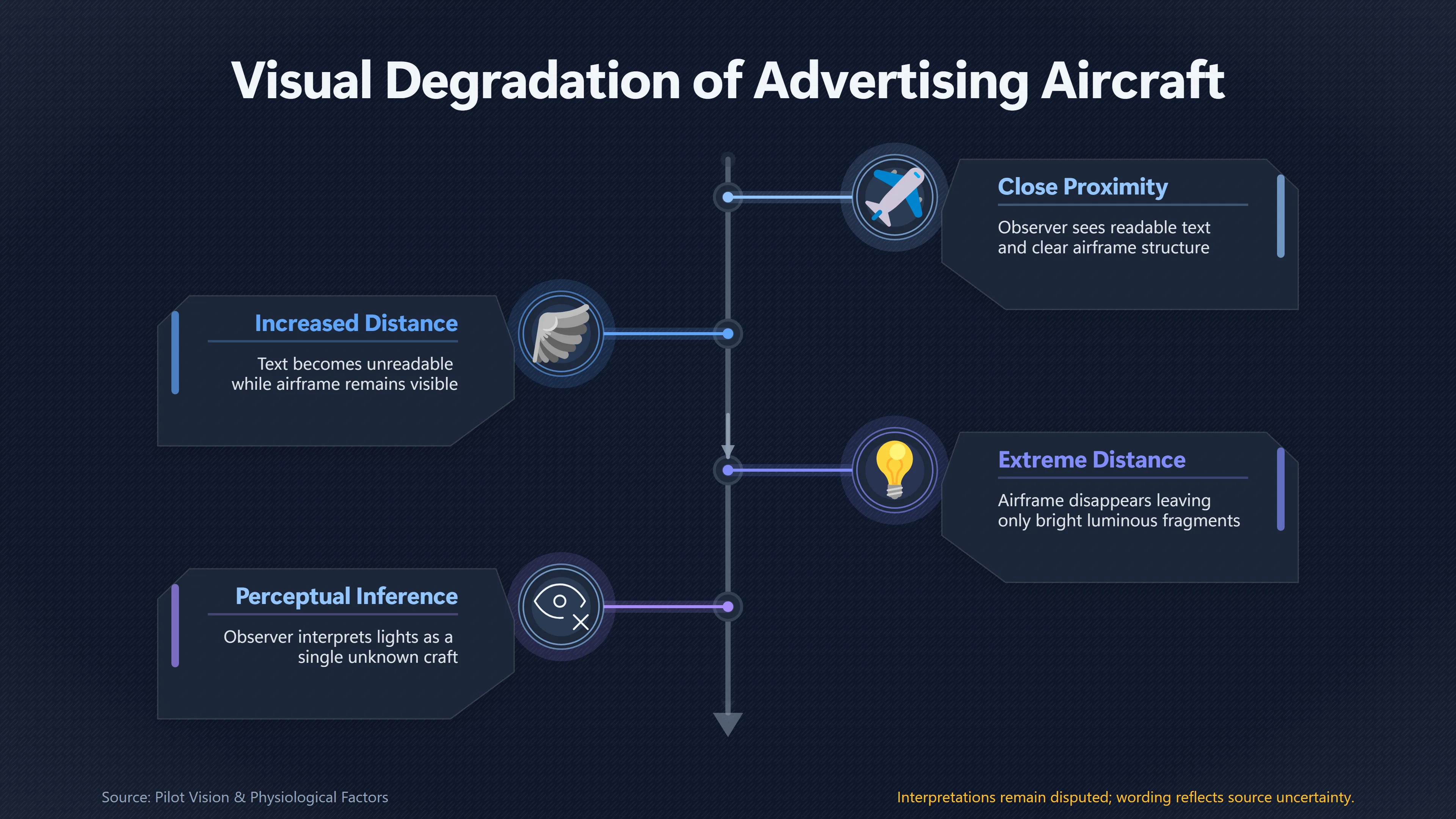
Modern aerial night signs illustrate the problem particularly well. The Skywriters system can scroll messages beneath the wings and run animated patterns, including stars, vehicles, aircraft and even UFO-themed imagery.[Skywriters]theskywriters.comOpen source on theskywriters.com. Seen at the intended range and angle, the sequence is advertising. Seen farther away, obliquely or only briefly, individual letters and pictures may cease to be readable while their luminous fragments remain highly conspicuous.
The observer can consequently be faced with something perceptually unusual but physically mundane: a coherent moving arrangement of lights with no visible support structure.
That absence of visible structure can itself become evidence in the witness’s interpretation. Instead of “I cannot resolve the aeroplane”, the experience naturally feels like “there is no aeroplane there”. In UFO reporting, that difference matters because an inferred dark body may subsequently be described as part of the observation rather than recognised as an interpretation of the spaces between visible lights.
A 1977 case shows the effect in practice
A particularly useful historical example occurred around Prince George’s County near Washington, DC, in June 1977. Residents reported an unusual illuminated object, but the source was traced to a Cessna 150 carrying 315 blinking advertising bulbs. Contemporary reporting in The Washington Post recorded descriptions likening the display to a blimp, a “flying jelly fish” and a UFO.[The Washington Post]washingtonpost.comOpen source on washingtonpost.com.
The case is valuable because the advertising operator explained the distance problem directly. The illuminated aircraft could be seen from far away, but its message was readable only from a much more restricted viewing area. At greater distances, what was intended as organised text degraded into a strange luminous form. The aircraft’s relatively slow advertising flight also contributed to the unfamiliar appearance.[The Washington Post]washingtonpost.comOpen source on washingtonpost.com.
That is exactly the transition relevant to night UFO reports:
close enough and correctly positioned: aeroplane plus readable advertising sign;
farther away or poorly positioned: bright organised lights but little useful airframe detail;
farther or more oblique still: fragmented luminous pattern whose intended meaning is no longer apparent.
The underlying aircraft has not changed. What changes is the information reaching the observer.
The same principle remains relevant to modern installations. Today’s LED systems can create far more elaborate patterns than the hundreds of blinking incandescent bulbs carried by the 1977 Cessna.[Skywriters]theskywriters.comOpen source on theskywriters.com. Technology has changed, but the perceptual vulnerability is essentially the same: the display remains detectable after the carrier has become difficult to recognise.

“No visible aircraft” is weak evidence by itself
For UFO investigation, the practical lesson is not that every unexplained group of night lights should be labelled an advertising aeroplane. It is that failure to see an airframe is not, by itself, strong evidence that no conventional aircraft was present.
Several observations would make a hidden-airframe explanation more plausible: a stable group of lights travelling together at an aircraft-like pace; a display whose illuminated components change while the whole pattern follows a continuous path; intermittent glimpses of ordinary position or anti-collision lights; or a later change of angle that briefly reveals a wing, tail or fuselage. Aircraft lighting itself can vary considerably: FAA guidance describes navigation lights, landing lights, rotating beacons and wingtip strobes serving different functions.[Federal Aviation Administration]faa.govOpen source on faa.gov.
Conversely, an advertising-aircraft explanation should become weaker if reliable evidence places the object where the proposed aeroplane could not have been, or if its motion, timing and location cannot be reconciled with the operator’s actual flight. The visual mechanism explains why an aeroplane might be missed; it does not prove that an aeroplane was present in any particular case.
That distinction prevents two opposite errors. A witness should not be dismissed merely because they failed to recognise an aircraft under poor night-viewing conditions. But investigators should also resist treating “I saw bright lights but no wings” as proof of an enormous dark craft. Night vision makes precisely that combination possible: high confidence that the lights existed alongside very limited information about the structure carrying them.
The key question is what was actually resolved
The most useful way to assess these reports is to separate observation from reconstruction. “Three lights moved together” describes directly visible information. “They were attached to a triangular object” is stronger only if the observer actually perceived a continuous boundary, surface, silhouette, reflection or occultation connecting those lights.
Without such evidence, the dark space between luminous points is ambiguous.
Advertising aircraft exploit that ambiguity unintentionally. Their lamps are engineered to attract attention and remain conspicuous; the aeroplane is merely the platform. FAA research and guidance independently demonstrate both sides of this visual imbalance: lighting greatly improves aircraft conspicuity, while darkness reduces the ability to see an aircraft that is not itself sufficiently illuminated.[Federal Aviation Administration]faa.govOpen source on faa.gov.
That is why an apparently unsupported luminous sign, row of lights or geometric pattern does not require the airframe itself to have been visible. At night, the brightest parts of an advertising aircraft can survive perceptually after almost everything that would identify it as an aeroplane has disappeared.
Amazon book picks
Further Reading
Books and field guides related to Why the Airplane Can Vanish Behind Its Lights. Use these as the next step if you want deeper reading beyond the article.
Pilot's Handbook of Aeronautical Knowledge
Pilot's Handbook of Aeronautical Knowledge, created by the Federal Aviation Administration, is the official reference manual for pilots a...
Human Factors in Flight
The late Captain Frank H Hawkins FRAes, M Phil, was Human Factors Consultant to KLM, for whom he had flown for over 30 years as line capt...
The Demon-Haunted World
Rating: 4.5/5 from 43 Google Books ratings
NEW YORK TIMES BESTSELLER • From the renowned astronomer and author of Cosmos comes a “powerful [and] stirring defense of informed ration...
The Invisible Gorilla: How Our Intuitions Deceive Us
NEW YORK TIMES BESTSELLER • Our minds don’t work the way we think they do. Two renowned psychologists explain how and why our intuitions...
eBay marketplace picks
Marketplace Samples
Live-tested eBay searches with available results related to this page.
Selected fromUFO poster oneBay.co.uk.

Current eBay listing
VINTAGE UFO FLYING SAUCERS COMIC ADVERTISING A2 POSTER PRINT


Current eBay listing
I Want To Believe UFO Poster Giclée Fine Art Heavyweight Print
Endnotes
1.
Source: faa.gov
Link:https://www.faa.gov/AIR_TRAFFIC/PUBLICATIONS/media/AIM_Chg_3_dtd_7-9-26.pdf
2.
Source: faa.gov
Link:https://www.faa.gov/documentLibrary/media/Notice/ND/N8900_20.pdf
3.
Source: faa.gov
Link:https://www.faa.gov/air_traffic/publications/atpubs/aim_html/chap8_section_1.html
4.
Source: theskywriters.com
Link:https://www.theskywriters.com/aerial-night-signs
Additional References
5.
Source: youtube.com
Link:https://www.youtube.com/watch?v=BpsbSEzD0fE
Source snippet
Pilot Vision & Physiological Factors - AeroGuard Flight Training Center...
6.
Source: youtube.com
Title: Pilot Vision & Physiological Factors
Link:https://www.youtube.com/watch?v=SzEPhfCJkRU
Source snippet
Ep. 104: Intro to Night Flying | Night Flight Planning...
7.
Source: youtube.com
Title: Optical Blind Spot
Link:https://www.youtube.com/watch?v=DxUDP0yLpmk
Source snippet
FAA TEST - RFP INSTRUCTOR PILOT - FLIGHT PHYSIOLOGY Q7164, Q7172, Q7174, Q7173 (12-12)...
8.
Source: youtube.com
Title: FAA TEST
Link:https://www.youtube.com/watch?v=mv3UcSmhuhQ
9.
Source: youtube.com
Title: Ep. 104: Intro to Night Flying | Night Flight Planning
Link:https://www.youtube.com/watch?v=gGI-D697cIo
Source snippet
Optical Blind Spot...
10.
Source: bufora.org.uk
Link:https://www.bufora.org.uk/guide-to-ufos