Within Mirages
Why Dramatic Mirages Cluster Near the Horizon
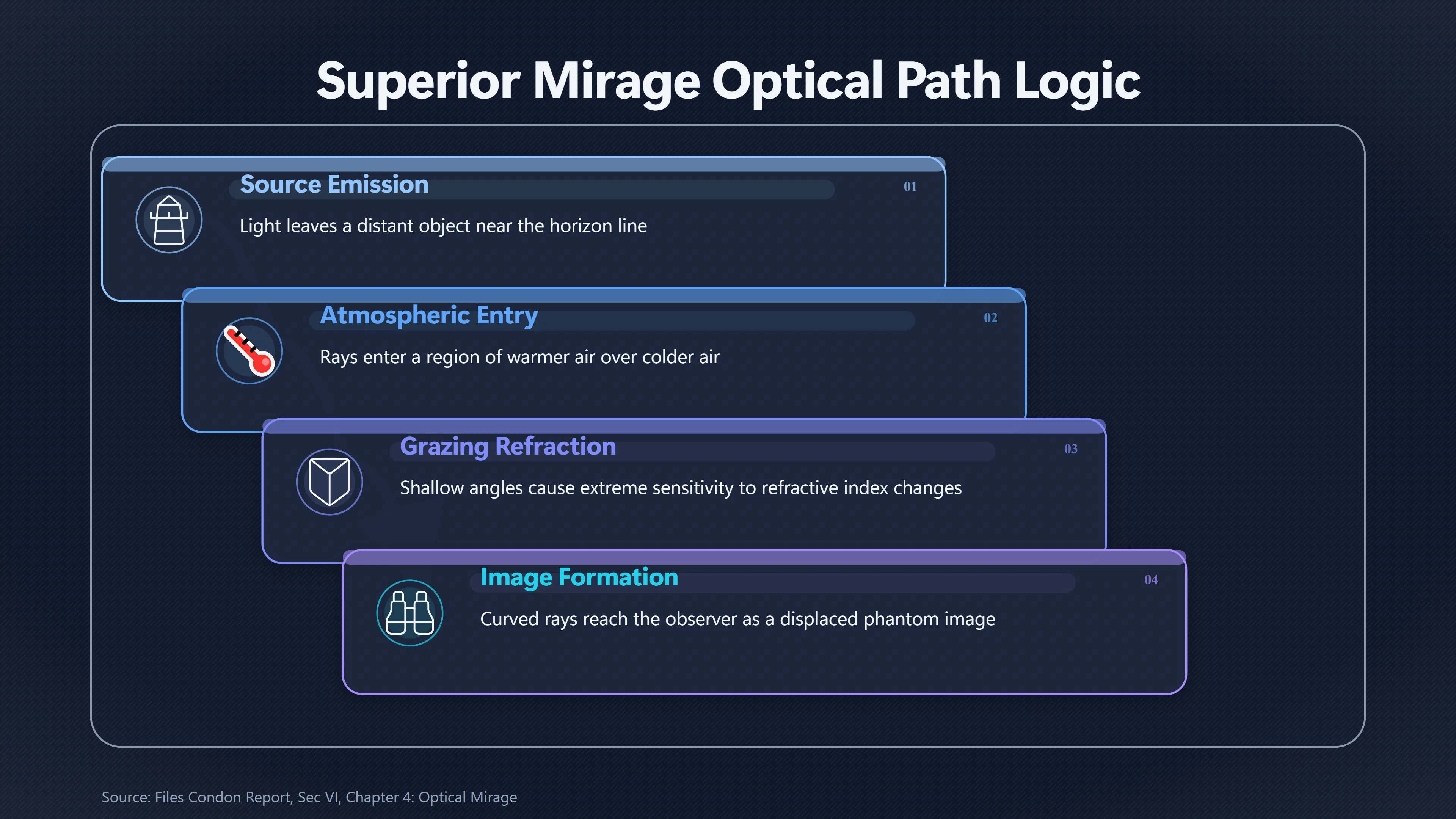
Strong inversion mirages usually require light to meet the refracting layer at a very shallow angle, making horizon geometry as important as temperature.
On this page
- Why an inversion alone does not guarantee a mirage
- How near grazing rays amplify refractive displacement
- Which source and observer positions make a mirage plausible
Page outline Jump by section
Introduction
A temperature inversion can be present without producing anything remotely dramatic to the eye. For the strong superior mirages relevant to some unusual aerial reports, geometry is the crucial second ingredient: light generally has to encounter the strongly refracting part of the atmosphere at a very shallow, near-horizontal angle. Near this grazing geometry, small differences in refractive index can translate into much larger changes in the direction from which light appears to arrive. That is why spectacular displacement, vertical stretching, inversion and multiple images tend to be concentrated in a narrow strip around the horizon rather than appearing anywhere in the sky.[sdsu.edu]aty.sdsu.eduA Green Flash Page RefractionA Green Flash Page Refraction
This provides an important test for proposed UFO or UAP explanations. Finding an inversion is not enough. Investigators also need to ask whether the reported object, observer and refracting layer could actually have formed the shallow ray paths required. A sighting high above the horizon can therefore be much harder to explain as an ordinary inversion mirage than a strange-looking light or object only a fraction of a degree above it.
Why an inversion alone does not guarantee a mirage
A superior mirage occurs when the atmospheric refractive-index structure bends rays downwards strongly enough to alter the apparent position or form of a distant object. Temperature inversions — warmer air over colder air — are especially favourable because colder, denser air normally has a slightly higher refractive index. The World Meteorological Organization notes that superior mirages can raise images above their true positions, while sufficiently complicated profiles can produce multiple, inverted, enlarged or reduced images.[International Cloud Atlas]cloudatlas.wmo.intInternational Cloud Atlas Mirage | International Cloud AtlasInternational Cloud Atlas Mirage | International Cloud Atlas
But the word “inversion” describes only the vertical temperature arrangement. It does not specify whether useful rays from a particular source actually pass through the critical portion of that arrangement at favourable angles.
This distinction matters because refractive effects depend on the entire ray path. The American Meteorological Society’s Glossary of Meteorology explicitly notes that what an observer sees in a superior mirage depends on both the distance of the object and the height of the observer, and that changing either can markedly change the resulting image. Specialist ray-tracing simulations likewise show strong sensitivity to eye height, target distance, inversion thickness, temperature gradient and the detailed transitions around the inversion.[ametsoc.org]glossary.ametsoc.orgGlossary of Meteorologysuperior mirageGlossary of Meteorology…
Consequently, two observers looking towards the same distant source under apparently identical weather can see substantially different things. One might see an elevated but recognisable object; another, at a different height or distance, might see vertical distortion or multiple images; and an observer whose line of sight misses the useful refracting geometry may see little that looks extraordinary at all.
This is the main weakness in simplistic claims that an unusual aerial sighting “must have been a mirage because there was an inversion”. The inversion establishes atmospheric potential. It does not establish the necessary optical path.
Why near-grazing rays produce the dramatic effects
The importance of a shallow angle follows from basic refraction. At ordinary incidence, the very small differences between the refractive indices of neighbouring layers of air normally produce correspondingly modest directional changes. Near grazing incidence — where a ray travels almost parallel to the layers — the angular response becomes much more sensitive.
Atmospheric-optics specialist Andrew T. Young illustrates this with Snell’s law: close to grazing incidence, a very small change on one side of a refracting boundary can correspond to an appreciably larger angular change on the other. He emphasises that this behaviour is particularly important for mirages and phenomena involving objects near the horizon.[A Green Flash Page]aty.sdsu.eduA Green Flash Page RefractionA Green Flash Page Refraction
Real atmospheric mirages are better understood as rays continuously curving through a refractive-index gradient rather than literally bouncing from a sharp atmospheric mirror. Nevertheless, the grazing-angle principle survives. Rays travelling almost horizontally can remain within, skim, turn inside or repeatedly interact with the region of unusually strong refractive gradient. In an optical duct, some ray trajectories can be carried for considerable horizontal distances. The result can be much larger apparent displacement and much more complicated imaging than would arise from a steep line of sight simply crossing the layer.[A Green Flash Page]aty.sdsu.eduA Green Flash Page Superior-Mirage SimulationsA Green Flash Page Superior-Mirage Simulations
Distance then magnifies the geometrical opportunity. In simulations of superior mirages, distortion evolves with both target range and eye height. Wegener-type models show particularly strong distortion around the astronomical horizon because rays there undergo different propagation histories from rays immediately above or below them; those differences accumulate with distance. In one set of model calculations, moving the observer towards the top of the optical duct brought the horizon ray closer to grazing incidence and produced increasingly complicated image distortion.[A Green Flash Page]aty.sdsu.eduA Green Flash Page Height Effects in Wegener's Mirage ModelA Green Flash Page Height Effects in Wegener's Mirage Model
This helps explain a characteristic feature of spectacular mirages: an extremely distorted strip can sit beside portions of the scene that remain relatively normal. Atmospheric Optics documents, for example, a four-image superior mirage of a distant ship near Redcar in north-east England while a nearer vessel in the same general view was not miraged. The distant ship’s rays happened to sample the inversion in the necessary geometry; merely sharing the same atmosphere did not guarantee the same appearance.[Atmospheric Optics]atoptics.org.ukAtmospheric Optics OPODAtmospheric OpticsOPOD - 4 ship superior mirageMarch 25, 2012…

Horizon geometry selects the plausible sources
For an unusual aerial report, the practical question is therefore not simply “Was there an inversion?” but “Could light from a real source have reached the observer along a near-grazing path through it?”
Three geometrical quantities deserve particular attention.
Observer height. Raising or lowering the observer changes which rays can enter the eye and how those rays intersect an elevated inversion or optical duct. Superior-mirage simulations show that even with an unchanged atmospheric profile and target, changing eye height can substantially alter the number, orientation and vertical magnification of the images.[A Green Flash Page]aty.sdsu.eduA Green Flash Page Height Effects in Wegener's Mirage ModelA Green Flash Page Height Effects in Wegener's Mirage Model
Source height. A ship, coastline, ground light or low aircraft naturally supplies rays close to the horizontal when sufficiently distant. A much higher aircraft can also participate if distance and inversion height create the required shallow intersection, but the geometry has to be demonstrated rather than assumed. The key quantity is the ray’s angle relative to the refracting layers, not simply whether the source itself is labelled “ground” or “airborne”.
Distance. A distant object is geometrically favoured because its apparent elevation tends to be small, and long, nearly horizontal ray paths can interact extensively with stratified air. Superior mirages are therefore characteristically associated with distant objects close to the horizon. The Condon Report’s meteorological treatment described superior mirages as generally distant — typically beyond a kilometre — and low in the sky, while modern meteorological references similarly emphasise distant objects and the horizon.[NCAS Files]files.ncas.orgFiles Condon Report, Sec VI, Chapter 4: Optical MirageNCAS FilesCondon Report, Sec VI, Chapter 4: Optical Mirage…
Earth’s curvature also becomes part of the problem at long range. Strong downward refraction can sometimes bring light from an object that would otherwise be partly or wholly below the geometric horizon into view. The Hong Kong Observatory describes this explicitly: when ray curvature approaches the curvature of the Earth, a source below the geometric horizon can appear displaced above it. The World Meteorological Organization cites the extreme astronomical example of the Novaya Zemlya effect, in which an inversion and optical ducting allow sunlight to follow Earth’s curvature far enough for a distorted Sun to appear while the real Sun remains geometrically below the horizon.[Hong Kong Observatory]weather.gov.hkHong Kong Observatory Mirage|Hong Kong Observatory(HKO)|Observatory's BlogHong Kong ObservatoryMirage|Hong Kong Observatory(HKO)|Observatory's BlogMay 25, 2020…
For UFO identification, that means the apparent location of the luminous or solid-looking “object” cannot automatically be treated as its physical location. A miraged source may actually be lower, farther away and even beyond the ordinary geometric horizon.
The grazing-angle test can also rule explanations out
The same mechanism that makes mirages plausible near the horizon makes it useful for rejecting weak mirage explanations elsewhere.
The Condon UFO study provides a particularly relevant example. In analysing the famous 1957 B-47 case, investigators considered whether an optical mirage associated with an elevated inversion might account for some reported phenomena. They did not regard the mere presence of an inversion as sufficient. One difficulty identified in the report was that, for part of the proposed geometry, the grazing angle at the elevated inversion would have been too large for a normal mirage. The study ultimately found no tenable overall solution to that case rather than forcing the inversion hypothesis to fit.[NCAS Files]files.ncas.orgFiles Condon Report, Sec III, Chapter 5: Optical & Radar AnalysisFiles Condon Report, Sec III, Chapter 5: Optical & Radar Analysis
That is a useful methodological lesson beyond the individual case. Atmospheric explanations become more credible when they make restrictive predictions. A superior-mirage hypothesis should work best when the observation involves a distant source close to the apparent horizon, with observer height, source height and inversion altitude permitting nearly horizontal propagation. If reconstruction instead requires rays to cross the inversion steeply, simply demonstrating that an inversion existed does little explanatory work.
Apparent elevation also needs care. The World Meteorological Organization notes that mirages can shift the apparent angular position of distant objects substantially under exceptional conditions. Therefore, a witness’s estimate that an object was “above the horizon” does not by itself establish that the physical source occupied that direction. But reports placing a phenomenon persistently far up in the sky require progressively more demanding geometry and should not casually be attributed to the same near-horizon mechanism.[International Cloud Atlas]cloudatlas.wmo.intInternational Cloud Atlas Mirage | International Cloud AtlasInternational Cloud Atlas Mirage | International Cloud Atlas
What a credible mirage reconstruction should establish
A strong inversion-mirage explanation for an unusual aerial observation should connect meteorology to geometry rather than stopping at a weather record. Ideally, it should establish the inversion’s altitude and vertical temperature structure, the observer’s height, the candidate source’s approximate height and range, and its true direction relative to the horizon.
Those variables can then be used for ray tracing. This is more than a theoretical ideal: published optical research has worked in the reverse direction, deriving atmospheric temperature or refractive-index profiles from observed superior mirages of known objects. Waldemar Lehn described superior-mirage images in terms of the elevation angle of rays reaching the observer and the corresponding heights at which those rays intersect the target; later research demonstrated related methods for recovering refractive-index profiles from observed mirage structure. In other words, mirage shape and ray geometry are quantitatively connected rather than merely associated by analogy.[Optica Publishing Group]opg.optica.orgOpen source on optica.org.
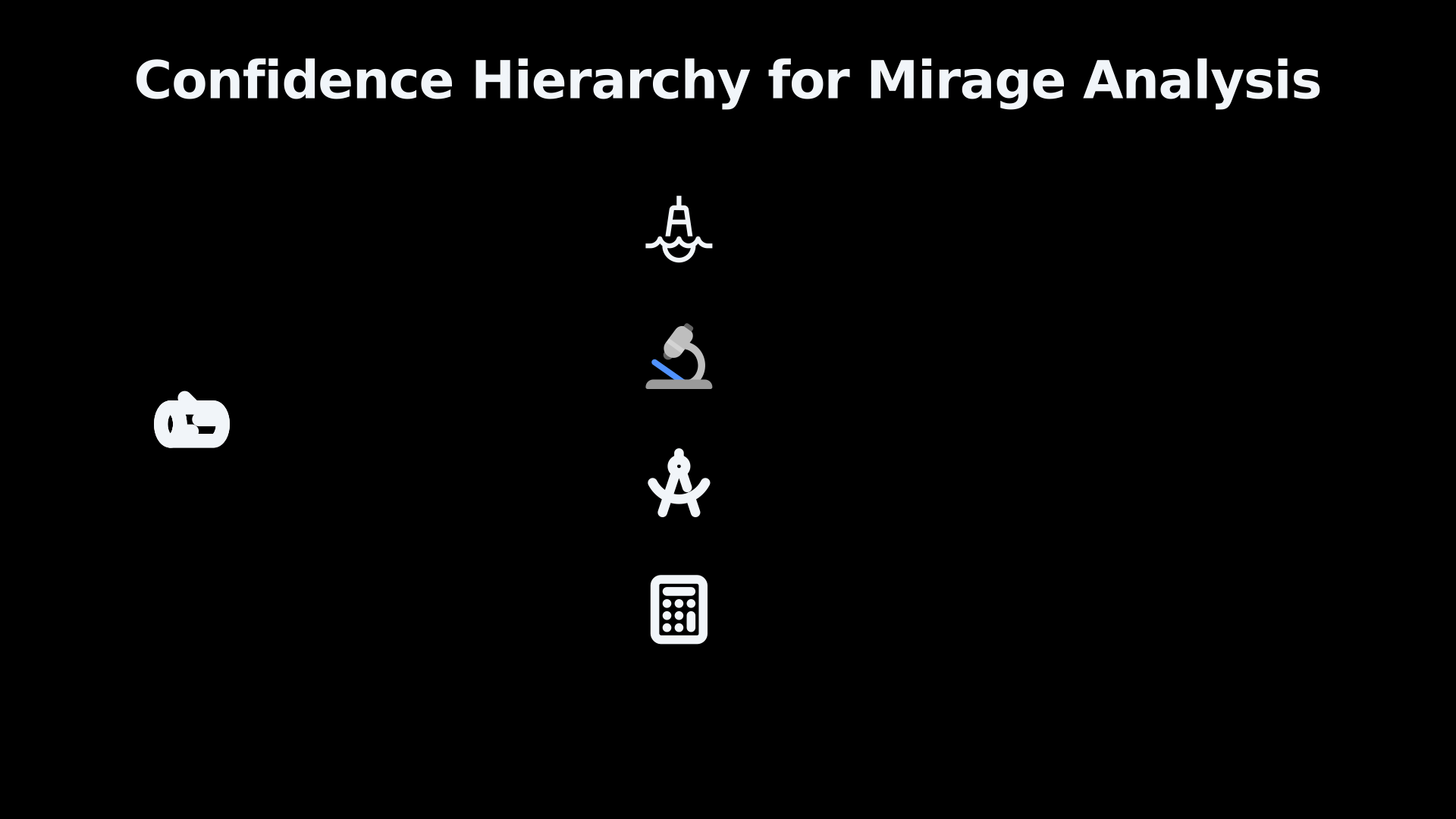
That gives investigations of UFO or UAP reports a useful hierarchy of confidence. An inversion recorded somewhere in the area is weak evidence. An inversion at the appropriate altitude combined with a low-elevation candidate source is better. A reconstruction showing that rays from that source pass through the inversion at the necessary shallow angles and reproduce the reported elevation or distortion is substantially stronger.
Conversely, failure of the geometry matters. If the candidate source is too high, too close, in the wrong direction, or seen along a path that intersects the refracting layer too steeply, the explanation should lose credibility even when the meteorological conditions initially look attractive.
Why dramatic mirages cluster near the horizon
The horizon is not merely where mirages happen to be easiest to notice. It is where the optical geometry becomes unusually favourable. Distant sources produce shallow sight lines; shallow rays can spend long distances interacting with horizontally stratified air; and near-grazing refraction is exceptionally sensitive to small changes in refractive index and ray angle. Changes in observer height, target distance or inversion structure can then decide whether the result is modest displacement, towering, an inverted image, several stacked images or effectively no conspicuous mirage at all.[sdsu.edu]aty.sdsu.eduA Green Flash Page RefractionA Green Flash Page Refraction
For unusual aerial reports, this sharply limits the explanatory reach of temperature inversions. They are not generic atmospheric machines capable of putting convincing phantom objects anywhere in the sky. Their strongest visual effects occupy particular geometrical corridors, overwhelmingly favouring long, shallow lines of sight.
That restriction is precisely what makes the mechanism useful in investigation. A strange object hovering just above a distant sea horizon, especially with vertical distortion or duplication, fits the geometry well enough to make superior mirage a serious hypothesis. A phenomenon at a large elevation angle does not gain the same support merely because an inversion was measured that night. The decisive evidence is the combination of atmosphere and grazing geometry.
Amazon book picks
Further Reading
Books and field guides related to Why Dramatic Mirages Cluster Near the Horizon. Use these as the next step if you want deeper reading beyond the article.
Light and Color in the Outdoors
All of science springs from the observation of nature. In this classic book, the late Professor Minnaert accompanies the reader on a tour...
Color and Light in Nature
We live in a world of optical marvels - from the commonplace but beautiful rainbow, to the rare and eerie superior mirage. But how many o...

Rainbows, Halos, and Glories
First published 1980. Subjects: Halos (Meteorology), Meteorological optics, Rainbow, Rainbows.
Optics
For courses in Optics A Contemporary Approach to Optics with Practical Applications and New Focused Pedagogy Hecht Optics balances theory...
eBay marketplace picks
Marketplace Samples
Live-tested eBay searches with available results related to this page.
Selected fromUFO poster oneBay.co.uk.


Current eBay listing
VINTAGE UFO FLYING SAUCERS COMIC ADVERTISING A2 POSTER PRINT
Current eBay listing
I Want To Believe UFO Poster Giclée Fine Art Heavyweight Print

Endnotes
1.
Source: files.ncas.org
Title: Files Condon Report, Sec VI, Chapter 4: Optical Mirage
Link:https://files.ncas.org/condon/text/s6chap04.htm
Source snippet
NCAS FilesCondon Report, Sec VI, Chapter 4: Optical Mirage...
2.
Source: files.ncas.org
Title: Files Condon Report, Sec III, Chapter 5: Optical & [Radar]({{ ‘radar/’ | relative_url }}) Analysis
Link:https://files.ncas.org/condon/text/s3chap05.htm
3.
Source: opg.optica.org
Link:https://opg.optica.org/josa/abstract.cfm?uri=josa
4.
Source: opg.optica.org
Title: Publishing Group Inversion of atmospheric refraction data
Link:https://opg.optica.org/josaa/abstract.cfm?uri=josaa
5.
Source: weather.com
Title: Words: Mirage | Weather.com
Link:https://weather.com/science/weather-explainers/news/2026-01-13-weather-words-mirage
6.
Source: opg.optica.org
Link:https://opg.optica.org/ao/abstract.cfm?uri=ao
7.
Source: opg.optica.org
Link:https://opg.optica.org/abstract.cfm?URI=ao-54-4-B170
8.
Source: opg.optica.org
Link:https://opg.optica.org/ao/abstract.cfm?uri=ao-54-4-b170
9.
Source: opg.optica.org
Link:https://opg.optica.org/ao/abstract.cfm?uri=ao
10.
Source: opg.optica.org
Link:https://opg.optica.org/abstract.cfm?uri=oam-1987-THZ2
11.
Source: opg.optica.org
Link:https://opg.optica.org/abstract.cfm?origin=search&uri=oam-1987-THZ2
12.
Source: opg.optica.org
Link:https://opg.optica.org/abstract.cfm?uri=josa
13.
Source: opg.optica.org
Link:https://opg.optica.org/abstract.cfm?uri=MO-1983-FC1
14.
Source: opg.optica.org
Link:https://opg.optica.org/josaa/abstract.cfm?origin=search&uri=oam-1987-THZ2
15.
Source: files.ncas.org
Link:https://files.ncas.org/condon/text/case35.htm
16.
Source: files.ncas.org
Link:https://files.ncas.org/condon/text/s6chap05.htm
17.
Source: files.ncas.org
Link:https://files.ncas.org/condon/text/s6chap09.htm
18.
Source: files.ncas.org
Link:https://files.ncas.org/condon/text/readme.htm
19.
Source: files.ncas.org
Link:https://files.ncas.org/condon/text/contents.htm
20.
Source: files.ncas.org
Link:https://files.ncas.org/condon/text/s6chap01.htm
21.
Source: files.ncas.org
Link:https://files.ncas.org/condon/text/case17.htm
22.
Source: files.ncas.org
Link:https://files.ncas.org/condon/text/case12.htm
23.
Source: files.ncas.org
Link:https://files.ncas.org/condon/
24.
Source: repository.fit.edu
Title: mce faculty
Link:https://repository.fit.edu/mce_faculty/1/
25.
Source: forecast.weather.gov
Link:https://forecast.weather.gov/glossary.php?word=INVERSION
26.
Source: forecast.weather.gov
Link:https://forecast.weather.gov/glossary.php?word=MARINE+INVERSION
27.
Source: forecast.weather.gov
Link:https://forecast.weather.gov/glossary.php?word=s
28.
Source: forecast.weather.gov
Link:https://forecast.weather.gov/glossary.php?word=n
29.
Source: forecast.weather.gov
Link:https://forecast.weather.gov/glossary.php?word=P
30.
Source: forecast.weather.gov
Link:https://forecast.weather.gov/glossary.php?word=T
31.
Source: forecast.weather.gov
Link:https://forecast.weather.gov/glossary.php?word=RADIATIONAL
32.
Source: forecast.weather.gov
Link:https://forecast.weather.gov/glossary.php?letter=i
33.
Source: forecast.weather.gov
Link:https://forecast.weather.gov/glossary.php?word=transverse+bands
34.
Source: forecast.weather.gov
Link:https://forecast.weather.gov/glossary.php?letter=t
35.
Source: forecast.weather.gov
Link:https://forecast.weather.gov/glossary.php?word=nocturnal
36.
Source: weather.gov
Link:https://www.weather.gov/source/zhu/ZHU_Training_Page/clouds/stratus_form_dissipate/Marine_Layer.html
37.
Source: files.ncas.org
Title: appndx q
Link:https://files.ncas.org/condon/text/appndx-q.htm
38.
Source: files.ncas.org
Link:https://files.ncas.org/ufosymposium/mcdonald.html
39.
Source: aty.sdsu.edu
Title: A Green Flash Page Refraction
Link:https://aty.sdsu.edu/explain/optics/refr.html
40.
Source: cloudatlas.wmo.int
Title: International Cloud Atlas Mirage | International Cloud Atlas
Link:https://cloudatlas.wmo.int/en/mirage.html
41.
Source: glossary.ametsoc.org
Title: Glossary of Meteorologysuperior mirage
Link:https://glossary.ametsoc.org/wiki/superior-mirage/
Source snippet
Glossary of Meteorology...
42.
Source: aty.sdsu.edu
Title: A Green Flash Page Superior-Mirage Simulations
Link:https://aty.sdsu.edu/mirages/mirsims/sup-mir/supintro.html
43.
Source: aty.sdsu.edu
Title: A Green Flash Page Mirages in the Smooth Model: Horizontal variations
Link:https://aty.sdsu.edu/mirages/mirsims/sup-mir/SMDrow/SMDrow.html
44.
Source: aty.sdsu.edu
Title: A Green Flash Page Height Effects in Wegener’s Mirage Model
Link:https://aty.sdsu.edu/mirages/mirsims/sup-mir/Weg2.html
45.
Source: aty.sdsu.edu
Title: A Green Flash Page Mirages in the Zigzag Model: Horizontal variations
Link:https://aty.sdsu.edu/mirages/mirsims/sup-mir/ZZhor/ZZhor.html
46.
Source: atoptics.org.uk
Title: Atmospheric Optics OPOD
Link:https://www.atoptics.org.uk/fz782.htm
Source snippet
Atmospheric OpticsOPOD - 4 ship superior mirageMarch 25, 2012...
Published: March 25, 2012
47.
Source: weather.gov.hk
Title: Hong Kong Observatory Mirage|Hong Kong Observatory(HKO)|Observatory’s Blog
Link:https://www.weather.gov.hk/en/Observatorys-Blog/104520/Mirage
Source snippet
Hong Kong ObservatoryMirage|Hong Kong Observatory(HKO)|Observatory's BlogMay 25, 2020...
Published: May 25, 2020
48.
Source: metoffice.gov.uk
Title: Rain on the horizon, but dry conditions likely to persist for many
Link:https://www.metoffice.gov.uk/about-us/news-and-media/media-centre/weather-and-climate-news/2026/rain-on-the-horizon-but-dry-conditions-likely-to-persist-for-many
49.
Source: metoffice.gov.uk
Title: Met Office weather: Cooler weather on the horizon
Link:https://www.metoffice.gov.uk/syndication/syndicated-articles/msn-news/2026/may/met-office-weather-cooler-weather-on-the-horizon
50.
Source: metoffice.gov.uk
Title: Deep Dive: High-pressure, dry air and meteor showers
Link:https://www.metoffice.gov.uk/blog/2026/met-office-deep-dive-for-april-22
51.
Source: metoffice.gov.uk
Title: Met Office Deep Dive: A change on the way, but when?
Link:https://www.metoffice.gov.uk/blog/2025/met-office-deep-dive-a-change-on-the-way-but-when
52.
Source: metoffice.gov.uk
Title: Met Office Deep Dive: Hot weather to bring heatwave for many
Link:https://www.metoffice.gov.uk/blog/2025/met-office-deep-dive-hot-weather-to-bring-heatwaves-for-much-of-the-country
53.
Source: glossary.ametsoc.org
Title: radio duct
Link:https://glossary.ametsoc.org/wiki/radio-duct/
54.
Source: atoptics.org.uk
Title: [Fata Morgana]({{ ‘fata-morgana/’ | relative_url }}), Alaska
Link:https://www.atoptics.org.uk/fz458.htm
55.
Source: atoptics.org.uk
Title: Miraged Icebergs, Greenland
Link:https://www.atoptics.org.uk/fz277.htm
56.
Source: cloudatlas.wmo.int
Link:https://cloudatlas.wmo.int/mirage.html
57.
Source: glossary.ametsoc.org
Link:https://glossary.ametsoc.org/wiki/mirage/
58.
Source: glossary.ametsoc.org
Title: orgsuperior mirage
Link:https://glossary.ametsoc.org/wiki/superior-mirages/
59.
Source: glossary.ametsoc.org
Link:https://glossary.ametsoc.org/wiki/looming/
60.
Source: phy.cuhk.edu.hk
Link:https://www.phy.cuhk.edu.hk/phyworld/iq/mirage/mirage_e.html
61.
Source: aty.sdsu.edu
Link:https://aty.sdsu.edu/explain/principles.html
62.
Source: aty.sdsu.edu
Link:https://aty.sdsu.edu/mirages/mirintro.html
63.
Source: aty.sdsu.edu
Link:https://aty.sdsu.edu/mirages/mirprin.html
64.
Source: aty.sdsu.edu
Link:https://aty.sdsu.edu/mirages/mirsims/sup-mir/Weg1.html
65.
Source: aty.sdsu.edu
Link:https://aty.sdsu.edu/mirages/mirtypes.html
66.
Source: aty.sdsu.edu
Link:https://aty.sdsu.edu/glossary.html
67.
Source: aty.sdsu.edu
Link:https://aty.sdsu.edu/mirages/bochoven/text.html
68.
Source: aty.sdsu.edu
Title: inf mir
Link:https://aty.sdsu.edu/mirages/mirsims/inf-mir/inf-mir.html
69.
Source: aty.sdsu.edu
Link:https://aty.sdsu.edu/mirages/mirsims/mock/mock.html
70.
Source: aty.sdsu.edu
Title: ord MM
Link:https://aty.sdsu.edu/mirages/mirsims/mock/ordMM.html
71.
Source: aty.sdsu.edu
Title: duct intro
Link:https://aty.sdsu.edu/explain/simulations/ducting/duct_intro.html
72.
Source: aty.sdsu.edu
Link:https://aty.sdsu.edu/mirages/mirsims/sup-mir/smduct/smduct.html
73.
Source: aty.sdsu.edu
Link:https://aty.sdsu.edu/mirages/mirsims/sup-mir/zigzag/ZZ.html
74.
Source: aty.sdsu.edu
Link:https://aty.sdsu.edu/bibliog/bibliog.html
75.
Source: aty.sdsu.edu
Link:https://aty.sdsu.edu/mirages/mirsims/loom/loom.html
76.
Source: aty.sdsu.edu
Title: duct MMSS
Link:https://aty.sdsu.edu/explain/simulations/ductMM/ductMMSS.html
77.
Source: aty.sdsu.edu
Link:https://aty.sdsu.edu/explain/atmos_refr/Kimm.html
78.
Source: aty.sdsu.edu
Link:https://aty.sdsu.edu/explain/simulations/inf-mir/Omega.html
79.
Source: aty.sdsu.edu
Link:https://aty.sdsu.edu/explain/atmos_refr/duct.html
80.
Source: aty.sdsu.edu
Link:https://aty.sdsu.edu/bibliog/alphindex.html
81.
Source: aty.sdsu.edu
Title: Weg Per
Link:https://aty.sdsu.edu/mirages/mirsims/sup-mir/WegPer.html
82.
Source: aty.sdsu.edu
Link:https://aty.sdsu.edu/explain/atmos_refr/horizon.html
83.
Source: aty.sdsu.edu
Link:https://aty.sdsu.edu/papers/Zenit/GF.html
84.
Source: aty.sdsu.edu
Link:https://aty.sdsu.edu/explain/atmos_refr/invariant.html
85.
Source: sciencedirect.com
Title: Grazing Angle
Link:https://www.sciencedirect.com/topics/engineering/grazing-angle
86.
Source: spark.iop.org
Link:https://spark.iop.org/mirages
87.
Source: atoptics.org.uk
Link:https://www.atoptics.org.uk/atoptics/gf3.htm
88.
Source: hyperphysics.gsu.edu
Link:https://hyperphysics.gsu.edu/hbase/atmos/mirage.html
89.
Source: weather.metoffice.gov.uk
Title: metoffice.gov.uk What is a temperature inversion?
Link:https://weather.metoffice.gov.uk/learn-about/weather/types-of-weather/temperature/temperature-inversion
90.
Source: library.metoffice.gov.uk
Title: Record View
Link:https://library.metoffice.gov.uk/portal/Default/en-GB/RecordView/Index/458258
91.
Source: library.metoffice.gov.uk
Title: Record View
Link:https://library.metoffice.gov.uk/portal/Default/en-GB/RecordView/Index/471177
92.
Source: weather.metoffice.gov.uk
Title: metoffice.gov.uk What are Lee Waves?
Link:https://weather.metoffice.gov.uk/learn-about/weather/types-of-weather/wind/lee-waves
93.
Source: metoffice.gov.uk
Title: Aerodrome Weather Warnings
Link:https://www.metoffice.gov.uk/services/transport/aviation/regulated/training-resources-for-aviation/aerodrome-warnings
94.
Source: library.metoffice.gov.uk
Title: Record View
Link:https://library.metoffice.gov.uk/portal/Default/en-GB/RecordView/Index/489292
95.
Source: weather.metoffice.gov.uk
Title: russian heatwave
Link:https://weather.metoffice.gov.uk/learn-about/weather/case-studies/russian-heatwave
Additional References
96.
Source: arxiv.org
Link:https://arxiv.org/abs/2204.02605
97.
Source: youtube.com
Title: Hovering Boats are Usually Not Mirages, they are beyond [False Horizons]({{ ‘false-horizons/’ | relative_url }})
Link:https://www.youtube.com/watch?v=er1mh90wN-k
Source snippet
View of "Marfa Mystery Lights" www.darack.com/refraction...
98.
Source: youtube.com
Title: View of “Marfa Mystery Lights” www.darack.com/refraction
Link:https://www.youtube.com/watch?v=3KzO5W-ys2I
Source snippet
What is Superior Mirage? Why the Ship looks Floating?...
99.
Source: youtube.com
Title: What is Superior Mirage? Why the Ship looks Floating?
Link:https://www.youtube.com/watch?v=Uy9adgmxQ_A
Source snippet
Optical illusion creates 'UFO mirage' over sea in Alaska...
100.
Source: youtube.com
Title: Fata Morgana: Mirage, Myth, and Meteorology
Link:https://www.youtube.com/watch?v=02Gy0EK5QNM
Source snippet
Hovering Boats are Usually Not Mirages, they are beyond False Horizons...
101.
Source: researchgate.net
Link:https://www.researchgate.net/publication/228538270_Chasing_the_green_Flash_A_global_illumination_solution_for_inhomogeneous_media
102.
Source: researchgate.net
Link:https://www.researchgate.net/figure/Robert-G-Greenler-p-589-Mirage-photograph-taken-over-Lake-Superior-by-W-R-Swain_fig8_247171945
103.
Source: researchgate.net
Link:https://www.researchgate.net/figure/a-Profile-of-a-temperature-inversion-that-creates-an-optical-duct-b-Light-rays-under_fig3_5502354
104.
Source: researchgate.net
Link:https://www.researchgate.net/publication/318042910_Numerical_reproduction_and_explanation_of_road_surface_mirages_under_grazing-angle_scattering
105.
Source: researchgate.net
Link:https://www.researchgate.net/figure/Atmospheric-refraction-OR-is-the-refracted-ray-of-light-from-a-star-that-reaches-the_fig1_5599542