Within Launches
Why Twilight Rocket Plumes Look So Enormous
Sunlit exhaust high above a dark observer can turn an ordinary launch into a vast glowing cloud that seems detached from the rocket.
On this page
- How high altitude exhaust stays in sunlight
- Why low pressure makes the plume spread
- Clues that distinguish a twilight plume from a craft
Page outline Jump by section
Introduction
A twilight rocket plume can look vastly larger than the rocket that produced it because two effects occur at once: the observer is already in darkness while the high-altitude exhaust remains in direct sunlight, and the exhaust itself spreads dramatically as outside air pressure falls. The result can be a luminous fan, teardrop, bubble or jellyfish-like cloud occupying a substantial part of the sky while the actual vehicle is little more than a bright point.
That geometry is especially important when assessing UFO or UAP reports around known launches. The apparently enormous object is usually not an enormous solid craft. Much of its visible outline is sunlight scattered by an expanding volume of exhaust, vapour, ice particles and other material tens or hundreds of kilometres above the observer. NASA documents the same basic illumination principle in both rocket plumes and naturally occurring high-altitude night-shining clouds.[nasa.gov]apod.nasa.govAstronomy Picture of the DayMarch 12, 2024…
How high-altitude exhaust stays in sunlight
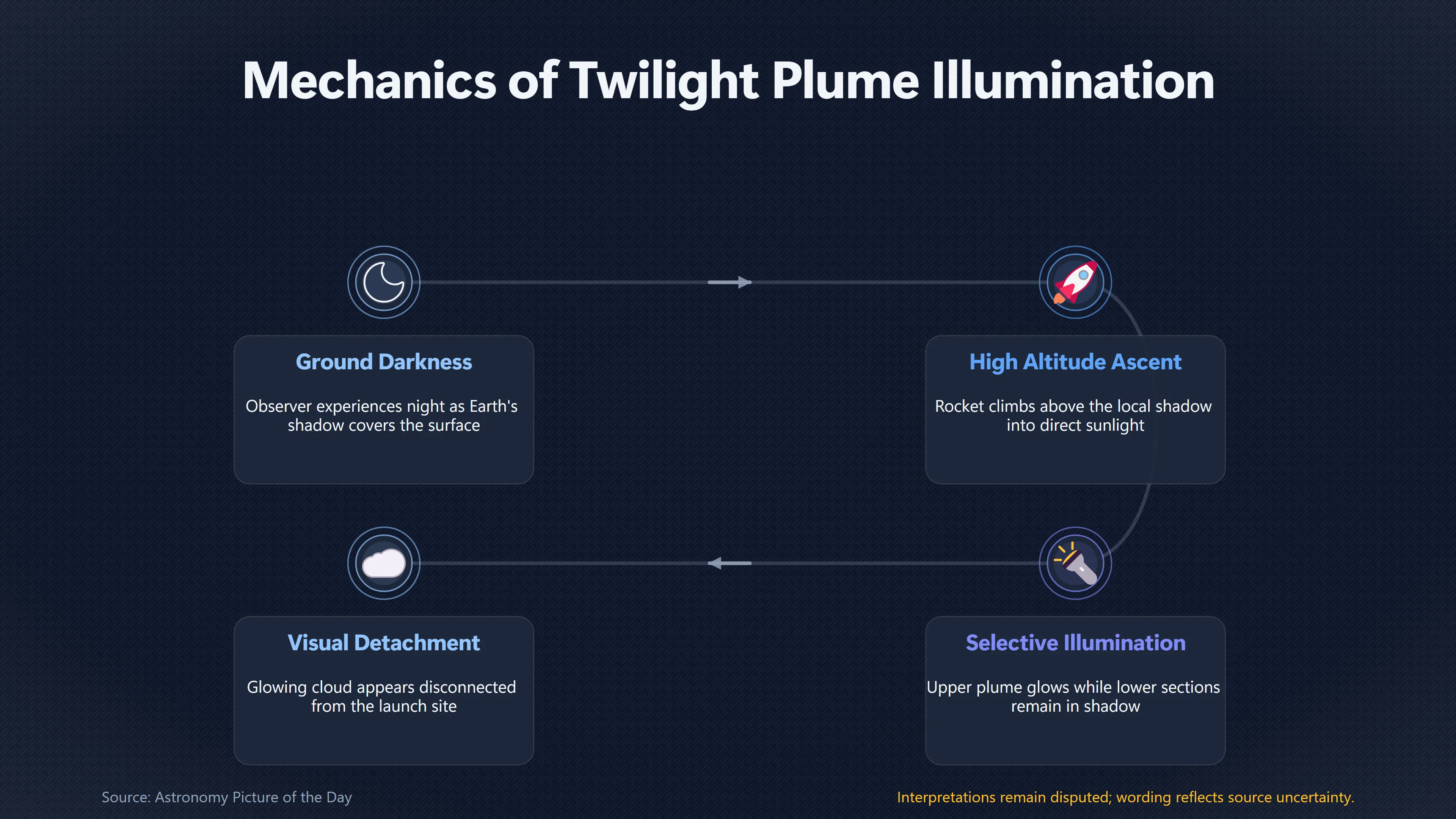
Sunset at ground level does not mean that everything above the observer has entered darkness. Earth’s shadow extends eastwards from the night side of the planet, and because Earth is curved, an object sufficiently high above the surface can still have an unobstructed line of sight to the Sun when someone on the ground cannot.
This is familiar from noctilucent, or night-shining, clouds. NASA notes that these clouds occur at roughly 80 kilometres altitude and can reflect sunlight after sunset because of their great height. Rocket exhaust can exploit the same geometry: climb high enough during evening twilight and the rocket and parts of its plume emerge above the observer’s local shadow into sunlight. Before sunrise, the geometry works in reverse — high-altitude material can see the approaching Sun before people below do.[NASA]nasa.govRocket Launches Can Create Night-Shining Clouds Away from the Poles, NASA’s AIM Mission Reveals - NASA…
NASA’s photograph of the Space Shuttle STS-98 launch on 7 February 2001 provides an unusually clear demonstration. The launch occurred near sunset. In the image, the upper portion of the Shuttle’s plume is brilliantly illuminated while the lower portion is comparatively dark. NASA explains that the upper plume was receiving direct sunlight whereas the lower plume lay inside Earth’s shadow.[NASA Science]science.nasa.govScience Smoke PlumeNASA ScienceSmoke Plume - NASA ScienceMarch 3, 2001…
That dividing line matters for eyewitness interpretation. A witness does not necessarily see a continuous trail leading neatly from the ground to the glowing phenomenon. The low-altitude exhaust can be poorly illuminated or lost against haze and terrain while the higher material suddenly becomes conspicuous. Visually, the illuminated region can therefore appear detached: a huge glowing form moving through a dark sky with no obvious connection to its launch site.
Contrast amplifies the effect. During broad daylight, sunlight may illuminate an exhaust plume just as effectively, but the bright sky competes with the scattered light. Around twilight, the observer instead has a relatively dark background behind material that is still sunlit. NASA’s Astronomy Picture of the Day explicitly describes this “Twilight Effect”: high-altitude rocket exhaust can remain illuminated even though the ground observer is experiencing night.[Astronomy Picture of the Day]apod.nasa.govMarch 12, 2024…
The illumination is therefore selective rather than mysterious. One section of a trail may blaze white or blue while another seems to disappear. As the rocket climbs and the Sun-Earth-rocket geometry changes, the illuminated boundary can also move through the plume, making its appearance evolve quickly.
Why low pressure makes the plume spread
Sunlight explains why the plume becomes conspicuous; gas dynamics explain why it can become enormous.
Near sea level, a rocket’s exhaust encounters relatively dense surrounding air. As the vehicle climbs, atmospheric pressure drops steeply. Exhaust leaving the nozzle can then expand much farther sideways before its pressure approaches that of its surroundings. NASA technical literature describes high-altitude rocket operation as producing strongly underexpanded exhaust flow — meaning that the gases leave the nozzle at a pressure greater than the ambient pressure and continue expanding outside it. NASA plume studies likewise note that very low ambient pressure can produce highly underexpanded, wide plumes.[NASA Technical Reports Server]ntrs.nasa.govNASA Technical Reports Servertheoretical boundaries and internal characteristics of…by EH Andrews Jr · 1965 · Cited by 14 — The operat…
This produces an important difference between the rocket itself and the thing an eyewitness actually sees. The rocket may be only a few metres across, but its exhaust is not confined to anything resembling the vehicle’s diameter. As the surrounding pressure falls, the illuminated material can occupy an increasingly broad volume behind it.
The visible cloud is also more complicated than a simple cone of hot gas. Depending on the propulsion system and phase of flight, exhaust products can include gases, water vapour and particles; material may cool, condense or freeze as it disperses. NASA sounding-rocket experiments deliberately exploit the visibility of high-altitude vapours, releasing tracer material that forms conspicuous artificial clouds so researchers can study motion in the upper atmosphere.[NASA]nasa.govNASA Mission to Study Earth’s Atmosphere by Forming Artificial Night-time Clouds over Marshall Islands - NASAMay 30, 2019…
For a distant observer, the combination can be startling:
- The bright point and the cloud have radically different apparent sizes. The rocket may be unresolved by the naked eye while its illuminated exhaust covers degrees of sky.
- The plume has no hard surface. Its soft boundary grows and changes continuously, unlike the silhouette expected from a conventional aircraft.
- Different parts can expand at different rates. Fresh exhaust remains associated with the moving rocket while older material spreads behind it.
- Perspective compresses depth. Material distributed along a long three-dimensional flight path can overlap in the observer’s line of sight, producing what looks like one bulbous or structured object.
This is why descriptions such as “giant craft”, “glowing bubble” or “jellyfish” can be perceptually understandable yet physically misleading. The observer is estimating the dimensions of an unknown object without knowing its distance. A diffuse cloud tens or hundreds of kilometres away provides few familiar size cues, so its angular extent can easily be mistaken for the outline of a single immense body.
The 2017 California plume shows the effect clearly
The Falcon 9 launch from Vandenberg on 22 December 2017 became a particularly useful real-world demonstration because it occurred shortly after sunset and was seen across a heavily populated region. Contemporary coverage recorded widespread surprise and UFO or alien speculation as a brilliant moving point developed an immense teardrop-shaped luminous plume over Southern California.[SYFY]syfy.comits a bird its a ufo its … a falcon 9 rocketits a bird its a ufo its … a falcon 9 rocket
The spectacle did not require an abnormal vehicle. Twilight made otherwise understandable launch physics unusually visible. As the Falcon 9 climbed, its high-altitude exhaust remained sunlit against the darker sky below. With the exhaust expanding into increasingly low ambient pressure, the luminous region became disproportionately large compared with the rocket itself. The result looked much less like the popular image of a rocket — a small vehicle with a narrow flame — and much more like an independent glowing aerial phenomenon. Vandenberg Space Force Base has subsequently highlighted the 2017 event as a twilight launch in which sunlight illuminated the exhaust plume.[Facebook]facebook.comOpen source on facebook.com.
The underlying effect is not peculiar to Falcon 9. A NASA image of a Shuttle plume shows the same sunlight-versus-Earth-shadow boundary, while NASA’s studies of noctilucent clouds establish the broader optical principle that sufficiently high material can remain sunlit over an observer experiencing darkness. The memorable Falcon 9 displays simply combine that lighting geometry with a particularly conspicuous expanding rocket plume.[NASA Science]science.nasa.govScience Smoke PlumeNASA ScienceSmoke Plume - NASA ScienceMarch 3, 2001…
Nor is the phenomenon merely historical. Predawn Falcon 9 launches in 2026 produced conspicuous “jellyfish” plumes over Florida when high-altitude exhaust caught sunlight before sunrise at ground level. The repetition under similar lighting conditions is useful evidence that the spectacular appearance depends strongly on geometry and timing rather than on an anomalous flight.[Space]space.comOpen source on space.com.
Why the cloud can seem detached from the rocket
Perhaps the most misleading feature is that a twilight plume does not always look like a “trail” in the everyday sense.
A familiar aircraft contrail encourages the eye to connect a narrow white line with an aeroplane at its tip. A high-altitude rocket plume can behave very differently. The rocket continues rapidly along its trajectory while older exhaust expands behind it. Illumination can emphasise only certain volumes of that material, and Earth’s shadow can hide lower portions altogether. The visible result may consist of a tiny bright source accompanied by a vastly larger translucent cloud, with dark gaps between apparently separate luminous regions.
A particularly extreme example appears in NASA’s 2024 Astronomy Picture of the Day. Exhaust associated with a Falcon 9 launch from Vandenberg was photographed from Akureyri, Iceland, as an enormous spiral that could superficially resemble a galaxy. NASA identified it as ordinary rocket exhaust seen under favourable twilight illumination, with the rocket’s reorientation contributing to the spiral structure.[Astronomy Picture of the Day]apod.nasa.govMarch 12, 2024…
That example demonstrates why apparent separation is weak evidence for a separate craft. At orbital distances, exhaust released by a rocket can remain visible over an enormous geographical area, and the brightest visible structure need not sit immediately beside an obvious rocket-shaped source. The luminous cloud traces where material has been deposited and illuminated, not the physical boundary of the vehicle.
Clues that distinguish a twilight plume from a craft
No single visual feature proves that a sighting is rocket exhaust, but twilight plumes have a recognisable combination of characteristics. The most useful assessment comes from matching several independent clues rather than relying on whether the shape “looks like” a rocket.
Timing near sunrise or sunset is a strong clue. The classic display requires a dark or darkening foreground and high-altitude material that can still receive direct sunlight. A spectacular plume appearing during twilight therefore has an immediate geometrical explanation worth checking. NASA documents this illumination mechanism directly.[Astronomy Picture of the Day]apod.nasa.govMarch 12, 2024…
Rapid expansion without a corresponding solid outline is another clue. A plume can broaden dramatically because it is gas and particulate material spreading into low ambient pressure. An apparent object whose luminous envelope balloons while a much smaller bright point continues along the flight path behaves more like an illuminated cloud than a rigid vehicle.[NASA Technical Reports Server]ntrs.nasa.govNASA Technical Reports Servertheoretical boundaries and internal characteristics of…by EH Andrews Jr · 1965 · Cited by 14 — The operat…
Soft, translucent or overlapping boundaries favour a plume interpretation. Sunlit exhaust can produce gradients, wisps and broad fans rather than a stable edge. Because different sections occupy different distances along the trajectory, projected shapes can overlap and change as the observer’s viewing geometry changes.
A dark lower trail and bright upper trail can reveal Earth’s shadow directly. NASA’s STS-98 image demonstrates this particularly well: the same plume changes brightness according to whether it is inside or outside Earth’s shadow. Such a boundary is difficult to explain as the physical edge of a huge luminous craft but follows naturally from twilight geometry.[NASA Science]science.nasa.govScience Smoke PlumeNASA ScienceSmoke Plume - NASA ScienceMarch 3, 2001…
The launch trajectory provides the strongest external check. If the time, direction and motion correspond to a documented rocket launch, the unusual apparent size is not evidence against that identification. It is often precisely what should be expected when an expanding high-altitude plume is illuminated under favourable twilight conditions.
The apparent size is the illusion’s central feature
Twilight plumes are especially effective generators of UFO or UAP reports because human vision normally treats a luminous boundary as evidence of an object’s boundary. With a rocket plume, that assumption fails. The edge of the light marks approximately where illuminated exhaust becomes too thin, too shadowed or too faint to see — not where a solid vehicle ends.
The rocket itself may therefore contribute only a tiny moving light to the spectacle. Almost everything that makes the event seem immense can be exhaust spread through a far larger volume and picked out by sunlight unavailable to the observer below.
That is the central mechanism behind the classic twilight “jellyfish”: Earth’s curvature separates the observer’s lighting conditions from those of the rocket, while low atmospheric pressure separates the size of the rocket from the size of its plume. Put those effects together against a dark sky, and an ordinary launch can generate a luminous structure so large and apparently detached that, without launch context, describing it initially as an unidentified aerial phenomenon is entirely unsurprising.[nasa.gov]apod.nasa.govAstronomy Picture of the DayMarch 12, 2024…
Amazon book picks
Further Reading
Books and field guides related to Why Twilight Rocket Plumes Look So Enormous. Use these as the next step if you want deeper reading beyond the article.
Reentry: SpaceX, Elon Musk, and the Reusable Rockets that Lau...
Featured in The Economist’s Best Books of 2024 USA Today Bestseller How did a shaky startup defy expectations and become the world’s lead...
Liftoff: Elon Musk and the Desperate Early Days That Launched...
The dramatic inside story of the first four historic flights that launched SpaceX-and Elon Musk-from a shaky startup into the world's lea...
Ignition!: An Informal History of Liquid Rocket Propellants
John Clark tells here, with irreverent and eyewitness immediacy, the story of the search for a power packaging which could be trusted to...
Rocket Propulsion Elements
Rating: 4.5/5 from 11 Google Books ratings
Aerospace Engineering/Mechanical Engineering The definitive text on rocket propulsion-now completely revised to reflect rapid advancement...
eBay marketplace picks
Marketplace Samples
Live-tested eBay searches with available results related to this page.
Selected fromrocket launch poster oneBay.co.uk.


Endnotes
1.
Source: apod.nasa.gov
Title: Astronomy Picture of the Day
Link:https://apod.nasa.gov/apod/ap240312.html
Source snippet
March 12, 2024...
Published: March 12, 2024
2.
Source: nasa.gov
Link:https://www.nasa.gov/missions/aim/rocket-launches-can-create-night-shining-clouds-away-from-the-poles-nasas-aim-mission-reveals/
Source snippet
Rocket Launches Can Create Night-Shining Clouds Away from the Poles, NASA’s AIM Mission Reveals - NASA...
3.
Source: science.nasa.gov
Title: Science NASA
Link:https://science.nasa.gov/missions/aim/nasa-noctilucent-clouds/
Source snippet
NASA ScienceNASA - Noctilucent Clouds - NASA Science...
4.
Source: nasa.gov
Title: Mission Seeks to Understand Bright Night-Shining Clouds by Creating One
Link:https://www.nasa.gov/missions/sounding-rockets/nasa-mission-seeks-to-understand-bright-night-shining-clouds-by-creating-one/
Source snippet
NASA Mission Seeks to Understand Bright Night-Shining Clouds by Creating One - NASA...
5.
Source: science.nasa.gov
Title: Science Smoke Plume
Link:https://science.nasa.gov/earth/earth-observatory/smoke-plume-1221/
Source snippet
NASA ScienceSmoke Plume - NASA ScienceMarch 3, 2001...
Published: March 3, 2001
6.
Source: ntrs.nasa.gov
Link:https://ntrs.nasa.gov/api/citations/19650009676/downloads/19650009676.pdf
Source snippet
NASA Technical Reports Servertheoretical boundaries and internal characteristics of...by EH Andrews Jr · 1965 · Cited by 14 — The operat...
7.
Source: ntrs.nasa.gov
Link:https://ntrs.nasa.gov/api/citations/20180003486/downloads/20180003486.pdf?attachment=true
Source snippet
NASA Technical Reports ServerOptical Diagnostic Imaging of Multi-Rocket Plume-Induced...At high altitudes, the freestream pressure is mu...
8.
Source: nasa.gov
Link:https://www.nasa.gov/missions/sounding-rockets/nasa-mission-to-study-earths-atmosphere-by-forming-artificial-night-time-clouds-over-marshall-islands/
Source snippet
NASA Mission to Study Earth’s Atmosphere by Forming Artificial Night-time Clouds over Marshall Islands - NASAMay 30, 2019...
Published: May 30, 2019
9.
Source: nasa.gov
Title: About Vapor Tracers
Link:https://www.nasa.gov/soundingrockets/about-vapor-tracers/
Source snippet
About Vapor Tracers - NASA...
10.
Source: syfy.com
Title: its a bird its a ufo its … a falcon 9 rocket
Link:https://www.syfy.com/syfy-wire/its-a-bird-its-a-ufo-its-%E2%80%A6-a-falcon-9-rocket
11.
Source: time.com
Title: spacex los angeles aliens
Link:https://time.com/5078397/spacex-los-angeles-aliens/
12.
Source: facebook.com
Link:https://www.facebook.com/SLD30/posts/did-you-see-it-throwbackthursday-to-dec-22-2017when-a-launch-from-vandenberg-lit/1398892488950376/
13.
Source: space.com
Link:https://www.space.com/space-exploration/launches-spacecraft/spacex-starlink-10-40-b1080-ccsfs-asog
14.
Source: space.com
Link:https://www.space.com/space-exploration/spacex-launch-creates-colorful-jellyfish-in-the-night-sky-space-photo-of-the-day-for-july
15.
Source: nasa.gov
Title: NAS A Simulations Improve Artemis II Launch Environment
Link:https://www.nasa.gov/aeronautics/artemis-sls-launch-sim/
16.
Source: apod.nasa.gov
Link:https://apod.nasa.gov/apod/ap260319.html
17.
Source: science.nasa.gov
Title: tropical solstice shadows
Link:https://science.nasa.gov/solar-system/skywatching/night-sky-network/tropical-solstice-shadows/
18.
Source: earth.com
Title: Strange white light photographed for 10 minutes in U.S. skies
Link:https://www.earth.com/news/strange-white-streak-of-light-resembled-smoke-plume-was-photographed-for-10-minutes-in-us-skies/
19.
Source: science.nasa.gov
Title: launching rockets into radio disrupting clouds
Link:https://science.nasa.gov/science-research/heliophysics/nasa-launching-rockets-into-radio-disrupting-clouds/
20.
Source: space.com
Link:https://www.space.com/space-exploration/launches-spacecraft/spacex-rocket-launch-spawns-dazzling-space-jellyfish-in-evening-sky-photos
21.
Source: apod.nasa.gov
Link:https://apod.nasa.gov/rjn/apod/ap240312.html
22.
Source: apod.nasa.gov
Link:https://apod.nasa.gov/apod/ap240311.html
23.
Source: apod.nasa.gov
Link:https://apod.nasa.gov/apod/ap240307.html
24.
Source: nasa.gov
Title: Falcon 9 Second Stage Engine Shuts Down
Link:https://www.nasa.gov/blogs/commercialcrew/2024/03/03/falcon-9-second-stage-engine-shuts-down-2/
25.
Source: nasa.gov
Title: Falcon 9 Second Stage Engine Shuts Down
Link:https://www.nasa.gov/blogs/spacestation/2024/03/03/falcon-9-second-stage-engine-shuts-down/
26.
Source: apod.nasa.gov
Link:https://apod.nasa.gov/apod/ap240211.html
27.
Source: nas.nasa.gov
Link:https://www.nas.nasa.gov/SC23/research/project12.html
28.
Source: space.com
Title: Sunset Space X rocket launch spawns ‘space jellyfish’ photos | Space
Link:https://www.space.com/spacex-sunset-rocket-launch-space-jellyfish-photos-december-2022
29.
Source: space.com
Title: X launch spawns spectacular sky ‘jellyfish’ (video, photos) | Space
Link:https://www.space.com/spacex-falcon-9-launch-sky-jellyfish-video-photos
30.
Source: science.nasa.gov
Title: crepuscular rays and light scattering 150090
Link:https://science.nasa.gov/earth/earth-observatory/crepuscular-rays-and-light-scattering-150090/
31.
Source: science.nasa.gov
Title: smoke in the stratosphere 148276
Link:https://science.nasa.gov/earth/earth-observatory/smoke-in-the-stratosphere-148276/
32.
Source: nasa.gov
Title: Plume Surface Interaction (PSI)
Link:https://www.nasa.gov/directorates/stmd/plume-surface-interaction-psi/
33.
Source: science.nasa.gov
Title: clouds light the night 145202
Link:https://science.nasa.gov/earth/earth-observatory/clouds-light-the-night-145202/
34.
Source: apod.nasa.gov
Link:https://apod.nasa.gov/apod/ap181012.html
35.
Source: apod.nasa.gov
Link:https://apod.nasa.gov/apod/ap171224.html
36.
Source: space.com
Title: UF O? No, That’s a Space X Rocket! These Photos Are Simply Amazing | Space
Link:https://www.space.com/39200-spacex-rocket-launch-not-ufo-spectactular-photos.html
37.
Source: ntrs.nasa.gov
Link:https://ntrs.nasa.gov/citations/20170010206
38.
Source: science.nasa.gov
Title: colorful clouds glow over virginia 90497
Link:https://science.nasa.gov/earth/earth-observatory/colorful-clouds-glow-over-virginia-90497/
39.
Source: nasa.gov
Title: NAS A Wallops Rocket Launch Lights up the Mid-Atlantic Coast
Link:https://www.nasa.gov/missions/sounding-rockets/nasa-wallops-rocket-launch-lights-up-the-mid-atlantic-coast/
40.
Source: space.com
Title: X Rocket Launch Sparks ‘UFO’ Sightings: Reports (Video) | Space
Link:https://www.space.com/23013-spacex-falcon-9-rocket-ufo.html
41.
Source: science.nasa.gov
Title: tidally locked [planets]({{ ‘planets/’ | relative_url }}) earth at twilight
Link:https://science.nasa.gov/resource/tidally-locked-planets-earth-at-twilight/
42.
Source: ntrs.nasa.gov
Link:https://ntrs.nasa.gov/citations/20110014613
43.
Source: science.nasa.gov
Title: polar mesospheric clouds illuminated by orbital sunrise 44488
Link:https://science.nasa.gov/earth/earth-observatory/polar-mesospheric-clouds-illuminated-by-orbital-sunrise-44488/
44.
Source: nasa.gov
Title: Earth at Twilight
Link:https://www.nasa.gov/image-article/earth-twilight/
45.
Source: science.nasa.gov
Title: noctilucent clouds 8366
Link:https://science.nasa.gov/earth/earth-observatory/noctilucent-clouds-8366/
46.
Source: apod.nasa.gov
Link:https://apod.nasa.gov/apod/ap020926.html
47.
Source: ntrs.nasa.gov
Link:https://ntrs.nasa.gov/search.jsp?R=19800039777
48.
Source: ntrs.nasa.gov
Link:https://ntrs.nasa.gov/citations/19770021268
49.
Source: ntrs.nasa.gov
Link:https://ntrs.nasa.gov/citations/19760015167
50.
Source: ntrs.nasa.gov
Link:https://ntrs.nasa.gov/citations/19760014193
51.
Source: ntrs.nasa.gov
Link:https://ntrs.nasa.gov/citations/19730020190
52.
Source: ntrs.nasa.gov
Link:https://ntrs.nasa.gov/citations/19720018638
53.
Source: rscience.gsfc.nasa.gov
Link:https://rscience.gsfc.nasa.gov/srrov.html
54.
Source: apod.nasa.gov
Title: apod search
Link:https://apod.nasa.gov/cgi-bin/apod/apod_search?tquery=2024
55.
Source: ntrs.nasa.gov
Link:https://ntrs.nasa.gov/api/citations/20200000979/downloads/20200000979.pdf
56.
Source: ntrs.nasa.gov
Link:https://ntrs.nasa.gov/api/citations/20110014613/downloads/20110014613.pdf
57.
Source: ntrs.nasa.gov
Link:https://ntrs.nasa.gov/api/citations/19670022660/downloads/19670022660.pdf
58.
Source: ntrs.nasa.gov
Link:https://ntrs.nasa.gov/api/citations/20150016548/downloads/20150016548.pdf
59.
Source: ntrs.nasa.gov
Link:https://ntrs.nasa.gov/api/citations/20140003943/downloads/20140003943.pdf
60.
Source: ntrs.nasa.gov
Link:https://ntrs.nasa.gov/api/citations/19770022262/downloads/19770022262.pdf
61.
Source: tfaws.nasa.gov
Title: TFAWS07 1012
Link:https://tfaws.nasa.gov/TFAWS07/Proceedings/TFAWS07-1012.pdf
62.
Source: ntrs.nasa.gov
Link:https://ntrs.nasa.gov/api/citations/19730002016/downloads/19730002016.pdf
63.
Source: ntrs.nasa.gov
Link:https://ntrs.nasa.gov/api/citations/19820010442/downloads/19820010442.pdf
64.
Source: ntrs.nasa.gov
Link:https://ntrs.nasa.gov/api/citations/19670026897/downloads/19670026897.pdf
65.
Source: ntrs.nasa.gov
Link:https://ntrs.nasa.gov/api/citations/20110015765/downloads/20110015765.pdf
66.
Source: ntrs.nasa.gov
Link:https://ntrs.nasa.gov/api/citations/19760017262/downloads/19760017262.pdf
67.
Source: nas.nasa.gov
Title: how To Rocket Plumes 08.11
Link:https://www.nas.nasa.gov/publications/software/docs/cart3d/pages/howto/howTo_RocketPlumes_08.11.pdf
68.
Source: ntrs.nasa.gov
Link:https://ntrs.nasa.gov/api/citations/19940008100/downloads/19940008100.pdf
69.
Source: ntrs.nasa.gov
Link:https://ntrs.nasa.gov/api/citations/19710005274/downloads/19710005274.pdf
70.
Source: ntrs.nasa.gov
Link:https://ntrs.nasa.gov/api/citations/20090032801/downloads/20090032801.pdf
71.
Source: facebook.com
Link:https://www.facebook.com/groups/233130583862628/posts/2237393563436310/
72.
Source: facebook.com
Link:https://www.facebook.com/groups/233130583862628/posts/2472484206593910/
73.
Source: facebook.com
Link:https://www.facebook.com/groups/SpaceLaunchSchedule/posts/1100209984352791/
74.
Source: facebook.com
Title: falcon 9 lit up the california night sky and delivered 45 payloads to orbit on t
Link:https://www.facebook.com/spacefans1/posts/falcon-9-lit-up-the-california-night-sky-and-delivered-45-payloads-to-orbit-on-t/1395056472653358/
75.
Source: facebook.com
Link:https://www.facebook.com/10NewsAU/posts/a-mysterious-white-plume-has-lit-up-the-night-sky-across-parts-of-australia-in-w/1434405662059321/
76.
Source: facebook.com
Link:https://www.facebook.com/thebrainmazeofficial/posts/a-mysterious-glow-in-the-sky-the-spacex-jellyfish-is-a-glowing-rocket-exhaust-pl/1057938386889754/
77.
Source: facebook.com
Link:https://www.facebook.com/groups/spaceXverse/posts/3860831827555147/
78.
Source: facebook.com
Link:https://www.facebook.com/news6/posts/jellyfish-in-the-sky-if-youve-ever-seen-a-glowing-space-jellyfish-after-a-rocket/1441276064701116/
79.
Source: facebook.com
Link:https://www.facebook.com/TomTerryWFTV/posts/another-beautiful-rocket-launch-this-morning-and-you-can-see-the-exhaust-jellyfi/1556751485814303/
80.
Source: facebook.com
Link:https://www.facebook.com/groups/252029351211252/posts/745869165160599/
81.
Source: facebook.com
Link:https://www.facebook.com/sameckholm/posts/missile-launches-glow-from-space/1373724948229517/
82.
Source: facebook.com
Link:https://www.facebook.com/SrijanKalam/posts/a-photograph-taken-from-jordan-after-irans-launch-of-sejjil-ballistic-missiles-c/1591715235651553/
83.
Source: facebook.com
Link:https://www.facebook.com/andrei.stoica.395/posts/spacex-falcon-9-launch-last-night-seen-from-south-chandler-arizonathese-launches/28302338146039255/
84.
Source: youtube.com
Title: CRS-15 Gorgeous Sunrise Launch!
Link:https://www.youtube.com/watch?v=11xIQ_mlS2g
Source snippet
SpaceX Launch Forms Space Jellyfish (May 6, 2022)...
Published: May 6, 2022
85.
Source: youtube.com
Title: Space X Launch Forms Space Jellyfish (
Link:https://www.youtube.com/watch?v=58QsG0uYTNA
Published: May 6, 2022
86.
Source: philsa.gov.ph
Title: Philippine Space Agency
Link:https://philsa.gov.ph/news/advisory-on-space-jellyfish-sighting-on-may-12/
87.
Source: philsa.gov.ph
Title: Philippine Space Agency
Link:https://philsa.gov.ph/news/advisory-on-space-jellyfish-sighting-on-11-april-2026/
88.
Source: spacex.com
Title: Space X
Link:https://www.spacex.com/launches/twilight
89.
Source: sprite.phys.ncku.edu.tw
Link:https://sprite.phys.ncku.edu.tw/astrolab/mirrors/apod_e/ap240312.html
90.
Source: aerotechnews.com
Title: Space X launch sparks UFO sightings
Link:https://www.aerotechnews.com/blog/2017/12/29/spacex-launch-sparks-ufo-sightings/
91.
Source: spaceflightnow.com
Title: Falcon 9 launch lights up Southern California sky – Spaceflight Now
Link:https://spaceflightnow.com/2017/12/28/falcon-9-launch-lights-up-southern-california-sky/
92.
Source: theguardian.com
Link:https://www.theguardian.com/science/2017/dec/23/spacex-rocket-dazzles-in-california-sky-as-it-carries-10-[satellites
93.
Source: spaceflightnow.com
Link:https://spaceflightnow.com/2017/12/23/spacex-launch-dazzles-delivering-10-more-satellites-for-iridium/
94.
Source: cbsnews.com
Title: Space X Rocket Launch Sparks UFO Rumors On Social Media
Link:https://www.cbsnews.com/newyork/news/california-rocket-launch-ufo-reports/
95.
Source: npr.org
Title: spacex rocket launch lights up the california sky freaks out some residents
Link:https://www.npr.org/sections/thetwo-way/2017/12/23/573194940/spacex-rocket-launch-lights-up-the-california-sky-freaks-out-some-residents
96.
Source: dailysabah.com
Title: Space X rocket mistaken for UFO, missile by spooked Californians | Daily Sabah
Link:https://www.dailysabah.com/science/2017/12/23/spacex-rocket-mistaken-for-ufo-missile-by-spooked-californians
97.
Source: kpbs.org
Link:https://www.kpbs.org/news/2017/12/23/spacex-rocket-launch-lights-up-the-california-sky
98.
Source: wgbh.org
Title: spacex rocket launch lights up the california sky freaks out some residents
Link:https://www.wgbh.org/news/2017-12-23/spacex-rocket-launch-lights-up-the-california-sky-freaks-out-some-residents
99.
Source: space.stackexchange.com
Link:https://space.stackexchange.com/questions/8358/what-does-the-exhaust-plume-of-a-rocket-look-like-in-vacuum
100.
Source: businessinsider.com
Link:https://www.businessinsider.com/spacex-starlink-internet-satellite-rocket-launch-glowing-cloud-photos-videos
101.
Source: sciencedirect.com
Title: Rocket Exhaust
Link:https://www.sciencedirect.com/topics/earth-and-planetary-sciences/rocket-exhaust
102.
Source: spacelaunchschedule.com
Link:https://www.spacelaunchschedule.com/news/the-jellyfish-effect-during-rocket-launches-a-stunning-twilight-phenomenon/
Additional References
103.
Source: youtube.com
Title: Experience a Space X Orbital Twilight
Link:https://www.youtube.com/watch?v=N842SaIlfFQ
Source snippet
Rare SpaceX Falcon 9 "SPACE JELLYFISH" Effect - Stunning...
104.
Source: weather.gov
Link:https://www.weather.gov/fsd/twilight
105.
Source: youtube.com
Title: Rare Space X Falcon 9 “SPACE JELLYFISH” Effect
Link:https://www.youtube.com/watch?v=HJy9mOGHsKU
Source snippet
Incredible Glowing Plume Captured During SpaceX Falcon 9 Launch...
106.
Source: researchgate.net
Link:https://www.researchgate.net/publication/229041937_Sublimation_of_ice_particles_from_rocket_exhausts_in_the_upper_atmosphere
107.
Source: sciencedirect.com
Link:https://www.sciencedirect.com/science/article/pii/S1270963826002622
108.
Source: instagram.com
Link:https://www.instagram.com/reel/DXuGF0NCLfU/
109.
Source: sciencedirect.com
Link:https://www.sciencedirect.com/science/article/abs/pii/S1270963824009507
110.
Source: reddit.com
Link:https://www.reddit.com/r/Astronomy/comments/1moyjcc/does_anyone_know_of_a_website_where_i_can_get_a/
111.
Source: instagram.com
Link:https://www.instagram.com/p/DW9U-zWDnNh/
112.
Source: sciencedirect.com
Link:https://www.sciencedirect.com/science/article/pii/S0017931025001061