Within Autokinesis
How Pilots Stop a Stationary Light Fooling Them
Pilots reduce autokinesis by breaking fixation, restoring external references and trusting instruments instead of an isolated light's apparent motion.
On this page
- Why staring at one light increases risk
- Scanning and external references as safeguards
- Why instruments outrank apparent visual motion
Page outline Jump by section
Introduction
Pilots break the autokinetic illusion by breaking prolonged fixation, rebuilding a stable frame of reference and refusing to steer the aircraft according to the apparent wandering of an isolated light. In ordinary night flying, that means moving the eyes through a systematic scan, looking at other objects and distances, and cross-checking the flight instruments. In some military training, pilots are also taught to place the suspicious light beside a fixed cockpit structure, such as a canopy bow, so its apparent movement can be judged against something known to be stationary.[FAASafety]faasafety.govYour Senses In The ShadowsYour Senses in the Shadows. Nighttime Visual Illusions and Spatial… | by FAA Safety Briefing Magazine | Jan, 2025 | Medium…
The operational point is important. Autokinesis does not merely make a star or distant light look odd. If a pilot treats the illusory motion as real, the apparent movement can provoke unnecessary turns, formation corrections or attempts to intercept a light that is not actually moving. The Federal Aviation Administration (FAA) explicitly warns that a disorientated pilot can lose control while trying to align the aircraft with such a light.[Federal Aviation Administration]faa.govFederal Aviation Administration Chapter 8. Medical Facts for PilotsFederal Aviation Administration Chapter 8. Medical Facts for Pilots
Why staring at one light increases risk
Autokinesis depends on sustained attention to a poorly referenced target. A lone star, planet, distant aircraft light or ground light against darkness supplies little information with which the visual system can determine whether the point itself has changed position. The practical defence therefore begins before the illusion becomes persuasive: do not give an isolated light uninterrupted visual attention for long enough to become the pilot’s reference for motion.
FAA safety guidance advises pilots to avoid staring at one point of light for more than a few seconds and to continue a systematic traffic scan. SKYbrary gives essentially the same prescription: avoid fixation, focus on objects at varying distances and maintain the normal scan pattern.[FAASafety]faasafety.govYour Senses In The ShadowsYour Senses in the Shadows. Nighttime Visual Illusions and Spatial… | by FAA Safety Briefing Magazine | Jan, 2025 | Medium…
This is not simply a theoretical precaution. A 2020 study from the Indian Air Force’s Institute of Aerospace Medicine put 103 fighter pilots through an autokinesis demonstration in a disorientation simulator. The average onset was about 20 seconds, but individual results ranged from just 4.1 seconds to more than two minutes. Most participants experienced the illusion within 30 seconds. That spread matters because there is no universally safe number of seconds for staring at an isolated light: some pilots became susceptible much faster than the familiar six-to-twelve-second rule of thumb would suggest.[Indian Journal of Aerospace Medicine]indjaerospacemed.comIndian Journal of Aerospace MedicineAutokinesis illusion in fighter flying revisited - Indian Journal of Aerospace Medicine…
The same study found that 17 of the 103 pilots said they had experienced autokinesis during actual flying. Their situations included air-to-air refuelling, combat air patrol, dark-night desert operations and maritime flying; some had mistaken stars or fixed ground lights for aircraft or adversaries and tried to join or intercept them. The finding reinforces why aviation treats fixation as an operational problem rather than merely an interesting optical illusion.[Indian Journal of Aerospace Medicine]indjaerospacemed.comIndian Journal of Aerospace MedicineAutokinesis illusion in fighter flying revisited - Indian Journal of Aerospace Medicine…
Scanning restores the missing references
The simplest countermeasure is deliberately to break the visual lock. Instead of continuously staring at the suspicious light, the pilot moves attention elsewhere and resumes scanning. FAA night-flying guidance describes a systematic traffic scan as the preventive response, while US Air Force guidance tells aircrew to shift their gaze frequently to avoid prolonged fixation.[FAASafety]faasafety.govYour Senses In The ShadowsYour Senses in the Shadows. Nighttime Visual Illusions and Spatial… | by FAA Safety Briefing Magazine | Jan, 2025 | Medium…
This works because it changes the visual problem. Autokinesis thrives when one point of light effectively occupies an otherwise unstructured visual field. Looking elsewhere introduces other information and prevents that single point from becoming the dominant reference. Aviation guidance therefore combines gaze movement with attempts to find independent references rather than simply asking the pilot to decide whether the light “looks as though” it is moving.[Skybrary]skybrary.aeroAutokinetic Effect | SKYbrary Aviation SafetyAutokinetic Effect | SKYbrary Aviation Safety…
US Air Force guidance offers a particularly concrete technique: view the light beside or through a relatively stationary aircraft structure such as the canopy bow. The apparent target is then no longer floating without a frame of reference. Its position can be compared with something whose relationship to the pilot is known. The same guidance recommends eye, head and body movements to help destroy the illusion, alongside continued instrument monitoring.[e-Publishing]static.e-publishing.af.milOpen source on af.mil.
Night-vision training makes the scanning principle even more explicit. A US Air Force aerospace-physiology training manual describes an exercise in which students first stare at fixed red lights until autokinetic movement develops. They are then taught a night scanning technique in which they imagine a diamond around the object and focus successively on points around that diamond for roughly two to three seconds, leaving the target in peripheral vision rather than maintaining uninterrupted fixation on it.[e-Publishing]static.e-publishing.af.milpam11 406e-PublishingAIR FORCE PAMPHLET 11-406December 29, 2020…
That distinction is useful when a pilot cannot simply stop watching a potentially important light. In real operations, a light might genuinely be another aircraft. The objective is therefore not necessarily to look away and forget it; it is to keep surveillance without allowing prolonged fixation to turn the target into an unreliable motion reference.
A gaze break can stop an illusion already under way
Training research suggests that breaking fixation is useful not only as prevention but also as an immediate intervention once apparent movement has begun. In the Indian Air Force simulator study, pilots deliberately allowed autokinesis to develop and then tried several ways of stopping it. A five-second gaze break worked for 99 of the 103 participants, or 96.1 per cent. Of the four for whom five seconds was insufficient, three succeeded after extending the gaze break to ten seconds.[Indian Journal of Aerospace Medicine]indjaerospacemed.comIndian Journal of Aerospace MedicineAutokinesis illusion in fighter flying revisited - Indian Journal of Aerospace Medicine…
The experiment also tested interventions that did not require losing sight of the target. Stretching the arms was reported as effective by 100 participants (97.1 per cent), while shrugging the shoulders worked for 94 (91.3 per cent). One particularly resistant participant needed a combination of gaze-breaking and shoulder movement. The authors interpreted the results as evidence that visual, vestibular and proprioceptive information — information about the body’s own movement and position — can interact in breaking the illusion.[Indian Journal of Aerospace Medicine]indjaerospacemed.comIndian Journal of Aerospace MedicineAutokinesis illusion in fighter flying revisited - Indian Journal of Aerospace Medicine…
These findings have a specific operational attraction. A fighter pilot refuelling at night, monitoring a possible target or flying formation may not want to take their eyes off a light for several seconds. The researchers therefore investigated shoulder and arm movements while pilots retained eye contact with the stimulus. They concluded that pilots should know several countermeasures rather than relying on one universal response.[Indian Journal of Aerospace Medicine]indjaerospacemed.comIndian Journal of Aerospace MedicineAutokinesis illusion in fighter flying revisited - Indian Journal of Aerospace Medicine…
That does not make arm stretching a general replacement for ordinary scanning in civil aviation. Mainstream FAA and SKYbrary advice remains centred on avoiding fixation, scanning normally and using reliable references. The simulator study is valuable because it shows experimentally that an established illusion can be disrupted and because it addresses specialised circumstances in which simply looking away may conflict with the pilot’s task.[Skybrary]skybrary.aeroAutokinetic Effect | SKYbrary Aviation SafetyAutokinetic Effect | SKYbrary Aviation Safety…
Why instruments outrank apparent visual motion
Breaking fixation deals with the deceptive light; instrument cross-checking protects the aircraft while the pilot decides what the light is doing. This is the more important safety principle.
The reason is straightforward. A pilot experiencing autokinesis may sincerely perceive movement. Trying harder to inspect the same light does not necessarily settle whether that movement is real. Flight instruments provide an independent source of information about aircraft attitude and motion. FAA guidance states that where neither a usable horizon nor surface references exist, aircraft attitude must be determined through artificial references such as the attitude indicator and other flight instruments.[Federal Aviation Administration]faa.govFederal Aviation Administration Spatial Disorientation_EnglishFederal Aviation Administration Spatial Disorientation_English
The FAA’s current spatial-disorientation guidance therefore tells pilots flying at night or in reduced visibility to use and rely on their instruments. If a visual illusion occurs, pilots are told to trust those instruments rather than conflicting bodily sensations. In a two-pilot aircraft, FAA guidance also recommends transferring control to the other pilot if one crewmember becomes affected by a visual illusion.[Federal Aviation Administration]faa.govFederal Aviation Administration Spatial DisorientationFederal Aviation AdministrationSpatial DisorientationApril 22, 2026…
Military guidance applies the same logic specifically to autokinesis. US Air Force material says pilots should monitor the flight instruments to prevent or resolve perceptual conflict. During night formation flying it additionally warns that keeping another aircraft’s lights in a constant position on the windscreen does not guarantee correct spacing or height, and calls frequent instrument scans essential.[e-Publishing]static.e-publishing.af.milOpen source on af.mil.
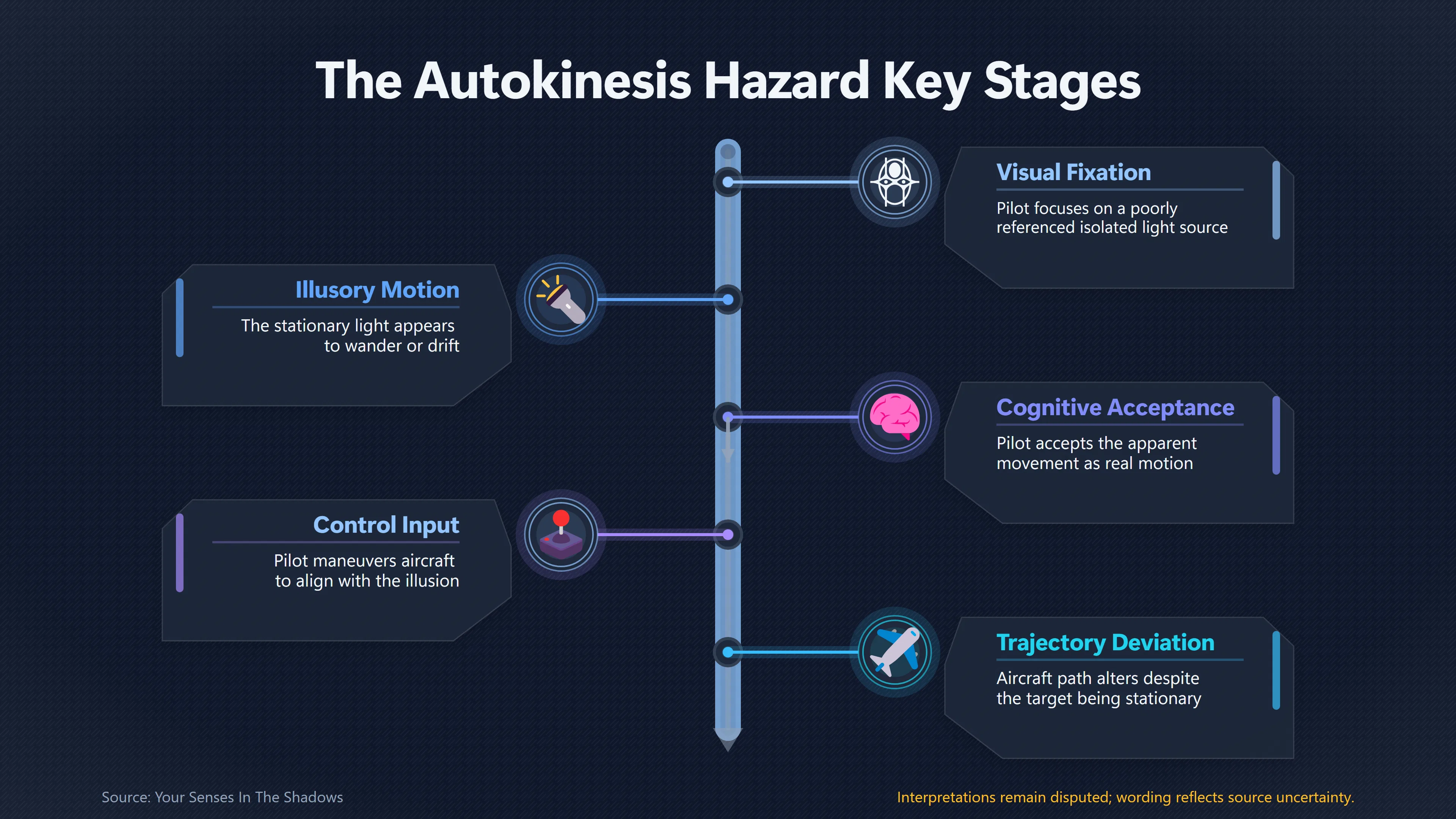
That point explains how a harmless stationary light can become a flight-control hazard. The dangerous sequence is not simply “pilot sees an illusion”. It is:
- the pilot fixates on a poorly referenced light;
- the light appears to move;[thepilotexam.com]thepilotexam.comSource details in endnotes.
- the pilot accepts that apparent movement as real;
- the pilot makes control inputs to compensate for it; and
- those inputs alter the real aircraft trajectory even though the original target movement was illusory.
The FAA’s Aeronautical Information Manual summarises the consequence starkly: a pilot affected by autokinesis can lose control while attempting to align the aircraft with the light. Aerospace-medicine literature likewise notes that unnecessary control inputs made while following or intercepting an apparently moving target increase workload and can turn the illusion into an operational hazard.[Federal Aviation Administration]faa.govFederal Aviation Administration Chapter 8. Medical Facts for PilotsFederal Aviation AdministrationChapter 8. Medical Facts for PilotsJanuary 8, 2015…
Training pilots to recognise the trick
A further defence happens before the flight: pilots can be shown the illusion under controlled conditions so that its signature is familiar when it appears unexpectedly.
The US Air Force uses night-vision training equipment to demonstrate autokinesis directly. Students stare at a fixed light until they experience apparent movement and are then taught the scanning technique used to prevent it. The purpose is not to prove that a trained pilot becomes immune. It is to make the perceptual failure recognisable and pair recognition with a practised response.[AMC]amc.af.milJune 7, 2020…
The Indian Air Force study points in the same direction. Pilots who had previously encountered autokinesis in flight recognised its onset sooner during their first simulator exposure than pilots without that experience. The researchers consequently argued that demonstrations should form part of training so aircrew learn to identify the illusion quickly enough to apply countermeasures.[Indian Journal of Aerospace Medicine]indjaerospacemed.comIndian Journal of Aerospace MedicineAutokinesis illusion in fighter flying revisited - Indian Journal of Aerospace Medicine…
FAA spatial-disorientation material adopts the broader version of this principle, recommending controlled exposure to sensory illusions using training devices so pilots are better prepared to recognise an illusion and respond appropriately in flight. It also stresses continued proficiency in controlling the aircraft by reference to instruments.[Federal Aviation Administration]faa.govFederal Aviation Administration Spatial Disorientation_EnglishFederal Aviation Administration Spatial Disorientation_English
What this means for apparent UAP motion
For UFO or UAP reports involving a solitary night-time light, pilot countermeasures provide a useful clue about what evidence distinguishes autokinesis from genuine displacement. Aviation practice does not resolve the uncertainty by asking whether the witness was confident that the light moved. Instead, it deliberately seeks independent reference information.
If apparent wandering diminishes when fixation is broken, or if the light remains fixed relative to reliable external references while seeming to move during prolonged staring, autokinesis becomes a strong candidate explanation. Conversely, movement independently measurable against the horizon, terrain, stars, cockpit references, instruments, radar or other suitable data cannot simply be dismissed as autokinesis merely because the observation occurred at night.
That is why the pilot defence is so revealing. The response to an isolated light that appears to manoeuvre is not to stare harder and follow it. It is to break fixation, restore references, cross-check independent information and keep the aircraft under instrument-supported control. The apparent motion may feel entirely real; aviation training is designed around the fact that, under these conditions, feeling real is not enough.[skybrary.aero]skybrary.aeroAutokinetic Effect | SKYbrary Aviation SafetyAutokinetic Effect | SKYbrary Aviation Safety…
Amazon book picks
Further Reading
Books and field guides related to How Pilots Stop a Stationary Light Fooling Them. Use these as the next step if you want deeper reading beyond the article.
Human Factors in Flight
The late Captain Frank H Hawkins FRAes, M Phil, was Human Factors Consultant to KLM, for whom he had flown for over 30 years as line capt...
Stick and Rudder
First published 1972. Subjects: Aerodynamics, Flight, Piloting, Airplanes, Airplanes, piloting.
The Pilot's Manual: Flight School
Time is money in an airplane and with an instructor. Effective for both preflight learning and post-flight briefings, Flight School will...
eBay marketplace picks
Marketplace Samples
Live-tested eBay searches with available results related to this page.
Selected fromUFO patch oneBay.co.uk.




Endnotes
1.
Source: faasafety.gov
Title: Your Senses In The Shadows
Link:https://www.faasafety.gov/files/events/SO/SO15/2024/SO15134204/YourSensesInTheShadows.pdf
Source snippet
Your Senses in the Shadows. Nighttime Visual Illusions and Spatial… | by FAA Safety Briefing Magazine | Jan, 2025 | Medium...
2.
Source: static.e-publishing.af.mil
Link:https://static.e-publishing.af.mil/production/1/af_a3_5/publication/afpam11-417/afpam11-417.pdf
3.
Source: faa.gov
Title: Federal Aviation Administration Chapter 8. Medical Facts for Pilots
Link:https://www.faa.gov/Air_traffic/publications/atpubs/aim_html/chap8_section_1.html
4.
Source: skybrary.aero
Title: Autokinetic Effect | SKYbrary Aviation Safety
Link:https://skybrary.aero/index.php/articles/autokinetic-effect
Source snippet
Autokinetic Effect | SKYbrary Aviation Safety...
5.
Source: faa.gov
Title: Federal Aviation Administration Spatial Disorientation_English
Link:https://www.faa.gov/pilots/safety/pilotsafetybrochures/SpatialD.pdf
6.
Source: faa.gov
Title: Federal Aviation Administration Spatial Disorientation
Link:https://www.faa.gov/pilots/safety/pilotsafetybrochures/media/spatiald_visillus.pdf
Source snippet
Federal Aviation AdministrationSpatial DisorientationApril 22, 2026...
Published: April 22, 2026
7.
Source: faa.gov
Title: Federal Aviation Administration Chapter 8. Medical Facts for Pilots
Link:https://www.faa.gov/air_traffic/publications/atpubs/aim/aim0801.html
Source snippet
Federal Aviation AdministrationChapter 8. Medical Facts for PilotsJanuary 8, 2015...
Published: January 8, 2015
8.
Source: amc.af.mil
Link:https://www.amc.af.mil/News/Article-Display/Article/2209213/black-box-sheds-light-on-night-vision-challenges-for-aircrew-students/
Source snippet
June 7, 2020...
Published: June 7, 2020
9.
Source: faa.gov
Title: Pilot’s Handbook of Aeronautical Knowledge | Federal Aviation Administration
Link:https://www.faa.gov/regulations_policies/handbooks_manuals/aviation/phak
10.
Source: faa.gov
Title: Handbooks & Manuals | Federal Aviation Administration
Link:https://www.faa.gov/regulations_policies/handbooks_manuals
11.
Source: faa.gov
Title: Airplane Flying Handbook | Federal Aviation Administration
Link:https://www.faa.gov/regulations_policies/handbooks_manuals/aviation/airplane_handbook
12.
Source: faa.gov
Title: pilots handbook aeronautical knowledge faa h 8083 25b
Link:https://www.faa.gov/aviation/phak/pilots-handbook-aeronautical-knowledge-faa-h-8083-25b
13.
Source: faa.gov
Link:https://www.faa.gov/air_traffic/publications/atpubs/aim_html/chap11_section_8.html
14.
Source: faa.gov
Title: EN R 1.15: Medical Facts for Pilots7.. JUDGMENT ASPECTS OF COLLISION AVOIDANCE 1
Link:https://www.faa.gov/air_traffic/publications/atpubs/aip_html/part2_enr_section_1.15.html
15.
Source: faa.gov
Link:https://www.faa.gov/air_traffic/publications/atpubs/aip_html/chap7_section_6.html
16.
Source: faa.gov
Link:https://www.faa.gov/air_traffic/publications/atpubs/aim_html/chap7_section_6.html
17.
Source: faa.gov
Link:https://www.faa.gov/data_research/research/med_humanfacs/oamtechreports/1970s/1972/7208
18.
Source: skybrary.aero
Link:https://skybrary.aero/index.php/articles/visual-illusions
19.
Source: skybrary.aero
Link:https://skybrary.aero/index.php/articles/visual-scanning-technique
20.
Source: skybrary.aero
Link:https://skybrary.aero/index.php/articles/flight-instrument-presentation-aircraft-attitude
21.
Source: skybrary.aero
Link:https://skybrary.aero/index.php/articles/spatial-disorientation
22.
Source: skybrary.aero
Link:https://skybrary.aero/index.php/articles/inadvertent-vfr-flight-imc
23.
Source: skybrary.aero
Link:https://skybrary.aero/index.php/articles/structured-scan-mitigating-blind-spot-effect
24.
Source: skybrary.aero
Link:https://skybrary.aero/index.php/articles/bank-angle-awareness
25.
Source: skybrary.aero
Link:https://skybrary.aero/index.php/articles/general-aviation-night-flying-guidance
26.
Source: faasafety.gov
Link:https://www.faasafety.gov/gslac/ALC/libview_chapter.aspx?chapter=Scan+Patterns&id=6851
27.
Source: indjaerospacemed.com
Link:https://indjaerospacemed.com/autokinesis-illusion-in-fighter-flying-revisited/
Source snippet
Indian Journal of Aerospace MedicineAutokinesis illusion in fighter flying revisited - Indian Journal of Aerospace Medicine...
28.
Source: static.e-publishing.af.mil
Title: pam11 406
Link:https://static.e-publishing.af.mil/production/1/af_a3/publication/afpam11-406/afpam11-406.pdf
Source snippet
e-PublishingAIR FORCE PAMPHLET 11-406December 29, 2020...
Published: December 29, 2020
29.
Source: clevnet.overdrive.com
Link:https://clevnet.overdrive.com/media/10012635
30.
Source: trid.trb.org
Link:https://trid.trb.org/View/1725604
31.
Source: aopa.org
Title: Night Flying
Link:https://www.aopa.org/training-and-safety/students/crosscountry/skills/night-flying
32.
Source: thepilotexam.com
Link:https://thepilotexam.com/glossary/autokinetic-illusion
Additional References
33.
Source: youtube.com
Link:https://www.youtube.com/watch?v=zsZHfZz4Vr8
Source snippet
Private Pilot Ground School Lesson on Aeromedical Illusions is relevant because it explicitly dedicates a section to techniques for reduc...
34.
Source: youtube.com
Title: Chapter 17 Aeromedical Factors | PHAK
Link:https://www.youtube.com/watch?v=n1UYc615ZTQ
Source snippet
Night Flying Ground Lesson for Private Pilot: Logging, Illusions and 3 Types of Night...
35.
Source: touringmachine.com
Link:https://www.touringmachine.com/Glossary/index.php?cat=&doc=H&kind=Word<r=ALL&src=FAA-H
36.
Source: quizlet.com
Link:https://quizlet.com/1192732009/05-cfi-weather-aeromedical-night-flash-cards/
37.
Source: faraim.org
Link:https://www.faraim.org/faa/aim/chapter-8/section-8-1-5.html
38.
Source: touringmachine.com
Link:https://www.touringmachine.com/Glossary/index.php?cat=&doc=H&kind=Word<r=ALL&src=FAA-H
39.
Source: free-online-private-pilot-ground-school.com
Link:https://www.free-online-private-pilot-ground-school.com/aeromedical.html
40.
Source: airplanegroundschools.com
Link:https://airplanegroundschools.com/Aeromedical-Factors/index.html
41.
Source: scribd.com
Link:https://www.scribd.com/document/526072699/Aircraft-Carrier-Operating-Procedures-for-DCS-v01-8
42.
Source: researchgate.net
Link:https://www.researchgate.net/publication/18156658_Autokinesis_and_Eye_Movement_Control-System_Stabilization_Pilot_Study_on_Effect_of_Brief_Hand_Viewing