Within Night Sightings
When Several Aircraft Lights Look Like One Orb
Separate aircraft lights can blend together with distance, creating a bright object that appears to have no recognizable structure.
On this page
- Why separate lights merge at long range
- How viewing angle changes the apparent light pattern
- Clues that distinguish a light cluster from a solid object
Page outline Jump by section
Introduction
A distant aircraft at night can look less like an aeroplane and more like a single bright orb. The reason is straightforward: the lights remain conspicuous at distances where the aircraft’s dark fuselage, wings and the spacing between individual lamps are difficult or impossible to resolve. Several physically separate sources can therefore collapse into one apparent luminous object.
This matters for UFO and UAP reports because an observer is not necessarily seeing the aircraft and then mistaking its shape. In some circumstances, the light pattern is effectively all that can be seen. An approaching aircraft may initially present a brilliant white point; only later, after its viewing angle or angular size changes, do red and green position lights, strobes or a recognisable aircraft outline become apparent. Aviation guidance confirms both the long-range visibility of aircraft lighting and the difficulty of judging illuminated objects at night.[Federal Aviation Administration]faa.gov12 afh ch11Federal Aviation AdministrationAirplane Flying Handbook (FAA-H-8083-3C)May 8, 2026…
Why separate lights merge at long range
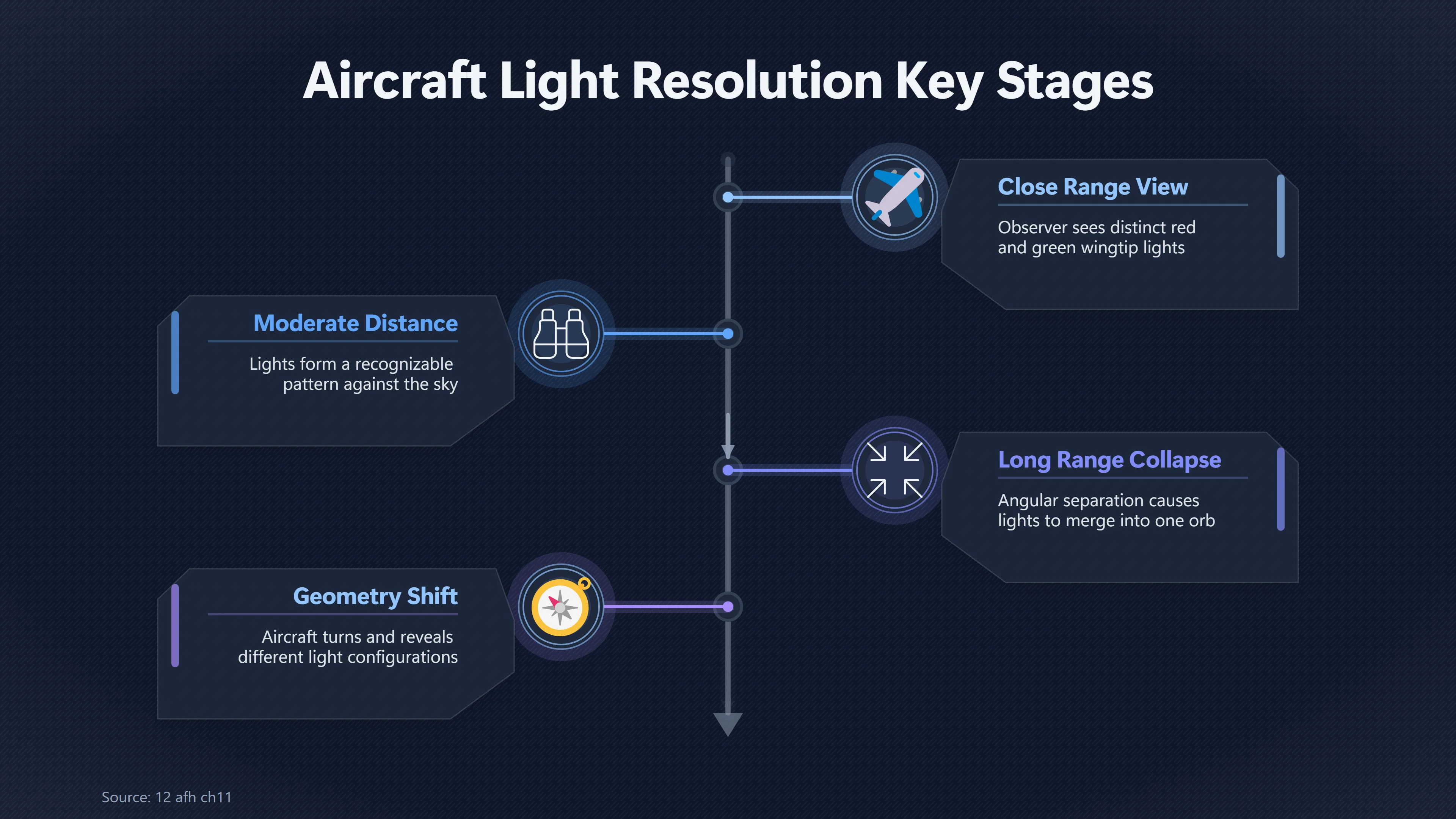
The key quantity is not simply physical distance but angular separation: how far apart two lights appear in the observer’s field of view. As an aircraft recedes, the physical spacing between its lights stays the same while their angular separation becomes progressively smaller. Eventually the observer can no longer resolve them as distinct sources.
NASA gives a useful everyday comparison. Human-eye angular resolution is roughly one minute of arc under favourable circumstances; distant car headlights therefore appear as one light until they become sufficiently separated in the observer’s view to resolve individually. Aircraft lights are subject to the same basic geometry.[NASA Science]science.nasa.govScience Hubble GlossaryNASA ScienceHubble Glossary - NASA ScienceJuly 13, 2026… Low illumination can make the practical situation worse: research on low-luminance vision finds that visual acuity declines as luminance falls, although the exact performance varies with the observer and viewing conditions.[PubMed]pubmed.ncbi.nlm.nih.govRelationship of Low-luminance Visual Acuity with Ocular Aberrations in Older Participants - PubMedDecember 1, 2023…
Consider an airliner whose visible lights span roughly 30 metres. At 10 kilometres, that span subtends only about 10 arcminutes; at 50 kilometres, roughly two arcminutes. Individual lamps separated by much less than the full wingspan subtend smaller angles still. These figures are illustrative rather than a fixed identification threshold, because visibility depends on brightness, contrast, atmospheric conditions, eyesight and which lights are actually facing the observer.
Brightness makes the resulting impression especially deceptive. FAA guidance describes the conventional arrangement as a red position light on the left wingtip, green on the right and white at the tail. Aircraft may additionally carry red or white anti-collision beacons or strobes, while landing lights provide powerful forward-facing white illumination.[Federal Aviation Administration]faa.gov12 afh ch11Federal Aviation AdministrationAirplane Flying Handbook (FAA-H-8083-3C)May 8, 2026…
At close range those sources form an informative pattern. At long range they may instead contribute to a compact patch of brightness while the unilluminated structure connecting them disappears against the sky. The observer consequently sees something that can reasonably be described as a light, ball or orb, even though its source has wings, a fuselage and several separate lamps.
Night also greatly extends the useful visibility of bright lights. As an indication of the scale involved, FAA guidance says visual approach slope indicator lights can be visible from three to five miles by day but 20 miles or more at night. That refers to aerodrome lighting rather than aircraft lights, but it illustrates the underlying problem: a bright source against darkness can remain conspicuous long after surrounding physical structure has ceased to provide useful visual information.[Federal Aviation Administration]faa.govOpen source on faa.gov.
Viewing angle can transform the same aircraft
The apparent pattern is not fixed. An aircraft viewed from ahead, from the side and from behind presents different combinations of lights, so an object that begins as a featureless white orb can acquire a recognisable aviation-light pattern without anything unusual happening to it.
A particularly important configuration is an aircraft approaching roughly towards the observer. Landing lights are directed forwards, and the FAA encourages their use during take-off and when flying below 10,000 feet, particularly within ten miles of an airport.[Federal Aviation Administration]faa.govFederal Aviation Administration ENR 1.1: General RulesFederal Aviation Administration ENR 1.1: General Rules From near the aircraft’s forward axis, those bright lamps can dominate what the observer sees.
The aircraft’s lateral movement can simultaneously be surprisingly small. A jet travelling substantially towards the observer changes its distance much faster than its bearing. Against a dark, reference-free sky it may therefore appear nearly stationary for a period, while its forward lights remain prominent. This can produce the striking combination of an apparently hovering bright object that gradually intensifies.
Then the geometry changes. As the aircraft turns or passes across the observer’s line of sight, its forward-facing lights may weaken dramatically while navigation lights and strobes become easier to distinguish. FAA material specifically explains that the red, green and white position-light arrangement allows observers to infer an aircraft’s general direction of movement when those lights can be separately seen.[Federal Aviation Administration]faa.gov12 afh ch11Federal Aviation AdministrationAirplane Flying Handbook (FAA-H-8083-3C)May 8, 2026…
That transition is diagnostically important. A witness might accurately report that a single brilliant light suddenly became several coloured or flashing lights. It does not necessarily mean that one object physically divided into several objects. The observer may simply have crossed the perceptual threshold at which separate lamps became visible, or the aircraft may have changed attitude sufficiently to expose a different set of lights.
The reverse can happen too. A recognisable pattern of separated aircraft lights can contract with distance until it becomes a single point. The underlying aircraft has not changed shape; only its apparent angular structure has fallen below what the observer can distinguish.
Why the aircraft itself can disappear
The seeming contradiction — extremely bright lights but no visible aeroplane — is precisely what makes this mechanism useful when examining night-time UFO reports.
Aircraft lighting is deliberately designed to make an aircraft conspicuous. FAA rules require position lights between sunset and sunrise, while anti-collision systems can contain bright red or white rotating beacons or strobes.[Federal Aviation Administration]faa.govFederal Aviation Administration Chapter 4. Air Traffic ControlFederal Aviation Administration Chapter 4. Air Traffic Control An FAA study of aircraft conspicuity similarly distinguishes navigation lights on the wingtips and tail, landing lights resembling headlights, and bright anti-collision lighting.[Federal Aviation Administration]faa.govInvestigation of Lighting Schemes to Improve s UAS ConspicuityFederal Aviation AdministrationDOT/FAA/AM-22/07February 11, 2026…
The aircraft’s skin has no comparable advantage. Against a black sky, an unilluminated wing or fuselage may reflect too little light to reveal its outline. There may consequently be nothing visually connecting one bright lamp to another.
This produces a perceptual reversal compared with daylight:
- By day, the observer may see a continuous aircraft with lights attached to it.
- At moderate night-time range, the observer may see several lights whose arrangement implies an aircraft.
- At still greater range or an unfavourable angle, the observer may see only one concentrated luminous source.
The final appearance can seem more exotic than the closer view precisely because distance has removed information rather than adding it. A smooth-looking orb is therefore not, by itself, evidence that the underlying object was spherical.
This distinction is relevant to modern UAP data. The US All-domain Anomaly Resolution Office (AARO) records orb/round/sphere and lights as the two most commonly reported morphology categories in its published reporting statistics, while some closed cases have been attributed to conventional aircraft. Those statistics do not establish that reported orbs are generally aircraft; they do show why apparent morphology alone is a weak discriminator when the observation consists chiefly of unresolved light.[AARO]aaro.milUAP TrendsAARO UAP Trends…
A particularly instructive AARO release from 2026 describes a witness seeing an intense single light near the horizon that subsequently resolved into multiple lights. AARO’s published description does not, by itself, establish what produced that event, so it should not be presented as a confirmed aircraft case. It nevertheless documents the relevant observational phenomenon directly: something initially perceived as one luminous object can reveal multiple light sources as viewing conditions change.[AARO]aaro.milNext - AARO UAP Report DocumentsMay 8, 2026…
What can reveal a light cluster rather than a solid orb?
A single photograph or a few seconds of distant video may preserve too little information for a confident identification. A longer observation is more useful because an aircraft’s changing geometry can expose structure that was initially hidden.
The strongest clues are changes that make sense as different aircraft lights come into and out of view. A bright white point that later develops separated red, green or flashing white components deserves particular attention. So does a brilliant light that fades sharply as the object turns, followed by a weaker pattern moving laterally across the sky.
Changing separation is especially informative. If one light becomes two or three as the object approaches, the earlier “orb” may simply have been an unresolved cluster. Conversely, lights that progressively converge as the source recedes are consistent with ordinary perspective.
Colour can help once it becomes resolvable. Conventional aircraft position lighting places red on the left wingtip, green on the right and white at the tail. Depending on orientation, an observer will not necessarily see all three at once, but a developing pattern consistent with this geometry is substantially more informative than the original white point.[Federal Aviation Administration]faa.gov12 afh ch11Federal Aviation AdministrationAirplane Flying Handbook (FAA-H-8083-3C)May 8, 2026…
Regular flashes are another clue, but not proof on their own. Aircraft anti-collision systems may use red or white rotating beacons or strobes, and different aircraft installations can produce different visible patterns.[Federal Aviation Administration]faa.govFederal Aviation Administration Chapter 4. Air Traffic ControlFederal Aviation Administration Chapter 4. Air Traffic Control A video that initially seems to show a continuously glowing object can also misrepresent very brief flashes through exposure, focus, sensor saturation or frame timing, so investigators should examine the original recording rather than relying solely on enlarged still frames.
A change in apparent shape during a turn can be more valuable than apparent shape at any one instant. If a featureless point develops lateral spacing at the same time that its trajectory bends, that is consistent with an aircraft changing aspect relative to the observer. The crucial evidence is the sequence, not whether one frame happens to resemble a sphere or triangle.
Finally, investigators can compare the observation with known aviation activity. Time, precise viewing direction and observer location allow candidate aircraft tracks to be tested against the sighting geometry. This is much stronger than simply saying that an airport was nearby: the useful question is whether a particular aircraft could have occupied the relevant line of sight and whether its movement and changing aspect reproduce what the witness saw.

The important lesson is lost structure
Distant aircraft lights do not need to produce a perfect optical fusion in every sighting to create an orb-like impression. It is enough for the eye or camera to preserve the luminous sources while losing the dark aircraft and enough of the spacing that gives those lights meaning.
That is why night-time descriptions such as “one brilliant sphere”, “a stationary white orb” or “a light that suddenly split into several lights” require caution. They can describe the appearance faithfully without reliably describing the underlying object’s physical shape.
The decisive question is therefore not simply “Did it look like an orb?” It is “Did the observation contain enough angular resolution and changing viewing geometry to show whether the light was actually one source?” When the answer is no, distant aircraft lighting remains a conventional explanation that should be tested before treating the apparent orb as evidence of an unusually shaped craft.
Amazon book picks
Further Reading
Books and field guides related to When Several Aircraft Lights Look Like One Orb. Use these as the next step if you want deeper reading beyond the article.
Sensation and Perception
. Bruce Goldstein's SENSATION AND PERCEPTION, the best-seller which has helped over 150,000 students understand the ties between how we s...
Eye and Brain: The Psychology of Seeing
Since the publication of the first edition in 1966, Eye and Brain has established itself worldwide as an essential introduction to the ba...
The Pilot's Handbook of Aeronautical Knowledge
Pilot's Handbook of Aeronautical Knowledge, an official Federal Aviation Administration (FAA) Handbook; provides basic knowledge that is...
Stick and Rudder: An Explanation of the Art of Flying
In the early 1940's, Wolfgang Langewiesche wrote a series of articles in Air Facts analyzing the various aspects of piloting techniques....
eBay marketplace picks
Marketplace Samples
Live-tested eBay searches with available results related to this page.
Selected fromUFO poster oneBay.co.uk.


Current eBay listing
I Want To Believe UFO Poster Giclée Fine Art Heavyweight Print

Current eBay listing
VINTAGE UFO FLYING SAUCERS COMIC ADVERTISING A2 POSTER PRINT

Endnotes
1.
Source: faa.gov
Title: 12 afh ch11
Link:https://www.faa.gov/sites/faa.gov/files/regulations_policies/handbooks_manuals/aviation/airplane_handbook/12_afh_ch11.pdf
Source snippet
Federal Aviation AdministrationAirplane Flying Handbook (FAA-H-8083-3C)May 8, 2026...
Published: May 8, 2026
2.
Source: science.nasa.gov
Title: Science Hubble Glossary
Link:https://science.nasa.gov/mission/hubble/multimedia/hubble-glossary/
Source snippet
NASA ScienceHubble Glossary - NASA ScienceJuly 13, 2026...
Published: July 13, 2026
3.
Source: faa.gov
Title: Federal Aviation Administration Chapter 4. Air Traffic Control
Link:https://www.faa.gov/Air_traffic/publications/atpubs/aim_html/chap4_section_3.html
4.
Source: faa.gov
Link:https://www.faa.gov/Air_traffic/publications/atpubs/aim_html/chap2_section_1.html
5.
Source: faa.gov
Title: Federal Aviation Administration ENR 1.1: General Rules
Link:https://www.faa.gov/air_traffic/publications/atpubs/aip_html/part2_enr_section_1.1.html
6.
Source: faa.gov
Title: Investigation of Lighting Schemes to Improve s UAS Conspicuity
Link:https://www.faa.gov/sites/faa.gov/files/2022-07/Investigation%20of%20Lighting%20Schemes%20to%20Improve%20sUAS%20Conspicuity%20.pdf
Source snippet
Federal Aviation AdministrationDOT/FAA/AM-22/07February 11, 2026...
Published: February 11, 2026
7.
Source: aaro.mil
Title: UAP Trends
Link:https://www.aaro.mil/UAP-Cases/UAP-Reporting-Trends/
Source snippet
AARO UAP Trends...
8.
Source: aaro.mil
Link:https://www.aaro.mil/Next-AARO-Home-redesign/Next-Parent/Next-UAP-Report-Documents/
Source snippet
Next - AARO UAP Report DocumentsMay 8, 2026...
Published: May 8, 2026
9.
Source: faa.gov
Title: Aviation Handbooks & Manuals | Federal Aviation Administration
Link:https://www.faa.gov/regulations_policies/handbooks_manuals/aviation
10.
Source: science.nasa.gov
Title: why have a telescope in space
Link:https://science.nasa.gov/mission/hubble/overview/why-have-a-telescope-in-space/
11.
Source: faa.gov
Title: Aircraft Handbooks & Manuals | Federal Aviation Administration
Link:https://www.faa.gov/regulations_policies/handbooks_manuals/aircraft
12.
Source: aaro.mil
Link:https://www.aaro.mil/Next-AARO-Home-redesign/Next-Parent/Next-UAP-Report-Documents/poster/dividLink/
13.
Source: aaro.mil
Link:https://www.aaro.mil/Next-AARO-Home-redesign/Next-Parent/Next-AARO-UAP-Imagery-Acc-Table/
14.
Source: aaro.mil
Link:https://www.aaro.mil/Next-AARO-Home-redesign/Next-Parent/Next-UAP-Report-Documents/poster/
15.
Source: science.nasa.gov
Link:https://science.nasa.gov/uap/
16.
Source: science.nasa.gov
Link:https://science.nasa.gov/universe/glossary-3/a-g/
17.
Source: aaro.mil
Link:https://www.aaro.mil/Next-AARO-Home-redesign/Next-Parent/Presidential-UAP-Transparency-Initiative/
18.
Source: faa.gov
Link:https://www.faa.gov/about/office_org/headquarters_offices/ato/service_units/techops/navservices/lsg/papi
19.
Source: fermi.gsfc.nasa.gov
Link:https://fermi.gsfc.nasa.gov/science/instruments/lat.html
20.
Source: fermi.gsfc.nasa.gov
Title: table1 1
Link:https://fermi.gsfc.nasa.gov/science/instruments/table1-1.html
21.
Source: aaro.mil
Link:https://www.aaro.mil/Next-AARO-Home-redesign/Next-Parent/Presidential-UAP-Transparency-Initiative/videoid/1010269/dvpcc/false/
22.
Source: aaro.mil
Link:https://www.aaro.mil/Next-AARO-Home-redesign/Next-Parent/Presidential-UAP-Transparency-Initiative/videoid/1006078/dvpcc/false/
23.
Source: aaro.mil
Link:https://www.aaro.mil/Next-AARO-Home-redesign/Next-Parent/Presidential-UAP-Transparency-Initiative/videoid/1006079/dvpcc/false/
24.
Source: science.nasa.gov
Title: faqs full
Link:https://science.nasa.gov/mission/webb/faqs-full/
25.
Source: science.nasa.gov
Link:https://science.nasa.gov/mission/hubble/observatory/design/optics/
26.
Source: faa.gov
Title: Pilot’s Handbook of Aeronautical Knowledge | Federal Aviation Administration
Link:https://www.faa.gov/regulations_policies/handbooks_manuals/aviation/phak
27.
Source: faa.gov
Title: Airplane Flying Handbook | Federal Aviation Administration
Link:https://www.faa.gov/regulations_policies/handbooks_manuals/aviation/airplane_handbook
28.
Source: aaro.mil
Link:https://www.aaro.mil/Next-AARO-Home-redesign/Next-Parent/Presidential-UAP-Transparency-Initiative/videoid/1010263/dvpcc/false/
29.
Source: heasarc.gsfc.nasa.gov
Link:https://heasarc.gsfc.nasa.gov/docs/einstein/heao2.html
30.
Source: asd.gsfc.nasa.gov
Link:https://asd.gsfc.nasa.gov/archive/infocus/char.html
31.
Source: faa.gov
Title: pilots handbook aeronautical knowledge faa h 8083 25b
Link:https://www.faa.gov/aviation/phak/pilots-handbook-aeronautical-knowledge-faa-h-8083-25b
32.
Source: faa.gov
Title: Chapter 8. Medical Facts for Pilots
Link:https://www.faa.gov/air_traffic/publications/atpubs/aim/aim0801.html
33.
Source: faa.gov
Title: Chapter 2. Aeronautical Lighting and Other Airport Visual Aids
Link:https://www.faa.gov/air_traffic/publications/atpubs/AIM/aim0201.html
34.
Source: faa.gov
Link:https://www.faa.gov/air_traffic/publications/ATpubs/AIM/aim0403.html
35.
Source: faa.gov
Link:https://www.faa.gov/air_traffic/publications/atpubs/aim/aim0506.html
36.
Source: faa.gov
Link:https://www.faa.gov/air_traffic/publications/ATpubs/ATC/atc0302.html
37.
Source: faa.gov
Title: Bell 206B-3 Jet Ranger III | Federal Aviation Administration
Link:https://www.faa.gov/lessons_learned/rotorcraft/accidents/N828AC
38.
Source: fermi.gsfc.nasa.gov
Link:https://fermi.gsfc.nasa.gov/science/resources/aosrd/
39.
Source: science.nasa.gov
Link:https://science.nasa.gov/uncategorized/hrma/
40.
Source: faa.gov
Title: Boeing 707-321B | Federal Aviation Administration
Link:https://www.faa.gov/lessons_learned/transport_airplane/accidents/AVA052
41.
Source: faa.gov
Title: A C 20-30B
Link:https://www.faa.gov/airports/resources/advisory_circulars/index.cfm/go/document.information/documentNumber/20-30B
42.
Source: faa.gov
Title: A C 20-74
Link:https://www.faa.gov/regulations_policies/advisory_circulars/index.cfm/go/document.information/documentID/22032
43.
Source: faa.gov
Link:https://www.faa.gov/air_traffic/publications/atpubs/aim_html/chap7_section_6.html
44.
Source: faa.gov
Link:https://www.faa.gov/Air_traffic/publications/atpubs/aim_html/chap8_section_1.html
45.
Source: faa.gov
Link:https://www.faa.gov/air_traffic/publications/atpubs/aip_html/chap7_section_6.html
46.
Source: faa.gov
Link:https://www.faa.gov/air_traffic/publications/atpubs/aip_html/part2_enr_section_1.15.html
47.
Source: faa.gov
Link:https://www.faa.gov/air_traffic/publications/atpubs/atc_html/chap9_section_8.html
48.
Source: faa.gov
Link:https://www.faa.gov/air_traffic/publications/atpubs/pcg_html/glossary-a.html
49.
Source: faa.gov
Link:https://www.faa.gov/air_traffic/publications/atpubs/aip_html/chap2_section_1.html
50.
Source: faa.gov
Title: Chapter 3. Airport Traffic Control
Link:https://www.faa.gov/air_traffic/publications/atpubs/atc_html/chap3_section_2.html
51.
Source: faa.gov
Link:https://www.faa.gov/air_traffic/publications/atpubs/aip_html/part3_ad_1.1.html
52.
Source: faa.gov
Link:https://www.faa.gov/air_traffic/publications/atpubs/aip_html/part2_enr_section_1.12.html
53.
Source: faa.gov
Title: chap5 section 6
Link:https://www.faa.gov/air_traffic/publications/ATpubs/AIM_html/chap5_section_6.html
54.
Source: faa.gov
Link:https://www.faa.gov/air_traffic/publications/atpubs/aip_html/part1_gen_section_3.4.html
55.
Source: faa.gov
Link:https://www.faa.gov/air_traffic/publications/atpubs/aip_html/part1_gen_section_1.7.html
56.
Source: faa.gov
Link:https://www.faa.gov/air_traffic/publications/atpubs/aip_html/chap6_section_3.html
57.
Source: faa.gov
Link:https://www.faa.gov/forms/index.cfm/go/document.list/sortColumn/documentTitle
58.
Source: aaro.mil
Link:https://www.aaro.mil/Next-AARO-Home-redesign/Next-Parent/Next-AARO-UAP-Trends/
59.
Source: aaro.mil
Link:https://www.aaro.mil/UAP-Cases/Official-UAP-Imagery/4/
60.
Source: aaro.mil
Link:https://www.aaro.mil/
61.
Source: aaro.mil
Link:https://www.aaro.mil/FAQ/
62.
Source: aaro.mil
Link:https://www.aaro.mil/Next-AARO-Home-redesign/Inactive-Parent/Next-UAP-Imagery-dup/
63.
Source: aaro.mil
Link:https://www.aaro.mil/Next-AARO-Home-redesign/Next-Parent/Next-AARO-UAP-Imagery-Fixed-Table/
64.
Source: aaro.mil
Link:https://www.aaro.mil/Next-AARO-Home-redesign/Bruce-working/Next-AARO-UAP-Trends-Charts/
65.
Source: aaro.mil
Link:https://www.aaro.mil/Next-AARO-Home-redesign/Next-Parent/AARO-UAP-Case-DT/
66.
Source: aaro.mil
Title: AAR O UAP Trends All-domain Anomaly Resolution Office UAP REPORTING TRENDS
Link:https://www.aaro.mil/UAP-Cases/UAP-Reporting-Trends/quot/
67.
Source: lambda.gsfc.nasa.gov
Link:https://lambda.gsfc.nasa.gov/product/iras/
68.
Source: pubmed.ncbi.nlm.nih.gov
Link:https://pubmed.ncbi.nlm.nih.gov/38019964/
Source snippet
Relationship of Low-luminance Visual Acuity with Ocular Aberrations in Older Participants - PubMedDecember 1, 2023...
Published: December 1, 2023
69.
Source: hantsfire.gov.uk
Title: Light aircraft on Lee-on-the-Solent beach
Link:https://www.hantsfire.gov.uk/incident/light-aircraft-on-lee-on-the-solent-beach/
70.
Source: pmc.ncbi.nlm.nih.gov
Link:https://pmc.ncbi.nlm.nih.gov/articles/PMC12177773/
71.
Source: pubmed.ncbi.nlm.nih.gov
Link:https://pubmed.ncbi.nlm.nih.gov/40488699/
72.
Source: GOV.UK
Title: aaib report airbus a321 253nx g oatw on 4 october 2023
Link:https://www.gov.uk/government/news/aaib-report-airbus-a321-253nx-g-oatw-on-4-october-2023
Published: october 2023
73.
Source: GOV.UK
Title: www.gov.uk AAI B investigation to Airbus A321-253NX, G-OATW
Link:https://www.gov.uk/aaib-reports/aaib-investigation-to-airbus-a321-253nx-g-oatw
74.
Source: GOV.UK
Title: aaib special bulletin s2 slash 2023 airbus a321 253nx g oatw
Link:https://www.gov.uk/aaib-reports/aaib-special-bulletin-s2-slash-2023-airbus-a321-253nx-g-oatw
75.
Source: GOV.UK
Link:https://www.gov.uk/government/news/aaib-special-bulletin-airbus-a321-253nx-g-oatw-damage-to-several-cabin-windows-london-stansted-airport
76.
Source: GOV.UK
Title: www.gov.uk AAI B investigation to Reims Cessna F172M, G-MOFO
Link:https://www.gov.uk/aaib-reports/aaib-investigation-to-reims-cessna-f172m-g-mofo
77.
Source: GOV.UK
Title: aaib investigation to parrot anafi usa uas registration n slash a 030421
Link:https://www.gov.uk/aaib-reports/aaib-investigation-to-parrot-anafi-usa-uas-registration-n-slash-a-030421
78.
Source: GOV.UK
Title: aaib investigation to parrot anafi usa uas registration n slash a 180421
Link:https://www.gov.uk/aaib-reports/aaib-investigation-to-parrot-anafi-usa-uas-registration-n-slash-a-180421
79.
Source: GOV.UK
Title: aaib investigation to parrot anafi usa uas registration n slash a 190221
Link:https://www.gov.uk/aaib-reports/aaib-investigation-to-parrot-anafi-usa-uas-registration-n-slash-a-190221
80.
Source: GOV.UK
Title: aaib investigation to parrot anafi uas registration n slash a 170720
Link:https://www.gov.uk/aaib-reports/aaib-investigation-to-parrot-anafi-uas-registration-n-slash-a-170720
81.
Source: pmc.ncbi.nlm.nih.gov
Link:https://pmc.ncbi.nlm.nih.gov/articles/PMC7545082/
82.
Source: media.nationalarchives.gov.uk
Title: nationalarchives.gov.uk The Cold War and UFOs | The National Archives
Link:https://media.nationalarchives.gov.uk/index.php/cold-war-ufos/
83.
Source: GOV.UK
Title: www.gov.uk AAI B investigation to Kolb Fire Fly, G-CEPN
Link:https://www.gov.uk/aaib-reports/aaib-investigation-to-kolb-firefly-g-cepn
84.
Source: pmc.ncbi.nlm.nih.gov
Link:https://pmc.ncbi.nlm.nih.gov/articles/PMC5713488/
85.
Source: pmc.ncbi.nlm.nih.gov
Link:https://pmc.ncbi.nlm.nih.gov/articles/PMC4757445/
86.
Source: ncbi.nlm.nih.gov
Link:https://www.ncbi.nlm.nih.gov/books/NBK11509/
87.
Source: ncbi.nlm.nih.gov
Link:https://www.ncbi.nlm.nih.gov/books/NBK11509/?report=reader
88.
Source: ncbi.nlm.nih.gov
Link:https://www.ncbi.nlm.nih.gov/books/NBK11509/figure/ch25kallspatial.F20/
89.
Source: skybrary.aero
Link:https://skybrary.aero/index.php/articles/visibility
90.
Source: pubmed.ncbi.nlm.nih.gov
Link:https://pubmed.ncbi.nlm.nih.gov/6507580/
91.
Source: pubmed.ncbi.nlm.nih.gov
Link:https://pubmed.ncbi.nlm.nih.gov/25906409/
92.
Source: pubmed.ncbi.nlm.nih.gov
Link:https://pubmed.ncbi.nlm.nih.gov/9390373/
93.
Source: pubmed.ncbi.nlm.nih.gov
Link:https://pubmed.ncbi.nlm.nih.gov/3445474/
Additional References
94.
Source: youtube.com
Title: Gimbal UFO
Link:https://www.youtube.com/watch?v=qsEjV8DdSbs
Source snippet
This video demonstrates how distant point sources of light and optical glare from aircraft engines merge into a single glowing orb on the...
95.
Source: skybrary.aero
Title: Night Visual Approaches | SKYbrary Aviation Safety
Link:https://skybrary.aero/index.php/articles/night-visual-approaches
Source snippet
Night Visual Approaches | SKYbrary Aviation Safety...
96.
Source: defense.gov
Link:https://www.defense.gov/News/News-Stories/Article/Article/3965403/dod-examining-unidentified-anomalous-phenomena/
97.
Source: defense.gov
Link:https://www.defense.gov/News/Releases/Release/Article/2672732/statement-by-pentagon-press-secretary-john-kirby-on-unidentified-aerial-phenome/
98.
Source: ecfr.gov
Link:https://www.ecfr.gov/current/title-14/chapter-I/subchapter-D/part-61/subpart-G/section-61.167
99.
Source: ecfr.gov
Link:https://www.ecfr.gov/current/title-14/chapter-II/subchapter-A/part-296/subpart-B?toc=1
100.
Source: ecfr.gov
Link:https://www.ecfr.gov/current/title-14/chapter-II/subchapter-A/part-234?toc=1
101.
Source: ecfr.gov
Link:https://www.ecfr.gov/current/title-5/chapter-I/subchapter-B/part-731/subpart-B/section-731.202
102.
Source: ecfr.gov
Title: e CF R:: 17 CFR 210.12-04 – Condensed financial information of registrant
Link:https://www.ecfr.gov/current/title-17/chapter-II/part-210/subject-group-ECFRba732fd3cf5b2c6/section-210.12-04
103.
Source: ecfr.gov
Title: e CF R:: 41 CFR 102-33.115 – Flight program operations. (FMR 102-33.115)
Link:https://www.ecfr.gov/current/title-41/subtitle-C/chapter-102/subchapter-B/part-102-33/subpart-C/section-102-33.115