Within UFO Identifications
Why Balloons Can Look Like Impossible Craft
Balloons can look stationary, accelerate with perspective or change direction as winds vary with altitude.
On this page
- How balloons lose recognizable scale and shape
- Wind, altitude and apparent changes in motion
- Clues investigators use to identify balloons
Page outline Jump by section
Introduction
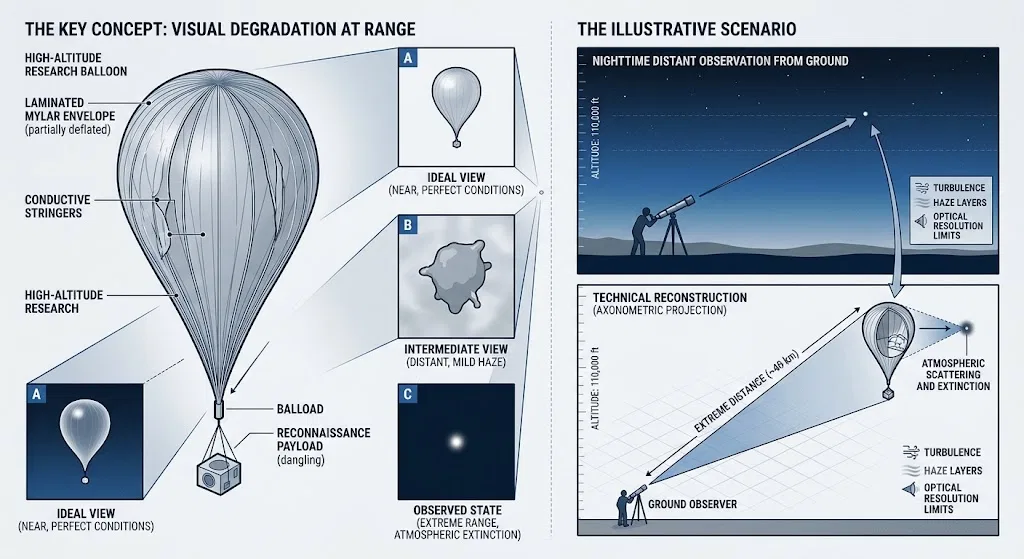
Balloons are among the most persistent ordinary objects mistaken for extraordinary flying craft because they can lose almost every familiar cue that normally tells us what they are. Seen at long range, through haze or clouds, or on an infrared sensor, a balloon may shrink to a featureless dot, sphere or irregular blob. Its true size and distance can be unknown, making speed estimates unreliable. If the observer is aboard a moving aircraft, motion parallax can make a slowly drifting balloon appear to race across the landscape. Changing winds at different altitudes can also alter its track without any propulsion.[AARO]aaro.milAARO FAQOptical phenomena, such as motion parallax, can explain how a stationary or slow-moving object can appear to be moving rapidl…
This is not merely a theoretical explanation. The US All-domain Anomaly Resolution Office (AARO) continues to resolve UAP reports as balloons ranging from reflective party balloons to large research balloons, while detailed case studies show how viewing geometry, infrared contrast, wind data and changing orientation can transform such objects into apparently exotic craft.[AARO]aaro.milFY25 Consolidated Annual Report on UAPAARO FY25 Consolidated Annual Report on UAP…
How balloons lose recognisable scale and shape
The first difficulty is deceptively simple: a small object in an empty sky provides very little information about its distance. A one-metre object nearby and a much larger object farther away can occupy the same angular size in an observer’s field of view. Without an independent range measurement, apparent size alone does not reveal physical size. NASA’s UAP independent study therefore stressed that determining distance is essential before claims of exceptional velocity or acceleration can be validated.[NASA Science]science.nasa.govNASA Science…
Balloons are particularly troublesome because their appearance is extraordinarily variable. AARO’s FY2025 report says resolved cases include latex balloons, reflective foil party balloons and large research balloons carrying suspended payloads. Those categories differ greatly in size, surface finish and shape even before damage, partial deflation or attached cords are considered.[AARO]aaro.milFY25 Consolidated Annual Report on UAPAARO FY25 Consolidated Annual Report on UAP…
A balloon cluster can look stranger still. Individual balloons turn, overlap and separate as they move, while strings and partly deflated envelopes hang below them. From one angle the group may resemble a single irregular body; seconds later it can acquire protrusions or apparently change shape. In AARO’s analysis of footage recorded at Al Taqaddum Air Base in Iraq in 2017, investigators found that changing numbers and shapes of dangling strings were consistent with a cluster of fully and partly inflated balloons changing orientation relative to the sensor. The object had originally been characterised as abnormally shaped.[AARO]aaro.milAl Taqaddam Case ResolutionAl Taqaddam Case Resolution…
Infrared imaging can remove still more of the cues people normally use for recognition. An infrared camera does not simply reproduce visible colour: it displays differences in detected radiation, often after automatic contrast processing. Surfaces with different temperatures, emissivities or reflectivities can therefore appear as sharply contrasting regions that do not resemble the object in ordinary daylight.
AARO’s Eglin case illustrates the effect. A military pilot described an object with a rounded bottom and apparent panel-like features, while infrared imagery showed contrasting hemispheres. Investigators compared the imagery with commercial helium lighting balloons and found that such balloons could reproduce aspects of the appearance. They also noted that sunlight, shade and reflective materials could make the upper and lower halves look dramatically different in infrared.[AARO]aaro.milEglin UAP Case ResolutionEglin UAP Case Resolution…
The lesson is that “odd shape” is much weaker evidence than it sounds when the target occupies only a small number of pixels. A smooth balloon can become a dark sphere, a two-toned disc, an asymmetrical mass or a structure with appendages depending on orientation, illumination, sensor mode and image processing.
Why a drifting balloon can appear to accelerate
The most important illusion is motion parallax. When an observer moves rapidly, nearby objects sweep across the visual field faster than distant background features. The brain can attribute that relative motion to the object instead of to the observer, especially when there is no reliable distance estimate.
AARO explicitly identifies motion parallax as a reason that stationary or slowly moving objects can appear to travel rapidly when viewed from a fast-moving platform.[AARO]aaro.milAARO FAQOptical phenomena, such as motion parallax, can explain how a stationary or slow-moving object can appear to be moving rapidl… NASA makes the related analytical point that distance must be established before an apparent high speed or acceleration can be treated as physically meaningful.[NASA Science]science.nasa.govNASA Science…
The 2013 Aguadilla, Puerto Rico, infrared case provides a particularly clear example. Footage taken from a US Customs and Border Protection aircraft appeared to show an object moving quickly over the ground, separating into two and apparently entering the sea. AARO reconstructed the aircraft’s changing position and the sensor’s line of sight. Its analysis concluded that there were two small objects drifting at roughly 8 mph, close to the measured wind speed, and that their apparent high velocity arose from motion parallax as the aircraft itself moved around the scene.[AARO]aaro.milPuerto Rico UAP Case ResolutionAARO Puerto Rico UAP Case Resolution…
That reconstruction also shows why judging motion directly from video can be misleading. During the encounter, the aircraft climbed and flew an arc around the airport while the range to the objects nearly tripled. Zoom changed as well. The resulting video therefore combines at least four motions or transformations: movement of the balloon-like objects, movement of the aircraft, rotation of the sensor’s line of sight and changes in magnification. What the eye sees on the screen is the combination, not the object’s ground speed alone.[AARO]aaro.milPuerto Rico UAP Case ResolutionAARO Puerto Rico UAP Case Resolution…
A related mistake occurs when an object appears almost stationary. A balloon travelling in a wind similar to an aircraft’s projected direction can remain near the same bearing for a time, creating the impression that it is hovering or pacing the aircraft. Conversely, a change in the observer’s heading can suddenly make the same object sweep across the frame. Neither observation requires the balloon itself to accelerate sharply.
Wind and altitude can produce real changes in direction
Balloons generally move with the surrounding air rather than choosing a heading, but this does not mean their trajectories must be straight or constant. Wind speed and direction vary with altitude, a phenomenon meteorologists call vertical wind shear. The US National Weather Service defines vertical wind shear as a change in wind direction and speed with height.[National Weather Service]forecast.weather.govNational Weather ServiceNOAA's National Weather Service - GlossaryVertical Wind Shear: the change in the wind's direction and speed with…
Weather balloons demonstrate the principle routinely. NOAA notes that radiosondes carried by balloons can ascend above 115,000 feet while drifting horizontally during flights lasting more than two hours. The balloons are useful precisely because their changing positions help measure winds through different atmospheric layers.[NOAA]noaa.govOpen source on noaa.gov.
That matters for UFO reports because a rising or descending balloon can encounter winds flowing in different directions. To an observer who assumes that an unpowered object should continue on one straight course, the subsequent turn can look like deliberate manoeuvring. No engine is needed: the surrounding air mass has changed.
Altitude also changes what an observer sees. A balloon moving nearly towards or away from the observer can show little sideways motion even while travelling steadily. Later, when the viewing angle changes, the same velocity can produce conspicuous lateral movement. If neither range nor altitude is known, an apparently sudden acceleration can therefore be caused by geometry rather than by a physical change in speed.
The Al Taqaddum case offers a useful reality check. AARO estimated the object at roughly 850–2,200 feet altitude and travelling about 4–14 mph. Its east-to-west path was within the measured wind-speed range. Investigators regarded that agreement between object motion and atmospheric motion as strong evidence for balloons, particularly when combined with visible balloon-like forms and a lack of the motor heat that would have been expected from the alternative quadcopter hypothesis.[AARO]aaro.milAl Taqaddam Case ResolutionAl Taqaddam Case Resolution…
Changing viewpoint can create apparent transformations
Balloons do not need to change physically for their apparent structure to change. A moving observer continuously alters the line of sight. Separate objects can overlap, an attached payload can disappear behind the envelope, and cords can rotate into or out of view.
Aguadilla demonstrates this effect unusually well. AARO concluded that the famous footage showed two objects travelling close together, not one object splitting into two. Early in the sequence, a shallow viewing angle and low magnification made them appear merged. As the aircraft climbed and the sensor acquired a more top-down perspective, their separation became clearer.[AARO]aaro.milPuerto Rico UAP Case ResolutionAARO Puerto Rico UAP Case Resolution…
That mechanism matters beyond one case. When two balloons overlap in a two-dimensional image, depth information is compressed. Their silhouettes may form one object. As relative geometry changes, the silhouettes separate and can look as though one craft has divided, released a companion or undergone a structural transformation.
Partial deflation can reinforce the impression. A balloon envelope need not remain spherical; changing internal pressure and airflow can make it sag, buckle or rotate. In a group, several partly inflated balloons can repeatedly obscure one another. AARO’s Al Taqaddum analysis specifically identified fully inflated shapes, partially inflated shapes and hanging strings within the recorded object.[AARO]aaro.milAl Taqaddam Case ResolutionAl Taqaddam Case Resolution…
Infrared video can make balloons disappear or change appearance
Some reported balloon-like UAP behaviour is produced not by motion at all but by loss of sensor contrast. Infrared systems detect differences between a target’s thermal or radiative signature and its background. If that contrast becomes too small, the target can fade from the image even though it remains physically present.
In the Aguadilla case, the objects appeared to vanish near imagery of the sea, helping create the impression that they had entered the water. AARO reconstructed the trajectory and concluded that they remained over land. The office attributed their apparent disappearance partly to thermal crossover: the infrared signatures became insufficiently distinct from the changing background.[AARO]aaro.milPuerto Rico UAP Case ResolutionAARO Puerto Rico UAP Case Resolution…
Automatic image processing can add another layer of apparent change. In the Al Taqaddum footage, AARO concluded that fluctuations in the infrared appearance resulted partly from the sensor continually assigning greyscale values to maximise image contrast against a changing background. In other words, a target can brighten, darken or alter apparent texture because the display algorithm has changed how the scene is rendered, not because the object has transformed.[AARO]aaro.milAl Taqaddam Case ResolutionAl Taqaddam Case Resolution…
Reflective foil balloons present an additional complication. AARO’s Eglin assessment notes that highly reflective surfaces can exaggerate illumination effects in infrared imagery. Sunlight, reflected light from the ground or cloud deck, surface coatings and the relative geometry of sensor and Sun can all produce asymmetric signatures.[AARO]aaro.milEglin UAP Case ResolutionEglin UAP Case Resolution…
For investigators, this means that statements such as “it changed temperature”, “it vanished” or “one side glowed” cannot safely be inferred from display brightness alone. The sensor mode, contrast settings and background have to be reconstructed first.
What investigators look for when testing a balloon explanation
A convincing balloon identification is usually cumulative. Shape by itself is rarely enough, particularly in low-resolution imagery. Investigators instead ask whether several independent features point in the same direction.
Movement with the wind is one of the strongest clues. Analysts compare the estimated object trajectory with historical or contemporaneous wind speed and direction at the relevant altitude. In both the Al Taqaddum and Eglin cases, correspondence between object movement and atmospheric winds supported a lighter-than-air explanation.[AARO]aaro.milAl Taqaddam Case ResolutionAl Taqaddam Case Resolution…
Range and geometry matter next. Aircraft position, heading, sensor azimuth and elevation, zoom, altitude and line of sight can be used to reconstruct where an object was actually moving. The Aguadilla analysis transformed what appeared to be rapid, transmedium motion into two objects travelling slowly with the wind once this geometry was modelled.[AARO]aaro.milPuerto Rico UAP Case ResolutionAARO Puerto Rico UAP Case Resolution…
Morphology becomes more useful when enough pixels are available. Investigators look for rounded lobes, reflective envelopes, seams, cords, tethers or suspended payloads. In the Al Taqaddum case, dangling strings and differently inflated balloons became visible in portions of the 17-minute video.[AARO]aaro.milAl Taqaddam Case ResolutionAl Taqaddam Case Resolution…
Infrared behaviour can distinguish competing hypotheses. An apparently structured object without the concentrated heat expected from propulsion may fit a passive balloon better than a powered drone. Conversely, investigators should not identify a balloon merely because a target lacks obvious heat; sensor sensitivity, range and viewing conditions also have to be considered. AARO’s rejection of a quadcopter interpretation at Al Taqaddum relied on both its wind-following trajectory and absence of the expected motor signature, not on either clue alone.[AARO]aaro.milAl Taqaddam Case ResolutionAl Taqaddam Case Resolution…
Environmental and operational records can provide external checks. Researchers may compare sightings with known meteorological launches, research-balloon operations or local balloon activity. In the Aguadilla case, AARO also consulted local hospitality vendors and found that sky-lantern releases were customary at area celebrations, supporting—but not proving—the office’s moderate-confidence identification of the objects as lanterns.[AARO]aaro.milPuerto Rico UAP Case ResolutionAARO Puerto Rico UAP Case Resolution…
Three cases that show different balloon failure modes
The value of modern resolved cases is that they demonstrate different routes from an ordinary airborne object to an extraordinary-looking report.
Eglin: a pilot encountered an object that visually suggested a structured craft, including apparent panel-like features and what was later recalled as an engine-like element. AARO reconstructed the geometry, examined Sun angle and infrared imagery, and physically tested a commercial lighting balloon with similar characteristics. It concluded with moderate confidence that the object was a lighter-than-air object and found no confirmed anomalous flight behaviour.[AARO]aaro.milEglin UAP Case ResolutionEglin UAP Case Resolution…
Al Taqaddum: a long infrared recording showed an unusually shaped floating object. Detailed frames revealed forms consistent with full and partly inflated balloons plus dangling strings. Its calculated speed and direction followed the wind, and the infrared data lacked the motor heat expected from a proposed quadcopter explanation. AARO assessed the object with high confidence as a balloon cluster.[AARO]aaro.milAl Taqaddam Case ResolutionAl Taqaddam Case Resolution…
Aguadilla: the most striking apparent behaviour came not from strange shape but from geometry. Two objects seemed to move rapidly, merge or split and pass into the sea. Three-dimensional reconstruction instead placed them over land, moving at approximately 8 mph with the wind. Changing viewpoint explained the apparent separation, motion parallax explained the impression of high speed, and infrared contrast loss explained the apparent disappearance. AARO judged the objects moderately likely to have been sky lanterns.[AARO]aaro.milPuerto Rico UAP Case ResolutionAARO Puerto Rico UAP Case Resolution…
Taken together, the cases demonstrate why “balloon” is not a single visual template. A balloon-related UAP might appear as a sphere, an irregular craft, a multi-lobed object, a dark infrared target or an apparently high-speed point. Identification depends on reconstructing what the object was doing in three-dimensional space, not merely deciding what one frame resembles.
Why some balloon explanations remain uncertain
Recognising that balloons can reproduce anomalous-looking behaviour does not mean every featureless UAP should be labelled a balloon. The distinction between plausible explanation and demonstrated identification matters.
AARO itself grades conclusions by confidence. The Eglin object was assessed as a lighter-than-air object with moderate confidence, whereas the Al Taqaddum object was assessed as a balloon cluster with high confidence. In Aguadilla, AARO expressed high confidence that the reported extraordinary performance did not occur but only moderate confidence that the specific objects were sky lanterns.[AARO]aaro.milEglin UAP Case ResolutionEglin UAP Case Resolution…
That difference is important. Geometry can sometimes rule out a claimed performance characteristic more firmly than it can identify the exact object. Investigators may establish that something travelled at wind speed without being able to distinguish whether it was a latex balloon, foil balloon, lantern or another passive airborne object.
Poor data also leave cases unresolved. AARO’s FY2025 report placed 191 of 319 newly considered reports into an active archive because available information was insufficient to determine whether the events matched natural or conventional phenomena. The same report states that all 370 cases resolved during that reporting period were attributed to prosaic objects or events, including balloons, satellites, birds, aircraft and unmanned systems.[AARO]aaro.milFY25 Consolidated Annual Report on UAPAARO FY25 Consolidated Annual Report on UAP…
The useful standard is therefore not “could this be a balloon?” Almost any small ambiguous dot could be. The stronger question is whether the object’s measured speed, direction, altitude, appearance, sensor signature and environmental circumstances jointly behave as a balloon should.

The practical takeaway
Balloons generate convincing UFO and UAP reports because three problems reinforce one another: uncertain distance destroys reliable scale and speed estimates; moving observers create powerful perspective effects; and balloons themselves drift, rotate, deform and pass through winds that vary with altitude. Infrared sensors can then strip away familiar colour and texture while adding contrast changes that make the object appear to transform or disappear.[nasa.gov]science.nasa.govNASA Science…
The strongest balloon identifications do not depend on resemblance alone. They emerge when independent evidence converges: a wind-matched trajectory, realistic speed, reconstructed range, balloon-like structure, cords or payloads, compatible infrared behaviour and the absence of features expected from a powered craft. Modern AARO case resolutions repeatedly show that once those variables are recovered, some of the most dramatic apparent behaviours—rapid flight, hovering, splitting, changing shape or vanishing—can disappear from the physical reconstruction even though they were genuinely striking in the original observation.[AARO]aaro.milAl Taqaddam Case ResolutionAl Taqaddam Case Resolution…
Amazon book picks
Further Reading
Books and field guides related to Why Balloons Can Look Like Impossible Craft. Use these as the next step if you want deeper reading beyond the article.
The Report on Unidentified Flying Objects
Edward J. Ruppelt's "The Report on Unidentified Flying Objects" serves as a pivotal text in the study of UFO phenomena, blending personal...
Atmospheric Science: An Introductory Survey
Atmospheric Science, Second Edition, is the long-awaited update of the classic atmospheric science text, which helped define the field ne...
eBay marketplace picks
Marketplace Samples
Live-tested eBay searches with available results related to this page.
Selected fromUFO poster oneBay.co.uk.

Current eBay listing
VINTAGE UFO FLYING SAUCERS COMIC ADVERTISING A2 POSTER PRINT



Current eBay listing
I Want To Believe UFO Poster Giclée Fine Art Heavyweight Print
Endnotes
1.
Source: aaro.mil
Link:https://www.aaro.mil/FAQ/
Source snippet
AARO FAQOptical phenomena, such as motion parallax, can explain how a stationary or slow-moving object can appear to be moving rapidl...
2.
Source: science.nasa.gov
Link:https://science.nasa.gov/wp-content/uploads/2023/09/uap-independent-study-team-final-report.pdf?emrc=80696d
Source snippet
NASA Science...
3.
Source: aaro.mil
Title: FY25 Consolidated Annual Report on UAP
Link:https://www.aaro.mil/Portals/136/PDFs/FY25%20UAP%20Annual%20Report/AARO_FY2025_Consolidated_Annual_Report_on_UAP.pdf
Source snippet
AARO FY25 Consolidated Annual Report on UAP...
4.
Source: aaro.mil
Title: Al Taqaddam Case Resolution
Link:https://www.aaro.mil/Portals/136/PDFs/case_resolution_reports/AARO_Al_Taqaddam_Case_Resolution_Final.pdf
Source snippet
Al Taqaddam Case Resolution...
5.
Source: aaro.mil
Title: Eglin UAP Case Resolution
Link:https://www.aaro.mil/portals/136/PDFs/case_resolution_reports/Case_Resolution_of_Eglin_UAP_2508.pdf
Source snippet
Eglin UAP Case Resolution...
6.
Source: aaro.mil
Title: Puerto Rico UAP Case Resolution
Link:https://www.aaro.mil/Portals/136/PDFs/case_resolution_reports/AARO_Puerto_Rico_UAP_Case_Resolution.pdf
Source snippet
AARO Puerto Rico UAP Case Resolution...
7.
Source: forecast.weather.gov
Link:https://forecast.weather.gov/glossary.php?word=R
Source snippet
National Weather ServiceNOAA's National Weather Service - GlossaryVertical Wind Shear: the change in the wind's direction and speed with...
8.
Source: weather.gov
Link:https://www.weather.gov/glossary/glossary.php?word=s
Source snippet
National Weather ServiceNOAA's National Weather Service - GlossaryThe component of wind shear which is due to a change in wind direction...
9.
Source: noaa.gov
Link:https://www.noaa.gov/jetstream/upperair/radiosondes
10.
Source: ncei.noaa.gov
Link:https://www.ncei.noaa.gov/products/weather-balloon/integrated-global-radiosonde-archive
11.
Source: aaro.mil
Link:https://www.aaro.mil/UAP-Cases/Official-UAP-Imagery/
12.
Source: aaro.mil
Link:https://www.aaro.mil/
13.
Source: aaro.mil
Title: AARO Historical Record Report Vol 1 2024
Link:https://www.aaro.mil/Portals/136/PDFs/AARO_Historical_Record_Report_Vol_1_2024.pdf
14.
Source: aaro.mil
Link:https://www.aaro.mil/UAP-Cases/UAP-Reporting-Trends/
15.
Source: aaro.mil
Title: AARO Trends 1996 2024 508
Link:https://www.aaro.mil/Portals/136/Images/UAP%20Reporting%20Trends/AARO_Trends_1996_2024_508.pdf
16.
Source: aaro.mil
Title: all-domain anomaly
Link:https://www.aaro.mil/Portals/136/PDFs/SASC_AARO_Open_Hearing_Case_Slides_19Nov2024.pdf
17.
Source: aaro.mil
Link:https://www.aaro.mil/Resources/
18.
Source: aaro.mil
Link:https://www.aaro.mil/UAP-Cases/UAP-Case-Resolution-Reports/
19.
Source: aaro.mil
Title: Next UAP Report Documents
Link:https://www.aaro.mil/Next-AARO-Home-redesign/Next-Parent/Next-UAP-Report-Documents/
20.
Source: ntrs.nasa.gov
Link:https://ntrs.nasa.gov/api/citations/19910022936/downloads/19910022936.pdf?attachment=true
21.
Source: balloons.online
Title: Online USA
Link:https://balloons.online/
22.
Source: forecast.weather.gov
Link:https://forecast.weather.gov/glossary.php?word=b
23.
Source: forecast.weather.gov
Link:https://forecast.weather.gov/glossary.php?word=A
24.
Source: weather.gov
Link:https://www.weather.gov/otx/full_weather_glossary
25.
Source: forecast.weather.gov
Link:https://forecast.weather.gov/glossary.php?word=LI
26.
Source: weather.gov
Link:https://www.weather.gov/media/aviation/afp/NWS%20Pittsburgh%20Summer%20Aviation%20Presentation.pdf
27.
Source: weather.gov
Link:https://www.weather.gov/media/zhu/ZHU_Training_Page/convective_parameters/Hodograph_Extensive.pdf
28.
Source: weather.gov
Title: Meteorological Techniques
Link:https://www.weather.gov/media/zhu/ZHU_Training_Page/Met_Tutorials/Meteorological_Techniques.pdf
29.
Source: forecast.weather.gov
Link:https://forecast.weather.gov/glossary.php?word=CA
30.
Source: repository.library.noaa.gov
Title: noaa 72975 DS1
Link:https://repository.library.noaa.gov/view/noaa/72975/noaa_72975_DS1.pdf
31.
Source: repository.library.noaa.gov
Title: noaa 60379 DS1
Link:https://repository.library.noaa.gov/view/noaa/60379/noaa_60379_DS1.pdf
32.
Source: repository.library.noaa.gov
Title: noaa 69349 DS1
Link:https://repository.library.noaa.gov/view/noaa/69349/noaa_69349_DS1.pdf
33.
Source: repository.library.noaa.gov
Title: noaa 46558 DS1
Link:https://repository.library.noaa.gov/view/noaa/46558/noaa_46558_DS1.pdf
34.
Source: repository.library.noaa.gov
Title: noaa 56649 DS1
Link:https://repository.library.noaa.gov/view/noaa/56649/noaa_56649_DS1.pdf
35.
Source: arl.noaa.gov
Title: Seidel GRUAN
Link:https://www.arl.noaa.gov/wp_arl/wp-content/uploads/Review/Posters/SeidelGRUAN.pdf
36.
Source: repository.library.noaa.gov
Title: noaa 53514 DS1
Link:https://repository.library.noaa.gov/view/noaa/53514/noaa_53514_DS1.pdf
37.
Source: arl.noaa.gov
Link:https://www.arl.noaa.gov/wp_arl/wp-content/uploads/documents/JournalPDFs/SunEtAl.JGR2010.JDO14457.pdf
38.
Source: target.com
Link:https://www.target.com/c/balloons-balloon-accessories-party-decorations-supplies/-/N-5xt20
39.
Source: Wikipedia
Link:https://en.wikipedia.org/wiki/Balloon
Additional References
40.
Source: youtube.com
Title: Full Uncut [Tracking]({{ ‘tracking/’ | relative_url }}) Video of the Infamous ‘Jellyfish’ UAP over Iraq
Link:https://www.youtube.com/watch?v=nb45rXZX6Yw
Source snippet
Inside NASA's UAP Report with Commission Chair David Spergel & Neil deGrasse Tyson...
41.
Source: youtube.com
Title: UAP FILES
Link:https://www.youtube.com/watch?v=TCLKbR_jbkA
Source snippet
Full Uncut Tracking Video of the Infamous 'Jellyfish' UAP over Iraq...
42.
Source: cia.gov
Link:https://www.cia.gov/readingroom/docs/CIA-RDP81R00560R000100060001-5.pdf
43.
Source: cia.gov
Link:https://www.cia.gov/readingroom/docs/DOC_0000838058.pdf
44.
Source: cia.gov
Link:https://www.cia.gov/readingroom/document/cia-rdp81r00560r000100010002-9
45.
Source: cia.gov
Link:https://www.cia.gov/readingroom/docs/CIA-RDP81R00560R000100010002-9.pdf
46.
Source: cia.gov
Title: cia rdp79b00752a000300100010 4
Link:https://www.cia.gov/readingroom/document/cia-rdp79b00752a000300100010-4
47.
Source: cia.gov
Link:https://www.cia.gov/readingroom/document/cia-rdp80b01676r004000110001-7
48.
Source: youtube.com
Title: Breakdown of the Pentagon UFO videos with Mick West
Link:https://www.youtube.com/watch?v=Le7Fqbsrrm8
Source snippet
UAP FILES - Footage Released of Object Tracked over Europe in 2022...
49.
Source: pbs.org
Link:https://www.pbs.org/newshour/science/3-ways-scientists-use-math-to-help-debunk-ufo-videos