Within Following Lights
Why Passing Scenery Makes a Light Seem to Pace You
Fast-moving trees, poles and buildings can make a remote light look unusually fixed beside a moving vehicle.
On this page
- How motion parallax separates near and far objects
- Why roadside objects exaggerate a distant light's stability
- What a passenger actually sees across different depth layers
Page outline Jump by section
Introduction
A distant light can seem to pace a moving car even when the light is fixed, or moving quite independently. The crucial visual ingredient is often not the light itself but the foreground scenery. Trees, lamp posts, signs and buildings close to the road sweep rapidly across a passenger’s view, while a much more distant light changes direction only slightly. That contrast makes the light look uncannily stable beside the vehicle.
This is a straightforward consequence of motion parallax: movement of the observer produces different apparent motion for objects at different distances. Vision research shows that these relative image movements are powerful cues to depth.[PubMed Central (PMC)]pmc.ncbi.nlm.nih.govPubMed Central (PMC)The motion/pursuit law for visual depth perception from motion parallax - PMCJuly 1, 2009… In a UFO or UAP sighting from a moving vehicle, however, the same cue can be misleading when a bright point has no obvious size or known distance. The scenery races backwards while the light remains in roughly the same direction, creating the impression that it is keeping pace.
How motion parallax separates near and far objects
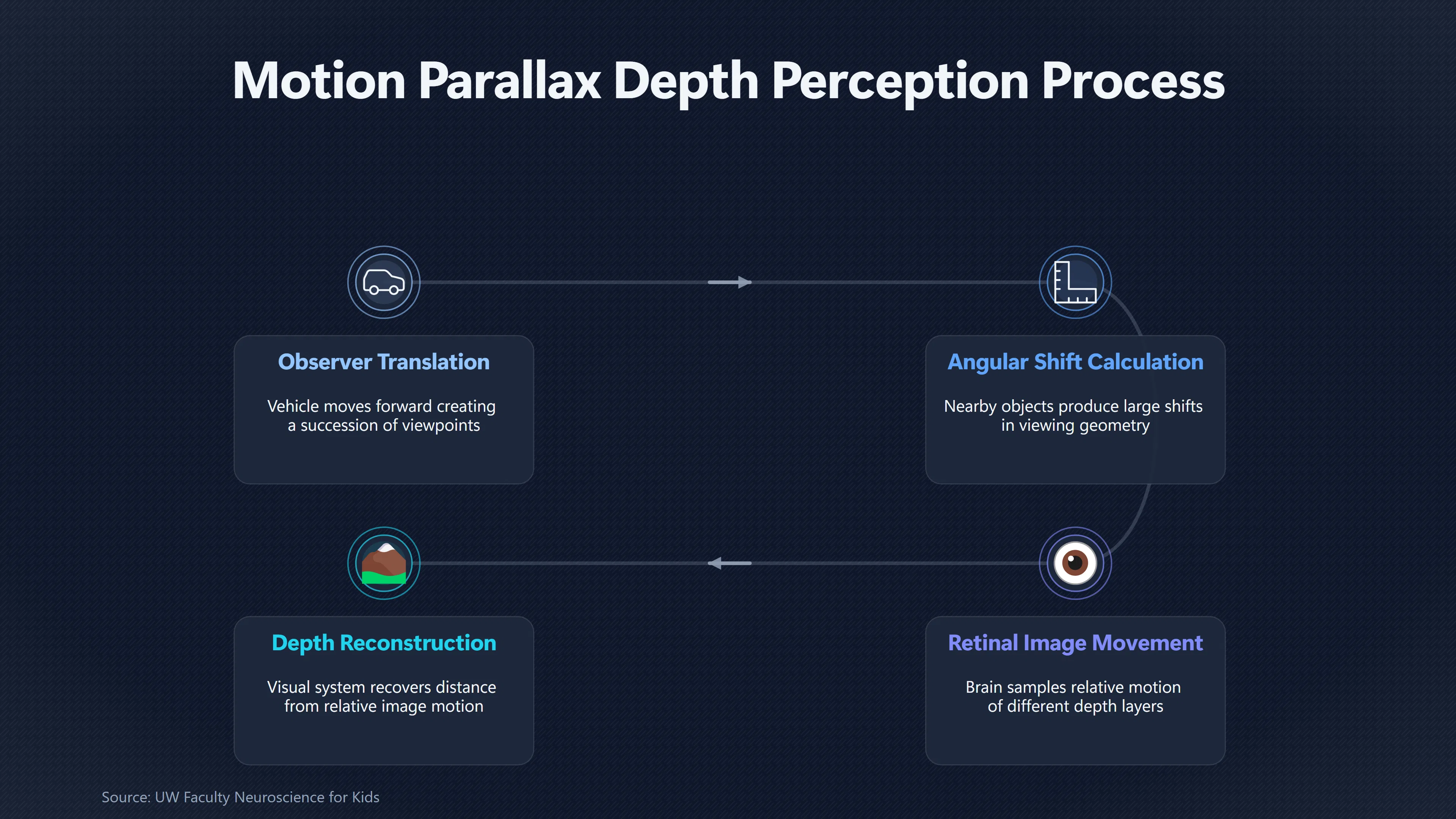
Motion parallax arises because the observer is changing position. A passenger looking sideways from a moving vehicle is effectively sampling the scene from a succession of viewpoints. Objects at different distances consequently shift by different amounts across the visual field. Research describes motion parallax as the relative retinal movement of objects at different depths produced by an observer’s translation through the environment.[PubMed Central (PMC)]pmc.ncbi.nlm.nih.govPub Med Central (PMC)Visual Depth from Motion Parallax and Eye PursuitPubMed Central (PMC)Visual Depth from Motion Parallax and Eye Pursuit - PMCJune 22, 2011…
The familiar roadside experience demonstrates the geometry particularly well. A telephone pole a few metres away can cross much of the passenger’s field of view in a second or two. A building hundreds of metres away changes direction much less rapidly. A distant hill barely seems to move. University of Washington teaching material uses essentially this example: roadside telephone poles appear to pass much faster from a moving car than buildings or trees farther away.[UW Faculty]faculty.washington.eduUW Faculty Neuroscience for KidsUW FacultyNeuroscience for Kids - Motion, form and depth… Hanover College’s perception material similarly contrasts nearby trees rushing past a moving vehicle with a distant farmhouse appearing to move much more slowly.[Isle]isle.hanover.eduIsle Motion Parallax ExplainedIsle Motion Parallax Explained
The reason can be understood without complicated mathematics. Suppose the observer moves sideways by the same distance while looking at two stationary objects. For the nearby object, that displacement represents a substantial change in viewing geometry, producing a large angular shift. For an object vastly farther away, the same displacement produces only a tiny angular shift.
This difference can become enormous. Physicist Rhett Allain illustrated the point using the familiar experience of the Moon apparently following a car. In his example, a car travelling about 31 metres in one second changes its viewing angle to the Moon by an effectively negligible amount, whereas the angular position of a tree only 10 metres away can change dramatically over the same interval.[WIRED]wired.comwhy does the moon follow meWhy does the Moon follow me? | WIREDSeptember 27, 2010…
The foreground therefore supplies a moving yardstick against which the distant object is judged. What feels remarkable — the light apparently staying with the vehicle — is partly the perceptual inverse of something entirely ordinary: everything nearby is moving across the view extremely quickly.
Why roadside scenery exaggerates the light’s stability
The pacing impression is strongest when the view contains pronounced differences in depth. Imagine a passenger watching one bright light through a side window. The visual scene may contain several layers at once:
- Lamp posts, hedges and roadside trees may flash backwards extremely quickly.
- Houses and larger buildings farther from the road drift backwards more slowly.
- Distant hills or a skyline may shift only gradually.
- A very remote light can remain almost stationary in angular position during the same interval.
These are not four different physical speeds that the passenger is observing directly. Much of the apparent movement has been generated by the vehicle’s own motion. Experiments have established that such relative image displacement can itself create a compelling perception of three-dimensional depth, even when other depth information is removed.[PubMed]pubmed.ncbi.nlm.nih.govPub Med Motion parallax as an independent cue for depth perceptionMotion parallax as an independent cue for depth perception - PubMed…
Foreground objects make the contrast particularly vivid because they repeatedly cross the line of sight. A distant light may appear first beside one tree, then between two buildings, then beyond a lamp post and finally over another rooftop. Each foreground object enters and leaves rapidly, yet the light remains in approximately the same part of the wider scene. The passenger can consequently experience the light as a persistent companion while the landscape appears to stream underneath or behind it.
The Moon provides the clearest everyday analogue. From a car, its direction barely changes over ordinary road distances while trees and other nearby objects sweep past. Allain notes that this combination — a distant object retaining almost the same angular position while nearer scenery moves rapidly — produces precisely the familiar impression that the Moon is following the vehicle.[WIRED]wired.comwhy does the moon follow meWhy does the Moon follow me? | WIREDSeptember 27, 2010… The same geometry does not require an object to be as distant as the Moon: any sufficiently remote light can exhibit much weaker angular displacement than nearby roadside references.
Importantly, the visual system normally benefits from these differences. Motion parallax is a useful depth cue rather than a defect in human vision. Researchers have shown that the brain combines retinal image motion with information associated with eye movements to recover the relative depth of objects in a scene.[PubMed Central (PMC)]pmc.ncbi.nlm.nih.govPubMed Central (PMC)The motion/pursuit law for visual depth perception from motion parallax - PMCJuly 1, 2009… The potential for confusion arises when the distant target provides too little information to establish its actual range.
What a passenger sees across different depth layers
Consider a passenger travelling along a straight road at night while watching a bright point above the horizon. A nearby tree approaches the edge of the window, races across the view and disappears behind the passenger. A more distant house takes longer to cross the same visual area. A ridge on the horizon changes position only slowly.
The bright point may scarcely shift at all.
That layered motion is important because the observer does not experience the light against an empty coordinate grid. The eye continually sees it in relation to objects whose apparent positions are changing at very different rates. Motion-parallax research specifically treats these relative movements as information from which the visual system reconstructs depth.[PubMed Central (PMC)]pmc.ncbi.nlm.nih.govPub Med Central (PMC)The neural basis of depth perception from motion parallaxPubMed Central (PMC)The neural basis of depth perception from motion parallax - PMC…
Occlusion can make the experience still more striking. A tree trunk may momentarily hide the light; a second later the light reappears on the other side. Then a building blocks it and it emerges again. Nothing about those disappearances requires the light to have moved around the obstacles. The observer has moved far enough for successive foreground objects to cross the line of sight.
This can produce a memorable subjective sequence: the light was beside us, went behind the trees, appeared again beyond the houses, and was still there several miles later. That description is entirely compatible with a sufficiently distant source. The repeated replacement of foreground scenery can actually strengthen the feeling of pursuit because the landscape changes dramatically while the target remains conspicuously persistent.
The effect also depends on viewing direction. Looking substantially sideways from a vehicle makes nearby scenery sweep especially dramatically across the visual field. Looking more nearly along the road produces a different pattern of visual flow, with scenery tending to expand away from the direction of travel rather than simply sliding laterally. The precise appearance therefore changes with the road, bends, viewing angle and where the passenger keeps looking. The underlying principle remains the same: observer movement generates depth-dependent apparent motion.
Why a point of light is especially easy to misjudge
A house, tower or mountain usually supplies information about its scale and location. An isolated night-time light may supply almost none. Without a visible structure around it, the observer may not know whether the source is a small light relatively nearby, an aircraft much farther away, or an astronomical object at an immense distance.
That uncertainty matters because angular position alone does not reveal range. A small nearby object and a large remote object can occupy similar apparent angles. Likewise, observing that a light remains near the same bearing does not establish that it has matched the vehicle’s speed.
Reduced reference information is a recognised problem in aviation perception. SKYbrary notes that a stationary point light against a dark or featureless background can even appear to move through the separate autokinetic effect, while night-flight guidance warns that stars or planets can be mistaken for aircraft when visual references are poor.[Skybrary]skybrary.aeroAutokinetic Effect | SKYbrary Aviation SafetyAutokinetic Effect | SKYbrary Aviation Safety Autokinesis should not be confused with the foreground pacing mechanism: one concerns apparent movement of an isolated light in a poorly referenced visual field, whereas the effect discussed here is driven principally by the strong contrast between rapidly moving nearby scenery and weakly shifting distant scenery.
This distinction is useful when assessing UFO/UAP reports. A witness can accurately report what the scene looked like — including that a light seemed to stay beside the car — without that observation establishing that the source physically flew alongside the vehicle.
Apparent motion is not the same as object motion
The wider UAP literature provides concrete reminders of why observer motion must be separated from target motion. In its analysis of the 2013 Puerto Rico UAP footage, the US All-domain Anomaly Resolution Office (AARO) reconstructed the geometry using the aircraft position and sensor parameters. AARO concluded that objects which appeared to travel at high speed were actually moving at about 3.6 metres per second in a straight line, broadly consistent with the wind, and attributed the perceived high speed to motion parallax produced by the moving observing aircraft and viewing geometry.[AARO]aaro.milPuerto Rico UAP Case ResolutionPuerto Rico UAP Case Resolution
That case involved an airborne sensor rather than someone looking through a car window, and it produced an apparent-speed effect rather than precisely the roadside pacing illusion described here. It nevertheless demonstrates the same important analytical principle: motion visible in an image or line of sight can be produced partly — and sometimes predominantly — by movement of the observer. AARO’s public UAP material explicitly notes that reconstruction of sensor look angles and platform motion can change the interpretation of apparent object behaviour.[AARO]aaro.milUAP ImageryUAP Imagery
For a vehicle sighting, foreground scenery offers a clue that the observer is seeing this geometry in action. If poles and trees race across the light while distant landmarks shift progressively more slowly, the scene displays the depth-dependent pattern expected from motion parallax. The apparent steadiness of the light should therefore not be converted directly into a claim that it is travelling at the vehicle’s speed.

What would distinguish pacing from real pursuit?
A genuinely pacing object and a very distant object can both remain at a roughly constant bearing for a time. The visual impression alone therefore cannot reliably distinguish them. The useful question is not simply, “Did the light stay beside the car?” but “Did anything establish its distance and independent movement?”
A change in observing geometry is particularly informative. If the vehicle turns substantially, stops, or reaches a location with different reference landmarks, the relationship between observer, foreground and light changes. Multiple observations from separated locations can be even more valuable because parallax itself can then constrain distance; this is the same basic geometric principle by which changes in viewpoint are used to infer the distances of astronomical objects. NASA defines parallax as the apparent positional shift of an object when it is viewed from different locations.[NASA Science]science.nasa.govScience Hubble GlossaryScience Hubble Glossary
Video can also help when it contains stable landmarks and information about the camera’s movement. Simply keeping the light centred in a handheld recording is less informative, because camera panning can remove much of the angular movement that would otherwise be visible. By contrast, identifiable terrain, road geometry, timestamps, direction of travel and known camera orientation can provide the references needed to separate observer-induced motion from target motion.
The central lesson is narrow but important for UFO/UAP interpretation. Fast-moving foreground scenery can make a remote light appear unusually loyal to a moving vehicle. Trees and poles sweep away, buildings drift past, distant terrain moves slowly, and the light changes direction least of all. The resulting experience can be vivid enough to feel like deliberate pursuit, even though the distinctive visual behaviour may arise from the observer moving through a landscape composed of very different depth layers.
Amazon book picks
Further Reading
Books and field guides related to Why Passing Scenery Makes a Light Seem to Pace You. Use these as the next step if you want deeper reading beyond the article.
Sensation and Perception
. Bruce Goldstein's SENSATION AND PERCEPTION, the best-seller which has helped over 150,000 students understand the ties between how we s...
Visual Intelligence: How We Create What We See
A unique, illustrated popular study reveals the way the human eye acts on the visual world not just to represent but to create the things...
Binocular Vision and Stereopsis
This book is a survey of knowledge about binocular vision, with an emphasis on its role in the perception of a three-dimensional world. T...
eBay marketplace picks
Marketplace Samples
Live-tested eBay searches with available results related to this page.
Selected fromUFO poster oneBay.co.uk.

Current eBay listing
I Want To Believe UFO Poster Giclée Fine Art Heavyweight Print

Current eBay listing
VINTAGE UFO FLYING SAUCERS COMIC ADVERTISING A2 POSTER PRINT
Endnotes
1.
Source: faculty.washington.edu
Title: UW Faculty Neuroscience for Kids
Link:https://faculty.washington.edu/chudler/pertr.html
Source snippet
UW FacultyNeuroscience for Kids - Motion, form and depth...
2.
Source: isle.hanover.edu
Title: Isle Motion Parallax Explained
Link:https://isle.hanover.edu/Ch07DepthSize/Ch07MotionParallaxExpl.html
3.
Source: wired.com
Title: why does the moon follow me
Link:https://www.wired.com/2010/09/why-does-the-moon-follow-me/
Source snippet
Why does the Moon follow me? | WIREDSeptember 27, 2010...
Published: September 27, 2010
4.
Source: skybrary.aero
Title: Autokinetic Effect | SKYbrary Aviation Safety
Link:https://skybrary.aero/index.php/articles/autokinetic-effect
5.
Source: skybrary.aero
Title: General Aviation Night Flying Guidance | SKYbrary Aviation Safety
Link:https://skybrary.aero/index.php/articles/general-aviation-night-flying-guidance
6.
Source: aaro.mil
Title: Puerto Rico UAP Case Resolution
Link:https://www.aaro.mil/Portals/136/PDFs/case_resolution_reports/AARO_Puerto_Rico_UAP_Case_Resolution.pdf
7.
Source: aaro.mil
Title: UAP Imagery
Link:https://www.aaro.mil/UAP-Cases/Official-UAP-Imagery/4/
8.
Source: science.nasa.gov
Title: Science Hubble Glossary
Link:https://science.nasa.gov/mission/hubble/multimedia/hubble-glossary/
9.
Source: aaro.mil
Link:https://www.aaro.mil/Next-AARO-Home-redesign/Next-Parent/Next-UAP-Report-Documents/poster/
10.
Source: aaro.mil
Link:https://www.aaro.mil/Next-AARO-Home-redesign/Next-Parent/Next-AARO-UAP-Imagery-Acc-Table/
11.
Source: aaro.mil
Link:https://www.aaro.mil/Next-AARO-Home-redesign/Next-Parent/Next-UAP-Report-Documents/
12.
Source: aaro.mil
Link:https://www.aaro.mil/Next-AARO-Home-redesign/Next-Parent/Next-UAP-Report-Documents/poster/dividLink/
13.
Source: aaro.mil
Link:https://www.aaro.mil/Next-AARO-Home-redesign/Next-Parent/Presidential-UAP-Transparency-Initiative/
14.
Source: svs.gsfc.nasa.gov
Link:https://svs.gsfc.nasa.gov/5320/
15.
Source: nasa.gov
Title: UPDAT E: NASA Shares UAP Independent Study Report; Names Director
Link:https://www.nasa.gov/news-release/update-nasa-shares-uap-independent-study-report-names-director/
16.
Source: nasa.gov
Title: NAS A to Release, Discuss Unidentified Anomalous Phenomena Report
Link:https://www.nasa.gov/news-release/nasa-to-release-discuss-unidentified-anomalous-phenomena-report/
17.
Source: nasa.gov
Title: NAS A Provides Coverage of Unidentified Anomalous Phenomena Meeting
Link:https://www.nasa.gov/news-release/nasa-provides-coverage-of-unidentified-anomalous-phenomena-meeting/
18.
Source: nasa.gov
Title: NAS A Announces Unidentified Aerial Phenomena Study Team Members
Link:https://www.nasa.gov/general/nasa-announces-unidentified-aerial-phenomena-study-team-members/
19.
Source: astrobiology.nasa.gov
Title: know thy star know thy planet
Link:https://astrobiology.nasa.gov/news/know-thy-star-know-thy-planet/
20.
Source: science.nasa.gov
Title: three steps to measuring the hubble constant
Link:https://science.nasa.gov/asset/hubble/three-steps-to-measuring-the-hubble-constant/
21.
Source: apod.nasa.gov
Link:https://apod.nasa.gov/apod/ap160520.html
22.
Source: imagine.gsfc.nasa.gov
Link:https://imagine.gsfc.nasa.gov/descriptions/parallax.html
23.
Source: science.nasa.gov
Title: hubble stretches stellar tape measure 10 times farther into space
Link:https://science.nasa.gov/missions/hubble/hubble-stretches-stellar-tape-measure-10-times-farther-into-space/
24.
Source: pwg.gsfc.nasa.gov
Link:https://pwg.gsfc.nasa.gov/stargaze/Smoon4.htm
25.
Source: ntrs.nasa.gov
Link:https://ntrs.nasa.gov/citations/20110012258
26.
Source: ntrs.nasa.gov
Link:https://ntrs.nasa.gov/citations/20110011637
27.
Source: skybrary.aero
Title: b738 kingston jamaica 2009
Link:https://skybrary.aero/index.php/accidents-and-incidents/b738-kingston-jamaica-2009
28.
Source: jpl.nasa.gov
Title: pia12013 how to find a tiny wobble in a zippy star
Link:https://www.jpl.nasa.gov/images/pia12013-how-to-find-a-tiny-wobble-in-a-zippy-star/
29.
Source: ntrs.nasa.gov
Link:https://ntrs.nasa.gov/citations/20050153369
30.
Source: ntrs.nasa.gov
Link:https://ntrs.nasa.gov/citations/20040088137
31.
Source: science.nasa.gov
Title: hubble sees bare neutron star streaking across space
Link:https://science.nasa.gov/missions/hubble/hubble-sees-bare-neutron-star-streaking-across-space/
32.
Source: science.nasa.gov
Title: the motion of rx j185635 3754 the nearest neutron star to earth
Link:https://science.nasa.gov/asset/hubble/the-motion-of-rx-j185635-3754-the-nearest-neutron-star-to-earth/
33.
Source: asrs.arc.nasa.gov
Title: cb 246
Link:https://asrs.arc.nasa.gov/publications/callback/cb_246.htm
34.
Source: ntrs.nasa.gov
Link:https://ntrs.nasa.gov/citations/20020038807
35.
Source: ntrs.nasa.gov
Link:https://ntrs.nasa.gov/citations/19980019496
36.
Source: ntrs.nasa.gov
Link:https://ntrs.nasa.gov/citations/20020015986
37.
Source: ntrs.nasa.gov
Link:https://ntrs.nasa.gov/search.jsp?R=19920024990
38.
Source: ntrs.nasa.gov
Link:https://ntrs.nasa.gov/citations/19900013620
39.
Source: ntrs.nasa.gov
Link:https://ntrs.nasa.gov/citations/19900013604
40.
Source: ntrs.nasa.gov
Link:https://ntrs.nasa.gov/citations/19900013621
41.
Source: ntrs.nasa.gov
Link:https://ntrs.nasa.gov/citations/19840026815
42.
Source: isle.hanover.edu
Title: Ch07Motion Parallax Illus
Link:https://isle.hanover.edu/Ch07DepthSize/Ch07MotionParallaxIllus.html
43.
Source: skybrary.aero
Link:https://skybrary.aero/index.php/articles/visual-illusions
44.
Source: skybrary.aero
Link:https://skybrary.aero/index.php/articles/night-visual-approaches
45.
Source: skybrary.aero
Link:https://skybrary.aero/index.php/articles/runway-visual-perspective
46.
Source: skybrary.aero
Link:https://skybrary.aero/index.php/articles/lessening-effects-visual-illusions
47.
Source: skybrary.aero
Link:https://skybrary.aero/articles/vision-oghfa-bn
48.
Source: skybrary.aero
Link:https://skybrary.aero/articles/transition-visual-flight-night-oghfa-se
49.
Source: skybrary.aero
Link:https://skybrary.aero/bookshelf/understanding-visual-illusions-and-disorientation
50.
Source: skybrary.aero
Link:https://skybrary.aero/index.php/articles/laser-interference-aviation
51.
Source: skybrary.aero
Link:https://skybrary.aero/index.php/accidents-and-incidents/ec25-vicinity-etap-central-offshore-platform-north-sea-uk
52.
Source: starchild.gsfc.nasa.gov
Link:https://starchild.gsfc.nasa.gov/docs/StarChild/questions/parallax.html
53.
Source: faculty.washington.edu
Link:https://faculty.washington.edu/chudler/eyeper.html
54.
Source: aaro.mil
Link:https://www.aaro.mil/UAP-Cases/Official-UAP-Imagery/
55.
Source: aaro.mil
Link:https://www.aaro.mil/FAQ/
56.
Source: aaro.mil
Link:https://www.aaro.mil/UAP-Records/-1/
57.
Source: aaro.mil
Link:https://www.aaro.mil/Resources/Historical-Record-Reports/Volume-II/
58.
Source: aaro.mil
Link:https://www.aaro.mil/Next-AARO-Home-redesign/Inactive-Parent/AARO-Records-Tabs/
59.
Source: aaro.mil
Title: UAP Imagery* “[Go Fast]({{ ‘go-fast/’ | relative_url }})” Object NAVAIR
Link:https://www.aaro.mil/Next-AARO-Home-redesign/Inactive-Parent/Next-UAP-Imagery-dup/
60.
Source: aaro.mil
Link:https://www.aaro.mil/Next-AARO-Home-redesign/Next-Parent/Next-AARO-UAP-Imagery-Fixed-Table/
61.
Source: aaro.mil
Title: AAR O UAP Trends All-domain Anomaly Resolution Office UAP REPORTING TRENDS
Link:https://www.aaro.mil/UAP-Cases/UAP-Reporting-Trends/
62.
Source: aaro.mil
Title: UAP Records
Link:https://www.aaro.mil/UAP-Records/
63.
Source: youtube.com
Title: The Moon Follows You? Here’s The Real Reason
Link:https://www.youtube.com/watch?v=qfXl9d2uCw0
Source snippet
Motion Parallax - sensation and perception...
64.
Source: youtube.com
Title: Motion Parallax
Link:https://www.youtube.com/watch?v=RxO3HMCjfQs
Source snippet
Depth Perception (Intro Psych Tutorial #57)...
65.
Source: pmc.ncbi.nlm.nih.gov
Link:https://pmc.ncbi.nlm.nih.gov/articles/PMC2735858/
Source snippet
PubMed Central (PMC)The motion/pursuit law for visual depth perception from motion parallax - PMCJuly 1, 2009...
Published: July 1, 2009
66.
Source: pmc.ncbi.nlm.nih.gov
Link:https://pmc.ncbi.nlm.nih.gov/articles/PMC3349336/
Source snippet
PubMed Central (PMC)Integration time for the perception of depth from motion parallax - PMC...
67.
Source: pmc.ncbi.nlm.nih.gov
Title: Pub Med Central (PMC)Visual Depth from Motion Parallax and Eye Pursuit
Link:https://pmc.ncbi.nlm.nih.gov/articles/PMC3348271/
Source snippet
PubMed Central (PMC)Visual Depth from Motion Parallax and Eye Pursuit - PMCJune 22, 2011...
Published: June 22, 2011
68.
Source: pmc.ncbi.nlm.nih.gov
Title: Pub Med Central (PMC)The neural basis of depth perception from motion parallax
Link:https://pmc.ncbi.nlm.nih.gov/articles/PMC4901450/
Source snippet
PubMed Central (PMC)The neural basis of depth perception from motion parallax - PMC...
69.
Source: pubmed.ncbi.nlm.nih.gov
Title: Pub Med Motion parallax as an independent cue for depth perception
Link:https://pubmed.ncbi.nlm.nih.gov/471676/
Source snippet
Motion parallax as an independent cue for depth perception - PubMed...
70.
Source: pmc.ncbi.nlm.nih.gov
Link:https://pmc.ncbi.nlm.nih.gov/articles/PMC4990516/
Source snippet
PubMed Central (PMC)A pursuit theory account for the perception of common motion in motion parallax - PMC...
71.
Source: pmc.ncbi.nlm.nih.gov
Link:https://pmc.ncbi.nlm.nih.gov/articles/PMC12115827/
72.
Source: savemyexams.com
Title: Motion Parallax
Link:https://www.savemyexams.com/glossary/gcse/psychology/motion-parallax/
73.
Source: pmc.ncbi.nlm.nih.gov
Link:https://pmc.ncbi.nlm.nih.gov/articles/PMC4974157/
74.
Source: pmc.ncbi.nlm.nih.gov
Link:https://pmc.ncbi.nlm.nih.gov/articles/PMC4586953/
75.
Source: pmc.ncbi.nlm.nih.gov
Link:https://pmc.ncbi.nlm.nih.gov/articles/PMC4323539/
76.
Source: pmc.ncbi.nlm.nih.gov
Link:https://pmc.ncbi.nlm.nih.gov/articles/PMC4186274/
77.
Source: pmc.ncbi.nlm.nih.gov
Link:https://pmc.ncbi.nlm.nih.gov/articles/PMC3868396/
78.
Source: pmc.ncbi.nlm.nih.gov
Link:https://pmc.ncbi.nlm.nih.gov/articles/PMC4521857/
79.
Source: pmc.ncbi.nlm.nih.gov
Link:https://pmc.ncbi.nlm.nih.gov/articles/PMC3471791/
80.
Source: pubmed.ncbi.nlm.nih.gov
Link:https://pubmed.ncbi.nlm.nih.gov/21695531/
81.
Source: pubmed.ncbi.nlm.nih.gov
Link:https://pubmed.ncbi.nlm.nih.gov/12049281/
82.
Source: pubmed.ncbi.nlm.nih.gov
Link:https://pubmed.ncbi.nlm.nih.gov/2974869/
83.
Source: pmc.ncbi.nlm.nih.gov
Link:https://pmc.ncbi.nlm.nih.gov/articles/PMC10561791/
84.
Source: pmc.ncbi.nlm.nih.gov
Link:https://pmc.ncbi.nlm.nih.gov/articles/PMC6740481/
85.
Source: pmc.ncbi.nlm.nih.gov
Link:https://pmc.ncbi.nlm.nih.gov/articles/PMC12221026/
86.
Source: sciencedirect.com
Title: Motion Parallax
Link:https://www.sciencedirect.com/topics/computer-science/motion-parallax
87.
Source: fiveable.me
Link:https://fiveable.me/intro-psychology/key-terms/motion-parallax
88.
Source: ultimatepopculture.fandom.com
Link:https://ultimatepopculture.fandom.com/wiki/Parallax
89.
Source: motionapp.com
Link:https://motionapp.com/
90.
Source: brainly.com
Link:https://brainly.com/question/33261098
91.
Source: brainly.com
Link:https://brainly.com/question/52550364
92.
Source: Wikipedia
Link:https://en.wikipedia.org/wiki/Parallax
Additional References
93.
Source: youtube.com
Title: 5 Monocular Cues: Adjusting To Depth Perception Problems
Link:https://www.youtube.com/watch?v=Qi-nHODlQwo
Source snippet
This video from StarTalk, The Truth Behind Famous UFO Sightings, explains how motion parallax and visual depth cues cause distant objects...
94.
Source: nature.com
Link:https://www.nature.com/articles/nature06814
95.
Source: faa.gov
Link:https://www.faa.gov/data_research/research/med_humanfacs/oamtechreports/1960s/1965/196511
96.
Source: faa.gov
Link:https://www.faa.gov/data_research/research/med_humanfacs/oamtechreports/1960s/1969/196915
97.
Source: faa.gov
Link:https://www.faa.gov/data_research/research/med_humanfacs/oamtechreports/1960s/1969/196923
98.
Source: faa.gov
Link:https://www.faa.gov/data_research/research/med_humanfacs/oamtechreports/1970s/1970/7002
99.
Source: faa.gov
Link:https://www.faa.gov/data_research/research/med_humanfacs/oamtechreports/1970s/1971/7131
100.
Source: faa.gov
Link:https://www.faa.gov/data_research/research/med_humanfacs/oamtechreports/1970s/1977/197712
101.
Source: faa.gov
Link:https://www.faa.gov/data_research/research/med_humanfacs/oamtechreports/1980s/1981/198106
102.
Source: faa.gov
Link:https://www.faa.gov/data_research/research/med_humanfacs/oamtechreports/1980s/1982/198206