Within UFO Identifications
When Distant Fireworks Lose Their Familiar Shape
Distant fireworks can appear as isolated flashes or hovering points when sound, launch location and recognizable bursts are absent.
On this page
- Why range can separate flashes from sound
- Obscured launch sites and partial bursts
- Checking local events and timing
Page outline Jump by section
Introduction
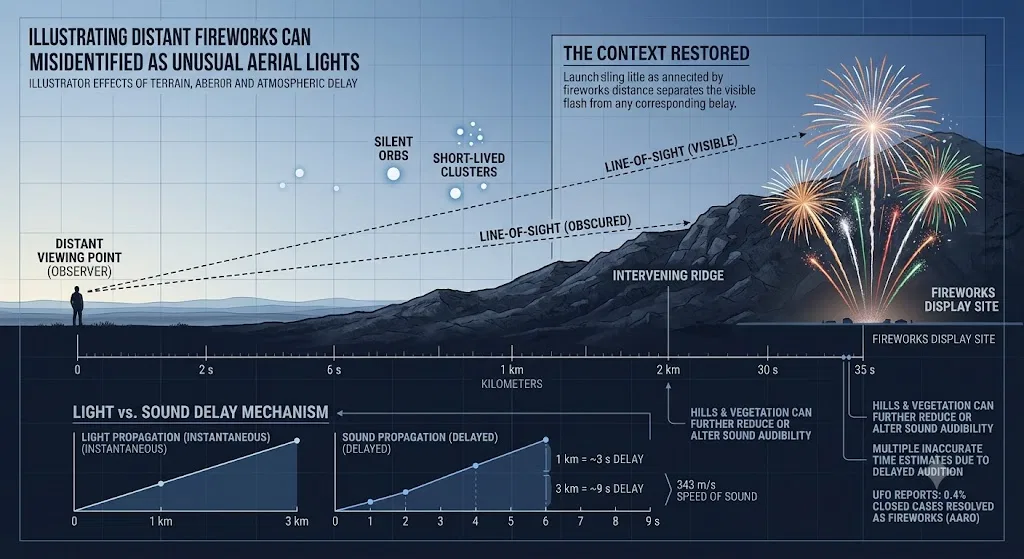
Distant fireworks can become surprisingly convincing unusual aerial lights when the clues that normally identify them are stripped away. A witness may see only a few orange or white flashes above a roofline, hill or trees, with no visible launch point and no immediately corresponding bang. At several kilometres’ distance, individual bursts may look like stationary glowing points, lights that appear and vanish, or short-lived clusters rather than the familiar expanding firework pattern.
This is a recognised, if relatively uncommon, source of UFO/UAP misidentification. The US All-domain Anomaly Resolution Office (AARO) currently lists four closed UAP cases resolved as fireworks, representing 0.4% of its published closed-case outcomes for reports dating from 1996 to 15 June 2026.[AARO]aaro.milOpen source on aaro.mil. The practical lesson is not that every unexplained flash is a firework, but that investigators should test the location and time of a sighting against nearby displays before treating apparent silence, hovering or odd geometry as evidence against a pyrotechnic explanation.
Why range can separate flashes from sound
The most misleading feature of distant fireworks is often the apparent absence of noise. Light from a burst reaches the observer for practical purposes immediately, whereas sound travels through ordinary air at roughly 343 metres per second near room temperature.[NIST]nist.govOpen source on nist.gov. That produces a noticeable delay even at modest distances: a burst one kilometre away is heard roughly three seconds after it is seen; at three kilometres, the delay approaches nine seconds.
A witness who watches several intermittent lights may therefore associate a later bang with the wrong flash, or fail to associate it with the lights at all. If attention has shifted elsewhere by the time the sound arrives, the original observation can be remembered as silent. The same basic effect explains the familiar delay between lightning and thunder. NOAA notes that atmospheric temperature structure affects how sound propagates and how far it remains audible, so audibility is not simply a matter of whether an explosion occurred.[NOAA]noaa.govOpen source on noaa.gov.
Distance also weakens sound while leaving a bright nocturnal flash conspicuous. Buildings, hills, vegetation and the listener’s position can further reduce or alter what reaches the ear. Consequently, “there was no sound” is useful evidence only when the likely distance and acoustic conditions are known. It is not, by itself, a strong reason to exclude fireworks.
This becomes especially important when witnesses estimate distance from the appearance of a light. A featureless point in a dark sky provides few reliable size cues. Something interpreted as a relatively nearby silent object may instead be a much more distant pyrotechnic burst whose sound is delayed, weakened or masked.

Obscured launches can leave only the strangest part visible
A normal firework display is easy to recognise because the observer usually sees a sequence: a rocket or shell rises from a known site, bursts into a symmetrical pattern and is accompanied by sound, smoke and repeated activity from the same area. Remove the lower half of that scene and the visual impression changes dramatically.
From behind houses, woodland, a ridge or an urban skyline, the firing site and rising projectile can be completely hidden while the highest part of a burst remains visible. Instead of seeing a firework, the observer sees a light suddenly appear in empty sky.
Only part of a burst may clear the obstruction. That can produce several effects relevant to unusual-light reports:
- An isolated orb: a bright component of a larger burst may be the only part visible above a roofline.
- Lights appearing beside one another: successive shells from the same site can illuminate roughly the same patch of sky without revealing their common launch point.
- A hovering impression: a bright burning component seen at long range may move too little across the observer’s field of view for its descent to be obvious.
- Abrupt appearance and disappearance: ignition and burnout naturally produce lights with no visible approach or departure.
- Apparently unusual colours: orange, red, green or white points seen without the structure of the full burst can resemble the colours repeatedly described in UFO reports.
A documented British example illustrates how much context matters. In Lincolnshire in January 2009, unusual lights reported near the Conisholme wind turbines became entangled with speculation after one turbine was found badly damaged. The Guardian subsequently established that a family birthday party roughly two miles from the turbine had included fireworks, including Roman candles producing orange and blue lights. A witness from the party remarked that, across the very flat landscape, the effects could be seen from miles away and might resemble orange balls of fire to a distant observer. The fireworks offered a straightforward explanation for at least some of the reported lights, although they were not considered capable of explaining the turbine failure itself.[The Guardian]theguardian.comOpen source on theguardian.com.
The distinction is useful: identifying fireworks as the source of lights does not require them to explain every event that happened nearby. UFO investigations can go wrong when several coincident observations are treated as necessarily having one cause.
Another modern example came from Worcestershire in August 2021, when an unusual high-tech firework display in Bromsgrove prompted reports of strange lights from neighbouring Redditch and surrounding areas. Contemporary local reporting described the display as being mistaken by some observers for UFO activity.[Birmingham Mail]birminghammail.co.ukOpen source on birminghammail.co.uk. Such cases show how observers well outside the intended audience of an event can encounter only its most ambiguous visual fragments.
Timing is often the quickest way to test the explanation
Because fireworks are short-lived events, the most useful investigative unit is usually an event time window rather than the general question “are fireworks used around here?” A plausible match should place a real display in the correct direction and at approximately the correct time.
Investigators should begin with the witness’s original time as precisely as possible. A phone photograph or video can be especially valuable because its metadata may preserve a timestamp more accurately than later recollection. The useful search window should then extend slightly either side of that time to allow for clock errors, estimated sighting times and displays starting or finishing a few minutes off schedule.
The next step is to search locally rather than nationally. Relevant records can include council event calendars, school and sports-club announcements, wedding venues, festival programmes, community social-media pages and local news coverage. UK government guidance specifically notes that firework displays are commonly organised by local authorities, schools and community groups, while wedding and other venues may also permit them. Organisers are encouraged to notify communities through websites, leaflets or social media, which means a planned display may leave a searchable record even when the witness had no prior knowledge of it.[GOV.UK]gov.ukOpen source on gov.uk.
A useful verification sequence is:
- Fix the observation window. Establish the best available start and end times.
- Establish the viewing direction. Even a rough compass direction or identifiable skyline feature can eliminate events on the wrong side of the observer.
- Search nearby events. Include private venues and community displays, not just major municipal shows.
- Compare duration and rhythm. A sequence of repeated appearances over several minutes is more compatible with an active display than one genuinely persistent object.
- Check the horizon geometry. Ask whether buildings, trees or terrain could have hidden the launch site and lower portions of the bursts.
- Reconsider reported silence. Estimate the potential range before treating lack of sound as contradictory evidence.
- Seek independent records. Other videos taken nearer the suspected site can show the complete bursts that appeared anomalous from farther away.
Calendar context can strengthen or weaken the hypothesis, although it should not replace event-specific evidence. In the UK, fireworks are normally prohibited between 11pm and 7am, with later cut-offs for Bonfire Night, New Year’s Eve, Diwali and Chinese New Year.[GOV.UK]gov.ukOpen source on gov.uk. A sighting at 10pm near a known celebration therefore fits the ordinary operating window much better than an unexplained sequence at 4am. Conversely, a late-night time outside the legal window does not make fireworks impossible: private misuse can occur, and regulations describe what is permitted rather than everything people actually do.
When the firework explanation fits — and when it does not
A good firework identification should explain several observations at once. The strongest cases combine a matching event, direction and time with lights that are brief, repeatedly originate in the same small area of sky, show colours typical of pyrotechnics and appear above an obstructed horizon. Delayed or faint bangs provide additional support but are not essential.
The hypothesis becomes weaker when the observed phenomenon persists continuously for a long period, travels coherently over a large angular distance, maintains a fixed formation while crossing the sky, or is recorded from multiple separated locations in a way that places it far from the proposed display. A firework explanation should be tested against the report, not selected merely because coloured lights were involved.
That caution is reflected in current official UAP data. AARO does explicitly record fireworks among resolved cases, confirming that the mechanism occurs in real reporting, but its published statistics show only four such resolutions in its closed-case dataset through mid-June 2026.[AARO]aaro.milOpen source on aaro.mil. Fireworks are therefore a genuine case family rather than a universal explanation for unexplained nocturnal lights.
Their importance lies in how effectively viewing conditions can remove familiar context. A firework seen from its audience area announces what it is through launch, shape, sound and repetition. The same event seen several kilometres away, between buildings and without advance knowledge may consist of nothing more than a silent orange point that appears, hangs briefly and vanishes. Reconstructing the event’s time, direction and local setting often restores the context that the original observer never had.
Amazon book picks
Further Reading
Books and field guides related to When Distant Fireworks Lose Their Familiar Shape. Use these as the next step if you want deeper reading beyond the article.
The UFO Handbook: A Guide to Investigating, Evaluating, and R...
An explanation of the usual reasons for confusing IFOs (identified flying objects) with UFOs and a survey of the tools used to investigat...

Fireworks: The Art, Science and Technique
First published 1988. Subjects: Fireworks, Poudres (pyrotechnie), Feux d'artifice, Pyrotechnie.
UFOs Explained
Analyzing several UFO cases, the author exposes the myth of extraterrestrial visitors to earth.
eBay marketplace picks
Marketplace Samples
Live-tested eBay searches with available results related to this page.
Selected fromUFO poster oneBay.co.uk.


Current eBay listing
I Want To Believe UFO Poster Giclée Fine Art Heavyweight Print
Current eBay listing
VINTAGE UFO FLYING SAUCERS COMIC ADVERTISING A2 POSTER PRINT
Endnotes
1.
Source: aaro.mil
Link:https://www.aaro.mil/UAP-Cases/Official-UAP-Imagery/4/
Additional References
2.
Source: youtube.com
Title: What UFO encounters teach us about the brain | Garry Nolan and Lex Fridman
Link:https://www.youtube.com/watch?v=0VOpX-M2RQE
Source snippet
This curated list of YouTube videos provides detailed analysis and expert perspectives on how common aerial phenomena, distant Pyrotechni...
3.
Source: youtube.com
Link:https://www.youtube.com/watch?v=3L9Yd_xwGvg
Source snippet
Most Unbelievable UFO Encounters Ever | The Proof Is Out There | History...
4.
Source: youtube.com
Link:https://www.youtube.com/watch?v=BfLSclIe9Zg
Source snippet
What UFO encounters teach us about the brain | Garry Nolan and Lex Fridman...
5.
Source: youtube.com
Title: Most Unbelievable UFO Encounters Ever | The Proof Is Out There | History
Link:https://www.youtube.com/watch?v=cVzyPnDYX2Y
Source snippet
Mystery behind Aliens and UFOs - Mars and Moon...
6.
Source: youtube.com
Title: Mystery behind Aliens and UFOs
Link:https://www.youtube.com/watch?v=1lBK7bYaA2k
7.
Source: cia.gov
Link:https://www.cia.gov/stories/story/how-to-investigate-a-flying-saucer/
8.
Source: media.defense.gov
Title: FY24 CONSOLIDATED ANNUAL REPORT ON UAP 508
Link:https://media.defense.gov/2024/Nov/14/2003583603/-1/-1/0/FY24-CONSOLIDATED-ANNUAL-REPORT-ON-UAP-508.PDF