Within Radar
Why Radar Can Put a Target at the Wrong Range
A delayed echo can be assigned to the wrong transmitted pulse, making a distant reflector appear at a falsely nearer range.
On this page
- How pulsed radar measures distance
- How delayed echoes create ambiguous range
- Why extreme range changes require raw data checks
Page outline Jump by section
Introduction
Range ambiguity is a well-understood way for pulsed radar to put a genuine echo at the wrong distance. Radar normally measures range by timing the interval between transmitting a pulse and receiving its reflection. But if the echo takes so long to return that the radar has already transmitted another pulse, the receiver may associate that echo with the wrong transmission. A distant reflector can then be displayed as though it were much nearer. The US National Weather Service calls this range folding and explicitly notes that the result is an improperly located echo.[National Weather Service]forecast.weather.govNational Weather Service NOAA's National Weather ServiceNational Weather ServiceNOAA's National Weather Service - Glossary…
This mechanism matters when assessing UFO or UAP radar reports because an apparently extraordinary trajectory may depend on derived range measurements rather than direct observation of an object moving through every displayed position. Range ambiguity does not explain every unusual radar track, and modern systems employ techniques to resolve it. But where dramatic speeds, jumps or reversals depend on radar range, investigators need the underlying measurements and radar operating parameters before treating the displayed track as a literal flight path.
How pulsed radar measures distance
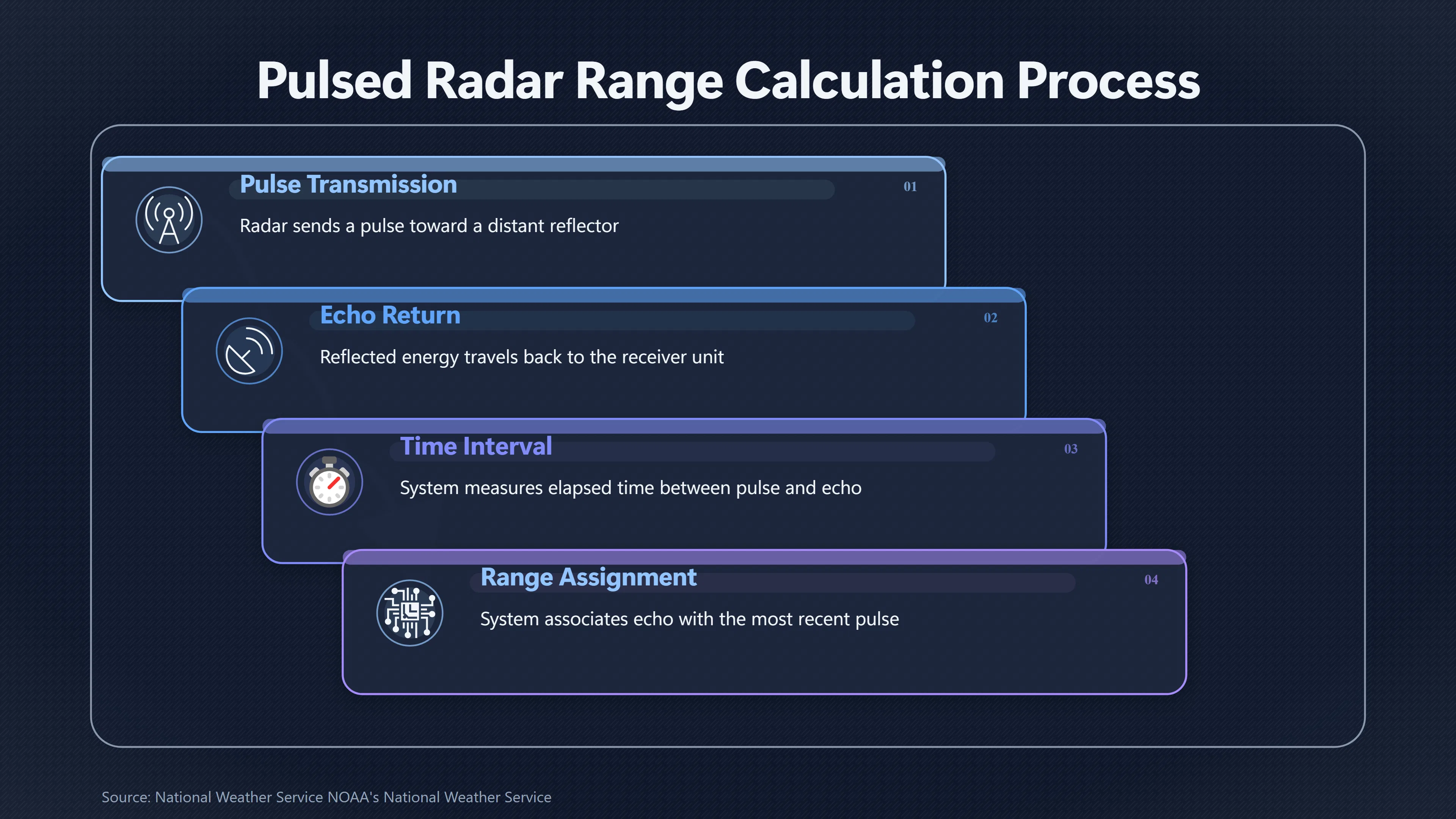
The basic ranging calculation is simple. A radar pulse travels towards a reflector at approximately the speed of light, and some of that energy returns to the receiver. Because the signal makes a round trip, target range is calculated from half the elapsed travel time. The difficulty is not measuring elapsed time itself; it is knowing which transmitted pulse produced a particular returning echo.
A pulsed radar repeatedly transmits, waits for returns and transmits again. The interval between transmissions is the pulse repetition interval, while the number of pulses transmitted per second is the pulse repetition frequency (PRF). There is therefore a maximum distance for which the radar can associate a return uniquely with the most recent pulse. In the simplest case:
Maximum unambiguous range = c / (2 × PRF)[forecast.weather.gov]forecast.weather.govSource details in endnotes.
where c is the speed of light. The UK’s Royal Air Force radar training material gives the same relationship and explains that the interval must be long enough for relevant echoes from one pulse to return before the next transmission if range ambiguity is to be avoided.[GOV.UK]assets.publishing.service.gov.ukVolume 11 RadarGOV.UKAP3456 – 11-1 - Introduction to RadarNovember 10, 2025…
The practical consequence is easy to see. At a PRF of 1,000 pulses per second, the pulse repetition interval is one millisecond and the theoretical maximum unambiguous range is about 150 kilometres, or roughly 81 nautical miles. The RAF’s example gives precisely that figure. At 250 pulses per second, the interval is four times longer and the unambiguous range becomes about 600 kilometres, or 324 nautical miles.[GOV.UK]assets.publishing.service.gov.ukVolume 11 RadarGOV.UKAP3456 – 11-1 - Introduction to RadarNovember 10, 2025…
That relationship creates an important design trade-off. Lower PRFs give echoes more time to return and therefore favour unambiguous long-range measurement. Higher PRFs can be advantageous for measuring Doppler information and detecting moving targets amid clutter, but reduce the distance that can be measured without ambiguity. MIT Lincoln Laboratory describes the fundamental problem succinctly: range becomes ambiguous when the round-trip transit time exceeds the spacing between pulses because the radar no longer knows which pulse was reflected.[MIT Lincoln Laboratory]archive.ll.mit.eduLincoln Laboratory Airborne Radars for Surveillance and Weapon DeliveryMIT Lincoln LaboratoryAirborne Radars for Surveillance and Weapon DeliveryMay 28, 2009…
This is why range ambiguity should not be understood simply as a primitive defect of obsolete radar. It follows from the timing physics of repetitive pulsed measurements. Modern pulse-Doppler systems are designed around that constraint and use signal-processing techniques to resolve ambiguities rather than pretending they do not exist. Contemporary research still describes the inherent trade-off between maximum unambiguous range and maximum unambiguous velocity in conventional pulse-Doppler radar.[IET Research Journals]ietresearch.onlinelibrary.wiley.comIET Research JournalsUnambiguous range extension for pulse‐Doppler radar via Poisson disk sampling - Dong - 2021 - IET Radar, Sonar & Nav…
How delayed echoes create a false range
Consider a simplified radar whose maximum unambiguous range is 150 kilometres. A reflector 170 kilometres away produces an echo, but the round trip takes longer than the interval between transmissions. By the time that echo reaches the receiver, the radar has already transmitted its next pulse.
If the receiver interprets the delayed echo as belonging to that newer pulse, the elapsed time corresponds not to 170 kilometres but to only 20 kilometres. The reflector can therefore appear in an apparently valid range cell even though its true range lies far beyond it.
The National Weather Service expresses this relationship as:[forecast.weather.gov]forecast.weather.govNational Weather Service NOAA's National Weather ServiceNational Weather ServiceNOAA's National Weather Service - Glossary…
displayed range = true range − n × maximum unambiguous range[forecast.weather.gov]forecast.weather.govSource details in endnotes.
where n is the number of complete unambiguous-range intervals by which the return has been delayed. Thus, with a 150-kilometre unambiguous interval, reflectors at 20, 170, 320 and 470 kilometres can, in principle, fold into the same 20-kilometre apparent range.[National Weather Service]forecast.weather.govNational Weather Service NOAA's National Weather ServiceNational Weather ServiceNOAA's National Weather Service - Glossary…
This is sometimes called a multiple-trip, multiple-time-around or second-trip echo. The terminology varies with radar application, but the underlying problem is the same: the echo is real, while its assigned range is not the reflector’s true range.
That distinction is particularly important for interpreting anomalous radar reports. Range ambiguity does not necessarily manufacture radio energy out of nothing. A genuine distant aircraft, precipitation region, terrain feature or other reflector may produce the return. The artefact lies in assigning that returned energy to the wrong pulse and therefore to the wrong distance. The resulting radar target can consequently look more compelling than a random noise spike because there really is reflected energy behind it.[National Weather Service]forecast.weather.govNational Weather Service NOAA's National Weather ServiceNational Weather ServiceNOAA's National Weather Service - Glossary…
Weather radar provides an unusually clear operational demonstration because strong precipitation can return detectable energy from beyond the normal unambiguous interval. The National Weather Service defines range folding specifically as receiving a return from a pulse other than the most recent one and warns that the radar may consequently assume that the echo came from an object much closer to it.[National Weather Service]forecast.weather.govNational Weather Service NOAA's National Weather ServiceNational Weather ServiceNOAA's National Weather Service - Glossary…
Why the error can look like extraordinary movement
A single incorrect range is misleading enough. The more consequential problem for UAP analysis arises when successive range estimates are turned into a track.
Radar displays and tracking systems do not merely show isolated measurements. Processing can associate detections over time and estimate a target’s position and motion. Academic work on airborne pulse-Doppler radar therefore treats ambiguity resolution and target tracking as linked problems: medium- and high-PRF radar can produce ambiguous target ranges, and algorithms must infer the correct ambiguity interval while estimating the target state. The problem becomes harder when signal-to-noise ratio is poor.[ScienceDirect]sciencedirect.comMultiple model particle filter track-before-detect for range ambiguous radar - ScienceDirectDecember 1, 2013…
That means an apparently extreme change in displayed range needs careful interpretation. Suppose two detections are assigned to different ambiguity intervals, or an ambiguity-resolution algorithm changes its preferred solution. The derived positions can be separated by a large distance even though no physical object traversed that distance in the elapsed time. If speed is subsequently calculated from those positions, the range error becomes an apparent velocity or acceleration.
The crucial distinction is therefore between measured echo delay, resolved range and derived trajectory. They are not necessarily the same evidential layer. In a range-ambiguous operating mode, the true distance may be reconstructed by comparing measurements obtained under different conditions. A finished display or track can conceal those intermediate processing decisions.
This does not mean that every sudden radar movement is caused by range folding. Nor does the existence of range ambiguity justify dismissing an unexplained radar report without examining the equipment. Whether the mechanism is plausible depends on the radar’s PRF, waveform, operating mode, ambiguity-resolution processing, target geometry and the actual measurements available. The relevant question is not simply “Can radar suffer range ambiguity?”—it can—but “Could this radar, in this mode, have produced this particular reported track through an ambiguity error?”

Modern radars actively try to resolve the ambiguity
Operational radar designers have long known about multiple-time-around returns, so systems employ countermeasures. One particularly useful technique is to change or stagger the PRF.
A true target range remains physically fixed when the pulse spacing changes, whereas the false folded position of a multiple-time-around echo depends on that spacing. The RAF explains that varying the PRF causes multiple-time-around echoes to spread across a finite range on the display while an unambiguous target remains in the same place. Successive pulses can also be distinguished through changes in properties such as phase, frequency or other coding schemes.[GOV.UK]assets.publishing.service.gov.ukVolume 11 RadarGOV.UKAP3456 – 11-1 - Introduction to RadarNovember 10, 2025…
Modern pulse-Doppler processing develops this principle considerably further. Measurements at multiple PRFs can be compared to find a range-and-velocity solution consistent across them. PRF staggering remains an established method for increasing the unambiguous range and Doppler region, while newer research investigates pulse coding, non-uniform sampling and joint processing to improve ambiguity resolution.[IET Research Journals]ietresearch.onlinelibrary.wiley.comIET Research JournalsCombining PRF staggering with phase‐coded inter‐pulse overlay to combat delay–Doppler ambiguities - Levanon - 2020…
There is an important qualification, however: having an ambiguity-resolution algorithm is not equivalent to ambiguity being impossible. MIT Lincoln Laboratory’s work on Terminal Doppler Weather Radar describes range and velocity ambiguities as significant data-quality challenges and reports that range-ambiguous precipitation returns contributed substantially to failures of wind-shear detection algorithms. That is a useful real-world reminder that sophisticated operational systems can mitigate a known measurement problem without eliminating it under every combination of targets, clutter and signal conditions.[Lincoln Laboratory]ll.mit.eduLincoln LaboratoryEvaluation of TDWR range-velocity ambiguity mitigation techniques | MIT Lincoln LaboratoryApril 4, 2003…
Research into range-ambiguous target tracking makes the same point from another direction. Algorithms may need to estimate both the target’s state and which pulse interval contains its true range, with performance depending partly on signal quality.[ScienceDirect]sciencedirect.comMultiple model particle filter track-before-detect for range ambiguous radar - ScienceDirectDecember 1, 2013… The existence of such research is itself evidence that ambiguity resolution is a genuine signal-processing task rather than a merely theoretical curiosity.
Why extreme range changes require raw-data checks
For UFO or UAP cases, the strongest claims often concern performance: an object allegedly crossed a large distance almost instantly, accelerated at an extraordinary rate or changed direction without an ordinary turning radius. Whenever such a conclusion is calculated from radar positions, the integrity of the range measurements becomes central.
A useful investigation therefore works backwards from the claimed motion rather than treating a displayed track as ground truth. Important questions include:
- What radar and operating mode generated each range measurement?[youtube.com]youtube.comRadar Range AmbiguityPulse Repetition Frequency of RADAR (Basics & Case Study) Explained…
- What PRF or sequence of PRFs was being used?
- What was the maximum unambiguous range in that mode?
- Was the reported range directly unambiguous or reconstructed by ambiguity-resolution processing?
- Are the original detections available, or only a processed track or operator recollection?
- Did changing PRF, waveform or radar mode change the reported position?
- Was the same range independently measured by another sensor?
- Are timestamps and sensor metadata sufficiently complete to reconstruct the geometry?
These are not special pleading applied only to UFO reports. They are ordinary questions about whether a derived radar measurement faithfully represents physical position.
NASA’s UAP Independent Study Team reached a closely related conclusion about anomalous observations more generally. It found that there were too few high-quality UAP observations to support firm scientific conclusions and emphasised systematic calibration, multiple measurements and thorough sensor metadata as requirements for creating reliable datasets.[NASA]nasa.govUPDATE: NASA Shares UAP Independent Study Report; Names DirectorUPDATE: NASA Shares UAP Independent Study Report; Names Director That principle is especially relevant to range ambiguity because deciding whether a radar return could have folded requires information about how the sensor was operating, not merely an image of its final display.
Independent sensing can be decisive. A radar-derived range supported at the same time by another radar with different ambiguity characteristics, optical triangulation, a reliable laser range measurement or other calibrated geometry is much harder to explain as a simple pulse-association error. Scientific proposals for dedicated UAP observatories accordingly emphasise multimodal observations and independent measurements of position and kinematics so that sensor artefacts can be recognised and detections corroborated.[arXiv]arxiv.orgOpen source on arxiv.org.
Conversely, a spectacular acceleration inferred solely from processed radar positions deserves more caution if the underlying pulse timing, ambiguity interval and range-resolution history are unavailable. Without those data, it may be impossible to distinguish an extraordinary physical manoeuvre from an ordinary reflector assigned to the wrong range.
What range ambiguity can — and cannot — explain
Range ambiguity has a narrow but important role in evaluating radar-associated UFO or UAP reports. It can explain how a real reflected signal acquires a false distance and, under some circumstances, how a sequence of range assignments can contribute to an apparently dramatic track. It is therefore particularly relevant when the anomaly consists mainly of implausible changes in radar-derived range, speed or acceleration.
It cannot automatically explain a target that is independently and consistently localised by several different sensors. It does not by itself explain unusual appearance, optical observations or every kind of false radar target. Nor is it enough merely to point out that the radar used pulses: investigators must establish that ambiguous returns were technically possible in the relevant mode and that the observed behaviour is compatible with them.
The evidential lesson is consequently more precise than saying “radar makes mistakes”. Pulsed radar measures distance by assigning an echo to a transmission. When an echo arrives outside the unambiguous interval, that assignment can be wrong, causing a distant reflector to appear at a much nearer range.[National Weather Service]forecast.weather.govNational Weather Service NOAA's National Weather ServiceNational Weather ServiceNOAA's National Weather Service - Glossary…
For a UAP report whose extraordinary performance depends on radar-derived distance, the decisive evidence is therefore not simply that a target symbol moved dramatically across a display. The stronger evidence would preserve enough raw or minimally processed information to show that the range was correctly disambiguated, that the track was not produced by a change in ambiguity solution, and that independent measurements support the same motion. Until those checks are possible, an extreme displayed trajectory and an extreme physical trajectory should not be treated as interchangeable.
Amazon book picks
Further Reading
Books and field guides related to Why Radar Can Put a Target at the Wrong Range. Use these as the next step if you want deeper reading beyond the article.
Introduction to Radar Systems
Since the publication of the second edition of "Introduction to Radar Systems," there has been continual development of new radar capabil...
Radar Handbook
This edition is the most comprehensive and informative available on radar systems and technology. Thoroughly revised and updated to refle...
Radar Signals
This is a reissue of a work which was originally published in 1967. The book describes the fundamental signal processing techniques that...
eBay marketplace picks
Marketplace Samples
Live-tested eBay searches with available results related to this page.
Selected fromaviation radar poster oneBay.co.uk.

Endnotes
1.
Source: forecast.weather.gov
Title: National Weather Service NOAA’s National Weather Service
Link:https://forecast.weather.gov/glossary.php?word=RANGE
Source snippet
National Weather ServiceNOAA's National Weather Service - Glossary...
2.
Source: assets.publishing.service.gov.uk
Title: Volume 11 Radar
Link:https://assets.publishing.service.gov.uk/government/uploads/system/uploads/attachment_data/file/857309/Volume_11_Radar.pdf
Source snippet
GOV.UKAP3456 – 11-1 - Introduction to RadarNovember 10, 2025...
Published: November 10, 2025
3.
Source: archive.ll.mit.edu
Title: Lincoln Laboratory Airborne Radars for Surveillance and Weapon Delivery
Link:https://archive.ll.mit.edu/mission/aviation/publications/publication-files/technical_notes/Muehe_1977_TN-1977-23_WW-18358.pdf
Source snippet
MIT Lincoln LaboratoryAirborne Radars for Surveillance and Weapon DeliveryMay 28, 2009...
Published: May 28, 2009
4.
Source: arxiv.org
Title: arXiv Unambiguous Delay-Doppler Recovery from Random Phase Coded Pulses
Link:https://arxiv.org/abs/2012.11882
5.
Source: sciencedirect.com
Link:https://www.sciencedirect.com/science/article/pii/S1000936113001696
Source snippet
Multiple model particle filter track-before-detect for range ambiguous radar - ScienceDirectDecember 1, 2013...
Published: December 1, 2013
6.
Source: ll.mit.edu
Link:https://www.ll.mit.edu/r-d/publications/evaluation-tdwr-range-velocity-ambiguity-mitigation-techniques
Source snippet
Lincoln LaboratoryEvaluation of TDWR range-velocity ambiguity mitigation techniques | MIT Lincoln LaboratoryApril 4, 2003...
Published: April 4, 2003
7.
Source: nasa.gov
Title: UPDATE: NASA Shares UAP Independent Study Report; Names Director
Link:https://www.nasa.gov/news-release/update-nasa-shares-uap-independent-study-report-names-director/
8.
Source: arxiv.org
Link:https://arxiv.org/abs/2305.18566
9.
Source: science.nasa.gov
Link:https://science.nasa.gov/science-research/earth-science/principal-investigator-and-quality-assessment-reports-evaluate-umbra-synthetic-aperture-radar-data/
10.
Source: science.nasa.gov
Title: satellite data evaluation
Link:https://science.nasa.gov/earth-science/csda/satellite-data-evaluation/
11.
Source: ons.gov.uk
Title: Developing UK digital trade statistics
Link:https://www.ons.gov.uk/businessindustryandtrade/internationaltrade/articles/developingukdigitaltradestatistics/2026update
12.
Source: asapdata.arc.nasa.gov
Link:https://asapdata.arc.nasa.gov/calibration.html
13.
Source: catalog.data.gov
Title: nisar permanent archive radar raw signal science data
Link:https://catalog.data.gov/dataset/nisar-permanent-archive-radar-raw-signal-science-data
14.
Source: science.nasa.gov
Link:https://science.nasa.gov/science-research/earth-science/joint-earth-observation-mission-quality-assessment-framework-optical-guidelines-documents-released/
15.
Source: science.nasa.gov
Link:https://science.nasa.gov/uap/
16.
Source: ons.gov.uk
Title: Business demography, UK
Link:https://www.ons.gov.uk/businessindustryandtrade/business/activitysizeandlocation/bulletins/businessdemography/latest
17.
Source: cassington-pc.gov.uk
Link:https://cassington-pc.gov.uk/documents/cassington-parish-council-responses-to-submissions-for-deadline-2-applicants-responses-to-the-examiners-questions-and-written-representations-for-deadline-3/
18.
Source: science.nasa.gov
Title: calibration and validation
Link:https://science.nasa.gov/mission/nisar/calibration-and-validation/
19.
Source: ccrc.gov.uk
Title: Court of Appeal quashes man’s murder conviction for second time
Link:https://ccrc.gov.uk/news/court-of-appeal-quashes-mans-murder-conviction-for-second-time/
20.
Source: swindon.gov.uk
Title: Council praises Swindon’s amazing volunteers | Swindon Borough Council
Link:https://www.swindon.gov.uk/news/article/1117/council_praises_swindons_amazing_volunteers
21.
Source: metoffice.gov.uk
Title: When will we know if snow is on the way this winter?
Link:https://www.metoffice.gov.uk/blog/2024/when-will-we-know-if-snow-is-on-the-way-this-winter
22.
Source: metoffice.gov.uk
Title: One in 250-year event underway high in the [atmosphere]({{ ‘atmosphere/’ | relative_url }})
Link:https://www.metoffice.gov.uk/blog/2024/one-in-250-year-event-underway-high-in-the-atmosphere
23.
Source: sciencedirect.com
Link:https://www.sciencedirect.com/science/article/pii/S0165168423003110
24.
Source: ntrs.nasa.gov
Link:https://ntrs.nasa.gov/citations/20230015735
25.
Source: GOV.UK
Link:https://www.gov.uk/government/publications/the-coronavirus-job-retention-scheme-final-evaluation/cjrs-final-evaluation-matched-counterfactual-analysis-of-employment-outcomes-technical-note
26.
Source: sciencedirect.com
Link:https://www.sciencedirect.com/science/article/pii/S1051200423000374
27.
Source: sciencedirect.com
Link:https://www.sciencedirect.com/science/article/pii/S0165168419303767
28.
Source: ons.gov.uk
Title: Ethnicity pay gaps in Great Britain
Link:https://www.ons.gov.uk/employmentandlabourmarket/peopleinwork/earningsandworkinghours/articles/ethnicitypaygapsingreatbritain/2018
29.
Source: ll.mit.edu
Title: wind turbine interference mitigation using waveform diversity radar
Link:https://www.ll.mit.edu/r-d/publications/wind-turbine-interference-mitigation-using-waveform-diversity-radar
30.
Source: ndacc.larc.nasa.gov
Title: appendix viii backscattersonde
Link:https://ndacc.larc.nasa.gov/about/protocols/appendix-viii-backscattersonde
31.
Source: ons.gov.uk
Link:https://www.ons.gov.uk/peoplepopulationandcommunity/populationandmigration/populationestimates/methodologies/homeofficeimmigrationdataexcludingasylumseekersqualityassuranceofadministrativedatausedinpopulationstatisticsfeb2017
32.
Source: uavsar.jpl.nasa.gov
Link:https://uavsar.jpl.nasa.gov/science/documents/calibration.html
33.
Source: ntrs.nasa.gov
Link:https://ntrs.nasa.gov/citations/20060051638
34.
Source: ll.mit.edu
Link:https://www.ll.mit.edu/r-d/publications/extended-range-signal-recovery-using-multi-pri-transmission-doppler-weather-radars
35.
Source: ntrs.nasa.gov
Link:https://ntrs.nasa.gov/citations/20000013442
36.
Source: ntrs.nasa.gov
Link:https://ntrs.nasa.gov/search.jsp?R=19990076691
37.
Source: ntrs.nasa.gov
Link:https://ntrs.nasa.gov/citations/19940025236
38.
Source: ll.mit.edu
Title: clutter filter design multiple prt signals
Link:https://www.ll.mit.edu/r-d/publications/clutter-filter-design-multiple-prt-signals
39.
Source: ntrs.nasa.gov
Link:https://ntrs.nasa.gov/citations/19930046300
40.
Source: ntrs.nasa.gov
Link:https://ntrs.nasa.gov/citations/19930035723
41.
Source: ntrs.nasa.gov
Link:https://ntrs.nasa.gov/citations/19920000353
42.
Source: ntrs.nasa.gov
Link:https://ntrs.nasa.gov/search.jsp?R=19950008356
43.
Source: ntrs.nasa.gov
Link:https://ntrs.nasa.gov/citations/19910000581
44.
Source: ll.mit.edu
Title: effectiveness adaptive prf selection minimizing range obscuration tdwr system
Link:https://www.ll.mit.edu/r-d/publications/effectiveness-adaptive-prf-selection-minimizing-range-obscuration-tdwr-system
45.
Source: ntrs.nasa.gov
Link:https://ntrs.nasa.gov/citations/19910031314
46.
Source: ntrs.nasa.gov
Link:https://ntrs.nasa.gov/citations/19890028542
47.
Source: ll.mit.edu
Title: tdwr prf selection criteria
Link:https://www.ll.mit.edu/r-d/publications/tdwr-prf-selection-criteria
48.
Source: ntrs.nasa.gov
Link:https://ntrs.nasa.gov/citations/19840019077
49.
Source: ll.mit.edu
Title: ground clutter cancellation nexrad system
Link:https://www.ll.mit.edu/r-d/publications/ground-clutter-cancellation-nexrad-system
50.
Source: ntrs.nasa.gov
Link:https://ntrs.nasa.gov/citations/19830059928
51.
Source: ntrs.nasa.gov
Link:https://ntrs.nasa.gov/citations/19830005275
52.
Source: ntrs.nasa.gov
Link:https://ntrs.nasa.gov/citations/19820053855
53.
Source: ntrs.nasa.gov
Link:https://ntrs.nasa.gov/citations/19820015502
54.
Source: ntrs.nasa.gov
Link:https://ntrs.nasa.gov/citations/19820031334
55.
Source: ntrs.nasa.gov
Link:https://ntrs.nasa.gov/citations/19780022515
56.
Source: ntrs.nasa.gov
Link:https://ntrs.nasa.gov/citations/19770014456
57.
Source: science.jpl.nasa.gov
Link:https://science.jpl.nasa.gov/projects/UAVSAR/
58.
Source: impact.earthdata.nasa.gov
Link:https://impact.earthdata.nasa.gov/casei/instrument/APU/
59.
Source: nasa.gov
Title: News Release
Link:https://www.nasa.gov/news-release/page/91/
60.
Source: scientific.net
Link:https://www.scientific.net/AMM.385-386.1909
61.
Source: sciencedirect.com
Title: Range Ambiguity
Link:https://www.sciencedirect.com/topics/engineering/range-ambiguity
62.
Source: sciencedirect.com
Title: Pulsed Radar
Link:https://www.sciencedirect.com/topics/engineering/pulsed-radar
63.
Source: sciencedirect.com
Title: Pulse Repetition Frequency
Link:https://www.sciencedirect.com/topics/engineering/pulse-repetition-frequency
64.
Source: sciencedirect.com
Title: Pulse Radar
Link:https://www.sciencedirect.com/topics/engineering/pulse-radar
65.
Source: sciencedirect.com
Title: Radar Parameter
Link:https://www.sciencedirect.com/topics/engineering/radar-parameter
66.
Source: sciencedirect.com
Title: Repetition Frequency
Link:https://www.sciencedirect.com/topics/computer-science/repetition-frequency
67.
Source: sciencedirect.com
Title: Moving Target Indicator
Link:https://www.sciencedirect.com/topics/engineering/moving-target-indicator
68.
Source: sciencedirect.com
Link:https://www.sciencedirect.com/science/article/pii/0963869594000118
69.
Source: sciencedirect.com
Link:https://www.sciencedirect.com/science/article/abs/pii/S0165168423003110
70.
Source: sciencedirect.com
Title: Pulse Doppler Radar
Link:https://www.sciencedirect.com/topics/engineering/pulse-doppler-radar
71.
Source: ll.mit.edu
Link:https://www.ll.mit.edu/r-d/publications?page=12&tag=686
72.
Source: ll.mit.edu
Link:https://www.ll.mit.edu/r-d/publications?keywords=radar+&page=17&rdarea=All&rdgroup=All
73.
Source: ll.mit.edu
Link:https://www.ll.mit.edu/r-d/publications?page=28&rdarea=61
74.
Source: ll.mit.edu
Link:https://www.ll.mit.edu/r-d/publications?author=3711
75.
Source: ll.mit.edu
Link:https://www.ll.mit.edu/r-d/publications?keywords=radar+&page=14&rdarea=All&rdgroup=All
76.
Source: forecast.weather.gov
Link:https://forecast.weather.gov/glossary.php?word=n
77.
Source: weather.gov
Link:https://www.weather.gov/roc/NewScience
78.
Source: weather.gov
Link:https://www.weather.gov/ggw/GlossaryR
79.
Source: training.weather.gov
Title: Section1 2
Link:https://training.weather.gov/nwstc/NEXRAD/RADAR/Section1-2.html
80.
Source: training.weather.gov
Link:https://training.weather.gov/wdtd/scripts/Glossary/glossary.php
81.
Source: weather.gov
Link:https://www.weather.gov/lmk/radar_sample
82.
Source: weather.gov
Link:https://www.weather.gov/bgm/researchRadarandBirds1997
83.
Source: forecast.weather.gov
Link:https://forecast.weather.gov/glossary.php?word=Sidelobe
84.
Source: forecast.weather.gov
Link:https://forecast.weather.gov/glossary.php?word=RADAR
85.
Source: forecast.weather.gov
Link:https://forecast.weather.gov/glossary.php?word=C
86.
Source: forecast.weather.gov
Link:https://forecast.weather.gov/glossary.php?word=RA
87.
Source: forecast.weather.gov
Link:https://forecast.weather.gov/glossary.php?letter=r
88.
Source: forecast.weather.gov
Link:https://forecast.weather.gov/glossary.php?word=D
89.
Source: forecast.weather.gov
Link:https://forecast.weather.gov/glossary.php?word=a
90.
Source: forecast.weather.gov
Link:https://forecast.weather.gov/glossary.php?word=r
91.
Source: marine.weather.gov
Link:https://marine.weather.gov/glossary.php?word=r
92.
Source: metoffice.gov.uk
Title: User guidance for the UK three month outlook
Link:https://www.metoffice.gov.uk/services/government/contingency-planners/user-guidance/user-guidance
93.
Source: braintree.gov.uk
Link:https://www.braintree.gov.uk/licensing/hackney-carriage-private-hire-criminal-convictions-policy
94.
Source: ntrs.nasa.gov
Link:https://ntrs.nasa.gov/citations/19660009122
95.
Source: ietresearch.onlinelibrary.wiley.com
Link:https://ietresearch.onlinelibrary.wiley.com/doi/full/10.1049/rsn2.12020
Source snippet
IET Research JournalsUnambiguous range extension for pulse‐Doppler radar via Poisson disk sampling - Dong - 2021 - IET Radar, Sonar & Nav...
96.
Source: ietresearch.onlinelibrary.wiley.com
Link:https://ietresearch.onlinelibrary.wiley.com/doi/10.1049/iet-rsn.2020.0153
Source snippet
IET Research JournalsCombining PRF staggering with phase‐coded inter‐pulse overlay to combat delay–Doppler ambiguities - Levanon - 2020...
97.
Source: aaro.mil
Link:https://www.aaro.mil/Next-AARO-Home-redesign/Next-Parent/Next-AARO-UAP-Imagery-Acc-Table/
98.
Source: aaro.mil
Link:https://www.aaro.mil/Next-AARO-Home-redesign/Next-Parent/Next-UAP-Report-Documents/poster/dividLink/
99.
Source: ietresearch.onlinelibrary.wiley.com
Link:https://ietresearch.onlinelibrary.wiley.com/doi/10.1049/rsn2.70141
100.
Source: aaro.mil
Link:https://www.aaro.mil/Next-AARO-Home-redesign/Next-Parent/Presidential-UAP-Transparency-Initiative/dvpmoduleid/77396/
101.
Source: aaro.mil
Link:https://www.aaro.mil/Next-AARO-Home-redesign/Next-Parent/Presidential-UAP-Transparency-Initiative/
102.
Source: agupubs.onlinelibrary.wiley.com
Link:https://agupubs.onlinelibrary.wiley.com/doi/full/10.1029/2024JE008778
103.
Source: sanfoundry.com
Title: Pulse Repetition Frequency
Link:https://www.sanfoundry.com/radar-questions-answers-pulse-repetition-frequency/
104.
Source: ietresearch.onlinelibrary.wiley.com
Link:https://ietresearch.onlinelibrary.wiley.com/doi/full/10.1049/rsn2.12487
105.
Source: doi.org
Link:https://doi.org/10.1049/rsn2.12487
106.
Source: doi.org
Link:https://doi.org/10.1049/ell2.12642
107.
Source: ietresearch.onlinelibrary.wiley.com
Link:https://ietresearch.onlinelibrary.wiley.com/doi/10.1049/rsn2.12328
108.
Source: ietresearch.onlinelibrary.wiley.com
Link:https://ietresearch.onlinelibrary.wiley.com/doi/abs/10.1049/rsn2.12328
109.
Source: doi.org
Link:https://doi.org/10.1049/ell2.12291
110.
Source: aaro.mil
Link:https://www.aaro.mil/Next-AARO-Home-redesign/Next-Parent/Presidential-UAP-Transparency-Initiative/videoid/1007707/dvpcc/false/
111.
Source: aaro.mil
Link:https://www.aaro.mil/Next-AARO-Home-redesign/Next-Parent/Presidential-UAP-Transparency-Initiative/videoid/1006083/dvpcc/false/
112.
Source: ietresearch.onlinelibrary.wiley.com
Title: iet rsn.2016.0024
Link:https://ietresearch.onlinelibrary.wiley.com/doi/full/10.1049/iet-rsn.2016.0024
113.
Source: ietresearch.onlinelibrary.wiley.com
Link:https://ietresearch.onlinelibrary.wiley.com/doi/10.1049/el.2016.1000
114.
Source: ietresearch.onlinelibrary.wiley.com
Title: iet spr.2015.0013
Link:https://ietresearch.onlinelibrary.wiley.com/doi/full/10.1049/iet-spr.2015.0013
115.
Source: ietresearch.onlinelibrary.wiley.com
Title: iet rsn.2014.0117
Link:https://ietresearch.onlinelibrary.wiley.com/doi/full/10.1049/iet-rsn.2014.0117
116.
Source: pubs.usgs.gov
Link:https://pubs.usgs.gov/publication/70042895
117.
Source: aaro.mil
Link:https://www.aaro.mil/Next-AARO-Home-redesign/Next-Parent/Next-AARO-UAP-Imagery-Fixed-Table/
118.
Source: aaro.mil
Link:https://www.aaro.mil/Next-AARO-Home-redesign/Next-Parent/Next-AARO-UAP-Trends/
119.
Source: elmi.hbku.edu.qa
Link:https://elmi.hbku.edu.qa/en/publications/an-adaptive-reduced-rank-stap-selection-with-staggered-prf-effect
120.
Source: origin-east-www-trainweather.woc.noaa.gov
Link:https://origin-east-www-trainweather.woc.noaa.gov/wdtd/scripts/Glossary/glossary.php
Additional References
121.
Source: youtube.com
Title: Radar Range Ambiguity
Link:https://www.youtube.com/watch?v=BRGSG8bKebI
Source snippet
Pulse Repetition Frequency of RADAR (Basics & Case Study) Explained...
122.
Source: faa.gov
Link:https://www.faa.gov/air_traffic/publications/atpubs/aim_html/chap4_section_5.html
123.
Source: faa.gov
Link:https://www.faa.gov/air_traffic/publications/atpubs/atc_html/chap5_section_3.html
124.
Source: dni.gov
Link:https://www.dni.gov/index.php/newsroom/reports-publications/reports-publications-2022/3591-complementary-efforts-on-anomalous-health-incidents
125.
Source: faa.gov
Link:https://www.faa.gov/air_traffic/publications/atpubs/aip_html/part2_enr_section_1.1.html
126.
Source: dni.gov
Link:https://www.dni.gov/index.php/newsroom/press-releases/press-releases-2023/3693-iarpa-kicks-off-new-research-program-to-detect-changes-in-movement-patterns
127.
Source: dni.gov
Link:https://www.dni.gov/index.php/newsroom/press-releases/press-releases-2023/3668-odni-releases-annual-report-on-unidentified-aerial-phenomena
128.
Source: dni.gov
Link:https://www.dni.gov/index.php/newsroom/reports-publications/reports-publications-2021/3550-preliminary-assessment-unidentified-aerial-phenomena?highlight=WyJvZiJd
129.
Source: dni.gov
Link:https://www.dni.gov/transparency/
130.
Source: faa.gov
Link:https://www.faa.gov/air_traffic/publications/atpubs/atbarc/03-2.htm