Within Night Sightings
Why Aircraft Bodies Disappear Behind Their Lights
At night, reduced color and fine-detail vision can leave aircraft lights visible while the aircraft itself effectively disappears.
On this page
- How low light vision sacrifices color and sharp detail
- Why aircraft structure becomes harder to recognize
- What visual information can restore identification
Page outline Jump by section
Introduction
At night, an aircraft can remain easy to see while becoming surprisingly difficult to recognise. The reason is a mismatch between what survives in darkness and what disappears. Bright navigation, anti-collision and landing lights may remain conspicuous over long distances, while the much dimmer fuselage, wings, tail, markings and surface colours fall below useful visibility. Human vision itself compounds the effect: as illumination falls, it increasingly favours the highly light-sensitive rod system, which is much poorer at resolving fine detail and colour than daylight cone vision.[Federal Aviation Administration]faa.govFederal Aviation Administration Chapter 9: Aeromedical FactorsFederal Aviation AdministrationChapter 9: Aeromedical FactorsApril 18, 2026…

For UFO and UAP sightings, this matters because the observer may not perceive an aeroplane with lights attached. They may perceive only two or three separated lights, a flashing point, or a bright white source whose supporting structure has effectively disappeared. The US All-domain Anomaly Resolution Office (AARO) explicitly lists conventional aircraft viewed in low-visibility conditions among objects that can appear anomalous.[AARO]aaro.milAARO Home…
How darkness trades colour and detail for sensitivity
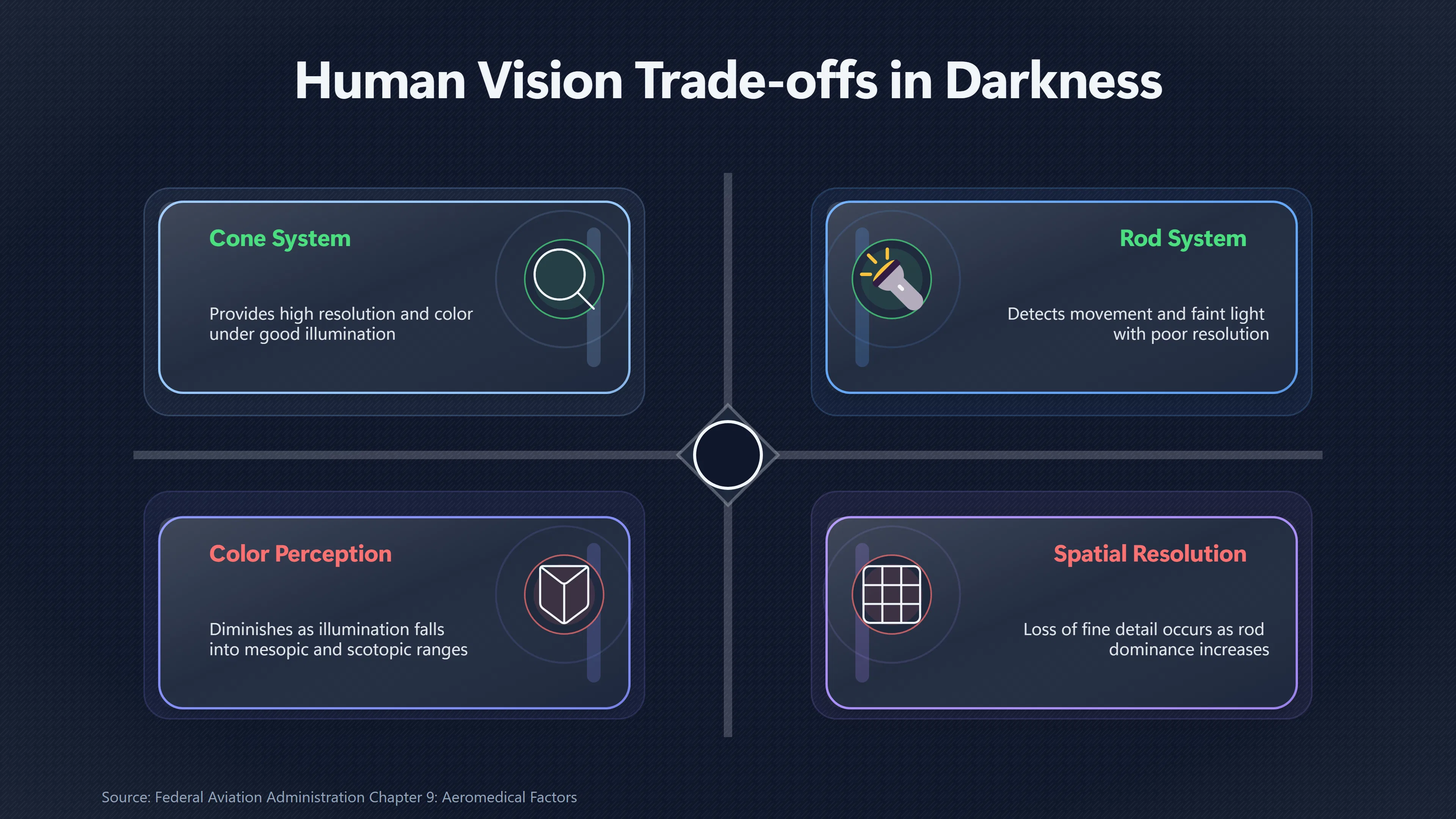
The retina contains two main classes of light-sensitive receptor: cones and rods. Cones provide the high-resolution, colour-sensitive vision used most effectively under good illumination. They are densely concentrated in the fovea, the central retinal region used when we look directly at something and inspect its detail. Rods are far more sensitive to faint light and become increasingly important as illumination falls, but their spatial resolution is much poorer.[Federal Aviation Administration]faa.govFederal Aviation Administration Chapter 9: Aeromedical FactorsFederal Aviation AdministrationChapter 9: Aeromedical FactorsApril 18, 2026…
That trade-off is central to understanding distant aircraft at night. FAA aeromedical guidance describes cones as particularly suited to detecting fine detail and colour at higher light levels, whereas rods are better at detecting movement and providing vision in dim conditions but cannot reliably supply colour information. Once dark-adapted, rods can be enormously more sensitive to light than cones, which is why a faint source may still be detected even when its shape cannot be resolved.[Federal Aviation Administration]faa.govFederal Aviation Administration Chapter 9: Aeromedical FactorsFederal Aviation AdministrationChapter 9: Aeromedical FactorsApril 18, 2026…
Colour does not simply switch off at one precise brightness. Between daylight vision and very dark, rod-dominated vision lies the mesopic range, in which rods and cones both contribute. Research on dim-light colour perception shows that as illumination decreases, colours generally become less saturated and their apparent hue and brightness become less dependable. Under sufficiently dark, scotopic conditions, conventional human colour discrimination is largely lost because vision is dominated by rods rather than the three cone types that normally support colour comparison.[PubMed Central (PMC)]pmc.ncbi.nlm.nih.govPub Med Central (PMC)Vision under mesopic and scotopic illuminationPubMed Central (PMC)Vision under mesopic and scotopic illumination - PMCJanuary 22, 2015…
For aircraft recognition, that removes useful information. In daylight, an observer might distinguish a white airliner, dark helicopter, painted tail, wing surface or reflective fuselage. At night, those distinctions may shrink towards shades of grey and then vanish against the sky. Colour may survive strongly in the lights because the lights themselves emit enough illumination to stimulate the visual system, while the comparatively unilluminated aircraft body does not.
The result is an uneven picture: the brightest, least shape-defining parts of the aircraft can dominate perception precisely when the shape-defining parts are being lost.
Why the aircraft body disappears before its lights
An aircraft is visible only if enough light from it reaches the observer with sufficient contrast against its background. During daylight, sunlight illuminates the wings, fuselage and tail, providing edges, shading, reflections and colour differences from which the brain can assemble a recognisable three-dimensional object. At night, an aircraft flying against a dark sky may have almost no useful external illumination.
Its lights are different. They are deliberately designed to remain conspicuous.
UK aviation rules require aircraft in flight at night to display anti-collision lights intended to attract attention and navigation lights intended to indicate the aircraft’s relative path. Regulations for aeroplanes operated at night also require navigation or position lighting and landing-light equipment.[Regulatory Library]regulatorylibrary.caa.co.uk00880 SERA3215 Lights to be displayed by aircraftRegulatory LibrarySERA.3215 Lights to be displayed by aircraft… In the equivalent US specification, position lighting includes red on the aircraft’s left side, green on its right and white facing aft.[Legal Information Institute]law.cornell.eduLegal Information Institute14 CFR § 23.2530 - External and cockpit lighting. | Electronic Code of Federal Regulations (e-CFR) | US Law |…
These lights therefore perform almost the opposite visual task from camouflage: they make an aircraft noticeable when its structure otherwise has poor contrast. That creates a common night-time appearance in which the observer sees luminous points without seeing the airframe connecting them.
Distance makes the problem stronger. Even before darkness is considered, increasing range reduces the aircraft’s angular size — how much of the observer’s visual field it occupies. Fine features such as the wing leading edge, tailplane or fuselage outline eventually become too small to resolve reliably. Low illumination then removes still more resolving power. Research on human visual acuity shows that recognition performance depends strongly on background luminance, while the rod system has markedly lower spatial resolution than the cone system.[NCBI]ncbi.nlm.nih.govNCBIVisual AcuityWebvision - NCBI BookshelfMay 1, 2005…
This explains an otherwise counter-intuitive observation: a person can be certain that something is there without obtaining enough information to determine what that something is. Detection and identification are different visual tasks.
FAA night-flight guidance makes this distinction particularly clear. The central foveal region that gives excellent daylight detail is dominated by cones, while rods make a larger contribution away from the centre. At low illumination, pilots are therefore taught off-centre viewing — looking several degrees away from a faint object so that its image falls on a more rod-rich part of the retina. FAA guidance recommends roughly 5° to 10° off centre for detecting faint night objects.[Federal Aviation Administration]faa.govFederal Aviation Administration Chapter 9: Aeromedical FactorsFederal Aviation AdministrationChapter 9: Aeromedical FactorsApril 18, 2026…
That technique improves detection, not daylight-like identification. The observer may become better able to see that a dim object exists while still lacking the colour and fine resolution needed to recognise its structure.
Lights can suggest a shape that is not actually visible
Once the airframe disappears, the brain has another problem: it must interpret the spatial arrangement of the surviving lights without seeing what connects them.
Consider an aeroplane crossing the observer’s field of view. Depending on range, orientation, lighting configuration and which lights are unobstructed, the observer might detect a red or green position light, one or more white lights and intermittent anti-collision flashes. Those points really do occupy positions on an aircraft, but seeing their arrangement is not the same as seeing the aircraft’s outline.
This distinction is important in reports of apparently triangular, V-shaped or otherwise geometrical night objects. A pattern of lights can legitimately provide clues about an aircraft’s orientation, which is one reason aviation regulations specify navigation-light characteristics.[Regulatory Library]regulatorylibrary.caa.co.uk00880 SERA3215 Lights to be displayed by aircraftRegulatory LibrarySERA.3215 Lights to be displayed by aircraft… But an observer should not automatically infer that the dark space between several lights is a solid surface of the same shape.
Three lights arranged roughly as a triangle, for example, can produce a compelling triangular percept even when the observer cannot actually see a triangular boundary. Conversely, parts of a conventional aircraft can remain invisible between its lights, making the apparent spacing seem unusual or making the object seem much less aircraft-like than it would in daylight.
There is also no guarantee that every expected light will be equally apparent from every viewpoint. Position lights have directional purposes, and an aircraft’s orientation relative to the observer changes which sources are prominent. Bright forward-facing landing lights can be especially dominant when an aircraft approaches more or less towards the observer. As its geometry changes, the apparent lighting pattern can therefore change dramatically even though the aircraft itself is behaving normally.
That is why identifying an object merely as “three lights”, “a bright white light” or “red and green points” is not equivalent to describing its physical shape. In sufficiently dark conditions, the lights may be observations; the shape joining them may be an inference.

Why colour reports need careful interpretation
Colour can still be useful evidence, but night-time colour descriptions deserve more caution than daylight ones. Human colour discrimination deteriorates progressively as illumination falls, rather than remaining perfectly stable until darkness. Experimental reviews of mesopic vision describe complex interactions between rods and cones, while studies of colour thresholds show that diminishing photon levels make chromatic discrimination increasingly noisy and unreliable.[PubMed Central (PMC)]pmc.ncbi.nlm.nih.govPub Med Central (PMC)Vision under mesopic and scotopic illuminationPubMed Central (PMC)Vision under mesopic and scotopic illumination - PMCJanuary 22, 2015…
There is an important distinction between the colour of the aircraft and the colour of its lights. A witness may have little or no reliable perception of the fuselage paint while still seeing a bright red or green source. Consequently, a report such as “a black object with green and white lights” need not mean that the observer visually resolved a black-painted structure. Unless edges or surface detail were genuinely visible, “black” may simply describe an area that could not be distinguished from the surrounding night sky.
Likewise, failure to notice a particular navigation-light colour does not by itself prove that the object lacked that light. Detection depends on brightness, viewing angle, atmospheric conditions, distance, visual attention and the observer’s adaptation state. The safest evidential distinction is therefore between colours actually perceived in luminous sources and colours attributed to poorly illuminated surfaces.
This is one reason colour alone rarely settles a difficult night identification. A red, green or white light can be valuable when combined with geometry, flash pattern, direction of travel and aircraft data, but the reliability of apparent body colour declines sharply once the underlying surface itself is barely visible.
Bright light can make the surrounding structure harder to recover
Dark adaptation adds another asymmetry. Rod sensitivity develops gradually in darkness, but exposure to brighter light temporarily reduces that sensitivity. FAA guidance warns that rods are readily overwhelmed by substantial light and require time to adapt again, while aviation training material notes that night adaptation can take tens of minutes.[Federal Aviation Administration]faa.govFederal Aviation Administration Chapter 9: Aeromedical FactorsFederal Aviation AdministrationChapter 9: Aeromedical FactorsApril 18, 2026…
That matters when looking at a strongly illuminated aircraft. A landing light or intense anti-collision flash may be much brighter than the already faint light coming from the surrounding fuselage. The visual scene therefore has an enormous brightness range: a conspicuous light source beside an almost invisible structure.
The observer should not expect the eye to reveal both equally well. The luminous source can attract attention immediately, while the weak silhouette remains below useful contrast. Repeated bright flashes can further interfere with dark-adapted vision. This helps explain why an observer may watch an aircraft for some time yet never obtain the clean outline that seems, retrospectively, as though it “ought” to have been visible.
The phenomenon does not require defective eyesight. It follows from the normal division of labour in human vision: extreme low-light sensitivity is purchased partly at the cost of colour and spatial resolution.
What information can bring the aircraft back into view
The most useful identification evidence is anything that restores the information darkness removed. A night sighting becomes substantially easier to classify when investigators can recover several independent cues rather than relying on the appearance of isolated lights.
A visible silhouette is especially valuable. Moonlight, twilight, illuminated cloud, city glow or another bright background can briefly put the aircraft in contrast and reveal wings, fuselage or tail. Even a short interval of genuine outline visibility is more informative about physical shape than prolonged observation of disconnected lights.
Changes in viewing geometry can also expose the lighting arrangement. As an aircraft turns or passes the observer, previously prominent lights may weaken while others become visible. A pattern that initially appears unfamiliar can then resolve into the expected lighting geometry of an aircraft.
Repeated observations under brighter conditions are another strong clue. A flight path that produces a mysterious light at night may look entirely ordinary when the same traffic flow is observed around dusk, when enough ambient illumination remains to reveal the aircraft body.
Independent flight information can restore identity without requiring the eye to do the impossible. Time, observer location, direction, elevation, duration and track can be compared with aircraft movements. This does not mean every matching light is automatically identified, but it tests the aircraft hypothesis using evidence independent of visual appearance.
That approach is consistent with modern UAP investigation. AARO explicitly recognises commercial and military aircraft as potential sources of UAP reports when they are viewed from unusual angles, under low-visibility conditions or through optical and infrared systems.[AARO]aaro.milOpen source on aaro.mil. The important investigative question is therefore not simply whether a witness recognised an aeroplane. It is whether the observing conditions actually supplied enough visual information for an aeroplane to look recognisably like one.
The key distinction: visibility is not recognisability
Night-time aircraft misidentification does not require an observer to overlook an obvious aeroplane. In the relevant conditions, the obvious aeroplane may never be visually available in the first place.
The lights can remain conspicuous because they are bright and deliberately designed to attract attention. The airframe can disappear because it reflects too little light, occupies too small an angle and lacks sufficient contrast against the night sky. Meanwhile, the visual system shifts towards rod-dominated processing that improves sensitivity to faint stimuli while sacrificing much of the colour discrimination and fine spatial detail on which aircraft recognition normally depends.[NCBI]ncbi.nlm.nih.govNCBIFunctional Specialization of the Rod and Cone SystemsNeuroscience - NCBI Bookshelf…
That combination creates a particularly important failure mode in UFO and UAP reports: a conventional aircraft can cease to look like an aircraft before it ceases to be visible. What remains may be only bright points, flashes and inferred geometry. Recovering the missing silhouette, lighting orientation or independent flight track can transform an apparently structureless or oddly shaped night object back into an identifiable aircraft.
Amazon book picks
Further Reading
Books and field guides related to Why Aircraft Bodies Disappear Behind Their Lights. Use these as the next step if you want deeper reading beyond the article.
Sensation and Perception
. Bruce Goldstein's SENSATION AND PERCEPTION, the best-seller which has helped over 150,000 students understand the ties between how we s...
Eye and Brain: The Psychology of Seeing
Since the publication of the first edition in 1966, Eye and Brain has established itself worldwide as an essential introduction to the ba...
The Pilot's Handbook of Aeronautical Knowledge
Pilot's Handbook of Aeronautical Knowledge, an official Federal Aviation Administration (FAA) Handbook; provides basic knowledge that is...
Visual Intelligence: How We Create What We See
A unique, illustrated popular study reveals the way the human eye acts on the visual world not just to represent but to create the things...
eBay marketplace picks
Marketplace Samples
Live-tested eBay searches with available results related to this page.
Selected fromaircraft art print oneBay.co.uk.
Endnotes
1.
Source: faa.gov
Title: Federal Aviation Administration Chapter 9: Aeromedical Factors
Link:https://www.faa.gov/regulations_policies/handbooks_manuals/aviation/Balloon_Flying_Handbook_FAA-H-8083-11B/bfh_chapter_9.pdf
Source snippet
Federal Aviation AdministrationChapter 9: Aeromedical FactorsApril 18, 2026...
Published: April 18, 2026
2.
Source: ncbi.nlm.nih.gov
Title: NCBIFunctional Specialization of the Rod and Cone Systems
Link:https://www.ncbi.nlm.nih.gov/books/NBK10850/
Source snippet
Neuroscience - NCBI Bookshelf...
3.
Source: aaro.mil
Link:https://www.aaro.mil/
Source snippet
AARO Home...
4.
Source: ncbi.nlm.nih.gov
Title: NCBIVisual Acuity
Link:https://ncbi.nlm.nih.gov/books/NBK11509/?report=printable
Source snippet
Webvision - NCBI BookshelfMay 1, 2005...
Published: May 1, 2005
5.
Source: aaro.mil
Link:https://www.aaro.mil/FAQ/
6.
Source: faa.gov
Title: Aviation Handbooks & Manuals | Federal Aviation Administration
Link:https://www.faa.gov/regulations_policies/handbooks_manuals/aviation
7.
Source: faa.gov
Title: Pilots | Federal Aviation Administration
Link:https://www.faa.gov/pilots
8.
Source: faa.gov
Title: Aircraft Handbooks & Manuals | Federal Aviation Administration
Link:https://www.faa.gov/regulations_policies/handbooks_manuals/aircraft
9.
Source: faa.gov
Title: Guide for Aviation Medical Examiners | Federal Aviation Administration
Link:https://www.faa.gov/ame_guide/dec_cons/disp
10.
Source: faa.gov
Title: Guide for Aviation Medical Examiners | Federal Aviation Administration
Link:https://www.faa.gov/ame_guide/app_process/exam_tech/item32/amd
11.
Source: faa.gov
Title: FA I FSS
Link:https://www.faa.gov/about/office_org/headquarters_offices/ato/service_units/systemops/fs/alaskan/alaska/fai/pubs
12.
Source: faa.gov
Title: Handbooks & Manuals | Federal Aviation Administration
Link:https://www.faa.gov/regulations_policies/handbooks_manuals
13.
Source: faa.gov
Title: Chapter 17: Aeromedical Factors | Federal Aviation Administration
Link:https://www.faa.gov/regulationspolicies/handbooksmanuals/aviation/phak/chapter-17-aeromedical-factors
14.
Source: faa.gov
Title: Getting to Know Your ADS-B System | Federal Aviation Administration
Link:https://www.faa.gov/air_traffic/technology/equipadsb/installation/know_adsb_system
15.
Source: faa.gov
Title: Airplane Flying Handbook | Federal Aviation Administration
Link:https://www.faa.gov/regulations_policies/handbooks_manuals/aviation/airplane_handbook
16.
Source: faa.gov
Title: Helicopter Flying Handbook | Federal Aviation Administration
Link:https://www.faa.gov/regulations_policies/handbooks_manuals/aviation/helicopter_flying_handbook
17.
Source: faa.gov
Title: Guide for Aviation Medical Examiners | Federal Aviation Administration
Link:https://www.faa.gov/ame_guide/app_process/exam_tech/et/31-34
18.
Source: faa.gov
Title: Guide for Aviation Medical Examiners | Federal Aviation Administration
Link:https://www.faa.gov/ame_guide/app_process/exam_tech/et/31-34/mv
19.
Source: faa.gov
Title: Chapter 8. Medical Facts for Pilots
Link:https://www.faa.gov/air_traffic/publications/atpubs/aim/aim0801.html
20.
Source: faa.gov
Link:https://www.faa.gov/air_traffic/publications/atpubs/aim_html/chap2_section_1.html
21.
Source: faa.gov
Link:https://www.faa.gov/air_traffic/publications/atpubs/aip_html/chap2_section_1.html
22.
Source: faa.gov
Link:https://www.faa.gov/air_traffic/publications/atpubs/aip_html/chap2_section_2.html
23.
Source: faa.gov
Link:https://www.faa.gov/air_traffic/publications/atpubs/aip_html/part3_ad_1.1.html
24.
Source: faa.gov
Link:https://www.faa.gov/Air_traffic/Publications/atpubs/aip_html/part3_ad_section_1.1.html
25.
Source: faa.gov
Link:https://www.faa.gov/data_research/research/med_humanfacs/oamtechreports/1970s/1971/7132
26.
Source: faa.gov
Title: Chapter 3. Airport Traffic Control
Link:https://www.faa.gov/air_traffic/publications/atpubs/atc_html/chap3_section_4.html
27.
Source: faa.gov
Link:https://www.faa.gov/Air_traffic/publications/atpubs/aim_html/chap8_section_1.html
28.
Source: faa.gov
Link:https://www.faa.gov/air_traffic/publications/atpubs/fs_html/chap9_section_1.html
29.
Source: faa.gov
Title: can i get faa medical certificate if i am colorblind 0
Link:https://www.faa.gov/faq/can-i-get-faa-medical-certificate-if-i-am-colorblind-0
30.
Source: faa.gov
Title: EN R 1.15: Medical Facts for Pilots7.. JUDGMENT ASPECTS OF COLLISION AVOIDANCE 1
Link:https://www.faa.gov/air_traffic/publications/atpubs/aip_html/part2_enr_section_1.15.html
31.
Source: faa.gov
Link:https://www.faa.gov/air_traffic/publications/atpubs/aip_html/part2_enr_section_1.1.html
32.
Source: pmc.ncbi.nlm.nih.gov
Title: Pub Med Central (PMC)Vision under mesopic and scotopic illumination
Link:https://pmc.ncbi.nlm.nih.gov/articles/PMC4302711/
Source snippet
PubMed Central (PMC)Vision under mesopic and scotopic illumination - PMCJanuary 22, 2015...
Published: January 22, 2015
33.
Source: pmc.ncbi.nlm.nih.gov
Link:https://pmc.ncbi.nlm.nih.gov/articles/PMC5312015/
Source snippet
PubMed Central (PMC)Thresholds and noise limitations of colour vision in dim light - PMC...
34.
Source: pubmed.ncbi.nlm.nih.gov
Title: Pub Med Thresholds and noise limitations of colour vision in dim light
Link:https://pubmed.ncbi.nlm.nih.gov/28193810/
Source snippet
Thresholds and noise limitations of colour vision in dim light - PubMed...
35.
Source: regulatorylibrary.caa.co.uk
Title: 00880 SERA3215 Lights to be displayed by aircraft
Link:https://regulatorylibrary.caa.co.uk/923-2012/Content/Regs/00880_SERA3215_Lights_to_be_displayed_by_aircraft.htm
Source snippet
Regulatory LibrarySERA.3215 Lights to be displayed by aircraft...
36.
Source: regulatorylibrary.caa.co.uk
Title: Regulatory Library NCO.ID E.A.115 Operating lights
Link:https://regulatorylibrary.caa.co.uk/965-2012/Content/Document%20Structure/07%20NCO/2%20Regs/20080_NCOIDEA115_Operating_lights.htm
37.
Source: law.cornell.edu
Link:https://www.law.cornell.edu/cfr/text/14/23.2530
Source snippet
Legal Information Institute14 CFR § 23.2530 - External and cockpit lighting. | Electronic Code of Federal Regulations (e-CFR) | US Law |...
38.
Source: nuforc.org
Link:https://nuforc.org/sighting/?id=199107
39.
Source: nuforc.org
Link:https://nuforc.org/sighting/?id=196716
40.
Source: ncbi.nlm.nih.gov
Link:https://ncbi.nlm.nih.gov/books/NBK545310/
41.
Source: casa.gov.au
Link:https://www.casa.gov.au/licences-and-certificates/aviation-medicals/colour-vision-assessment-medical-certificates
42.
Source: ncbi.nlm.nih.gov
Link:https://www.ncbi.nlm.nih.gov/books/NBK542177/
43.
Source: ncbi.nlm.nih.gov
Link:https://www.ncbi.nlm.nih.gov/books/NBK542177/?report=reader
44.
Source: ncbi.nlm.nih.gov
Link:https://www.ncbi.nlm.nih.gov/books/NBK470227/
45.
Source: ncbi.nlm.nih.gov
Link:https://www.ncbi.nlm.nih.gov/books/NBK545246/?report=reader
46.
Source: books.google.com.pr
Link:https://books.google.com.pr/books?id=mDVKEAAAQBAJ
47.
Source: pmc.ncbi.nlm.nih.gov
Link:https://pmc.ncbi.nlm.nih.gov/articles/PMC7786355/
48.
Source: pmc.ncbi.nlm.nih.gov
Link:https://pmc.ncbi.nlm.nih.gov/articles/PMC7545082/
49.
Source: nuforc.org
Link:https://nuforc.org/sighting/?id=157882
50.
Source: ncbi.nlm.nih.gov
Link:https://ncbi.nlm.nih.gov/books/NBK549947/
51.
Source: media.nationalarchives.gov.uk
Title: nationalarchives.gov.uk The Cold War and UFOs | The National Archives
Link:https://media.nationalarchives.gov.uk/index.php/cold-war-ufos/
52.
Source: pmc.ncbi.nlm.nih.gov
Link:https://pmc.ncbi.nlm.nih.gov/articles/PMC6153147/
53.
Source: pubmed.ncbi.nlm.nih.gov
Link:https://pubmed.ncbi.nlm.nih.gov/28633024/
54.
Source: pmc.ncbi.nlm.nih.gov
Link:https://pmc.ncbi.nlm.nih.gov/articles/PMC7141062/
55.
Source: pmc.ncbi.nlm.nih.gov
Link:https://pmc.ncbi.nlm.nih.gov/articles/PMC4884057/
56.
Source: pmc.ncbi.nlm.nih.gov
Link:https://pmc.ncbi.nlm.nih.gov/articles/PMC4757445/
57.
Source: pmc.ncbi.nlm.nih.gov
Link:https://pmc.ncbi.nlm.nih.gov/articles/PMC4763127/
58.
Source: pmc.ncbi.nlm.nih.gov
Link:https://pmc.ncbi.nlm.nih.gov/articles/PMC4380301/
59.
Source: pubmed.ncbi.nlm.nih.gov
Link:https://pubmed.ncbi.nlm.nih.gov/25657632/
60.
Source: pubmed.ncbi.nlm.nih.gov
Link:https://pubmed.ncbi.nlm.nih.gov/22176733/
61.
Source: pmc.ncbi.nlm.nih.gov
Link:https://pmc.ncbi.nlm.nih.gov/articles/PMC2630540/
62.
Source: pib.gov.in
Title: English Releases
Link:https://www.pib.gov.in/newsite/erelcontent.aspx?lang=2®=48&relid=32593
63.
Source: nuforc.org
Link:https://nuforc.org/sighting/?id=8727
64.
Source: caa.co.uk
Link:https://www.caa.co.uk/[drones
65.
Source: caa.co.uk
Link:https://www.caa.co.uk/drones/drone-regulations/news-and-updates/
66.
Source: regulatorylibrary.caa.co.uk
Link:https://regulatorylibrary.caa.co.uk/965-2012/Content/Document%20Structure/04%20CAT/2%20Regs/09050_CATIDEA115_Operating_lights.htm
67.
Source: caa.co.uk
Link:https://www.caa.co.uk/commercial-industry/airspace/event-and-obstacle-notification/lighting-and-marking-of-obstacles/
68.
Source: caa.co.uk
Link:https://www.caa.co.uk/aeromedical/medical-standards/pilots/medical-conditions/visual/spectacle-frame-and-lens-choice/
69.
Source: regulatorylibrary.caa.co.uk
Link:https://regulatorylibrary.caa.co.uk/923-2012/Content/Regs/03820_3._SIGNALS_FOR_AERODROME_TRAFFIC.htm?Highlight=light+signals
70.
Source: caa.co.uk
Link:https://www.caa.co.uk/commercial-industry/aerodromes/safeguarding/frequently-asked-questions/
71.
Source: caa.co.uk
Link:https://www.caa.co.uk/aeromedical/medical-standards/pilots/medical-conditions/visual/
72.
Source: caa.co.uk
Link:https://www.caa.co.uk/aeromedical/medical-standards/pilots/medical-conditions/visual/guidance-on-the-use-of-contact-lenses/
73.
Source: caa.co.uk
Link:https://www.caa.co.uk/aeromedical/medical-standards/pilots/medical-conditions/visual/visual-acuity-assessments/
74.
Source: caa.co.uk
Link:https://www.caa.co.uk/aeromedical/medical-standards/pilots/medical-conditions/visual/colour-vision-guidance-material-gm/
75.
Source: caa.co.uk
Link:https://www.caa.co.uk/aeromedical/medical-standards/pilots/medical-conditions/visual/visual-system-guidance-material-gm/
76.
Source: regulatorylibrary.caa.co.uk
Link:https://regulatorylibrary.caa.co.uk/923-2012/Content/Regs/03800_1._DISTRESS_AND_URGENCY_SIGNALS.htm
77.
Source: regulatorylibrary.caa.co.uk
Title: GM1 SPA NVIS 140 Information
Link:https://regulatorylibrary.caa.co.uk/air-operations-pre-30-october-2025/Content/Document%20Amendment/Replace%20GM%20Decision%2047/GM1%20SPA%20NVIS%20140%20Information.htm
78.
Source: regulatorylibrary.caa.co.uk
Link:https://regulatorylibrary.caa.co.uk/965-2012/Content/Document%20Structure/05%20SPA/4%20GM/GM1%20SPA%20NVIS%20140%20Information.htm
79.
Source: caa.co.uk
Link:https://www.caa.co.uk/aeromedical/medical-standards/pilots/medical-conditions/visual/reading-glasses-for-presbyopic-correction/
80.
Source: regulatorylibrary.caa.co.uk
Title: GM2 SPA NVIS 130 f Crew requirements
Link:https://regulatorylibrary.caa.co.uk/air-operations-pre-30-october-2025/Content/Document%20Amendment/Replace%20GM%20Decision%2047/GM2%20SPA%20NVIS%20130%20f%20Crew%20requirements.htm
81.
Source: pubmed.ncbi.nlm.nih.gov
Link:https://pubmed.ncbi.nlm.nih.gov/24597155/
82.
Source: pubmed.ncbi.nlm.nih.gov
Link:https://pubmed.ncbi.nlm.nih.gov/3414000/
83.
Source: pubmed.ncbi.nlm.nih.gov
Link:https://pubmed.ncbi.nlm.nih.gov/19911516/
84.
Source: pubmed.ncbi.nlm.nih.gov
Link:https://pubmed.ncbi.nlm.nih.gov/12974325/
85.
Source: pubmed.ncbi.nlm.nih.gov
Link:https://pubmed.ncbi.nlm.nih.gov/6601793/
86.
Source: pubmed.ncbi.nlm.nih.gov
Link:https://pubmed.ncbi.nlm.nih.gov/6043516/
87.
Source: pubmed.ncbi.nlm.nih.gov
Link:https://pubmed.ncbi.nlm.nih.gov/12445842/
88.
Source: pubmed.ncbi.nlm.nih.gov
Link:https://pubmed.ncbi.nlm.nih.gov/3576979/
89.
Source: pubmed.ncbi.nlm.nih.gov
Link:https://pubmed.ncbi.nlm.nih.gov/3559784/
90.
Source: skybrary.aero
Link:https://skybrary.aero/index.php/articles/visibility
91.
Source: ais.caa.gov.tw
Link:https://ais.caa.gov.tw/eaip/AIRAC%20AIP%20AMDT%2003-26_2026_08_06/eAIP/RC-AD%202%20RCTP%20%E8%87%BA%E7%81%A3%E6%A1%83%E5%9C%92%E5%9C%8B%E9%9A%9BTAIPEI-TAIWAN%20TAOYUAN%20INTL-en-GB.html
92.
Source: law.cornell.edu
Title: edu14 CFR § 31.65
Link:https://www.law.cornell.edu/cfr/text/14/31.65
93.
Source: pubmed.ncbi.nlm.nih.gov
Link:https://pubmed.ncbi.nlm.nih.gov/14107460/
Additional References
94.
Source: nature.com
Link:https://www.nature.com/articles/s41598-023-49527-x
95.
Source: nature.com
Link:https://www.nature.com/articles/eye2016266
96.
Source: youtube.com
Title: Night Illusions (Private Pilot Lesson 15d)
Link:https://www.youtube.com/watch?v=y_HvgmQ3NJs
Source snippet
Night Flying Ground Lesson for Private Pilot: Logging, Illusions and 3 Types of Night (E17)...
97.
Source: defense.gov
Link:https://www.defense.gov/News/Transcripts/Transcript/Article/3702219/media-engagement-with-acting-aaro-director-tim-phillips-on-the-historical-recor/
98.
Source: highways.fhwa.dot.gov
Link:https://highways.fhwa.dot.gov/safety/other/visibility/fhwa-lighting-handbook-august-2012/3-vision-and-fundamental-concepts
99.
Source: youtube.com
Title: PPGS Lesson 14.1 | Aeromedical: The Human Eye, Vision & Vision at Night
Link:https://www.youtube.com/watch?v=h1fu8jH6b3Y
Source snippet
Night Illusions (Private Pilot Lesson 15d)...
100.
Source: youtube.com
Link:https://www.youtube.com/watch?v=zsZHfZz4Vr8
Source snippet
Part 107 Night Training (full course)...
101.
Source: medium.com
Link:https://medium.com/faa/a-guide-in-the-dark-ffe6840cd7f5
102.
Source: faraim.org
Link:https://faraim.org/faa/aim/chapter-4/section-4-3-19.html
103.
Source: faraim.org
Link:https://www.faraim.org/faa/aim/chapter-4/section-4-3-24.html