Within UFO Identifications
How Windblown Objects Can Look Intelligently Controlled
Kites, plastic bags and other windborne objects can tumble, hover and change direction in ways that look controlled at long distance.
On this page
- Why lightweight objects move unpredictably
- Scale and silhouette problems at distance
- Wind data and visual clues that resolve reports
Page outline Jump by section
Introduction
Kites, plastic bags, loose sheeting and other lightweight airborne objects are a small but persistent source of UFO and UAP reports. They are especially deceptive when the observer cannot judge their distance. A nearby object only a metre or two across can subtend the same apparent angle as a much larger object far away, while wind-driven fluttering, rotation and sideways drift can make passive debris appear to hover, accelerate or manoeuvre deliberately. Modern US UAP guidance explicitly lists windborne debris such as plastic bags among the forms of “airborne clutter” that can confuse observers and sensors.[Archive DNI]dni.govOpen source on dni.gov.
Kites have an unusually long history in this role. A 1966 Project Blue Book briefing named kites among the ordinary objects frequently reported to the US Air Force as UFOs, placing them in an established identification category alongside birds, reflections and other commonplace sources.[ESD]whs.milOpen source on whs.mil. What makes this category distinctive is not merely that rubbish or recreational objects can be airborne, but that their aerodynamics naturally create some of the very movements that witnesses tend to interpret as signs of control.
Why lightweight objects can look intelligently controlled
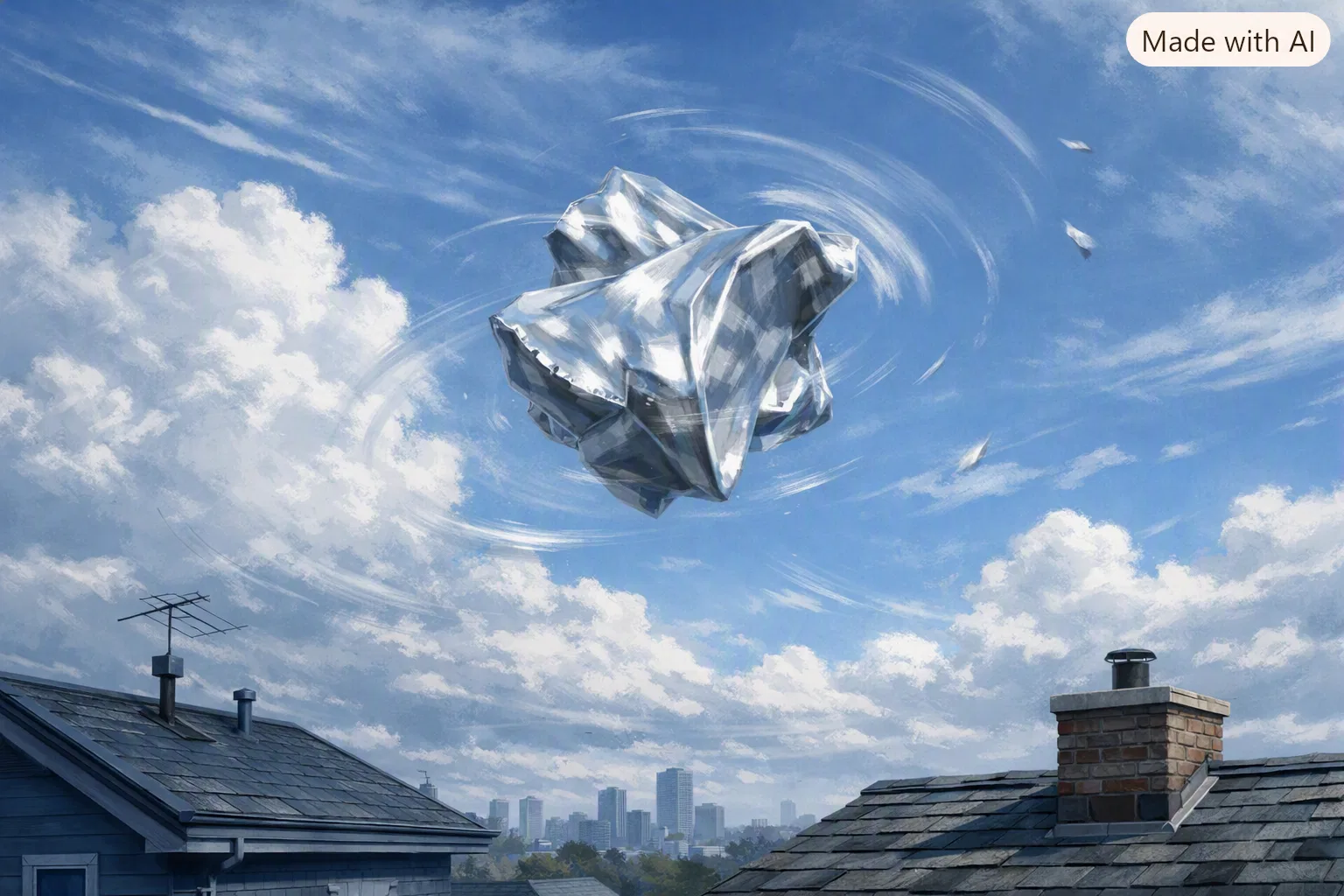
A powered aircraft follows a trajectory determined largely by propulsion and steering. A loose sheet, bag or fragment follows a more complicated interaction between gravity, aerodynamic drag, lift, rotation and constantly changing airflow. The result need not resemble simple “drifting”.
Fluid-dynamics experiments with thin plates and paper-like objects show several passive flight modes, including fluttering, end-over-end tumbling and other oscillatory trajectories. Research published in the Journal of Fluid Mechanics describes ordinary falling paper as capable of back-and-forth flutter and tumbling without any propulsion at all. Experiments on plate-like bodies likewise distinguish steady descent, fluttering, tumbling and chaotic motion as different aerodynamic regimes.[Cambridge University Press]cambridge.orgOpen source on cambridge.org.
Those findings matter for UAP interpretation because the eye does not directly reveal the forces acting on a distant object. A bag that briefly catches an updraught can rise; one side collapsing can cause it to roll; a gust can carry it sharply across the observer’s line of sight; then a lull can make it seem to stop. Repeated changes can produce a sequence that looks less like rubbish blowing in the wind and more like an object making decisions.
The surrounding air is itself variable. The US National Weather Service defines wind shear as a change in wind speed, direction or both between different points, including with height. Even within the lower atmosphere, wind direction and speed can vary substantially as altitude changes, while turbulence produces shorter-lived fluctuations.[National Weather Service]weather.govOpen source on weather.gov. An object rising or falling through those layers can therefore change its ground track without possessing any means of steering.
Kites introduce a related but somewhat different illusion. Their tether gives them a preferred area of sky, so they can remain roughly fixed for long periods and then surge, dive, arc or zigzag as line tension and wind change. At night the kite body and string may disappear entirely while attached lights remain visible. In Bermuda in 1993, for example, Harbour Radio received a UFO report concerning a mysterious green light; the source proved to be a kite carrying a fluorescent light. The newspaper account noted that while the kite zigzagged, neither the kite nor its string was visible to the observer — only the light.[Royal Gazette]royalgazette.comOpen source on royalgazette.com.
That combination is particularly effective at producing an apparent “craft”: a light apparently suspended in empty sky, capable of moving sideways and reversing direction, with no visible wings, engine or support.
Distance turns small objects into large “craft”
The hardest problem in many single-observer reports is scale. Human vision measures the angular size of an object — how much of the visual field it occupies — but physical size cannot be recovered from angular size alone unless distance is also known.
This creates a simple but consequential ambiguity. A small nearby object and a much larger distant object can look equally large. If a witness assumes the object is hundreds or thousands of metres away when it is actually tens of metres away, every inferred quantity changes with that assumption: size becomes exaggerated and apparent angular movement is converted into an implausibly high calculated speed.
The inverse mistake also affects perceptions of hovering. A small object drifting with the local wind may show little angular displacement when viewed along or nearly along its path. If the observer is moving — particularly in an aircraft or vehicle — relative motion makes the reconstruction harder still. Without an independent distance measurement, statements such as “it was the size of a bus”, “it covered miles in seconds” or “it was stationary at high altitude” may describe an interpretation of the sighting rather than directly measured properties.
NASA’s 2023 UAP study highlighted precisely this measurement problem. It recommended collecting location and imaging data from multiple viewpoints so that observations could be triangulated and an object’s position, velocity and size estimated rather than inferred visually.[NASA Science]nasa.govOpen source on nasa.gov.
Silhouette adds another layer of ambiguity. Flexible debris changes shape as it folds and unfolds. A crumpled bag can alternate between a compact blob, a disc-like profile and an elongated shape in seconds. Rotation also causes reflected sunlight to switch on and off, producing flashes that can be mistaken for lights or changes in luminosity. At long range, cameras may record only a handful of pixels, stripping away the wrinkles, tether or other details that would make the object obvious at close quarters.
Illuminated kites take the process further because the lights themselves can define a completely different apparent shape. In Washington state in 2011, reports of unusual lights were traced to a large kite carrying hundreds of LEDs. Contemporary reporting described a kite roughly 13 feet wide with a long illuminated tail; from a distance, the points of light were far more conspicuous than the supporting structure.[The Columbian]columbian.comOpen source on columbian.com.
The broader lesson is that perceived size, speed and shape are linked. Get the distance wrong and the other estimates can become wrong together, producing a mutually reinforcing picture of a large, fast, structured craft.
Historical reports and modern UAP data show the same problem
Kites are not a new explanation devised for smartphone-era videos. They appear in the documentary history of official UFO investigation.
Project Blue Book’s 1966 public briefing stated that missiles, balloons, birds, kites, searchlights, aircraft lights, astronomical objects and meteorological phenomena were among the objects frequently mistaken for UFOs. Blue Book also grouped kites under its miscellaneous “Other” identifications.[ESD]whs.milOpen source on whs.mil. The National Archives records that Blue Book ultimately accumulated 12,618 reports between 1947 and 1969, of which 701 remained categorised as unidentified; the existence of unresolved cases did not mean that every mundane category could always be excluded from every poorly documented report.[National Archives]archives.govOpen source on archives.gov.
Later incidents illustrate why the kite category persisted. In Vancouver, Washington, unusual lights reported in 2011 were traced to an elaborate LED-equipped kite.[The Columbian]columbian.comOpen source on columbian.com. In a much more recent West Michigan episode in November 2024, witnesses watched a large dark object apparently hanging in the sky for many minutes; local reporting documented the growing speculation and a witness’s eventual assessment that it was a giant kite. That identification was less firmly established than the Vancouver example, but the incident shows how a tethered object can produce the familiar combination of apparent hovering, strange silhouette and uncertain scale.[FOX 17 West Michigan News (WXMI)]fox17online.comOpen source on fox17online.com.
Modern US intelligence assessments have widened the category from kites to “airborne clutter”. The 2021 Office of the Director of National Intelligence preliminary UAP assessment explicitly listed birds, balloons, recreational drones and airborne debris such as plastic bags as objects that can muddle a scene. Importantly, the document did not claim that plastic bags explained all or even most of its unresolved cases; it presented debris as one plausible explanatory family requiring case-by-case testing.[Archive DNI]dni.govOpen source on dni.gov.
The 2022 follow-on UAP report retained the same basic approach. In discussing cases with unremarkable characteristics, it again referred to birds, weather events and airborne debris such as plastic bags among possible prosaic sources.[Archive DNI]dni.govOpen source on dni.gov. AARO’s current public material likewise includes windborne debris among objects frequently reported as UAP and specifically notes that such debris can appear anomalous because its movement is unpredictable.[AARO]aaro.milOpen source on aaro.mil.
The continuity is striking. Blue Book investigators in the 1960s dealt with kites; twenty-first-century analysts explicitly consider plastic bags and other windborne clutter. The vocabulary and sensors have changed, but the underlying identification problem has not.

Wind data and visual clues that resolve reports
A windborne-object explanation is strongest when it makes specific, testable predictions. It should not be used simply because an object looks odd.
The most useful check is whether its motion is compatible with the atmosphere at its actual or plausible altitude. Surface weather observations alone may be misleading because winds change with height. National Weather Service material shows that both direction and speed can vary through the vertical column, so an object moving differently from the wind felt by a witness on the ground is not automatically moving “against the wind”.[National Weather Service]weather.govOpen source on weather.gov.
Several clues become especially useful when combined:
- Repeated flutter or rotation. Periodic changes between broadside and edge-on views, regular bright-dark flashes or an irregular tumbling silhouette favour a flexible sheet or lightweight irregular object. Laboratory work confirms that fluttering and tumbling arise naturally in unpowered plate-like bodies.[Cambridge University Press]cambridge.orgOpen source on cambridge.org.
- Motion tied to gusts. Changes that coincide with visible tree movement, cloud motion or measured wind fluctuations are more consistent with passive transport than independent propulsion.
- No reliable distance cue. A single video against featureless sky provides weak evidence for physical size or speed. Multiple viewpoints, known landmarks or triangulation are far more informative. NASA specifically recommends multisensor and multi-observer data capable of determining position and estimating velocity and size.[NASA Science]nasa.govOpen source on nasa.gov.
- Shape that changes too readily to be rigid. Folding, stretching, twisting or abrupt changes in outline are strong clues for flexible material rather than a solid airframe.
- A constrained wandering pattern. For kites, motion that repeatedly returns towards the same patch of sky can indicate a tether, even when the string cannot be seen. Night-time illuminated-kite cases demonstrate how effectively the supporting structure can disappear from view.[Royal Gazette]royalgazette.comOpen source on royalgazette.com.
- Local corroboration. Knowledge that kite flying, construction debris, agricultural plastic or other lightweight material was present nearby can turn an otherwise speculative explanation into a testable one.
NASA’s UAP study argued that weather radar and geostationary satellite data could help separate genuinely interesting observations from windborne airborne clutter.[NASA Science]nasa.govOpen source on nasa.gov. That points towards the most reliable investigative principle: compare the object’s reported motion with independently measured environmental data rather than judging its behaviour by appearance alone.
When the explanation fits — and when it does not
“Kite” or “plastic bag” should not become a catch-all dismissal. Windborne objects have characteristic limitations. They respond strongly to local airflow; they do not sustain arbitrary high-speed motion independently of the wind; a conventional kite remains tethered; and flexible debris commonly shows changes in orientation or shape. A report containing reliable range measurements, sustained motion incompatible with measured winds, consistent rigid geometry from several viewpoints, or independent sensor data may require a different explanation.
Conversely, a low-resolution object that apparently hovers, wanders, changes direction and alters shape is not thereby showing evidence of intelligent control. Those are precisely the behaviours that lightweight objects can acquire through passive aerodynamics and turbulent air. Fluid-dynamics studies demonstrate that surprisingly complex trajectories can arise without propulsion, while modern UAP investigators explicitly treat windborne debris as a real source of observational clutter.[aps.org]aps.orgOpen source on aps.org.
That distinction is the practical value of this category within UFO and UAP investigation. The question is not whether a strange-looking object could be called a kite or a bag. It is whether its size, changing silhouette, trajectory, lighting and relationship to measured winds jointly behave as those objects should. When those pieces line up, apparently purposeful motion can often be reduced to something much less exotic: a lightweight object faithfully following an atmosphere that is itself complex and constantly moving.

Amazon book picks
Further Reading
Books and field guides related to How Windblown Objects Can Look Intelligently Controlled. Use these as the next step if you want deeper reading beyond the article.
The UFO Handbook
An explanation of the usual reasons for confusing IFOs (identified flying objects) with UFOs and a survey of the tools used to investigat...
UFOs Explained
Analyzing several UFO cases, the author exposes the myth of extraterrestrial visitors to earth.

Light and Color in the Outdoors
First published 1993. Subjects: Color, Light, Popular works, Science: General Issues, Photographic equipment & techniques.
The Magnificent Book of Kites
Rating: 3.5/5 from 6 Google Books ratings
Provides step-by-step instruction for designing a variety of kites, and offers tips on material selection and flying techniques.
eBay marketplace picks
Marketplace Samples
Live-tested eBay searches with available results related to this page.
Selected fromUFO poster oneBay.co.uk.

Current eBay listing
VINTAGE UFO FLYING SAUCERS COMIC ADVERTISING A2 POSTER PRINT


Current eBay listing
I Want To Believe UFO Poster Giclée Fine Art Heavyweight Print
Endnotes
1.
Source: aaro.mil
Link:https://www.aaro.mil/UAP-Cases/Official-UAP-Imagery/4/
Additional References
2.
Source: youtube.com
Title: Breakdown of the Pentagon UFO videos with Mick West
Link:https://www.youtube.com/watch?v=Le7Fqbsrrm8
Source snippet
This collection of videos is directly relevant because it features official government investigations and optical analysis from scientifi...
3.
Source: youtube.com
Link:https://www.youtube.com/watch?v=bi0H_mkwTW0
Source snippet
GOFAST UFO Analysis (yeah no, probably just a balloon)...
4.
Source: youtube.com
Title: Congress Fell for a BALLOON? | MICK WEST Breaks Down The Hellfire Missile UFO
Link:https://www.youtube.com/watch?v=FY4aRfx17vQ
Source snippet
THE 2022 UFO REPORT (UAPS) IS FINALLY OUT - ARE THEY ALIENS?...
5.
Source: youtube.com
Title: GOFAST UFO Analysis (yeah no, probably just a balloon)
Link:https://www.youtube.com/watch?v=-3NYowlCoDc
Source snippet
Congress Fell for a BALLOON? | MICK WEST Breaks Down The Hellfire Missile UFO...
6.
Source: youtube.com
Link:https://www.youtube.com/watch?v=DlzKmVsEZ9o
Source snippet
Breakdown of the Pentagon UFO videos with Mick West...
7.
Source: cia.gov
Link:https://www.cia.gov/stories/story/how-to-investigate-a-flying-saucer/
8.
Source: media.defense.gov
Title: FY24 CONSOLIDATED ANNUAL REPORT ON UAP 508
Link:https://media.defense.gov/2024/Nov/14/2003583603/-1/-1/0/FY24-CONSOLIDATED-ANNUAL-REPORT-ON-UAP-508.PDF