Within False Horizons
How Your Own Bank Can Make a Target Turn
A pilot who unknowingly banks toward a false horizon can rotate the whole visual scene and make a distant target trace a misleading arc or diagonal path.
On this page
- Why false horizons can trigger unconscious roll corrections
- How cockpit rotation changes a target's apparent track
- Which reported manoeuvres can arise from combined observer and target motion
Page outline Jump by section
Introduction
A false horizon can do more than make a pilot misjudge which way is level. If the pilot responds to that false reference by banking the aircraft, the observer physically rotates with the cockpit. A distant light or aircraft is then viewed through a changing coordinate system, so some of the motion seen across the windscreen is produced by the observer’s own roll and turn rather than by the target. FAA guidance explicitly warns that false horizons can lead a disorientated pilot to place the aircraft in an incorrect attitude.[Federal Aviation Administration]faa.govFederal Aviation Administration Chapter 8. Medical Facts for PilotsFederal Aviation Administration Chapter 8. Medical Facts for Pilots

That feedback is particularly important when assessing UFO/UAP reports from aircraft. A target that is genuinely moving smoothly — or is so distant that its own angular motion is small — can appear to sweep diagonally, climb, descend or curve when the observing aircraft banks. The key question is therefore not simply, “What did the object do?” but “What was the observer’s aircraft doing at the same moment?”
Why a false horizon can make the pilot roll
The visual system normally has an excellent reference for aircraft attitude: the real horizon. At night, above cloud, in haze or over poorly illuminated terrain, that reference can become weak while a sloping cloud deck, shoreline or pattern of lights remains conspicuous. The Federal Aviation Administration (FAA) identifies precisely these conditions as sources of false-horizon illusions and warns that the resulting disorientation can cause inappropriate aircraft attitudes.[Federal Aviation Administration]faa.govFederal Aviation Administration Chapter 8. Medical Facts for PilotsFederal Aviation AdministrationChapter 8. Medical Facts for PilotsJanuary 8, 2015…
The important point for UFO/UAP interpretation is that this need not remain a purely perceptual error. A pilot who sees what appears to be a tilted world has a natural reason to correct it. If a cloud bank slopes five degrees but is unconsciously accepted as horizontal, for example, bringing the aircraft visually “level” with that cloud bank can put the aircraft several degrees away from true wings-level flight.
The pilot may not immediately feel that something is wrong. A slowly developing bank can be difficult for the vestibular system to detect, and once a coordinated turn is established the pilot can experience the aircraft as essentially upright. A review of aviation spatial orientation notes that an aircraft inadvertently banked into a gentle turn can continue to feel “wings level”. SKYbrary similarly describes slow rolls that remain below the pilot’s motion-detection threshold and the powerful temptation to make control inputs based on the resulting false sensation.[PubMed Central (PMC)]pmc.ncbi.nlm.nih.govPub Med Central (PMC)Orientation and disorientation in aviationPubMed Central (PMC)Orientation and disorientation in aviation - PMC…
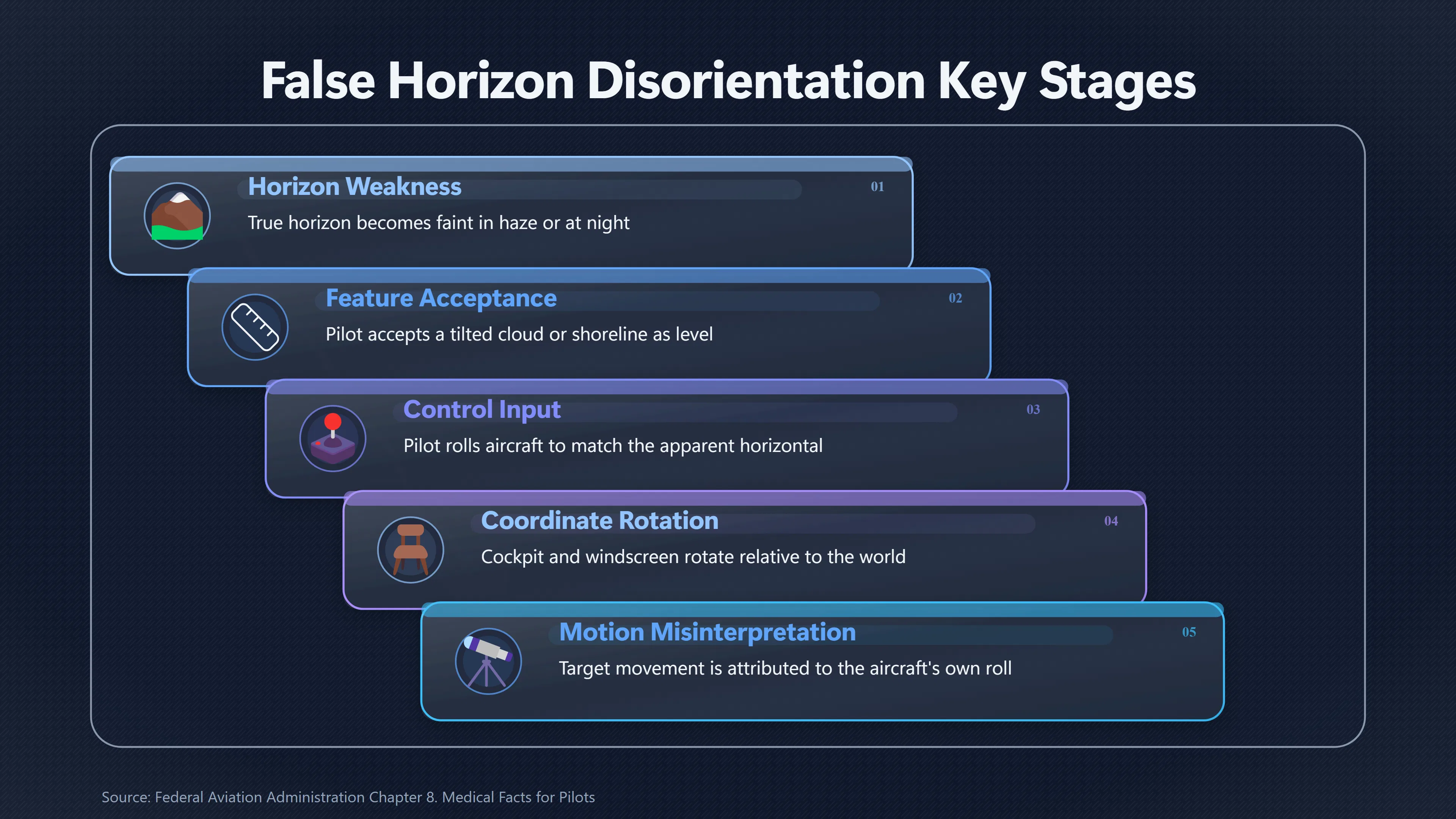
This produces a potentially self-reinforcing sequence:
- the true horizon is weak or absent;
- a tilted feature is accepted as horizontal;
- the pilot rolls towards that apparent horizontal;
- the aircraft and cockpit actually rotate;
- the target’s position changes across the pilot’s field of view;
- the pilot interprets some of that relative motion as movement by the target.
The first three stages are established aviation-disorientation mechanisms. The last three follow from the geometry of observing an external target from a rotating and turning platform. They are especially important when reconstructing an aerial observation from testimony alone, because a witness may accurately remember dramatic movement across the windscreen while being mistaken about which body produced that movement.
How your own bank can make a target appear to turn
Banking changes two things at once: the orientation of the observer’s viewing frame and, if the bank is maintained, the aircraft’s flight path.
The first effect is immediate. As an aircraft rolls, the cockpit and windscreen rotate relative to the outside world. Imagine a bright distant object slightly above and to the right of the nose. If the aircraft rolls right while the pilot keeps looking forward, the object’s position relative to the cockpit changes even if its position relative to the Earth hardly changes. Its apparent track across the windscreen can therefore acquire a diagonal or curved component.
The second effect develops as the bank becomes a turn. Aerodynamically, banking tilts the aircraft’s lift vector and produces a horizontal component that curves the aircraft’s flight path. NASA’s explanation of banking turns notes that the aircraft follows a circular arc while bank is maintained and then departs along a new heading after the wings are levelled.[NASA Glenn Research Center]www1.grc.nasa.govGlenn Research Center Banking Turns | Glenn Research Center | NASANASA Glenn Research CenterBanking Turns | Glenn Research Center | NASA…
That means the observer’s viewpoint is not merely rotating in place. It is travelling along an arc and changing heading. The line of sight to a distant target consequently changes because of combined observer and target motion.
This distinction is easy to miss in a verbal report. “It suddenly went from my two o’clock towards twelve o’clock” sounds like a statement about target manoeuvring. Geometrically, however, it describes only a change in bearing relative to the observer’s aircraft. A turn by the observing aircraft can change that bearing without requiring an equivalent turn by the object.
The effect is strongest as an interpretive problem when the target offers few independent distance and position cues. An isolated light against darkness or cloud gives the observer little information with which to separate target motion from own-aircraft motion. Aviation research describes analogous situations in which pilots perceive a visual target as moving rather than correctly attributing the changing relationship to their own aircraft and acceleration.[PubMed Central (PMC)]pmc.ncbi.nlm.nih.govPub Med Central (PMC)Orientation and disorientation in aviationPubMed Central (PMC)Orientation and disorientation in aviation - PMC…
Why the apparent manoeuvre can look surprisingly sharp
A common intuition is that observer motion should produce only gentle visual drift. That is not necessarily so.
Angular position in the cockpit can change noticeably during an ordinary bank because the observer’s reference axes themselves are rotating. If roll begins while the pilot is concentrating on a small distant light, the light can appear to depart from its previous track at almost the same instant. To the witness, that temporal coincidence may resemble the target initiating a manoeuvre.
A roll followed by a sustained turn can make the effect more elaborate. During roll-in, the visual field rotates. During the established turn, the aircraft heading progressively changes. During roll-out, the cockpit rotates back towards level while the aircraft now points in a different direction. A target observed throughout that sequence can therefore describe a curved or changing track relative to the windscreen even if its Earth-relative trajectory is simple.
There is experimental reason to take such orientation errors seriously rather than assuming trained observers automatically separate them. In one study involving a moving-horizon display, 29 of 37 pilots made errors in judging attitude or roll/pitch direction under the experimental conditions. The authors reported cases in which pilots effectively perceived the surrounding visual space as moving rather than the aircraft.[PubMed]pubmed.ncbi.nlm.nih.govPub Med[Visual illusions and moving horizonPubMed[Visual illusions and moving horizon] - PubMed…
More recent simulator research with military helicopter pilots likewise found that false-horizon stimuli measurably altered pilots’ gaze behaviour. The result does not establish that every false horizon produces a control error, but it reinforces the narrower point: misleading horizon information can materially change how trained pilots process an otherwise ordinary visual scene.[PubMed Central (PMC)]pmc.ncbi.nlm.nih.govPubMed Central (PMC)Quantifying the Impact of Spatial Disorientation on Pilot Mental Workload and Attentional Focus - PMCApril 10, 2025…
Which reported manoeuvres can arise this way
Observer banking cannot plausibly explain every extraordinary-looking aerial trajectory. Its usefulness is more specific: it provides a conventional mechanism for certain angular movements reported relative to an aircraft, particularly when the external horizon was unreliable.
Several descriptions deserve particular scrutiny.
A sudden diagonal sweep. Roll changes the orientation of the cockpit’s horizontal and vertical axes. A target previously perceived as moving sideways can consequently acquire an apparent upward or downward component as the aircraft banks.
An apparent climb or dive. If “up” and “down” are being judged against a false horizon while the aircraft itself is rolling, a comparatively level target can appear to change elevation. The observation becomes especially ambiguous when there is no visible ground reference with which to establish the target’s true altitude.
A curved or arcing path. Roll followed by a coordinated turn changes both viewing orientation and aircraft heading. A distant target can therefore trace an arc through the pilot’s visual field without executing a comparable Earth-relative arc itself. NASA’s description of the observer aircraft’s own curved trajectory during a banked turn illustrates why heading-relative observations cannot automatically be treated as target trajectories.[NASA Glenn Research Center]www1.grc.nasa.govGlenn Research Center Turns | Glenn Research Center | NASANASA Glenn Research CenterTurns | Glenn Research Center | NASA…
A reversal or hook-like movement. If the observer rolls into a turn and later rolls out or corrects in the opposite direction, successive changes in the viewing frame can make the apparent target track bend or partially reverse. Demonstrating that explanation in a particular UAP case, however, requires attitude and heading data; witness wording alone cannot establish it.
An apparent acceleration. The angular rate of a target across the windscreen can increase as the observing aircraft’s roll rate or turn geometry changes. That is not the same thing as proving that the target accelerated through space. Without reliable range, even converting observed angular movement into a target speed is underdetermined.
This last distinction is particularly important. A witness can be entirely correct that a light crossed a large angular distance very quickly while the inference that the light itself made a high-speed manoeuvre remains wrong. Angular motion and physical target velocity are not interchangeable measurements.
The feedback loop makes false horizons unusually important
A simple visual illusion changes what the observer thinks they see. A false horizon can go further by changing what the observer does, which then changes what they see next.
That is why the banking mechanism deserves separate treatment from a static horizon error. The FAA’s warning is explicitly behavioural: a disorientated pilot may put the aircraft into an inappropriate attitude.[Federal Aviation Administration]faa.govFederal Aviation Administration Chapter 8. Medical Facts for PilotsFederal Aviation Administration Chapter 8. Medical Facts for Pilots Once that happens, the original perceptual mistake has produced a genuine change in the observing platform.
Aviation accident evidence shows how substantial such control consequences can become. In its lessons from a fatal Robinson R44 accident, the FAA notes that losing external horizon reference even briefly can lead to sensory illusions followed by incorrect control inputs; investigators considered the dark-night environment conducive to false-horizon and other visual illusions.[Federal Aviation Administration]faa.govFederal Aviation Administration Robinson R44 | Federal Aviation AdministrationFederal Aviation AdministrationRobinson R44 | Federal Aviation AdministrationJanuary 31, 2023… UK Air Accidents Investigation Branch cases likewise document spatial-disorientation sequences involving progressively increasing bank and descent, demonstrating that pilots can remain unaware of significant deviations from their intended attitude when external visual references deteriorate.[GOV.UK]GOV.UK2 2010 vq tiu 6 february 20072 2010 vq tiu 6 february 2007
Those accidents should not be treated as evidence that a particular UAP witness was disorientated. Their value is narrower and stronger: they demonstrate that substantial, unintended aircraft motion under degraded orientation conditions is a real aviation phenomenon, not merely a hypothetical perceptual possibility.
What would distinguish target motion from observer motion?
For investigating an aircraft-based UFO/UAP report, the decisive evidence is therefore not simply the vividness of the witness’s description. The useful question is whether independent records can reconstruct the observing aircraft’s attitude while the reported manoeuvre occurred.
Flight-data recorder information, attitude and heading data, autopilot status, GPS track, air-traffic-control radar, cockpit video with a stable aircraft reference, or sufficiently detailed avionics recordings can all help. If the reported target “turned” at precisely the time the observer aircraft rolled or altered heading, an observer-motion explanation deserves serious consideration.
Conversely, if reliable instrumentation shows that the observing aircraft remained wings-level on a constant heading while independently calibrated imagery records a large change in the target’s line of sight, pilot banking becomes much less persuasive as the explanation.
Instrument cross-checking is central precisely because human orientation can be compellingly wrong. FAA guidance states that spatial disorientation produced by misleading visual and motion cues must be resolved through reliable external references or flight instruments, while SKYbrary stresses that pilots may find themselves questioning accurate instruments because their sensory impression says something different.[Federal Aviation Administration]faa.govFederal Aviation Administration Chapter 8. Medical Facts for PilotsFederal Aviation Administration Chapter 8. Medical Facts for Pilots
For UAP analysis, the same principle applies after the flight: reconstruct the reference frame before reconstructing the target’s trajectory.

The key distinction for UFO/UAP reports
Pilot expertise makes airborne observations valuable, but it does not make the observer’s reference frame inert. An aircraft is itself a moving, rotating observation platform, and false-horizon conditions can cause its pilot unknowingly to add further roll and turn.
The most defensible interpretation is therefore not that false horizons routinely “explain UFOs”, nor that every reported sharp manoeuvre is an illusion. It is that a particular class of reports — isolated targets seen in weak-horizon conditions whose extraordinary motion is described mainly relative to the cockpit or apparent horizon — contains an important ambiguity.
In those circumstances, three motions have to be separated: the target’s true movement, the observing aircraft’s translational movement, and the observer’s roll and changing visual reference. A false horizon can corrupt the last of these and prompt a real control input that changes the second. What finally reaches the witness is the combined result.
That is why a distant target can appear to make a striking turn even when the most consequential manoeuvre in the encounter was made by the observer’s own aircraft.
Amazon book picks
Further Reading
Books and field guides related to How Your Own Bank Can Make a Target Turn. Use these as the next step if you want deeper reading beyond the article.
Human Factors in Aviation
Fully updated and expanded, the second edition of Human Factors in Aviation serves the needs of the widespread aviation community - stude...
Sensation and Perception
. Bruce Goldstein's SENSATION AND PERCEPTION, the best-seller which has helped over 150,000 students understand the ties between how we s...
The UFO Experience: A Scientific Inquiry
Cited by the New York Review of Books as "the best brief for visitation," this classic study presents an analysis of UFO reports and conc...
eBay marketplace picks
Marketplace Samples
Live-tested eBay searches with available results related to this page.
Selected fromairplane model oneBay.co.uk.
Endnotes
1.
Source: faa.gov
Title: Federal Aviation Administration Chapter 8. Medical Facts for Pilots
Link:https://www.faa.gov/Air_traffic/publications/atpubs/aim_html/chap8_section_1.html
2.
Source: faa.gov
Title: Federal Aviation Administration Chapter 8. Medical Facts for Pilots
Link:https://www.faa.gov/air_traffic/publications/atpubs/aim/aim0801.html
Source snippet
Federal Aviation AdministrationChapter 8. Medical Facts for PilotsJanuary 8, 2015...
Published: January 8, 2015
3.
Source: skybrary.aero
Title: Spatial Disorientation | SKYbrary Aviation Safety
Link:https://skybrary.aero/index.php/articles/spatial-disorientation
Source snippet
Spatial Disorientation | SKYbrary Aviation Safety...
4.
Source: www1.grc.nasa.gov
Title: Glenn Research Center Banking Turns | Glenn Research Center | NASA
Link:https://www1.grc.nasa.gov/beginners-guide-to-aeronautics/banking-turns/
Source snippet
NASA Glenn Research CenterBanking Turns | Glenn Research Center | NASA...
5.
Source: www1.grc.nasa.gov
Title: Glenn Research Center Turns | Glenn Research Center | NASA
Link:https://www1.grc.nasa.gov/beginners-guide-to-aeronautics/aircraft-motion-turns/
Source snippet
NASA Glenn Research CenterTurns | Glenn Research Center | NASA...
6.
Source: faa.gov
Title: Federal Aviation Administration Robinson R44 | Federal Aviation Administration
Link:https://www.faa.gov/lessons_learned/rotorcraft/accidents/N474FA
Source snippet
Federal Aviation AdministrationRobinson R44 | Federal Aviation AdministrationJanuary 31, 2023...
Published: January 31, 2023
7.
Source: GOV.UK
Title: 2 2010 vq tiu 6 february 2007
Link:https://www.gov.uk/aaib-reports/2-2010-vq-tiu-6-february-2007
Published: february 2007
8.
Source: GOV.UK
Title: AAI B investigation to Piper PA-28-140 Cherokee, G-BHXK
Link:https://www.gov.uk/aaib-reports/aaib-investigation-to-piper-pa-28-140-cherokee-g-bhxk
9.
Source: GOV.UK
Title: aar 3 2007 piper pa 23 250 aztec n444da 26 december 2005
Link:https://www.gov.uk/aaib-reports/aar-3-2007-piper-pa-23-250-aztec-n444da-26-december-2005
Published: december 2005
10.
Source: faa.gov
Link:https://www.faa.gov/blog/clearedfortakeoff/vertically-speaking-beware-green-dot-syndrome
11.
Source: atsb.gov.au
Link:https://www.atsb.gov.au/taxonomy/term/386
12.
Source: atsb.gov.au
Link:https://www.atsb.gov.au/taxonomy/term/391
13.
Source: gloucester.gov.uk
Title: Gloucestershire Airport – shareholder statement | Gloucester City Council
Link:https://www.gloucester.gov.uk/news/2026-news/gloucestershire-airport-shareholder-statement/
14.
Source: faa.gov
Title: Beechcraft Bonanza 35 | Federal Aviation Administration
Link:https://www.faa.gov/lessons_learned/small_airplane/accidents/N3794N
15.
Source: atsb.gov.au
Link:https://www.atsb.gov.au/investigations/ao
16.
Source: faa.gov
Title: Eurocopter AS350B2 | Federal Aviation Administration
Link:https://www.faa.gov/lessonslearned/rotorcraft/accidents/N6007S
17.
Source: faa.gov
Title: Airman Education Programs | Federal Aviation Administration
Link:https://www.faa.gov/pilots/training/airman_education/topics_of_interest/spatial_disorientation
18.
Source: GOV.UK
Title: www.gov.uk AAI B investigation to Jabiru J400, G-CCPV
Link:https://www.gov.uk/aaib-reports/aaib-investigation-to-jabiru-j400-g-ccpv
19.
Source: atsb.gov.au
Link:https://www.atsb.gov.au/investigations/ao
20.
Source: grc.nasa.gov
Link:https://www.grc.nasa.gov/WWW/k-12/VirtualAero/BottleRocket/airplane/alr.html
21.
Source: grc.nasa.gov
Link:https://www.grc.nasa.gov/WWW/K-12/airplane/aroll.html
22.
Source: atsb.gov.au
Link:https://www.atsb.gov.au/publications/investigation_reports/2019/aair/ao
23.
Source: atsb.gov.au
Title: dont push it dont go dangers vfr imc
Link:https://www.atsb.gov.au/dont-push-it-dont-go-dangers-vfr-imc
24.
Source: atsb.gov.au
Title: accidents involving visual flight rules pilots
Link:https://www.atsb.gov.au/publications/avoidable-accidents/2022/aviation/accidents-involving-visual-flight-rules-pilots
25.
Source: atsb.gov.au
Link:https://www.atsb.gov.au/investigations/ao
26.
Source: atsb.gov.au
Link:https://www.atsb.gov.au/occurrence-briefs/ab
27.
Source: nasa.gov
Title: NAS A, Boeing Testing Synthetic Vision Technologies
Link:https://www.nasa.gov/aeronautics/nasa-boeing-testing-synthetic-vision-technologies/
28.
Source: GOV.UK
Link:https://www.gov.uk/aaib-reports/aaib-investigation-to-aircreation-flexwing-bionix-tanarg-912es-sp-mtki
29.
Source: GOV.UK
Title: www.gov.uk AAI B investigation to Zenair CH 601UL Zodiac, G-CCZK
Link:https://www.gov.uk/aaib-reports/aaib-investigation-to-zenair-ch-601ul-zodiac-g-cczk
30.
Source: faa.gov
Link:https://www.faa.gov/air_traffic/publications/atpubs/aim/aim0705.html
31.
Source: GOV.UK
Title: piper pa 280181 archer 2 g emaz 4 september 2005
Link:https://www.gov.uk/aaib-reports/piper-pa-280181-archer-2-g-emaz-4-september-2005
Published: september 2005
32.
Source: GOV.UK
Title: robinson r44 raven i g ouel 30 july 2003
Link:https://www.gov.uk/aaib-reports/robinson-r44-raven-i-g-ouel-30-july-2003
Published: july 2003
33.
Source: GOV.UK
Title: piper pa 28r 201t turbo cherokee arrow iii g jmtt 9 april 2007
Link:https://www.gov.uk/aaib-reports/piper-pa-28r-201t-turbo-cherokee-arrow-iii-g-jmtt-9-april-2007
Published: april 2007
34.
Source: GOV.UK
Title: eurocopter as350b2 squirrel g cbhl 15 september 2007
Link:https://www.gov.uk/aaib-reports/eurocopter-as350b2-squirrel-g-cbhl-15-september-2007
Published: september 2007
35.
Source: faa.gov
Title: Bell 206B-3 Jet Ranger III | Federal Aviation Administration
Link:https://www.faa.gov/lessons_learned/rotorcraft/accidents/N828AC
36.
Source: faa.gov
Title: Perceived Pitch Versus Actual Pitch
Link:https://www.faa.gov/data_research/research/med_humanfacs/aeromedical/aircraftaccident/charlotte
37.
Source: ntrs.nasa.gov
Link:https://ntrs.nasa.gov/citations/20080042307
38.
Source: skybrary.aero
Title: be20 vicinity north caicos british west indies 2007
Link:https://skybrary.aero/index.php/accidents-and-incidents/be20-vicinity-north-caicos-british-west-indies-2007
39.
Source: atsb.gov.au
Link:https://www.atsb.gov.au/investigations/200100346
40.
Source: atsb.gov.au
Link:https://www.atsb.gov.au/investigations/199502225
41.
Source: ntrs.nasa.gov
Link:https://ntrs.nasa.gov/citations/19850001749
42.
Source: atsb.gov.au
Link:https://www.atsb.gov.au/news/2025/spatial-disorientation-likely-flight-below-msa
43.
Source: atsb.gov.au
Link:https://www.atsb.gov.au/news/2022/flight-break-accident-highlights-dangers-vfr-pilots-encountering-imc
44.
Source: atsb.gov.au
Link:https://www.atsb.gov.au/news/2022/nothing-see-night
45.
Source: atsb.gov.au
Link:https://www.atsb.gov.au/media/news-items/2026/bankstown-vfr-imc-incident-demonstrates-importance-early-assessment-weather-conditions
46.
Source: atsb.gov.au
Link:https://www.atsb.gov.au/taxonomy/term/385
47.
Source: atsb.gov.au
Link:https://www.atsb.gov.au/taxonomy/term/302
48.
Source: atsb.gov.au
Link:https://www.atsb.gov.au/node?page=914
49.
Source: faa.gov
Link:https://www.faa.gov/air_traffic/publications/atpubs/aip_html/part2_enr_section_5.3.html
50.
Source: faa.gov
Link:https://www.faa.gov/Air_traffic/publications/atpubs/aim_html/chap7_section_6.html
51.
Source: faa.gov
Link:https://www.faa.gov/air_traffic/publications/atpubs/aip_html/chap7_section_6.html
52.
Source: skybrary.aero
Title: general aviation night flying guidance
Link:https://skybrary.aero/index.php/articles/general-aviation-night-flying-guidance
53.
Source: skybrary.aero
Link:https://skybrary.aero/articles/spatial-disorientation-oghfa-se
54.
Source: skybrary.aero
Title: S E201: Airplane State Awareness
Link:https://skybrary.aero/articles/se201-airplane-state-awareness-bank-angle-alerting-and-recovery-guidance-systems
55.
Source: skybrary.aero
Link:https://skybrary.aero/index.php/articles/visual-illusions
56.
Source: skybrary.aero
Link:https://skybrary.aero/index.php/articles/inadvertent-vfr-flight-imc
57.
Source: skybrary.aero
Link:https://skybrary.aero/bookshelf/inadequate-visual-references-flight-pose-threat-spatial-disorientation
58.
Source: skybrary.aero
Link:https://skybrary.aero/index.php/articles/somatogravic-and-somatogyral-illusions
59.
Source: skybrary.aero
Link:https://skybrary.aero/index.php/articles/vfr-flights-night
60.
Source: skybrary.aero
Link:https://skybrary.aero/index.php/articles/vestibular-system-and-illusions-oghfa-bn
61.
Source: skybrary.aero
Title: FS F ALAR Briefing Note 5.3
Link:https://skybrary.aero/bookshelf/fsf-alar-briefing-note-53-visual-illusions
62.
Source: skybrary.aero
Link:https://skybrary.aero/bookshelf/understanding-spatial-disorientation
63.
Source: skybrary.aero
Link:https://skybrary.aero/index.php/articles/disorientation-during-vectored-go-around-oghfa-se
64.
Source: skybrary.aero
Link:https://skybrary.aero/index.php/articles/bank-angle-awareness
65.
Source: www1.grc.nasa.gov
Title: wing warping interactive
Link:https://www1.grc.nasa.gov/beginners-guide-to-aeronautics/wing-warping-interactive/
66.
Source: grc.nasa.gov
Link:https://www.grc.nasa.gov/www/k-12/VirtualAero/BottleRocket/airplane/roll.html
67.
Source: www1.grc.nasa.gov
Title: rotation control axes
Link:https://www1.grc.nasa.gov/beginners-guide-to-aeronautics/rotation-control-axes/
68.
Source: grc.nasa.gov
Link:https://www.grc.nasa.gov/www/k-12/VirtualAero/BottleRocket/airplane/turns.html
69.
Source: grc.nasa.gov
Link:https://www.grc.nasa.gov/WWW/k-12/VirtualAero/BottleRocket/airplane/spoil.html
70.
Source: www2.anac.gov.br
Link:https://www2.anac.gov.br/anacpedia/ing-por/tr4373.htm
71.
Source: weather.metoffice.gov.uk
Title: metoffice.gov.uk How we measure visibility
Link:https://weather.metoffice.gov.uk/guides/observations/how-we-measure-visibility
72.
Source: pmc.ncbi.nlm.nih.gov
Title: Pub Med Central (PMC)Orientation and disorientation in aviation
Link:https://pmc.ncbi.nlm.nih.gov/articles/PMC3710190/
Source snippet
PubMed Central (PMC)Orientation and disorientation in aviation - PMC...
73.
Source: pubmed.ncbi.nlm.nih.gov
Title: Pub Med[Visual illusions and moving horizon]
Link:https://pubmed.ncbi.nlm.nih.gov/23156114/
Source snippet
PubMed[Visual illusions and moving horizon] - PubMed...
74.
Source: pmc.ncbi.nlm.nih.gov
Link:https://pmc.ncbi.nlm.nih.gov/articles/PMC12420934/
Source snippet
PubMed Central (PMC)Quantifying the Impact of Spatial Disorientation on Pilot Mental Workload and Attentional Focus - PMCApril 10, 2025...
Published: April 10, 2025
75.
Source: pubmed.ncbi.nlm.nih.gov
Link:https://pubmed.ncbi.nlm.nih.gov/40211600/
Source snippet
Quantifying the Impact of Spatial Disorientation on Pilot Mental Workload and Attentional Focus - PubMed...
76.
Source: ncbi.nlm.nih.gov
Link:https://www.ncbi.nlm.nih.gov/sites/books/NBK518976/
77.
Source: pubmed.ncbi.nlm.nih.gov
Link:https://pubmed.ncbi.nlm.nih.gov/37438399/
78.
Source: pmc.ncbi.nlm.nih.gov
Link:https://pmc.ncbi.nlm.nih.gov/articles/PMC9478724/
79.
Source: trid.trb.org
Link:https://trid.trb.org/View/2010365
80.
Source: pmc.ncbi.nlm.nih.gov
Link:https://pmc.ncbi.nlm.nih.gov/articles/PMC9388953/
81.
Source: pubmed.ncbi.nlm.nih.gov
Link:https://pubmed.ncbi.nlm.nih.gov/31422245/
82.
Source: trid.trb.org
Link:https://trid.trb.org/View/1624776
83.
Source: pubmed.ncbi.nlm.nih.gov
Link:https://pubmed.ncbi.nlm.nih.gov/29557053/
84.
Source: pubmed.ncbi.nlm.nih.gov
Link:https://pubmed.ncbi.nlm.nih.gov/28323583/
85.
Source: verticalmag.com
Title: False Horizon
Link:https://verticalmag.com/features/falsehorizon/
86.
Source: pmc.ncbi.nlm.nih.gov
Link:https://pmc.ncbi.nlm.nih.gov/articles/PMC2736108/
87.
Source: pubmed.ncbi.nlm.nih.gov
Link:https://pubmed.ncbi.nlm.nih.gov/9491247/
88.
Source: pubmed.ncbi.nlm.nih.gov
Link:https://pubmed.ncbi.nlm.nih.gov/9184732/
89.
Source: pubmed.ncbi.nlm.nih.gov
Link:https://pubmed.ncbi.nlm.nih.gov/6981410/
90.
Source: pubmed.ncbi.nlm.nih.gov
Link:https://pubmed.ncbi.nlm.nih.gov/9842511/
91.
Source: pubmed.ncbi.nlm.nih.gov
Link:https://pubmed.ncbi.nlm.nih.gov/10801002/
92.
Source: pubmed.ncbi.nlm.nih.gov
Link:https://pubmed.ncbi.nlm.nih.gov/36442173/
93.
Source: pubmed.ncbi.nlm.nih.gov
Link:https://pubmed.ncbi.nlm.nih.gov/22643447/
94.
Source: pubmed.ncbi.nlm.nih.gov
Link:https://pubmed.ncbi.nlm.nih.gov/1456916/
95.
Source: pubmed.ncbi.nlm.nih.gov
Link:https://pubmed.ncbi.nlm.nih.gov/19378915/
96.
Source: pubmed.ncbi.nlm.nih.gov
Link:https://pubmed.ncbi.nlm.nih.gov/2818402/
97.
Source: pubmed.ncbi.nlm.nih.gov
Link:https://pubmed.ncbi.nlm.nih.gov/2710631/
98.
Source: pubmed.ncbi.nlm.nih.gov
Link:https://pubmed.ncbi.nlm.nih.gov/11000392/
99.
Source: trid.trb.org
Link:https://trid.trb.org/View/2572706
100.
Source: trid.trb.org
Link:https://trid.trb.org/View/743093
Additional References
101.
Source: nature.com
Link:https://www.nature.com/articles/srep14584
102.
Source: youtube.com
Title: The SHOCKING Math Error Behind Viral UFO Videos | Mick West
Link:https://www.youtube.com/watch?v=ypfbhfEXnBo
Source snippet
Accident Case Study: Deadly Disorientation...
103.
Source: researchgate.net
Link:https://www.researchgate.net/publication/317588237_An_Investigation_of_Minimum_Information_Requirements_for_an_Unmanned_Aircraft_System_Detect_and_Avoid_Traffic_Display
104.
Source: researchgate.net
Link:https://www.researchgate.net/publication/263694508_Cognitive_Determinants_of_Pilots%27_Effectiveness_Under_a_False_Horizon_Illusion
105.
Source: researchgate.net
Link:https://www.researchgate.net/publication/289262654_Design_of_experiment_for_the_pilot_evaluation_of_an_airborne_runway_incursion_alerting_system
106.
Source: researchgate.net
Link:https://www.researchgate.net/publication/317589430_Detection_of_aircraft_below_the_horizon_for_vision-based_detect_and_avoid_in_unmanned_aircraft_systems
107.
Source: researchgate.net
Link:https://www.researchgate.net/publication/3977688_Flight_demonstration_of_3D_perspective_synthetic_vision_and_ADS-B_for_closely_spaced_parallel_approaches
108.
Source: researchgate.net
Link:https://www.researchgate.net/publication/12612968_Induction_and_impairment_of_saturated_yaw_and_surge_vection
109.
Source: researchgate.net
Link:https://www.researchgate.net/publication/335730548_The_influence_of_sloping_cloud_in_the_visual_field_on_the_cognitive_determinants_of_military_pilots%27_behavior
110.
Source: researchgate.net
Link:https://www.researchgate.net/publication/258339423_Vision-Based_Estimation_of_Airborne_Target_Pseudobearing_Rate_using_Hidden_Markov_Model_Filters