Within AARO Results
Why satellites suddenly explain so many UAP reports
AARO's new satellite-flare modelling turned hundreds of puzzling lights into predictable reflections from spacecraft.
On this page
- How satellite flares can look unlike ordinary satellites
- What changed in AARO's modelling capability
- Why backlog cases were resolved after new tools arrived
Page outline Jump by section
Introduction
Satellite flares have become one of the most consequential modern explanations for reported unidentified anomalous phenomena (UAP). The key development is not simply that more satellites are visible. Under the right geometry, low-Earth-orbit spacecraft can reflect sunlight towards an observer in brief, intense flashes that look very different from the familiar image of a satellite steadily crossing the stars. Multiple spacecraft can flare in succession, producing lights that appear, disappear and seemingly repeat in one part of the sky.[AARO]aaro.milCorrelations of Starlink Satellite Flaring with UAP ObservationsCorrelations of Starlink Satellite Flaring with UAP ObservationsJanuary 24, 2025…
For the Pentagon’s All-domain Anomaly Resolution Office (AARO), learning to model that geometry produced an unusually large change in case resolution. Its FY2025 report says a newly introduced analytical capability, based on advanced three-dimensional modelling and simulation, enabled analysts to resolve 238 reported UAP as satellite flaring. That figure spans AARO’s broader workload, including older cases, rather than only reports received during the year.[New Space Economy]newspaceeconomy.caNew Space EconomyWhat Does the FY 2025 AARO UAP Report Reveal About Unidentified Anomalous Phenomena? | New Space EconomyJuly 21, 2026…
The result is an instructive example of how a UAP backlog can shrink without the objects themselves changing. A phenomenon that was difficult to identify from eyewitness descriptions alone became predictable once investigators could reconstruct the relationship between the observer, spacecraft and Sun.
How satellite flares can look unlike ordinary satellites
The word “flare” can be misleading. Nothing is burning or being released from the spacecraft. A satellite flare, or glint, occurs when sunlight reflects from a spacecraft surface towards an observer. AARO distinguishes this specular reflection from ordinary diffuse reflection. Rougher surfaces scatter light in many directions, helping a satellite appear as a relatively faint moving point. A smooth or mirror-like surface can instead concentrate reflected sunlight into a much narrower direction. When that beam sweeps across an observer, the spacecraft can brighten dramatically and then disappear again.[AARO]aaro.milCorrelations of Starlink Satellite Flaring with UAP ObservationsCorrelations of Starlink Satellite Flaring with UAP ObservationsJanuary 24, 2025…
That difference is central to the UAP problem. Someone who already knows what an ordinary satellite looks like can still be surprised by a flare. Astronomical observations have documented rapid satellite brightness changes, while research on Starlink specifically has found that its spacecraft can become extremely bright when their geometry produces strong specular reflection. Anthony Mallama and Richard Cole found that the brightness of extreme Starlink flares was consistent with reflection from the satellite chassis and applied the model to an incident reported as UAP by commercial pilots.[arXiv]arxiv.orgarXiv Extreme Flaring of Starlink SatellitesarXiv Extreme Flaring of Starlink Satellites
Under favourable conditions, the effect can be conspicuous. Sky & Telescope reported measurements and modelling showing Starlink flares reaching brightness comparable with prominent planets. The strongest geometry discussed there placed the Sun roughly 25–30 degrees below the horizon while the satellites appeared only about 5–10 degrees above it. The precise appearance depends on spacecraft design, attitude, orbital position, observer position and solar geometry, so this should not be treated as a universal identification rule.[Sky & Telescope]skyandtelescope.orgSky & Telescope Starlink Flares Can Fool Anyone — Even Airline PilotsSky & TelescopeStarlink Flares Can Fool Anyone — Even Airline Pilots - Sky & TelescopeJune 10, 2024…
The huge number of spacecraft in modern constellations makes the phenomenon stranger still. AARO’s December 2024 information paper noted that more than 6,700 Starlink spacecraft were already in orbit by the end of November 2024. Instead of one isolated flare, an observer can therefore encounter reflections from numerous satellites travelling through geometries favourable to illumination.[AARO]aaro.milCorrelations of Starlink Satellite Flaring with UAP ObservationsCorrelations of Starlink Satellite Flaring with UAP ObservationsJanuary 24, 2025…
This can produce several characteristics that make an eyewitness report sound less obviously “satellite-like”:
- a light can emerge suddenly rather than traverse the whole visible sky;
- it may brighten sharply and then fade within seconds;
- several separate satellites can flare in approximately the same region;
- successive reflections can make the phenomenon appear repetitive;
- without reliable range information, a distant orbital light may be interpreted as a nearer object moving in unusual ways.
The last two effects are particularly important for aviation reports. Pilots have described repeating lights sometimes called “racetrack” UAP because successive appearances can suggest that a luminous object is circling or returning. In reality, different satellites moving through a favourable Sun-satellite-observer geometry can brighten one after another. The apparent repetition belongs to the reflection geometry, not to one vehicle physically flying a racetrack.[Sky & Telescope]skyandtelescope.orgSky & Telescope Starlink Flares Can Fool Anyone — Even Airline PilotsSky & TelescopeStarlink Flares Can Fool Anyone — Even Airline Pilots - Sky & TelescopeJune 10, 2024…
Why Starlink became such an important source of reports
Satellite glints are not new. Reflecting sunlight was used to observe artificial satellites from the beginning of the space age, and the former Iridium constellation became famous for predictable, bright flares. What changed is the density of low-Earth-orbit spacecraft and the resulting frequency with which observers can encounter unfamiliar reflection patterns. AARO explicitly links the modern problem to the growth of communications mega-constellations.[AARO]aaro.milCorrelations of Starlink Satellite Flaring with UAP ObservationsCorrelations of Starlink Satellite Flaring with UAP ObservationsJanuary 24, 2025…
Starlink is especially significant because of its scale. It is also useful analytically because the satellites’ orbits can be compared with the time and geometry of observations. This turns what might initially be a vague report of flashing lights into a testable hypothesis: were suitable satellites actually where they needed to be, while illuminated by the Sun, to produce a reflection towards the observer?
AARO was already seeing this pattern before its large FY2025 closure surge. Its FY2024 annual report said the office was increasingly receiving cases that it could resolve to Starlink. One example involved a commercial pilot who reported white flashing lights at night. No imagery, altitude or speed was available, but AARO correlated the observation with a Starlink launch from Cape Canaveral about an hour earlier and found that the sighting occurred along the satellites’ known orbital path. The same report said AARO was investigating whether other unresolved cases might be attributable to the expansion of Starlink and other low-Earth-orbit mega-constellations.[Astrophysics at Stony Brook University]astro.sunysb.eduFY24 CONSOLIDATED ANNUAL REPORT ON UAP 508physics at Stony Brook UniversityUNCLASSIFIEDFebruary 11, 2026…
The aviation connection is independently supported by technical work outside AARO. In a study discussed by Sky & Telescope, investigators examined observations made by pilots aboard two commercial aircraft on trans-Pacific routes. Using aircraft flight information, satellite orbital data and image analysis, they identified closely spaced Starlink spacecraft associated with the observations. The measured light in a pilot photograph was around magnitude –4, comparable to Venus.[Sky & Telescope]skyandtelescope.orgSky & Telescope Starlink Flares Can Fool Anyone — Even Airline PilotsSky & TelescopeStarlink Flares Can Fool Anyone — Even Airline Pilots - Sky & TelescopeJune 10, 2024…
This is why “experienced observers know what satellites look like” is not sufficient to eliminate satellites from a UAP investigation. The relevant comparison is not necessarily with the familiar steady-moving point of light. It is with a large constellation whose individual spacecraft can briefly become far brighter under particular illumination angles.
What changed in AARO’s modelling capability
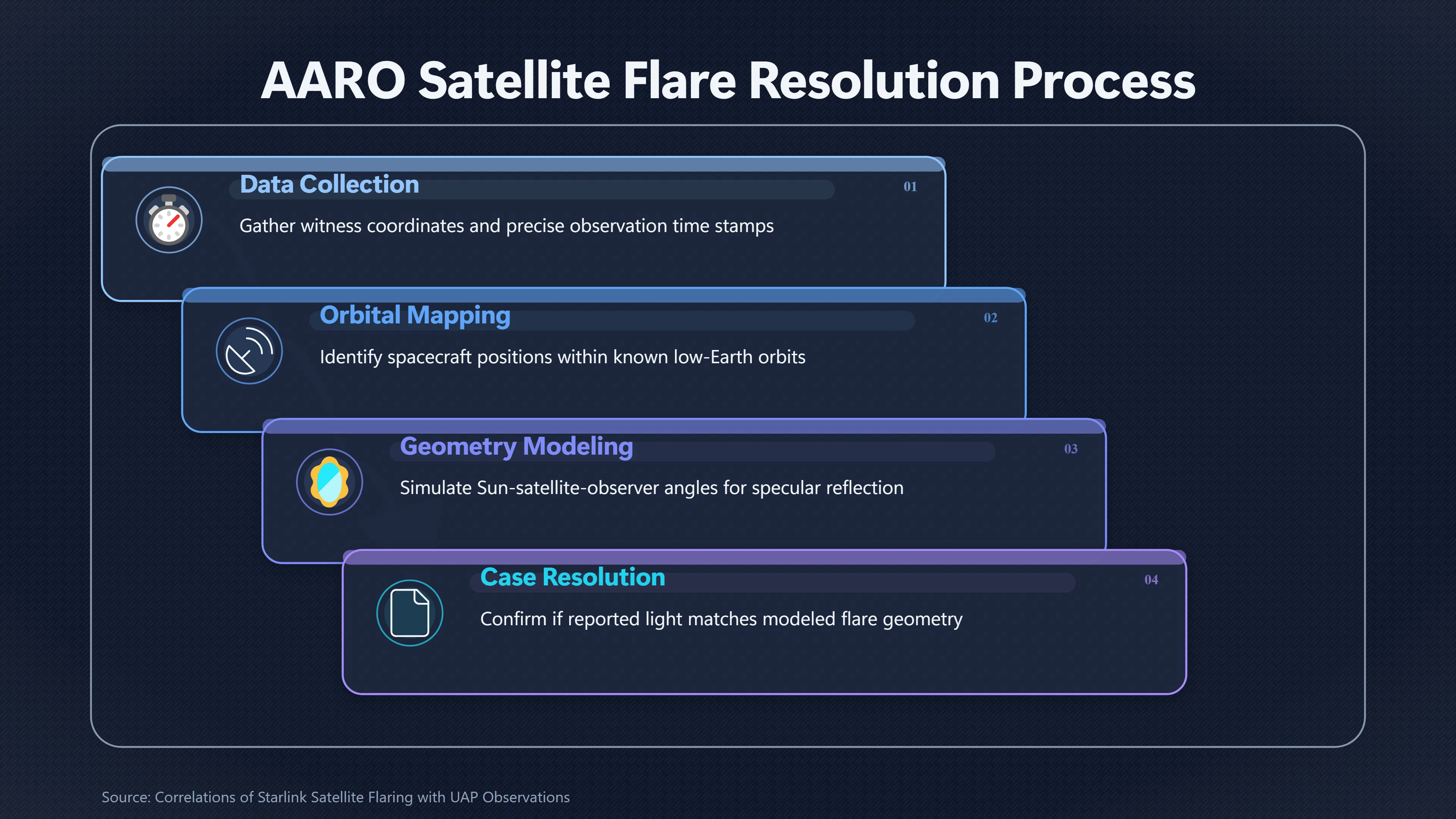
The decisive step was moving from recognising satellite flares as a plausible explanation to modelling them efficiently enough to apply the explanation across a large case inventory.
AARO’s December 2024 satellite-flaring paper set out the physical basis for this approach. To test a potential flare, investigators need information about the observation and observer, together with satellite orbital information and illumination geometry. The aim is not simply to note that “Starlink was overhead”, but to determine whether a satellite could have occupied the appropriate line of sight while sunlight could reach it and reflect towards the witness.[AARO]aaro.milCorrelations of Starlink Satellite Flaring with UAP ObservationsCorrelations of Starlink Satellite Flaring with UAP ObservationsJanuary 24, 2025…
That distinction matters. Thousands of satellites make a loose coincidence almost meaningless: there will often be some spacecraft somewhere in the sky. A stronger identification requires a geometrically consistent match. Time, observer position, viewing direction and spacecraft location constrain the problem, while the Sun’s position determines whether the satellite was illuminated and capable of producing the observed flare.
AARO’s FY2025 reporting describes its new capability as using advanced three-dimensional modelling and simulation applications. The office says the capability substantially improved its ability to determine efficiently when UAP reports were attributable to satellite flaring. It credits the system with resolving 238 reports during the reporting period.[GreWi]grewi.deus ufo untersuchungsbehoerde aaro veroeffentlicht jahresbericht 2025US-UFO-Untersuchungsbehörde AARO veröffentlicht Jahresbericht 2025…
This also explains why metadata can be more valuable than a visually dramatic video. An indistinct point of light may contain little information about the object’s physical form. But an accurate timestamp, observer coordinates, viewing direction and aircraft position can make orbital reconstruction possible. Conversely, a striking account without dependable timing or geometry may remain difficult to test.
AARO’s own reporting repeatedly identifies missing timely and actionable sensor data as a constraint on resolution. Satellite-flare modelling does not remove that limitation; it demonstrates what becomes possible when enough information survives to reconstruct an observation.[New Space Economy]newspaceeconomy.caNew Space EconomyWhat Does the FY 2025 AARO UAP Report Reveal About Unidentified Anomalous Phenomena? | New Space EconomyJuly 21, 2026…
Why backlog cases were resolved after new tools arrived
The headline figure of 238 satellite-flare resolutions needs careful interpretation because it is easy to confuse it with AARO’s current-year case statistics.
During the period covered by its FY2025 report, AARO received 319 reports. It resolved 114 of those incoming reports and also resolved 256 reports from previous periods, producing 370 resolutions in total during the reporting cycle. Among the 114 incoming cases that were closed, 60 were balloons and 44 satellites, with the small remainder attributed to aircraft, birds, unmanned aerial systems, a commercial rocket or missile launch and a crewed jetpack.[New Space Economy]newspaceeconomy.caNew Space EconomyWhat Does the FY 2025 AARO UAP Report Reveal About Unidentified Anomalous Phenomena? | New Space EconomyJuly 21, 2026…
The separate figure of 238 satellite-flare resolutions therefore should not be read as “238 of the 319 new reports were Starlink”. It describes what the new analytical capability achieved across AARO’s broader casework, including older reports.[New Space Economy]newspaceeconomy.caNew Space EconomyWhat Does the FY 2025 AARO UAP Report Reveal About Unidentified Anomalous Phenomena? | New Space EconomyJuly 21, 2026…
That difference is precisely what makes the episode significant. Cases can remain unresolved not because their cause is inherently unknowable, but because investigators lack either sufficient evidence or an analytical method capable of exploiting the evidence already available. Once AARO acquired a scalable way to reconstruct satellite-flare geometry, reports scattered through its existing inventory became candidates for reassessment.
The chronology supports that interpretation. In FY2024, satellites represented only a small share of AARO’s published closed-case categories, yet the office was already flagging Starlink as a growing explanation and referring some possible flare cases for advanced modelling. By FY2025, the modelling capability had been brought into operational use and hundreds of reports were attributed to the phenomenon.[sunysb.edu]astro.sunysb.eduFY24 CONSOLIDATED ANNUAL REPORT ON UAP 508physics at Stony Brook UniversityUNCLASSIFIEDFebruary 11, 2026…
In other words, the closure surge reflects two changes happening together. The physical sky has changed because large low-Earth-orbit constellations supply many more potential reflectors. The investigative environment has also changed because AARO has developed better tools for predicting when those reflectors should become visible.

What the 238 resolutions do — and do not — establish
AARO’s satellite work is strong evidence that spacecraft reflections now constitute a major identifiable source of modern UAP reports. It does not, however, justify treating every unexplained nocturnal light as a satellite flare.
A proper satellite attribution is a constrained explanation. The reported time and viewing geometry must be compatible with the relevant spacecraft and illumination conditions. If crucial information is absent, modelling may be unable to discriminate between satellites and other possibilities. AARO itself continues to retain cases for which available information is insufficient to reach a reliable assessment.[New Space Economy]newspaceeconomy.caNew Space EconomyWhat Does the FY 2025 AARO UAP Report Reveal About Unidentified Anomalous Phenomena? | New Space EconomyJuly 21, 2026…
Nor does a satellite identification mean that witnesses reported something imaginary. A flare is a real optical event produced by a real spacecraft. The perceptual mistake occurs in judging its distance, motion, identity or relationship to other lights. That distinction is particularly useful for understanding apparently extraordinary pilot reports: an observer may describe the appearance accurately while lacking the orbital information needed to understand its cause.
There is also an important methodological limit to the FY2025 number. AARO has publicly explained the flare mechanism and its general identification process, but the annual aggregate of 238 resolutions is not accompanied by a public case-by-case evidentiary file for all 238 reports. Readers can therefore verify the physical plausibility of satellite flaring and examine AARO’s stated methodology, but cannot independently audit every individual attribution from the annual-report total alone. AARO’s public records do provide its dedicated satellite-flaring paper and animation as supporting material for the method.[AARO]aaro.milUAP RecordsAARO UAP Records…
The broader lesson is consequently narrower, but more useful, than saying that “UAP are satellites”. Satellite flares are a specific, predictable mechanism that can generate surprisingly unconventional-looking lights. The multiplication of low-Earth-orbit constellations increased the number of opportunities for that mechanism to occur, while three-dimensional reconstruction gave AARO a practical way to search older and newer reports for the required geometry.
That combination explains the sudden statistical jump. Hundreds of cases did not become conventional because the past changed; they became resolvable because investigators gained a model capable of connecting an unfamiliar visual effect with the spacecraft already producing it.
Amazon book picks
Further Reading
Books and field guides related to Why satellites suddenly explain so many UAP reports. Use these as the next step if you want deeper reading beyond the article.
UFO: The Inside Story of the US Government's Search for Alien...
"The full story of our national obsession with UFOs--and the covert, decades-long search by scientists, the United States military, and t...
The Backyard Astronomer's Guide
Discusses the practical aspects of stargazing, including how to choose appropriate equipment, contending with light pollution, taking suc...
Turn Left at Orion
With over 100,000 copies sold since first publication, this is one of the most popular astronomy books of all time. It is a unique guideb...
Satellite Orbits: Models, Methods and Applications
Satellite Orbits -Models, Methods, and Applications has been written as a compre hensive textbook that guides the reader through the theo...
eBay marketplace picks
Marketplace Samples
Live-tested eBay searches with available results related to this page.
Selected fromsatellite model oneBay.co.uk.
Endnotes
1.
Source: aaro.mil
Title: Correlations of Starlink Satellite Flaring with UAP Observations
Link:https://www.aaro.mil/Portals/136/PDFs/Information%20Papers/AARO_Satellite_Flaring_Paper.pdf
Source snippet
Correlations of Starlink Satellite Flaring with UAP ObservationsJanuary 24, 2025...
Published: January 24, 2025
2.
Source: arxiv.org
Title: arXiv Extreme Flaring of Starlink Satellites
Link:https://arxiv.org/abs/2405.13091
3.
Source: grewi.de
Title: us ufo untersuchungsbehoerde aaro veroeffentlicht jahresbericht 2025
Link:https://www.grewi.de/us-ufo-untersuchungsbehoerde-aaro-veroeffentlicht-jahresbericht-2025/
Source snippet
US-UFO-Untersuchungsbehörde AARO veröffentlicht Jahresbericht 2025...
4.
Source: arxiv.org
Link:https://arxiv.org/abs/2111.09735
5.
Source: aaro.mil
Title: UAP Records
Link:https://www.aaro.mil/UAP-Records/
Source snippet
AARO UAP Records...
6.
Source: note.com
Link:https://note.com/nazo001/n/n9d4b7119e606
7.
Source: aaro.mil
Link:https://www.aaro.mil/Next-AARO-Home-redesign/Next-Parent/Next-UAP-Report-Documents/
8.
Source: aaro.mil
Link:https://www.aaro.mil/Next-AARO-Home-redesign/Next-Parent/Next-AARO-UAP-Imagery-Acc-Table/
9.
Source: aaro.mil
Link:https://www.aaro.mil/Next-AARO-Home-redesign/Next-Parent/Next-UAP-Report-Documents/poster/
10.
Source: aaro.mil
Link:https://www.aaro.mil/Next-AARO-Home-redesign/Inactive-Parent/AARO-Records-Tabs/
11.
Source: aaro.mil
Title: AAR O UAP Trends All-domain Anomaly Resolution Office UAP REPORTING TRENDS
Link:https://www.aaro.mil/UAP-Cases/UAP-Reporting-Trends/
12.
Source: aaro.mil
Link:https://www.aaro.mil/Next-AARO-Home-redesign/Next-Parent/Next-AARO-UAP-Trends/
13.
Source: aaro.mil
Link:https://www.aaro.mil/Next-AARO-Home-redesign/Inactive-Parent/Next-AARO-UAP-DT-Records/
14.
Source: aaro.mil
Link:https://www.aaro.mil/Next-AARO-Home-redesign/Next-Parent/AARO-UAP-Case-DT/
15.
Source: aaro.mil
Link:https://www.aaro.mil/Next-AARO-Home-redesign/Next-Parent/Next-AARO-Congressional-Press-Products/
16.
Source: aaro.mil
Link:https://www.aaro.mil/Congressional-Press-Products/%5D/
17.
Source: aaro.mil
Link:https://www.aaro.mil/Next-AARO-Home-redesign/Bruce-working/Next-AARO-UAP-Trends-Charts/
18.
Source: aaro.mil
Link:https://www.aaro.mil/
19.
Source: aaro.mil
Link:https://www.aaro.mil/FAQ/
20.
Source: aaro.mil
Link:https://www.aaro.mil/Next-AARO-Home-redesign/Next-Parent/Next-AARO-UAP-Imagery-Fixed-Table/
21.
Source: aaro.mil
Link:https://www.aaro.mil/UAP-Cases/Official-UAP-Imagery/4/
22.
Source: aaro.mil
Title: Congressional Tab DT
Link:https://www.aaro.mil/Next-AARO-Home-redesign/Next-Parent/AARO-Congressional-Tab-DT/
23.
Source: aaro.mil
Link:https://www.aaro.mil/Resources/Historical-Record-Reports/Volume-II/
24.
Source: aaro.mil
Title: AARO FY2025 Consolidated Annual Report on UAP
Link:https://www.aaro.mil/Portals/136/PDFs/FY25%20UAP%20Annual%20Report/AARO_FY2025_Consolidated_Annual_Report_on_UAP.pdf
25.
Source: everything.explained.today
Title: Satellite flare
Link:https://everything.explained.today/Satellite_flare/
26.
Source: newspaceeconomy.ca
Link:https://newspaceeconomy.ca/2026/07/21/what-does-the-fy-2025-aaro-uap-report-reveal-about-unidentified-anomalous-phenomena/
Source snippet
New Space EconomyWhat Does the FY 2025 AARO UAP Report Reveal About Unidentified Anomalous Phenomena? | New Space EconomyJuly 21, 2026...
Published: July 21, 2026
27.
Source: skyandtelescope.org
Title: Sky & Telescope Starlink Flares Can Fool Anyone — Even Airline Pilots
Link:https://skyandtelescope.org/astronomy-news/starlink-flares-can-fool-anyone-even-airline-pilots/
Source snippet
Sky & TelescopeStarlink Flares Can Fool Anyone — Even Airline Pilots - Sky & TelescopeJune 10, 2024...
Published: June 10, 2024
28.
Source: astro.sunysb.edu
Title: FY24 CONSOLIDATED ANNUAL REPORT ON UAP 508
Link:https://www.astro.sunysb.edu/fwalter/AST248/UAP/FY24-CONSOLIDATED-ANNUAL-REPORT-ON-UAP-508.PDF
Source snippet
physics at Stony Brook UniversityUNCLASSIFIEDFebruary 11, 2026...
Published: February 11, 2026
29.
Source: newspaceeconomy.ca
Title: what does uap knowledge in 2026 actually show
Link:https://newspaceeconomy.ca/2026/07/21/what-does-uap-knowledge-in-2026-actually-show/
30.
Source: newspaceeconomy.ca
Title: what does uap knowledge in 2026 actually show
Link:https://newspaceeconomy.ca/2026/07/21/what-does-uap-knowledge-in-2026-actually-show/?amp=1
31.
Source: skyandtelescope.org
Title: Satellite or Meteor? Dissecting Light Trails in Your Sky Photos
Link:https://skyandtelescope.org/astronomy-news/satellite-or-meteor-dissecting-light-trails-in-your-sky-photos/
32.
Source: nuforc.org
Link:https://nuforc.org/sighting/?id=196319
33.
Source: newspaceeconomy.ca
Link:https://newspaceeconomy.ca/2025/02/06/are-we-chasing-aliens-or-just-starlink-the-role-of-satellite-flares-in-uap-reports/
34.
Source: skyandtelescope.org
Link:https://skyandtelescope.org/astronomy-news/page/31/
35.
Source: skyandtelescope.org
Title: Astronomy News & Astronomical Events | Sky & Telescope By: Monica Young
Link:https://skyandtelescope.org/astronomy-news/page/33/
36.
Source: skyandtelescope.org
Link:https://skyandtelescope.org/author/tmallamaskyandtelescope-com/
37.
Source: skyandtelescope.org
Link:https://skyandtelescope.org/astronomy-news/astronomy-and-society/page/2/
38.
Source: skyandtelescope.org
Link:https://skyandtelescope.org/astronomy-news/page/28/?c=y&id=123828866
Additional References
39.
Source: youtube.com
Title: Have you seen such flashing light ball in the sky?
Link:https://www.youtube.com/watch?v=VyWieVT9vZ4
Source snippet
Nimitz Encounters Visual Simulation of DIstances The Nimitz Encounters · 6.5K views...
40.
Source: dni.gov
Title: 4020 PANI 2024
Link:https://www.dni.gov/index.php/newsroom/reports-publications/reports-publications-2024/4020-PANI-2024
Source snippet
ODNI2024 Consolidated Annual Report on Unidentified Anomalous Phenomena | Office of the Director of National Intelligence...
41.
Source: defense.gov
Link:https://www.defense.gov/News/News-Stories/Article/Article/3965403/dod-examining-unidentified-anomalous-phenomena/
42.
Source: defense.gov
Link:https://www.defense.gov/News/News-Stories/Article/Article/3701297/dod-report-discounts-sightings-of-extraterrestrial-technology/
43.
Source: defense.gov
Link:https://www.defense.gov/News/News-Stories/Article/Article/3575511/dod-unidentified-anomalous-phenomena-office-[launches
44.
Source: defense.gov
Link:https://www.defense.gov/News/News-Stories/Article/article/3368109/dod-working-to-better-understand-resolve-anomalous-phenomena/
45.
Source: defense.gov
Link:https://www.defense.gov/News/Releases/Release/Article/3100053/dod-announces-the-establishment-of-the-all-domain-anomaly-resolution-office/
46.
Source: defense.gov
Link:https://www.defense.gov/About/Biographies/Biography/Article/3884328/dr-jon-t-kosloski/
47.
Source: dni.gov
Link:https://www.dni.gov/index.php/what-we-do/foia-reading-room
48.
Source: dni.gov
Link:https://www.dni.gov/index.php/foia?highlight=WyJzIiwiJ3MiXQ%3D%3D