Within UFO Identifications
Why Bright Planets Still Get Reported as UFOs
A bright planet in a dark sky can seem to hover, follow a vehicle or move when surrounding reference points disappear.
On this page
- Why Venus and Jupiter attract attention
- Clouds, vehicles and false apparent motion
- Checking position with astronomical data
Page outline Jump by section
Introduction
A bright planet can look surprisingly unlike a planet. Venus in particular can appear as an intensely luminous, nearly stationary light in twilight or darkness, while Jupiter can produce a similar effect when it is conspicuous and isolated. Without familiar reference points, such lights may seem to hover, manoeuvre, retreat from an approaching vehicle or remain alongside it for miles. Modern US UAP investigators still list bright planets, specifically Venus and Jupiter, among celestial objects that are commonly misperceived as hovering or manoeuvring objects.[AARO]aaro.milAARO HomeCelestial objects: Bright planets like Venus and Jupiter, meteors, and other astronomical bodies can be misperceived as hove…
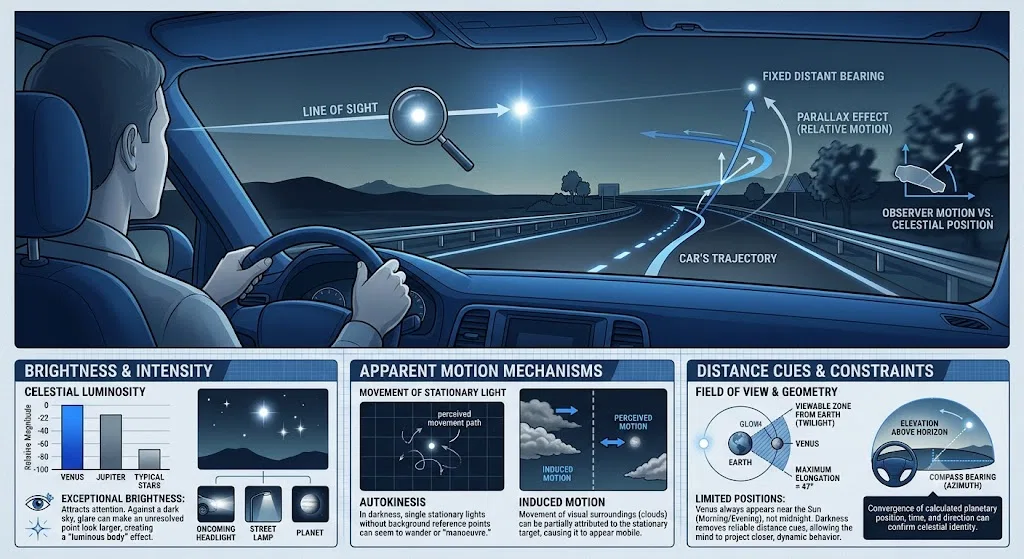
The key is not simply that witnesses “mistake a planet for a light”. Several mechanisms can operate together: exceptional brightness attracts attention; darkness removes reliable distance cues; atmospheric effects alter the light’s appearance; moving clouds can generate false motion; and movement by the observer can make a very distant object behave unlike anything nearby. A planet explanation is therefore strongest when investigators can match the reported direction and time to a calculated planetary position rather than merely noting that Venus happened to be visible somewhere in the sky.
Why Venus and Jupiter attract attention
Venus is unusually effective at producing UFO reports because it can be startlingly bright. NASA eclipse calculations, for example, give Venus apparent visual magnitudes around −4 to −4.5 during especially bright appearances. On the astronomical magnitude scale, lower numbers mean greater brightness, so Venus can outshine every star in the night sky by a wide margin. NASA has noted that under suitable conditions it can even be visible in daylight.[NASA Eclipse]eclipse.gsfc.nasa.govsky at totalityNASA EclipseNASA RP 1383: Sky at TotalityVenus is located 42° west of the Sun where it will reach greatest elongation the following month…
That brightness matters because a casual observer may have no reason to interpret the object as a planet. The NASA-supported Night Sky Network describes a familiar experience among amateur astronomers: someone contacts them about an extraordinary bright light, while they themselves have already been watching Venus in precisely that part of the sky. The network recommends recording the exact time, location, duration, direction of drift and brightness because those details can turn an apparently anomalous observation into an astronomical identification.[Night Sky]nightsky.jpl.nasa.govOpen source on nasa.gov.
Venus also appears where UFO reports are particularly likely to attract attention: in the evening after sunset or in the morning before sunrise. Because Venus orbits closer to the Sun than Earth does, it never wanders freely through the whole night sky. NASA explains that Venus and Mercury always remain relatively near the Sun as seen from Earth, appearing in the morning or evening sky rather than around midnight. Venus reaches a maximum angular separation from the Sun of roughly 47 degrees.[NASA Science]nasa.govScience Chapter 1: The Solar SystemNASA ScienceChapter 1: The Solar System - NASA Science
This constraint is diagnostically useful. A brilliant unidentified light low in the western sky after sunset, or in the eastern sky before sunrise, can be a good Venus candidate. A supposed Venus sighting high in the sky around local midnight cannot simply be accepted because Venus is bright; the planet’s known geometry rules it out.
Jupiter presents a slightly different problem. As an outer planet it is not restricted to twilight and can remain visible through much of the night. It is normally much dimmer than Venus at Venus’s brightest, but it is still one of the most conspicuous point-like objects in the sky. This is why contemporary AARO guidance names both Venus and Jupiter among celestial objects liable to be reported as UAP.[AARO]aaro.milAARO FAQCelestial objects: Bright planets like Venus and Jupiter, meteors, and other astronomical bodies can be misperceived as hover…
Brightness can also encourage faulty size judgements. A naked-eye planet is effectively an unresolved point of light, but glare, imperfect focus, haze and visual adaptation can make the luminous patch seem much larger than its true angular disc. The British Astronomical Association notes that Venus is so brilliant against a dark sky that its glare can overwhelm delicate detail even for telescopic observers.[British Astronomical Association]britastro.orgthe phases of venusthe phases of venus A witness may therefore describe a “large light” or luminous body without having actually resolved the physical outline of an object.
Atmospheric conditions can add further apparent complexity. NASA defines scintillation as brightness variation caused by turbulent fluctuations in the atmosphere and notes that the effect becomes stronger near the horizon because the incoming light passes through more air.[NASA Science]science.nasa.govScience Universe glossaryScience Universe glossary A very bright astronomical source viewed low down can consequently appear less steady than the simple phrase “planet in the sky” suggests.
Clouds, vehicles and false apparent motion
The most important source of confusion is often motion. Witnesses sometimes reject an astronomical explanation because the light seemed to move, follow them or react when they changed direction. Those perceptions do not necessarily require the source itself to be travelling through the atmosphere.
One relevant effect is autokinesis: the apparent movement of a stationary light when it is viewed against a dark or featureless background. Modern experimental work describes autokinesis as perceived motion arising from a small visual stimulus in darkness, while aviation guidance treats the phenomenon as a practical hazard because a distant stationary light can seem to wander.[PubMed Central (PMC)]pmc.ncbi.nlm.nih.govOpen source on nih.gov. In a UFO report, the essential ingredients may be present naturally: a single brilliant light, prolonged attention and few stable objects nearby against which its position can be judged.
Moving clouds can produce a different illusion. In induced motion, movement of the visual surroundings is attributed partly or wholly to a stationary target. Experimental literature uses the Moon seen beside wind-blown clouds as a classic example: the surrounding cloud movement can make the celestial object itself appear to move in the opposite direction.[PubMed Central (PMC)]pmc.ncbi.nlm.nih.govOpen source on nih.gov. The same mechanism is relevant to a bright planet intermittently framed by cloud banks. If cloud motion is subtle or poorly visible in darkness, the luminous point may seem to slide, accelerate or emerge from one position into another.
A moving car or aircraft introduces another powerful cue. Nearby objects change position rapidly against the background as the observer moves, while extremely distant objects change far less. This is the geometry of parallax: NASA defines it as the apparent positional shift caused by changing the observer’s viewpoint, with the effect being larger for nearby objects.[NASA Scientific Visualization Studio]svs.gsfc.nasa.govScientific Visualization Studio Moon Essentials: ParallaxScientific Visualization Studio Moon Essentials: Parallax
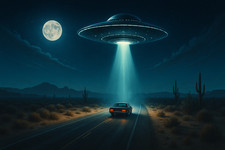
That explains the familiar “following” effect. A driver passes trees, signs, lamp posts and buildings, all of which sweep through the visual field. A planet is so distant that ordinary road travel produces no comparable visible sideways shift. It can therefore remain in roughly the same direction through the windscreen for a long period. If the witness assumes that the light is only a few kilometres away, its persistence can be interpreted as active pursuit: the car turns and the light “turns”; the car accelerates and the light “keeps up”.
The effect becomes especially persuasive on winding roads. When vegetation or buildings repeatedly obscure the planet, the observer sees it disappear and reappear from changing directions within the vehicle. The actual change is mainly in the car’s orientation and the foreground scenery, but the most salient object is the bright light, so movement may be attributed to it.
A historical case examined in the Condon Report shows how elaborate such an experience can become. Police and a light-aircraft pilot reported brilliant objects that appeared to flee from vehicles, return when pursuit ceased and remain visible into daylight. Investigators calculated that Venus and Jupiter occupied the relevant part of the sky and noted that the objects repeatedly settled into positions matching those planets. The pilot described being unable to catch a brilliant white object despite climbing towards it; when the pursuit ended, it appeared to return to its former position.[files.ncas.org]files.ncas.orgCondon Report, Case 37: Planets Venus & JupiterCondon Report, Case 37: Planets Venus & Jupiter
The investigators concluded that the episode was primarily caused by Venus, with Jupiter involved in some observations. Their analysis specifically highlighted observer motion, haze, near-horizon viewing and scintillation as mechanisms capable of making a distant astronomical source appear mobile or physically unusual.[files.ncas.org]files.ncas.orgCondon Report, Case 37: Planets Venus & JupiterCondon Report, Case 37: Planets Venus & Jupiter
That case is useful as an illustration, but it also shows why “Venus” should not be treated as an all-purpose dismissal. The report reached its conclusion by matching repeated observation times and sky positions, examining the claimed radar evidence and interviewing the pilot. It did not establish the identification merely from the fact that Venus was bright that month.[files.ncas.org]files.ncas.orgCondon Report, Case 37: Planets Venus & JupiterCondon Report, Case 37: Planets Venus & Jupiter

Checking position with astronomical data
The decisive advantage of a planetary explanation is that it is testable. Venus and Jupiter do not appear wherever an investigator needs them to be. Their positions at a given time and place can be calculated with very high precision.
NASA’s Jet Propulsion Laboratory maintains the Horizons ephemeris system, which generates observer-specific positions for planets and other Solar System bodies. Horizons can calculate quantities including right ascension and declination, azimuth and elevation, brightness, sky-motion rates, rise and set times, and visibility for a specified observer location and time.[JPL Solar System Dynamics]nasa.govJPL Solar System Dynamics Horizons SystemJPL Solar System Dynamics Horizons System
For a reported UFO, a useful planetary check therefore begins with four pieces of information: where the witness was, the date, the local time and the direction/elevation of the light. Exact information is much more valuable than recollections such as “somewhere over the hills” or “late in the evening”. The NASA Night Sky Network similarly recommends preserving location, time, duration, direction of motion and brightness when trying to identify an unusual light.[Night Sky]nightsky.jpl.nasa.govOpen source on nasa.gov.
A robust comparison then asks several questions.
- Was the candidate planet above the horizon? If Venus had already set, or had not yet risen, it cannot explain a contemporaneous visual sighting.
- Was it in the reported direction? A witness who repeatedly places the object in the north should not have the report attributed to Venus merely because Venus was bright in the west.

-
Does the timing make astronomical sense? Venus is constrained to the morning or evening side of the sky because its orbit lies inside Earth’s. It never appears around midnight at a large angular separation from the Sun. NASA Science
- Does its apparent behaviour fit a distant fixed source? Long periods of apparent hovering, failure to approach despite a chase, reappearance after turns, or gradual motion consistent with the changing sky are all compatible with an astronomical source. A verified close pass in front of a nearby object, on the other hand, would require a different explanation.
- Do independent observations agree? A photograph with identifiable stars, a skyline landmark, compass bearing or several observations from known positions can make the test much stronger. JPL Horizons can provide the expected celestial position for comparison. JPL Solar System Dynamics
The same process guards against retrospective overconfidence. Human estimates of altitude, distance and speed are particularly fragile when the target has no known size. If a witness reports that a light was “500 metres away” solely because it looked bright, that range should not be treated as measured fact. Conversely, if reliable geometry or imaging demonstrates that an object passed between the observer and a nearby landmark, an astronomical explanation can be rejected.
What makes a planet identification convincing
A good identification is a convergence of independent details rather than a resemblance. “It looked like Venus” is weak. “Venus was at the reported azimuth and elevation at that exact time, had the required brightness, remained visible for the stated interval, and the object’s apparent movement changed when the observer’s vehicle changed direction” is much stronger.
This distinction has been part of UFO investigation for decades. Project Blue Book explicitly classified bright stars and planets within its astronomical category and developed descriptions of known aerial and astronomical phenomena so that incoming reports could be compared with expected characteristics. CIA Contemporary AARO material likewise identifies Venus and Jupiter as recurring UAP lookalikes, showing that the mechanism has not disappeared simply because astronomical information is now easier to obtain. AARO
Smartphone sky applications can provide a quick initial check, but for a serious reconstruction an ephemeris such as JPL Horizons is preferable because the observer’s coordinates and exact time can be specified and the expected azimuth and elevation can be recorded. JPL Solar System Dynamics The useful question is not whether a planet was “visible that night”, but whether it occupied the same line of sight as the reported object.
Venus and Jupiter therefore remain important IFO mechanisms not because observers routinely fail to recognise obvious planets, but because perception is being asked to solve an unusually difficult problem. A brilliant point of light in darkness gives almost no direct information about its range. Remove foreground references, introduce haze or moving clouds, then put the observer in a moving vehicle, and a fixed celestial object can acquire convincing apparent motion and behaviour. Astronomical data provide the way out: unlike an unknown craft, a planet has a calculable position, so the explanation can be checked rather than assumed.
Amazon book picks
Further Reading
Books and field guides related to Why Bright Planets Still Get Reported as UFOs. Use these as the next step if you want deeper reading beyond the article.
The UFO Handbook: A Guide to Investigating, Evaluating, and R...
An explanation of the usual reasons for confusing IFOs (identified flying objects) with UFOs and a survey of the tools used to investigat...
The UFO Experience: A Scientific Inquiry
The author belives that a number of UFO siting are still to be explained.
NightWatch: A Practical Guide to Viewing the Universe
A practical guide to viewing the universe.
The Backyard Astronomer's Guide
Discusses the practical aspects of stargazing, including how to choose appropriate equipment, contending with light pollution, taking suc...
eBay marketplace picks
Marketplace Samples
Live-tested eBay searches with available results related to this page.
Selected fromUFO poster oneBay.co.uk.
Current eBay listing
I Want To Believe UFO Poster Giclée Fine Art Heavyweight Print
Current eBay listing
VINTAGE UFO FLYING SAUCERS COMIC ADVERTISING A2 POSTER PRINT
Endnotes
1.
Source: aaro.mil
Link:https://www.aaro.mil/
Source snippet
AARO HomeCelestial objects: Bright planets like Venus and Jupiter, [meteors]({{ 'meteors/' | relative_url }}), and other astronomical bodies can be misperceived as hove...
2.
Source: aaro.mil
Link:https://www.aaro.mil/FAQ/
Source snippet
AARO FAQCelestial objects: Bright planets like Venus and Jupiter, meteors, and other astronomical bodies can be misperceived as hover...
3.
Source: eclipse.gsfc.nasa.gov
Title: sky at totality
Link:https://eclipse.gsfc.nasa.gov/SEpubs/19980226/text/sky-at-totality.html
Source snippet
NASA EclipseNASA RP 1383: Sky at TotalityVenus is located 42° west of the Sun where it will reach greatest elongation the following month...
4.
Source: eclipse.gsfc.nasa.gov
Title: sky at totality
Link:https://eclipse.gsfc.nasa.gov/SEpubs/20021204/text/sky-at-totality.html
Source snippet
NASA EclipseNASA/TP-2001-209990: Sky at TotalityThe most conspicuous planet visible during totality will be Venus (mv = -4.5) located 39°...
5.
Source: nightsky.jpl.nasa.gov
Link:https://nightsky.jpl.nasa.gov/news/39/
7.
Source: pwg.gsfc.nasa.gov
Title: PWGThe Scale of the Solar System
Link:https://pwg.gsfc.nasa.gov/stargaze/Skepler3%28op%29.htm
8.
Source: science.nasa.gov
Title: Science Universe glossary
Link:https://science.nasa.gov/universe/glossary/
9.
Source: svs.gsfc.nasa.gov
Title: Scientific Visualization Studio Moon Essentials: Parallax
Link:https://svs.gsfc.nasa.gov/5320/
10.
Source: jpl.nasa.gov
Title: a teachable moment in the sky the transit of mercury
Link:https://www.jpl.nasa.gov/edu/resources/teachable-moment/a-teachable-moment-in-the-sky-the-transit-of-mercury/
11.
Source: files.ncas.org
Title: Condon Report, Case 37: Planets Venus & Jupiter
Link:https://files.ncas.org/condon/text/case37.htm
13.
Source: cia.gov
Title: How To Investigate a Flying Saucer
Link:https://www.cia.gov/stories/story/how-to-investigate-a-flying-saucer/
14.
Source: eclipse.gsfc.nasa.gov
Title: sky at totality
Link:https://eclipse.gsfc.nasa.gov/SEpubs/19970309/text/sky-at-totality.html
15.
Source: eclipse.gsfc.nasa.gov
Title: sky at totality
Link:https://eclipse.gsfc.nasa.gov/SEpubs/19990811/text/sky-at-totality.html
16.
Source: eclipse.gsfc.nasa.gov
Title: sky at totality
Link:https://eclipse.gsfc.nasa.gov/SEpubs/20010621/text/sky-at-totality.html
17.
Source: eclipse.gsfc.nasa.gov
Title: sky at totality
Link:https://eclipse.gsfc.nasa.gov/SEpubs/19951024/text/sky-at-totality.html
18.
Source: eclipse.gsfc.nasa.gov
Title: observing sky
Link:https://eclipse.gsfc.nasa.gov/SEpubs/19941103/text/observing-sky.html
19.
Source: eclipse.gsfc.nasa.gov
Title: TSE2012 Sky2039
Link:https://eclipse.gsfc.nasa.gov/SEmono/TSE2012/TSE2012fig/TSE2012-Sky2039.pdf
20.
Source: ntrs.nasa.gov
Link:https://ntrs.nasa.gov/api/citations/19790012783/downloads/19790012783.pdf
21.
Source: ntrs.nasa.gov
Link:https://ntrs.nasa.gov/api/citations/19700019406/downloads/19700019406.pdf
22.
Source: ssd.jpl.nasa.gov
Link:https://ssd.jpl.nasa.gov/horizons/app.html
23.
Source: ssd.jpl.nasa.gov
Link:https://ssd.jpl.nasa.gov/horizons/
24.
Source: ssd.jpl.nasa.gov
Link:https://ssd.jpl.nasa.gov/ephem.html
25.
Source: ssd.jpl.nasa.gov
Title: approx pos
Link:https://ssd.jpl.nasa.gov/planets/approx_pos.html
26.
Source: ssd-api.jpl.nasa.gov
Link:https://ssd-api.jpl.nasa.gov/doc/horizons.html
27.
Source: ssd.jpl.nasa.gov
Title: orbit viewer
Link:https://ssd.jpl.nasa.gov/tools/orbit_viewer.html
28.
Source: ssd.jpl.nasa.gov
Title: obs data
Link:https://ssd.jpl.nasa.gov/planets/obs_data.html
29.
Source: ssd.jpl.nasa.gov
Title: phys par
Link:https://ssd.jpl.nasa.gov/planets/phys_par.html
30.
Source: ntrs.nasa.gov
Link:https://ntrs.nasa.gov/api/citations/19750016555/downloads/19750016555.pdf
31.
Source: science.nasa.gov
Link:https://science.nasa.gov/mercury/facts/
32.
Source: nightsky.jpl.nasa.gov
Link:https://nightsky.jpl.nasa.gov/events/12298/
33.
Source: science.nasa.gov
Title: the moon illusion why does the moon look so big sometimes
Link:https://science.nasa.gov/solar-system/moon/the-moon-illusion-why-does-the-moon-look-so-big-sometimes/
34.
Source: ntrs.nasa.gov
Link:https://ntrs.nasa.gov/api/citations/19700019506/downloads/19700019506.pdf
35.
Source: svs.gsfc.nasa.gov
Link:https://svs.gsfc.nasa.gov/search/?search=%22Oort+Cloud%22
36.
Source: nasa.gov
Link:https://www.nasa.gov/wp-content/uploads/2023/04/1977.pdf
37.
Source: science.nasa.gov
Title: hubble constant and tension
Link:https://science.nasa.gov/mission/hubble/science/science-behind-the-discoveries/hubble-constant-and-tension/
38.
Source: science.nasa.gov
Title: improved hubble yardstick gives fresh evidence for new physics in the universe
Link:https://science.nasa.gov/missions/hubble/improved-hubble-yardstick-gives-fresh-evidence-for-new-physics-in-the-universe/
39.
Source: science.nasa.gov
Title: hubble and gaia team up to fuel cosmic conundrum
Link:https://science.nasa.gov/missions/hubble/hubble-and-gaia-team-up-to-fuel-cosmic-conundrum/
40.
Source: science.nasa.gov
Title: hubble glossary
Link:https://science.nasa.gov/mission/hubble/multimedia/hubble-glossary/
41.
Source: science.nasa.gov
Title: for the first time hubble directly measures mass of a lone white dwarf
Link:https://science.nasa.gov/missions/hubble/for-the-first-time-hubble-directly-measures-mass-of-a-lone-white-dwarf/
42.
Source: svs.gsfc.nasa.gov
Link:https://svs.gsfc.nasa.gov/13795/
43.
Source: science.nasa.gov
Link:https://science.nasa.gov/missions/hubble/hubble-makes-the-first-precise-distance-measurement-to-an-ancient-globular-star-cluster/
44.
Source: nasa.gov
Title: ai lensing planets masses
Link:https://www.nasa.gov/technology/goddard-tech/ai-lensing-planets-masses/
45.
Source: ntrs.nasa.gov
Link:https://ntrs.nasa.gov/api/citations/20040191353/downloads/20040191353.pdf
46.
Source: ntrs.nasa.gov
Link:https://ntrs.nasa.gov/api/citations/20020073029/downloads/20020073029.pdf
47.
Source: ntrs.nasa.gov
Link:https://ntrs.nasa.gov/api/citations/19850009583/downloads/19850009583.pdf?attachment=true
48.
Source: ntrs.nasa.gov
Link:https://ntrs.nasa.gov/api/citations/19890000830/downloads/19890000830.pdf
49.
Source: ntrs.nasa.gov
Link:https://ntrs.nasa.gov/api/citations/20000115872/downloads/20000115872.pdf
50.
Source: ntrs.nasa.gov
Link:https://ntrs.nasa.gov/api/citations/19680024918/downloads/19680024918.pdf
51.
Source: svs.gsfc.nasa.gov
Link:https://svs.gsfc.nasa.gov/
52.
Source: ntrs.nasa.gov
Link:https://ntrs.nasa.gov/api/citations/19650019205/downloads/19650019205.pdf
53.
Source: ntrs.nasa.gov
Link:https://ntrs.nasa.gov/api/citations/19670014580/downloads/19670014580.pdf
54.
Source: cia.gov
Link:https://www.cia.gov/readingroom/document/cia-rdp81r00560r000100010002-9
55.
Source: cia.gov
Link:https://www.cia.gov/readingroom/docs/CIA-RDP81R00560R000100010002-9.pdf
56.
Source: cia.gov
Title: CIA RDP81R00560R000100010001 0
Link:https://www.cia.gov/readingroom/docs/CIA-RDP81R00560R000100010001-0.pdf
57.
Source: cia.gov
Title: role study UFOs
Link:https://www.cia.gov/resources/csi/static/cia-role-study-UFOs.pdf
58.
Source: cia.gov
Link:https://www.cia.gov/readingroom/docs/DOC_0000838058.pdf
59.
Source: cia.gov
Link:https://www.cia.gov/readingroom/document/cia-rdp81r00560r000100010001-0
60.
Source: cia.gov
Title: CIA RDP81R00560R000100010010 0
Link:https://www.cia.gov/readingroom/docs/CIA-RDP81R00560R000100010010-0.pdf
61.
Source: cia.gov
Link:https://www.cia.gov/readingroom/docs/CIA-RDP81R00560R000100010012-8.pdf
62.
Source: cia.gov
Link:https://www.cia.gov/readingroom/document/cia-rdp81r00560r000100010010-0
63.
Source: aaro.mil
Title: AARO Historical Record Report Vol 1 2024
Link:https://www.aaro.mil/Portals/136/PDFs/AARO_Historical_Record_Report_Vol_1_2024.pdf
64.
Source: britastro.org
Title: the phases of venus
Link:https://britastro.org/2016/the-phases-of-venus
65.
Source: pmc.ncbi.nlm.nih.gov
Link:https://pmc.ncbi.nlm.nih.gov/articles/PMC10965040/
66.
Source: pmc.ncbi.nlm.nih.gov
Link:https://pmc.ncbi.nlm.nih.gov/articles/PMC9459461/
67.
Source: space.com
Title: 14884 jupiter venus mistaken ufos
Link:https://www.space.com/14884-jupiter-venus-mistaken-ufos.html
68.
Source: space.com
Title: 42941 project blue book ufos history channel
Link:https://www.space.com/42941-project-blue-book-ufos-history-channel.html
69.
Source: space.com
Link:https://www.space.com/stargazing/why-do-venus-and-jupiter-meet-up-in-the-sky-so-often-its-a-symptom-of-a-solar-system-that-supports-life-on-earth
70.
Source: space.com
Title: What Is Parallax?
Link:https://www.space.com/30417-parallax.html
71.
Source: Wikipedia
Title: Project Blue Book
Link:https://en.wikipedia.org/wiki/Project_Blue_Book
72.
Source: archives.gov
Title: Project BLUE BOOK
Link:https://www.archives.gov/research/military/air-force/ufos
73.
Source: archives.gov
Title: Project BLUE BOOK
Link:https://www.archives.gov/foia/ufos.html
74.
Source: pmc.ncbi.nlm.nih.gov
Link:https://pmc.ncbi.nlm.nih.gov/articles/PMC26692/
Additional References
75.
Source: youtube.com
Title: Bright Object Seen in SOHO LASCO C3! Is it a UFO or just Venus?
Link:https://www.youtube.com/watch?v=c28UtMQnA6o
Source snippet
UFO lookalike? Close-up of Planet Venus looks pretty interesting! - 1080P HD...
76.
Source: faa.gov
Link:https://www.faa.gov/sites/faa.gov/files/regulations_policies/handbooks_manuals/aviation/airplane_handbook/12_afh_ch11.pdf
77.
Source: faa.gov
Link:https://www.faa.gov/sites/faa.gov/files/02_phak_toc.pdf
78.
Source: faa.gov
Link:https://www.faa.gov/sites/faa.gov/files/regulations_policies/handbooks_manuals/aviation/faa-h-8083-21.pdf
79.
Source: faa.gov
Link:https://www.faa.gov/sites/faa.gov/files/2022-01/Spatial%20Disorientation.pdf
80.
Source: faa.gov
Link:https://www.faa.gov/pilots/safety/pilotsafetybrochures/media/spatiald_visillus.pdf
81.
Source: faa.gov
Link:https://www.faa.gov/data_research/research/med_humanfacs/oamtechreports/media/AM63-30pt04.pdf
82.
Source: researchgate.net
Link:https://www.researchgate.net/publication/250277638_Dealing_with_Astrology_UFOs_and_Faces_on_Other_Worlds_A_Guide_to_Addressing_Astronomical_Pseudoscience_in_the_Classroom
83.
Source: facebook.com
Link:https://www.facebook.com/airandspace/posts/a-history-of-the-phenomenon-of-ufo-sightings-and-claims-of-alien-abduction/10154963578382797/
84.
Source: skybrary.aero
Link:https://skybrary.aero/sites/default/files/bookshelf/6021.pdf