Within Bright Stars
Why Does a Bright Star Seem to Follow Your Car?
A star can appear to keep pace with a moving vehicle because nearby scenery changes direction rapidly while the star's bearing barely changes.
On this page
- Why astronomical distance keeps a star's bearing nearly fixed
- How passing scenery creates misleading depth cues
- How to distinguish apparent pacing from a nearby object
Page outline Jump by section
Introduction
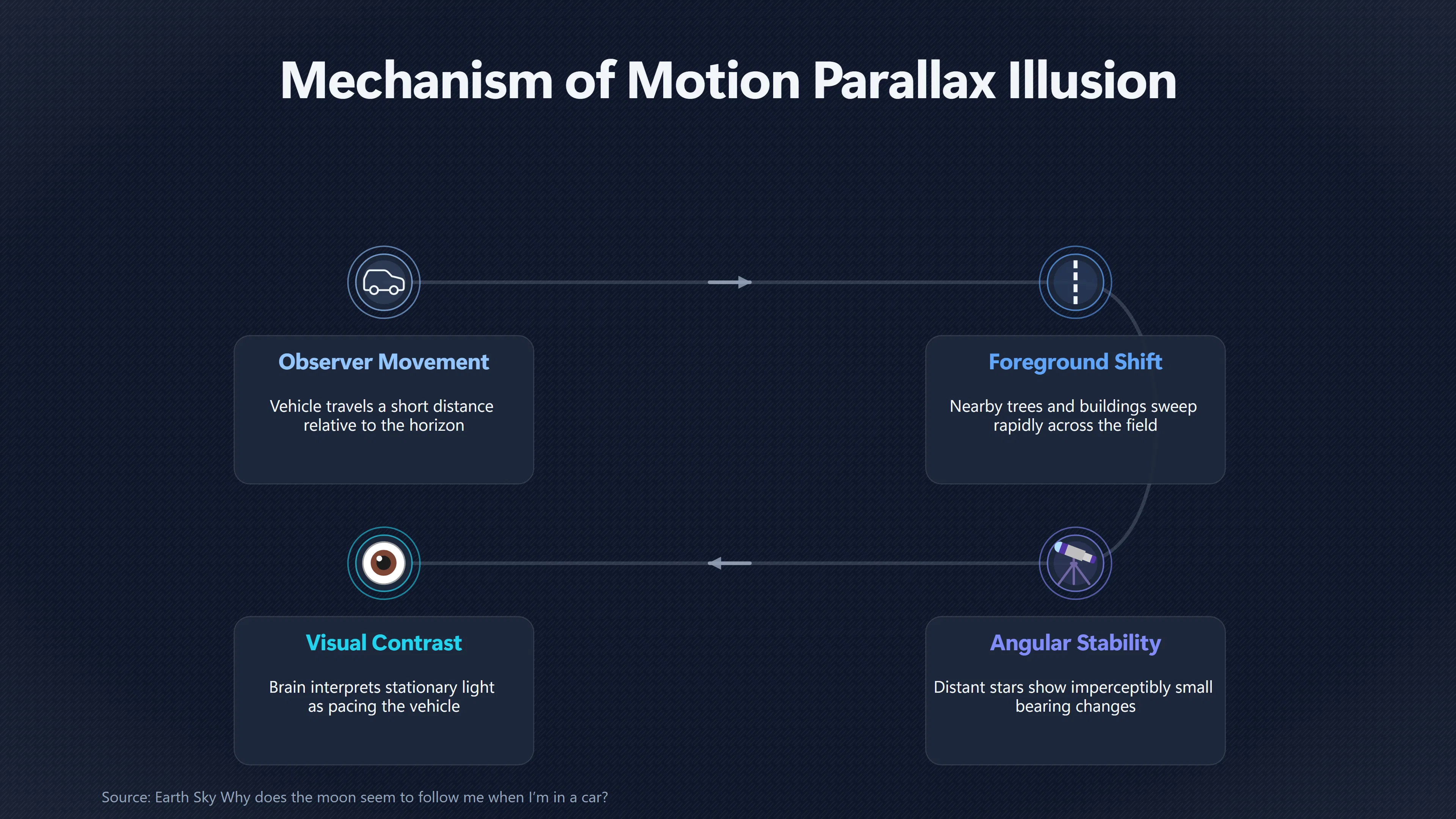
A bright star can seem to follow a moving car for a simple geometric reason: the car travels a tiny distance compared with the star’s enormous distance from Earth. Trees, lamp posts and buildings close to the road therefore sweep rapidly across the passenger’s field of view, while the direction to the star changes by an imperceptibly small amount. The star consequently remains in roughly the same part of the windscreen or side window and can look as though it is keeping pace with the vehicle.
This is an everyday example of motion parallax, a depth cue produced when an observer moves through a scene. It is familiar from the Moon seeming to follow a car, but the effect applies even more strongly to stars because they are vastly farther away.[nih.gov]pubmed.ncbi.nlm.nih.govPub Med Visual depth from motion parallax and eye pursuitVisual depth from motion parallax and eye pursuit - PubMedJune 22, 2011… For UFO or UAP reports made from moving vehicles, that distinction matters: apparent pacing by a point of light does not, by itself, demonstrate that the light is a nearby object travelling alongside the observer.
Why the star’s direction barely changes
Parallax is an apparent change in an object’s position caused by a change in the observer’s viewpoint. Its size depends strongly on distance. The European Space Agency illustrates the principle with a nearby finger: changing viewpoint makes the finger shift conspicuously against a distant background, whereas increasing its distance reduces that apparent displacement. Astronomers exploit exactly the same geometry to measure stellar distances.[European Space Agency]esa.intEuropean Space Agency ESAEuropean Space AgencyESA - Parallax…
A car journey provides the same geometry on a different scale. Imagine a passenger looking sideways while the vehicle travels 100 metres. A roadside sign only 20 metres away is now being viewed from a dramatically different position, so its bearing changes greatly. A hill several kilometres away shifts much less. A star, however, may be tens or hundreds of trillions of kilometres away. Moving a few hundred metres along a road makes essentially no visible difference to the line of sight.
The scale is striking even for the nearest stars. ESA notes that the nearest star is about 40 trillion kilometres away, and that astronomers need a baseline comparable with the diameter of Earth’s orbit around the Sun to produce a parallax displacement of less than an arcsecond for even nearby stars.[European Space Agency]esa.intEuropean Space Agency ESAEuropean Space AgencyESA - Parallax… A car’s displacement during an ordinary sighting is negligible by comparison.
This explains an important feature of the experience. The star is not actually following the vehicle, nor does it need to move in synchrony with it. Its bearing merely changes too little for the observer to notice. EarthSky describes the corresponding Moon experience in almost exactly the setting that makes the illusion memorable: buildings, people and fields pass by, while the distant astronomical object appears to stay with the traveller.[EarthSky]earthsky.orgEarth Sky Why does the moon seem to follow me when I’m in a car?Earth Sky Why does the moon seem to follow me when I’m in a car?
Why passing scenery makes the illusion convincing
Motion parallax is not simply a curiosity of geometry. The human visual system actively uses relative motion to judge depth. Experimental research has shown that movement generated as an observer translates through an environment provides powerful information about the relative distances of objects.[Sage Journals]journals.sagepub.comSage Journals Motion Parallax as an Independent Cue for Depth PerceptionSage JournalsMotion Parallax as an Independent Cue for Depth Perception - Brian Rogers, Maureen Graham, 1979…
A passenger looking from a moving car sees a particularly strong version of that depth pattern. Nearby fence posts may flash past almost instantaneously; houses cross the field of view more slowly; distant hills seem almost stationary. Hanover College’s psychology material uses precisely this driving example to explain motion parallax: nearby objects travel farther across the visual field than distant ones, while a distant farmhouse appears to move much more slowly.[Hanover College Psychology Department]psych.hanover.eduCollege Psychology Department Motion ParallaxHanover College Psychology DepartmentMotionParallax…
A star occupies the extreme end of that sequence:
- Roadside objects change bearing very quickly.
- Distant buildings or hills change bearing more slowly.
- Astronomical objects show essentially no detectable change from the car’s movement.
The contrast can create the subjective impression that the foreground world is moving backwards while the star is travelling forwards with the observer. What is actually changing is the observer’s viewpoint and the angular position of nearby scenery.
The effect can be especially persuasive on a long journey because the same bright light may repeatedly reappear between trees, buildings or hills. Each foreground obstruction races past, but the star emerges again in nearly the same direction. Instead of looking like a succession of different viewing opportunities towards one extremely distant object, the experience can feel like a single light maintaining its position relative to the vehicle.
Why this can resemble a pacing aerial object
At night, distance is much harder to judge when a light has no visible structure around it. A bright point against the sky does not reveal its physical size: an intense light kilometres away and a star at astronomical distance can both occupy effectively point-like images to the unaided eye. Motion parallax normally helps the visual system organise objects by distance, but an astronomical source lies so far beyond the terrestrial scene that the car’s movement produces virtually no useful parallax for judging its actual distance. Research on visual perception confirms that relative image motion generated by observer movement is an important depth cue.[PubMed Central (PMC)]pmc.ncbi.nlm.nih.govPub Med Central (PMC)Visual Depth from Motion Parallax and Eye PursuitPubMed Central (PMC)Visual Depth from Motion Parallax and Eye Pursuit - PMCJune 22, 2011…
This creates a potentially misleading interpretation from inside a vehicle. Suppose a brilliant star is visible through the front-left portion of the windscreen. After several minutes of driving, it is still broadly front-left. Houses and trees have fallen behind, yet the light has not. If its astronomical identity is not recognised, a natural inference can be that the light itself is travelling in approximately the same direction as the car.
Turns complicate the experience rather than necessarily resolving it. A significant change in the vehicle’s heading will eventually alter where a fixed star appears relative to the car, but bends in the road, intermittent obstructions and changes in where the passenger is looking make intuitive reconstruction difficult. A witness may remember that the light was visible during several portions of the journey without accurately retaining its bearing against the celestial background.
The wider UFO-reporting context makes this worth recognising without treating it as a universal explanation. The US Air Force’s Project Blue Book investigated 12,618 reported sightings between 1947 and 1969, illustrating the longstanding need to distinguish genuinely unidentified observations from ordinary phenomena.[Secrets Declassified]secretsdeclassified.af.milOpen source on af.mil. Bright astronomical objects are particularly capable of generating misleading impressions when distance and reference cues are poor.
Apparent pacing versus a nearby object
The most useful question is not simply, “Did the light stay with the car?” A star is expected to do that. More informative observations concern whether its bearing against distant fixed references changes in ways incompatible with an astronomical source.
A few practical distinctions are especially useful:
- Compare the light with stars rather than nearby trees. A suspected star should retain its position relative to recognisable stars over the short duration of an ordinary drive, apart from the slow apparent motion of the whole sky. Comparing it only with passing lamp posts or buildings exaggerates the apparent difference in motion.
- Notice what happens during a substantial change of direction. A light genuinely pacing the vehicle may alter its bearing according to its own trajectory. A star remains tied to a celestial direction, so turning the car changes where that direction falls relative to the windscreen.
- Stop the vehicle if it is safe and lawful to do so. If the supposed pacing depends on the contrast with rapidly moving foreground scenery, stopping removes that cue. A star will simply remain an astronomical point in the sky.
- Record direction, time and location. These allow a later comparison with the positions of bright stars and planets. “It stayed beside us for ten miles” is much less diagnostic than “it remained approximately 20 degrees above the south-western horizon from 21:15 to 21:30”.
- Use distant landmarks when available. A star seen repeatedly above the same distant ridge or relative to a stable horizon provides a much better reference than vegetation flashing past a side window.
A second perceptual effect can occasionally make the situation more confusing. Autokinesis occurs when a small stationary light viewed against a dark or featureless background appears to move. The US Federal Aviation Administration explicitly warns pilots that a static light stared at in darkness can appear to move, while aviation guidance notes that the effect results from inadequate surrounding visual references.[Federal Aviation Administration]faa.govFederal Aviation Administration Chapter 8. Medical Facts for PilotsFederal Aviation Administration Chapter 8. Medical Facts for Pilots This is distinct from the car-following effect: motion parallax explains why the star seems to keep pace with the observer, whereas autokinesis can add an impression that the point itself is wandering or manoeuvring.
What apparent following does — and does not — establish
The striking part of a “following star” experience is that the observation itself is genuine. The light really can remain at nearly the same bearing while kilometres of terrestrial scenery pass by. The mistaken step is interpreting that stable bearing as evidence that the light must be moving alongside the car.
Astronomical distance predicts exactly this behaviour. Parallax decreases as distance increases, and stars are so remote that ordinary human movement produces no naked-eye displacement of consequence. At the same time, nearby scenery supplies abundant motion parallax, making the contrast between the apparently racing landscape and apparently pacing light unusually vivid.[esa.int]esa.intEuropean Space Agency ESAEuropean Space AgencyESA - Parallax…
That makes apparent pacing a weak discriminator between a bright star and a nearby aerial object. A report becomes more informative when it contains independently measurable changes in bearing, angular elevation, position against the stars or other stable references. Without those observations, “the light followed our car” can describe precisely what an extremely distant, completely stationary-looking astronomical source is expected to look like from a moving vehicle.
Amazon book picks
Further Reading
Books and field guides related to Why Does a Bright Star Seem to Follow Your Car?. Use these as the next step if you want deeper reading beyond the article.
The Invisible Gorilla: How Our Intuitions Deceive Us
NEW YORK TIMES BESTSELLER • Our minds don’t work the way we think they do. Two renowned psychologists explain how and why our intuitions...
Visual Intelligence: Sharpen Your Perception, Change Your Life
An engrossing guide to seeing—and communicating—more clearly from the groundbreaking course that helps FBI agents, cops, CEOs, ER docs, a...
The Stars: A New Way to See Them
Written with the primary purpose of enabling everyone to gain more pleasure from stargazing.
NightWatch: A Practical Guide to Viewing the Universe
A practical guide to viewing the universe.
eBay marketplace picks
Marketplace Samples
Live-tested eBay searches with available results related to this page.
Selected fromstar wall art oneBay.co.uk.


Endnotes
1.
Source: earthsky.org
Title: Earth Sky Why does the moon seem to follow me when I’m in a car?
Link:https://earthsky.org/astronomy-essentials/moon-and-stars-distance-appearance/
2.
Source: isle.hanover.edu
Title: Isle Motion Parallax Explained
Link:https://isle.hanover.edu/Ch07DepthSize/Ch07MotionParallaxExpl.html
3.
Source: esa.int
Title: European Space Agency ESA
Link:https://www.esa.int/Science_Exploration/Space_Science/Gaia/Parallax
Source snippet
European Space AgencyESA - Parallax...
4.
Source: psych.hanover.edu
Title: College Psychology Department Motion Parallax
Link:https://psych.hanover.edu/krantz/motionparallax/motionparallax.html
Source snippet
Hanover College Psychology DepartmentMotionParallax...
5.
Source: ideas.esa.int
Title: int Open Space Innovation Platform
Link:https://ideas.esa.int/core/servlet/hype/IMT?documentId=49ea79ae25c541011de44d84f66fdf43&documentTableId=7803042287534020974&templateName=&userAction=Browse
6.
Source: esa.int
Link:https://www.esa.int/Science_Exploration/Space_Science/Gaia/How_does_Gaia_study_the_Milky_Way
7.
Source: pubmed.ncbi.nlm.nih.gov
Title: Pub Med Visual depth from motion parallax and eye pursuit
Link:https://pubmed.ncbi.nlm.nih.gov/21695531/
Source snippet
Visual depth from motion parallax and eye pursuit - PubMedJune 22, 2011...
Published: June 22, 2011
8.
Source: journals.sagepub.com
Title: Sage Journals Motion Parallax as an Independent Cue for Depth Perception
Link:https://journals.sagepub.com/doi/10.1068/p080125
Source snippet
Sage JournalsMotion Parallax as an Independent Cue for Depth Perception - Brian Rogers, Maureen Graham, 1979...
9.
Source: pmc.ncbi.nlm.nih.gov
Title: Pub Med Central (PMC)Visual Depth from Motion Parallax and Eye Pursuit
Link:https://pmc.ncbi.nlm.nih.gov/articles/PMC3348271/
Source snippet
PubMed Central (PMC)Visual Depth from Motion Parallax and Eye Pursuit - PMCJune 22, 2011...
Published: June 22, 2011
10.
Source: secretsdeclassified.af.mil
Link:https://www.secretsdeclassified.af.mil/Fact-Sheets/Display/Article/459832/project-blue-book/
11.
Source: faa.gov
Title: Federal Aviation Administration Chapter 8. Medical Facts for Pilots
Link:https://www.faa.gov/Air_traffic/publications/atpubs/aim_html/chap8_section_1.html
12.
Source: pubmed.ncbi.nlm.nih.gov
Title: Pub Med Motion parallax as an independent cue for depth perception
Link:https://pubmed.ncbi.nlm.nih.gov/471676/
13.
Source: pubmed.ncbi.nlm.nih.gov
Title: Pub Med Motion parallax is computed in the updating of human spatial memory
Link:https://pubmed.ncbi.nlm.nih.gov/12954876/
14.
Source: en.ikwipedia.org
Title: Project Blue Book
Link:https://en.ikwipedia.org/wiki/Project_Blue_Book
15.
Source: archives.gov
Title: Project BLUE BOOK
Link:https://www.archives.gov/research/military/air-force/ufos
16.
Source: pmc.ncbi.nlm.nih.gov
Link:https://pmc.ncbi.nlm.nih.gov/articles/PMC10965040/
17.
Source: faa.gov
Title: Robinson R44 | Federal Aviation Administration
Link:https://www.faa.gov/lessons_learned/rotorcraft/accidents/N474FA
18.
Source: archives.gov
Title: Project BLUE BOOK
Link:https://www.archives.gov/foia/ufos.html
19.
Source: pubmed.ncbi.nlm.nih.gov
Link:https://pubmed.ncbi.nlm.nih.gov/27269599/
20.
Source: faa.gov
Title: Chapter 8. Medical Facts for Pilots
Link:https://www.faa.gov/air_traffic/publications/atpubs/aim/aim0801.html
21.
Source: imagine.gsfc.nasa.gov
Link:https://imagine.gsfc.nasa.gov/descriptions/parallax.html
22.
Source: pmc.ncbi.nlm.nih.gov
Link:https://pmc.ncbi.nlm.nih.gov/articles/PMC3868396/
23.
Source: thebicyclops.com
Title: Parallax | thebicyclops
Link:https://thebicyclops.com/2013/08/02/parallax/
24.
Source: secretsdeclassified.af.mil
Link:https://www.secretsdeclassified.af.mil/News/Article-Display/Article/459840/project-grudge-documents/
25.
Source: history.com
Title: Project Blue Book
Link:https://www.history.com/articles/project-blue-book
26.
Source: faa.gov
Link:https://www.faa.gov/data_research/research/med_humanfacs/oamtechreports/2000s/2006/200623
27.
Source: journals.sagepub.com
Link:https://journals.sagepub.com/doi/pdf/10.1068/p080125
28.
Source: faa.gov
Title: Office of Aerospace Medicine Technical Reports | Federal Aviation Administration
Link:https://www.faa.gov/data_research/research/med_humanfacs/oamtechreports/1970s/1971/7134
29.
Source: wikizero.net
Title: Project Blue Book
Link:https://www.wikizero.net/wiki/en/Project_Blue_Book
30.
Source: mysteriousworld.fandom.com
Title: Project Blue Book
Link:https://mysteriousworld.fandom.com/wiki/Project_Blue_Book
31.
Source: military-history.fandom.com
Title: Project Blue Book
Link:https://military-history.fandom.com/wiki/Project_Blue_Book
32.
Source: internationalflyingsaucerbureau.com
Title: Project Blue Book
Link:https://www.internationalflyingsaucerbureau.com/project-blue-book/
33.
Source: astro.unl.edu
Link:https://astro.unl.edu/naap/distance/parallax.html
34.
Source: brainylemons.com
Link:https://www.brainylemons.com/content/aqa/gcse/psychology/37/
35.
Source: starchild.gsfc.nasa.gov
Link:https://starchild.gsfc.nasa.gov/docs/StarChild/questions/parallax.html
36.
Source: sciencedirect.com
Title: Motion Parallax
Link:https://www.sciencedirect.com/topics/computer-science/motion-parallax
37.
Source: academickids.com
Title: Project Blue Book
Link:https://academickids.com/encyclopedia/index.php/Project_Blue_Book
38.
Source: fiveable.me
Link:https://fiveable.me/intro-psychology/key-terms/motion-parallax
39.
Source: faa.gov
Link:https://www.faa.gov/data_research/research/med_humanfacs/oamtechreports/1960s/1969/196923
40.
Source: faa.gov
Link:https://www.faa.gov/data_research/research/med_humanfacs/oamtechreports/1970s/1979/197926
41.
Source: faa.gov
Link:https://www.faa.gov/data_research/research/med_humanfacs/oamtechreports/1980s/1982/198206
42.
Source: faa.gov
Link:https://www.faa.gov/data_research/research/med_humanfacs/oamtechreports/2000s/2006/200628
43.
Source: faa.gov
Link:https://www.faa.gov/data_research/research/med_humanfacs/oamtechreports/1970s/1970/7009
44.
Source: faa.gov
Link:https://www.faa.gov/data_research/research/med_humanfacs/oamtechreports/1960s/1967/196719
45.
Source: faa.gov
Link:https://www.faa.gov/data_research/research/med_humanfacs/oamtechreports/1970s/1970/7002
46.
Source: faa.gov
Link:https://www.faa.gov/air_traffic/publications/atpubs/aip_html/part2_enr_section_1.15.html
47.
Source: faa.gov
Link:https://www.faa.gov/sites/faa.gov/files/2022-01/Spatial%20Disorientation.pdf
48.
Source: faa.gov
Link:https://www.faa.gov/sites/faa.gov/files/regulations_policies/handbooks_manuals/aviation/airplane_handbook/12_afh_ch11.pdf
49.
Source: secretsdeclassified.af.mil
Title: Fact Sheets
Link:https://www.secretsdeclassified.af.mil/Fact-Sheets/
50.
Source: secretsdeclassified.af.mil
Link:https://www.secretsdeclassified.af.mil/Historical-Documents/Unidentified-Flying-Objects/
51.
Source: nationalarchives.gov.uk
Title: UF O reports
Link:https://www.nationalarchives.gov.uk/explore-the-collection/explore-by-time-period/postwar/ufo-reports/
52.
Source: cufos.org
Title: Project Blue Book
Link:https://cufos.org/resources/project-blue-book/
Additional References
53.
Source: lco.global
Title: Las Cumbres Observatory The Cosmic Distance Ladder: Parallax
Link:https://lco.global/education/activities/the-cosmic-distance-ladder-parallax/
Source snippet
Las Cumbres ObservatoryThe Cosmic Distance Ladder: Parallax - Las Cumbres Observatory...
54.
Source: youtube.com
Title: Distances: Crash Course Astronomy #25
Link:https://www.youtube.com/watch?v=CWMh61yutjU
Source snippet
Moon follow moving car parallax optical illusion 🌙 Why Does the Moon Seem to Follow Us — A Fascinating Optical Illusion! #shorts #ytshort...
55.
Source: nature.com
Link:https://www.nature.com/articles/nature06814
56.
Source: archives.gov
Link:https://www.archives.gov/research/catalog/catalog-bulk-downloads/uap-bulk-download
57.
Source: archives.gov
Link:https://www.archives.gov/news/articles/project-blue-book-50th-anniversary
58.
Source: archives.gov
Link:https://www.archives.gov/research/topics/uaps/publications
59.
Source: archives.gov
Link:https://www.archives.gov/research/topics/uaps/photographs
60.
Source: archives.gov
Link:https://www.archives.gov/research/topics/uaps/textual-and-microfilm
61.
Source: archives.gov
Link:https://www.archives.gov/research/guide-fed-records/groups/341.html
62.
Source: faasafety.gov
Link:https://www.faasafety.gov/files/events/SO/SO15/2024/SO15134204/YourSensesInTheShadows.pdf