Within Starlink
Why Starlink Trains Can Suddenly Disappear
A Starlink train can fade abruptly when reflected sunlight weakens or the satellites enter Earth's shadow.
On this page
- Why satellites remain sunlit after sunset
- How Earth's shadow cuts off visibility
- Why fading can make a sighting seem anomalous
Page outline Jump by section
Introduction
A Starlink train can appear to switch off in mid-flight because the satellites are not shining like aircraft lamps. What an observer normally sees is sunlight reflected from their surfaces. After sunset, the ground may already be dark while satellites hundreds of kilometres above it remain exposed to the Sun. When their orbit carries them into the Earth’s shadow, that direct illumination is cut off and the visible points can fade rapidly or disappear altogether. NASA describes the same basic effect for ordinary satellites and the International Space Station: once a spacecraft enters the Earth’s shadow, its reflected-light visibility drops away.[Astronomy Picture of the Day]apod.nasa.govAstronomy Picture of the DayAPOD: 2025 May 21 – International Space Station Crosses the SunMay 21, 2025…
For Starlink trains, the effect can be especially striking because many satellites follow almost the same route. One after another, they may reach nearly the same shadow boundary and vanish at approximately the same place in the sky. That orderly disappearance can look anomalous even though the satellites themselves continue normally along predictable orbits.
Why satellites remain sunlit after sunset
Sunset is local. It means the Sun has dropped below the observer’s horizon; it does not mean sunlight has disappeared from all the space above that observer.
A low-Earth-orbit satellite can still have an unobstructed line of sight to the Sun while the person watching it is already standing on the night side of the Earth. NASA’s explanation of naked-eye satellite observing makes this distinction explicit: a satellite can be illuminated because it is high above the observer even when the observer is already inside the Earth’s shadow. This is why artificial satellites are particularly familiar sights during the period after sunset and before sunrise.[Imagine the Universe]imagine.gsfc.nasa.govOpen source on nasa.gov.
Starlink trains exploit this geometry unintentionally from the observer’s point of view. Newly deployed spacecraft can be conspicuous during twilight because they are comparatively close together and each can return some of the sunlight falling on it towards the ground. Current observing guidance consequently notes that Starlink trains are most readily seen around the hours after sunset or before sunrise and stresses that the satellites are visible through reflected sunlight rather than their own visible illumination.[Space]space.comStarlink satellite train: how to see and track it in the night skyThese satellites appear as a bright, fast-moving group of lights in the sky shortly after launch, before ascending to a higher operationa…
The amount of light reaching an observer is not constant, either. The solar phase angle — the angle between the Sun, satellite and observer — affects how much reflected sunlight arrives at the observer. A 2026 multi-year photometric study of Starlink spacecraft found that satellites were generally brighter at smaller solar phase angles and fainter at larger ones. Separate large-sample photometry has likewise identified solar phase angle as an important influence on Starlink brightness.[OUP Academic]academic.oup.comOUP AcademicBrightness evolution of LEO Starlink mega-constellation satellites from 2021 to 2023: a multiyear ground-based photometric st…
This means a satellite does not need to reach complete shadow before becoming difficult to see. Its apparent brightness can already be falling because the Sun-satellite-observer geometry is becoming less favourable. Starlink’s shape and orientation complicate the effect further: modelling has shown that its brightness is particularly sensitive to illumination geometry, with circumstances in which sunlight illuminates surfaces in a way that leaves very little light visible to an observer below.[arXiv]arxiv.orgA Flat-Panel Brightness Model for the Starlink Satellites and Measurement of their Absolute Visual MagnitudeMarch 17, 2020…
The practical result is an important distinction for UFO identification: orbital motion and apparent brightness are separate things. A Starlink satellite can continue travelling smoothly along exactly the orbit predicted for it while its visible brightness changes dramatically.
How Earth’s shadow cuts off visibility
The Earth’s night side extends into space as a shadow. A satellite travelling through low Earth orbit repeatedly moves between regions illuminated by the Sun and regions where the Earth blocks direct sunlight.
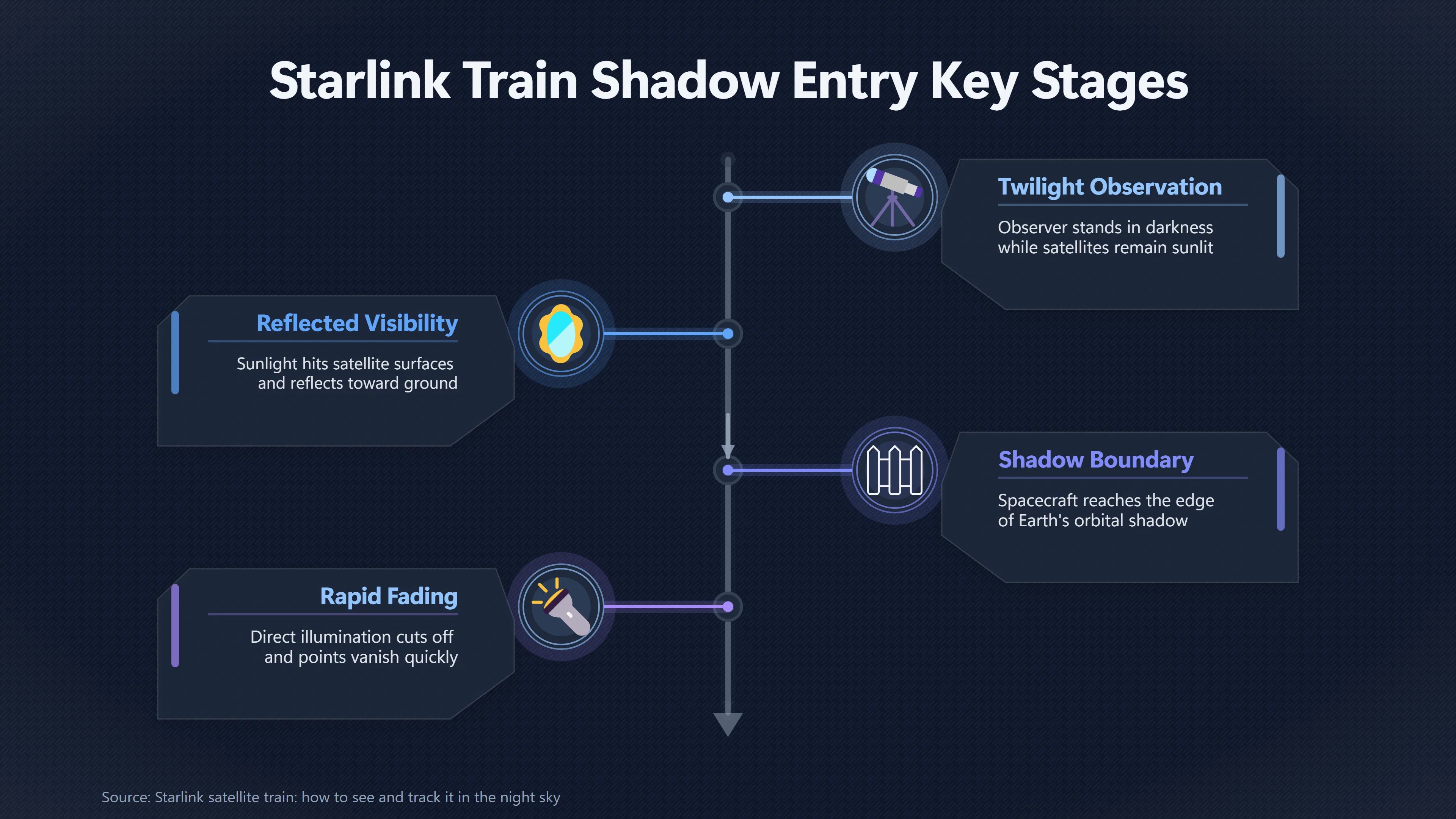
For an observer watching a satellite near twilight, crossing that boundary can produce a remarkably simple sequence:
- The observer is already in darkness.
- The satellite remains high enough to receive direct sunlight.
- Reflected sunlight makes the satellite visible against the darker sky.
- The satellite advances along its orbit towards the Earth’s shadow.
- Direct sunlight reaching it diminishes and is then blocked.
- Its bright reflected-light appearance fades or disappears, although the satellite continues moving.
NASA gives precisely this general explanation for satellites that seem to disappear during a pass: they can be followed for minutes and then vanish when they cross into the Earth’s shadow. The ISS behaves similarly, dropping out of ordinary naked-eye visibility after entering shadow.[Imagine the Universe]imagine.gsfc.nasa.govOpen source on nasa.gov.
With a Starlink train, however, this ordinary satellite behaviour becomes much more visually unusual. The spacecraft occupy similar orbital paths, so successive members can encounter the illumination boundary in succession. Instead of one isolated satellite fading, an observer may watch a whole procession apparently being erased from one end.
Real astronomical observations document both directions of the effect. The Orwell Astronomical Society in Suffolk recorded Starlink Group 4-11 after its February 2022 launch emerging from the Earth’s shadow over eastern England. Other observations on the society’s Starlink page similarly show members of a train progressively becoming visible as they leave shadow. Reversing the geometry gives the familiar evening spectacle: successive satellites enter shadow and disappear.[oasi.org.uk]oasi.org.ukOAS I: StarlinkStarlinkSeptember 6, 2025…
An astrophotographic example provides the complementary view. A photographed Starlink train published by Deep Sky Workflows forms a line of satellite tracks that terminates at the Earth’s shadow. The significance is not merely photographic: a fixed boundary in illumination can make a moving procession appear to end at a particular location in otherwise clear sky.[deepskyworkflows.com]deepskyworkflows.comThe Starlink Train | Deep Sky Workflows by Jeremy LiknessJuly 6, 2023…
That is why descriptions such as “they disappeared at exactly the same point” do not, by themselves, argue against a satellite explanation. In suitable geometry, the repeated disappearance at one part of the sky is exactly what should be expected.
Fading can happen before complete shadow
Earth’s shadow is the clearest mechanism for a genuine cut-off, but not every dramatic brightness change should automatically be labelled a shadow crossing. Reflected-light geometry matters throughout the visible part of the pass.
Research based on roughly 100,000 Starlink brightness measurements found that Starlink brightness varies with illumination geometry and that the spacecraft can also undergo short-lived flares. More recent photometric work continues to find strong relationships between viewing geometry and measured brightness.[arXiv]arxiv.orgOpen source on arxiv.org.
The physical reason is straightforward. A spacecraft is not a uniformly glowing sphere. Its chassis, solar array and other surfaces reflect different amounts of sunlight in different directions. Diffuse reflection spreads light broadly, while more mirror-like, or specular, reflection can concentrate sunlight into a much narrower direction. The US All-domain Anomaly Resolution Office (AARO) highlights both mechanisms when explaining why satellite reflections can generate UAP reports.[AARO]aaro.milCorrelations of Starlink Satellite Flaring with UAP ObservationsCorrelations of Starlink Satellite Flaring with UAP Observations
Starlink-specific modelling reinforces that point. A flat-panel brightness model found circumstances in which the orientation of illumination makes a Starlink effectively invisible to an observer on the ground even though sunlight is still reaching the spacecraft. Observations of VisorSat designs likewise show that apparent magnitude depends not only on solar phase angle but on how satellite structures are oriented relative to the observer.[arXiv]arxiv.orgA Flat-Panel Brightness Model for the Starlink Satellites and Measurement of their Absolute Visual MagnitudeMarch 17, 2020…
Consequently, “it faded” and “it entered the Earth’s shadow” are not interchangeable statements. A reconstruction should calculate the actual satellite position and illumination state. If the predicted spacecraft crosses the shadow boundary at the reported time and direction, shadow entry is a particularly strong explanation. If it remains sunlit, changing reflection geometry may instead account for the loss of visibility.
Why the disappearance can look anomalous
The humanly surprising part is not simply that a light goes out. It is the combination of continued motion, repetition and an apparently invisible boundary.
A Starlink train may cross a perfectly clear portion of sky and then lose its members sequentially. There is no visible cloud bank, horizon or physical obstacle marking the point. The first light disappears, then another reaches approximately the same place and disappears, followed by another. From the ground this can resemble objects entering an unseen opening or being extinguished deliberately.
Public descriptions illustrate how counter-intuitive the effect can be. Witness discussions of Starlink sightings repeatedly describe trains disappearing “one by one” or seeming to enter a “tunnel”, precisely because there is nothing visible in the foreground to explain where the lights have gone. Such accounts are anecdotal rather than scientific evidence for the mechanism, but they are useful evidence of how the mechanism is perceived by unfamiliar observers.[Reddit]reddit.comStarlink train disappears from view?Starlink train disappears from view?
There is another perceptual trap: reflected sunlight can produce the opposite behaviour as well. Satellites emerging from shadow can apparently materialise at nearly the same location, travel for a while and later fade. An astronomical observation from South Africa, for example, recorded 39 Starlink satellites emerging from the Earth’s shadow in December 2019.[YouTube]youtube.comYou Tube Starlink satellite "train" emerging from Earth's shadowYou Tube Starlink satellite "train" emerging from Earth's shadow
To a witness who assumes that visible lights correspond directly to physical objects, appearing and disappearing may suggest that the objects themselves have started or stopped. For satellites, that assumption is wrong. The object was present throughout; what changed was whether enough sunlight reached the satellite and then the observer.
Why brightness changes matter in UFO identification
This mechanism is particularly relevant to modern UFO and UAP reports because abrupt fading can seem inconsistent with the popular mental picture of a satellite as a steadily moving point of light. In reality, variable brightness is a normal consequence of satellite illumination.
AARO’s December 2024 information paper specifically identifies reflected sunlight from Starlink and other satellite constellations as a source of UAP observations. It explains that both diffuse and specular reflections can change what an observer sees and that reflected-light phenomena may last from brief flashes to longer portions of a satellite’s passage.[AARO]aaro.milCorrelations of Starlink Satellite Flaring with UAP ObservationsCorrelations of Starlink Satellite Flaring with UAP Observations
Research on extreme Starlink flaring has demonstrated how far this effect can go. Anthony Mallama and Richard Cole showed that favourable specular reflection can make Starlink satellites exceptionally bright and applied the model to objects reported as UAP by commercial pilots.[arXiv]arxiv.orgarXiv Extreme Flaring of Starlink SatellitesarXiv Extreme Flaring of Starlink Satellites Another study of orbit-raising Starlink Mini satellites notes directly that these spacecraft attract substantial public attention and have been reported as UAP by airline pilots.[arXiv]arxiv.orgarXiv The Brightness of Starlink Mini Satellites During Orbit-RaisingarXiv The Brightness of Starlink Mini Satellites During Orbit-Raising
The same physics that can make a satellite suddenly conspicuous can therefore make it rapidly inconspicuous. An observer may catch only the bright portion of the trajectory. Without knowing that the illumination is changing, the resulting account can sound much stranger than the underlying motion actually was.
For investigators, this gives sudden fading diagnostic value rather than making a sighting inherently more mysterious. A credible Starlink identification should ask whether:
- the reported lights moved along a track compatible with the relevant satellites;
- their time and direction agree with orbital predictions;
- the Sun was in the appropriate position below or near the observer’s horizon;
- the satellites were illuminated during the visible portion of the report; and
- the predicted shadow boundary or changing reflection geometry corresponds to where the witness reported fading.
This distinction is important. “It vanished” is an observation; “the object ceased to exist, accelerated away or switched off its lights” is an interpretation. For a Starlink train, sunlight provides a testable alternative.
The key clue is where the train disappears
A particularly useful report is one in which multiple lights vanish sequentially at approximately the same point along a common trajectory. That pattern can initially sound more anomalous than a gradual fade, yet it is highly compatible with satellites crossing a shared illumination boundary.
The disappearance point will not remain fixed permanently relative to the stars. The Earth’s rotation, the satellite orbit and the changing position of the Sun continually alter the geometry. NASA notes that, as the night progresses, low-Earth-orbit satellites enter the Earth’s shadow in different portions of their apparent passes; several hours after sunset, many low-orbit objects may spend the relevant overhead portions of their trajectories in shadow and therefore never become naked-eye objects at all.[Imagine the Universe]imagine.gsfc.nasa.govOpen source on nasa.gov.
Altitude also matters. Lower spacecraft encounter Earth’s shadow differently from higher ones, and research on orbit-raising Starlink Minis notes that lower-altitude satellites spend longer in Earth’s shadow.[arXiv]arxiv.orgarXiv The Brightness of Starlink Mini Satellites During Orbit-RaisingarXiv The Brightness of Starlink Mini Satellites During Orbit-Raising This helps explain why a prediction of orbital position alone is insufficient for reconstructing a sighting: knowing that a Starlink satellite was geometrically above the horizon does not establish that anyone could see it.
The most persuasive identification therefore reproduces both motion and visibility. If orbital data put a train where witnesses saw it, while illumination calculations predict that its members should lose sunlight where witnesses saw them vanish, the apparent disappearance ceases to be anomalous behaviour. It becomes an additional piece of evidence for the satellite identification.
Sudden fading is expected, not a broken orbit
Starlink trains do not need to fly behind clouds, descend, turn away or switch off onboard lamps to disappear. They are primarily visible because sunlight reaches them and some of that light is reflected towards an observer. Both parts of that optical arrangement can change quickly.
Near twilight, the observer can be in darkness while the satellites remain brilliantly sunlit. Changing phase and spacecraft orientation can then weaken the reflection. Finally, entry into the Earth’s shadow can remove the direct sunlight responsible for their conspicuous appearance altogether. Photometric studies confirm that Starlink brightness is strongly geometry-dependent, while NASA’s basic satellite-observing guidance explains why shadow entry makes artificial satellites disappear from view.[oup.com]academic.oup.comOUP AcademicBrightness evolution of LEO Starlink mega-constellation satellites from 2021 to 2023: a multiyear ground-based photometric st…
For UFO and UAP assessment, the counter-intuitive lesson is therefore simple: a line of lights suddenly vanishing can strengthen rather than weaken a Starlink explanation. If the satellites disappear successively along a common track at the place and time where orbital illumination predicts entry into Earth’s shadow, the dramatic visual effect follows directly from sunlight, shadow and an otherwise ordinary satellite orbit.
Amazon book picks
Further Reading
Books and field guides related to Why Starlink Trains Can Suddenly Disappear. Use these as the next step if you want deeper reading beyond the article.
NightWatch: A Practical Guide to Viewing the Universe
A practical guide to viewing the universe.
The Backyard Astronomer's Guide
Discusses the practical aspects of stargazing, including how to choose appropriate equipment, contending with light pollution, taking suc...
Celestial Objects for Modern Telescopes
Based on field notes made by the author during his own career as an amateur astronomer, this unique guide covers both the traditional and...
Turn Left at Orion
With over 100,000 copies sold since first publication, this is one of the most popular astronomy books of all time. It is a unique guideb...
eBay marketplace picks
Marketplace Samples
Live-tested eBay searches with available results related to this page.
Selected fromStarlink satellite model oneBay.co.uk.

Endnotes
1.
Source: apod.nasa.gov
Link:https://apod.nasa.gov/apod/ap250521.html
Source snippet
Astronomy Picture of the DayAPOD: 2025 May 21 – International Space Station Crosses the SunMay 21, 2025...
Published: May 21, 2025
2.
Source: imagine.gsfc.nasa.gov
Link:https://imagine.gsfc.nasa.gov/ask_astro/night_sky.html
3.
Source: space.com
Title: Starlink satellite train: how to see and track it in the night sky
Link:https://www.space.com/starlink-satellite-train-how-to-see-and-track-it
Source snippet
These satellites appear as a bright, fast-moving group of lights in the sky shortly after launch, before ascending to a higher operationa...
4.
Source: academic.oup.com
Link:https://academic.oup.com/mnras/article/548/2/stag552/8540255
Source snippet
OUP AcademicBrightness evolution of LEO Starlink mega-constellation satellites from 2021 to 2023: a multiyear ground-based photometric st...
5.
Source: arxiv.org
Title: arXiv Multicolor photometry of LEO mega-constellations Starlink and One Web
Link:https://arxiv.org/abs/2403.05150
6.
Source: arxiv.org
Link:https://arxiv.org/abs/2003.07805
Source snippet
A Flat-Panel Brightness Model for the Starlink Satellites and Measurement of their Absolute Visual MagnitudeMarch 17, 2020...
Published: March 17, 2020
7.
Source: oasi.org.uk
Title: OAS I: Starlink
Link:https://oasi.org.uk/Obsvns/20250825_satellite_constellations/20250825_satellite_constellations.php
Source snippet
StarlinkSeptember 6, 2025...
Published: September 6, 2025
8.
Source: deepskyworkflows.com
Title: The Starlink Train | Deep Sky Workflows by Jeremy Likness
Link:https://deepskyworkflows.com/gallery/starlink-train/
Source snippet
July 6, 2023...
Published: July 6, 2023
9.
Source: arxiv.org
Link:https://arxiv.org/abs/2111.09735
10.
Source: aaro.mil
Title: Correlations of Starlink Satellite Flaring with UAP Observations
Link:https://www.aaro.mil/Portals/136/PDFs/Information%20Papers/AARO_Satellite_Flaring_Paper.pdf
11.
Source: arxiv.org
Title: arXiv Multicolor and multi-spot observations of Starlink’s Visorsat
Link:https://arxiv.org/abs/2304.05191
12.
Source: reddit.com
Title: Starlink train disappears from view?
Link:https://www.reddit.com/r/Starlink/comments/1498t1p/starlink_train_disappears_from_view/
13.
Source: youtube.com
Title: You Tube Starlink satellite “train” emerging from Earth’s shadow
Link:https://www.youtube.com/watch?v=PlXNW-3ws6s
14.
Source: arxiv.org
Title: arXiv Extreme Flaring of Starlink Satellites
Link:https://arxiv.org/abs/2405.13091
15.
Source: arxiv.org
Title: arXiv The Brightness of Starlink Mini Satellites During Orbit-Raising
Link:https://arxiv.org/abs/2405.12007
16.
Source: academic.oup.com
Link:https://academic.oup.com/mnras/article/550/1/stag1136/8722194
17.
Source: space.com
Title: Starlink satellites: Facts, [tracking]({{ ‘tracking/’ | relative_url }}) and impact on astronomy | Space
Link:https://www.space.com/spacex-starlink-satellites.html
18.
Source: aaro.mil
Link:https://www.aaro.mil/Next-AARO-Home-redesign/Next-Parent/Next-UAP-Report-Documents/poster/dividLink/
19.
Source: science.nasa.gov
Title: shades of a lunar eclipse
Link:https://science.nasa.gov/earth/earth-observatory/shades-of-a-lunar-eclipse/
20.
Source: nasa.gov
Title: Sunglint on Atlantic Ocean
Link:https://www.nasa.gov/image-article/sunglint-on-atlantic-ocean/
21.
Source: aaro.mil
Title: AAR O UAP Records
Link:https://www.aaro.mil/UAP-Records/fbclid/IwZXh0bgNhZW0CMTEAAR0F9nbI4TTQyu8d96BuOtBb1uVQuvapZEvLug7mWxQC4ZqlNDrM5_ejMt4_aem_q0czZMebJdVWJ-6XDLdWAA/
22.
Source: aaro.mil
Link:https://www.aaro.mil/Next-AARO-Home-redesign/Next-Parent/Presidential-UAP-Transparency-Initiative/dvpmoduleid/77396/
23.
Source: jpl.nasa.gov
Title: whats up june 2024
Link:https://www.jpl.nasa.gov/videos/whats-up-june-2024/
Published: june 2024
24.
Source: academic.oup.com
Link:https://academic.oup.com/mnras/article/530/4/5006/7669132
25.
Source: space.com
Link:https://www.space.com/elon-musk-ufos-aliens-no-evidence-starlink
26.
Source: space.com
Link:https://www.space.com/may-2024-international-space-station-more-visible-how-to-see
27.
Source: aaro.mil
Link:https://www.aaro.mil/Next-AARO-Home-redesign/Next-Parent/Presidential-UAP-Transparency-Initiative/videoid/1006080/dvpmoduleid/77396/
28.
Source: academic.oup.com
Link:https://academic.oup.com/pasj/article/75/3/584/7111120
29.
Source: aaro.mil
Link:https://www.aaro.mil/Next-AARO-Home-redesign/Next-Parent/Presidential-UAP-Transparency-Initiative/videoid/1007790/dvpcc/false/
30.
Source: apod.nasa.gov
Link:https://apod.nasa.gov/apod/ap220411.html
31.
Source: space.com
Title: Best mobile apps to identify space stations and satellites | Space
Link:https://www.space.com/41678-spotting-identifying-satellites-best-mobile-apps.html
32.
Source: academic.oup.com
Link:https://academic.oup.com/mnras/article/509/2/1848/6406501
33.
Source: academic.oup.com
Link:https://academic.oup.com/mnrasl/article/504/1/L40/6188393
34.
Source: apod.nasa.gov
Link:https://apod.nasa.gov/apod/ap191028.html
35.
Source: science.nasa.gov
Title: clouds light the night 145202
Link:https://science.nasa.gov/earth/earth-observatory/clouds-light-the-night-145202/
36.
Source: apod.nasa.gov
Link:https://apod.nasa.gov/apod/ap170717.html
37.
Source: nasa.gov
Title: NAS A’s EPIC View Spots Flashes on Earth
Link:https://www.nasa.gov/science-research/earth-science/nasas-epic-view-spots-flashes-on-earth/
38.
Source: science.nasa.gov
Title: earthshine 83782
Link:https://science.nasa.gov/earth/earth-observatory/earthshine-83782/
39.
Source: science.nasa.gov
Title: how to interpret a false color satellite image
Link:https://science.nasa.gov/earth/earth-observatory/how-to-interpret-a-false-color-satellite-image/
40.
Source: space.com
Title: Spot the Space Station | Space
Link:https://www.space.com/5610-spot-space-station.html
41.
Source: science.nasa.gov
Title: dark sky bright sun
Link:https://science.nasa.gov/missions/hubble/dark-sky-bright-sun/
42.
Source: ceres.larc.nasa.gov
Link:https://ceres.larc.nasa.gov/science/publications/
43.
Source: aaro.mil
Link:https://www.aaro.mil/Next-AARO-Home-redesign/Inactive-Parent/AARO-Records-Tabs/
44.
Source: aaro.mil
Link:https://www.aaro.mil/Resources/Historical-Record-Reports/Volume-II/
45.
Source: aaro.mil
Link:https://www.aaro.mil/FAQ/
46.
Source: aaro.mil
Link:https://www.aaro.mil/
47.
Source: aaro.mil
Title: AAR O UAP Trends All-domain Anomaly Resolution Office UAP REPORTING TRENDS
Link:https://www.aaro.mil/UAP-Cases/UAP-Reporting-Trends/
48.
Source: aaro.mil
Link:https://www.aaro.mil/Next-AARO-Home-redesign/Next-Parent/Next-AARO-UAP-Trends/
49.
Source: aaro.mil
Link:https://www.aaro.mil/Next-AARO-Home-redesign/Next-Parent/Next-AARO-UAP-Imagery-Fixed-Table/
50.
Source: youtube.com
Title: Passage of Starlink Satellites (
Link:https://www.youtube.com/watch?v=jts_BVIEgbc
Source snippet
Passage of Starlink Satellites Aug 28, 2023...
Published: November 9, 2023
51.
Source: youtube.com
Link:https://www.youtube.com/watch?v=MDEsjHvDpI4
Source snippet
ISS and STARLINK G5-15 satellite train seen at same moment...
52.
Source: youtube.com
Title: ISS and STARLINK G5-15 satellite train seen at same moment
Link:https://www.youtube.com/watch?v=2BMEFIWXEtw
Source snippet
Starlink G4-37 satellite train double flyby...
53.
Source: youtube.com
Title: Starlink G4-37 satellite train double flyby
Link:https://www.youtube.com/watch?v=ze0EVTebI94
Source snippet
A column of 20 satellites moving across the sky...
54.
Source: youtube.com
Title: A column of 20 satellites moving across the sky
Link:https://www.youtube.com/watch?v=G24aWIr2_Tw
Source snippet
Passage of Starlink Satellites (November 9, 2023) AmazingSky · 4.2K views Passage of Starlink Satellites Aug 28, 2023...
Published: November 9, 2023
55.
Source: spaceweather.com
Link:https://www.spaceweather.com/archive.php?day=17&month=07&view=view&year=2026
56.
Source: spaceweather.com
Link:https://spaceweather.com/archive.php?day=10&month=07&view=view&year=2026
57.
Source: spaceinformer.com
Title: How to See Starlink Satellites Tonight
Link:https://spaceinformer.com/how-to-see-starlink-satellites-tonight/
58.
Source: nuforc.org
Link:https://nuforc.org/sighting/?id=198705
59.
Source: spaceweather.com
Title: youradhere popup
Link:https://www.spaceweather.com/archive.php/images2018/20jun18/submissions/spaceweathergallery.com/youradhere_popup.php?day=08&month=06&view=view&year=2026
60.
Source: spaceweather.com
Link:https://spaceweather.com/archive.php?day=14&month=05&view=1&year=2026
61.
Source: spaceweather.com
Title: youradhere popup
Link:https://www.spaceweather.com/archive.php/glossary/spaceweathergallery.com/youradhere_popup.php
62.
Source: spaceweather.com
Link:https://www.spaceweather.com/archive.php?day=29&month=04&view=view&year=2026
64.
Source: spaceweather.com
Title: results canon
Link:https://www.spaceweather.com/archive.php/images2018/20jun18/xtra/results_canon.php?day=15&month=04&view=view&year=2026
65.
Source: spaceweather.com
Title: more links popup
Link:https://www.spaceweather.com/archive.php/images2018/20jun18/spaceweather.com/submissions/spaceweathergallery.com/more_links_popup.php?day=22&month=03&view=view&year=2026
66.
Source: spacenexus.us
Title: how to track satellites real time 2026 guide
Link:https://spacenexus.us/blog/how-to-track-satellites-real-time-2026-guide
67.
Source: spaceweather.com
Link:https://www.spaceweather.com/archive.php?day=17&month=03&view=view&year=2026
68.
Source: spaceweather.com
Link:https://spaceweather.com/archive.php?day=12&month=03&view=view&year=2026
69.
Source: nuforc.org
Link:https://nuforc.org/sighting/?id=195375
70.
Source: nuforc.org
Link:https://nuforc.org/sighting/?id=190648
71.
Source: nuforc.org
Link:https://nuforc.org/sighting/?id=190287
72.
Source: radiocayman.gov.ky
Title: ky23 Starlink communication satellites
Link:https://www.radiocayman.gov.ky/community-events/23-starlink-communication-satellites
73.
Source: thedebrief.org
Link:https://thedebrief.org/spacex-starlink-extreme-flaring-increases-reported-uap-sightings-and-poses-aviation-risks-new-research-finds/
74.
Source: spaceweather.com
Link:https://www.spaceweather.com/archive.php/images2018/20jun18/gallery/index.php?day=06&month=09&view=view&year=2023
75.
Source: arxiver.moonhats.com
Title: unidentified aerial phenomena ii evaluation of uap properties cl
Link:https://arxiver.moonhats.com/2022/12/01/unidentified-aerial-phenomena-ii-evaluation-of-uap-properties-cl/
76.
Source: independent.co.uk
Link:https://www.independent.co.uk/tech/spacex-starlink-satellites-tracker-how-to-see-uk-live-elon-musk-latest-a9476386.html
77.
Source: independent.co.uk
Link:https://www.independent.co.uk/tech/spacex-starlink-satellites-visible-when-elon-musk-a9561121.html
78.
Source: space.stackexchange.com
Link:https://space.stackexchange.com/questions/43933/have-astronauts-seen-starlink-trains
79.
Source: phys.org
Link:https://phys.org/news/2020-05-spacex-theyre-starlink-satellites-visible.amp
80.
Source: flickr.com
Title: Space X Starlink Satellite Train (60 Satellites) Plus (ISS… | Flickr
Link:https://www.flickr.com/photos/28411479%40N08/49714234562/
81.
Source: iauarchive.eso.org
Title: satellite constellations
Link:https://iauarchive.eso.org/public/themes/satellite-constellations/
82.
Source: nuforc.org
Link:https://nuforc.org/sighting/?id=151023
83.
Source: spaceflightnow.com
Title: Starlink ‘train’ traces path across twilight skies – Spaceflight Now
Link:https://spaceflightnow.com/2019/11/14/starlink-train-traces-path-across-twilight-skies/
84.
Source: space.stackexchange.com
Link:https://space.stackexchange.com/questions/36388/is-the-starlink-array-really-visible-from-earth
85.
Source: nuforc.org
Link:https://nuforc.org/sighting/?id=144324
86.
Source: spacefrontiers.org
Link:https://spacefrontiers.org/r/10.48550/arxiv.2405.13091
87.
Source: spaceatlas.tech
Link:https://www.spaceatlas.tech/see-starlink
88.
Source: spaceatlas.tech
Link:https://www.spaceatlas.tech/satellites-overhead
89.
Source: skyandtelescope.org
Link:https://skyandtelescope.org/stargazing-and-observing/celestial-objects-to-watch/space-satellites/
90.
Source: cosmosage.online
Link:https://cosmosage.online/arxiv/?pid=2506.13034&rank=pid
91.
Source: inkl.com
Link:https://www.inkl.com/news/spacex-starlink-satellites-how-to-see-them-and-what-they-actually-are
92.
Source: spacenexus.us
Link:https://spacenexus.us/satellite-spotting
Additional References
93.
Source: nature.com
Title: Satellite megaconstellations will threaten space-based astronomy | Nature
Link:https://www.nature.com/articles/s41586-025-09759-5
94.
Source: researchgate.net
Link:https://www.researchgate.net/publication/233391048_Limits_on_spin-dependent_WIMP-proton_cross-sections_from_the_neutrinoexperiment_at_the_Baksan_Underground_Scintillator_Telescope
95.
Source: researchgate.net
Link:https://www.researchgate.net/publication/395437535_Modeling_the_Optical_Impact_of_the_Second-generation_Starlink_Satellite_Constellation
96.
Source: researchgate.net
Link:https://www.researchgate.net/publication/345261416_Optical_to_NIR_magnitude_measurements_of_the_Starlink_LEO_Darksat_satellite_and_effectiveness_of_the_darkening_treatment
97.
Source: researchgate.net
Link:https://www.researchgate.net/publication/348576747_Optical-to-NIR_magnitude_measurements_of_the_Starlink_LEO_Darksat_satellite_and_effectiveness_of_the_darkening_treatment
98.
Source: researchgate.net
Link:https://www.researchgate.net/publication/329575956_Performance_Analysis_of_Multi-Constellation_and_Multi-Frequency_GNSS_Receivers_in_Deep_Space
99.
Source: researchgate.net
Link:https://www.researchgate.net/publication/259969636_Spherical_and_Oblate_Earth_Conical_Shadow_Models_for_LEO_Satellites_Applications_and_comparisons_with_real_time_data_and_STK_to_IRS_Satellites
100.
Source: researchgate.net
Link:https://www.researchgate.net/publication/357069085_The_Brightness_of_Starlink_and_OneWeb_Satellites_During_Ingress_and_Egress_from_Terrestrial_Eclipses
101.
Source: cabletv.com
Link:https://www.cabletv.com/wv/racine
102.
Source: 24vids.com
Link:https://www.24vids.com/channel/mickwest