Within Why Military Flares
When Separate Flares Look Like One Formation
Overlapping flare burns, common wind drift and staggered burnout can make independent lights resemble a changing aerial formation.
On this page
- How common winds move several flares together
- Why staggered releases create changing patterns
- How burnout can resemble coordinated switching
Page outline Jump by section
Introduction
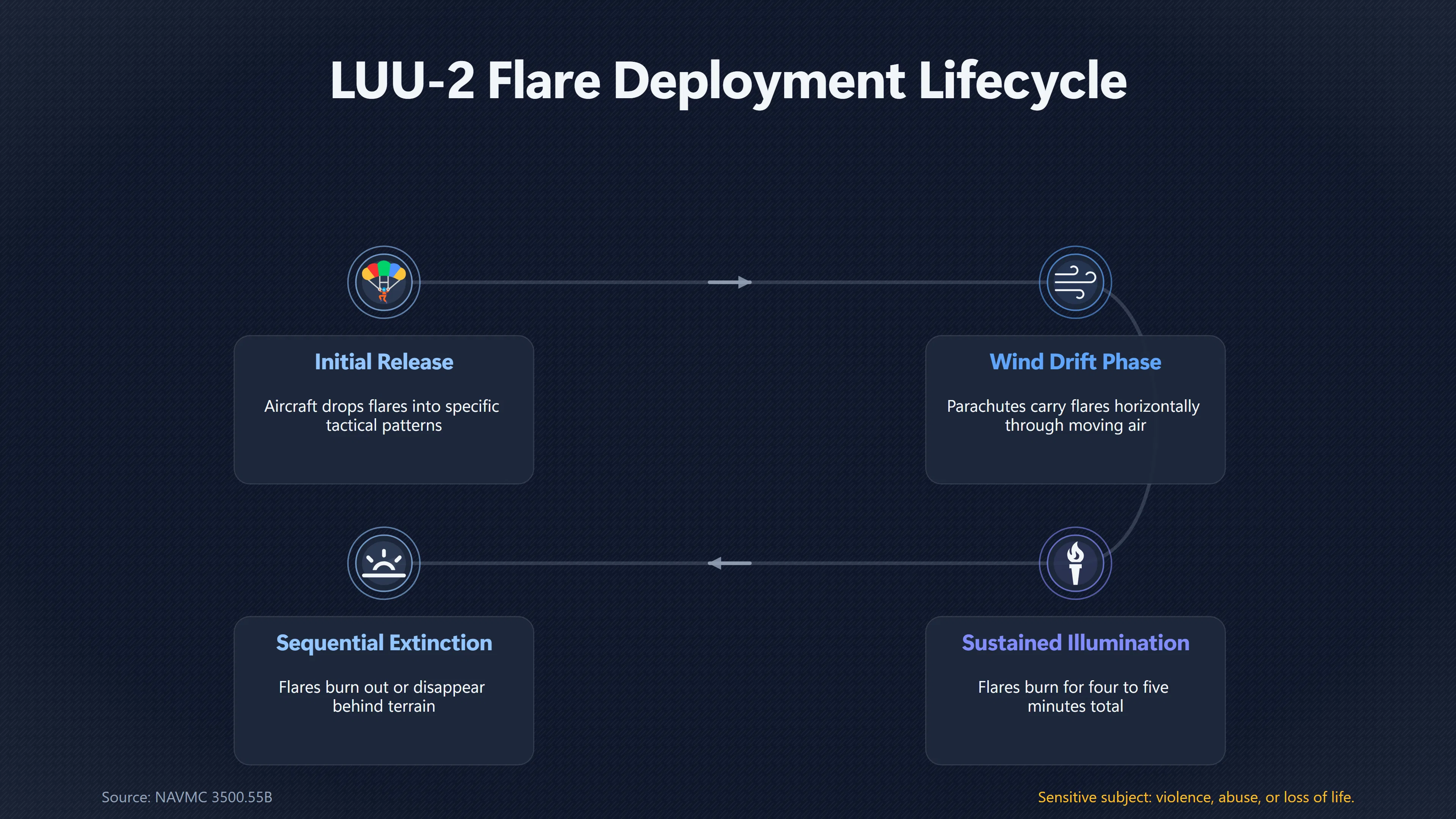
Several parachute illumination flares burning at the same time can look less like separate falling lights and more like a single organised aerial formation. The effect arises from ordinary features of flare deployment: multiple flares may remain illuminated for several minutes, neighbouring parachutes are carried by broadly the same winds, releases can be staggered, and individual flares eventually extinguish or disappear behind terrain. Together, those processes can produce lines, arcs, chevrons and slowly changing geometric arrangements that appear to move or switch lights in a coordinated way.
This is especially deceptive at night because an observer may see only brilliant points against a dark sky, without the parachutes, aircraft, smoke, landscape or other depth cues that reveal what the lights actually are. Military documentation confirms that battlefield illumination can involve deliberately specified flare patterns and subsequent pattern corrections, while Air Force material shows that wind drift is operationally significant for parachute flares.[U.S. Marine Corps]marines.milNAVMC 3500.55BU.S. Marine CorpsDEPARTMENT OF THE NAVYNovember 8, 2025…
How common winds move several flares together
A parachute flare is not simply a stationary lamp suspended in the sky. Once its parachute deploys, it descends through moving air and is carried horizontally by the wind. That drift can be considerable. A US Air Force safety publication discussing an unlit LUU-2 gives a rule of thumb of about 600 feet of horizontal travel per 10 knots of wind for every 1,000 feet spent descending under the parachute. Under a 20-knot baseline wind, it says, horizontal drift in feet can approximately equal the altitude through which the flare descends.[U.S. Air Force Safety Center]safety.af.milU.S. Air Force Safety Center FSM May 05.inddU.S. Air Force Safety Center FSM May 05.indd
That matters even more when several flares are airborne together. Flares released into the same general air mass do not need any means of communicating with one another to travel broadly in the same direction. Their parachutes are all responding to the surrounding wind, creating what can look from the ground like common motion.
The resemblance to a formation does not require their paths to be identical. Indeed, slight differences help make the display look dynamic. One flare may descend into a somewhat different wind before another does; parachutes can have small differences in descent and drift; and releases made at different positions begin with different spacing. The result can be a row that gradually bends into an arc, an irregular cluster that seems to spread, or a triangle whose proportions slowly change.
Military doctrine reinforces the point that multiple illumination sources can genuinely be deployed as a pattern. A US Marine Corps training manual for air-delivered battlefield illumination instructs controllers to specify the flare pattern and location according to the tactical situation and to provide “pattern corrections” for later deliveries. In other words, seeing several illumination flares arranged across an area is not an accidental or exotic circumstance: patterned illumination is an operational technique.[U.S. Marine Corps]marines.milNAVMC 3500.55BU.S. Marine CorpsDEPARTMENT OF THE NAVYNovember 8, 2025…
From a distant viewing position, however, the geometry on the sky can be misleading. Three independently drifting lights need only occupy the right projected positions to outline a triangle. Four or five can suggest a boomerang or chevron. Because their true distances from the observer are unknown, apparently neat two-dimensional spacing does not demonstrate that the lights are physically connected or even at exactly the same distance.
Why staggered releases create changing patterns
Long burn time is crucial to the illusion. Illumination flares are quite different from the rapid defensive countermeasure flares commonly seen streaming behind military aircraft. The LUU-2 family, for example, is parachute-supported and designed to provide sustained battlefield illumination. Accounts of the 1997 Phoenix flare exercise describe LUU-2-series flares burning for roughly four to five minutes, giving numerous individual lights time to coexist in the sky.[Skeptical Inquirer]skepticalinquirer.orgOpen source on skepticalinquirer.org.
They also need not ignite simultaneously. When successive flares are deployed, a new light can enter the visible arrangement while earlier ones are already descending. To somebody watching only the luminous points, this can resemble a formation changing configuration.
Imagine four flares released sequentially along an aircraft’s path. The first has already descended and drifted by the time the fourth becomes conspicuous. Their projected positions might initially resemble a diagonal line. As the older flares sink and all four drift, that line can flatten or curve. If another flare then appears at one side while the oldest disappears at the other, the whole pattern may seem to be translating across the sky or deliberately rearranging itself.
This is one reason a still photograph is weak evidence for determining whether a collection of lights constituted a rigid craft. A photograph captures only one geometric arrangement. Video is more useful because it can reveal whether the distances and angles between the lights gradually change. A genuinely rigid structure should constrain the relative positions of lights attached to it, allowing for perspective as the structure changes orientation. Independent parachute flares have no such constraint.
The useful question is therefore not simply, “Do these lights form a triangle?” It is whether that triangle behaves as a rigid geometric object. Slow changes in separation, imperfect common motion, individual appearances and disappearances, and a general downward drift are all compatible with several independent flare systems rather than lights fixed to one vehicle.

How burnout can resemble coordinated switching
The end of the display can be particularly persuasive. One light vanishes, then another, followed by another. Without a visible cause, sequential extinction can look intentional — almost as though lights on a craft are being switched off in a programmed sequence.
There are at least two ordinary routes to this effect. A flare can reach the end of its burn, or it can continue burning while descending behind intervening terrain. If the flares were released at different times, their burnouts will naturally be staggered as well. Nothing has to coordinate the extinction sequence beyond the original timing of the releases.
Terrain can make the sequence look even sharper. The later, heavily recorded portion of the 13 March 1997 Phoenix Lights provides a prominent example. It is important to distinguish this roughly 10 pm event from the earlier moving formation reported elsewhere in Arizona that evening. The later display consisted of brilliant lights south-west of Phoenix and was associated with an exercise involving A-10 aircraft of the Maryland Air National Guard dropping parachute illumination flares over the Barry M. Goldwater Range. Contemporary controversy eventually made the two events easy to conflate, but later reporting continues to distinguish the flare display from the earlier sightings.[Skeptical Inquirer]skepticalinquirer.orgOpen source on skepticalinquirer.org.
The flare display is valuable here because it demonstrates how multiple independent illumination sources can be perceived as a coherent arrangement. Investigators described the lights as a row apparently hovering or falling slowly. The exercise involved multiple LUU-2-series flares released at unusually high altitude, making them conspicuous from Phoenix.[Skeptical Inquirer]skepticalinquirer.orgOpen source on skepticalinquirer.org.
Another striking feature was the way lights disappeared individually. Analysis described in Discover Magazine compared the night footage with the mountain horizon seen from the same general viewing geometry and found the disappearances consistent with descending flares becoming hidden by the distant mountain ridge. To an observer who could not see that dark foreground terrain at night, each occultation could instead look like an abrupt extinction in open sky.[Discover Magazine]discovermagazine.comOpen source on discovermagazine.com.
That distinction is diagnostically important. A light apparently “switching off” provides little information unless its position is compared with the local horizon and terrain. Repeated disappearances along a hidden ridge line can be much stronger evidence for descending sources than the apparent abruptness of the disappearances is evidence for controlled switching.
Why the formation can look more coherent than it is
Human vision is extremely good at organising separate points into meaningful shapes. In a sparse night sky, three or four bright lights supply enough information for an observer to perceive an outline even though no visible surface connects them. Once a line, triangle or V has been recognised, subsequent motion may be interpreted as movement of that inferred object rather than as movement of independent lights.
Parachute flares create unusually favourable conditions for that mistake. The observer may have several similar-looking sources, approximately common drift, slow apparent motion and no visible support structure. Unlike nearby objects, they offer few familiar cues to distance. Consequently, an arrangement spanning a substantial angle of sky can be interpreted as lights attached to a nearby large craft rather than widely separated sources much farther away.
The key evidence is therefore in how the geometry evolves. A convincing flare identification becomes stronger when several characteristics occur together:
- Relative spacing changes slowly. Independent parachutes can converge or diverge in angular position rather than preserving a perfectly rigid arrangement.
- The whole group drifts broadly together. Shared winds naturally produce common directional movement without implying a common vehicle.
- New lights appear at different times. Sequential flare deployment can make a formation seem to grow or reconfigure.
- Individual lights descend or disappear sequentially. Staggered burnout and terrain occultation can imitate controlled switching.
- The event lasts minutes rather than seconds. That is compatible with long-burning battlefield illumination flares such as the LUU-2 family.[U.S. Air Force Safety Center]safety.af.milU.S. Air Force Safety Center FSM May 05.inddU.S. Air Force Safety Center FSM May 05.indd
- The sight line intersects a military training area or documented exercise. In a specific case, matching time, direction and operations is much stronger evidence than visual resemblance alone.
None of these clues individually proves that a sighting involved flares. Several unrelated lights can form patterns by chance, while aircraft, drones, celestial objects and other sources have their own characteristic behaviours. The significance comes from the combination: long-lived bright points, independent but correlated motion, evolving geometry and staggered disappearance are exactly the features expected when several parachute illumination flares occupy the sky simultaneously.
Formation is not the same as coordination
The central identification trap is treating an apparent geometric pattern as evidence that its components are physically linked. Multiple parachute flares show why that inference can fail. Their deployment can establish the initial pattern, common winds can preserve enough collective movement to make it look coherent, small differences in drift can reshape it, and staggered release or disappearance can create an apparent sequence of controlled changes.
The Phoenix flare display remains a useful real-world illustration precisely because the lights did not need to behave randomly to be independent. Multiple illumination flares deployed during a military exercise could create a conspicuous row or arc, remain visible long enough to seem nearly stationary, and disappear individually while observers watched.[Skeptical Inquirer]skepticalinquirer.orgOpen source on skepticalinquirer.org.
For UFO or UAP assessment, the strongest discriminator is therefore not whether several lights look like a formation, but whether they maintain the rigid relationships that a single structured object would require. When the geometry gradually deforms, the group shares a wind-like drift, lights have different lifetimes and disappear in a sequence consistent with descent or terrain, a seemingly coordinated formation can instead be the combined appearance of several entirely independent flares.
Amazon book picks
Further Reading
Books and field guides related to When Separate Flares Look Like One Formation. Use these as the next step if you want deeper reading beyond the article.
The UFO Handbook: A Guide to Investigating, Evaluating, and R...
An explanation of the usual reasons for confusing IFOs (identified flying objects) with UFOs and a survey of the tools used to investigat...
The UFO Experience: A Scientific Inquiry
Cited by the New York Review of Books as "the best brief for visitation," this classic study presents an analysis of UFO reports and conc...
UFOs Explained
Analyzing several UFO cases, the author exposes the myth of extraterrestrial visitors to earth.
The Myth and Mystery of UFOs
When United Airlines workers reported a UFO at O'Hare Airport in November 2006, it was met with the typical denials and hush-up that usua...
eBay marketplace picks
Marketplace Samples
Live-tested eBay searches with available results related to this page.
Selected fromUFO poster oneBay.co.uk.


Current eBay listing
VINTAGE UFO FLYING SAUCERS COMIC ADVERTISING A2 POSTER PRINT


Current eBay listing
I Want To Believe UFO Poster Giclée Fine Art Heavyweight Print
Endnotes
1.
Source: marines.mil
Title: NAVMC 3500.55B
Link:https://www.marines.mil/Portals/59/Publications/NAVMC%203500.55B.pdf?mobile-app=true&theme=wiki
Source snippet
U.S. Marine CorpsDEPARTMENT OF THE NAVYNovember 8, 2025...
Published: November 8, 2025
2.
Source: safety.af.mil
Title: U.S. Air Force Safety Center FSM May 05.indd
Link:https://www.safety.af.mil/Portals/71/documents/Magazines/FSM/fsmmay05.pdf?ver=2017-03-28-101221-357
3.
Source: skepticalinquirer.org
Link:https://skepticalinquirer.org/2015/03/alien-lights-at-phoenix-stephenville-and-elsewhere-a-postmortem/
4.
Source: discovermagazine.com
Link:https://www.discovermagazine.com/why-i-dont-believe-in-ufos-the-phoenix-lights-19314
5.
Source: theconspiratory.com
Title: phoenix lights
Link:https://theconspiratory.com/theory/phoenix-lights
Source snippet
4184-G● Open File Theories/UFOs & Aliens·Modern A MASSIVE UNIDENTIFIED CRAFT FLEW OVER PHOENIX IN 1997 Where the evidence lands: Unproven...
6.
Source: thisunexplaineduniverse.com
Title: phoenix lights
Link:https://www.thisunexplaineduniverse.com/articles/phoenix-lights
7.
Source: slashlore.com
Title: phoenix lights
Link:https://www.slashlore.com/phoenix-lights/
8.
Source: ufoinsight.com
Title: 1997 phoenix lights
Link:https://www.ufoinsight.com/ufos/sightings/1997-phoenix-lights
9.
Source: 3rdmaw.marines.mil
Title: mil A VMM’s light in dark of night
Link:https://www.3rdmaw.marines.mil/Media-Room/Photos/igphoto/2000712974/
10.
Source: ufology.wikidot.com
Title: phoenix lights
Link:https://ufology.wikidot.com/phoenix-lights
11.
Source: discovermagazine.com
Title: Phoenix lights again?! | Discover Magazine
Link:https://www.discovermagazine.com/phoenix-lights-again-19350
12.
Source: skepticalinquirer.org
Title: Out of Balance | Skeptical Inquirer
Link:https://skepticalinquirer.org/exclusive/out-of-balance/
13.
Source: ufo-books.com
Title: phoenix lights
Link:https://ufo-books.com/incidents/phoenix-lights
14.
Source: probed.space
Title: Phoenix Lights | Events | Probed
Link:https://probed.space/events/phoenix-lights
15.
Source: kb42.info
Title: Phoenix Lights
Link:https://kb42.info/index.php?title=Phoenix_Lights
16.
Source: skepticalinquirer.org
Link:https://skepticalinquirer.org/2016/11/the-phoenix-lights-become-an-incident/
17.
Source: skepticalinquirer.org
Link:https://skepticalinquirer.org/volume/no-4-vol-40/
18.
Source: skepticalinquirer.org
Link:https://skepticalinquirer.org/2008/07/the-mysterious-phoenix-lights/
19.
Source: skepticalinquirer.org
Title: psychic vibrations
Link:https://skepticalinquirer.org/category/psychic-vibrations/
20.
Source: skepticalinquirer.org
Link:https://skepticalinquirer.org/2016/07/the-phoenix-lights-become-an-incident/
21.
Source: skepticalinquirer.org
Link:https://skepticalinquirer.org/volume/no-4-vol-32/
22.
Source: high-strangeness.fandom.com
Title: Phoenix Lights
Link:https://high-strangeness.fandom.com/wiki/Phoenix_Lights
23.
Source: revengerists.fandom.com
Title: Phoenix Lights
Link:https://revengerists.fandom.com/wiki/Phoenix_Lights
24.
Source: unexplained-mysteries.com
Link:https://www.unexplained-mysteries.com/encyclopedia/101278/phoenix-lights
25.
Source: 3rdmaw.marines.mil
Link:https://www.3rdmaw.marines.mil/Media-Room/Stories/News-Article-Display/Article/549002/a-vmms-light-in-dark-of-night/
26.
Source: youtube.com
Title: The Phoenix Lights
Link:https://www.youtube.com/watch?v=8SUJTh6Hs-I
Source snippet
Phoenix Lights - The Dark Truth?...
27.
Source: youtube.com
Title: Phoenix Lights
Link:https://www.youtube.com/watch?v=N1fW1l1sh-A
Source snippet
Craig Charles: UFO Conspiracies | Episode 6 | Phoenix Lights...
Additional References
28.
Source: timecyclopedia.com
Title: While often grainy and indistinct due to the technology available at the time
Link:https://timecyclopedia.com/entry/phoenix-lights
Source snippet
Phoenix Lights (1997): Declassified Doc & Full TranscriptMay 11, 2026 — One of the most compelling pieces of evidence from this first pha...
Published: May 11, 2026
29.
Source: axios.com
Title: lights arizona ufo legend 1997
Link:https://www.axios.com/local/phoenix/2024/03/13/lights-arizona-ufo-legend-1997
Source snippet
Thousands of residents in the Phoenix area reported witnessing mysterious lights arranged in a "V" formation hovering silently over the V...
30.
Source: youtube.com
Title: Air Force Pilot Breaks His Silence on the Phoenix Lights Craft | James Fox
Link:https://www.youtube.com/watch?v=UBlJlBQdv5w
Source snippet
Van Buren, Arkansas Parachute Flares Brian Emfinger · 18K views The Phoenix Lights - 17 years later...
31.
Source: wikidisc.org
Title: Phoenix Lights 1997
Link:https://www.wikidisc.org/wiki/Phoenix_Lights_1997
Source snippet
July 2, 2026 — PHOENIX LIGHTS 1997 [Input] Add languages Add links * Page * Discussion [Input] English * Read * Edit Infobox/Data...
Published: July 2, 2026
32.
Source: youtube.com
Title: Craig Charles: UFO Conspiracies | Episode 6 | Phoenix Lights
Link:https://www.youtube.com/watch?v=a6yAbXyPnwo
Source snippet
Air Force Pilot Breaks His Silence on the Phoenix Lights Craft | James Fox...
33.
Source: researchgate.net
Link:https://www.researchgate.net/publication/377290294_Optimal_operation_mode_of_wind_turbines_in_distribution_grid_to_minimize_energy_loss_considering_power_generation_probability
34.
Source: capnaux.com
Link:https://capnaux.com/ufo-capn-aux-investigates-the-phoenix-lights/
35.
Source: scribd.com
Link:https://www.scribd.com/document/793762586/TO-1-1M-34
36.
Source: studylib.net
Link:https://studylib.net/doc/11700152/aircraft-ordnance-chapter-8
37.
Source: scribd.com
Link:https://www.scribd.com/document/62601822/2009-Summer-All-Guide