Within Reflections
When Cockpit Reflections Look Like Objects in Flight
Dim exterior skies and bright cockpit instruments can place convincing reflected lights directly over the real view outside.
On this page
- Why cockpit lighting reflects into the night view
- Clues that separate reflections from outside traffic
- Why pilot movement can make reflected lights appear mobile
Page outline Jump by section
Introduction
At night, a cockpit windscreen can act as both a window and a weak mirror. The pilot sees the real sky through it, but bright instrument displays, annunciators, map lights and other illuminated cockpit features can also be reflected into the same line of sight. Against a nearly black exterior, even a faint reflection may look like a compact airborne light apparently suspended kilometres ahead of the aircraft.

This is not merely a hypothetical UFO explanation. Aviation authorities explicitly design and operate flight decks to minimise windscreen reflections, and night-flying guidance tells pilots to reduce cockpit illumination for the same reason. The important investigative question is therefore not whether a pilot genuinely saw a light, but whether that light originated outside the aircraft.[dot.gov]hfcc.dot.govHuman Factors CoordinationHuman Factors Considerations in the Design and Evaluation of Flight Deck Displays and ControlsNovember 1, 2013…
Why cockpit lighting reflects into the night view
Aircraft transparencies transmit most of the exterior light reaching them, but they also reflect a fraction of light originating inside the cockpit. In daylight, the bright outside scene normally overwhelms those reflections. During a dark night flight, the balance changes dramatically: the exterior may contain little more than stars and scattered ground lights while electronic displays and illuminated controls remain relatively bright.
The Federal Aviation Administration’s human-factors guidance recognises this directly. In evaluating aircraft for night operation, it says internal and external lighting should be assessed under realistic combinations and notes that some reflection of avionics equipment in the windscreen may be unavoidable. It also says windscreen reflections can be significant enough to influence the design of glareshields, while cabin lighting should be assessed for its effect on the pilot’s outside view.[Human Factors Coordination]hfcc.dot.govHuman Factors CoordinationHuman Factors Considerations in the Design and Evaluation of Flight Deck Displays and ControlsNovember 1, 2013…
The issue is important enough to appear in operating rules as well as design guidance. US regulations for transport-category night operations require instrument lighting to be arranged so direct rays are shielded from flight crew and no objectionable reflections are visible, with controllable illumination intensity unless fixed lighting has been shown satisfactory.[FAR/AIM]faraim.orgOpen source on faraim.org.
European guidance is similarly explicit. The European Union Aviation Safety Agency warns that light reflected from materials and equipment can interfere with a clear view through the windscreen. Surprisingly ordinary objects can contribute: light-coloured flight suits, helmets and charts can produce significant reflections. The effect is not confined to the main windscreen but can occur in side windows, canopies and other transparent panels.[EASA]easa.europa.euEASAEasy Access Rules for Air OperationsRevision 24, March 2026 | EASA…
This means the apparent “object” need not resemble an obvious instrument panel. A small illuminated control, bright patch of clothing, reading light or reflective fitting can generate only a fragment of its own appearance on an angled transparency. What reaches the pilot’s eye may consequently be an isolated dot, oval, streak or diffuse glow rather than a recognisable duplicate of something inside the cockpit.
Why a reflection can look genuinely airborne
The most misleading feature of a cockpit reflection is its placement. It is optically superimposed on the actual outside scene. A reflected point can therefore appear above a cloud deck, beside stars or ahead of the aircraft even though its source is only a short distance from the pilot.
Night flying removes many of the visual cues that would normally expose this mistake. A small unresolved light provides little reliable information about its physical size, and without size there is no straightforward visual estimate of distance. A centimetre-scale reflected image on a windscreen can therefore be interpreted perceptually as a much larger object far away.
FAA aeromedical guidance describes the wider vulnerability of human vision under these conditions. It warns that excessive illumination reflected from aircraft canopies and cockpit surfaces creates glare and notes that exposure to bright light disrupts dark adaptation. The FAA also describes autokinesis, in which a stationary light viewed against darkness can appear to move after prolonged observation.[Federal Aviation Administration]faa.govFederal Aviation Administration Chapter 8. Medical Facts for PilotsFederal Aviation AdministrationChapter 8. Medical Facts for PilotsJanuary 8, 2015…
Autokinesis and windscreen reflection are different phenomena, but at night they can reinforce the same mistaken interpretation. First, the windscreen supplies a light that is not actually in the distant scene. Then the sparse visual environment gives the observer poor information with which to judge its range or motion.
This is why experience does not make reflection testing unnecessary. Pilots are trained observers, but aviation safety systems are built around the fact that trained crews remain subject to optical and perceptual limitations. FAA research has documented practical visual difficulties associated with cockpit illumination and reflections; in one survey of 50 general-aviation pilots, 32 per cent reported visual problems from light reflected by instrument cover plates, while instrument readability problems were more common at night than at dusk or in daylight.[Federal Aviation Administration]faa.govOpen source on faa.gov.
Clues that separate reflections from outside traffic
A windscreen-reflection hypothesis becomes stronger or weaker according to how the apparent light behaves when the viewing geometry changes. Investigators should therefore look for relationships between the light, the camera or observer, the windscreen and the aircraft rather than judging the object’s appearance alone.
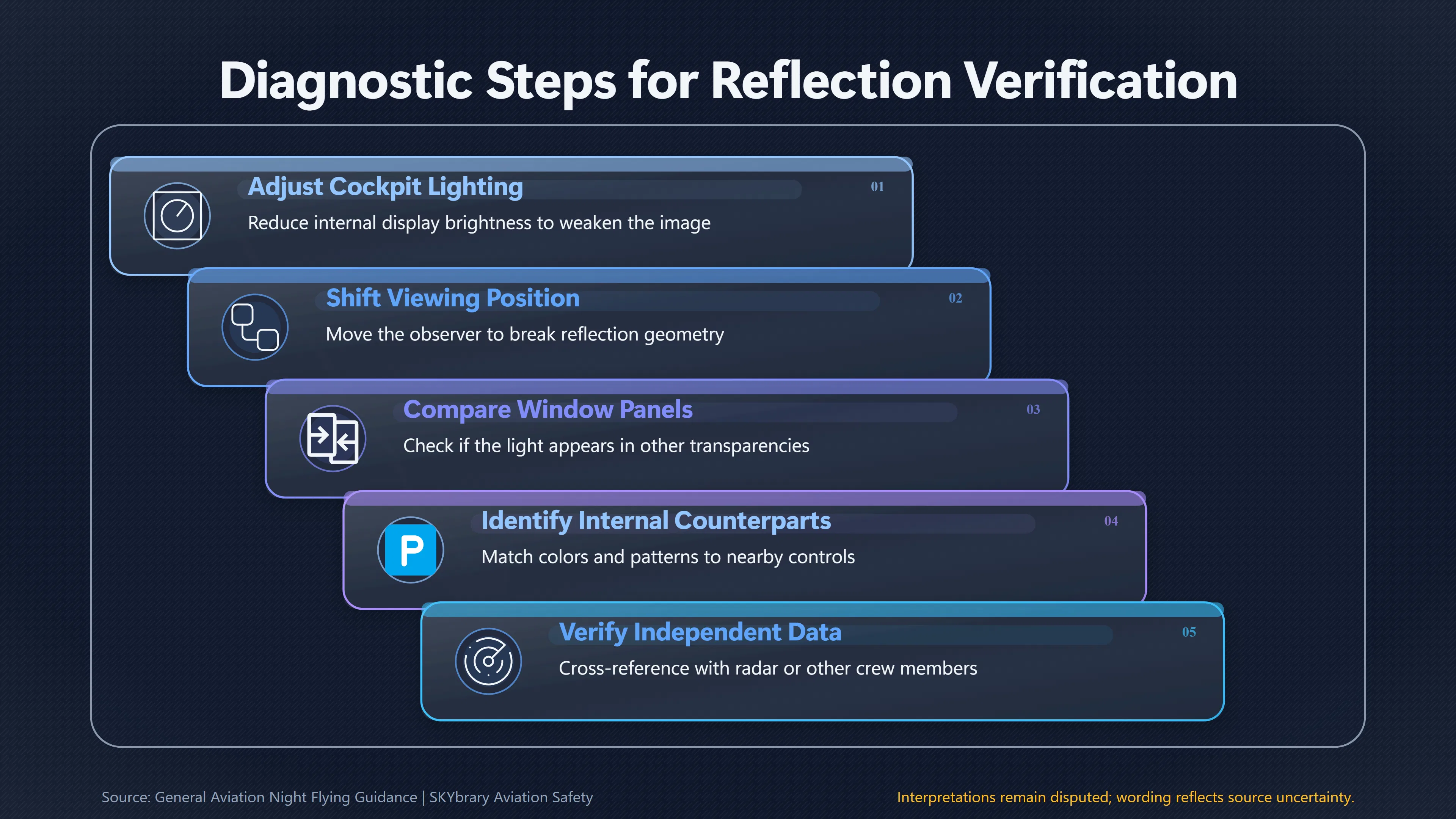
Several checks are especially useful:
- Change the cockpit lighting. If practical and operationally safe, reducing the relevant display or panel illumination may weaken or remove the image. Night-flying guidance specifically recommends adjusting cockpit lighting to improve night vision and reduce reflections.[Skybrary]skybrary.aeroGeneral Aviation Night Flying Guidance | SKYbrary Aviation SafetyGeneral Aviation Night Flying Guidance | SKYbrary Aviation Safety…
- Change the viewing position. A genuine distant light should retain a geometrically sensible relationship with the outside scene as the observer shifts position. A reflection can change substantially or disappear when the pilot’s head or camera moves because the required reflection geometry has been broken.
- Compare different windows. An exterior object may remain observable through another suitable transparency; a reflection associated with one particular windscreen panel often will not.
- Look for cockpit counterparts. Colour, spacing and repeating patterns can sometimes be matched to illuminated controls, annunciators, reading lights or other nearby sources. The match need not be visually exact because reflection angle, focus, windscreen curvature and camera exposure can alter the apparent image.
- Check independent information. Air-traffic data, another crew member observing from a different position, radar or other sensors can provide evidence independent of the suspect optical path. Absence from another sensor does not by itself prove reflection, but independent corroboration greatly changes the evidential weight of a visual sighting.
A particularly useful test is whether the phenomenon behaves like part of the windscreen geometry rather than part of the distant world. If a light repeatedly appears at a particular relationship to the cockpit or camera while stars, clouds and ground features move differently, an interior origin deserves serious examination.
The reverse is also important. “It looks like a reflection” is not enough to establish that it is one. A persuasive identification should ideally locate a plausible internal light source and show that its position and behaviour reproduce the reported image. NASA’s UAP study stressed this broader evidential principle: eyewitness reports can be compelling, but without adequate supporting data they often cannot establish the origin of an observation definitively.[NASA]nasa.govuap independent study team final report 0UNIDENTIFIED ANOMALOUS PHENOMENA…
Why pilot movement can make reflected lights appear mobile
Cockpit reflections are especially deceptive when either the observer or aircraft moves. A reflection does not occupy a fixed position in the distant sky. Its apparent location depends on the relative geometry of the light source, transparent surface and observer.
A pilot leaning forward, turning their head or raising a phone can therefore cause a reflected light to slide across the windscreen. If the observer assumes that the light is many kilometres away, that angular displacement is naturally interpreted as motion of an airborne object rather than movement of a nearby virtual image.
Aircraft manoeuvring can add another layer. A reflection may remain in a broadly similar part of the pilot’s visual field while the real horizon, stars or clouds shift behind it. From the cockpit this can create the impression of an object travelling with the aircraft. Under other geometries it can suddenly fade, brighten or disappear as the aircraft attitude changes.
The phenomenon has a useful engineering counterpart: regulators do not test flight-deck reflections only with everything stationary in one ideal configuration. FAA human-factors guidance calls for night lighting to be evaluated under likely combinations and expected flight conditions and specifically mentions testing reflections associated with landing lights, taxi lights, anti-collision lights and cabin illumination.[Human Factors Coordination]hfcc.dot.govHuman Factors CoordinationHuman Factors Considerations in the Design and Evaluation of Flight Deck Displays and ControlsNovember 1, 2013…
The effect is also why a short video can be misleading. Camera movement that would normally provide clues about three-dimensional position can instead animate the reflection. Without a stable view of the cockpit and outside reference points, apparent motion across the recorded sky is not automatically evidence of motion through the atmosphere.
A recent cockpit photograph shows the diagnostic problem
A useful modern example emerged in 2025 when photographs reportedly taken from a Bombardier Global 5000 cockpit during a night flight attracted online attention because unusual luminous forms appeared in a small number of images. The pilot reported noticing nothing unusual while taking roughly 80 photographs and finding the anomalies later. The images had been made during a long-exposure attempt to photograph the aurora.[Reddit]reddit.comPilot snaps pics of a UAP at 43K feet– apparently saw nothing while infightPilot snaps pics of a UAP at 43K feet– apparently saw nothing while infightAugust 2, 2025…
Online investigators proposed cockpit reflections, including possible reflections associated with equipment around the upper cockpit area. The pilot disputed those identifications, arguing that suggested sources such as sun visors or cockpit lights did not correspond to the observed forms. The available public discussion therefore does not justify presenting the photographs as a conclusively solved reflection case.[Reddit]reddit.comOpen source on reddit.com.
What makes the episode useful is the diagnostic difficulty it exposes. Once a photograph has been taken through a cockpit windscreen, a luminous form can combine windscreen reflection, camera exposure and a genuine exterior background in one frame. Establishing its origin requires more than recognising a vaguely similar cockpit component. Ideally, investigators need the exact aircraft configuration, camera position, illumination state, windscreen geometry and additional frames taken under controlled changes.
That distinction matters in UAP analysis. A plausible reflection mechanism can explain how an image could arise without an exterior object; demonstrating that it did arise that way requires enough information to reproduce or constrain the geometry.
What a stronger cockpit UAP report would record
For cockpit sightings, a few observations made during or immediately after an event can greatly improve later analysis. Alongside the normal time, position, heading and description of the phenomenon, useful details include which windscreen panel was being used, approximate eye or camera position, cockpit-light settings and whether the apparent object changed when the observer moved.
If operational circumstances permit, a crew can also note whether another person sees the same light from a substantially different position. Two pilots seeing “the same thing” is useful, but their exact sightlines matter: reflections from large transparencies can potentially be visible from more than one position, while independent angular measurements against stars or the horizon provide much stronger geometric information.
Photographs should ideally include more than tightly framed views of the supposed object. A wider frame showing the windscreen edges and part of the cockpit can preserve clues needed to reconstruct the optical path. Sequential photographs are especially useful if lighting settings or camera position change between frames.
This approach fits NASA’s recommendation that UAP investigation move towards systematic observations, calibration, multiple measurements and adequate sensor metadata rather than relying solely on compelling eyewitness descriptions. NASA notes that the present shortage of high-quality observations limits firm conclusions about many reported events.[NASA]nasa.govUPDATE: NASA Shares UAP Independent Study Report; Names DirectorUPDATE: NASA Shares UAP Independent Study Report; Names Director

What cockpit glare can and cannot explain
Cockpit windscreen reflection is a strong candidate when an apparent UAP is a luminous point or shape seen at night through aircraft glazing, particularly when the cockpit contains bright displays or lights and the phenomenon lacks independent sensor confirmation. Aviation engineering and operating guidance independently establish all of the physical ingredients needed for such images to occur.[dot.gov]hfcc.dot.govHuman Factors CoordinationHuman Factors Considerations in the Design and Evaluation of Flight Deck Displays and ControlsNovember 1, 2013…
It should not, however, become a universal explanation for pilot sightings. A reflection hypothesis becomes much less satisfactory when observations from genuinely independent positions establish consistent external geometry, when an object is reliably tracked by independent sensors, or when a proposed cockpit source cannot reproduce the reported position and behaviour.
That caution mirrors the wider treatment of unidentified reports. The All-domain Anomaly Resolution Office’s review of historical US investigations found that many UFO reports were eventually assigned ordinary causes, while some remained unidentified; NASA likewise emphasises that insufficient data can prevent a definitive determination. “Unidentified” therefore does not mean extraordinary, but neither does the existence of a plausible reflection mechanism by itself constitute an identification.[AARO]aaro.milUnclassified Final DSD AARO Historical ReportUnclassified Final DSD AARO Historical Report
For this particular class of report, the most revealing question is often simple: does the light move as though it belongs to the sky, or as though it belongs to the pilot, camera and windscreen? Night cockpits make that distinction surprisingly difficult to judge by eye. Careful changes in viewing position, illumination and independent observation are what turn a convincing phantom light into a testable optical explanation.
Amazon book picks
Further Reading
Books and field guides related to When Cockpit Reflections Look Like Objects in Flight. Use these as the next step if you want deeper reading beyond the article.
Human Factors in Flight
The late Captain Frank H Hawkins FRAes, M Phil, was Human Factors Consultant to KLM, for whom he had flown for over 30 years as line capt...
Optics
For courses in Optics A Contemporary Approach to Optics with Practical Applications and New Focused Pedagogy Hecht Optics balances theory...
Understanding Exposure
Rating: 4.5/5 from 19 Google Books ratings
Provides detailed lessons on the elements of exposure and how each relates to depth of field, freezing and blurring action, and shooting...
The Killing Zone: How & Why Pilots Die
This literal survival guide for new pilots identifies "the killing zone," the 40-250 flight hours during which unseasoned aviators are li...
eBay marketplace picks
Marketplace Samples
Live-tested eBay searches with available results related to this page.
Selected fromUFO poster oneBay.co.uk.
Current eBay listing
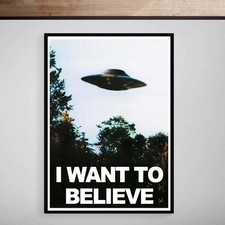
I Want To Believe UFO Poster Giclée Fine Art Heavyweight Print
Current eBay listing
VINTAGE UFO FLYING SAUCERS COMIC ADVERTISING A2 POSTER PRINT

Endnotes
1.
Source: hfcc.dot.gov
Link:https://hfcc.dot.gov/publications/docs/GeneralGuidance/zz_FAA_GeneralGuidanceDoc_Chapter_02_Section_03.html
Source snippet
Human Factors CoordinationHuman Factors Considerations in the Design and Evaluation of Flight Deck Displays and ControlsNovember 1, 2013...
Published: November 1, 2013
2.
Source: skybrary.aero
Title: General Aviation Night Flying Guidance | SKYbrary Aviation Safety
Link:https://skybrary.aero/index.php/articles/general-aviation-night-flying-guidance
Source snippet
General Aviation Night Flying Guidance | SKYbrary Aviation Safety...
3.
Source: easa.europa.eu
Title: EASAEasy Access Rules for Air Operations
Link:https://www.easa.europa.eu/en/document-library/easy-access-rules/online-publications/easy-access-rules-air-operations?erules-id=ERULES-1963177438-21073
Source snippet
Revision 24, March 2026 | EASA...
Published: March 2026
4.
Source: faa.gov
Title: Federal Aviation Administration Chapter 8. Medical Facts for Pilots
Link:https://www.faa.gov/air_traffic/publications/atpubs/aim/aim0801.html
Source snippet
Federal Aviation AdministrationChapter 8. Medical Facts for PilotsJanuary 8, 2015...
Published: January 8, 2015
5.
Source: faa.gov
Title: Federal Aviation Administration Chapter 8. Medical Facts for Pilots
Link:https://www.faa.gov/Air_traffic/publications/atpubs/aim_html/chap8_section_1.html
6.
Source: faa.gov
Link:https://www.faa.gov/data_research/research/med_humanfacs/oamtechreports/1970s/1977/197702
7.
Source: nasa.gov
Title: uap independent study team final report 0
Link:https://www.nasa.gov/wp-content/uploads/2023/09/uap-independent-study-team-final-report-0.pdf?emrc=6691779350040
Source snippet
UNIDENTIFIED ANOMALOUS PHENOMENA...
8.
Source: reddit.com
Title: Pilot snaps pics of a UAP at 43K feet– apparently saw nothing while infight
Link:https://www.reddit.com/r/UFOPilotReports/comments/1mfdzjv/pilot_snaps_pics_of_a_uap_at_43k_feet_apparently/
Source snippet
Pilot snaps pics of a UAP at 43K feet-- apparently saw nothing while infightAugust 2, 2025...
Published: August 2, 2025
9.
Source: reddit.com
Link:https://www.reddit.com/r/UFOPilotReports/comments/1mhwvmk
10.
Source: nasa.gov
Title: UPDATE: NASA Shares UAP Independent Study Report; Names Director
Link:https://www.nasa.gov/news-release/update-nasa-shares-uap-independent-study-report-names-director/
11.
Source: aaro.mil
Title: Unclassified Final DSD AARO Historical Report
Link:https://www.aaro.mil/Portals/136/PDFs/AARO_Historical_Record_Report_Vol_1_2024.pdf?emci=622cd777-b774-f011-8dc9-6045bda9d96b&emdi=ea000000-0000-0000-0000-000000000001&sourceid=1070813
12.
Source: faa.gov
Title: Aviation Handbooks & Manuals | Federal Aviation Administration
Link:https://www.faa.gov/regulations_policies/handbooks_manuals/aviation
13.
Source: science.nasa.gov
Link:https://science.nasa.gov/uap/faqs/
14.
Source: aaro.mil
Link:https://www.aaro.mil/Next-AARO-Home-redesign/Next-Parent/Next-AARO-UAP-Imagery-Acc-Table/
15.
Source: aaro.mil
Link:https://www.aaro.mil/Next-AARO-Home-redesign/Next-Parent/Next-UAP-Report-Documents/poster/dividLink/
16.
Source: nasa.gov
Title: 8.0 Architecture
Link:https://www.nasa.gov/reference/8-0-architecture-vol-2/
17.
Source: nasa.gov
Title: 10.0 Crew Interfaces
Link:https://www.nasa.gov/reference/10-0-crew-interfaces-vol-2/
18.
Source: science.nasa.gov
Link:https://science.nasa.gov/uap/
19.
Source: aaro.mil
Link:https://www.aaro.mil/Next-AARO-Home-redesign/Next-Parent/Presidential-UAP-Transparency-Initiative/
20.
Source: aaro.mil
Link:https://www.aaro.mil/Next-AARO-Home-redesign/Next-Parent/Presidential-UAP-Transparency-Initiative/videoid/1006078/dvpcc/false/
21.
Source: aaro.mil
Link:https://www.aaro.mil/Next-AARO-Home-redesign/Next-Parent/Presidential-UAP-Transparency-Initiative/videoid/1006079/dvpcc/false/
22.
Source: aaro.mil
Link:https://www.aaro.mil/Next-AARO-Home-redesign/Next-Parent/Presidential-UAP-Transparency-Initiative/videoid/1006074/dvpcc/false/
23.
Source: faa.gov
Title: Pilot’s Handbook of Aeronautical Knowledge | Federal Aviation Administration
Link:https://www.faa.gov/regulations_policies/handbooks_manuals/aviation/phak
24.
Source: nasa.gov
Title: NAS A to Release, Discuss Unidentified Anomalous Phenomena Report
Link:https://www.nasa.gov/news-release/nasa-to-release-discuss-unidentified-anomalous-phenomena-report/
25.
Source: nasa.gov
Title: NAS A Provides Coverage of Unidentified Anomalous Phenomena Meeting
Link:https://www.nasa.gov/news-release/nasa-provides-coverage-of-unidentified-anomalous-phenomena-meeting/
26.
Source: aaro.mil
Link:https://www.aaro.mil/Next-AARO-Home-redesign/Next-Parent/Presidential-UAP-Transparency-Initiative/videoid/1014100/dvpcc/false/
27.
Source: aaro.mil
Link:https://www.aaro.mil/Next-AARO-Home-redesign/Next-Parent/Presidential-UAP-Transparency-Initiative/videoid/1006107/dvpcc/false/
28.
Source: nasa.gov
Title: NAS A Announces Unidentified Aerial Phenomena Study Team Members
Link:https://www.nasa.gov/general/nasa-announces-unidentified-aerial-phenomena-study-team-members/
29.
Source: faa.gov
Title: Airplane Flying Handbook | Federal Aviation Administration
Link:https://www.faa.gov/regulations_policies/handbooks_manuals/aviation/airplane_handbook
30.
Source: faa.gov
Title: Helicopter Flying Handbook | Federal Aviation Administration
Link:https://www.faa.gov/regulations_policies/handbooks_manuals/aviation/helicopter_flying_handbook
31.
Source: ntrs.nasa.gov
Link:https://ntrs.nasa.gov/citations/20160001934
32.
Source: faa.gov
Link:https://www.faa.gov/air_traffic/publications/atpubs/aim/aim1002.html
33.
Source: faa.gov
Title: Chapter 10. Helicopter Operations
Link:https://www.faa.gov/air_traffic/publications/atpubs/aim/aim1001.html
34.
Source: ntrs.nasa.gov
Link:https://ntrs.nasa.gov/citations/19970010181
35.
Source: ntrs.nasa.gov
Link:https://ntrs.nasa.gov/citations/19900013614
36.
Source: ntrs.nasa.gov
Link:https://ntrs.nasa.gov/citations/19720025374
37.
Source: asrs.arc.nasa.gov
Title: cb 530
Link:https://asrs.arc.nasa.gov/publications/callback/cb_530.html
38.
Source: asrs.arc.nasa.gov
Title: cb 220
Link:https://asrs.arc.nasa.gov/publications/callback/cb_220.htm
39.
Source: faa.gov
Link:https://www.faa.gov/air_traffic/publications/atpubs/aim_html/chap7_section_6.html
40.
Source: faa.gov
Link:https://www.faa.gov/data_research/research/med_humanfacs/oamtechreports/2000s/2006/200628
41.
Source: faa.gov
Link:https://www.faa.gov/air_traffic/publications/atpubs/aip_html/chap7_section_6.html
42.
Source: faa.gov
Link:https://www.faa.gov/air_traffic/publications/atpubs/aip_html/chap2_section_1.html
43.
Source: faa.gov
Title: EN R 1.15: Medical Facts for Pilots7.. JUDGMENT ASPECTS OF COLLISION AVOIDANCE 1
Link:https://www.faa.gov/air_traffic/publications/atpubs/aip_html/part2_enr_section_1.15.html
44.
Source: faa.gov
Link:https://www.faa.gov/Air_traffic/publications/atpubs/aim_html/chap4_section_3.html
45.
Source: faa.gov
Link:https://www.faa.gov/air_traffic/publications/atpubs/aim_html/chap10_section_1.html
46.
Source: faa.gov
Link:https://www.faa.gov/air_traffic/publications/atpubs/aip_html/part2_enr_section_1.1.html
47.
Source: aaro.mil
Link:https://www.aaro.mil/UAP-Cases/Official-UAP-Imagery/4/
48.
Source: aaro.mil
Link:https://www.aaro.mil/
49.
Source: aaro.mil
Link:https://www.aaro.mil/FAQ/
50.
Source: aaro.mil
Link:https://www.aaro.mil/Next-AARO-Home-redesign/Next-Parent/Next-AARO-UAP-Imagery-Fixed-Table/
51.
Source: aaro.mil
Link:https://www.aaro.mil/Next-AARO-Home-redesign/Inactive-Parent/Next-UAP-Imagery-dup/
52.
Source: aaro.mil
Title: AAR O UAP Trends All-domain Anomaly Resolution Office UAP REPORTING TRENDS
Link:https://www.aaro.mil/UAP-Cases/UAP-Reporting-Trends/
53.
Source: aaro.mil
Link:https://www.aaro.mil/Next-AARO-Home-redesign/Next-Parent/Next-AARO-UAP-Trends/
54.
Source: aaro.mil
Link:https://www.aaro.mil/Next-AARO-Home-redesign/Next-Parent/Next-Submit-a-Report-dup/
55.
Source: aaro.mil
Link:https://www.aaro.mil/UAP-Records/-1/
56.
Source: aaro.mil
Title: Congressional Press Products
Link:https://www.aaro.mil/Congressional-Press-Products/
57.
Source: aaro.mil
Link:https://www.aaro.mil/Next-AARO-Home-redesign/Inactive-Parent/Next-Congressional-Press-Products/
58.
Source: aaro.mil
Title: Congressional Tab DT
Link:https://www.aaro.mil/Next-AARO-Home-redesign/Next-Parent/AARO-Congressional-Tab-DT/
59.
Source: aaro.mil
Link:https://www.aaro.mil/Next-AARO-Home-redesign/Inactive-Parent/Next-AARO-UAP-DT-Records/
60.
Source: aaro.mil
Link:https://www.aaro.mil/Resources/Historical-Record-Reports/Volume-II/
61.
Source: aaro.mil
Link:https://www.aaro.mil/Next-AARO-Home-redesign/Bruce-working/Next-AARO-UAP-Trends-Charts/
62.
Source: hfcc.dot.gov
Title: zz FAA General Guidance Doc Chapter 06 Section 01
Link:https://hfcc.dot.gov/publications/docs/GeneralGuidance/zz_FAA_GeneralGuidanceDoc_Chapter_06_Section_01.html
63.
Source: hfcc.dot.gov
Title: zz FAA General Guidance Doc Chapter 02 Section 01
Link:https://hfcc.dot.gov/publications/docs/GeneralGuidance/zz_FAA_GeneralGuidanceDoc_Chapter_02_Section_01.html
64.
Source: skybrary.aero
Title: Pilot Seating Position | SKYbrary Aviation Safety PILOT SEATING POSITION
Link:https://skybrary.aero/index.php/articles/pilot-seating-position
65.
Source: skybrary.aero
Link:https://skybrary.aero/index.php/articles/external-lights
66.
Source: skybrary.aero
Link:https://skybrary.aero/index.php/articles/head-display-hud
67.
Source: skybrary.aero
Link:https://skybrary.aero/index.php/articles/enhanced-vision-system
68.
Source: skybrary.aero
Link:https://skybrary.aero/index.php/articles/taxiway-lighting
69.
Source: skybrary.aero
Link:https://skybrary.aero/index.php/articles/runway-holding-point-lighting
70.
Source: faraim.org
Link:https://www.faraim.org/faa/far/cfr/title-14/part-121/section-121.323.html
71.
Source: easa.europa.eu
Title: eu Easy Access Rules for Normal-Category Aeroplanes (CS-23)
Link:https://www.easa.europa.eu/en/document-library/easy-access-rules/online-publications/easy-access-rules-normal-category-CS-6-AMC-GM-5?erules-id=ERULES-1963177438-7100
72.
Source: easa.europa.eu
Title: eu Easy Access Rules for Normal-Category Aeroplanes (CS-23)
Link:https://www.easa.europa.eu/en/document-library/easy-access-rules/online-publications/easy-access-rules-normal-category-CS-6-AMC-GM-5?erules-id=ERULES-1963177438-7263
73.
Source: easa.europa.eu
Title: eu Easy Access Rules for Air Operations
Link:https://www.easa.europa.eu/en/document-library/easy-access-rules/online-publications/easy-access-rules-air-operations?erules-id=ERULES-1963177438-12516
74.
Source: easa.europa.eu
Title: eu Easy Access Rules for Air Operations
Link:https://www.easa.europa.eu/en/document-library/easy-access-rules/online-publications/easy-access-rules-air-operations?erules-id=ERULES-1963177438-12292
75.
Source: easa.europa.eu
Title: easy access rules aerodromes regulation eu
Link:https://www.easa.europa.eu/en/document-library/easy-access-rules/online-publications/easy-access-rules-aerodromes-regulation-eu?erules-id=ERULES-1963177438-2538
76.
Source: nuforc.org
Link:https://nuforc.org/sighting/?id=184069
77.
Source: easa.europa.eu
Title: eu Easy Access Rules for Normal-Category Aeroplanes (CS-23)
Link:https://www.easa.europa.eu/en/document-library/easy-access-rules/online-publications/easy-access-rules-normal-category-aeroplanes?page=16
78.
Source: easa.europa.eu
Title: eu Easy Access Rules for Small Rotorcraft (CS-27)
Link:https://www.easa.europa.eu/en/document-library/easy-access-rules/online-publications/easy-access-rules-small-rotorcraft-cs-27-0?page=23
79.
Source: easa.europa.eu
Title: eu Easy Access Rules for Large Aeroplanes (CS-25)
Link:https://www.easa.europa.eu/en/document-library/easy-access-rules/online-publications/easy-access-rules-large-aeroplanes-cs-25?page=72
80.
Source: easa.europa.eu
Title: eu Easy Access Rules for Large Aeroplanes (CS-25)
Link:https://www.easa.europa.eu/en/document-library/easy-access-rules/online-publications/easy-access-rules-large-aeroplanes-cs-25?page=26
81.
Source: easa.europa.eu
Title: eu Easy Access Rules for All-Weather Operations (CS-AWO)
Link:https://www.easa.europa.eu/en/document-library/easy-access-rules/online-publications/easy-access-rules-all-weather-operations-cs?page=14
82.
Source: mini-0806.info
Link:https://mini-0806.info/features/
83.
Source: faraim.org
Title: § 29.773 Pilot compartment view. | 14 CFR Part 29 | FAR/AIM.org
Link:https://faraim.org/faa/far/cfr/title-14/part-29/section-29.773.html
84.
Source: avsim.com
Title: Windscreen Reflections
Link:https://www.avsim.com/forums/topic/57454-windscreen-reflections/
85.
Source: trid.trb.org
Link:https://trid.trb.org/View/211939
86.
Source: easa.europa.eu
Link:https://www.easa.europa.eu/en/document-library/easy-access-rules/online-publications/easy-access-rules-small-category-vca?page=19
Additional References
87.
Source: ntsb.gov
Link:https://www.ntsb.gov/Advocacy/safety-alerts/Pages/default.aspx
88.
Source: youtube.com
Title: Gimbal UFO
Link:https://www.youtube.com/watch?v=tf1uLwUTDA0
Source snippet
Pilot UAP Sightings and Optical Misidentifications at Night...
89.
Source: researchgate.net
Link:https://www.researchgate.net/publication/375073858_Assessing_and_modeling_night-time_contrast_perception_of_elderly_drivers_under_conditions_of_glare
90.
Source: researchgate.net
Link:https://www.researchgate.net/publication/372284105Black_Hole_Illusion_In_Aviation-_A_Simulator_Experiment_to_examine_Predominant_Criteria_in_a_Real-Life_Environment
91.
Source: researchgate.net
Link:https://www.researchgate.net/publication/235107100_Computing_Internal_Cockpit_Reflections_of_External_Point_Light_Sources_for_the_Model_YAH-64_Advanced_Attack_Helicopter_Low_Glare_Canopy_Design
92.
Source: researchgate.net
Link:https://www.researchgate.net/publication/382741180Improve_anti-glare_ability_of[helicopters
93.
Source: researchgate.net
Link:https://www.researchgate.net/publication/279162914_Predicting_Effects_of_Veiling_Glare_Caused_by_Instrument_Panel_Reflections_in_the_Windshields
94.
Source: sciencedirect.com
Link:https://www.sciencedirect.com/science/article/abs/pii/S1529183907002734
95.
Source: sciencedirect.com
Link:https://www.sciencedirect.com/science/article/pii/S1529183907002734
96.
Source: sciencedirect.com
Link:https://www.sciencedirect.com/science/article/pii/S0022437597800035