Within UFO Identifications
When Video Compression Manufactures UFO Weirdness
Heavy compression and pixelation can erase outlines, introduce flicker and make tiny distant targets appear more exotic than they are.
On this page
- What compression removes from small targets
- Pixelation, flicker and changing outlines
- Why original footage matters for identification
Page outline Jump by section
Introduction
Video compression can make an ordinary distant object look much stranger than the object itself. When a target occupies only a handful of pixels, lossy encoding may remove the very information needed to recognise its outline while adding new visual features of its own: blocky edges, halos, apparent tails, flicker, shape changes and short-lived “appendages”. These are not hypothetical problems. The US All-domain Anomaly Resolution Office (AARO) has published UAP cases in which an apparent atmospheric wake was ultimately assessed as a sensor artefact produced by video compression.[AARO]aaro.milUAP ImageryAARO assesses that the object likely is a commercial aircraft and that the trailing cavitation is a sensor artifact result…
The central problem is simple: compression is designed to preserve a video that looks acceptably similar while using far less data, not to preserve every original pixel as scientific evidence. That distinction matters enormously when investigators are trying to identify a tiny, low-contrast object at the limits of a camera or infrared sensor. Once the footage has been heavily compressed, enlarged and perhaps re-encoded again for sharing, seemingly meaningful details may say more about the video-processing chain than about the object in the sky.
What compression removes from small targets
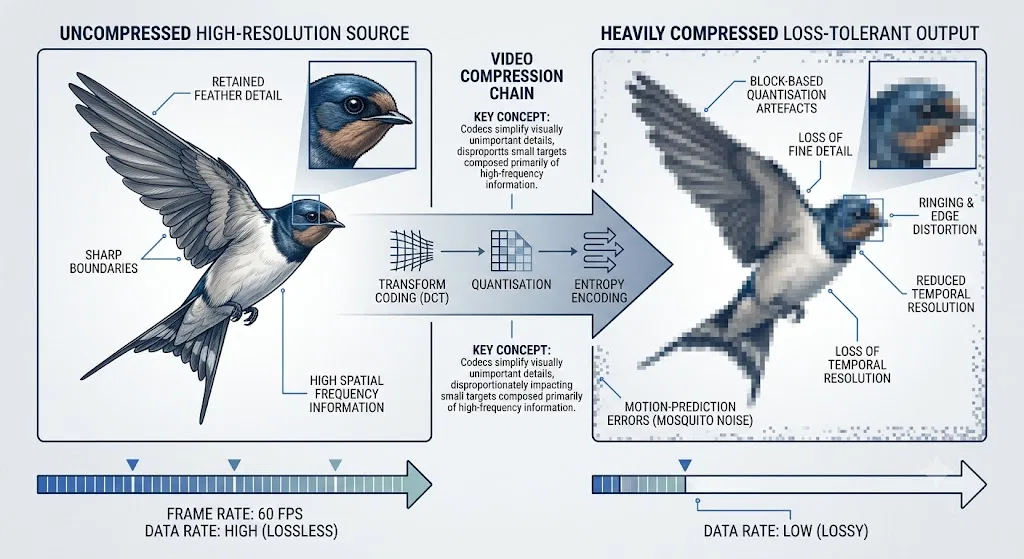
Digital video contains far more information than is normally practical to store or transmit uncompressed. Modern codecs therefore reduce the data rate by exploiting similarities both within individual frames and between successive frames. Broadly, they preserve the visually important parts of the scene while approximating or discarding other information. That strategy works extremely well for ordinary viewing, but it has an obvious weakness for UAP identification: a tiny target may itself consist almost entirely of the fine detail that the compression system finds easiest to simplify.
One important mechanism is quantisation. Video encoders transform image information into components representing different levels of spatial detail, then represent some of those components less precisely. Research on compression artefacts notes that this process tends to reduce high-frequency information, producing blur and loss of fine spatial detail. Block-based processing can additionally introduce blocking, ringing and other distortions around boundaries.[ECE Web]eceweb.uwaterloo.caECE Web
For a large aircraft filling hundreds of pixels, losing a few fine details may make little difference to identification. For an aircraft, balloon, bird or drone represented by perhaps only several pixels, the situation is very different. Wing tips, a tail, the gap between two nearby objects or the difference between a circular and elongated outline may fall below the surviving resolution. The encoded image can therefore preserve the existence of a target while destroying much of the evidence for what kind of target it is.
This helps explain why the phrase “it does not look like an aircraft” can become unreliable when applied to highly magnified low-resolution video. A camera may never have resolved an aircraft-like silhouette in the first place, and compression can further simplify what little structure was captured. In AARO’s published Western United States case, distant commercial aircraft appeared only as small dots in infrared imagery; their identification depended on analysis of full-motion video and matching the objects against commercial flight data rather than extracting recognisable aircraft shapes from the dots themselves.[AARO]aaro.milUAP ImageryAARO assesses that the object likely is a commercial aircraft and that the trailing cavitation is a sensor artifact result…
Compression is therefore not simply a matter of making an otherwise faithful picture slightly fuzzier. At very small image scales, it can alter the kind of evidence available. An object that originally carried weak structural clues can become a featureless blob from which confident morphological claims are no longer justified.
Pixelation, flicker and changing outlines
Some of the most misleading compression effects occur not because information disappears, but because the codec creates patterns that were never present in the original scene.
Block-based compression can make curved or diagonal boundaries look squared-off or stepped. Ringing can create faint bands or halos beside strong edges. Blurring can merge neighbouring features. These effects become especially conspicuous after digital enlargement because the viewer is no longer seeing additional detail: the existing pixels and their artefacts are simply being made larger. Studies of compressed video distinguish these single-frame or spatial artefacts from temporal distortions that emerge only as the video plays.[ECE Web]eceweb.uwaterloo.caECE Web
Temporal artefacts are particularly relevant to UFO footage because viewers naturally interpret frame-to-frame changes as physical movement. Compression research identifies phenomena including flickering and “floating”, in which reconstructed image regions change perceptually over time even though those changes do not faithfully represent changes in the original scene.[ECE Web]eceweb.uwaterloo.caECE Web
A well-studied example is mosquito noise. Researchers at the US National Institute of Standards and Technology described it as a time-dependent MPEG compression impairment affecting fine detail around crisp edges. The artefact can appear intermittently from frame to frame, creating unstable patterns close to an object’s boundary.[NIST]tsapps.nist.govMosquito noise in MPEG-compressed video: test patternsMosquito noise in MPEG-compressed video: test patterns…July 7, 2009 — Mosquito noise is a time dependent video compression impairm… Researchers at the University of Waterloo similarly describe mosquito noise as arising from the interaction of object motion with time-varying ringing and motion-prediction errors near sharp boundaries.[ECE Web]eceweb.uwaterloo.caECE Web
On ordinary television footage, that may register merely as shimmering. On a magnified video of a five- or ten-pixel UAP, the same instability can dominate the visible target. Several misleading impressions can follow:
- A changing shape. Individual edge pixels appear and disappear, making a small object alternate between round, angular, elongated or asymmetric forms.
- A vibrating or pulsing boundary. Compression changes around the target can resemble rapid physical deformation or rotation.
- A false halo or appendage. Ringing and edge noise may produce apparently detached or semi-attached bright or dark regions.
- A temporary trail. Errors involving temporal prediction can leave reconstructed information displaced across successive frames, producing something that looks like material extending behind a moving target.
- False multiplicity. When two small bright regions merge and separate through blur, thresholding or compression, viewers may infer that one object has divided into two, or vice versa.
These effects do not mean that every unusual feature in compressed footage is an artefact. Nor does the presence of compression prove that the underlying object is ordinary. The narrower and more defensible conclusion is that features close to the pixel scale cannot automatically be treated as physical structure. If an alleged wing, tail, wake or secondary object is only a few pixels wide and changes with the codec’s frame structure, its evidential value is weak until it survives comparison with better-quality material.
There is also an important qualification: compression does not destroy useful information at some fixed universal threshold. Experimental work on object detection has found that moderate H.264 compression can leave detection performance relatively robust, while stronger compression causes appreciable deterioration, especially under difficult conditions such as poor lighting, complex scenes and fast motion.[arXiv]arxiv.orgImpact of Video Compression on the Performance of Object Detection Systems for Surveillance ApplicationsNovember 10, 2022… Separate work on object tracking likewise found a statistically significant relationship between quantisation strength and tracking accuracy.[arXiv]arxiv.orgarXiv Does Video Compression Impact Tracking Accuracy?arXiv Does Video Compression Impact Tracking Accuracy? The practical lesson is therefore not “compressed video is worthless”, but that reliability depends on compression strength, target size, contrast, movement and the particular question being asked.
The “atmospheric wake” case shows the risk
AARO’s “Atmospheric Wakes” investigation provides an unusually direct UAP example because the disputed feature was not merely obscured by poor imagery; the apparently anomalous feature itself was assessed as an artefact.
The cases involved infrared recordings made during military operations in the Middle East and Mediterranean region in 2022 and 2023. Operators reported objects that appeared to show unusual propulsion signatures or atmospheric wakes. AARO’s published resolution states that the apparent wakes were sensor anomalies rather than evidence of anomalous propulsion. One object was assessed as a known military aircraft; another appeared unusually oblong partly because of camera aberration; a further object was assessed as an identified commercial aircraft travelling along a recognised air corridor.[AARO]aaro.milCase Resolution of Atmospheric Wakes 508 02262024Case Resolution of Atmospheric Wakes 508 02262024
AARO’s public imagery page is more specific about the South Asian footage: after examining full-motion video, longer-focal-length imagery and commercial flight information, the office assessed that the target was probably a commercial aircraft and that the apparent trailing feature was an artefact resulting from video compression.[aaro.mil]aaro.milUAP ImageryAARO assesses that the object likely is a commercial aircraft and that the trailing cavitation is a sensor artifact result…
That case illustrates an important analytical trap. A visible “wake” seems at first to be a physical clue about propulsion or aerodynamics. If investigators assume from the outset that every coherent-looking feature belongs to the object, the footage appears to contain evidence of unusual technology. Once the imaging and encoding process is treated as part of the system being investigated, however, a different question becomes possible: does the feature remain attached to the object because something is physically there, or because the video-processing system is reconstructing nearby pixels in a correlated way?
The resolution depended on evidence beyond the intriguing pixels themselves. Longer-focal-length footage provided a better view, while external flight information supplied an independent test of the aircraft interpretation.[AARO]aaro.milUAP ImageryAARO assesses that the object likely is a commercial aircraft and that the trailing cavitation is a sensor artifact result… This is precisely why isolated screenshots and short social-media clips are poor foundations for claims about exotic morphology. A compression artefact may look entirely convincing when separated from the longer sequence and the sensor data needed to diagnose it.
Why original footage matters for identification
Forensic video practice strongly favours working as close to the original recording as possible. The Scientific Working Group on Digital Evidence advises analysts to understand compression artefacts, frame rate, chroma subsampling and resolution as part of interpreting a recording. Its guidance also recommends preserving the native video stream where possible rather than introducing unnecessary conversions.[SWGDE - SWGDE]swgde.orgBest Practices for Digital Forensic Video AnalysisBest Practices for Digital Forensic Video Analysis
A proposed forensic digital-video examination standard published through the US National Institute of Standards and Technology is particularly explicit: video intended for further analysis should not be transcoded into another lossy format except under constrained circumstances, because another lossy encoding can modify the evidence again.[NIST]nist.govOpen source on nist.gov. NIST documentation on CCTV similarly notes that such systems commonly use lossy compression to reduce the amount of stored video data.[NIST]tsapps.nist.govClosed Circuit Television (CCTV) Digital Video Export ProfileClosed Circuit Television (CCTV) Digital Video Export Profile
For UFO and UAP analysis, that produces a clear hierarchy of evidence. The best material is the original or native recording together with its metadata and information about the sensor. A direct copy preserving the encoded stream is preferable to a converted version. A platform upload, messaging-app copy, screen recording or repeatedly reposted clip is progressively less useful because each stage may rescale, recompress, change the frame rate or strip metadata.
This distinction is more consequential than it may appear. Consider a bright dot recorded against a dark sky:
- The camera or infrared system first converts a real optical or thermal signal into pixels.
- The recording system may already compress those pixels.
- An operator exports the footage, potentially introducing another conversion.
- A video platform resizes and re-encodes it for streaming.
- Someone crops and enlarges the target.
- The enlarged clip is uploaded again and undergoes another compression pass.
By the end of that chain, the visible outline may contain contributions from the atmosphere, optics, sensor, internal processing, original codec, rescaling algorithm, sharpening and several later encoders. Treating every boundary pixel as a direct measurement of the original object is therefore unsafe.
This is one reason AARO advises that higher-resolution video with metadata is more useful for UAP analysis and notes that camera data should ideally be uncompressed because compression adds artefacts.[AARO]aaro.milOpen source on aaro.mil. NASA’s independent UAP study reached the broader but closely related conclusion that rigorous analysis is hindered by poor calibration, missing metadata, lack of multiple measurements and insufficient baseline data. It recommended well-characterised observations from multiple calibrated sensors rather than relying on visually striking but poorly constrained recordings.[NASA Science]science.nasa.govScience Independent Study Team ReportScience Independent Study Team Report
How to judge whether a “weird” feature is trustworthy
The safest way to assess an unusual feature is not to ask whether it looks real, but whether it behaves like independently supported physical structure.
A feature deserves greater confidence when it persists across many frames without changing according to block boundaries or compression quality; appears in higher-resolution or longer-focal-length footage; scales consistently as the camera zooms; occurs in more than one independent sensor; and agrees with known geometry, tracking data or other measurements. Conversely, confidence should fall when the feature appears only after strong enlargement, occupies just one or two pixels, flickers irregularly, vanishes in a higher-quality copy or is visible only in a re-encoded excerpt.
Frame-by-frame viewing can help, but it can also make the problem worse if used carelessly. Pausing a highly compressed video encourages the eye to assign significance to individual pixel clusters that were never stable across time. Some compression artefacts are specifically temporal, so the relationship between neighbouring frames is itself diagnostic.[NIST]tsapps.nist.govMosquito noise in MPEG-compressed video: test patternsMosquito noise in MPEG-compressed video: test patterns…July 7, 2009 — Mosquito noise is a time dependent video compression impairm…
Sharpening requires similar caution. It can make a target easier to see, but it cannot recover information that was discarded before the analyst received the file. Enhancement methods may emphasise real edges and compression artefacts together. Forensic guidance therefore treats clarification as an analytical process that must account first for the video’s structure, compression, resolution and other technical characteristics rather than assuming that a more visually striking image is a more truthful one.[SWGDE - SWGDE]swgde.orgBest Practices for Digital Forensic Video AnalysisBest Practices for Digital Forensic Video Analysis
The most useful question is consequently not “What shape is this UFO?” but “At this target size and generation of video, which visible features are actually resolved?” Sometimes the only defensible answer is that the footage establishes the presence of a small contrasting object but cannot preserve enough reliable morphology to identify it.

Compression can create mystery without creating an object
Video compression usually does not invent an entire UFO from nothing. More commonly, it acts on a real but poorly resolved object — an aircraft, balloon, bird, drone or simply an unidentified distant target — and changes the details by which viewers try to interpret it. The object may be genuine while its apparently exotic outline, shimmer, trail or changing form is not.
That distinction is central to understanding IFOs. An observer can accurately report that a video contains something difficult to recognise while still being mistaken about the meaning of its finest visible features. The AARO atmospheric-wake cases demonstrate the point unusually clearly: a feature suggestive of unconventional propulsion was assessed, after fuller analysis, as an imaging artefact rather than a physical wake.[AARO]aaro.milCase Resolution of Atmospheric Wakes 508 02262024Case Resolution of Atmospheric Wakes 508 02262024
Compression should therefore be treated as part of the evidence, not as an incidental technical detail. When an extraordinary interpretation depends on a handful of unstable pixels, the decisive evidence is often not what those pixels seem to depict, but whether the feature survives examination of the original footage, metadata, longer sequences and independent sensor or flight information.
Amazon book picks
Further Reading
Books and field guides related to When Video Compression Manufactures UFO Weirdness. Use these as the next step if you want deeper reading beyond the article.
H.264 and MPEG-4 Video Compression: Video Coding for Next-gen...
Following on from the successful MPEG-2 standard, MPEG-4 Visual is enabling a new wave of multimedia applications from Internet video str...
Digital Video and HD: Algorithms and Interfaces
& Quot;Digital Video and HDTV Algorithms and Interfaces covers the theory and engineering of digital video systems in a manner that is eq...
The H.264 Advanced Video Compression Standard
H.264 Advanced Video Coding or MPEG-4 Part 10 is fundamental to a growing range of markets such as high definition broadcasting, internet...
Digital Image Processing
This is the eBook of the printed book and may not include any media, website access codes, or print supplements that may come packaged wi...
eBay marketplace picks
Marketplace Samples
Live-tested eBay searches with available results related to this page.
Selected fromUFO poster oneBay.co.uk.


Current eBay listing
I Want To Believe UFO Poster Giclée Fine Art Heavyweight Print

Current eBay listing
VINTAGE UFO FLYING SAUCERS COMIC ADVERTISING A2 POSTER PRINT

Endnotes
1.
Source: aaro.mil
Link:https://www.aaro.mil/UAP-Cases/Official-UAP-Imagery/
Source snippet
UAP ImageryAARO assesses that the object likely is a commercial aircraft and that the trailing cavitation is a sensor artifact result...
2.
Source: aaro.mil
Title: Case Resolution of Atmospheric Wakes 508 02262024
Link:https://www.aaro.mil/Portals/136/PDFs/case_resolution_reports/Case_Resolution_of_Atmospheric_Wakes_508-02262024.pdf
3.
Source: eceweb.uwaterloo.ca
Title: ECE Web
Link:https://eceweb.uwaterloo.ca/~z70wang/publications/HVEI14.pdf
4.
Source: arxiv.org
Title: arXiv PEA265: Perceptual Assessment of Video Compression Artifacts
Link:https://arxiv.org/abs/1903.00473
5.
Source: tsapps.nist.gov
Title: Mosquito noise in MPEG-compressed video: test patterns
Link:https://tsapps.nist.gov/publication/get_pdf.cfm?pub_id=28452
Source snippet
Mosquito noise in MPEG-compressed video: test patterns...July 7, 2009 — Mosquito noise is a time dependent video compression impairm...
Published: July 7, 2009
6.
Source: arxiv.org
Link:https://arxiv.org/abs/2211.05805
Source snippet
Impact of Video Compression on the Performance of Object Detection Systems for Surveillance ApplicationsNovember 10, 2022...
Published: November 10, 2022
7.
Source: arxiv.org
Title: arXiv Does Video Compression Impact Tracking Accuracy?
Link:https://arxiv.org/abs/2202.00892
8.
Source: dvidshub.net
Link:https://www.dvidshub.net/video/880271/south-asian-object-2
9.
Source: dvidshub.net
Link:https://www.dvidshub.net/video/880270/south-asian-object-1
10.
Source: swgde.org
Title: Best Practices for Digital Forensic Video Analysis
Link:https://www.swgde.org/wp-content/uploads/2025/12/2025-12-10-Best-Practices-for-Digital-Forensic-Video-Analysis-18-V-001-2.0.pdf
11.
Source: swgde.org
Title: Best Practices for Digital Forensic Video Analysis
Link:https://www.swgde.org/documents/published-complete-listing/18-v-001-best-practices-for-digital-forensic-video-analysis/
12.
Source: nist.gov
Link:https://www.nist.gov/document/osac-2022-s-0031-standard-guide-forensic-digital-video-examination-workflow-version-20
13.
Source: nist.gov
Title: osac 2022 s 0031 comment adjudication
Link:https://www.nist.gov/document/osac-2022-s-0031-comment-adjudication
14.
Source: tsapps.nist.gov
Title: Closed Circuit Television (CCTV) Digital Video Export Profile
Link:https://tsapps.nist.gov/publication/get_pdf.cfm?pub_id=927780
15.
Source: aaro.mil
Link:https://www.aaro.mil/FAQ/
16.
Source: science.nasa.gov
Title: Science Independent Study Team Report
Link:https://science.nasa.gov/wp-content/uploads/2023/09/uap-independent-study-team-final-report.pdf?emrc=80696d
17.
Source: science.nasa.gov
Title: uap independent study team final report
Link:https://science.nasa.gov/wp-content/uploads/2023/09/uap-independent-study-team-final-report.pdf
18.
Source: data.nasa.gov
Link:https://data.nasa.gov/
19.
Source: science.nasa.gov
Link:https://science.nasa.gov/uap/faqs/
20.
Source: science.nasa.gov
Link:https://science.nasa.gov/uap/
21.
Source: science.nasa.gov
Link:https://science.nasa.gov/
22.
Source: svs.gsfc.nasa.gov
Link:https://svs.gsfc.nasa.gov/30613/
23.
Source: nasa.gov
Title: update nasa shares uap independent study report names director
Link:https://www.nasa.gov/news-release/update-nasa-shares-uap-independent-study-report-names-director/
24.
Source: earthdata.nasa.gov
Link:https://www.earthdata.nasa.gov/data/instruments/tirs
25.
Source: ntrs.nasa.gov
Link:https://ntrs.nasa.gov/api/citations/20050202011/downloads/20050202011.pdf?attachment=true
26.
Source: asrs.arc.nasa.gov
Link:https://asrs.arc.nasa.gov/
27.
Source: nasa.gov
Title: fy 2026 q1 foia log.xlsx
Link:https://www.nasa.gov/wp-content/uploads/2026/01/fy-2026-q1-foia-log.xlsx?emrc=2566e7
28.
Source: nasa.gov
Title: to release discuss unidentified anomalous phenomena report
Link:https://www.nasa.gov/news-release/nasa-to-release-discuss-unidentified-anomalous-phenomena-report/
29.
Source: ntrs.nasa.gov
Link:https://ntrs.nasa.gov/api/citations/20110002751/downloads/20110002751.pdf
30.
Source: ntrs.nasa.gov
Title: TM 20205007358 Redacted
Link:https://ntrs.nasa.gov/api/citations/20205007358/downloads/TM%2020205007358_Redacted.pdf?attachment=true
31.
Source: nasa.gov
Link:https://www.nasa.gov/wp-content/uploads/2025/08/2022-agency-foia-log.xlsx?emrc=93a4ff
32.
Source: nasa.gov
Link:https://www.nasa.gov/wp-content/uploads/2025/08/fy-2025-q3-foia-log.xlsx?emrc=36f27c
33.
Source: aaro.mil
Title: [Go Fast]({{ ‘go-fast/’ | relative_url }}) Case Resolution Card Methodology Final
Link:https://www.aaro.mil/Portals/136/PDFs/case_resolution_reports/AARO_GoFast_Case_Resolution_Card_Methodology_Final.pdf
34.
Source: aaro.mil
Link:https://www.aaro.mil/Portals/136/PDFs/AARO_Mission_Brief_2025.pdf
35.
Source: aaro.mil
Link:https://www.aaro.mil/
36.
Source: aaro.mil
Title: AARO Brief to SASC DoD UAP Mission April 19 2023 508
Link:https://www.aaro.mil/Portals/136/PDFs/AARO_Brief_to_SASC-DoD_UAP_Mission-April_19_2023_508.pdf
37.
Source: aaro.mil
Title: Next UAP Report Documents
Link:https://www.aaro.mil/Next-AARO-Home-redesign/Next-Parent/Next-UAP-Report-Documents/
38.
Source: swgde.org
Title: Best Practices for Digital Video Authentication
Link:https://www.swgde.org/documents/published-complete-listing/23-v-001-best-practices-for-digital-video-authentication/
39.
Source: swgde.org
Link:https://www.swgde.org/documents/published-complete-listing/16-v-002-technical-notes-on-ffmpeg-for-forensic-video-examinations/
40.
Source: swgde.org
Link:https://www.swgde.org/documents/published-complete-listing/08-a-001-swgde-best-practices-for-forensic-audio/
41.
Source: swgde.org
Title: 2024 03 07 SWGDE Best Practices for Digital Video Authentication 23 V 001 1.2
Link:https://www.swgde.org/wp-content/uploads/2024/03/2024-03-07-SWGDE-Best-Practices-for-Digital-Video-Authentication-23-V-001-1.2.pdf
42.
Source: swgde.org
Title: 18 V 001 1.1 Best Practices for Digital Forensic Video Analysis Archived
Link:https://www.swgde.org/wp-content/uploads/2026/05/SWGDE-18-V-001-1.1-Best-Practices-for-Digital-Forensic-Video-Analysis_Archived.pdf
43.
Source: swgde.org
Title: 2018 11 20 SWGDE Best Practices for Digital Forensic Video Analysis
Link:https://www.swgde.org/wp-content/uploads/2023/11/2018-11-20-SWGDE-Best-Practices-for-Digital-Forensic-Video-Analysis.pdf
44.
Source: swgde.org
Link:https://www.swgde.org/wp-content/uploads/2023/11/2020-09-17-SWGDE-Core-Technical-Concepts-for-Time-Based-Analysis-of-Digital-Video-Files_v1.0.pdf
45.
Source: swgde.org
Title: 2018 09 20 SWGDE Best Practices for Digital Aud
Link:https://www.swgde.org/wp-content/uploads/2023/11/2018-09-20-SWGDE-Best-Practices-for-Digital-Aud.pdf
46.
Source: nist.gov
Link:https://www.nist.gov/document/osac-2022-s-0031standard-guide-forensic-digital-video-examination-workflowopen-comment
47.
Source: nist.gov
Link:https://www.nist.gov/document/osac-2023-n-0001-standard-practice-training-areas-video-analysis-image-analysis-and-0
48.
Source: nist.gov
Link:https://www.nist.gov/document/osac-2023-n-0001-standard-practice-training-areas-video-analysis-image-analysis-and
49.
Source: nvlpubs.nist.gov
Title: SP.500 290e4
Link:https://nvlpubs.nist.gov/nistpubs/SpecialPublications/NIST.SP.500-290e4.pdf
50.
Source: tsapps.nist.gov
Title: get pdf.cfm
Link:https://tsapps.nist.gov/publication/get_pdf.cfm?pub_id=922565
51.
Source: nist.gov
Title: osac 2021 s 0037 standard guide forensic photogrammetry
Link:https://www.nist.gov/document/osac-2021-s-0037-standard-guide-forensic-photogrammetry
52.
Source: tsapps.nist.gov
Title: get pdf.cfm
Link:https://tsapps.nist.gov/publication/get_pdf.cfm?pub_id=922342
53.
Source: arxiv.org
Link:https://arxiv.org/html/2411.06776v1
54.
Source: arxiv.org
Link:https://arxiv.org/pdf/2210.11549
55.
Source: arxiv.org
Link:https://arxiv.org/pdf/2301.01069
56.
Source: dvidshub.net
Link:https://www.dvidshub.net/video/1010263/fbi-uap-pr001-triangle-orbs-2021
57.
Source: hsdl.org
Link:https://www.hsdl.org/c/view?docid=895849
58.
Source: hal.science
Link:https://hal.science/hal-00450121/document
59.
Source: Wikipedia
Link:https://en.wikipedia.org/wiki/Video
60.
Source: dictionary.cambridge.org
Link:https://dictionary.cambridge.org/dictionary/english/video
61.
Source: play.google.com
Link:https://play.google.com/store/apps/details?hl=es_US&id=com.uap
Additional References
62.
Source: war.gov
Link:https://www.war.gov/News/Releases/Release/Article/4515408/department-of-war-publishes-third-release-of-unidentified-anomalous-phenomena-f/
63.
Source: war.gov
Link:https://www.war.gov/ufo/
64.
Source: intelligence.gov
Link:https://www.intelligence.gov/publics-daily-brief/publics-daily-brief-articles/unidentified-aerial-phenomena-preliminary-intelligence-assessment
65.
Source: youtube.com
Title: Breakdown of the Pentagon UFO videos with Mick West
Link:https://www.youtube.com/watch?v=Le7Fqbsrrm8
Source snippet
DECLASIFIED VIDEO: UFO FILES - South Asian Object 2...
66.
Source: youtube.com
Title: Is the Nimitz UFO Video Just a Plane?
Link:https://www.youtube.com/watch?v=s1oTg0kxzDs
Source snippet
Mick West video compression UFO UAP artifact Gimbal UFO - A New Analysis...
67.
Source: researchgate.net
Link:https://www.researchgate.net/publication/261701780_Forensic_analysis_of_video_file_formats
68.
Source: researchgate.net
Link:https://www.researchgate.net/publication/365359832_Impact_of_Video_Compression_on_the_Performance_of_Object_Detection_Systems_for_Surveillance_Applications
69.
Source: buap.mx
Link:https://www.buap.mx/
70.
Source: crime-scene-investigator.net
Link:https://www.crime-scene-investigator.net/PDF/best-practices-for-forensic-video-analysis.pdf
71.
Source: researchgate.net
Link:https://www.researchgate.net/publication/262949789_Characterizing_Perceptual_Artifacts_in_Compressed_Video_Streams