Within Meteors
Can matching UFO report times reveal a fireball?
Reports from different places within the same few seconds can turn an unknown light into a reconstructable meteor event.
On this page
- Why a few seconds matter more than vivid descriptions
- How locations and sight lines connect separate reports
- What cameras and sensor records can confirm
Page outline Jump by section
Introduction
Yes. When UFO or UAP reports from widely separated places describe a brief flash or fast-moving light at essentially the same time, the timing cluster can be the clue that turns several apparently independent mysteries into one fireball. A meteor high in the atmosphere can be visible across hundreds of kilometres, so witnesses may describe it from very different perspectives while all recording the same few-second event.

The important shift is from asking whether the descriptions sound alike to asking whether the observations are compatible in time and geometry. The International Meteor Organization (IMO) explicitly combines public eyewitness reports to estimate fireball trajectories, while NASA routinely combines American Meteor Society reports with cameras and other sensors to reconstruct individual events.[International Meteor Organization]imo.netInternational Meteor Organization Fireball Program | IMOInternational Meteor Organization Fireball Program | IMO
For investigators assessing brief UFO reports, that makes timing unusually powerful. Colour, apparent size and even perceived direction can vary between witnesses. A tight temporal cluster spread across a geographically coherent region is much harder to dismiss as coincidence — and it creates something that can be tested against cameras, meteor networks, satellites and other records.
Why a few seconds matter more than vivid descriptions
A bright meteor is an extremely short event. NASA’s reconstruction of a 7 December 2025 fireball over the Great Lakes found that it travelled about 61 miles through the atmosphere in less than three seconds, at roughly 73,000 mph. Another event over southern New York on 11 March 2026 covered more than 38 miles in just under three seconds.[Fireballs NDC]fireballs.ndc.nasa.govFireballs NDCEvent 20251207-225900December 7, 2025…
That brevity changes how a cluster of UFO reports should be evaluated. Suppose people in several towns independently report an intense light at approximately 22:14. Their accounts might disagree about whether it looked green, white or orange; whether it appeared the size of a star or something much larger; or whether it seemed close to the observer. Those subjective details can be useful, but they are vulnerable to perception, viewing conditions and memory.
The shared time is different. If the reports can be narrowed to the same seconds, investigators have evidence that the witnesses may have observed a single physical event.
This does not mean that eyewitness clocks are precise enough to demand second-for-second agreement. Public fireball databases themselves illustrate the problem: individual witnesses can submit times differing by minutes even when reports are grouped as one event. Human estimates, vehicle clocks and manually entered times all introduce uncertainty. The practical task is therefore to identify a plausible time window, then improve it with records whose clocks are more reliable.
That distinction matters. A weak pattern is “several people saw something strange that evening”. A much stronger pattern is “people across a broad region reported a brilliant, roughly three-second event at about the same time, and a timestamped camera recorded a streak during that window”.
The value of multiple reports is measurable. NASA researchers tested trajectories derived from American Meteor Society eyewitness reports against instrumental observations from the NASA All Sky Fireball Network. Across 33 cases, reconstructions improved substantially when more reports were available: cases with more than 75 eyewitnesses performed nearly twice as well across most tested measures as cases with fewer reports. Even then, eyewitness-only reconstruction remained approximate rather than equivalent to precision camera observations.[NASA Technical Reports Server]ntrs.nasa.govNASA Technical Reports ServerComparing Eyewitness-Derived Trajectories of Bright Meteors to Instrumentally-Observed Data - NASA Technical…
That is an important limitation for UFO investigations. A timing cluster is not proof by itself. It is a mechanism for converting scattered testimony into a hypothesis that can be checked.
How locations and sight lines connect separate reports
Timing answers when something happened. Locations and viewing directions begin to answer where it happened.
A fireball takes place tens of kilometres above Earth, so observers separated by large distances can see the same object against different parts of their local sky. This produces an initially counter-intuitive pattern: two witnesses may both be accurate yet describe substantially different apparent paths.
The IMO’s public reporting programme is designed around precisely this principle. Its form collects information that can be combined with reports from other witnesses to estimate the fireball’s trajectory and assess whether material may have reached the ground.[International Meteor Organization]imo.netInternational Meteor Organization Fireball Program | IMOInternational Meteor Organization Fireball Program | IMO
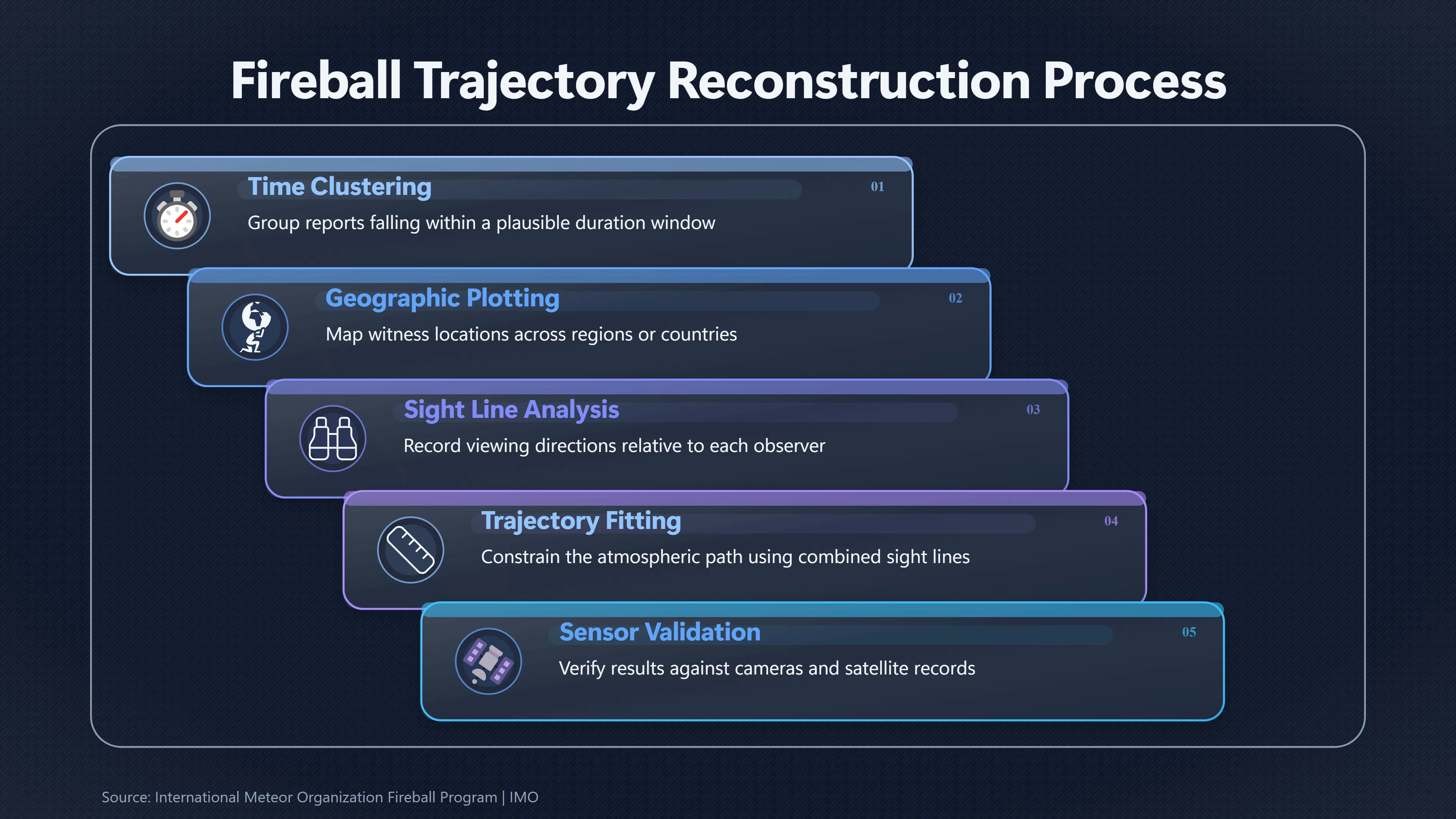
In simplified terms, investigators can work through a cluster like this:
- Group reports by time. Identify observations falling within the plausible duration and reporting uncertainty of a single event.
- Plot the witnesses geographically. A real bright fireball may produce observations across several counties, regions or even countries.
- Record each viewing direction and apparent path. The relevant information is not merely “looking south”, but where the light appeared and disappeared relative to the observer.
- Compare the sight lines. Observations from sufficiently separated locations constrain the object’s atmospheric path.
- Check the solution against independent recordings. Cameras and sensors can confirm the timing, direction, speed and altitude far more precisely.
This is the same broad principle behind dedicated meteor-camera networks. Multiple stations observe the same meteor from different positions, allowing its three-dimensional trajectory to be triangulated. Modern research goes further by fitting multi-sensor line-of-sight measurements to models of the meteoroid’s motion; timing information is especially valuable because it allows velocity and changes in motion to be estimated along the reconstructed path.[arXiv]arxiv.orgarXiv A Dynamic Trajectory Fit to Multi-Sensor Fireball ObservationsA Dynamic Trajectory Fit to Multi-Sensor Fireball ObservationsNovember 3, 2019…
A 2022 European example shows what this means in practice. Footage from cameras at different locations in the AllSky7 and Southwestern Europe Meteor Network systems allowed researchers to calculate a fireball trajectory beginning at about 100 kilometres altitude over Madrid and ending at about 77 kilometres over Guadalajara.[European Space Agency]esa.intEuropean Space Agency ESAEuropean Space AgencyESA - Meteor's trajectory determined through European fireball camera networksAugust 8, 2022…
For a UFO report cluster, investigators do not initially need that level of precision. The first question is simpler: do the reported times, witness locations and directions make sense as views of one high-altitude object? If they do, the apparently separate sightings have become one testable event.
A real cluster can span an unexpectedly large area
The geographic spread of reports is one reason a meteor can initially seem harder to explain rather than easier. Witnesses may assume that the brilliant object was nearby. If someone hundreds of kilometres away reports an apparently similar light, it can therefore sound as though two extraordinary objects were present.
High-altitude geometry produces the opposite conclusion.
NASA’s 29 April 2026 fireball reconstruction is a particularly clear example. Well over 100 witnesses reported the event from Oregon, Washington and British Columbia at about 00:12 Pacific time. Investigators combined those accounts with public camera recordings and data from the Geostationary Lightning Mapper aboard the GOES-18 weather satellite. The resulting reconstruction placed the beginning of the luminous trajectory roughly 56 miles — about 91 kilometres — above Vancouver Island. The meteoroid travelled approximately 55 miles through the upper atmosphere before fragmenting over the Pacific.[Fireballs NDC]fireballs.ndc.nasa.govFireballs NDCEvent 20260429-071216April 29, 2026…
A similarly broad cluster occurred on 8 March 2026. Hundreds of reports arrived from a large swathe of the eastern United States and Ontario. Meteor cameras, including three belonging to NASA’s Fireball Network, recorded the event. Video analysis showed a meteor travelling about 86 miles through the upper atmosphere before disintegrating over southern Pennsylvania.[Fireballs NDC]fireballs.ndc.nasa.govFireballs NDCEvent 20260309-014122March 9, 2026…
These cases demonstrate why report geography should not be interpreted like sightings of a low-flying aircraft. A meteor tens of kilometres above Earth naturally has an enormous viewing footprint.
The pattern can consequently become diagnostically useful. A brilliant object reported within a narrow time window from many distant locations, with viewing directions that converge on a plausible atmospheric path, fits a fireball much better than an object assumed to be hovering locally near each witness.
Cameras can turn approximate times into a trajectory
Eyewitness clustering becomes much more powerful once investigators locate timestamped imagery.
This imagery does not have to come from a purpose-built astronomical observatory. NASA increasingly combines public reports with ordinary Earth-facing cameras. For the March 2026 southern New York event, for example, eyewitness information was combined with EarthCams and other publicly accessible cameras. NASA derived a start altitude of about 52 miles, an end altitude of about 32 miles and a speed of roughly 45,900 mph.[Fireballs NDC]fireballs.ndc.nasa.govFireballs NDCEvent 20260311-040116…
Another March 2026 event was reconstructed using eyewitness reports together with train-station cameras and an EarthCam on Reunion Tower in Dallas. The resulting path placed the meteor over Louisiana, travelling west at roughly 30,000 mph before disintegrating at about 27 miles altitude.[Fireballs NDC]fireballs.ndc.nasa.govOpen source on nasa.gov.
This is where an investigation can move beyond “many people saw something”. A camera provides several pieces of information simultaneously: a timestamp, a measurable path against the background scene or sky, the duration of the event and changes in brightness. Multiple cameras at known positions provide different sight lines.
There is a precedent on a much larger scale in the 2013 Chelyabinsk event. The meteoroid was captured by numerous surveillance and dashboard cameras, and researchers used footage from different locations to reconstruct its atmospheric trajectory and pre-impact orbit. Separate geophysical work used seismic observations to constrain the explosion time to 03:20:34 UTC.[arXiv]arxiv.orgOpen source on arxiv.org.
The underlying lesson applies to far smaller events. Once a precise camera time is established, investigators can return to the looser eyewitness cluster and ask which reports are temporally and geometrically consistent with that recorded fireball.
What satellites and sensors can confirm
Some of the strongest confirmation can come from instruments that were never designed primarily to investigate UFOs or even meteors.
A notable example is the Geostationary Lightning Mapper (GLM) carried by NOAA’s GOES weather satellites. GLM was built to detect lightning, but extremely bright meteors also produce optical flashes that the instrument can record. NOAA says it takes 500 images of Earth per second, allowing the brightness history of sufficiently luminous meteors to be measured with millisecond precision.[NESDIS]nesdis.noaa.govOpen source on noaa.gov.
That creates an exceptionally useful independent clock. If eyewitnesses and cameras indicate a brilliant atmospheric event at a particular moment and GLM records a compatible flash, the fireball interpretation becomes substantially stronger.
NASA’s investigation of the daylight fireball over Georgia on 26 June 2025 demonstrates how several evidence streams can converge. Public accounts were combined with camera, satellite, infrasound and Doppler weather-radar data. NASA reconstructed a meteor beginning about 48 miles above Oxford, Georgia, travelling southwest at roughly 30,000 mph and disintegrating about 27 miles above West Forest. GOES lightning mappers detected the event, while radar later recorded signatures associated with falling meteorites.[Fireballs NDC]fireballs.ndc.nasa.govOpen source on nasa.gov.
NOAA has documented the same principle in events where witnesses heard unexplained booms. On 2 December 2020, for example, witnesses from Ontario to Virginia reported a bright flash, while GLM recorded an atmospheric anomaly at the corresponding time. The event was identified as a meteor; people nearer its path also reported a sonic boom.[NESDIS]nesdis.noaa.govOpen source on noaa.gov.
Seismic and infrasound stations can add another timing layer when a sufficiently energetic fireball produces atmospheric pressure waves. The US Geological Survey notes that an atmospheric sonic boom can sometimes be distinguished from an earthquake because the timing between seismic stations follows the much slower propagation of sound through air rather than seismic waves through rock.[USGS]usgs.govSonic Booms | U.S. Geological SurveySonic Booms | U.S. Geological Survey
The crucial point is independence. Witnesses can influence one another, and their recollections can be imprecise. A satellite detector, calibrated camera or geophysical instrument is not repeating the same testimony. It is recording a physical signal on its own clock.

Timing clusters have limits
Matching times should not be treated as an automatic meteor identification. The quality of the match matters.
A few reports rounded to “about 9.30” provide much weaker evidence than independent recordings timestamped to within seconds. Similarly, investigators should be cautious about forcing observations into the same event simply because they occurred during the same evening. The relevant question is whether the timing differences are compatible with normal reporting errors and with the proposed trajectory.
There is also a distinction between detection and precision reconstruction. Eyewitnesses can establish that something probably occurred and provide useful directional information, but their reports contain substantial uncertainty. NASA’s comparison with instrumentally observed meteors found that even relatively large eyewitness samples produced only crude trajectories compared with dedicated camera measurements.[NASA Technical Reports Server]ntrs.nasa.govNASA Technical Reports ServerComparing Eyewitness-Derived Trajectories of Bright Meteors to Instrumentally-Observed Data - NASA Technical…
Camera clocks can have errors too. Consumer devices may be set incorrectly, drift, use the wrong time zone or preserve inaccurate metadata. Professional multi-station fireball analysis therefore has to account for timing offsets as part of trajectory fitting. Research on dynamic fireball reconstruction explicitly includes the ability to fit systematic observatory timing offsets alongside the object’s trajectory.[arXiv]arxiv.orgarXiv A Dynamic Trajectory Fit to Multi-Sensor Fireball ObservationsA Dynamic Trajectory Fit to Multi-Sensor Fireball ObservationsNovember 3, 2019…
Finally, simultaneity alone cannot distinguish every possible source. Aircraft, spacecraft re-entries and other phenomena can also generate observations from multiple places. The meteor explanation becomes compelling when the whole pattern agrees: a very short duration, geographically distributed reports, compatible sight lines, a meteor-like atmospheric trajectory and independent optical or sensor detections.
When an “unknown” becomes one atmospheric event
The practical strength of timing clusters is that they change the unit of investigation. Instead of treating ten UFO reports as ten unexplained objects, investigators can test whether they are ten observations of one event.
A strong fireball identification develops in layers. First comes the narrow time cluster. Witness locations then show whether a single high-altitude object could have been visible to all of them. Viewing directions constrain its path. Timestamped cameras tighten the event time and geometry. Meteor networks can supply precise astrometry, while weather satellites, radar, infrasound or seismic records may independently confirm that something energetic passed through or broke apart in the atmosphere.
NASA’s recent fireball analyses show this process working routinely. On 22 March 2026, more than 200 eyewitness reports from California, Arizona and Nevada were combined with public camera recordings to reconstruct a meteor travelling 58 miles through the upper atmosphere. On 29 April, eyewitnesses, public cameras and a GOES satellite together constrained a fireball over Vancouver Island and the Pacific.[Fireballs NDC]fireballs.ndc.nasa.govOpen source on nasa.gov.
That is why precise timing deserves disproportionate attention in brief UFO reports. A dramatic description may preserve what an observer thought the object looked like. A cluster of matching times, locations and sight lines can reveal what the object was actually doing — and, in the right circumstances, reduce a scattered collection of unidentified lights to a single reconstructable fireball.
Amazon book picks
Further Reading
Books and field guides related to Can matching UFO report times reveal a fireball?. Use these as the next step if you want deeper reading beyond the article.
Meteorites: The Story of Our Solar System
Meteorite tells the fascinating story of the stones from outer space scattered across our planet. From the impact that finished off the d...
Observing Comets, Asteroids, Meteors, and the Zodiacal Light
When can you see fireballs and who should you contact if you spot one? When is it best to hunt for comets and meteors and whereabouts? Ho...
The Backyard Astronomer's Guide
Discusses the practical aspects of stargazing, including how to choose appropriate equipment, contending with light pollution, taking suc...
NightWatch: A Practical Guide to Viewing the Universe
A practical guide to viewing the universe.
eBay marketplace picks
Marketplace Samples
Live-tested eBay searches with available results related to this page.
Selected frommeteorite display specimen oneBay.co.uk.

Endnotes
1.
Source: imo.net
Title: International Meteor Organization Fireball Program | IMO
Link:https://www.imo.net/observations/fireballs/fireball-report-program/
2.
Source: fireballs.ndc.nasa.gov
Link:https://fireballs.ndc.nasa.gov/skyfalls/events/20260311-040116
Source snippet
Fireballs NDCEvent 20260311-040116...
3.
Source: fireballs.ndc.nasa.gov
Link:https://fireballs.ndc.nasa.gov/skyfalls/events/20251207-225900
Source snippet
Fireballs NDCEvent 20251207-225900December 7, 2025...
Published: December 7, 2025
4.
Source: ntrs.nasa.gov
Link:https://ntrs.nasa.gov/citations/20170009052
Source snippet
NASA Technical Reports ServerComparing Eyewitness-Derived Trajectories of Bright Meteors to Instrumentally-Observed Data - NASA Technical...
5.
Source: arxiv.org
Title: arXiv A Dynamic Trajectory Fit to Multi-Sensor Fireball Observations
Link:https://arxiv.org/abs/1911.00816
Source snippet
A Dynamic Trajectory Fit to Multi-Sensor Fireball ObservationsNovember 3, 2019...
Published: November 3, 2019
6.
Source: arxiv.org
Title: arXiv Determining fireball fates using the $α$-$β$ criterion
Link:https://arxiv.org/abs/1909.11494
7.
Source: fireballs.ndc.nasa.gov
Link:https://fireballs.ndc.nasa.gov/skyfalls/events/20260429-071216
Source snippet
Fireballs NDCEvent 20260429-071216April 29, 2026...
Published: April 29, 2026
8.
Source: fireballs.ndc.nasa.gov
Link:https://fireballs.ndc.nasa.gov/skyfalls/events/20260309-014122?linkId=917098575
Source snippet
Fireballs NDCEvent 20260309-014122March 9, 2026...
Published: March 9, 2026
9.
Source: fireballs.ndc.nasa.gov
Link:https://fireballs.ndc.nasa.gov/skyfalls/events/20260303-011854
10.
Source: arxiv.org
Link:https://arxiv.org/abs/1303.1796
11.
Source: nesdis.noaa.gov
Link:https://www.nesdis.noaa.gov/our-satellites/currently-flying/goes-east-west/geostationary-lightning-mapper-glm
12.
Source: nesdis.noaa.gov
Link:https://www.nesdis.noaa.gov/news/flashes-the-sky-how-the-lightning-sensor-weather-satellite-can-also-track-meteoroids
13.
Source: fireballs.ndc.nasa.gov
Link:https://fireballs.ndc.nasa.gov/skyfalls/events/20250626-162457
14.
Source: nesdis.noaa.gov
Link:https://www.nesdis.noaa.gov/news/earth-orbit-catching-bolides
15.
Source: usgs.gov
Title: Sonic Booms | U.S. Geological Survey
Link:https://www.usgs.gov/programs/earthquake-hazards/sonic-booms
16.
Source: fireballs.ndc.nasa.gov
Link:https://fireballs.ndc.nasa.gov/skyfalls/events/20260323-031821
17.
Source: star.nesdis.noaa.gov
Title: conus band
Link:https://www.star.nesdis.noaa.gov/GOES/conus_band.php?band=EXTENT3&dim=1&length=144&refresh=true&sat=G19
18.
Source: fireball.imo.net
Link:https://fireball.imo.net/members/imo_view/event/2026/5397
19.
Source: fireball.imo.net
Link:https://fireball.imo.net/members/imo_view/report/427766
20.
Source: fireballs.ndc.nasa.gov
Link:https://fireballs.ndc.nasa.gov/skyfalls/events/20260615-032626
21.
Source: fireballs.ndc.nasa.gov
Link:https://fireballs.ndc.nasa.gov/skyfalls/events/20260602-024149
22.
Source: fireball.imo.net
Link:https://fireball.imo.net/imo_view/event/2026/2982
23.
Source: fireball.imo.net
Link:https://fireball.imo.net/imo_view/event/2026/2787
24.
Source: fireball.imo.net
Link:https://fireball.imo.net/imo_view/event/2026/2758
25.
Source: fireballs.imo.net
Link:https://fireballs.imo.net/imo_view/event/2026/2557
26.
Source: fireballs.ndc.nasa.gov
Link:https://fireballs.ndc.nasa.gov/skyfalls/events/20260407-183400
27.
Source: fireballs.ndc.nasa.gov
Link:https://fireballs.ndc.nasa.gov/skyfalls/events/20260329-033429
28.
Source: fireballs.ndc.nasa.gov
Link:https://fireballs.ndc.nasa.gov/skyfalls/events/20260327-005226
29.
Source: fireballs.ndc.nasa.gov
Link:https://fireballs.ndc.nasa.gov/skyfalls/events/20260324-013109
30.
Source: fireballs.ndc.nasa.gov
Link:https://fireballs.ndc.nasa.gov/skyfalls/events/20260323-031821%3Futm_source%3DTWITTER%26utm_medium%3DNASASpaceAlerts%26utm_campaign%3DNASASocial%26linkId%3D922514183
31.
Source: fireballs.ndc.nasa.gov
Link:https://fireballs.ndc.nasa.gov/skyfalls/events/20260321-214010
32.
Source: fireball.imo.net
Link:https://fireball.imo.net/imo_view/event/2026/1920
33.
Source: fireballs.imo.net
Link:https://fireballs.imo.net/members/imo_view/event/2026/1948
34.
Source: fireball.imo.net
Link:https://fireball.imo.net/imo_view/event/2026/1932
35.
Source: fireballs.imo.net
Link:https://fireballs.imo.net/members/imo_view/event/2026/1845
36.
Source: fireballs.imo.net
Link:https://fireballs.imo.net/imo_view/event/2026/1828
37.
Source: fireballs.ndc.nasa.gov
Link:https://fireballs.ndc.nasa.gov/skyfalls/events/20260304-050847?linkId=915436912
38.
Source: fireballs.imo.net
Link:https://fireballs.imo.net/members/imo_view/event/2026/1257
39.
Source: fireballs.imo.net
Link:https://fireballs.imo.net/members/imo_view/event/2026/1118
40.
Source: fireballs.ndc.nasa.gov
Link:https://fireballs.ndc.nasa.gov/skyfalls/events/20260211-043200
41.
Source: fireball.imo.net
Link:https://fireball.imo.net/members/imo_view/event/2026/921
42.
Source: fireballs.imo.net
Link:https://fireballs.imo.net/members/imo_view/event/2026/924
43.
Source: fireball.imo.net
Link:https://fireball.imo.net/imo_view/event/2026/793
44.
Source: fireball.imo.net
Link:https://fireball.imo.net/imo_view/event/2026/300
45.
Source: fireball.imo.net
Link:https://fireball.imo.net/imo_view/event/2026/90
46.
Source: fireballs.ndc.nasa.gov
Link:https://fireballs.ndc.nasa.gov/skyfalls/events/20251210-004206
47.
Source: fireballs.ndc.nasa.gov
Link:https://fireballs.ndc.nasa.gov/skyfalls/events/20251123-103053
48.
Source: nesdis.noaa.gov
Link:https://www.nesdis.noaa.gov/news/10-memorable-images-captured-noaas-goes-satellites
49.
Source: fireballs.ndc.nasa.gov
Link:https://fireballs.ndc.nasa.gov/skyfalls/events/20250822-031203
50.
Source: fireballs.ndc.nasa.gov
Link:https://fireballs.ndc.nasa.gov/skyfalls/events/20250817-013344?sort=value
51.
Source: fireball.imo.net
Link:https://fireball.imo.net/members/imo_view/event/2025/4777
52.
Source: cneos.jpl.nasa.gov
Link:https://cneos.jpl.nasa.gov/fireballs/notes.html
53.
Source: fireball.imo.net
Link:https://fireball.imo.net/imo_view/event/2025/2642
54.
Source: usgs.gov
Link:https://www.usgs.gov/media/videos/may-3-2025-bolide-acoustic-signal-recorded-infrasound-station-yellowstone-national
55.
Source: fireballs.ndc.nasa.gov
Link:https://fireballs.ndc.nasa.gov/skyfalls/events/20250304-003753
56.
Source: usgs.gov
Link:https://www.usgs.gov/faqs/how-does-usgs-tell-difference-between-earthquake-and-a-sonic-boom?items_per_page=6&page=1
57.
Source: fireballs.ndc.nasa.gov
Link:https://fireballs.ndc.nasa.gov/skyfalls/events/20240716-151500
58.
Source: fireballs.ndc.nasa.gov
Link:https://fireballs.ndc.nasa.gov/skyfalls/events/20240417-025932
59.
Source: fireballs.ndc.nasa.gov
Link:https://fireballs.ndc.nasa.gov/skyfalls/events/20240221-234856
60.
Source: fireballs.ndc.nasa.gov
Link:https://fireballs.ndc.nasa.gov/skyfalls/events/20230915-045314
61.
Source: fireballs.ndc.nasa.gov
Link:https://fireballs.ndc.nasa.gov/skyfalls/events/20230904-012256
62.
Source: cneos.jpl.nasa.gov
Link:https://cneos.jpl.nasa.gov/news/news209.html
63.
Source: usgs.gov
Link:https://www.usgs.gov/faqs/what-are-those-booms-i-sometimes-hear-or-during-earthquake?items_per_page=6&page=1&qt-news_science_products=0
64.
Source: fireballs.ndc.nasa.gov
Link:https://fireballs.ndc.nasa.gov/skyfalls/events/20210815-030011
65.
Source: fireballs.ndc.nasa.gov
Link:https://fireballs.ndc.nasa.gov/skyfalls/events/20210731-073400
66.
Source: nesdis.noaa.gov
Title: satellite data predict future lightning strikes
Link:https://www.nesdis.noaa.gov/news/noaa-satellite-data-predict-future-lightning-strikes
67.
Source: fireballs.ndc.nasa.gov
Link:https://fireballs.ndc.nasa.gov/skyfalls/events/20210204-020650
68.
Source: nesdis.noaa.gov
Title: goes east captured meteor streaking over new york state
Link:https://www.nesdis.noaa.gov/news/goes-east-captured-meteor-streaking-over-new-york-state
69.
Source: fireballs.ndc.nasa.gov
Link:https://fireballs.ndc.nasa.gov/skyfalls/events/20190819-005410
70.
Source: fireballs.ndc.nasa.gov
Link:https://fireballs.ndc.nasa.gov/skyfalls/events/20190411-041415
71.
Source: fireballs.ndc.nasa.gov
Link:https://fireballs.ndc.nasa.gov/skyfalls/events/20180923-031118
72.
Source: nesdis.noaa.gov
Title: [tracking]({{ ‘tracking/’ | relative_url }}) lightning space how satellites keep you safe during thunderstorms
Link:https://www.nesdis.noaa.gov/news/tracking-lightning-space-how-satellites-keep-you-safe-during-thunderstorms
73.
Source: fireballs.ndc.nasa.gov
Link:https://fireballs.ndc.nasa.gov/skyfalls/events/20180629-043520
74.
Source: nesdis.noaa.gov
Title: goes s map lightning the west
Link:https://www.nesdis.noaa.gov/news/goes-s-map-lightning-the-west
75.
Source: earthquake.usgs.gov
Link:https://earthquake.usgs.gov/earthquakes/eventpage/us2000ck7p
76.
Source: nesdis.noaa.gov
Title: hunting lightning day goes 16 post launch field campaign
Link:https://www.nesdis.noaa.gov/content/hunting-lightning-day-goes-16-post-launch-field-campaign
77.
Source: nesdis.noaa.gov
Title: flashy first images arrive noaas goes 16 lightning mapper
Link:https://www.nesdis.noaa.gov/news/flashy-first-images-arrive-noaas-goes-16-lightning-mapper
78.
Source: nesdis.noaa.gov
Title: flashy first images arrive noaas goes 16 lightning mapper 0
Link:https://www.nesdis.noaa.gov/news/flashy-first-images-arrive-noaas-goes-16-lightning-mapper-0
79.
Source: ntrs.nasa.gov
Link:https://ntrs.nasa.gov/citations/20160008877
80.
Source: ntrs.nasa.gov
Link:https://ntrs.nasa.gov/citations/20160008889
81.
Source: nasa.gov
Title: Fireball Lights Pre-Dawn Sky over Arizona
Link:https://www.nasa.gov/centers-and-facilities/marshall/fireball-lights-pre-dawn-sky-over-arizona/
82.
Source: ntrs.nasa.gov
Link:https://ntrs.nasa.gov/citations/20150009435
83.
Source: nasa.gov
Title: Fireball over Jacksonville, Florida on Feb. 21
Link:https://www.nasa.gov/blogs/watch-the-skies/2015/02/23/fireball-over-jacksonville-florida-on-feb-21/
84.
Source: nasa.gov
Title: Fireball Just Southwest of Tuscaloosa, Alabama Seen by All Sky Cameras
Link:https://www.nasa.gov/blogs/watch-the-skies/2014/11/24/fireball-just-southwest-of-tuscaloosa-alabama-seen-by-all-sky-cameras/
85.
Source: nasa.gov
Title: NAS A Cameras Capture Another Fireball
Link:https://www.nasa.gov/blogs/watch-the-skies/2014/03/03/nasa-cameras-capture-another-fireball/
86.
Source: cneos.jpl.nasa.gov
Link:https://cneos.jpl.nasa.gov/news/news182a.html
87.
Source: science.nasa.gov
Title: 15aug russianmeteorplume
Link:https://science.nasa.gov/science-research/earth-science/15aug_russianmeteorplume/
88.
Source: svs.gsfc.nasa.gov
Link:https://svs.gsfc.nasa.gov/4094
89.
Source: nasa.gov
Title: Fireball in the Sky!
Link:https://www.nasa.gov/blogs/watch-the-skies/2013/05/17/fireball-in-the-sky/
90.
Source: cneos.jpl.nasa.gov
Title: fireball 130301
Link:https://cneos.jpl.nasa.gov/news/fireball_130301.html
91.
Source: jpl.nasa.gov
Title: additional details on the large feb 15 fireball over russia
Link:https://www.jpl.nasa.gov/news/additional-details-on-the-large-feb-15-fireball-over-russia/
92.
Source: science.nasa.gov
Title: meteor fragments blaze over the ural mountains
Link:https://science.nasa.gov/blogs/earth-matters/2013/02/15/meteor-fragments-blaze-over-the-ural-mountains/
93.
Source: pubs.usgs.gov
Link:https://pubs.usgs.gov/publication/70048204
94.
Source: nasa.gov
Title: Fireball in the Sky!
Link:https://www.nasa.gov/blogs/watch-the-skies/2010/10/04/fireball-in-the-sky-2/
95.
Source: cneos.jpl.nasa.gov
Link:https://cneos.jpl.nasa.gov/news/news165.html
96.
Source: cneos.jpl.nasa.gov
Link:https://cneos.jpl.nasa.gov/news/2008tc3.html
97.
Source: ntrs.nasa.gov
Link:https://ntrs.nasa.gov/citations/20010003444
98.
Source: pubs.usgs.gov
Link:https://pubs.usgs.gov/publication/ofr9148
99.
Source: www-prod.goesr.woc.noaa.gov
Link:https://www-prod.goesr.woc.noaa.gov/spacesegment/glm.html
100.
Source: vlab.noaa.gov
Link:https://vlab.noaa.gov/web/geostationary-lightning-mapper/products
101.
Source: repository.library.noaa.gov
Link:https://repository.library.noaa.gov/view/noaa/64553/
102.
Source: nesdis.noaa.gov
Title: goes r series data products
Link:https://www.nesdis.noaa.gov/our-satellites/currently-flying/goes-east-west/goes-r-series-data-products
103.
Source: nesdis.noaa.gov
Title: geoxo lightning mapping
Link:https://www.nesdis.noaa.gov/our-satellites/future-programs/geoxo/geoxo-lightning-mapping
104.
Source: vlab.noaa.gov
Title: satellite based lightning detection glm
Link:https://vlab.noaa.gov/web/osti-r2o/lightning/satellite-based-lightning-detection-glm
105.
Source: nesdis.noaa.gov
Title: goes u mission overview
Link:https://www.nesdis.noaa.gov/news-events/goes-u-launch/goes-u-mission-overview
106.
Source: fireball.imo.net
Title: browse reports
Link:https://fireball.imo.net/members/imo_view/browse_reports/
107.
Source: cneos.jpl.nasa.gov
Link:https://cneos.jpl.nasa.gov/fireballs/
108.
Source: cneos.jpl.nasa.gov
Link:https://cneos.jpl.nasa.gov/fireballs/intro.html
109.
Source: cneos.jpl.nasa.gov
Link:https://cneos.jpl.nasa.gov/fireballs/lc/
110.
Source: cneos.jpl.nasa.gov
Link:https://cneos.jpl.nasa.gov/ca/intro.html
111.
Source: cneos.jpl.nasa.gov
Link:https://cneos.jpl.nasa.gov/pi/
112.
Source: cneos.jpl.nasa.gov
Link:https://cneos.jpl.nasa.gov/links/
113.
Source: usgs.gov
Link:https://www.usgs.gov/programs/earthquake-hazards/earthquake-booms-seneca-guns-and-other-sounds
114.
Source: burnseverity.cr.usgs.gov
Title: compare products
Link:https://burnseverity.cr.usgs.gov/compare-products
115.
Source: burnseverity.cr.usgs.gov
Title: data access
Link:https://burnseverity.cr.usgs.gov/ravg/data-access
116.
Source: mi.water.usgs.gov
Title: OF02 1LW
Link:https://mi.water.usgs.gov/pubs/OF/OF02-1/OF02-1LW.php
117.
Source: mi.water.usgs.gov
Title: OF02 1TOC
Link:https://mi.water.usgs.gov/pubs/OF/OF02-1/OF02-1TOC.php
118.
Source: esa.int
Title: European Space Agency ESA
Link:https://www.esa.int/ESA_Multimedia/Videos/2022/08/Meteor_s_trajectory_determined_through_European_fireball_camera_networks
Source snippet
European Space AgencyESA - Meteor's trajectory determined through European fireball camera networksAugust 8, 2022...
Published: August 8, 2022
119.
Source: esa.int
Link:https://www.esa.int/Space_Safety/Planetary_Defence/Weather_satellites_on_lightning_watch_caught_mystery_Atlantic_fireball
120.
Source: fireballs.amsmeteors.org
Link:https://fireballs.amsmeteors.org/event/2026/5253
121.
Source: fireballs.amsmeteors.org
Link:https://fireballs.amsmeteors.org/members/imo_view/event/2026/5176
122.
Source: fireballs.amsmeteors.org
Link:https://fireballs.amsmeteors.org/members/imo_view/event/2026/5093
123.
Source: fireballs.amsmeteors.org
Link:https://fireballs.amsmeteors.org/members/imo_view/event/2026/5066
124.
Source: fireballs.amsmeteors.org
Link:https://fireballs.amsmeteors.org/event/2026/5052
125.
Source: fireballs.amsmeteors.org
Link:https://fireballs.amsmeteors.org/event/2026/4822
126.
Source: fireball.amsmeteors.org
Link:https://fireball.amsmeteors.org/members/imo_view/event/2026/4686
127.
Source: fireballs.amsmeteors.org
Link:https://fireballs.amsmeteors.org/members/imo_view/event/2026/4658
128.
Source: fireball.amsmeteors.org
Link:https://fireball.amsmeteors.org/imo_view/event/2026/4316
129.
Source: democracy.peakdistrict.gov.uk
Title: peakdistrict.gov.uk Agenda item
Link:https://democracy.peakdistrict.gov.uk/mgAi.aspx?ID=26905
130.
Source: democracy.peakdistrict.gov.uk
Title: ie List Documents.aspx
Link:https://democracy.peakdistrict.gov.uk/ieListDocuments.aspx?CId=129&MId=5170
131.
Source: fireballs.amsmeteors.org
Link:https://fireballs.amsmeteors.org/members/imo_view/event/2026/3488
132.
Source: fireball.amsmeteors.org
Link:https://fireball.amsmeteors.org/members/imo_view/event/2026/3451
133.
Source: fireballs.amsmeteors.org
Link:https://fireballs.amsmeteors.org/imo_view/event/2026/3395
134.
Source: fireball.amsmeteors.org
Link:https://fireball.amsmeteors.org/imo_view/event/2026/2912
135.
Source: fireball.amsmeteors.org
Link:https://fireball.amsmeteors.org/imo_view/event/2026/2808
136.
Source: fireball.amsmeteors.org
Link:https://fireball.amsmeteors.org/imo_view/event/2026/2573
137.
Source: fireball.amsmeteors.org
Link:https://fireball.amsmeteors.org/imo_view/event/2026/2561
138.
Source: fireball.amsmeteors.org
Link:https://fireball.amsmeteors.org/imo_view/event/2026/2433
139.
Source: fireball.amsmeteors.org
Link:https://fireball.amsmeteors.org/members/imo_view/event/2026/2403
140.
Source: fireball.amsmeteors.org
Link:https://fireball.amsmeteors.org/imo_view/event/2026/2296
141.
Source: castlepoint.gov.uk
Link:https://castlepoint.gov.uk/w/council-reports-major-progress-delivering-its-corporate-plan-one-year-from-launch
142.
Source: fireball.amsmeteors.org
Link:https://fireball.amsmeteors.org/imo_view/event/2026/1726
143.
Source: esa.int
Link:https://www.esa.int/ESA_Multimedia/Videos/2026/03/Fireball_over_Europe_8_March_2026/%28lang%29/en
144.
Source: esa.int
Title: ES A Television
Link:https://www.esa.int/esatv/Videos/2026/03/Fireball_over_Europe_8_March_2026
145.
Source: esa.int
Link:https://www.esa.int/Space_Safety/Planetary_Defence/ESA_analysing_fireball_over_Europe_on_8_March_2026?searchtext=ruchi%3Futm_source%3Darticle_title_click
146.
Source: fireball.amsmeteors.org
Link:https://fireball.amsmeteors.org/members/imo_view/event/2026/512
147.
Source: fireball.amsmeteors.org
Link:https://fireball.amsmeteors.org/imo_view/event/2026/83
148.
Source: fireball.amsmeteors.org
Link:https://fireball.amsmeteors.org/imo_view/event/2026/50
149.
Source: fireball.amsmeteors.org
Link:https://fireball.amsmeteors.org/members/imo_view/event/2026/38
150.
Source: fireball.amsmeteors.org
Link:https://fireball.amsmeteors.org/imo_view/event/2025/6355
151.
Source: video.storyful.com
Link:https://video.storyful.com/record/35589
152.
Source: video.storyful.com
Link:https://video.storyful.com/record/35591
153.
Source: esa.int
Link:https://www.esa.int/Applications/Observing_the_Earth/Meteorological_missions/meteosat_third_generation/Fireball_witnessed_by_weather_satellite
154.
Source: esa.int
Link:https://www.esa.int/ESA_Multimedia/Videos/2024/05/Stunning_meteor_captured_by_ESA_s_fireball_camera_in_Caceres_Spain/%28lang%29/en
155.
Source: esa.int
Title: ES A Television
Link:https://www.esa.int/esatv/Videos/2024/05/Stunning_meteor_captured_by_ESA_s_fireball_camera_in_Caceres_Spain
156.
Source: news.leicester.gov.uk
Link:https://news.leicester.gov.uk/news-articles/2024/february/new-powers-will-see-council-tackle-moving-traffic-offences-at-key-junctions/
157.
Source: metoffice.gov.uk
Title: Fourth Calibration and Monitoring Workshop Programme
Link:https://www.metoffice.gov.uk/research/approach/collaboration/wxrcalmon-2023-programme
158.
Source: decisionmaking.westberks.gov.uk
Title: westberks.gov.uk West Berkshire Council
Link:https://decisionmaking.westberks.gov.uk/mgAi.aspx?ID=72347
159.
Source: esa.int
Link:https://www.esa.int/Space_Safety/Madrid_meteor_s_cometary_origins_unearthed
160.
Source: esa.int
Title: ES A Television
Link:https://www.esa.int/esatv/Videos/2022/08/Meteor_s_trajectory_determined_through_European_fireball_camera_networks
161.
Source: media.nationalarchives.gov.uk
Title: nationalarchives.gov.uk The Cold War and UFOs | The National Archives
Link:https://media.nationalarchives.gov.uk/index.php/cold-war-ufos/
162.
Source: esa.int
Link:https://www.esa.int/ESA_Multimedia/Videos/2018/07/FRIPON_network_watching_the_skies
163.
Source: amsmeteors.org
Link:https://www.amsmeteors.org/fireballs/
165.
Source: amsmeteors.org
Link:https://www.amsmeteors.org/fireballs/page/3/
166.
Source: amsmeteors.org
Link:https://www.amsmeteors.org/fireballs/page/5/
167.
Source: amsmeteors.org
Link:https://amsmeteors.org/fireballs/page/11/
169.
Source: amsmeteors.org
Link:https://www.amsmeteors.org/fireballs/page/11/?referer=www.cuteslator.com
170.
Source: amsmeteors.org
Link:https://www.amsmeteors.org/fireballs/page/2/
171.
Source: amsmeteors.org
Link:https://amsmeteors.org/fireballs/page/9/
172.
Source: amsmeteors.org
Link:https://amsmeteors.org/fireballs/page/7/
174.
Source: esa.int
Title: ES A Television
Link:https://www.esa.int/esatv/Keywords/Description/Meteor
175.
Source: nationalarchives.gov.uk
Link:https://www.nationalarchives.gov.uk/search/results/19?_q=Test
176.
Source: hertfordshire.gov.uk
Link:https://www.hertfordshire.gov.uk/contractcatalogue/default.aspx?tab=contracts&type=1106&view=4
177.
Source: hertfordshire.gov.uk
Link:https://www.hertfordshire.gov.uk/services/recycling-waste-and-environment/recycling-and-waste/about-wasteaware/our-wasteaware-strategy.aspx
178.
Source: hertfordshire.gov.uk
Link:https://www.hertfordshire.gov.uk/contractcatalogue/default.aspx?tab=contracts&type=478&view=3
179.
Source: cornwall-ifca.gov.uk
Link:https://www.cornwall-ifca.gov.uk/
Additional References
180.
Source: youtube.com
Title: These Are a LOT More Than Just Fireballs
Link:https://www.youtube.com/watch?v=HTJrZ6A5rW4
Source snippet
"Fireballs, UFO Files & Rocket Fire — Is The Universe Sending Us Messages?[https://www.youtube.com/watch?v=rfglhSiZ41s..."](https://www.youtube.com/watch?v=rfglhSiZ41s...")...
181.
Source: nature.com
Link:https://www.nature.com/articles/s43247-022-00469-8
182.
Source: nature.com
Link:https://www.nature.com/subjects/meteoritics/nature
183.
Source: nature.com
Link:https://www.nature.com/articles/367624a0
184.
Source: nature.com
Link:https://www.nature.com/articles/nature12671
185.
Source: nature.com
Link:https://www.nature.com/articles/nature12671.pdf
186.
Source: science.gov
Link:https://www.science.gov/topicpages/h/harvard%2Bradio%2Bmeteor
187.
Source: youtube.com
Title: “Fireball” seen flying across Idaho sky
Link:https://www.youtube.com/watch?v=E1gIvvxBBj4
Source snippet
"What Did NASA Track Into Cape Cod Bay?[https://www.youtube.com/watch?v=FTuVx4GXa-4..."](https://www.youtube.com/watch?v=FTuVx4GXa-4...")...
188.
Source: researchgate.net
Link:https://www.researchgate.net/publication/258680392_A_new_method_of_meteor_trajectory_determination_applied_to_multiple_unsynchronized_video_cameras
189.
Source: researchgate.net
Link:https://www.researchgate.net/publication/260441836_Geophysical_observations_during_the_flight_of_the_Chelyabinsk_meteoroid