Within Compression
How Much Compression Makes UFO Footage Unreliable?
Moderate compression may preserve useful detection cues, while stronger compression increasingly damages tracking and identification in difficult scenes.
On this page
- Why there is no single failure threshold
- What object detection and tracking studies show
- Which target and scene conditions raise the risk
Page outline Jump by section
Introduction
There is no single compression setting at which UFO or UAP footage suddenly becomes unreliable. The evidence instead points to a condition-dependent failure boundary. Moderate compression can leave detection and tracking largely useful, while stronger compression progressively damages those tasks; the point at which this matters depends on how many pixels the target occupies, how quickly it moves, its contrast, lighting conditions and the complexity of the surrounding scene. Research on surveillance video, infrared imagery and object tracking consistently shows that small or difficult targets reach that boundary sooner than large, clear ones.[arxiv.org]arxiv.orgOpen source on arxiv.org.
That distinction is important for UFO footage. A compressed clip is not automatically worthless, but neither does a recognisable-looking video guarantee that the fine details used to identify a distant object have survived. In some circumstances the footage may remain adequate for establishing that something is present while no longer being reliable enough to determine its shape, maintain a stable track or distinguish an aircraft from another small airborne target.
Why there is no single failure threshold
Compression strength is often described through bitrate or encoder controls such as the quantisation parameter (QP) or constant rate factor (CRF). Broadly, stronger quantisation permits a codec to represent image information less precisely and therefore achieve greater data reduction. But a particular QP, CRF or bitrate cannot be translated into a universal statement such as “above this point UFO footage is unreliable”. The outcome depends on the codec, encoder settings, resolution, frame content and, crucially, what investigators are trying to extract from the footage.
A useful demonstration comes from research by Michael O’Byrne and colleagues on 50 surveillance videos containing people, bicycles and vehicles. They encoded the material with H.264 at five CRF settings: 22, 32, 37, 42 and 47. Their YOLOv5 object detector proved fairly resilient to moderate compression. Moving from CRF 22 to 37 substantially reduced bitrate and file size without harming detection performance appreciably. At the more aggressive settings, however, performance deteriorated, particularly in difficult scenes involving poor illumination and fast-moving targets.[arXiv]arxiv.orgOpen source on arxiv.org.
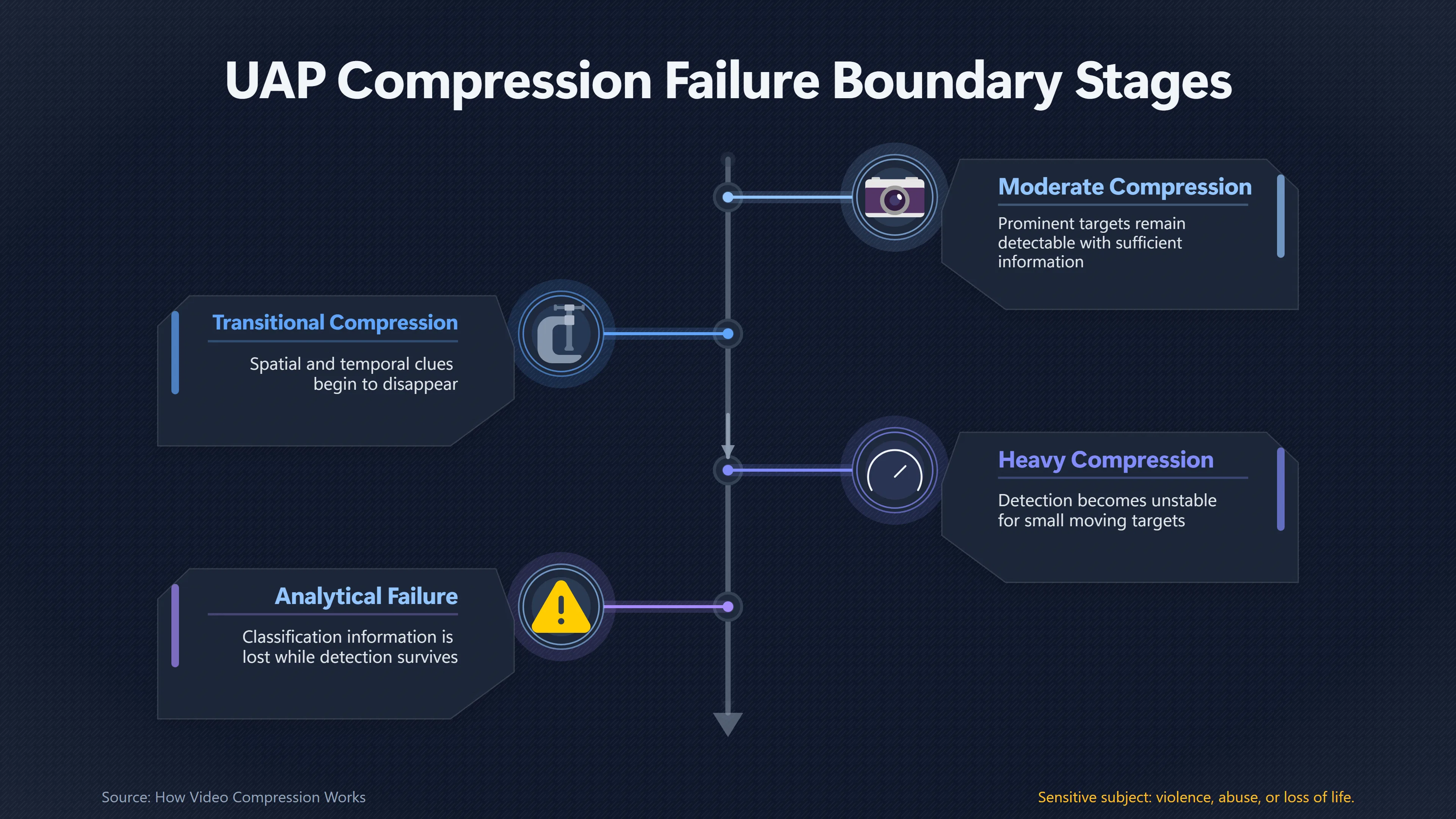
That pattern is more useful for interpreting UAP footage than any supposed universal bitrate threshold. It suggests three broad regimes rather than a sharp dividing line:
- Moderate compression: much of the information needed simply to detect a sufficiently prominent target can survive.
- Transitional compression: the object remains visible, but weaker spatial or temporal clues begin disappearing, so tracking and identification become less dependable.
- Heavy compression: losses become large enough that detection itself may become unstable, particularly for small, moving or poorly contrasted objects.
The boundaries between those regimes move according to the footage. A large aircraft against an uncluttered sky has considerable redundancy. A distant light or infrared spot occupying very few pixels has far less information available to lose.
This also explains why visual inspection alone is an inadequate test of whether compression has become important. Bhowmik and colleagues, studying compressed thermal imagery, found that computer-vision performance could decline even when compressed images remained visually very similar to their originals. Compression can therefore remove weak discriminating information before the overall picture looks obviously damaged to a human observer.[CVF Open Access]thecvf.comOpen source on thecvf.com.
What detection and tracking studies show
The historical research record does not support the simple claim that “any compression ruins analysis”. Studies instead show a graded effect, with the strongest deterioration appearing as compression becomes more aggressive or the visual task becomes harder.
As early as 2011, researchers at the Technical University of Munich were investigating JPEG and H.264 compression specifically because irreversible changes to far-infrared night-vision imagery could affect pedestrian-detection systems. The problem was already being treated not merely as one of subjective picture quality but of task performance: whether useful information-processing operations still worked on the compressed imagery.[Technical University of Munich]tum.deOpen source on tum.de.
Later work has made that relationship clearer. In the surveillance experiment by O’Byrne and colleagues, moderate H.264 compression produced substantial storage savings before detection suffered seriously. The result is a useful corrective to claims that the presence of compression alone invalidates a video. What matters is how strongly the material has been compressed relative to the difficulty of the target.[arXiv]arxiv.orgOpen source on arxiv.org.
Tracking presents an additional problem because it depends on maintaining useful information across successive frames. Takehiro Tanaka, Alon Harell and Ivan Bajić tested HEVC-compressed video using QP values from 18 through 46 and a YOLOv3-plus-SORT tracking system. Their statistical analysis found that QP had a significant effect on Multiple Object Tracking Accuracy (MOTA), while the tested motion-search-range parameter did not show a statistically supported effect. Average tracking performance was highest on uncompressed footage and declined as QP increased.[ResearchGate]researchgate.netOpen source on researchgate.net.
Importantly, the researchers also reported that even low-to-moderate compression could have a statistically significant effect on tracking. That does not mean every moderately compressed track becomes unusable. It means that “the target can still be seen” and “its motion can still be measured with the same reliability” are different propositions.[ResearchGate]researchgate.netOpen source on researchgate.net.
This distinction is particularly relevant to UFO videos because unusual motion is often central to the interpretation. If a target intermittently loses its clean boundary, merges with nearby pixels or becomes harder for a tracker to localise consistently, apparent variations in its trajectory need to be treated more cautiously. The tracking research does not establish that a particular UAP movement is a compression artefact; it establishes that increasing compression is capable of degrading the measurements used to support such a claim.
Small infrared targets reach the limit first
Perhaps the closest experimental analogue to many military UAP recordings comes from the 2022 CVPR Workshops study Lost in Compression. Researchers applied JPEG compression at quality settings of 95, 75, 50, 15, 10 and 5 to thermal infrared imagery from the FLIR dataset and tested three different object-detection architectures.[CVF Open Access]thecvf.comOpen source on thecvf.com.
The most important result for UAP analysis was not simply that extreme compression reduced performance. It was that object size changed the effect. Tiny and small objects were more sensitive to compression than medium and large objects, and the strongest deterioration appeared at the heavier compression levels of 15, 10 and 5.[CVF Open Access]thecvf.comOpen source on thecvf.com.
That result makes intuitive sense. Consider two targets:
Target A spans a large portion of the image. Even after some fine detail is removed, many edges, intensity differences and structural relationships remain.
Target B is a distant aircraft represented by a tiny cluster of infrared pixels. Those few pixels carry almost all the available evidence about its extent and shape. Altering only a small amount of information can therefore change a large fraction of the evidence available for identification.
The second situation resembles a substantial fraction of difficult UAP footage far more closely than ordinary high-resolution photography. A tiny object may survive compression as a visible spot while losing the subtle information needed to distinguish wings, fuselage, multiple adjacent objects or a stable outline. The important threshold is therefore not necessarily where the target disappears. It may be where classification information disappears while detection information survives.
The infrared study also produced a caution about treating compression thresholds as universal constants. Retraining the detection systems on compressed imagery substantially improved their performance under severe compression. In other words, the failure point depended partly on the analysis system as well as on the image itself.[CVF Open Access]thecvf.comOpen source on thecvf.com.
Which target and scene conditions raise the risk?
Across the experimental literature, several conditions repeatedly move footage towards the unreliable side of the compression boundary.
Very small targets are the clearest warning sign. The FLIR experiments directly found greater compression sensitivity among tiny and small objects. For UAP analysis, this means the number of useful target pixels matters more than whether the overall video resolution sounds impressive. A 4K frame does not provide 4K worth of information about an object occupying only a minute fraction of it.[CVF Open Access]thecvf.comOpen source on thecvf.com.
Fast movement makes aggressive compression more consequential. The surveillance experiments found appreciable degradation at high compression levels particularly in scenes containing fast-moving targets. This matters where either the object or the camera platform is moving rapidly, because investigators may be interested not just in recognising the object but in measuring its changing position.[arXiv]arxiv.orgOpen source on arxiv.org.
Poor illumination and weak contrast reduce the safety margin. O’Byrne and colleagues identified poor lighting among the difficult conditions under which strongly compressed video produced greater detection degradation. Earlier automotive research likewise examined compression specifically in far-infrared night-vision detection, where the imagery is being used to extract objects under conditions in which ordinary visible-light cues are limited.[arXiv]arxiv.orgOpen source on arxiv.org.
Complex scenes consume the available encoding budget. The surveillance research found stronger degradation in difficult, complex scenes. A small object against a clean, nearly uniform sky is a fundamentally easier encoding and detection problem than a similarly sized object against cloud texture, terrain, sea clutter, sensor noise or other moving structures.[arXiv]arxiv.orgOpen source on arxiv.org.
Tracking can become questionable before visibility does. Tanaka and colleagues demonstrated a statistically significant relationship between increasing quantisation and tracking accuracy. Thus, investigators should not assume that because a target remains visually apparent throughout a clip, every small positional change represents equally trustworthy physical motion.[ResearchGate]researchgate.netOpen source on researchgate.net.
These factors compound one another. A large, slow object against an uncluttered background may tolerate considerable compression. A tiny, low-contrast, fast-moving infrared target in a noisy or complex scene can become analytically fragile much sooner.

The UAP case that demonstrates the practical problem
AARO’s South Asian “Atmospheric Wake” case provides a concrete example of why compression strength and available source quality matter in UFO analysis. The footage was captured by an MQ-9 forward-looking infrared sensor and appeared to show an object with a trailing atmospheric disturbance. After analysing the full-motion video, additional footage taken at a longer focal length and commercial flight information, the All-domain Anomaly Resolution Office assessed the object as probably a commercial aircraft and the apparent trailing feature as a sensor artefact resulting from video compression.[AARO]aaro.milOpen source on aaro.mil.
The case is significant here for what happened when the evidence base improved. Investigators did not have to infer the object’s identity solely from the shape of the compressed target. They could compare more informative imagery and external flight data. A visually striking feature in the poorer representation was therefore not treated automatically as a physical structure belonging to the object.[AARO]aaro.milOpen source on aaro.mil.
This is exactly where compression-strength research changes the interpretation of UFO footage. As compression increases, the sensible question shifts from “Can I still see the object?” to “Which claims does this version of the video still support?” Detection, tracking, shape identification and fine-feature interpretation require progressively more dependable information.
A compressed UAP clip might therefore support the statement that a moving target was recorded while being inadequate to establish whether a small protrusion is a wing, whether a faint extension is a wake, or whether slight frame-to-frame deformation represents a physical shape change. AARO’s case demonstrates that this distinction is not merely theoretical: compression-related structure has already figured in the official assessment of apparently anomalous military footage.[AARO]aaro.milOpen source on aaro.mil.
When should compressed UFO footage be treated cautiously?
The research does not justify imposing a universal CRF, QP, JPEG-quality or bitrate cut-off on UAP evidence. Values that worked in one experiment cannot simply be transferred to a different sensor, codec, target size and scene. The surveillance study’s useful performance around H.264 CRF 37, for example, is evidence about that experiment, not a declaration that every video encoded at CRF 37 preserves aircraft-identification evidence. Likewise, the sharp losses at low JPEG-quality settings in the FLIR experiments demonstrate a trend rather than a universal forensic threshold.[arXiv]arxiv.orgOpen source on arxiv.org.
A better assessment is relative. Confidence should decline as several risk factors accumulate: a target only a few pixels across, heavy quantisation, weak contrast, rapid relative motion, difficult lighting, cluttered backgrounds, unstable tracking or dependence on very fine shape details. Multiple rounds of processing or distribution can make provenance and compression history particularly important because the analyst may no longer know how closely the available clip represents the original sensor output.
The strongest warning sign is a mismatch between the coarseness of the evidence and the precision of the claim. Heavily compressed footage may still establish that a target exists and moves through the scene, yet be incapable of supporting confident statements about tiny appendages, exact outlines or subtle changes of shape. Conversely, dismissing every compressed video is also unsupported: experiments show that substantial data reduction can sometimes be achieved while useful detection performance remains comparatively stable.[arXiv]arxiv.orgOpen source on arxiv.org.
For UFO investigations, compression strength is therefore best understood as a sliding evidential limit rather than an on/off switch. The smaller, faster, dimmer and more visually complicated the target, the sooner that limit is reached. Once a case depends on details near that boundary, higher-quality source footage, longer-focal-length imagery, original sensor data or independent evidence becomes substantially more valuable than further enlargement of the compressed pixels already available.
Amazon book picks
Further Reading
Books and field guides related to How Much Compression Makes UFO Footage Unreliable?. Use these as the next step if you want deeper reading beyond the article.
H.264 and MPEG-4 Video Compression: Video Coding for Next-gen...
Following on from the successful MPEG-2 standard, MPEG-4 Visual is enabling a new wave of multimedia applications from Internet video str...
The H.264 Advanced Video Compression Standard
H.264 Advanced Video Coding or MPEG-4 Part 10 is fundamental to a growing range of markets such as high definition broadcasting, internet...
Digital Video and HD: Algorithms and Interfaces
& Quot;Digital Video and HDTV Algorithms and Interfaces covers the theory and engineering of digital video systems in a manner that is eq...
Digital Image Processing
This is the eBook of the printed book and may not include any media, website access codes, or print supplements that may come packaged wi...
eBay marketplace picks
Marketplace Samples
Live-tested eBay searches with available results related to this page.
Selected fromUFO poster oneBay.co.uk.

Current eBay listing
I Want To Believe UFO Poster Giclée Fine Art Heavyweight Print


Current eBay listing
VINTAGE UFO FLYING SAUCERS COMIC ADVERTISING A2 POSTER PRINT

Endnotes
1.
Source: aaro.mil
Link:https://www.aaro.mil/UAP-Cases/Official-UAP-Imagery/
Additional References
2.
Source: youtube.com
Title: How Video Compression Works
Link:https://www.youtube.com/watch?v=QoZ8pccsYo4
Source snippet
Bitrate CRF bitrate quantization video compression quality loss Video Compression 101...
3.
Source: youtube.com
Title: Handbrake x264 “Constant Quality” (RF) comparisons
Link:https://www.youtube.com/watch?v=YicJVl1J2oE
Source snippet
FFMPEG Constant Rate Factor (CRF) Comparison...
4.
Source: eceweb.uwaterloo.ca
Link:https://eceweb.uwaterloo.ca/~z70wang/publications/HVEI14.pdf
5.
Source: youtube.com
Title: Beat the Compression! How to Get Better You Tube Uploads
Link:https://www.youtube.com/watch?v=DI1BjkmVhTg
Source snippet
Video Compression 101...
6.
Source: youtube.com
Title: Video Compression 101
Link:https://www.youtube.com/watch?v=HEiH2hjN4sY
Source snippet
How Video Compression Works...