Within UFO Identifications
When Separate Lights Look Like One Huge Craft
Separate aircraft, satellites or flares can align from one viewpoint and appear to form a single structured object or coordinated formation.
On this page
- How perspective joins unrelated lights
- Why darkness encourages imagined outlines
- Testing whether lights share distance and motion
Page outline Jump by section
Introduction
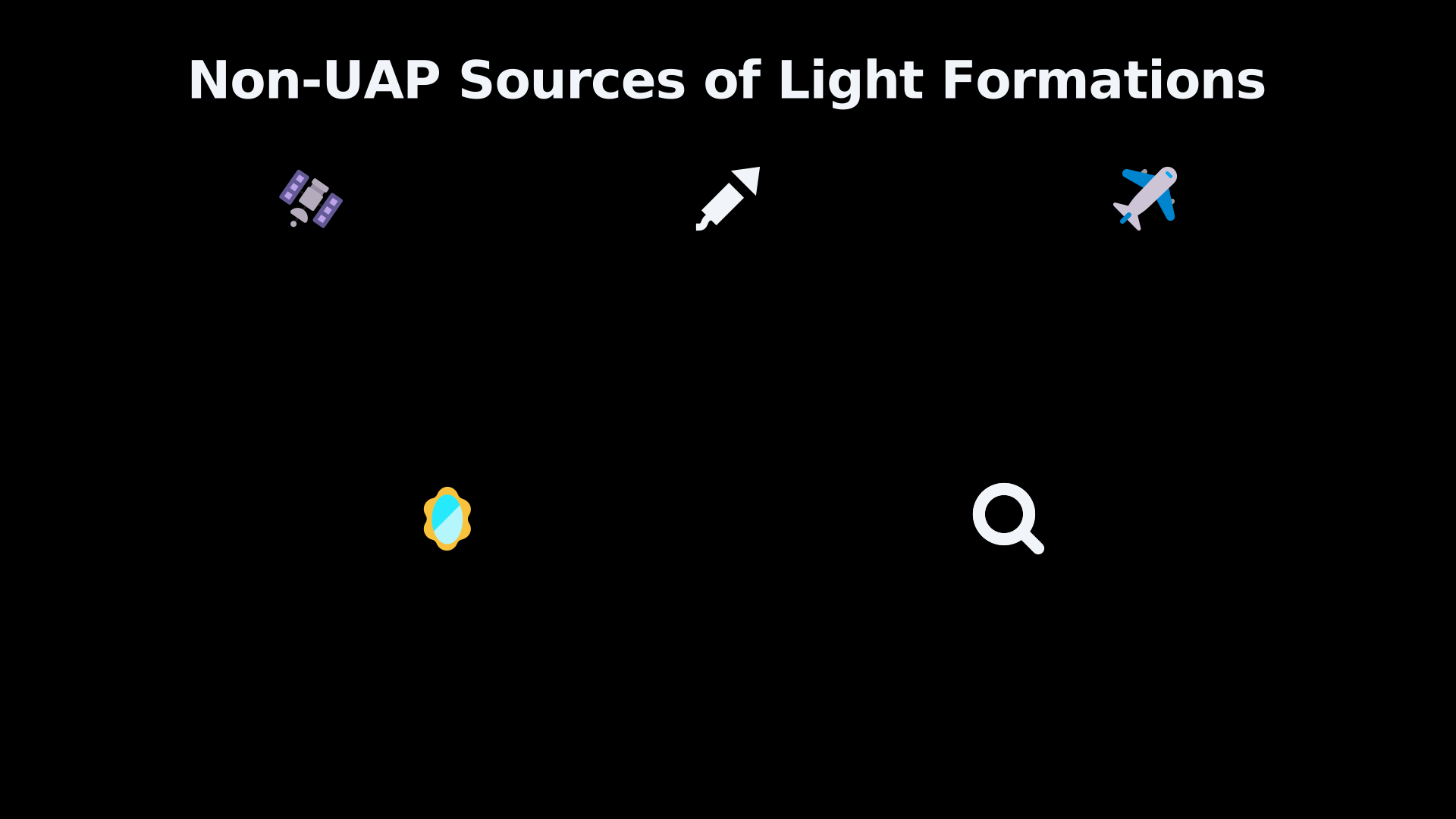
Several ordinary lights can look like a single enormous UFO when perspective strips away the information that would normally tell us they are separate objects. Aircraft on different flight paths, satellites spread along an orbit, or illumination flares descending many kilometres away can project onto the sky as a neat line, arc, V or triangle. In darkness, the eye then has little evidence for their individual distances, and visual perception naturally groups nearby or similarly moving points into a coherent whole.[Aviation Safety Reporting System]asrs.arc.nasa.govAviation Safety Reporting System CALLBACK 246Aviation Safety Reporting System CALLBACK 246
That distinction matters because a formation of lights is not, by itself, evidence for a craft connecting them. The crucial question is whether the lights can independently be shown to share the same distance, motion and physical structure. Modern UAP analysis increasingly makes that test explicitly: the All-domain Anomaly Resolution Office (AARO) now uses three-dimensional modelling to identify cases in which apparently remarkable lights are actually satellites or other ordinary objects seen under misleading geometry.[AARO]aaro.milUAP RecordsAARO UAP Records…
How perspective joins unrelated lights
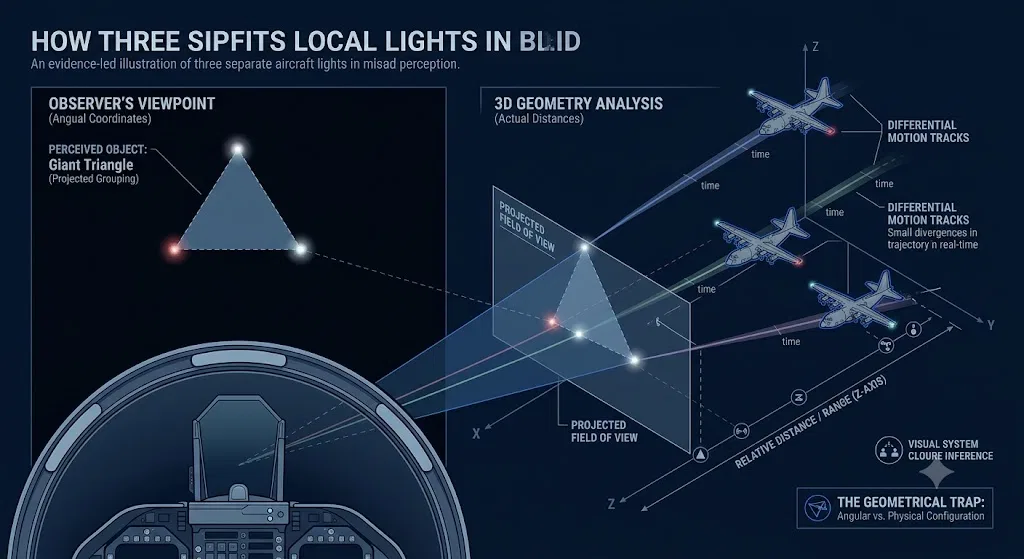
A night sky is effectively a two-dimensional screen unless the observer has reliable depth cues. A bright point might be a nearby aircraft, a distant aircraft, a satellite hundreds of kilometres away or a flare beyond a mountain range; its angular position alone does not reveal its range. Two or more objects at substantially different distances can therefore fall along neighbouring lines of sight and appear to belong to one formation.
NASA’s Aviation Safety Reporting System has documented an unusually clear real-world example. Three people in an aircraft saw what appeared to be two lights belonging to a single large aircraft rapidly approaching them. They took evasive action. Only when the sources came closer did they discover that the supposed single aircraft was actually two separate aircraft approaching from the west. The observers specifically reported a very dark, moonless environment over water, with few surface features to provide scale or separation cues.[Aviation Safety Reporting System]asrs.arc.nasa.govAviation Safety Reporting System CALLBACK 246Aviation Safety Reporting System CALLBACK 246
The same NASA bulletin records an even more revealing combination: another pilot interpreted the red and green lights of an aircraft together with a bright star as the lights of one threatening aircraft. In physical space, one of the apparent “running lights” was not attached to the aircraft at all. It merely occupied a convincing position in the observer’s field of view.[Aviation Safety Reporting System]asrs.arc.nasa.govAviation Safety Reporting System CALLBACK 246Aviation Safety Reporting System CALLBACK 246
This is the key geometrical trap in reports of giant triangles or V-shaped craft. If three lights subtend the corners of a triangle, the observer sees a triangle in angular coordinates. That observation does not establish a triangular solid object between them. To establish the latter, investigators need additional evidence showing that the lights remain physically connected rather than merely projected into a suggestive arrangement.
Perspective can also make genuinely coordinated but separate objects look like one structure. Aircraft do fly in formations, and newly deployed satellites can travel in strikingly regular sequences. After SpaceX’s first major Starlink deployment in 2019, dozens of satellites were visible as a tightly organised straight line crossing the sky; contemporary observing reports described nearly 50 distinct satellites visible in a single linear procession. The formation was real, but the “object” was not: each light was a separate spacecraft.[Sky & Telescope]skyandtelescope.orgSky & Telescope Space X Launches First Volley of Starlink SatellitesSky & TelescopeSpaceX Launches First Volley of Starlink Satellites - Sky & Telescope…
Why darkness encourages imagined outlines
The tendency to connect lights is not peculiar to UFO witnesses. It reflects ordinary visual organisation. A large body of experimental psychology shows that the visual system groups elements using cues including proximity, similarity, good continuation, closure and common fate — the tendency to treat elements moving in similar ways as parts of the same perceptual unit.[nih.gov]pmc.ncbi.nlm.nih.govPub Med Central (PMC)A Century of Gestalt Psychology in Visual Perception Iby J Wagemans · 2012 · Cited by 2382 — Contour Integration we discuss the grouping principles that play a role in contour integration…
Against a detailed daytime background these grouping tendencies are constrained by abundant contradictory information. Buildings, clouds, landscape features and visible aircraft bodies help establish scale and depth. Against a dark sky, much of that information disappears. The FAA explicitly warns pilots that night flight over featureless terrain can remove normal peripheral orientation cues, and that a stationary point of light against a completely dark background can even acquire illusory motion through the autokinetic effect.[Federal Aviation Administration]faa.govFederal Aviation Administration Spatial DFederal Aviation Administration Spatial D
Several effects therefore reinforce one another:
- Proximity: lights close together in the field of view are more readily treated as belonging together.
- Common motion: if the lights drift in roughly the same direction, the visual system has an additional reason to group them.
- Regular spacing: lines, arcs and symmetrical V shapes look more intentionally organised than irregular scatterings.
- Closure: when lights roughly mark the corners or edges of a familiar shape, perception can favour the implied whole even though no illuminated outline exists.
- Missing depth cues: without a visible surface, horizon or intervening scenery, there may be no immediate way to tell whether the lights are hundreds of metres apart or many kilometres apart.
These are useful perceptual mechanisms, but they should not be turned into a catch-all dismissal. Seeing a triangle of lights does not prove that the triangle is imaginary; aircraft, drones and other systems can genuinely maintain geometric formations. The narrower point is that the perceived outline is an inference until independent observations establish a connecting structure.
The danger becomes especially strong when observers describe a dark area between lights as the body of an object. A patch of black sky supplies remarkably little positive information. If stars are absent inside the apparent outline, that can be significant only if investigators first establish that stars should have been visible there under the actual brightness, haze, cloud and glare conditions. Bright lights themselves can impair detection of much fainter background stars. An absence that feels like a silhouette is therefore not automatically evidence of an opaque hull.
Real formations can mimic a single craft
Not every misleading formation consists of coincidentally aligned objects. Sometimes several ordinary objects genuinely are travelling together, but witnesses reasonably interpret their collective pattern as the lighting geometry of one much larger vehicle.
Aircraft provide the simplest example. At long distance, fuselages and wings become too small or too poorly illuminated to see while navigation, landing or formation lights remain conspicuous. A flight of several aircraft can consequently be reduced to several luminous points. If their relative positions remain stable, “common fate” becomes a powerful perceptual cue: the lights turn, climb or cross the sky together, exactly as lights attached to one rigid object might. The NASA case in which two independent aircraft initially appeared to be one large aircraft demonstrates that observers need not be careless for this fusion to occur.[Aviation Safety Reporting System]asrs.arc.nasa.govAviation Safety Reporting System CALLBACK 246Aviation Safety Reporting System CALLBACK 246
Satellite deployments create a different geometry. The first Starlink launches produced trains in which dozens of separate spacecraft followed almost the same orbital track. In the early phase after deployment, they could form a compact, orderly line visible to the naked eye. Individual satellites could also brighten and fade as their reflecting geometry changed.[Sky & Telescope]skyandtelescope.orgSky & Telescope Space X Launches First Volley of Starlink SatellitesSky & TelescopeSpaceX Launches First Volley of Starlink Satellites - Sky & Telescope…
This satellite mechanism has become important enough to affect official UAP statistics. AARO’s FY2025 report says a newly adopted analytical capability enabled it to resolve 238 previously reported UAP as satellite flaring. The office describes satellite reports as frequently involving bright or coloured lights and moving “orbs”, and says it uses three-dimensional modelling to test whether reported observations match sunlight reflecting from orbiting spacecraft.[AARO]aaro.milFY25 Consolidated Annual Report on UAPAARO FY25 Consolidated Annual Report on UAP…
AARO has separately published technical material explaining how specular and diffuse sunlight reflections from satellites can be mistaken for UAP, alongside a paper on forced perspective and parallax. The significance is not that every cluster of lights is Starlink, but that modern investigators can increasingly replace visual impressions with predicted positions, illumination geometry and trajectories.[AARO]aaro.milUAP RecordsAARO UAP Records…

Flares can create shapes without a vehicle
Flares are especially effective at producing apparent formations because multiple bright sources may be released in a deliberate pattern and remain visible for a substantial period. Parachute-supported illumination flares descend slowly, so from a distant viewpoint their downward movement can be subtle. Several may appear approximately stationary, while their spacing suggests a line, arc or other coherent arrangement.
The later lights in the famous Phoenix Lights episode of 13 March 1997 illustrate why this mechanism deserves careful separation from claims about a single structured craft. At roughly 10 p.m., observers around Phoenix saw a row of brilliant lights that appeared to hang over the region. Months later, the military reported that Maryland Air National Guard aircraft had released high-intensity illumination flares during training over the Barry M. Goldwater Range. Contemporary Associated Press reporting recorded the military flare explanation, and later accounts have continued to distinguish this later Phoenix display from the earlier moving V-shaped reports that evening.[Deseret News]deseret.comNews Flares, not UFOs, caused light show, military saysNews Flares, not UFOs, caused light show, military says
That distinction is methodologically important. A night containing several unusual-looking light events need not have one cause, and apparent continuity between sightings cannot simply be assumed. Treating all observations as manifestations of one giant object can itself manufacture a stronger case than the raw evidence supports.
Flares can also vanish in a way that makes the formation seem technologically controlled. A flare may burn out, become obscured by terrain or haze, or drop below a ridge invisible against the dark sky. If several lights disappear sequentially, witnesses may understandably interpret the pattern as lights on a craft being switched off. The alternative hypothesis predicts essentially the same visual sequence without requiring a solid structure connecting the sources.
Apparent rigidity is suggestive, not decisive
One of the strongest arguments witnesses give for a single object is that the lights “held formation” while moving. That observation deserves weight, but it does not uniquely identify a rigid craft.
Separate aircraft flying together are intended to preserve relative position. Satellites in related orbits can maintain orderly angular relationships for part of a pass. Distant flares released from aircraft can initially inherit systematic spacing and motion. And objects that are physically unrelated can show very little relative angular movement when the observation is short or when they are extremely distant.
What would be more diagnostic is evidence of rigid-body motion. If lights truly occupy fixed positions on one craft, then changes in viewing angle should produce a geometrically consistent transformation of the entire pattern. Their angular separations should change together in ways compatible with a single object at one range. Independent points at different distances are more likely, given sufficiently good observations, to reveal differential motion or parallax.
This is why witness descriptions such as “the lights moved together” are valuable starting data rather than final proof of structure. The central investigative risk is moving too quickly from a statement about angular configuration — what the lights looked like from one viewpoint — to a statement about physical configuration in three-dimensional space.
Testing whether the lights share distance and motion
A good investigation asks not “what shape do the lights resemble?” but “what measurements would have to be true if they belonged to one object?” That change of question turns an impression into a testable geometry.
The most useful checks are complementary rather than individually conclusive.
Track each light separately. Frame-by-frame video can show whether angular spacing is genuinely constant. Small divergences that are difficult to notice in real time may reveal independent trajectories.
Use observations from separated locations. Parallax is particularly valuable because changing the observer’s position changes the apparent direction of nearby objects more than distant ones. NASA defines the parallax effect precisely in terms of an apparent positional shift caused by movement of the observer, and its aviation cases show how badly distance can be misjudged when this geometry is not recognised.[Aviation Safety Reporting System]asrs.arc.nasa.govAviation Safety Reporting System CALLBACK 246Aviation Safety Reporting System CALLBACK 246 Two synchronised recordings from well-separated locations can therefore help determine whether apparently adjacent lights occupy the same region of space.
Preserve landmarks and the horizon. A tightly zoomed video of lights against black sky discards much of the information needed to reconstruct azimuth, elevation and camera movement. Wider views containing terrain, buildings, stars or a known horizon are often more analytically useful even when the lights themselves look smaller.
Check ordinary traffic and orbital predictions. Time, location and viewing direction allow investigators to compare a sighting with aircraft movements and predicted satellite paths. This kind of reconstruction is central to AARO’s current satellite-flare work, which employs three-dimensional modelling rather than relying on resemblance alone.[AARO]aaro.milFY25 Consolidated Annual Report on UAPAARO FY25 Consolidated Annual Report on UAP…
Look for independent evidence of a connecting body. A continuous silhouette, radar return, thermal structure or multiple-viewpoint geometry consistent with one volume would carry considerably more evidential weight than points of light alone. Conversely, if individual lights can be matched to separate aircraft or satellites, the apparent outline loses its physical basis.
Test disappearance events against terrain and illumination. Lights that seem to switch off at the same angular boundary may actually be passing into shadow, behind a ridge or below a cloud layer. Reconstructing the sightline can distinguish a dramatic visual event from an ordinary occlusion.
The key mistake is turning a pattern into an object
A line, V or triangle of lights is a real observation. The uncertain step is deciding what the pattern represents.
Human vision is designed to organise fragments into objects, and normally that is extremely useful. At night, however, the same process works with unusually sparse information. Nearby points group together; coordinated motion strengthens the grouping; missing depth cues make vastly different distances look compatible; and darkness supplies an apparently continuous background on which the mind can infer a hull or outline. Experimental research on perceptual organisation and operational aviation experience both show that these effects are ordinary features of vision rather than evidence that witnesses are unreliable.[nih.gov]pmc.ncbi.nlm.nih.govPub Med Central (PMC)A Century of Gestalt Psychology in Visual Perception Iby J Wagemans · 2012 · Cited by 2382 — Contour Integration we discuss the grouping principles that play a role in contour integration…
For UFO and UAP analysis, the safest conclusion is therefore deliberately modest: multiple lights can demonstrate a formation without demonstrating a single craft. Establishing one physical object requires evidence that the lights share a common range, move as a rigid system and are connected by something more than the geometry of one observer’s line of sight.
Amazon book picks
Further Reading
Books and field guides related to When Separate Lights Look Like One Huge Craft. Use these as the next step if you want deeper reading beyond the article.
Sensation and Perception
. Bruce Goldstein's SENSATION AND PERCEPTION, the best-seller which has helped over 150,000 students understand the ties between how we s...
Visual Intelligence: How We Create What We See
A unique, illustrated popular study reveals the way the human eye acts on the visual world not just to represent but to create the things...
The UFO Handbook: A Guide to Investigating, Evaluating, and R...
An explanation of the usual reasons for confusing IFOs (identified flying objects) with UFOs and a survey of the tools used to investigat...
The Cambridge Handbook of Visuospatial Thinking
Visuospatial thinking encompasses a wide range of thinking processes concerning space, whether it be navigating across town, understandin...
eBay marketplace picks
Marketplace Samples
Live-tested eBay searches with available results related to this page.
Selected fromUFO poster oneBay.co.uk.
Current eBay listing
I Want To Believe UFO Poster Giclée Fine Art Heavyweight Print
Current eBay listing
VINTAGE UFO FLYING SAUCERS COMIC ADVERTISING A2 POSTER PRINT

Endnotes
1.
Source: asrs.arc.nasa.gov
Title: Aviation Safety Reporting System CALLBACK 246
Link:https://asrs.arc.nasa.gov/publications/callback/cb_246.htm
2.
Source: aaro.mil
Title: UAP Records
Link:https://www.aaro.mil/UAP-Records/
Source snippet
AARO UAP Records...
3.
Source: aaro.mil
Title: FY25 Consolidated Annual Report on UAP
Link:https://www.aaro.mil/Portals/136/PDFs/FY25%20UAP%20Annual%20Report/AARO_FY2025_Consolidated_Annual_Report_on_UAP.pdf
Source snippet
AARO FY25 Consolidated Annual Report on UAP...
4.
Source: faa.gov
Title: Federal Aviation Administration Spatial D
Link:https://www.faa.gov/pilots/safety/pilotsafetybrochures/media/spatiald_visillus.pdf
5.
Source: deseret.com
Title: News Flares, not UFOs, caused light show, military says
Link:https://www.deseret.com/1997/7/26/19325702/flares-not-ufos-caused-light-show-military-says/
6.
Source: ntrs.nasa.gov
Link:https://ntrs.nasa.gov/api/citations/19710024584/downloads/19710024584.pdf
7.
Source: ntrs.nasa.gov
Link:https://ntrs.nasa.gov/api/citations/19840008727/downloads/19840008727.pdf
8.
Source: ntrs.nasa.gov
Link:https://ntrs.nasa.gov/api/citations/19890012106/downloads/19890012106.pdf
9.
Source: ntrs.nasa.gov
Link:https://ntrs.nasa.gov/api/citations/19970005476/downloads/19970005476.pdf
10.
Source: ntrs.nasa.gov
Link:https://ntrs.nasa.gov/api/citations/19800017541/downloads/19800017541.pdf
11.
Source: ntrs.nasa.gov
Link:https://ntrs.nasa.gov/api/citations/20030051605/downloads/20030051605.pdf
12.
Source: ntrs.nasa.gov
Link:https://ntrs.nasa.gov/api/citations/19810012531/downloads/19810012531.pdf
13.
Source: asrs.arc.nasa.gov
Title: cb 193
Link:https://asrs.arc.nasa.gov/publications/callback/cb_193.htm
14.
Source: ntrs.nasa.gov
Link:https://ntrs.nasa.gov/api/citations/19850006497/downloads/19850006497.pdf?attachment=true
15.
Source: science.nasa.gov
Title: the moon illusion why does the moon look so big sometimes
Link:https://science.nasa.gov/solar-system/moon/the-moon-illusion-why-does-the-moon-look-so-big-sometimes/
16.
Source: ntrs.nasa.gov
Link:https://ntrs.nasa.gov/api/citations/19780002749/downloads/19780002749.pdf
17.
Source: ntrs.nasa.gov
Link:https://ntrs.nasa.gov/api/citations/19820014374/downloads/19820014374.pdf
18.
Source: ntrs.nasa.gov
Title: MASSot Av5
Link:https://ntrs.nasa.gov/api/citations/20260005089/downloads/MASSotAv5.pdf
19.
Source: nasa.gov
Title: soa 2026
Link:https://www.nasa.gov/wp-content/uploads/2026/05/soa-2026.pdf?emrc=12c9ca
20.
Source: apod.nasa.gov
Title: apod search
Link:https://apod.nasa.gov/cgi-bin/apod/apod_search?tquery=orion
21.
Source: ntrs.nasa.gov
Title: CA Handbook CM Version 2 24 23.docx
Link:https://ntrs.nasa.gov/api/citations/20230002470/downloads/CA_Handbook_CM%20Version%202-24-23.docx.pdf
22.
Source: science.nasa.gov
Title: heliophysics lws architecture committee report final
Link:https://science.nasa.gov/wp-content/uploads/2024/06/nasa-heliophysics-lws-architecture-committee-report-final.pdf
23.
Source: nasa.gov
Title: Image of the Day
Link:https://www.nasa.gov/image-of-the-day/page/23/?id=366456
24.
Source: ntrs.nasa.gov
Title: SOA 2025 Final
Link:https://ntrs.nasa.gov/api/citations/20250000142/downloads/SOA%202025_Final.pdf?attachment=true
25.
Source: ntrs.nasa.gov
Link:https://ntrs.nasa.gov/api/citations/19960003417/downloads/19960003417.pdf
26.
Source: ceres.larc.nasa.gov
Link:https://ceres.larc.nasa.gov/science/publications/
27.
Source: nasa.gov
Title: 2025 in review highlights from nasa in silicon valley
Link:https://www.nasa.gov/centers-and-facilities/ames/2025-in-review-highlights-from-nasa-in-silicon-valley/
28.
Source: aaro.mil
Link:https://www.aaro.mil/
29.
Source: aaro.mil
Link:https://www.aaro.mil/Resources/
30.
Source: aaro.mil
Link:https://www.aaro.mil/UAP-Cases/Official-UAP-Imagery/
31.
Source: aaro.mil
Link:https://www.aaro.mil/UAP-Cases/UAP-Reporting-Trends/
32.
Source: aaro.mil
Link:https://www.aaro.mil/FAQ/
33.
Source: faa.gov
Link:https://www.faa.gov/sites/faa.gov/files/regulations_policies/handbooks_manuals/aviation/airplane_handbook/12_afh_ch11.pdf
34.
Source: faa.gov
Link:https://www.faa.gov/sites/faa.gov/files/regulations_policies/handbooks_manuals/aviation/phak/19_phak_ch17.pdf
35.
Source: faa.gov
Link:https://www.faa.gov/sites/faa.gov/files/2022-01/NovDec2015.pdf
36.
Source: faa.gov
Title: pilot handbook
Link:https://www.faa.gov/sites/faa.gov/files/pilots/pilot_handbook.pdf
37.
Source: faa.gov
Link:https://www.faa.gov/air_traffic/publications/atpubs/aim_html/chap7_section_6.html
38.
Source: faa.gov
Link:https://www.faa.gov/sites/faa.gov/files/data_research/research/med_humanfacs/oamtechreports/AM79-25.pdf
39.
Source: faa.gov
Title: PHA K Table of Contents Chapter 1
Link:https://www.faa.gov/sites/faa.gov/files/regulations_policies/handbooks_manuals/aviation/phak/02_phak_toc.pdf
40.
Source: faa.gov
Link:https://www.faa.gov/about/office_org/headquarters_offices/avs/offices/aam/cami/library/online_libraries/aerospace_medicine/media/77004299.pdf
41.
Source: faa.gov
Link:https://www.faa.gov/sites/faa.gov/files/about/office_org/headquarters_offices/avs/Final%2520Report%2520FA8650-04-C-6457.pdf
42.
Source: faa.gov
Title: 2019 11 07 ACS WG Interim Recommendation Report Powered Lift Handbook
Link:https://www.faa.gov/regulations_policies/rulemaking/committees/documents/media/2019-11-07%20ACS%20WG%20Interim%20Recommendation%20Report%20-%20Powered-Lift%20Handbook.pdf
43.
Source: phoenix.gov
Link:https://www.phoenix.gov/
44.
Source: pmc.ncbi.nlm.nih.gov
Title: Pub Med Central (PMC)A Century of Gestalt Psychology in Visual Perception I
Link:https://pmc.ncbi.nlm.nih.gov/articles/PMC3482144/
Source snippet
by J Wagemans · 2012 · Cited by 2382 — Contour Integration we discuss the grouping principles that play a role in contour integration...
45.
Source: skyandtelescope.org
Title: Sky & Telescope Space X Launches First Volley of Starlink Satellites
Link:https://skyandtelescope.org/astronomy-news/observing-news/spacex-launches-starlink-satellites/
Source snippet
Sky & TelescopeSpaceX Launches First Volley of Starlink Satellites - Sky & Telescope...
46.
Source: frontiersin.org
Link:https://www.frontiersin.org/journals/psychology/articles/10.3389/fpsyg.2014.00719/full
Source snippet
FrontiersThe development of contour processing: evidence from...by G Taylor · 2014 · Cited by 25 — Gestalt theorists have proposed that...
47.
Source: pmc.ncbi.nlm.nih.gov
Link:https://pmc.ncbi.nlm.nih.gov/articles/PMC10746863/
Source snippet
When the dots shown...Read more...
48.
Source: frontiersin.org
Link:https://www.frontiersin.org/journals/computer-science/articles/10.3389/fcomp.2023.1154957/full
49.
Source: frontiersin.org
Link:https://www.frontiersin.org/journals/psychology/articles/10.3389/fpsyg.2012.00274/full
50.
Source: frontiersin.org
Link:https://www.frontiersin.org/journals/psychology/articles/10.3389/fpsyg.2018.01358/full
51.
Source: frontiersin.org
Link:https://www.frontiersin.org/journals/psychology/articles/10.3389/fpsyg.2018.01455/full
52.
Source: frontiersin.org
Link:https://www.frontiersin.org/journals/psychology/articles/10.3389/fpsyg.2012.00274/xml/nlm?isPublishedV2=False
53.
Source: frontiersin.org
Link:https://www.frontiersin.org/journals/human-neuroscience/articles/10.3389/fnhum.2022.960542/full
54.
Source: frontiersin.org
Link:https://www.frontiersin.org/journals/psychology/articles/10.3389/fpsyg.2015.01522/pdf
55.
Source: frontiersin.org
Link:https://www.frontiersin.org/journals/psychology/articles/10.3389/fpsyg.2014.00800/full
56.
Source: frontiersin.org
Link:https://www.frontiersin.org/journals/psychology/articles/10.3389/fpsyg.2012.00259/full
57.
Source: skyandtelescope.org
Title: top 10 astronomy news stories 2019
Link:https://skyandtelescope.org/astronomy-news/top-10-astronomy-news-stories-2019/
58.
Source: skyandtelescope.org
Title: this weeks sky at a glance december 3 11
Link:https://skyandtelescope.org/astronomy-news/this-weeks-sky-at-a-glance-december-3-11/
59.
Source: skyandtelescope.org
Title: parker solar probe swings by sun in closest approach yet
Link:https://skyandtelescope.org/astronomy-news/parker-solar-probe-swings-by-sun-in-closest-approach-yet/
60.
Source: skyandtelescope.org
Link:https://skyandtelescope.org/astronomy-news/amazing-images-giant-fireball-bering-sea/
61.
Source: skyandtelescope.org
Title: euclid observatory opens cosmic treasure trove
Link:https://skyandtelescope.org/astronomy-news/euclid-observatory-opens-cosmic-treasure-trove/
62.
Source: skyandtelescope.org
Title: 2012 venus transit streports
Link:https://skyandtelescope.org/astronomy-news/observing-news/2012-venus-transit-streports/
63.
Source: skyandtelescope.org
Title: eking out observing from under wildfire smoke
Link:https://skyandtelescope.org/astronomy-news/observing-news/eking-out-observing-from-under-wildfire-smoke/
64.
Source: skyandtelescope.org
Title: stindex 2000 2009
Link:https://skyandtelescope.org/wp-content/uploads/stindex-2000-2009.htm
65.
Source: skyandtelescope.org
Title: stindex thru May 2020.txt
Link:https://skyandtelescope.org/wp-content/uploads/stindex-thru-May-2020.txt
Published: May 2020
66.
Source: dictionary.cambridge.org
Link:https://dictionary.cambridge.org/dictionary/english/pilot
67.
Source: Wikipedia
Link:https://en.wikipedia.org/wiki/Phoenix
68.
Source: Wikipedia
Title: Phoenix Lights
Link:https://en.wikipedia.org/wiki/Phoenix_Lights
69.
Source: pmc.ncbi.nlm.nih.gov
Link:https://pmc.ncbi.nlm.nih.gov/articles/PMC8142711/
70.
Source: pmc.ncbi.nlm.nih.gov
Link:https://pmc.ncbi.nlm.nih.gov/articles/PMC3728284/
71.
Source: pmc.ncbi.nlm.nih.gov
Link:https://pmc.ncbi.nlm.nih.gov/articles/PMC13035581/
72.
Source: pmc.ncbi.nlm.nih.gov
Link:https://pmc.ncbi.nlm.nih.gov/articles/PMC4630503/
73.
Source: pmc.ncbi.nlm.nih.gov
Link:https://pmc.ncbi.nlm.nih.gov/articles/PMC4085732/
74.
Source: pmc.ncbi.nlm.nih.gov
Link:https://pmc.ncbi.nlm.nih.gov/articles/PMC9326748/
75.
Source: pmc.ncbi.nlm.nih.gov
Link:https://pmc.ncbi.nlm.nih.gov/articles/PMC9774493/
76.
Source: pmc.ncbi.nlm.nih.gov
Link:https://pmc.ncbi.nlm.nih.gov/articles/PMC6138684/
77.
Source: nationalcareers.service.gov.uk
Link:https://nationalcareers.service.gov.uk/job-profiles/airline-pilot
78.
Source: careers.ba.com
Link:https://careers.ba.com/pilots
Additional References
79.
Source: youtube.com
Title: Gestalt principles | Processing the Environment | MCAT | Khan Academy
Link:https://www.youtube.com/watch?v=20N53khArXA
Source snippet
Imperfect Perception: Illusions, Gestalt Principles of Grouping, and Language Relativism...
80.
Source: youtube.com
Link:https://www.youtube.com/watch?v=pMUbfFRsLmQ
Source snippet
How optical illusions trick your brain - Nathan S. Jacobs...
81.
Source: youtube.com
Title: How optical illusions trick your brain
Link:https://www.youtube.com/watch?v=rfdJyDfIHIc
Source snippet
Starlink train satellite formation lights ufo star link satellites passes by 🛰🛰🛰 #starlink #satellite...
82.
Source: youtube.com
Title: The Un Xplained: The Phoenix Lights Phenomenon is STILL UNEXPLAINABLE
Link:https://www.youtube.com/watch?v=XcDDofS5Huw
Source snippet
Gestalt principles | Processing the Environment | MCAT | Khan Academy...
83.
Source: balpa.org
Link:https://www.balpa.org/becoming-a-pilot/
84.
Source: facebook.com
Link:https://www.facebook.com/MarkCurtis12News/posts/i-remember-looking-up-and-thinking-ok-i-know-those-arent-ufos-but-what-are-they-/935419308033425/
85.
Source: reddit.com
Link:https://www.reddit.com/r/skeptic/comments/xuhht4/need_help_finding_video_that_explains_phoenix/
86.
Source: facebook.com
Link:https://www.facebook.com/RealAirPower/posts/on-this-day-25-years-ago-the-phoenix-lights-were-seen-over-phoenix-arizona-by-th/2148598925277963/
87.
Source: af.mil
Link:https://www.af.mil/Portals/1/documents/Secretariat%20of%20the%20AF/SAF-FM/Budget%20-%202006/AFD-070221-110.pdf?ver=_cPpJGYIX0Ak7KSuLudK_w%3D%3D
88.
Source: af.mil
Link:https://www.af.mil/Portals/1/documents/Secretariat%20of%20the%20AF/SAF-FM/Budget%20-%202009/AFD-080204-086.pdf?ver=OLcoOIuUvMyB4KVnezSH1g%3D%3D