Within Aircraft
How a Plane Can Seem to Hover for Minutes
An observer near an extended arrival path can watch an aircraft hold almost the same bearing for minutes while it steadily closes the distance.
On this page
- Why arrival routes can preserve nearly constant bearing
- How distance and darkness distort perceived duration
- What changes when the aircraft turns or passes nearby
Page outline Jump by section
Introduction
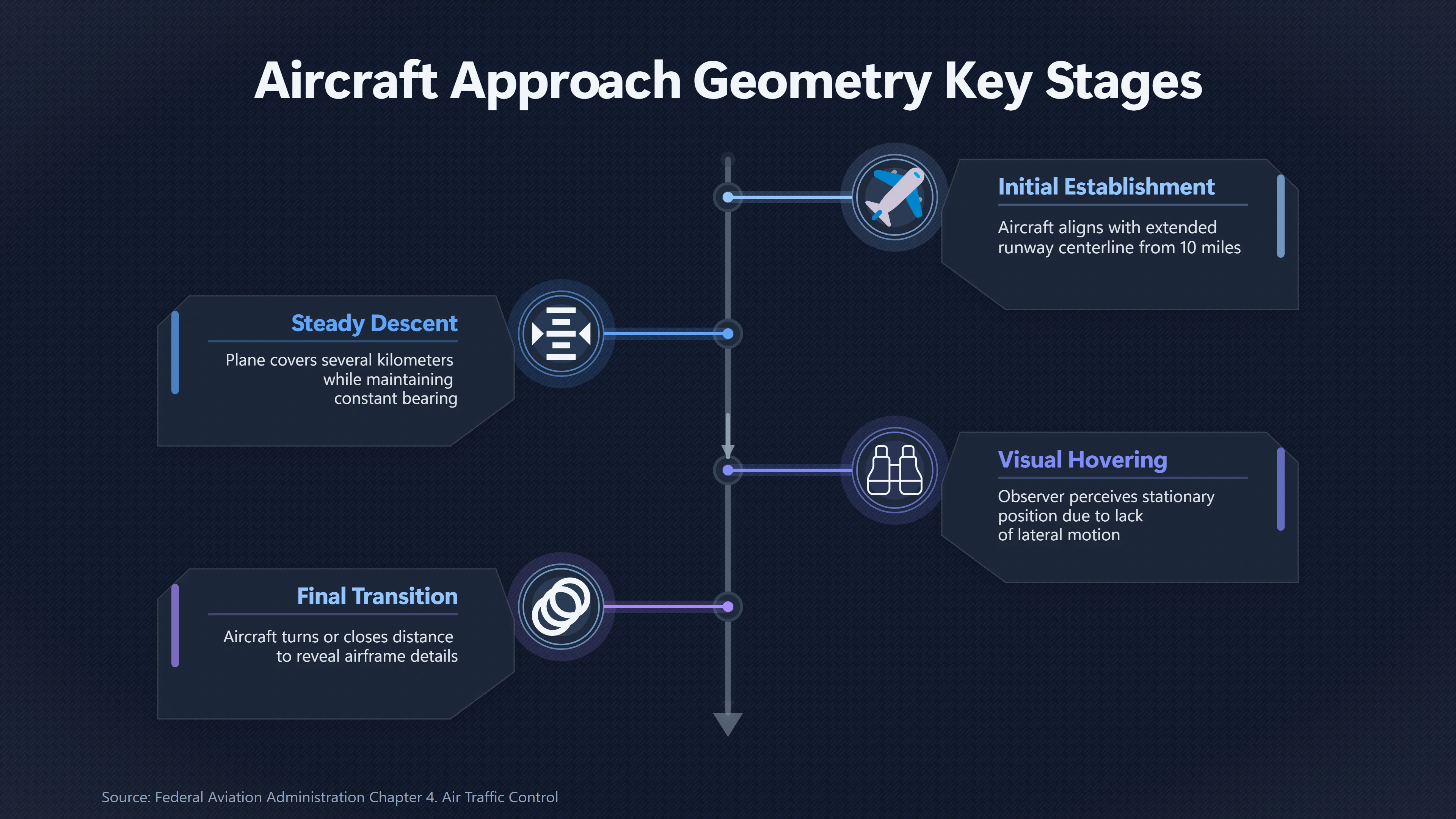
A plane on a long final approach can seem to hover for several minutes because the very thing that makes the approach orderly — sustained alignment with the runway — can also keep the aircraft close to one bearing from a suitably placed observer. The aeroplane is not stationary: it may be covering several kilometres while descending steadily. But if most of that motion is towards the witness rather than sideways across their view, surprisingly little changes in its apparent position.
Long finals make this illusion more persistent than a brief head-on encounter. Ten-nautical-mile finals are entirely ordinary in aviation contexts, and official guidance routinely describes aircraft established several miles from the runway. At night, bright forward-facing landing lights can further reduce an approaching aircraft to a conspicuous point of light whose changing distance is difficult to judge.[eurocontrol.int]eurocontrol.intEUROPEAN ORGANISATIONJuly 10, 2003…
Why arrival routes can preserve nearly constant bearing
In aviation terminology, final approach is the flight path towards landing along the extended runway centreline. A straight-in approach can therefore place an aircraft on essentially the same track towards the runway for a considerable distance. The US Federal Aviation Administration (FAA), for example, defines final approach in terms of the extended runway centreline and explicitly uses a “5-mile final” as a normal reporting position.[Federal Aviation Administration]faa.govFederal Aviation Administration TFederal Aviation Administration T
Some operations extend much farther. A Eurocontrol airport study defined “long final” as an aircraft established on final approach 10 nautical miles from touchdown. A UK Civil Aviation Authority document concerning Newcastle described proposed satellite-navigation approaches that would line aircraft up with the runway and glide path from approximately 10 nautical miles away, replicating existing Instrument Landing System approaches. Historical Gatwick procedures have likewise required certain night arrivals not to join the centreline closer than 10 nautical miles from touchdown.[eurocontrol.int]eurocontrol.intEUROPEAN ORGANISATIONJuly 10, 2003…
That matters to a ground witness because runway alignment can preserve the geometry behind the apparent hover. Aviation safety literature describes the more exact version of the phenomenon in collision-course encounters: two converging aircraft at constant bearing produce little or no apparent lateral motion. A UK military service inquiry states plainly that an aircraft on a collision course can appear stationary in the visual field. An Air Accidents Investigation Branch investigation similarly found that, during the final seconds before a mid-air collision, constant relative bearings meant each aircraft would have appeared stationary in the other’s windscreen.[GOV.UK]assets.publishing.service.gov.ukUKPAR T 1.41.4 FINDINGSMarch 26, 2026…
An observer near an airport does not need to be on the aircraft’s exact flight path for a weaker version of the same geometry to occur. Suppose a person is several kilometres beyond, beside or roughly in line with the extended centreline. An arriving aircraft can spend much of its long final reducing its range to that person while accumulating relatively little sideways displacement in their field of view. The result is not mathematically perfect constant bearing, but it may be perceptually close enough to look stationary.
The duration can be counter-intuitive. FAA air-traffic material uses threshold ground speeds of 130 and 140 knots as examples in arrival-capacity calculations. At 140 knots, an aircraft covers 10 nautical miles in about 4 minutes 17 seconds; even five nautical miles takes a little over two minutes. These are illustrative figures rather than a universal landing speed, but they show why “it stayed there for minutes” is entirely compatible with an aircraft steadily flying a long final.[Federal Aviation Administration]faa.govOpen source on faa.gov.
This is the distinctive importance of a long approach in UFO or UAP assessment. A witness does not necessarily need to have looked away and reacquired the object, nor does the illusion have to last only a few seconds. If the viewing geometry remains favourable, the seemingly fixed phase itself can persist for a meaningful portion of an aircraft’s arrival.
How distance and darkness distort perceived duration
At night, the aircraft can become visible as a light well before it becomes recognisable as an aeroplane. The FAA encourages pilots to use landing lights below 10,000 feet, particularly within 10 miles of an airport, specifically because the lights make aircraft easier for others to see. Its Airplane Flying Handbook also notes that aircraft lights can blend with stars or urban lighting at night.[Federal Aviation Administration]faa.govFederal Aviation Administration ENR 1.1: General RulesFederal Aviation Administration ENR 1.1: General Rules
This creates an unusual combination: high visibility but poor identification. The witness can notice the aircraft from far away because its lights are conspicuous, yet still lack the visual information needed to judge its size, orientation and distance. In reporting on public confusion between drones and conventional aircraft, the Associated Press quoted a University of Maryland aviation expert stressing that a distant light supplies very little range information: a bright point can be relatively nearby or many kilometres away while presenting a similarly ambiguous appearance.[AP News]apnews.comAP News Is that a drone or a plane?Experts help explain the differencesDecember 16, 2024 — Distinguishing drones from planes and helicopters can be challenging from a dista…
Aviation research has been demonstrating the broader weakness of night-time range and approach cues for decades. A 1978 FAA study found large visual errors during simulated night approaches and reported that relative motion parallax — normally a useful depth cue — was ineffective in the tested conditions. A 1982 FAA experiment likewise investigated how approach and runway lighting altered pilots’ perception of approach angle at night. These studies concerned pilots judging their own approach rather than witnesses identifying aircraft from the ground, so they should not be treated as direct experiments on UFO reports. They nevertheless establish an important underlying point: darkness removes or degrades visual information that normally helps people interpret changing distance and motion.[Federal Aviation Administration]faa.govOpen source on faa.gov.
The effect is particularly relevant when the observer sees mostly the forward lights. At great range, the fuselage and wings may subtend too little angle or have too little contrast to provide a useful scale reference. Research datasets developed for aircraft collision detection even include cases in which an approaching aircraft first becomes detectable through its landing lights while the airframe remains poorly visible through haze or cloud.[ResearchGate]researchgate.netOpen source on researchgate.net.
Consequently, the witness may experience several minutes of observation without receiving the cues they intuitively expect from several minutes of motion. There may be no obvious sweep across the sky, no clearly visible airframe growing steadily larger and no nearby object against which to judge distance. What changes most strongly — the range — is precisely the dimension that unaided vision is poorly placed to measure from a distant unresolved light.
This also helps explain why recollected duration can seem so striking. Someone who watches an ordinary aircraft cross sideways through a patch of sky sees continuous positional change. Someone watching an approaching light may instead see what appears to be the same light in the same place every time they glance back at it. The passage of time therefore feels inconsistent with the lack of apparent travel, reinforcing the impression that the object must actually be hovering.
What changes when the aircraft turns or passes nearby
The illusion is strongest while the aircraft remains close to the observer’s line of sight. It can weaken abruptly once that geometry changes.
A turn is especially revealing. As the aircraft leaves the near-head-on aspect, part of its velocity becomes lateral from the witness’s perspective. Its bearing then begins changing more rapidly, and an object that appeared almost fixed can suddenly start traversing the sky. That transition can seem like an unexplained change of behaviour even though the aircraft has maintained ordinary forward flight throughout.
Lighting can change at the same moment. From nearly ahead, powerful landing lights can dominate what the witness sees. As the aircraft turns, those forward-directed lights no longer point as directly towards the observer, while navigation lights, strobes and the shape of the airframe may become easier to distinguish. Conventional aircraft carry different lighting systems, including navigation, anti-collision and landing lights, so a changing aspect can materially change the visual appearance of the same aircraft.[AP News]apnews.comAP News Is that a drone or a plane?Experts help explain the differencesDecember 16, 2024 — Distinguishing drones from planes and helicopters can be challenging from a dista…
Closing distance also eventually defeats the illusion. The aircraft occupies a larger angle in the sky, structural details become easier to resolve, engine noise may become apparent, and even a modest lateral offset produces increasingly noticeable angular movement. The apparently stationary “star” can therefore resolve quite suddenly into an aeroplane that seems to start moving only near the end of the sighting.
That sequence is diagnostically useful when considering an unidentified-light report near an airport:
- a bright object remains in approximately one part of the sky for minutes;
- it slowly becomes brighter or larger without obvious sideways travel;
- it subsequently begins moving laterally;
- separate lights or an aircraft silhouette emerge as it approaches or turns;
- it then continues towards, across or away from a known runway approach corridor.
None of those features alone proves that a particular sighting was an aircraft. Together, however, they are strongly compatible with the geometry of a long final approach, especially when contemporaneous flight data place an arrival on the corresponding extended runway centreline.
Why “it hovered for minutes” is not the decisive detail
The duration of apparent hovering can sound like evidence against an aeroplane only if one assumes that an aeroplane must visibly cross the sky throughout those minutes. A long final removes that assumption. Aviation procedures can keep aircraft aligned with a runway from around 10 nautical miles out, while ordinary approach speeds make that final segment last several minutes.[eurocontrol.int]eurocontrol.intEUROPEAN ORGANISATIONJuly 10, 2003…
There is also a useful historical comparison. Long before modern UFO videos, aviation researchers and accident investigators were already concerned about moving aircraft producing nearly stationary retinal images. FAA night-approach experiments in the 1970s and 1980s documented the unreliability of visual motion and distance cues in darkness, while collision investigations repeatedly described approaching aircraft as stationary in the observer’s field of view. Modern phone cameras and flight-tracking services have made the phenomenon easier to record and reconstruct, but they did not create the underlying perceptual problem.[Federal Aviation Administration]faa.govOpen source on faa.gov.
For UFO and UAP reports, the more useful question is therefore not simply “How long did it hover?” but “Did its bearing remain nearly constant while its distance was changing?” A witness normally cannot answer the second question from visual impression alone. Airport location, runway orientation, time, viewing direction and historical flight tracks are much more discriminating evidence.
A genuinely stationary object and an aircraft on a long, nearly head-on final can produce superficially similar testimony for several minutes. The difference emerges when the trajectory is reconstructed. If the light eventually grows, reveals conventional aircraft lighting, turns into lateral motion or coincides with an arrival following the extended runway centreline, the prolonged “hover” is not an obstacle to the aircraft explanation. It is exactly what the approach geometry can produce.
Amazon book picks
Further Reading
Books and field guides related to How a Plane Can Seem to Hover for Minutes. Use these as the next step if you want deeper reading beyond the article.
Instrument Flying Handbook
The Federal Aviation Administration's Instrument Flying Handbook provides pilots, student pilots, aviation instructors, and controllers w...
Pilot's Handbook of Aeronautical Knowledge
Pilot's Handbook of Aeronautical Knowledge, created by the Federal Aviation Administration, is the official reference manual for pilots a...
Airplane Flying Handbook
This official U.S. government guide to piloting aircraft—created by the Federal Aviation Administration—is the essential resource for fin...
The Thinking Pilot's Flight Manual
Volume 2 of The Thinking Pilot's Flight Manual carries on the widely praise, penetrating, and clear-headed approach of Volume I, addressi...
eBay marketplace picks
Marketplace Samples
Live-tested eBay searches with available results related to this page.
Selected fromairplane model oneBay.co.uk.
Related eBay result
16cm A380 Airbus Emirates Metal Aircraft Plane Model Gift UK
Related eBay result
EasyJet Airbus A320Neo Snap-fit Model Plane 1/200 Model Plane
Endnotes
1.
Source: eurocontrol.int
Link:https://www.eurocontrol.int/archive_download/all/node/10139
Source snippet
EUROPEAN ORGANISATIONJuly 10, 2003...
Published: July 10, 2003
2.
Source: faa.gov
Title: Federal Aviation Administration Chapter 4. Air Traffic Control
Link:https://www.faa.gov/Air_traffic/publications/atpubs/aim_html/chap4_section_3.html
3.
Source: faa.gov
Title: Federal Aviation Administration T
Link:https://www.faa.gov/air_traffic/publications/atpubs/pcg_html/chap1_section_21.html
4.
Source: assets.publishing.service.gov.uk
Title: UKPAR T 1.4
Link:https://assets.publishing.service.gov.uk/media/5a79990ce5274a3864fd8395/ServiceInquiry_TutorAircraft_Part_1_4_Findings.pdf
Source snippet
1.4 FINDINGSMarch 26, 2026...
Published: March 26, 2026
5.
Source: GOV.UK
Title: November Bulletin
Link:https://www.gov.uk/government/uploads/system/uploads/attachment_data/file/384886/November_Bulletin.pdf
Source snippet
AAIB Bulletin: 11/2006...
6.
Source: faa.gov
Link:https://www.faa.gov/air_traffic/publications/atpubs/foa_html/chap10_section_7.html
7.
Source: faa.gov
Title: Federal Aviation Administration ENR 1.1: General Rules
Link:https://www.faa.gov/air_traffic/publications/atpubs/aip_html/part2_enr_section_1.1.html
8.
Source: faa.gov
Title: 12 afh ch11
Link:https://www.faa.gov/sites/faa.gov/files/regulations_policies/handbooks_manuals/aviation/airplane_handbook/12_afh_ch11.pdf
Source snippet
Federal Aviation AdministrationAirplane Flying Handbook (FAA-H-8083-3C)...
9.
Source: faa.gov
Link:https://www.faa.gov/data_research/research/med_humanfacs/oamtechreports/1970s/1978/197815
10.
Source: faa.gov
Link:https://www.faa.gov/data_research/research/med_humanfacs/oamtechreports/1980s/1982/198206
11.
Source: researchgate.net
Link:https://www.researchgate.net/publication/356817165_A_Dataset_of_Stationary_Fixed-wing_Aircraft_on_a_Collision_Course_for_Vision-Based_Sense_and_Avoid
12.
Source: faa.gov
Title: Federal Aviation Administration
Link:https://www.faa.gov/air_traffic/publications/atpubs/aim/aim0403.html
13.
Source: weather.metoffice.gov.uk
Title: metoffice.gov.uk Puebla Pue. (Mexico) weather
Link:https://weather.metoffice.gov.uk/forecast/9g6hq5vnq
14.
Source: weather.metoffice.gov.uk
Title: metoffice.gov.uk North Ronaldsay Airfield (Orkney Islands) weather
Link:https://weather.metoffice.gov.uk/forecast/gfw38xee9
15.
Source: weather.metoffice.gov.uk
Title: metoffice.gov.uk Gondar (Ethiopia) weather
Link:https://weather.metoffice.gov.uk/forecast/sf4x7s8
16.
Source: weather.metoffice.gov.uk
Title: metoffice.gov.uk Oukaimden (Morocco) weather
Link:https://weather.metoffice.gov.uk/forecast/evd3efg62
17.
Source: weather.metoffice.gov.uk
Title: metoffice.gov.uk Kisii (Kenya) weather
Link:https://weather.metoffice.gov.uk/forecast/kzbspqn0b
18.
Source: weather.metoffice.gov.uk
Title: metoffice.gov.uk Quetzaltenango (Guatemala) weather
Link:https://weather.metoffice.gov.uk/forecast/9fwumc79r
19.
Source: weather.metoffice.gov.uk
Title: metoffice.gov.uk Dalanzadgad (Mongolia) weather
Link:https://weather.metoffice.gov.uk/forecast/wrdrbn41k
20.
Source: weather.metoffice.gov.uk
Title: metoffice.gov.uk Dronfield Woodhouse (Derbyshire) weather
Link:https://weather.metoffice.gov.uk/forecast/gcqzjz9e7
21.
Source: weather.metoffice.gov.uk
Title: metoffice.gov.uk Lubango (Angola) weather
Link:https://weather.metoffice.gov.uk/forecast/km3ehf167?new-design=true
22.
Source: eurocontrol.int
Title: Optimising Point Merge operations
Link:https://www.eurocontrol.int/publication/optimising-point-merge-operations-reducing-level-offs-during-peaks
23.
Source: faa.gov
Title: San Antonio International Airport (SAT) | Federal Aviation Administration
Link:https://www.faa.gov/flight_deck/sat
24.
Source: atsb.gov.au
Link:https://www.atsb.gov.au/investigations/ao
25.
Source: atsb.gov.au
Title: king air misaligned striking edge light night
Link:https://www.atsb.gov.au/news/2026/king-air-misaligned-striking-edge-light-night
26.
Source: metoffice.gov.uk
Link:https://www.metoffice.gov.uk/blog/2025/how-does-the-met-office-measure-sunshine-visibility-pressure-and-radiation
27.
Source: eurocontrol.int
Title: optimised runway occupancy time spacings arrivals
Link:https://www.eurocontrol.int/publication/optimised-runway-occupancy-time-spacings-arrivals
28.
Source: faa.gov
Title: Navigation Programs
Link:https://www.faa.gov/about/office_org/headquarters_offices/ato/service_units/techops/navservices/lsg
29.
Source: atsb.gov.au
Link:https://www.atsb.gov.au/investigations/ao
30.
Source: atsb.gov.au
Link:https://www.atsb.gov.au/investigations/mo
31.
Source: atsb.gov.au
Link:https://www.atsb.gov.au/publications/investigation_reports/2022/mair/mo
32.
Source: atsb.gov.au
Link:https://www.atsb.gov.au/investigations/2023-001
33.
Source: faa.gov
Title: Runway Status Lights | Federal Aviation Administration
Link:https://www.faa.gov/air_traffic/technology/rwsl
34.
Source: atsb.gov.au
Title: ra2024 00142
Link:https://www.atsb.gov.au/repcon/2025/ra2024-00142
35.
Source: faa.gov
Title: Airman Education Programs | Federal Aviation Administration
Link:https://www.faa.gov/pilots/training/airman_education/topics_of_interest/spatial_disorientation
36.
Source: eurocontrol.int
Link:https://www.eurocontrol.int/publication/eurocontrol-guidelines-final-target-distance-indicator-ftdi-distance-based-separation
37.
Source: eurocontrol.int
Link:https://www.eurocontrol.int/publication/eurocontrol-guidelines-time-based-separation-tbs-optimised-runway-delivery-ord-final
38.
Source: faa.gov
Link:https://www.faa.gov/about/office_org/headquarters_offices/ato/service_units/techops/navservices/lsg/malsr
39.
Source: atsb.gov.au
Link:https://www.atsb.gov.au/safety-issues/AO-2021-018-SI-01
40.
Source: eurocontrol.int
Title: ftdi solution
Link:https://www.eurocontrol.int/publication/ftdi-solution
41.
Source: aviation.bot
Title: Appendix 1 to AMC1 SERA.14001 General
Link:https://aviation.bot/EASA/SERA-FEB-2023/Appendix-1-to-AMC1-SERA.14001-General?p=p_k2gVE1BlRag&s=1
42.
Source: faa.gov
Link:https://www.faa.gov/about/office_org/headquarters_offices/ato/service_units/techops/navservices/lsg/reil
43.
Source: ext.eurocontrol.int
Title: int Basic Data of Route Segment
Link:https://ext.eurocontrol.int/aixm_confluence/display/ACGAIP/Basic%2BData%2Bof%2BRoute%2BSegment
44.
Source: atsb.gov.au
Link:https://www.atsb.gov.au/investigations/2022-001
45.
Source: eurocontrol.int
Link:https://www.eurocontrol.int/news/first-dreams-project-flight-trial-twente-airfield-brings-enhanced-arrival-procedures-supported
46.
Source: eurocontrol.int
Title: coast calibration optimised approach spacing tool use machine learning
Link:https://www.eurocontrol.int/publication/eurocontrol-coast-calibration-optimised-approach-spacing-tool-use-machine-learning
47.
Source: contentzone.eurocontrol.int
Title: int Phraseology Database
Link:https://contentzone.eurocontrol.int/phraseology/Default.aspx
48.
Source: atsb.gov.au
Link:https://www.atsb.gov.au/investigations/ao
49.
Source: atsb.gov.au
Link:https://www.atsb.gov.au/investigations/ao
50.
Source: eurocontrol.int
Link:https://www.eurocontrol.int/news/better-runway-throughput-lower-emissions-and-noise-new-arrival-procedure-simulation-validates
51.
Source: eurocontrol.int
Link:https://www.eurocontrol.int/news/flight-sim-arrival-procedure-promises-increase-runway-capacity-less-noise
52.
Source: eurocontrol.int
Title: reducing 14 time spent busy runway
Link:https://www.eurocontrol.int/news/reducing-14-time-spent-busy-runway
53.
Source: atsb.gov.au
Link:https://www.atsb.gov.au/investigations/ao
54.
Source: atsb.gov.au
Link:https://www.atsb.gov.au/investigations/ao
55.
Source: faa.gov
Title: Chapter 5. [Radar]({{ ‘radar/’ | relative_url }})
Link:https://www.faa.gov/air_traffic/publications/atpubs/atc_html/chap5_section_7.html
56.
Source: faa.gov
Link:https://www.faa.gov/air_traffic/publications/ATpubs/ATC/PCG/A.HTM
57.
Source: faa.gov
Title: Chapter 2. Aeronautical Lighting and Other Airport Visual Aids
Link:https://www.faa.gov/air_traffic/publications/atpubs/AIM/aim0201.html
58.
Source: faa.gov
Link:https://www.faa.gov/air_traffic/publications/ATpubs/ATC/PCG/S.HTM
59.
Source: faa.gov
Link:https://www.faa.gov/air_traffic/publications/ATpubs/ATC/PCG/T.HTM
60.
Source: faa.gov
Link:https://www.faa.gov/air_traffic/publications/atpubs/aim/aim1002.html
61.
Source: faa.gov
Title: Chapter 8. Medical Facts for Pilots
Link:https://www.faa.gov/air_traffic/publications/atpubs/aim/aim0801.html
62.
Source: faa.gov
Title: Chapter 4. Air Traffic Control
Link:https://www.faa.gov/air_traffic/publications/ATpubs/AIM/aim0401.html
63.
Source: faa.gov
Title: Chapter 10. Terminal Operations, Services, and Equipment
Link:https://www.faa.gov/air_traffic/publications/atpubs/fac/1005.html
64.
Source: faa.gov
Link:https://www.faa.gov/air_traffic/publications/atpubs/atc/atc0607.html
65.
Source: faa.gov
Link:https://www.faa.gov/air_traffic/publications/ATpubs/ATC/atc0304.html
66.
Source: faa.gov
Link:https://www.faa.gov/air_traffic/publications/atpubs/atc/atc0307.html
67.
Source: faa.gov
Link:https://www.faa.gov/air_traffic/publications/atpubs/ATC/atc0310.html
68.
Source: atsb.gov.au
Title: Avoidable Accidents No. 7
Link:https://www.atsb.gov.au/publications/avoidable-accidents/2013/aviation/avoidable-accidents-no-7-visual-flight-night
69.
Source: atsb.gov.au
Title: blind to potential hazards
Link:https://www.atsb.gov.au/media/news-items/2012/blind-to-potential-hazards
70.
Source: atsb.gov.au
Link:https://www.atsb.gov.au/investigations/199600399
71.
Source: faa.gov
Title: Office of Aerospace Medicine Technical Reports | Federal Aviation Administration
Link:https://www.faa.gov/data_research/research/med_humanfacs/oamtechreports/1990s/1997/9703
72.
Source: faa.gov
Title: Boeing 707-321B | Federal Aviation Administration
Link:https://www.faa.gov/lessons_learned/transport_airplane/accidents/AVA052
73.
Source: faa.gov
Title: Office of Aerospace Medicine Technical Reports | Federal Aviation Administration
Link:https://www.faa.gov/data_research/research/med_humanfacs/oamtechreports/1970s/1979/197925
74.
Source: faa.gov
Link:https://www.faa.gov/air_traffic/publications/atpubs/aip_html/chap2_section_1.html
75.
Source: faa.gov
Link:https://www.faa.gov/Air_traffic/publications/atpubs/aim_html/chap2_section_1.html
76.
Source: faa.gov
Link:https://www.faa.gov/air_traffic/publications/atpubs/pcg_html/glossary-a.html
77.
Source: faa.gov
Link:https://www.faa.gov/Air_traffic/Publications/atpubs/aip_html/part3_ad_section_1.1.html
78.
Source: faa.gov
Link:https://www.faa.gov/air_traffic/publications/atpubs/pcg_html/chap1_section_2.html
79.
Source: faa.gov
Link:https://www.faa.gov/air_traffic/publications/atpubs/aim_html/chap1_section_1.html
80.
Source: faa.gov
Link:https://www.faa.gov/air_traffic/publications/atpubs/aip_html/part2_enr_section_1.5.html
81.
Source: faa.gov
Title: glossary s
Link:https://www.faa.gov/air_traffic/publications/atpubs/pcg_html/glossary-s.html
82.
Source: faa.gov
Link:https://www.faa.gov/air_traffic/publications/atpubs/atc_html/chap5_section_9.html
83.
Source: faa.gov
Link:https://www.faa.gov/air_traffic/publications/atpubs/atc_html/chap6_section_7.html
84.
Source: faa.gov
Link:https://www.faa.gov/air_traffic/publications/atpubs/atc_html/chap5_section_11.html
85.
Source: faa.gov
Link:https://www.faa.gov/air_traffic/publications/atpubs/aip_html/part1_gen_section_1.7.html
86.
Source: faa.gov
Link:https://www.faa.gov/air_traffic/publications/atpubs/fs_html/chap9_section_1.html
87.
Source: faa.gov
Link:https://www.faa.gov/air_traffic/publications/atpubs/aip_html/chap10_section_2.html
88.
Source: faa.gov
Link:https://www.faa.gov/air_traffic/publications/atpubs/aip_html/part3_ad_1.1.html
89.
Source: faa.gov
Title: Chapter 3. Airport Traffic Control
Link:https://www.faa.gov/air_traffic/publications/atpubs/atc_html/chap3_section_4.html
90.
Source: faa.gov
Title: glossary v
Link:https://www.faa.gov/air_traffic/publications/atpubs/pcg_html/glossary-v.html
91.
Source: faa.gov
Link:https://www.faa.gov/data_research/research/med_humanfacs/oamtechreports/1960s/1966/196624
92.
Source: faa.gov
Link:https://www.faa.gov/data_research/research/med_humanfacs/oamtechreports/2020s/2020/202002
93.
Source: faa.gov
Link:https://www.faa.gov/data_research/research/med_humanfacs/oamtechreports/1970s/1977/197712
94.
Source: faa.gov
Link:https://www.faa.gov/air_traffic/publications/atpubs/aip_html/part2_enr_section_5.3.html
95.
Source: faa.gov
Link:https://www.faa.gov/air_traffic/publications/atpubs/atc_html/chap7_section_4.html
96.
Source: faa.gov
Link:https://www.faa.gov/data_research/research/med_humanfacs/oamtechreports/1980s/1981/198106
97.
Source: faa.gov
Title: Chapter 3. Airport Traffic Control
Link:https://www.faa.gov/air_traffic/publications/atpubs/atc_html/chap3_section_7.html
98.
Source: faa.gov
Link:https://www.faa.gov/Air_traffic/publications/atpubs/aim_html/chap5_section_4.html
99.
Source: faa.gov
Link:https://www.faa.gov/air_traffic/publications/atpubs/foa_html/chap10_section_4.html
100.
Source: faa.gov
Link:https://www.faa.gov/air_traffic/publications/atpubs/atc_html/chap4_section_8.html
101.
Source: faa.gov
Title: EN R 4.1: Navigation Aids
Link:https://www.faa.gov/air_traffic/publications/atpubs/aip_html/part2_enr_section_4.1.html
102.
Source: datahub.metoffice.gov.uk
Link:https://datahub.metoffice.gov.uk/docs/glossary
103.
Source: weather.metoffice.gov.uk
Title: metoffice.gov.uk [Auroras]({{ ‘auroras/’ | relative_url }})
Link:https://weather.metoffice.gov.uk/learn-about/space-weather/auroras
104.
Source: atsb.gov.au
Link:https://www.atsb.gov.au/news/2025/study-demonstrates-visibility-issues-midair-collision
105.
Source: atsb.gov.au
Link:https://www.atsb.gov.au/node?page=967
106.
Source: atsb.gov.au
Link:https://www.atsb.gov.au/node?page=1090
107.
Source: atsb.gov.au
Link:https://www.atsb.gov.au/taxonomy/term/374
108.
Source: atsb.gov.au
Link:https://www.atsb.gov.au/news/2022/visibility-study
109.
Source: atsb.gov.au
Link:https://www.atsb.gov.au/flying-reduced-visual-cues
110.
Source: atsb.gov.au
Link:https://www.atsb.gov.au/safetywatch/flying-with-reduced-visual-cues
111.
Source: atsb.gov.au
Title: Ambiguous runway lighting | ATSB* Rail statistics * Reporting * Mandatory
Link:https://www.atsb.gov.au/media/news-items/2021/ambiguous-runway-lighting
112.
Source: atsb.gov.au
Link:https://www.atsb.gov.au/news/2022/nothing-see-night
113.
Source: atsb.gov.au
Link:https://www.atsb.gov.au/taxonomy/term/322?page=2
114.
Source: assets.publishing.service.gov.uk
Link:https://assets.publishing.service.gov.uk/media/5e18b047ed915d3b0d1b767b/Volume_06_Aviation_Medicine.pdf
115.
Source: ext.eurocontrol.int
Title: int Public Airport Corner
Link:https://ext.eurocontrol.int/airport_corner_public/strategic/separation_spacing_procedures
116.
Source: researchgate.net
Link:https://www.researchgate.net/publication/258339148_Sense_and_Avoid_in_UAS_Research_and_Applications
117.
Source: faa.gov
Title: Aerospace Medicine Technical Reports | Federal Aviation Administration
Link:https://www.faa.gov/data_research/research/med_humanfacs/oamtechreports/1960s/1965/196532
118.
Source: caa.co.uk
Title: Civil Aviation Authority Arrival and Approach Procedure
Link:https://www.caa.co.uk/media/mvjozzxi/201703-newcastle-international-airport-consultation-document.pdf
119.
Source: caa.co.uk
Title: Civil Aviation Authority EG.en_GB
Link:https://www.caa.co.uk/publication/download/16015
120.
Source: apnews.com
Title: AP News Is that a drone or a plane?
Link:https://apnews.com/article/57a0d051a2a94d21787089ceaf47b175
Source snippet
Experts help explain the differencesDecember 16, 2024 — Distinguishing drones from planes and [helicopters]({{ 'helicopters/' | relative_url }}) can be challenging from a dista...
Published: December 16, 2024
121.
Source: video.storyful.com
Link:https://video.storyful.com/record/29718
122.
Source: nuforc.org
Link:https://nuforc.org/sighting/?id=72288
Additional References
123.
Source: youtube.com
Title: 3 Ways your BRAIN Tricks You into Thinking AIRPLANES HOVER!
Link:https://www.youtube.com/watch?v=3osSwf7dgUI
Source snippet
Why Do Airplanes Sometimes “STOP” in the Sky?...
124.
Source: doi.org
Link:https://doi.org/10.13140/RG.2.2.32110.47684
125.
Source: av8n.com
Link:https://www.av8n.com/how/htm/landing.html
126.
Source: faraim.org
Link:https://www.faraim.org/faa/aim/chapter-4/section-4-3-24.html
127.
Source: icao.int
Link:https://www.icao.int/es/node/5011?fid=28068
128.
Source: studylib.net
Link:https://studylib.net/doc/28044936/cae-oxford-aviation-academy-atpl-book-14-communications
129.
Source: pilotguru.ai
Link:https://pilotguru.ai/blog/airspacesafety-collisionavoidance-2026
130.
Source: bufora.org.uk
Link:https://www.bufora.org.uk/sightings/analysis-of-ufo-photographs
131.
Source: airproxboard.org.uk
Link:https://www.airproxboard.org.uk/media/ov1navc2/airprox-magazine-2017.pdf
132.
Source: skybrary.aero
Link:https://skybrary.aero/index.php/articles/flying-visual-approach