Within Why Military Flares
Why Falling Flares Can Look Perfectly Still
A slowly descending parachute flare can look almost stationary when distance, altitude and foreground references are unknown.
On this page
- How parachutes slow a flare's descent
- Why distance hides downward movement
- Brightness, silence and missing visual references
Page outline Jump by section
Introduction
A parachute illumination flare does not need to stop falling to look as though it is hovering. Its parachute deliberately slows the descent, while its enormous brightness allows the flare to remain conspicuous at distances where a drop of hundreds of metres can occupy only a small angle in the observer’s view. At night, with no visible terrain, smoke trail or parachute to establish distance and scale, that slow angular movement can be surprisingly difficult to recognise.
Military specifications show why the illusion can persist. The US Air Force describes LUU-2 aircraft parachute flares as producing about two million candlepower for roughly five minutes, while current manufacturer information gives about 1.8 million candlepower for four to five minutes.[E-Publishing]static.e-publishing.af.milE-Publishingair force manual 11-2mc-130jJuly 23, 2020 — 3 Apr 2020 — LUU-2/B, 2A/B; Flare, Aircraft Parachute. 19.7.7.1.1. Description. The LUU-2/B, 2A/B is an air-launched para… The result is an unusually bright point that can remain in approximately the same part of a dark sky for minutes. To an observer who does not know how far away it is, a steadily descending flare can therefore look stationary, slowly drifting, or even capable of changing direction.
How parachutes turn a fall into a slow descent
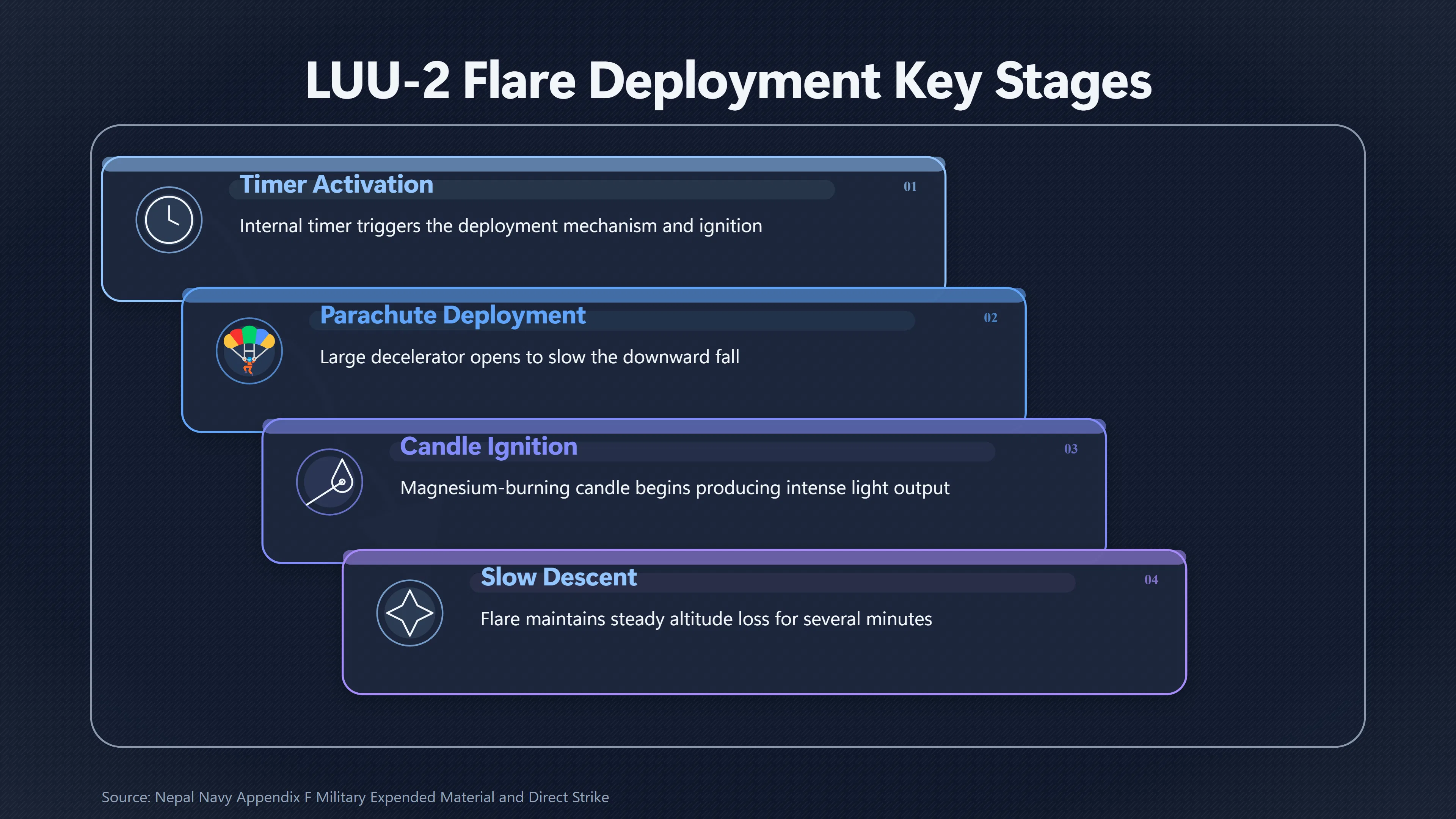
The parachute is the essential mechanism behind the false-hovering effect. An illumination flare is intended to light an area for an extended period rather than plunge rapidly towards the ground. After release, its parachute deploys and supports the burning flare beneath it, greatly reducing its rate of descent. A technical paper on aircraft parachute flares reported descent rates of roughly 2.5 to 4.5 feet per second for the cross-parachute flare designs it examined.[AIAA Publications]arc.aiaa.orgAIAA PublicationsPredicting descent rate for aircraft parachute flaresValues ranging from two and one-half to four and one- half feet per…
The parachutes can be substantial. A US Navy environmental analysis uses an 18-foot-diameter parachute as representative of the LUU-2 illumination flare, while more recent Navy documentation describes illumination-flare parachutes reaching about 19 feet in diameter.[Nepal Navy]nepa.navy.milNepal Navy Appendix F Military Expended Material and Direct StrikeSeptember 9, 2020 — per flare… Flares that have a large parachute; MEM size based on half the surface area of an 18 ft. diameter p… Their purpose is precisely to exchange rapid downward motion for time aloft.
That time can be several minutes. Air Force guidance identifies the LUU-2/B and LUU-2A/B as air-launched parachute flares rated at approximately two million candlepower for about 300 seconds.[E-Publishing]static.e-publishing.af.milE-Publishingair force manual 11-2mc-130jJuly 23, 2020 — 3 Apr 2020 — LUU-2/B, 2A/B; Flare, Aircraft Parachute. 19.7.7.1.1. Description. The LUU-2/B, 2A/B is an air-launched para… A current LUU-2D/B product description similarly specifies about 1.8 million candlepower for four to five minutes.[towndock.net> <meta name=]towndock.net> <meta name=Northrop Grumman's LUU parachute flaresThe LUU-2D/B parachute flare supports visible nighttime target illumination and rescu… Federal documentation gives the LUU-2B a light output of 1.8 million candlepower and explains that a timer deploys the parachute and ignites its magnesium-burning candle.[GovInfo]govinfo.gov79, No. 135/Tuesday, July 15, 2014/…June 2, 2024 — 15 Jul 2014 — The LUU–2B Flare has a light output rating of 1.8 x 10⁶ candlepower a…
Five minutes is a long time when judging an unidentified light. An observer expecting an ordinary falling object may intuitively expect rapid acceleration towards the ground. A parachute flare behaves differently: drag produces a much slower, comparatively steady descent. The physical object is continuously losing altitude, but its visible behaviour is closer to a suspended lantern than to a dropped projectile.
Wind adds another dimension. Once hanging beneath a large parachute, the flare is also carried horizontally by the surrounding air. The combination of downward descent and wind drift means that its true path can be diagonal or curved rather than vertically downwards. A light may consequently appear to hang in one area, ease sideways and only gradually sink.
Why distance can hide hundreds of metres of falling
The crucial distinction is between physical movement and angular movement. An observer does not directly see how many metres a distant flare has descended. The eye sees how far its image moves across the field of view. The farther away the flare is, the smaller that angular change becomes.
Consider an illustrative case rather than a specification for any particular flare. Suppose a light descends 300 metres while it is 30 kilometres from an observer. Its change in viewing angle is only about 0.57 degrees. If the descent takes several minutes, the light crawls down the sky at a fraction of a degree per minute. Increase the range further and the apparent movement becomes smaller still.
This is why the unknown distance is so important in UFO reports. A bright point contains almost no intrinsic scale information. Unless something else reveals its range, the observer cannot readily tell whether it is a modest-sized light a few kilometres away or an extraordinarily bright source tens of kilometres away. The same uncertainty affects estimates of altitude and speed.
The flare’s exceptional luminosity makes the problem worse rather than better. Federal documentation states that an LUU-2B at 1,000 feet can illuminate a ground circle roughly 500 metres across at the specified illumination level.[GovInfo]govinfo.gov79, No. 135/Tuesday, July 15, 2014/…June 2, 2024 — 15 Jul 2014 — The LUU–2B Flare has a light output rating of 1.8 x 10⁶ candlepower a… At long range, however, the observer need not see the illuminated ground, the flare body or the parachute. What survives visually may simply be an intense unresolved point against black sky.
This creates a counter-intuitive combination: the source is conspicuous enough to demand attention but too distant and visually unresolved to reveal what it is doing in three dimensions.
Why a dark sky removes the clues to motion
During daylight, the visual system has numerous ways to recognise descent. An object can be compared with buildings, hills, clouds, trees or the horizon. Its size and structure may also indicate approximately how far away it is. Much of that information disappears at night.
A bright flare over unlit terrain may instead be surrounded by almost featureless darkness. The Federal Aviation Administration (FAA) explicitly warns pilots that darkness can produce powerful visual illusions because ordinary reference information is missing. Its guidance notes, for example, that a stationary light stared at in darkness can appear to move, an effect known as autokinesis.[Federal Aviation Administration]faa.govFederal Aviation Administration Chapter 8. Medical Facts for PilotsFederal Aviation Administration Chapter 8. Medical Facts for Pilots SKYbrary similarly explains that motion perception normally depends on reference points, so an isolated light in a featureless environment has no obvious visual anchor.[Skybrary]skybrary.aeroAutokinetic Effect | SKYbrary Aviation SafetyAutokinetic Effect | SKYbrary Aviation Safety
Autokinesis is not what physically keeps a flare in the sky: the parachute does that. But the two effects can combine. The real flare may be descending and drifting very slowly while the observer’s perception adds small apparent wanderings of its own. A witness can therefore be entirely sincere in describing a light as hovering, wobbling or shifting unpredictably even though its underlying trajectory is an ordinary parachute descent.
Brightness changes can also influence perceived motion. FAA training material notes that changes in a light’s luminance can be interpreted as changes in distance, and describes autokinesis as a consequence of losing the surrounding references that normally stabilise visual perception.[Federal Aviation Administration]faa.govOpen source on faa.gov. A flare burning through changing atmospheric transparency, thin cloud or smoke may consequently look as though its behaviour is changing even when its flight remains mundane.
Bright, silent and apparently motionless
Three witness descriptions often sound especially impressive together: very bright, completely silent and stationary. For a distant parachute flare, however, none is unexpected.
Brightness is intrinsic to the device. The LUU-2 family is designed for large-scale night illumination, with outputs measured in the neighbourhood of two million candlepower and burn times measured in minutes.[govinfo.gov]govinfo.gov79, No. 135/Tuesday, July 15, 2014/…June 2, 2024 — 15 Jul 2014 — The LUU–2B Flare has a light output rating of 1.8 x 10⁶ candlepower a… A light can therefore be visible from much farther away than an observer might intuitively assume.
Silence does little to establish that the source is nearby. The aircraft may already have moved well away by the time the observer notices the burning flare, and a distant release need not provide an obvious sound cue at the observer’s position. More importantly, the light itself does not advertise its range. People can therefore associate its intense apparent brightness with proximity even when the source is actually far away.
The apparent lack of descent is likewise compatible with range. A flare falling several feet each second is unquestionably descending in physical terms, yet if it is tens of kilometres away its position against a featureless sky may change only slowly. The relevant question is not simply, “Was it falling?” but “Was its angular descent large enough to be obvious from the observer’s location?”
That distinction helps explain why the statement “it could not have been a flare because it hovered for several minutes” is weak evidence on its own. Several minutes of brilliant, slow flight is exactly what large parachute illumination flares are engineered to provide.
The Phoenix Lights show the illusion at city scale
The later portion of the 13 March 1997 Phoenix Lights episode provides a useful real-world example because witnesses reported brilliant lights that seemed to hover or descend slowly, while the relevant military activity involved parachute illumination flares. It is important to distinguish this approximately 10 p.m. display from the earlier moving formation reported across Arizona; the flare explanation concerns the later group of lights rather than every report that evening. Contemporary and later reporting identified Maryland Air National Guard A-10 aircraft conducting training on the Barry M. Goldwater Range as the source of the later flare display.[Phoenix New Times]phoenixnewtimes.comPhoenix New Times Phoenix Lights UFO mystery explanations | Phoenix New TimesPhoenix New Times Phoenix Lights UFO mystery explanations | Phoenix New Times
The episode demonstrates how scale can become badly misleading at night. To people looking towards a distant training range, the individual lights could appear suspended over the region rather than obviously attached to parachutes falling over remote terrain. The visible lights were consequently remembered and described in the vocabulary of hovering objects even though parachute flares provide a conventional mechanism for exactly that appearance.[Skeptical Inquirer]skepticalinquirer.orgOpen source on skepticalinquirer.org.
Terrain can strengthen the effect further. A descending flare need not visibly continue all the way to the ground. If a mountain ridge lies between the observer and the distant flare, the light can disappear behind it while the dark ridge itself is effectively invisible against the night sky. To the observer, a luminous object that appeared to hover can simply extinguish. That behaviour may seem mysterious unless the hidden terrain and viewing geometry are reconstructed.
The lesson from Phoenix is therefore narrower and more useful than claiming that “UFOs are flares”. A known flare operation can produce lights that look strikingly stationary from a distant city, and the apparent hovering does not contradict the flare identification.
What makes a flare explanation convincing
Appearance alone is not enough to identify an unexplained light as a parachute flare. Many distant lights can look stationary at night. The strongest flare identifications bring the visual mechanism together with independent evidence.
A flare hypothesis becomes substantially stronger when several features coincide: the sighting occurs towards a military range or documented exercise area; the lights persist for a duration compatible with illumination-flare burn times; their apparent motion is slow descent or wind-like drift rather than sustained rapid manoeuvring; several lights appear or extinguish at intervals compatible with separate releases; and independent records confirm aircraft or flare activity at the relevant time and bearing.
Conversely, “it hovered” is not good evidence against a parachute flare. A large parachute, a burn lasting several minutes, enormous luminosity, long viewing distance and absence of foreground references all push perception in the same direction.[af.mil]static.e-publishing.af.milE-Publishingair force manual 11-2mc-130jJuly 23, 2020 — 3 Apr 2020 — LUU-2/B, 2A/B; Flare, Aircraft Parachute. 19.7.7.1.1. Description. The LUU-2/B, 2A/B is an air-launched para…
The most useful diagnostic evidence is therefore geometric rather than impressionistic. A fixed-camera recording with visible terrain, stars or another stable reference can reveal slow downward motion that was difficult to perceive by eye. Bearings from observers at different locations can constrain the source’s position. Known ridgelines can show whether an apparently extinguishing light actually dropped behind terrain. Confirmed training activity can then test whether the timing and location make sense.
That is the central mechanism behind false hovering: the flare really is falling, but the observer is watching angular motion, not metres of descent. A parachute makes the physical fall slow; great distance makes its angular movement smaller; darkness removes the reference points that would expose it. Add a light bright enough to remain conspicuous for four or five minutes, and an ordinary descending flare can look remarkably like something simply hanging in the night sky.
Amazon book picks
Further Reading
Books and field guides related to Why Falling Flares Can Look Perfectly Still. Use these as the next step if you want deeper reading beyond the article.
The UFO Handbook: A Guide to Investigating, Evaluating, and R...
An explanation of the usual reasons for confusing IFOs (identified flying objects) with UFOs and a survey of the tools used to investigat...
UFOs Explained
Analyzing several UFO cases, the author exposes the myth of extraterrestrial visitors to earth.
The UFO Experience: A Scientific Inquiry
Cited by the New York Review of Books as "the best brief for visitation," this classic study presents an analysis of UFO reports and conc...

Light and Color in the Outdoors
First published 1993. Subjects: Color, Light, Popular works, Science: General Issues, Photographic equipment & techniques.
eBay marketplace picks
Marketplace Samples
Live-tested eBay searches with available results related to this page.
Selected frommilitary aviation poster oneBay.co.uk.

Endnotes
1.
Source: towndock.net
Link:https://towndock.net/files/LUU_Parachute_Factsheet.pdf
Source snippet
> <meta name=Northrop Grumman's LUU parachute flaresThe LUU-2D/B parachute flare supports visible nighttime target illumination and rescu...
2.
Source: arc.aiaa.org
Link:https://arc.aiaa.org/doi/pdfplus/10.2514/6.1973-482
Source snippet
AIAA PublicationsPredicting descent rate for aircraft parachute flaresValues ranging from two and one-half to four and one- half feet per...
3.
Source: nepa.navy.mil
Title: Nepal Navy Appendix F Military Expended Material and Direct Strike
Link:https://www.nepa.navy.mil/Portals/20/Documents/Pacific%20Fleet/NWTT/files/final_seis/section/NWTT_Final_SEIS_Sept2020_Appendix_F_Military_Expended_Material_and_Direct_Strike_Impact_Analyses.pdf
Source snippet
September 9, 2020 — per flare... Flares that have a large parachute; MEM size based on half the surface area of an 18 ft. diameter p...
Published: September 9, 2020
4.
Source: nepa.navy.mil
Link:https://www.nepa.navy.mil/Portals/20/Documents/Pacific%20Fleet/MITT/files/Draft-EIS-OEIS/MITTDSEISAPPENDIXCACOUSTICANDNONACOUSTICEFFECTSMARCH2026.pdf
Source snippet
parachute, flare end cap, or chaff... LUU-2 Paraflare. Magnesium granules, sodium... Illumination flares use large decelerators/parachu...
5.
Source: govinfo.gov
Link:https://www.govinfo.gov/content/pkg/FR-2014-07-15/pdf/2014-16454.pdf
Source snippet
79, No. 135/Tuesday, July 15, 2014/...June 2, 2024 — 15 Jul 2014 — The LUU–2B Flare has a light output rating of 1.8 x 10⁶ candlepower a...
Published: July 15, 2014
6.
Source: faa.gov
Title: Federal Aviation Administration Chapter 8. Medical Facts for Pilots
Link:https://www.faa.gov/Air_traffic/publications/atpubs/aim_html/chap8_section_1.html
7.
Source: faa.gov
Link:https://www.faa.gov/sites/faa.gov/files/pilots/FAA-H-8083-15B.pdf
8.
Source: skybrary.aero
Title: Autokinetic Effect | SKYbrary Aviation Safety
Link:https://skybrary.aero/index.php/articles/autokinetic-effect
9.
Source: faa.gov
Link:https://www.faa.gov/sites/faa.gov/files/regulations_policies/handbooks_manuals/aviation/FAA-H-8083-4.pdf
10.
Source: skybrary.aero
Title: final report a320 oe ine dr40 bordeaux france 31 september 2022
Link:https://skybrary.aero/bookshelf/final-report-a320-oe-ine-dr40-bordeaux-france-31-september-2022
Published: september 2022
11.
Source: faa.gov
Title: Mc Donnell Douglas DC-10 | Federal Aviation Administration
Link:https://www.faa.gov/lessons_learned/transport_airplane/accidents/TC-JAV
12.
Source: faa.gov
Title: Boeing Model 727-22C | Federal Aviation Administration
Link:https://www.faa.gov/lessons_learned/transport_airplane/accidents/N7434U
13.
Source: skybrary.aero
Title: a320 dr40 bordeaux france 2022
Link:https://skybrary.aero/index.php/accidents-and-incidents/a320-dr40-bordeaux-france-2022
14.
Source: faa.gov
Link:https://www.faa.gov/lessons_learned/transport_airplane/accidents/N310EA
15.
Source: skybrary.aero
Title: b773 b752 london heathrow uk 2022
Link:https://skybrary.aero/accidents-and-incidents/b773-b752-london-heathrow-uk-2022
16.
Source: faa.gov
Title: Operations Over People General Overview | Federal Aviation Administration
Link:https://www.faa.gov/uas/commercial_operators/operations_over_people
17.
Source: skybrary.aero
Title: fa7x london city uk 2016
Link:https://skybrary.aero/index.php/accidents-and-incidents/fa7x-london-city-uk-2016
18.
Source: faa.gov
Title: Chapter 8. Medical Facts for Pilots
Link:https://www.faa.gov/air_traffic/publications/atpubs/aim/aim0801.html
19.
Source: faa.gov
Title: Bell 206B-3 Jet Ranger III | Federal Aviation Administration
Link:https://www.faa.gov/lessons_learned/rotorcraft/accidents/N828AC
20.
Source: skybrary.aero
Title: a319 south london uk 2005
Link:https://skybrary.aero/index.php/accidents-and-incidents/a319-south-london-uk-2005
21.
Source: skybrary.aero
Title: a343 b744 london heathrow uk 2007
Link:https://skybrary.aero/index.php/accidents-and-incidents/a343-b744-london-heathrow-uk-2007
22.
Source: skybrary.aero
Title: a319 london heathrow uk 2007
Link:https://skybrary.aero/index.php/accidents-and-incidents/a319-london-heathrow-uk-2007
23.
Source: airporttech.tc.faa.gov
Title: evaluation of wind driven retroreflective taxiway edge markers 1
Link:https://www.airporttech.tc.faa.gov/Products/Airport-Safety-Papers-Publications/Airport-Safety-Detail/evaluation-of-wind-driven-retroreflective-taxiway-edge-markers-1
24.
Source: faa.gov
Title: Office of Aerospace Medicine Technical Reports | Federal Aviation Administration
Link:https://www.faa.gov/data_research/research/med_humanfacs/oamtechreports/1970s/1971/7134
25.
Source: faa.gov
Link:https://www.faa.gov/data_research/research/med_humanfacs/oamtechreports/1960s/1969/196923
26.
Source: faa.gov
Link:https://www.faa.gov/data_research/research/med_humanfacs/oamtechreports/1970s/1979/197926
27.
Source: faa.gov
Link:https://www.faa.gov/data_research/research/med_humanfacs/oamtechreports/1970s/1977/197702
28.
Source: skybrary.aero
Link:https://skybrary.aero/index.php/articles/general-aviation-night-flying-guidance
29.
Source: skybrary.aero
Link:https://skybrary.aero/index.php/articles/visual-illusions
30.
Source: skybrary.aero
Link:https://skybrary.aero/index.php/articles/runway-visual-perspective
31.
Source: skybrary.aero
Link:https://skybrary.aero/articles/lessening-effects-visual-illusions
32.
Source: skybrary.aero
Link:https://skybrary.aero/index.php/articles/pulse-light-approach-slope-indicator-plasi
33.
Source: skybrary.aero
Title: cl30 vehicle subang malaysia 2019
Link:https://skybrary.aero/accidents-and-incidents/cl30-vehicle-subang-malaysia-2019
34.
Source: govinfo.gov
Link:https://www.govinfo.gov/content/pkg/FR-2011-11-18/xml/FR-2011-11-18.xml
35.
Source: govinfo.gov
Link:https://www.govinfo.gov/content/pkg/GOVPUB-Y3_IS7-89a1499e69a9b9b74cd1564634c8d868/pdf/GOVPUB-Y3_IS7-89a1499e69a9b9b74cd1564634c8d868-1.pdf
36.
Source: govinfo.gov
Title: Vol. 76 Friday, No. 223
Link:https://www.govinfo.gov/content/pkg/FR-2011-11-18/pdf/FR-2011-11-18.pdf
37.
Source: govinfo.gov
Link:https://www.govinfo.gov/content/pkg/GOVPUB-D301-PURL-LPS103309/pdf/GOVPUB-D301-PURL-LPS103309.pdf
38.
Source: nepa.navy.mil
Link:https://www.nepa.navy.mil/Portals/20/Documents/Pacific%20Fleet/NWTT/files/2015-2016/feis/NWTT_FEIS_A_Navy_Activities_Descriptions_Oct_2015.pdf
39.
Source: secnav.navy.mil
Link:https://www.secnav.navy.mil/doni/Directives/08000%20Ordnance%20Material%20Management%20and%20Support/08-00%20General%20Ordnance%20Material%20Support/8023.24D.pdf
40.
Source: nepa.navy.mil
Title: mil3.1 Sediments and Water Quality
Link:https://www.nepa.navy.mil/Portals/20/Documents/Pacific%20Fleet/NWTT/files/2015-2016/feis/NWTT_FEIS_3.1_Sediments_and_Water_Quality_Oct_2015.pdf
41.
Source: nepa.navy.mil
Title: mil3.2 Expended Materials
Link:https://www.nepa.navy.mil/Portals/20/Documents/Pacific%20Fleet/GOA/files/EIS/Final_EIS_2011/sections/GOA_FEIS_3_2_Expended_Materials.pdf
42.
Source: nepa.navy.mil
Title: mil Mariana Islands Training and Testing
Link:https://www.nepa.navy.mil/Portals/20/Documents/Pacific%20Fleet/MITT/files/Draft-EIS-OEIS/MITTDSEISandAPPENDICESMARCH2026.pdf
43.
Source: towndock.net
Title: bombing target eleven bt 11
Link:https://towndock.net/captains-blog/bombing-target-eleven-bt-11
44.
Source: static.e-publishing.af.mil
Title: E-Publishingair force manual 11-2mc-130j
Link:https://static.e-publishing.af.mil/production/1/afsoc/publication/afman11-2mc-130jv3_afsocsup/afman11-2mc-130jv3_afsocsup-i.pdf
Source snippet
July 23, 2020 — 3 Apr 2020 — LUU-2/B, 2A/B; Flare, Aircraft Parachute. 19.7.7.1.1. Description. The LUU-2/B, 2A/B is an air-launched para...
Published: July 23, 2020
45.
Source: phoenixnewtimes.com
Title: Phoenix New Times Phoenix Lights UFO mystery explanations | Phoenix New Times
Link:https://www.phoenixnewtimes.com/arts-culture/phoenix-lights-ufo-mystery-explanations-19105870/
46.
Source: skepticalinquirer.org
Link:https://skepticalinquirer.org/2016/11/the-phoenix-lights-become-an-incident/
47.
Source: listennotes.com
Title: The Phoenix Lights | Arizona’s Mass UFO Sighting
Link:https://www.listennotes.com/podcasts/the-haunted-bunker/the-phoenix-lights-arizonas-jy8t-lUW9_F/
48.
Source: thisunexplaineduniverse.com
Title: phoenix lights
Link:https://www.thisunexplaineduniverse.com/articles/phoenix-lights
49.
Source: encyclopedia.arabpsychology.com
Link:https://encyclopedia.arabpsychology.com/autokinesis/
50.
Source: slashlore.com
Title: phoenix lights
Link:https://www.slashlore.com/phoenix-lights/
51.
Source: metabunk.org
Title: Phoenix Lights | Metabunk
Link:https://www.metabunk.org/threads/phoenix-lights.11938/
52.
Source: phoenixnewtimes.com
Title: the phoenix lights are no mystery 6661825
Link:https://www.phoenixnewtimes.com/arts-culture/the-phoenix-lights-are-no-mystery-6661825/
53.
Source: phoenixnewtimes.com
Title: The Hack and the Quack | Phoenix New Times
Link:https://www.phoenixnewtimes.com/news/the-hack-and-the-quack-6445593/
54.
Source: ufo-books.com
Title: phoenix lights
Link:https://ufo-books.com/incidents/phoenix-lights
55.
Source: kb42.info
Title: Phoenix Lights
Link:https://kb42.info/index.php?title=Phoenix_Lights
56.
Source: af.mil
Link:https://www.af.mil/Portals/1/documents/Secretariat%20of%20the%20AF/SAF-FM/Budget%20-%202002/AFD-070223-112.pdf?ver=nXaCCDpLMrph5lAqB-pGCg%3D%3D
57.
Source: static.e-publishing.af.mil
Link:https://static.e-publishing.af.mil/production/1/af_a3/publication/afman11-2mc-130jv3/afman11-2mc-130jv3.pdf
58.
Source: static.e-publishing.af.mil
Title: man11 214
Link:https://static.e-publishing.af.mil/production/1/af_a3/publication/afman11-214/afman11-214.pdf
59.
Source: static.e-publishing.af.mil
Link:https://static.e-publishing.af.mil/production/1/af_a3/publication/dafman11-2ec-130jv3/dafman11-2ec-130jv3.pdf
60.
Source: static.e-publishing.af.mil
Title: lukeafbi13 212
Link:https://static.e-publishing.af.mil/production/1/lukeafb/publication/lukeafbi13-212/lukeafbi13-212.pdf
61.
Source: thestatefiles.com
Title: The Phoenix Lights
Link:https://thestatefiles.com/the-phoenix-lights/
62.
Source: revengerists.fandom.com
Title: Phoenix Lights
Link:https://revengerists.fandom.com/wiki/Phoenix_Lights
63.
Source: jstor.org
Link:https://www.jstor.org/stable/45361742
Additional References
64.
Source: quizlet.com
Link:https://quizlet.com/465939230/2w0x1b-vol-2-unit-review-flash-cards/
65.
Source: canada.ca
Link:https://www.canada.ca/en/department-national-defence/maple-leaf/rcaf/migration/2015/a-multi-purpose-air-platform-for-multiple-roles-the-cc-130-hercules-and-435-transport-and-rescue-squadron.html
66.
Source: faraim.org
Link:https://www.faraim.org/faa/aim/chapter-8/section-8-1-5.html
67.
Source: scribd.com
Link:https://www.scribd.com/document/793762586/TO-1-1M-34
68.
Source: scribd.com
Link:https://www.scribd.com/document/114005259/Aircraft-Ordnance
69.
Source: studylib.net
Link:https://studylib.net/doc/11700152/aircraft-ordnance-chapter-8
70.
Source: doczz.net
Link:https://doczz.net/doc/7848890/aviation-signal-lighting–impacts-of-lighting
71.
Source: jetcareers.com
Link:https://jetcareers.com/forums/threads/can-we-please-talk-about-the-weird-lights-that-people-are-seeing-to-the-west-at-night.333049/page-5
72.
Source: researchgate.net
Link:https://www.researchgate.net/publication/324609665Combustion_Rate_and_Light_Emission_of_MgNaNO3Na2C2O4Binder-_Flares
73.
Source: digitalcombatsimulator.com
Link:https://www.digitalcombatsimulator.com/upload/iblock/715/t05fb1h8itdhcvcf6fyi3h5944fvv4fx/DCS_A-10C_II_Flight_Manual_EN.pdf