Within Autokinesis
When Real Motion Becomes Too Slow to Trust
Modern experiments show that very slow real motion can become difficult to distinguish from the illusory motion created by autokinesis.
On this page
- How researchers compare real and illusory motion
- The low speed threshold problem
- Why distant UFO lights are especially ambiguous
Page outline Jump by section
Introduction
Experiments on autokinesis reveal a more important problem than the familiar observation that a stationary light can seem to move. They show that real motion itself can become unreliable when it is sufficiently slow and the target is viewed without useful visual references. In a 2024 experiment, observers watched a small dot that genuinely moved through darkness at several controlled speeds. At the slowest speed, their reported direction was strongly influenced by each observer’s own pattern of autokinetic illusion. As the dot moved faster, perception increasingly followed its true direction. The same slow movement was judged much more accurately when the room was illuminated.[ScienceDirect]sciencedirect.comScienceDirect Autokinesis Reveals a Threshold for Perception of Visual MotionAutokinesis Reveals a Threshold for Perception of Visual Motion - ScienceDirectApril 5, 2024…
That finding matters for UFO and UAP reports involving distant lights. A witness may not simply face a choice between “stationary” and “moving”. At very low apparent speeds, genuine displacement and illusory displacement can compete in perception, making the direction and path of a remote light surprisingly difficult to judge by eye alone.
How researchers compare real and illusory motion
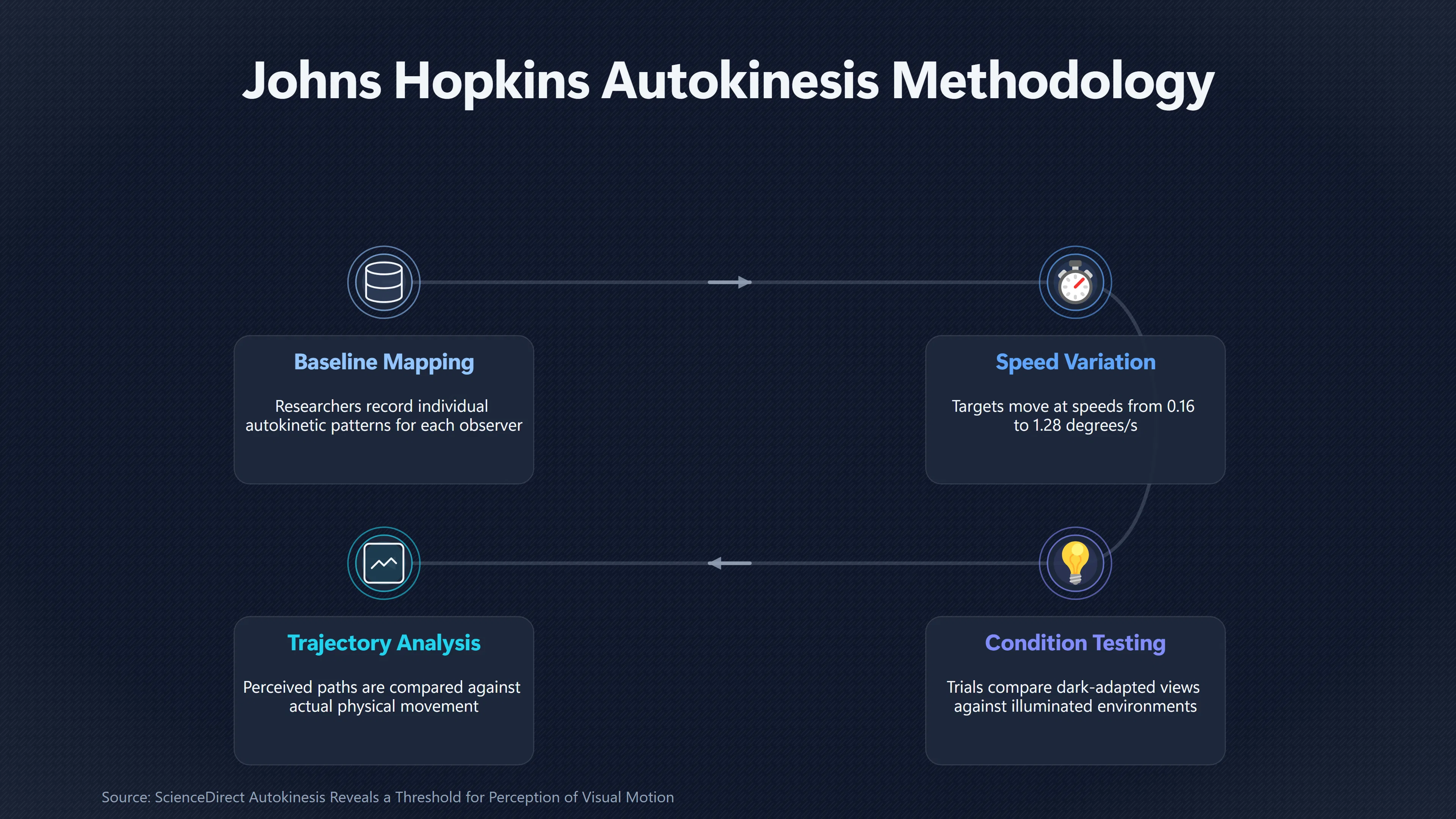
The 2024 study by Yihao Liu and colleagues at Johns Hopkins approached autokinesis in an unusually direct way. Rather than merely asking whether a stationary dot seemed to move, the researchers first measured the apparent motion produced when the target really was stationary. Participants manually reproduced what they perceived using an optically tracked device, allowing the researchers to construct an individual pattern of autokinetic motion for each observer. Repeated measurements showed that these perceived-motion patterns had significant within-person consistency.[PubMed Central (PMC)]pmc.ncbi.nlm.nih.govPubMed Central (PMC)Autokinesis reveals a threshold for perception of visual motion - PMC…
The researchers could then introduce actual target motion and ask a more revealing question: when real movement is weak, does perception follow the physical target or the observer’s autokinetic pattern?
Twelve participants viewed a small target moving horizontally or vertically. The slowest physical speed was 0.16 degrees of visual angle per second, at which the dot took about 30 seconds to cross the display. Other trials increased that speed by factors of two, three, four and six. Participants were dark-adapted before the dark trials, while an additional condition presented the slowest movement with the lights on.[PubMed Central (PMC)]pmc.ncbi.nlm.nih.govPubMed Central (PMC)Autokinesis reveals a threshold for perception of visual motion - PMC…
The crucial comparison was therefore not between movement and complete immobility. It was between three competing situations:
- a stationary point generating autokinetic apparent motion;
- a genuinely moving point travelling very slowly through darkness;
- and the same kind of physical movement when environmental visual information was available.
This design allowed the researchers to measure whether perceived direction resembled the target’s actual trajectory or the observer’s previously recorded autokinetic pattern. That makes the experiment especially useful for understanding ambiguous lights in the night sky: the physical target can genuinely be moving while its perceived path is nevertheless substantially distorted by autokinesis.[ScienceDirect]sciencedirect.comScienceDirect Autokinesis Reveals a Threshold for Perception of Visual MotionAutokinesis Reveals a Threshold for Perception of Visual Motion - ScienceDirectApril 5, 2024…
The approach also has historical roots. Pearce and Matin developed a “nulling” technique in the 1960s in which physical motion was imposed opposite to perceived autokinetic motion until the observer no longer reliably experienced movement in one direction. That work already implied that real and autokinetic motion could oppose one another within the same perceptual judgement. The newer experiment extends the idea by systematically varying the speed of a genuinely moving target and recording its perceived trajectory.[ResearchGate]researchgate.netResearch Gate The measurement of autokinetic speedThe measurement of autokinetic speedJanuary 1, 1966…
The low-speed threshold problem
The clearest result was that slow physical movement in darkness was poorly represented in perceived direction. At the base speed of 0.16°/s, the researchers’ direction-accuracy measure was low in darkness. When exactly the same slow speed was presented with the lights on, accuracy became high. Increasing the target’s physical speed in darkness also progressively improved the correspondence between perceived and actual direction; the statistical effect of speed was highly significant.[PubMed Central (PMC)]pmc.ncbi.nlm.nih.govPubMed Central (PMC)Autokinesis reveals a threshold for perception of visual motion - PMC…
Another analysis makes the size of the ambiguity particularly clear. At the lowest speed in darkness, 78% ± 2% of the measured perceived-motion vectors did not occupy the same directional bin as the target’s actual movement. The corresponding figure fell as the physical speed increased, while it was only 34% ± 2% when the lowest-speed movement was viewed in the light.[PubMed Central (PMC)]pmc.ncbi.nlm.nih.govPubMed Central (PMC)Autokinesis reveals a threshold for perception of visual motion - PMC…
More importantly, those errors were not simply random. The researchers compared the erroneous directions with the pattern previously produced by autokinesis for each participant. Their measure of alignment with autokinesis was highest at the slowest dark speed, 0.44 ± 0.03, and progressively declined as physical speed increased, reaching 0.26 ± 0.03 at six times the base speed. At the slow speed with the lights on it was lower still, at 0.23 ± 0.02. The difference across conditions was statistically significant.[PubMed Central (PMC)]pmc.ncbi.nlm.nih.govPubMed Central (PMC)Autokinesis reveals a threshold for perception of visual motion - PMC…
In practical terms, the experiment produced a transition rather than a sharp universal cut-off. When the real motion signal was weak, perception tended to inherit more of the observer’s autokinetic pattern. As the physical movement became stronger, its true direction increasingly won out. The authors therefore describe the results as evidence for a threshold for accurate perception of motion signals, rather than proposing one fixed speed below which human beings simply cannot see movement.[ScienceDirect]sciencedirect.comScienceDirect Autokinesis Reveals a Threshold for Perception of Visual MotionAutokinesis Reveals a Threshold for Perception of Visual Motion - ScienceDirectApril 5, 2024…
That distinction is important. The experiment does not establish that 0.16°/s is a universal human motion threshold. The result came from a particular stimulus, viewing geometry and experimental setting, and autokinesis itself varies between individuals and with factors such as illumination and available visual cues. Instead, the evidence shows that motion accuracy deteriorates as the physical signal becomes weaker relative to perceptual instability.[PubMed Central (PMC)]pmc.ncbi.nlm.nih.govPubMed Central (PMC)Autokinesis reveals a threshold for perception of visual motion - PMC…
Older experiments reinforce the idea that the boundary between “real” and “apparent” movement is not perceptually clean. Walker and Meyer found that even movement too weak to have an obvious conscious perceptual counterpart could alter the course of autokinesis. Earlier work also showed that providing additional information about a target’s position — in one experiment, allowing observers to grasp the target-light mount — delayed autokinesis and reduced its magnitude and duration. Together, these findings indicate that apparently tiny changes in sensory evidence can alter what observers experience as target movement.[BPS Psych Hub]bpspsychub.onlinelibrary.wiley.comBPS Psych HubThe subliminal perception of movement and the course of autokinesis - Walker - 1978 - British Journal of Psychology - Wiley…
Why darkness changes the answer
The illuminated condition in the 2024 experiment is particularly revealing because the target itself did not have to move faster for perception to improve. At the same slow physical speed, adding environmental visual information greatly increased directional accuracy.[PubMed Central (PMC)]pmc.ncbi.nlm.nih.govPubMed Central (PMC)Autokinesis reveals a threshold for perception of visual motion - PMC…
That result fits the broader understanding of autokinesis as a problem of unstable spatial reference. Normally, the visual system can judge a moving object relative to other objects and combine retinal information with signals concerning the observer’s own eye, head and body movements. A tiny isolated light in darkness strips away much of that supporting information. Under those conditions, a weak physical motion signal has to compete with uncertainty about the stability of the visual scene itself.[ScienceDirect]sciencedirect.comScienceDirect Autokinesis Reveals a Threshold for Perception of Visual MotionAutokinesis Reveals a Threshold for Perception of Visual Motion - ScienceDirectApril 5, 2024…
Experiments also caution against reducing the effect to the simple claim that involuntary eye movements directly make the light appear to move. For example, image-stabilisation experiments have shown that stabilising a target against horizontal eye movements can markedly reduce the horizontal component of autokinesis, demonstrating an important relationship between eye-position signals and the illusion. Other work has found more complicated relationships between fixation and perceived movement. The modern picture is therefore one of interaction between retinal motion, eye-position information and the visual system’s attempt to maintain a stable representation of space.[PubMed]pubmed.ncbi.nlm.nih.govAUTOKINETIC MOVEMENT: SELECTIVE MANIPULATION OF DIRECTIONAL COMPONENTS BY IMAGE STABILIZATION - PubMedJanuary 10, 1964…
The 2024 results add a particularly useful piece to that picture: instability does not merely create fictitious movement when the world is stationary. It can also contaminate the perceived direction of movement that really exists when that movement is weak enough.
Why distant UFO lights are especially ambiguous
For UFO and UAP investigation, the experimental variable that matters is angular speed — how quickly a light changes position across the observer’s visual field — rather than its speed in kilometres per hour. A physically fast object at great distance can have very little apparent angular movement. Conversely, a nearby object moving much more slowly can sweep rapidly across the sky. This means that the perceptual difficulty demonstrated experimentally is relevant whenever a distant unresolved light moves only gradually against a dark, poorly referenced background.
Consider a witness watching what appears to be a single light low in an otherwise dark sky. If its actual angular motion is strong and sustained, perception should increasingly follow the real trajectory. But if it drifts only slightly, the 2024 results show why visual judgement becomes less trustworthy: the observer can perceive a mixture in which genuine movement is present but its apparent direction is pulled towards the pattern that the same observer experiences during autokinesis.[PubMed Central (PMC)]pmc.ncbi.nlm.nih.govPubMed Central (PMC)Autokinesis reveals a threshold for perception of visual motion - PMC…
That is more subtle than saying that “a star can look as though it moves”. It means reports of small reversals, sideways wandering or uncertain changes of direction deserve particular caution when they involve a point-like light with no visible structure or reference frame. Such testimony may accurately describe the observer’s experience while being an unreliable measurement of the object’s physical trajectory.
Aviation guidance provides a real-world parallel. The US Federal Aviation Administration explicitly warns that a static light stared at in darkness can appear to move and treats autokinesis as a potential source of pilot disorientation. Its current safety material likewise describes stars, planets and aircraft lights against very dark backgrounds as situations in which apparent movement can occur, recommending systematic scanning rather than prolonged fixation.[Federal Aviation Administration]faa.govFederal Aviation Administration Chapter 8. Medical Facts for PilotsFederal Aviation Administration Chapter 8. Medical Facts for Pilots
None of this means that slow-moving nocturnal lights should automatically be classified as autokinetic illusions. The experiment demonstrates almost the opposite of such a simplistic rule: some targets really are moving, yet observers can still misperceive how they are moving. Autokinesis is therefore most useful as a warning about the evidential limits of unaided visual tracking, not as a universal explanation for UFO reports.
The strongest discriminator is independent positional information. A stable horizon, buildings, stars captured in the same image, calibrated video, repeated angular measurements or simultaneous observations from separated locations can provide reference information that naked-eye viewing lacks. Where those references are absent, descriptions such as “it slowly drifted left, stopped, then moved back” should not automatically be treated as precise records of physical manoeuvres.
The experimental lesson is narrower but stronger: below some condition-dependent level of motion strength, the visual system’s estimate of a light’s direction becomes increasingly vulnerable to its own instability. The 2024 Johns Hopkins study shows this quantitatively. Slow real motion in darkness can begin to resemble autokinetic motion; faster motion or better visual references restore much more reliable direction judgements.[ScienceDirect]sciencedirect.comScienceDirect Autokinesis Reveals a Threshold for Perception of Visual MotionAutokinesis Reveals a Threshold for Perception of Visual Motion - ScienceDirectApril 5, 2024…
For investigations of distant nocturnal UFO or UAP lights, that makes very slow apparent movement one of the situations in which eyewitness trajectory alone carries the least certainty. A light need not be stationary for autokinesis to matter. The harder and more experimentally supported problem is that a genuinely moving light can move too slowly for its true path to dominate what the observer sees.
Amazon book picks
Further Reading
Books and field guides related to When Real Motion Becomes Too Slow to Trust. Use these as the next step if you want deeper reading beyond the article.
Sensation and Perception
. Bruce Goldstein's SENSATION AND PERCEPTION, the best-seller which has helped over 150,000 students understand the ties between how we s...
Visual Perception: Physiology, Psychology, and Ecology
This edition contains over 460 additional references and the treatment of visual psychology in the early chapters has been extensively re...
Vision Science: Photons to Phenomenology
This textbook on vision reflects the integrated computational approach of modern research scientists, combining psychological, computatio...
Seeing Motion: A History of Visual Perception in Art and Science
The central focus of this publication is the synthesis of science and art in the field of visual perception, in particular how early 19th...
eBay marketplace picks
Marketplace Samples
Live-tested eBay searches with available results related to this page.
Selected fromUFO poster oneBay.co.uk.
Current eBay listing
I Want To Believe UFO Poster Giclée Fine Art Heavyweight Print



Current eBay listing
VINTAGE UFO FLYING SAUCERS COMIC ADVERTISING A2 POSTER PRINT
Endnotes
1.
Source: sciencedirect.com
Title: ScienceDirect Autokinesis Reveals a Threshold for Perception of Visual Motion
Link:https://www.sciencedirect.com/science/article/pii/S0306452224000514
Source snippet
Autokinesis Reveals a Threshold for Perception of Visual Motion - ScienceDirectApril 5, 2024...
Published: April 5, 2024
2.
Source: researchgate.net
Title: Research Gate The measurement of autokinetic speed
Link:https://www.researchgate.net/publication/263922364_The_measurement_of_autokinetic_speed
Source snippet
The measurement of autokinetic speedJanuary 1, 1966...
Published: January 1, 1966
3.
Source: sciencedirect.com
Link:https://www.sciencedirect.com/science/article/abs/pii/0042698977901584
Source snippet
Proprioceptive information about target location suppresses autokinesis - ScienceDirect...
4.
Source: sciencedirect.com
Link:https://www.sciencedirect.com/science/article/pii/0042698969900339
Source snippet
Autokinesis and the perception of movement: The physiology of eccentric fixation - ScienceDirect...
5.
Source: researchgate.net
Link:https://www.researchgate.net/publication/400385806_Physiology_in_Aviation_Hearing_Vision_Spatial_Disorientation_and_Visual_Illusions
6.
Source: researchgate.net
Title: 378706437 Autokinesis reveals a threshold for perception of visual motion
Link:https://www.researchgate.net/publication/378706437_Autokinesis_reveals_a_threshold_for_perception_of_visual_motion
7.
Source: researchgate.net
Title: (PDF) Autokinesis illusion in fighter flying revisited
Link:https://www.researchgate.net/publication/347618171_Autokinesis_illusion_in_fighter_flying_revisited
8.
Source: sciencedirect.com
Title: Real-motion signals in human early visual cortex
Link:https://www.sciencedirect.com/science/article/abs/pii/S1053811918303021
9.
Source: sciencedirect.com
Title: Motion [parallax]({{ ‘parallax/’ | relative_url }}) thresholds for unambiguous depth perception
Link:https://www.sciencedirect.com/science/article/pii/S0042698915002412
10.
Source: researchgate.net
Title: (PDF) Illusory Motion Produced by Dichoptic Stimuli during Saccades
Link:https://www.researchgate.net/publication/50806824_Illusory_Motion_Produced_by_Dichoptic_Stimuli_during_Saccades
11.
Source: sciencedirect.com
Title: Strength and variability of the backscroll illusion
Link:https://www.sciencedirect.com/science/article/pii/S0042698909000509
12.
Source: sciencedirect.com
Title: Imaging the visual autokinetic illusion with f MRI
Link:https://www.sciencedirect.com/science/article/pii/S1053811905002168
13.
Source: sciencedirect.com
Title: Motion detection from photopic to low scotopic luminance levels
Link:https://www.sciencedirect.com/science/article/pii/S0042698999001674
14.
Source: researchgate.net
Title: (PDF) Autokinetic drifts and gaze deviation
Link:https://www.researchgate.net/publication/16321013_Autokinetic_drifts_and_gaze_deviation
15.
Source: researchgate.net
Title: (PDF) Eye movements following autokinesis
Link:https://www.researchgate.net/publication/232484192_Eye_movements_following_autokinesis
16.
Source: researchgate.net
Link:https://www.researchgate.net/publication/18598794_Autokinetic_illusion_A_systematic_review_of_theories_measures_and_independent_variables
17.
Source: sciencedirect.com
Title: Proprioceptive information about target location suppresses autokinesis
Link:https://www.sciencedirect.com/science/article/pii/0042698977901584
18.
Source: sciencedirect.com
Title: Subthreshold addition of real and apparent motion
Link:https://www.sciencedirect.com/science/article/pii/0042698981901012
19.
Source: sciencedirect.com
Title: Perceived global direction of a compound of real and apparent motion
Link:https://www.sciencedirect.com/science/article/pii/S004269890700082X
20.
Source: sciencedirect.com
Title: Neuronal mechanisms for detection of motion in the [field of view]({{ ‘field-of-view/’ | relative_url }})
Link:https://www.sciencedirect.com/science/article/pii/S002839320300174X
21.
Source: sciencedirect.com
Title: Neuronal mechanisms for detection of motion in the field of view
Link:https://www.sciencedirect.com/science/article/abs/pii/S002839320300174X
22.
Source: sciencedirect.com
Title: Eye Muscle
Link:https://www.sciencedirect.com/topics/engineering/eye-muscle
23.
Source: sciencedirect.com
Title: The detection of motion in chromatic stimuli: Pedestals and masks
Link:https://www.sciencedirect.com/science/article/pii/S0042698905003287
24.
Source: sciencedirect.com
Link:https://www.sciencedirect.com/science/article/pii/S0042698999001297
25.
Source: sciencedirect.com
Link:https://www.sciencedirect.com/author/35068364800/amir-kheradmand
26.
Source: researchgate.net
Link:https://www.researchgate.net/publication/18462668_Autokinesis_for_Meaningful_Stimuli_and_the_Effect_of_Set
27.
Source: researchgate.net
Link:https://www.researchgate.net/figure/sual-responses-and-velocity-tuning-curves-of-motion-sensitive-cells-recorded-in-area-V1_fig1_5588558
28.
Source: researchgate.net
Link:https://www.researchgate.net/scientific-contributions/Leonard-Matin-39265281
29.
Source: researchgate.net
Link:https://www.researchgate.net/publication/256289447_How_the_unstable_eye_sees_a_stable_and_moving_world
30.
Source: researchgate.net
Link:https://www.researchgate.net/publication/45424020_Effects_of_Anisometropic_Amblyopia_on_Visuomotor_Behavior_I_Saccadic_Eye_Movements
31.
Source: researchgate.net
Link:https://www.researchgate.net/scientific-contributions/E-Riva-Sanseverino-61985199
32.
Source: liu.yihao.one
Link:https://liu.yihao.one/
33.
Source: researchgate.net
Title: Consistency of Individual Patterns of Autokinetic Direction
Link:https://www.researchgate.net/publication/390768522_Consistency_of_Individual_Patterns_of_Autokinetic_Direction
34.
Source: researchgate.net
Title: Stability of Autokinetic Movement
Link:https://www.researchgate.net/publication/17330058_Stability_of_Autokinetic_Movement
35.
Source: pmc.ncbi.nlm.nih.gov
Link:https://pmc.ncbi.nlm.nih.gov/articles/PMC10965040/
Source snippet
PubMed Central (PMC)Autokinesis reveals a threshold for perception of visual motion - PMC...
36.
Source: bpspsychub.onlinelibrary.wiley.com
Link:https://bpspsychub.onlinelibrary.wiley.com/doi/10.1111/j.2044-8295.1978.tb01652.x
Source snippet
BPS Psych HubThe subliminal perception of movement and the course of autokinesis - Walker - 1978 - British Journal of Psychology - Wiley...
37.
Source: pubmed.ncbi.nlm.nih.gov
Link:https://pubmed.ncbi.nlm.nih.gov/14075726/
Source snippet
AUTOKINETIC MOVEMENT: SELECTIVE MANIPULATION OF DIRECTIONAL COMPONENTS BY IMAGE STABILIZATION - PubMedJanuary 10, 1964...
Published: January 10, 1964
38.
Source: faa.gov
Title: Federal Aviation Administration Chapter 8. Medical Facts for Pilots
Link:https://www.faa.gov/Air_traffic/publications/atpubs/aim_html/chap8_section_1.html
39.
Source: faasafety.gov
Title: Your Senses In The Shadows
Link:https://www.faasafety.gov/files/events/SO/SO15/2024/SO15134204/YourSensesInTheShadows.pdf
40.
Source: encyclopedia.arabpsychology.com
Link:https://encyclopedia.arabpsychology.com/autokinesis/
41.
Source: pubmed.ncbi.nlm.nih.gov
Link:https://pubmed.ncbi.nlm.nih.gov/38432549/
42.
Source: pmc.ncbi.nlm.nih.gov
Link:https://pmc.ncbi.nlm.nih.gov/articles/PMC5777566/
43.
Source: pmc.ncbi.nlm.nih.gov
Link:https://pmc.ncbi.nlm.nih.gov/articles/PMC4586953/
44.
Source: faa.gov
Title: Chapter 8. Medical Facts for Pilots
Link:https://www.faa.gov/air_traffic/publications/atpubs/aim/aim0801.html
45.
Source: pubmed.ncbi.nlm.nih.gov
Link:https://pubmed.ncbi.nlm.nih.gov/21868482/
46.
Source: pmc.ncbi.nlm.nih.gov
Link:https://pmc.ncbi.nlm.nih.gov/articles/PMC1559950/
47.
Source: pubmed.ncbi.nlm.nih.gov
Link:https://pubmed.ncbi.nlm.nih.gov/12928763/
48.
Source: pubmed.ncbi.nlm.nih.gov
Link:https://pubmed.ncbi.nlm.nih.gov/9205710/
49.
Source: pubmed.ncbi.nlm.nih.gov
Link:https://pubmed.ncbi.nlm.nih.gov/508043/
50.
Source: pubmed.ncbi.nlm.nih.gov
Link:https://pubmed.ncbi.nlm.nih.gov/1454474/
51.
Source: pmc.ncbi.nlm.nih.gov
Link:https://pmc.ncbi.nlm.nih.gov/articles/PMC10709820/
52.
Source: pubmed.ncbi.nlm.nih.gov
Link:https://pubmed.ncbi.nlm.nih.gov/2385924/
53.
Source: pubmed.ncbi.nlm.nih.gov
Link:https://pubmed.ncbi.nlm.nih.gov/13221746/
Additional References
54.
Source: youtube.com
Title: ICEFLAGS: Unmasking In-Flight Illusions
Link:https://www.youtube.com/watch?v=uRZO1LRLQ4I
Source snippet
This selection of videos explores the science of autokinesis and motion perception, detailing how slow movement and visual deprivation tr...
55.
Source: youtube.com
Title: Social Influence: Conformity Types, Asch’s Line Study & Sherif’s Experiment
Link:https://www.youtube.com/watch?v=e45A7tAkcq8
Source snippet
Aeromedical Illusions: Autokinesis and Spatial Disorientation...
56.
Source: nature.com
Link:https://www.nature.com/articles/s41598-024-51982-z
57.
Source: nature.com
Link:https://www.nature.com/articles/s41598-018-26507-0
58.
Source: nature.com
Link:https://www.nature.com/articles/s41598-025-26456-5
59.
Source: youtube.com
Title: Aeromedical Illusions: Autokinesis and Spatial Disorientation
Link:https://www.youtube.com/watch?v=ZBPmFaqECdM
Source snippet
The SHOCKING Math Error Behind Viral UFO Videos | Mick West...
60.
Source: skybrary.aero
Title: Autokinetic Effect | SKYbrary Aviation Safety
Link:https://skybrary.aero/index.php/articles/autokinetic-effect
Source snippet
Autokinetic Effect | SKYbrary Aviation Safety...
61.
Source: faraim.org
Link:https://www.faraim.org/faa/aim/chapter-8/section-8-1-5.html
62.
Source: quizlet.com
Link:https://quizlet.com/1016672158/ch-8-and-9-practice-questions-flash-cards/
63.
Source: skybrary.aero
Link:https://skybrary.aero/index.php/articles/general-aviation-night-flying-guidance