Within UFO Identifications
How Birds Become Orbs on Infrared Video
Distant birds can shrink to a few pixels, while glare and compression turn their outlines into apparently spherical targets.
On this page
- Why birds lose shape at long range
- Compression, glare and the flickering wing effect
- Motion clues that distinguish birds from aircraft
Page outline Jump by section
Introduction
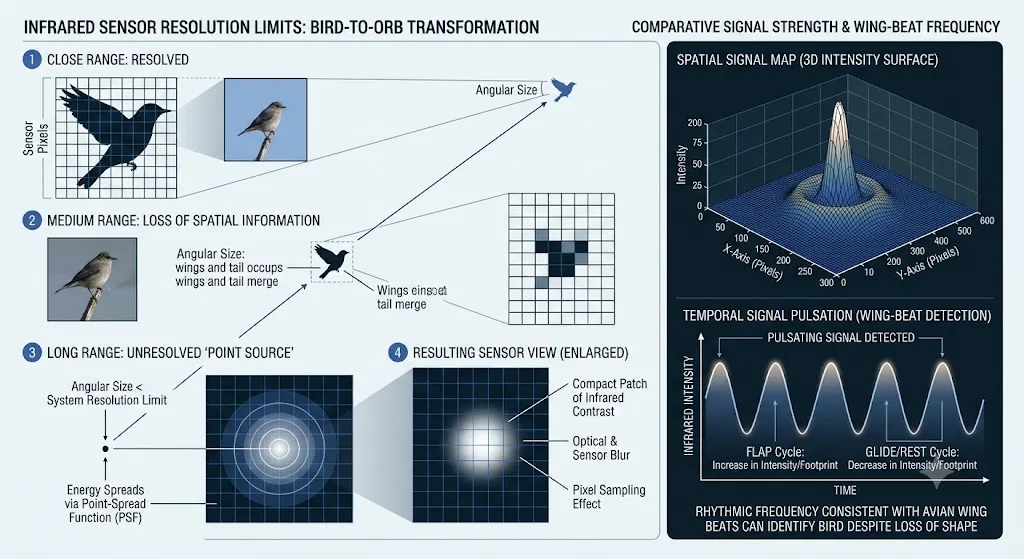
A bird does not need to be physically spherical to look like an “orb” on military infrared video. At sufficient range, its body and wings may occupy only a handful of sensor pixels. Once the target falls near or below the system’s resolving limit, the camera records a compact patch of infrared contrast rather than a recognisable silhouette. Optical blur, sensor sampling, contrast enhancement and later video compression can further smooth or erase the thin structures that would otherwise identify wings and a tail. The result may be a rounded, bright or dark blob whose apparent shape reflects the imaging system as much as the animal itself. Research on infrared small-target detection describes exactly this problem: distant targets carry very little spatial information because they occupy so few pixels.[joig.net]joig.netSurvey of Video Based Small Target DetectionNovember 24, 2021 — by Y Liu · 2021 · Cited by 118 — This paper first briefly introduces the traditional video based target detection alg…
This is not merely a hypothetical explanation for UFO or UAP footage. The US All-domain Anomaly Resolution Office (AARO) has now published military infrared cases that it assesses with high confidence as birds, including migrating groups whose identification rested partly on flight formation, migration routes and a repeating infrared signal consistent with wing beats.[AARO]aaro.milUAP ImageryOfficial UAP Imagery · UAP Case… AARO bases its assessment on the objects' strong morphological consistency with other…
Why birds lose their shape at long range
The key variable is not how large a bird looks in ordinary life, but its angular size: how much of the sensor’s field of view the animal occupies. A large bird several kilometres away can project onto very few detector elements. At that scale, the sensor may still detect that something warmer or otherwise infrared-contrasting is present while no longer preserving enough detail to show what it is.
This distinction between detection and identification is fundamental to infrared imaging. Small-target research routinely deals with objects occupying only one or a few pixels, where there is simply too little spatial information for a useful outline. Such targets can be detected because their intensity differs from the background even though their actual geometry cannot be recovered reliably.[arXiv]arxiv.orgSpatio-Temporal Feedback Control of Small Target Motion Detection Visual SystemNovember 18, 2022…
Optics add another layer. Every imaging system converts an ideal point into a finite pattern called the point-spread function. In plain terms, even a perfectly tiny source is recorded as a small patch rather than a mathematical point. When a bird becomes sufficiently distant, its own outline and the camera’s blur pattern begin to merge. Wings that would be unmistakable at close range may contribute only slightly to the intensity of neighbouring pixels rather than appearing as separate structures. Point-source imaging routinely produces signals spread over several pixels, even when the source itself is unresolved.[SPIE Digital Library]spiedigitallibrary.org1.JATIS.8.2.027002.fullpixel, with light from each star spread over several pixels (defining the point spread function or PSF). This was an intentional design ….
Thermal imaging makes birds particularly detectable despite this loss of form because birds are warm-blooded and can contrast strongly with a colder sky. Modern ornithologists deliberately exploit that fact to find nocturnal migrants. Recent field work combining thermal imaging with ordinary telephoto photography illustrates the difference neatly: thermal equipment can first detect a night-flying bird, while the higher-detail visible image is then needed to establish its species.[OUP Academic]academic.oup.comOUP AcademicUsing thermal imaging to directly observe nocturnal migrationby Y Morales-Góngora · 2026 — Combining recent advances in therm…
That helps explain the otherwise counter-intuitive military-video situation: a sensor can have a perfectly genuine, persistent target while displaying almost none of the anatomy that would make the target obviously avian.
AARO’s own analyses also show why this point should not be pushed too far. In its investigation of the 2013 Puerto Rico infrared case, the office rejected a proposed bird explanation partly because, at its reconstructed distances, it expected birds to retain visible features such as wings or to show an infrared pulsation associated with wing beats.[AARO]aaro.milPuerto Rico UAP Case ResolutionPuerto Rico UAP Case Resolution In other words, “it looks like a blob” is not sufficient evidence for a bird. Whether wings ought to be visible depends on range, optics, resolution, target size, viewing angle and image quality.
Compression, glare and the flickering-wing effect
The compact object shown on a cockpit or intelligence display is not necessarily a direct map of the target’s physical boundary. Between bird and viewer lie the optics, detector, image processing, display scaling and, in publicly released material, often another generation of encoding or compression.
A few pixels cannot preserve a bird silhouette
Once a target occupies very few pixels, small changes in orientation can produce surprisingly large changes in its displayed appearance. A wing extending sideways might briefly add a pixel to one edge; moments later that same wing may align with the body and disappear into the central spot. Sub-pixel motion changes how the target’s energy is divided among neighbouring detector elements. Consequently, a bird can alternate between slightly elongated, asymmetrical and nearly circular forms without changing its basic flight path.
This is one reason infrared small-target detection is treated as a specialised technical problem rather than a conventional object-recognition task. Researchers describe small infrared targets as possessing severely limited shape and texture information, often with blurred boundaries.[arXiv]arxiv.orgOpen source on arxiv.org.
Video compression can remove still more information. Lossy codecs reduce data by approximating spatial detail and changes between frames. For a large object, losing a little edge information may hardly matter. For an object that is only several pixels across, those discarded edge differences may constitute much of the available evidence for wings or a tail. Surveys of video-based small-object detection therefore identify limited pixel coverage as a basic obstacle to classification.[joig.net]joig.netSurvey of Video Based Small Target DetectionNovember 24, 2021 — by Y Liu · 2021 · Cited by 118 — This paper first briefly introduces the traditional video based target detection alg…
Compression should not be treated as a universal explanation for every round-looking UAP. The important point is narrower: once an object is already near the resolution limit, processing and compression can make its apparent boundary less trustworthy than the underlying motion of the target.
A halo can look more solid than the object
Bright or high-contrast sources can also acquire halos or enlarged apparent footprints through optical spreading, processing or, in some imaging technologies, saturation effects. The general phenomenon is well established in digital imaging: a compact source can be recorded with a wider point-spread profile, while saturated detector technologies can produce blooming into neighbouring pixels.[Hamamatsu Learning Center]hamamatsu.magnet.fsu.eduHamamatsu Learning Center CCD Saturation and BloomingHamamatsu Learning Center CCD Saturation and Blooming
The exact behaviour depends strongly on the sensor, so footage should not automatically be diagnosed as “glare” without information about the camera and its settings. Indeed, AARO’s recently published material distinguishes between what an image visually resembles and what analysis can actually establish. One 2024 military report described an object as a misshapen ball of white light and noted a glare or halo in the full-motion-video feed, but AARO’s publication deliberately treats such visual descriptions as observations rather than determinations of the object’s nature.[AARO]aaro.milNext UAP Report DocumentsNext UAP Report Documents
For distant birds, the more defensible general mechanism is therefore a combination of poor spatial resolution and a broadened high-contrast image, sometimes compounded by compression, rather than an assumption that every apparent orb is produced by literal optical glare.
Wings may survive as flicker instead of shape
The most useful clue can appear in time rather than space. Even when a sensor cannot resolve individual wings, flapping can modulate the amount or distribution of infrared energy reaching it. From frame to frame, the object’s displayed brightness or footprint can pulse.
AARO has explicitly used this feature in a military case. Its PR-016 case, submitted by US European Command from a military infrared sensor in 2023, was assessed at greater than 95 per cent likelihood to depict birds. Among the reasons AARO cited were the objects’ relative positioning and a pulsating infrared return at a frequency consistent with wing beats.[AARO]aaro.milUAP ImageryOfficial UAP Imagery · UAP Case… AARO bases its assessment on the objects' strong morphological consistency with other…
That interpretation has independent support from bird-monitoring research. Thermal-video studies have found that wing-beat frequency and flight pattern carry enough information to help distinguish avian groups even when ordinary visual identification is difficult.[ScienceDirect]sciencedirect.comOpen source on sciencedirect.com. Ornithological measurements also show that species have characteristic combinations of airspeed and wing-beat frequency, although neither measurement alone provides a foolproof identification.[Wiley Online Library]onlinelibrary.wiley.comj.1474 919X.2010.01014.xj.1474 919X.2010.01014.x
An “orb” that rhythmically changes intensity may therefore contain information about wings even though no wing is ever clearly visible in a single frame.
Motion clues that distinguish birds from aircraft
When shape information collapses, investigators increasingly have to ask how the object behaves, not merely what one frame looks like.
AARO’s published bird resolutions illustrate the method. In PR-016, the office cited both wing-beat-like pulsation and the tendency of multiple objects to maintain relative positions associated with energy-efficient bird flight. In another case, PR-002, an Africa Command infrared recording from 2024, AARO assessed a group of objects as migratory birds with at least 95 per cent confidence because their morphology matched other bird imagery and their flight behaviour corresponded with known migration routes. An Intelligence Community partner concurred.[AARO]aaro.milUAP ImageryOfficial UAP Imagery · UAP Case… AARO bases its assessment on the objects' strong morphological consistency with other…
Several motion features can be especially informative:
- Repeated flapping modulation. Regular brightness, size or radar-return changes at biologically plausible wing-beat frequencies favour birds over fixed-wing aircraft and many balloons. Thermal-video research specifically uses wing-beat behaviour for classification.[ScienceDirect]sciencedirect.comOpen source on sciencedirect.com.
- Flap-and-glide cycles. Some species alternate powered wing beats with brief glides, producing a repeating temporal pattern rather than continuous propulsion. Studies of migratory birds have directly measured such intermittent flight.[Springer]link.springer.comOpen source on springer.com.
- Flock geometry. Several small targets preserving characteristic spacing or formation can be more revealing than any individual blob. Formation flight can reduce birds’ energy expenditure, providing a biological reason for organised relative positioning.[PubMed]pubmed.ncbi.nlm.nih.govOpen source on nih.gov.
- Migration-compatible direction and location. A track that coincides with established migration behaviour can strengthen a bird interpretation, especially when several objects travel together. This was part of AARO’s reasoning in PR-002.[AARO]aaro.milUAP ImageryOfficial UAP Imagery · UAP Case… AARO bases its assessment on the objects' strong morphological consistency with other…
- Moderate, continuous trajectories. A distant target’s motion across the display can appear dramatic when the observing aircraft, sensor turret or field of view is itself moving. Genuine speed therefore has to be reconstructed from geometry and telemetry rather than inferred from screen motion alone. AARO explicitly warns that apparent rapid UAP motion can arise from viewing geometry and observer or sensor motion.[AARO]aaro.milOpen source on aaro.mil.
Aircraft, of course, can also fly steadily and in formation. No single clue establishes “bird”. The strongest identification comes when several independent characteristics agree: target scale, repeated wing-beat modulation, flock spacing, plausible speed and altitude, environmental setting and migration behaviour.
This is why a short isolated clip is much harder to interpret than a longer sequence. A single still frame may contain little more than a round spot. Tens of seconds of uninterrupted recording can reveal periodic flickering, group structure and changes between flapping and gliding that are largely invisible in a screenshot.
Military cases show the orb is often an imaging category, not a physical shape
The publicly available AARO record demonstrates that birds are a recurring, though not dominant, source of resolved UAP reports. AARO’s reporting-trends data covering cases through 15 June 2026 lists 23 closed cases resolved as birds, representing 2.5 per cent of its published closed-case resolution outcomes. Balloons and satellites account for far larger shares, but the bird category is substantial enough to be an established part of UAP analysis rather than a speculative edge case.[AARO]aaro.milOpen source on aaro.mil.
The more instructive evidence comes from the imagery itself. AARO’s publicly released military cases include:
PR-016, Europe, 2023: twenty-five seconds of infrared footage from a US military platform. AARO judged the objects almost certainly to be birds, relying on morphology, relative positioning and infrared pulsation consistent with wing beats.[AARO]aaro.milUAP ImageryOfficial UAP Imagery · UAP Case… AARO bases its assessment on the objects' strong morphological consistency with other…
PR-002, Africa, 2024: one minute and eighteen seconds of infrared footage. AARO assessed the objects as a group of migratory birds, citing morphological similarity to resolved bird imagery and behaviour matching known migration routes.[AARO]aaro.milUAP ImageryOfficial UAP Imagery · UAP Case… AARO bases its assessment on the objects' strong morphological consistency with other…
These examples are particularly useful because they show what competent identification looks like once an object has lost its obvious bird shape. The conclusion is not based simply on saying that a fuzzy object “could be anything”. Analysts recover information from time-dependent behaviour that survives after spatial detail has vanished.
The opposite lesson is equally important. An indistinct orb cannot be labelled a bird merely because birds sometimes look like orbs. AARO’s Puerto Rico analysis shows the value of testing the hypothesis quantitatively: if the proposed range implies that wings should have been resolved, or the reconstructed speed and trajectory conflict with avian flight, then a bird explanation becomes weaker rather than stronger.[AARO]aaro.milPuerto Rico UAP Case ResolutionPuerto Rico UAP Case Resolution

What a featureless orb does — and does not — tell us
A smooth, roughly circular infrared target is therefore weak evidence about an object’s real geometry. At long range, the displayed outline may primarily describe the sensor’s ability to resolve a small source. Thin appendages disappear first; a warm central body remains detectable; optical spreading makes the remaining signal compact; processing and compression may suppress marginal edge information. A flapping bird can consequently resemble an orb for much of a video while intermittently betraying itself through rhythmic changes in intensity or footprint.
That changes how such UAP footage should be read. The best diagnostic questions are usually not “Why can’t I see wings?” or “Why is it perfectly round?” but how many pixels the source actually occupies, whether its brightness pulses, how it moves relative to neighbouring objects, whether its apparent speed survives geometric reconstruction, and whether the track fits plausible bird behaviour.
Military sensors can be highly capable and still face this limitation. Detecting a distant source and resolving its anatomy are different tasks. That gap between detection and recognition is precisely where ordinary birds can become apparently extraordinary infrared “orbs” — until their motion supplies the information their silhouette no longer can.
Amazon book picks
Further Reading
Books and field guides related to How Birds Become Orbs on Infrared Video. Use these as the next step if you want deeper reading beyond the article.
Infrared Thermal Imaging: Fundamentals, Research and Applicat...
This richly illustrated hands-on guide is designed for researchers, teachers and practitioners. The huge selection of examples taken from...
Passive Infrared Detection: Theory and Applications
Familiarization with the infrared world Thermal imaging systems extend human perception beyond the visible spectrum. Since their principl...
Hawks at a Distance: Identification of Migrant Raptors
The ultimate field manual for identifying distant raptors The ultimate must-have guide for identifying migrant raptors, Hawks at a Distan...
eBay marketplace picks
Marketplace Samples
Live-tested eBay searches with available results related to this page.
Selected fromUFO poster oneBay.co.uk.

Current eBay listing
I Want To Believe UFO Poster Giclée Fine Art Heavyweight Print



Current eBay listing
VINTAGE UFO FLYING SAUCERS COMIC ADVERTISING A2 POSTER PRINT
Endnotes
1.
Source: joig.net
Title: Survey of Video Based Small Target Detection
Link:https://www.joig.net/uploadfile/2021/1124/20211124052219501.pdf
Source snippet
November 24, 2021 — by Y Liu · 2021 · Cited by 118 — This paper first briefly introduces the traditional video based target detection alg...
Published: November 24, 2021
2.
Source: aaro.mil
Link:https://www.aaro.mil/UAP-Cases/Official-UAP-Imagery/
Source snippet
UAP ImageryOfficial UAP Imagery · UAP Case... AARO bases its assessment on the objects' strong morphological consistency with other...
3.
Source: arxiv.org
Link:https://arxiv.org/abs/2211.10128
Source snippet
Spatio-Temporal Feedback Control of Small Target Motion Detection Visual SystemNovember 18, 2022...
Published: November 18, 2022
4.
Source: arxiv.org
Link:https://arxiv.org/abs/2605.00886
5.
Source: academic.oup.com
Link:https://academic.oup.com/auk/article/143/2/1/8506565
Source snippet
OUP AcademicUsing thermal imaging to directly observe nocturnal migrationby Y Morales-Góngora · 2026 — Combining recent advances in therm...
6.
Source: aaro.mil
Title: Puerto Rico UAP Case Resolution
Link:https://www.aaro.mil/Portals/136/PDFs/case_resolution_reports/AARO_Puerto_Rico_UAP_Case_Resolution.pdf
7.
Source: arxiv.org
Link:https://arxiv.org/abs/2604.05363
8.
Source: academic.oup.com
Link:https://academic.oup.com/mnras/article/531/2/2517/7676869
9.
Source: aaro.mil
Title: Next UAP Report Documents
Link:https://www.aaro.mil/Next-AARO-Home-redesign/Next-Parent/Next-UAP-Report-Documents/
10.
Source: sciencedirect.com
Link:https://www.sciencedirect.com/science/article/pii/S1574954115001478
11.
Source: onlinelibrary.wiley.com
Title: j.1474 919X.2010.01014.x
Link:https://onlinelibrary.wiley.com/doi/10.1111/j.1474-919X.2010.01014.x
12.
Source: link.springer.com
Link:https://link.springer.com/article/10.1007/s10336-022-01978-1
13.
Source: aaro.mil
Link:https://www.aaro.mil/FAQ/
14.
Source: aaro.mil
Link:https://www.aaro.mil/UAP-Cases/UAP-Reporting-Trends/
15.
Source: arxiv.org
Link:https://arxiv.org/html/2403.19366v1
16.
Source: aaro.mil
Link:https://www.aaro.mil/
17.
Source: aaro.mil
Title: [Go Fast]({{ ‘go-fast/’ | relative_url }}) Case Resolution Card Methodology Final
Link:https://www.aaro.mil/Portals/136/PDFs/case_resolution_reports/AARO_GoFast_Case_Resolution_Card_Methodology_Final.pdf
18.
Source: aaro.mil
Title: all-domain anomaly
Link:https://www.aaro.mil/Portals/136/PDFs/SASC_AARO_Open_Hearing_Case_Slides_19Nov2024.pdf
19.
Source: aaro.mil
Link:https://www.aaro.mil/Portals/136/PDFs/Information%20Papers/AARO_Declassification_Info_Paper_2025.pdf
20.
Source: aaro.mil
Title: UNCLASSIFIED FY23 Consolidated Annual Report on UAP Oct 25 2023 1236
Link:https://www.aaro.mil/Portals/136/PDFs/UNCLASSIFIED-FY23_Consolidated_Annual_Report_on_UAP-Oct_25_2023_1236.pdf
21.
Source: aaro.mil
Link:https://www.aaro.mil/Congressional-Press-Products/
22.
Source: aaro.mil
Title: EFOIA Reading Room
Link:https://www.aaro.mil/EFOIA-Reading-Room/
23.
Source: aaro.mil
Title: AARO Historical Record Report Vol 1 2024
Link:https://www.aaro.mil/Portals/136/PDFs/AARO_Historical_Record_Report_Vol_1_2024.pdf
24.
Source: pmc.ncbi.nlm.nih.gov
Link:https://pmc.ncbi.nlm.nih.gov/articles/PMC7961815/
Source snippet
PubMed Central (PMC)Detecting Small Size and Minimal Thermal Signature Targets...by M Uzair · 2021 · Cited by 19 — Thermal infrared imag...
25.
Source: spiedigitallibrary.org
Link:https://www.spiedigitallibrary.org/journals/Journal-of-[Astronomical
Source snippet
pixel, with light from each star spread over several pixels (defining the point spread function or PSF). This was an intentional design...
26.
Source: pmc.ncbi.nlm.nih.gov
Title: Pub Med Central (PMC)New Results on Small and Dim Infrared Target Detection
Link:https://pmc.ncbi.nlm.nih.gov/articles/PMC8621198/
27.
Source: hamamatsu.magnet.fsu.edu
Title: Hamamatsu Learning Center CCD Saturation and Blooming
Link:https://hamamatsu.magnet.fsu.edu/articles/ccdsatandblooming.html
28.
Source: pubmed.ncbi.nlm.nih.gov
Link:https://pubmed.ncbi.nlm.nih.gov/11607019/
29.
Source: spiedigitallibrary.org
Link:https://www.spiedigitallibrary.org/conference-proceedings-of-spie/12777/2690634/Super-resolved-compressive-demonstrator-for-Earth-Observation-applications-in-the/10.1117/12.2690634.full
30.
Source: proceedings.spiedigitallibrary.org
Link:https://proceedings.spiedigitallibrary.org/proceedings/Download?urlId=10.1117%2F12.857585
31.
Source: spiedigitallibrary.org
Link:https://www.spiedigitallibrary.org/journals/optical-engineering/volume-50/issue-7/072601/Compressed-sensing-for-practical-optical-imaging-systems-a-tutorial/10.1117/1.3596602.full
32.
Source: spiedigitallibrary.org
Link:https://www.spiedigitallibrary.org/conference-proceedings-of-spie/12777/1277741/Super-resolved-compressive-demonstrator-for-Earth-Observation-applications-in-the/10.1117/12.2690634.pdf
33.
Source: spiedigitallibrary.org
Link:https://www.spiedigitallibrary.org/journals/Journal-of-Astronomical-Telescopes-Instruments-and-Systems/volume-2/issue-2/025004/High-resolution-broadband-spectroscopy-using-externally-dispersed-interferometry-at-the/10.1117/1.JATIS.2.2.025004.full
34.
Source: spiedigitallibrary.org
Link:https://www.spiedigitallibrary.org/conference-proceedings-of-spie/13468/134680G/Further-development-of-the-target-acquisition-performance-model-ECOMOS/10.1117/12.3055690.full
35.
Source: spiedigitallibrary.org
Link:https://www.spiedigitallibrary.org/journals/optical-engineering/volume-39/issue-4
36.
Source: spiedigitallibrary.org
Link:https://www.spiedigitallibrary.org/conference-proceedings-of-spie/11180/111807I/A-pipeline-to-improve-compressed-image-quality/10.1117/12.2536189.full
37.
Source: spiedigitallibrary.org
Link:https://www.spiedigitallibrary.org/conference-proceedings-of-spie/14236/142361G/Aero-optical-effects-in-detection-systems/10.1117/12.3111408.full
38.
Source: pmc.ncbi.nlm.nih.gov
Link:https://pmc.ncbi.nlm.nih.gov/articles/PMC8165734/
39.
Source: pmc.ncbi.nlm.nih.gov
Link:https://pmc.ncbi.nlm.nih.gov/articles/PMC11312577/
40.
Source: Wikipedia
Link:https://en.wikipedia.org/wiki/Official
41.
Source: dictionary.cambridge.org
Link:https://dictionary.cambridge.org/us/dictionary/english/official
42.
Source: vocabulary.com
Link:https://www.vocabulary.com/dictionary/official
Additional References
43.
Source: youtube.com
Link:https://www.youtube.com/watch?v=_6HHz55Py-g
Source snippet
UAP FILES - Visual Evidence from 3 Cases over Africa (2022-2024)...
44.
Source: youtube.com
Title: GOFAST UFO Analysis (yeah no, probably just a balloon)
Link:https://www.youtube.com/watch?v=-3NYowlCoDc
Source snippet
All-domain Anomaly Resolution Office (AARO): a Duality in Mission Regarding UAPs (Sean Kirkpatrick)...
45.
Source: youtube.com
Title: UAP FILES
Link:https://www.youtube.com/watch?v=rhP8VdCIz9A
Source snippet
Breakdown of the Pentagon UFO videos with Mick West...
46.
Source: defense.gov
Title: department of defense releases the annual report on unidentified anomalous phen
Link:https://www.defense.gov/News/Releases/Release/Article/3964824/department-of-defense-releases-the-annual-report-on-unidentified-anomalous-phen/
47.
Source: defense.gov
Title: media engagement with acting aaro director tim phillips on the historical recor
Link:https://www.defense.gov/News/Transcripts/Transcript/Article/3702219/media-engagement-with-acting-aaro-director-tim-phillips-on-the-historical-recor/
48.
Source: defense.gov
Title: statement by pentagon press secretary maj gen pat ryder on the historical recor
Link:https://www.defense.gov/News/Releases/Release/Article/3700894/statement-by-pentagon-press-secretary-maj-gen-pat-ryder-on-the-historical-recor/
49.
Source: defense.gov
Title: dr jon kosloski director aaro media roundtable on the fy24 consolidated annual
Link:https://www.defense.gov/News/Transcripts/Transcript/Article/3965734/dr-jon-kosloski-director-aaro-media-roundtable-on-the-fy24-consolidated-annual/
50.
Source: youtube.com
Title: Breakdown of the Pentagon UFO videos with Mick West
Link:https://www.youtube.com/watch?v=Le7Fqbsrrm8
Source snippet
GOFAST UFO Analysis (yeah no, probably just a balloon)...
51.
Source: researchgate.net
Link:https://www.researchgate.net/publication/244488968_Physical_modeling_and_characterization_of_the_halo_phenomenon_in_Night_Vision_Goggles
52.
Source: academia.edu
Link:https://www.academia.edu/23027974/The_Study_of_Bird_Migration_by_Radar