Within IR Glare
Does Gimbal Show an Object or Infrared Glare?
The Gimbal debate shows why an infrared silhouette alone cannot establish an object's physical shape or identity.
On this page
- Why the dark shape has been interpreted as glare
- How apparent rotation complicates the reading
- Why the aircraft explanation remains disputed
Page outline Jump by section
Introduction
The 2015 Navy “Gimbal” footage is one of the clearest tests of a basic warning about infrared UAP imagery: the dark silhouette on the display need not be the physical outline of the object producing it. In the 34-second clip, a dark, roughly oval form appears against clouds and then seems to rotate. One interpretation is straightforward but remarkable — the camera recorded an object physically rolling. The competing explanation is that much of the visible shape is infrared glare from a distant aircraft, with the apparent rotation produced by the geometry and image-derotation system of the AN/ASQ-228 ATFLIR targeting pod.[Naval Air Systems Command]navy.milOpen source on navy.mil.
Gimbal does not settle the wider UAP question. It does, however, show why an infrared silhouette alone is insufficient for identifying an object’s shape. The glare hypothesis has genuine optical and mechanical support, including documented ATFLIR derotation optics and correlations between apparent rotation and camera behaviour. But the stronger claim that the hidden source was specifically an ordinary distant jet remains disputed, chiefly because target range and motion are not established by the publicly released video alone.[Metabunk]metabunk.orgOpen source on metabunk.org.
Why the dark shape has been interpreted as glare
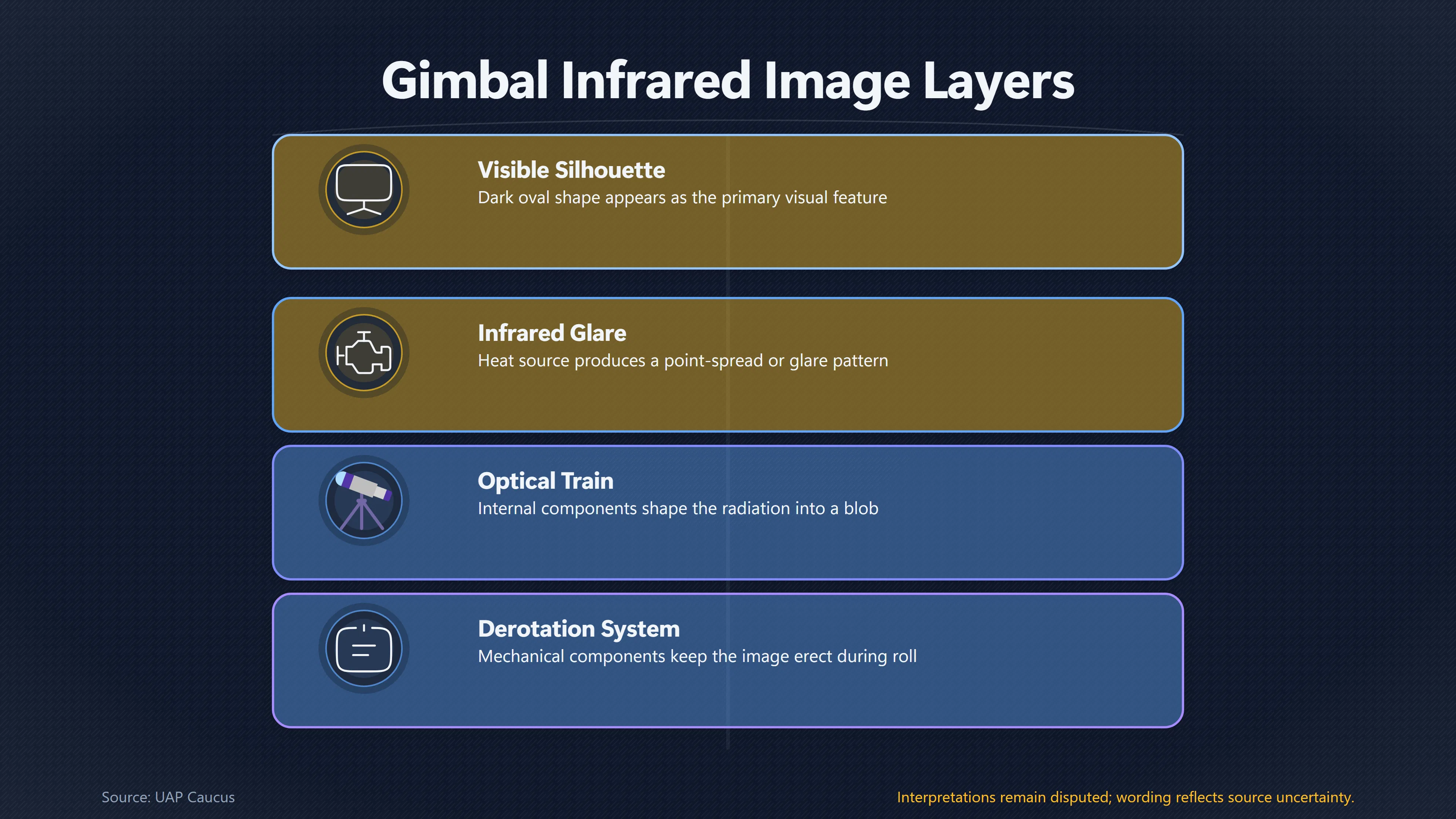
The first important distinction is between what generated the infrared radiation and the shape that radiation acquired in the recorded image. Gimbal was recorded through ATFLIR, an electro-optical targeting system rather than an ordinary visible-light camera. Public Navy records confirm the Gimbal video as official footage, while Raytheon patents describing ATFLIR-related architecture show an infrared optical train containing imaging optics, stabilisation components and a reflective derotation mechanism designed to keep the IR image erect.[navy.mil]navy.milOpen source on navy.mil.
That matters because an optical artifact generated inside such a system does not have to behave like a solid feature in the outside scene. A sufficiently strong unresolved infrared source can produce a point-spread or glare pattern whose displayed dimensions and orientation are determined partly by the imaging system. The resulting dark region in a black-hot presentation may therefore conceal a smaller underlying source rather than trace its physical boundary.
This is the basis of Mick West’s detailed Gimbal analysis. His proposal is not that there was literally “nothing” where the dark blob appears. Rather, he argues that an ordinary distant aircraft could lie behind the blob, with hot engine exhaust viewed from approximately behind producing an infrared glare large enough to obscure the aircraft’s wings and fuselage. In that model, the visually distinctive oval belongs substantially to the image of the heat source, not necessarily to the aircraft itself.[Metabunk]metabunk.orgOpen source on metabunk.org.
Experiments presented in support of the hypothesis demonstrate the more limited proposition that asymmetric glare can exist and can rotate when the camera is rotated while the resulting scene is derotated. Tests with bright sources have produced elongated or saucer-like glare patterns whose long axes depend on camera orientation. They are not laboratory reproductions of the classified operational ATFLIR configuration in the Gimbal encounter, so they cannot identify the target by themselves. They do show why the argument “the image is oval, therefore the object was oval” is unsafe.[Metabunk]metabunk.orgOpen source on metabunk.org.
The ATFLIR documentation strengthens that narrower point. Raytheon patents explicitly describe an outer roll gimbal and a reflective derotation mechanism in the infrared optical path that derotates the beam to maintain an erect image. That is independent evidence that image orientation in such a system is actively managed rather than simply passed from the external scene to the display without transformation.[Google Patents]patents.google.comGoogle Patents+2Google Patents…
Consequently, Gimbal presents two different identification questions that are sometimes collapsed into one:
- Is the visible dark oval the object’s physical outline? The glare explanation provides a plausible reason why it may not be.
- If glare dominates the image, what object produced it? That is a harder question. Demonstrating glare does not, by itself, demonstrate a conventional aircraft.
Keeping those questions separate is crucial to assessing the case fairly.
How apparent rotation complicates the reading
The dramatic moment comes near the end of the clip. The dark form rolls clockwise while a crew member remarks that it is rotating. Taken literally, the imagery seems to show an unusual object changing attitude in flight. But the ATFLIR’s own mechanical and optical behaviour creates another possibility: a camera-fixed asymmetric glare can appear to rotate relative to a stabilised outside scene.
This sounds paradoxical because the clouds do not simply roll around the screen with the blob. The derotation system is precisely why that observation is not decisive. ATFLIR-related patents describe a roll-capable optical assembly combined with a reflective mechanism that keeps the infrared scene erect. If an artifact is tied to some orientation within the optical train while the external scene is being corrected for roll, the artifact and scene need not retain the same apparent orientation.[Google Patents]patents.google.comGoogle Patents+2Google Patents…
That gives the glare interpretation a testable prediction. If Gimbal’s oval is predominantly an optical pattern, changes in its angle should correspond in some systematic way to changes in the targeting system’s viewing geometry. If it is simply a rigid object’s visible outline, that relationship should not be necessary.
Analyses developed on Metabunk have attempted exactly that comparison. Researchers reconstructed the aircraft and sensor geometry from information visible on the display, including changing azimuth, elevation and aircraft attitude. They argue that the strongest apparent rotation occurs where the targeting geometry requires substantial optical roll or derotation, and that smaller image disturbances immediately preceding the main turn also track changes expected from the optical system.[Metabunk]metabunk.orgOpen source on metabunk.org.
An especially interesting part of the argument concerns the beginning, rather than the famous end, of the clip. During an early interval, the aircraft banks while the blob does not perform the corresponding conspicuous rotation that a simple “aircraft banking equals blob rotating” reading might suggest. West and collaborators interpret the difference between this interval and the later rotation as evidence that the oval’s orientation is connected to the distinction between aircraft roll, pod tracking and optical derotation rather than straightforward physical rolling of the target.[Metabunk]metabunk.orgOpen source on metabunk.org.
This is stronger than merely noticing that targeting pods have moving parts. It attempts to explain when rotation appears and when it does not. Nevertheless, it remains a reconstruction from the released imagery and publicly available technical material, not a published manufacturer analysis of the exact Gimbal recording. Details of the operational ATFLIR’s complete processing chain, calibration state and internal telemetry for this event are not available in the public video.
The most defensible conclusion is therefore narrower than “Gimbal’s rotation has been debunked”. The footage does not allow the visible rotation to be treated automatically as measured rotation of a physical object. There is a technically grounded optical alternative that must first be excluded.[Google Patents]patents.google.comGoogle Patents+2Google Patents…
Why the aircraft explanation remains disputed
The glare hypothesis becomes more vulnerable when it moves from explaining the appearance to identifying the source. Saying that the oval could be glare does not establish that a distant conventional jet was actually in the relevant position, at the relevant range, travelling along the required trajectory.
Range is particularly important. The publicly released Gimbal video does not display an unambiguous target range. Different assumed distances therefore generate different reconstructed trajectories. A distant aircraft can produce comparatively ordinary motion while remaining approximately tail-on to the observing fighter; bringing the target much closer can imply a substantially different flight path.
This issue is central to a 2023 analysis by Yannick Peings and Marik von Rennenkampff. Using the changing viewing geometry in the video, they reconstructed families of possible target trajectories as a function of assumed distance. They explicitly considered the distant-aircraft/glare explanation but argued that a range of roughly 10 nautical miles, based on recollections attributed to naval aviators involved with the encounter, produces a trajectory consistent with accounts of the target slowing and reversing direction. At that assumed range, they contend that the distant conventional-jet interpretation becomes much harder to sustain.[arXiv]arxiv.orgOpen source on arxiv.org.
That result does not independently prove a 10-nautical-mile range. It demonstrates why range uncertainty controls the argument. The extraordinary-looking trajectory follows only if the target really was relatively close; the more prosaic distant-aircraft solution depends on placing it farther away. The public ATFLIR clip alone cannot cleanly choose between those assumptions.[arXiv]arxiv.orgOpen source on arxiv.org.
There is a second complication. Accounts associated with the event describe radar contacts and other objects — the “fleet” mentioned by the crew in the recording. Those reports make the complete encounter richer than a single anonymous heat source viewed in isolation. But information remembered from radar displays or subsequent briefings cannot simply be converted into precise range data for every frame of the publicly available video. The distinction between contemporaneous sensor records and later witness recollection matters when testing competing geometric models.[UAP Caucus]uapcaucus.comUAP Caucus
Nor does the absence of obvious wings settle the matter in favour of an exotic object. If glare is large enough to obscure an unresolved aircraft, hidden wings are exactly what the hypothesis predicts. Conversely, the mere demonstration that glare could hide wings cannot establish that wings actually existed. Both arguments become circular if the silhouette itself is treated as proof.
This is why Gimbal remains unusually useful as a case study even without a final identification. The strongest sceptical analysis and the strongest counterarguments are testing different layers of the problem:
The glare case is strongest about image formation. ATFLIR has roll and derotation mechanisms; asymmetric infrared glare is physically plausible; and reconstructed sensor behaviour offers a coherent alternative explanation for the apparent rotation.[Google Patents]patents.google.comGoogle Patents+2Google Patents…
The counter-case is strongest about target geometry and encounter context. If the object was within roughly 10 nautical miles and followed the trajectory described by the participating aviators, a distant tail-on jet becomes difficult to reconcile with the event. But that conclusion depends heavily on range information that is not independently encoded as a clear measurement in the released clip.[arXiv]arxiv.orgOpen source on arxiv.org.
These positions are therefore not exact opposites. It is possible for the visible oval to be substantially shaped by infrared glare and for the underlying object still to remain unidentified. Proving the former does not automatically prove the latter was an aeroplane.
What Gimbal actually establishes about infrared silhouettes
For the broader problem of UFO and UAP identification, Gimbal’s most durable lesson is methodological rather than spectacular. A targeting-camera image contains several layers: the external target, its infrared emissions, atmospheric transmission, optical response, detector behaviour, stabilisation and derotation, and subsequent image processing. The final silhouette can be a product of that entire chain.
Gimbal is unusually valuable because apparent physical behaviour — the famous rotation — can itself be tested against the behaviour expected from the sensor. Public technical documentation establishes that ATFLIR-related systems include roll and infrared derotation mechanisms. Independent reconstructions then show how such mechanisms could make an asymmetric camera-linked glare rotate against a stabilised background. That is enough to make physical rotation ambiguous, even though it does not conclusively identify the source.[Google Patents]patents.google.comGoogle Patents+2Google Patents…
The unresolved range problem prevents the case from doing more. A high-confidence identification as a distant aircraft would benefit from contemporaneous range, radar and tracking data tied precisely to the video, together with sufficient technical information about the ATFLIR configuration to reproduce its optical behaviour quantitatively. Conversely, establishing that the target was close and executing the reconstructed reversal would seriously weaken the ordinary distant-jet model. Modern scientific proposals for UAP investigation emphasise precisely this kind of multimodal measurement — combining imaging with independent range and kinematic data so that ambiguous apparent motion does not have to carry the entire identification.[arXiv]arxiv.orgOpen source on arxiv.org.
Gimbal therefore supports a limited but important conclusion: the black rotating form cannot safely be read as a direct photograph of a black rotating craft. Infrared glare and ATFLIR’s image-control mechanisms provide a credible alternative account of both its shape and apparent rotation. Whether the concealed source was specifically a conventional aircraft is a separate and still contested inference. In a field where unusual silhouettes are often treated as evidence of unusual vehicles, that distinction is the central evidential value of the Gimbal footage.
Amazon book picks
Further Reading
Books and field guides related to Does Gimbal Show an Object or Infrared Glare?. Use these as the next step if you want deeper reading beyond the article.
Infrared Thermal Imaging: Fundamentals, Research and Applicat...
This richly illustrated hands-on guide is designed for researchers, teachers and practitioners. The huge selection of examples taken from...
Introduction to Infrared and Electro-Optical Systems
This newly revised and updated edition offers a current and complete introduction to the analysis and design of Electro-Optical (EO) imag...
Infrared Detectors and Systems
Infrared Detectors and Systems offers a deep and detailed examination of the optical detection process and the electronics of mimicking t...
eBay marketplace picks
Marketplace Samples
Live-tested eBay searches with available results related to this page.
Selected fromUFO poster oneBay.co.uk.


Current eBay listing
VINTAGE UFO FLYING SAUCERS COMIC ADVERTISING A2 POSTER PRINT

Current eBay listing
I Want To Believe UFO Poster Giclée Fine Art Heavyweight Print
Endnotes
1.
Source: arxiv.org
Link:https://arxiv.org/abs/2306.08773
2.
Source: uapcaucus.com
Title: UAP Caucus
Link:https://www.uapcaucus.com/research/reconstruction-of-potential-flight-paths-for-the-january-2015-gimbal-uap
3.
Source: patents.google.com
Link:https://patents.google.com/patent/EP1394494B1/en
Source snippet
Google Patents+2Google Patents...
4.
Source: arxiv.org
Link:https://arxiv.org/abs/2305.18566
Additional References
5.
Source: youtube.com
Title: “Gimbal” UFO ATFLIR video rotation explained by a Depot Level FLIR Technician
Link:https://www.youtube.com/watch?v=hzmdSsszf5g
Source snippet
Gimbal UAP glare rotation Mick West ATFLIR Gimbal UFO - A New Analysis...
6.
Source: youtube.com
Link:https://www.youtube.com/watch?v=4X1PRDbtiF0
Source snippet
"Gimbal" UFO ATFLIR video rotation explained by a Depot Level FLIR Technician...
7.
Source: youtube.com
Title: Gimbal UFO: Why Does the Glare Rotate When the Horizon Does Not?
Link:https://www.youtube.com/watch?v=ka_bX9Hx1H0
Source snippet
Explained: Gimbal UFO rotation caused by...a Gimbal...
8.
Source: youtube.com
Title: Explained: GIMBAL UFO Video
Link:https://www.youtube.com/watch?v=Jr1cfpos6vo
Source snippet
Gimbal UFO: Why Does the Glare Rotate When the Horizon Does Not?...
9.
Source: youtube.com
Title: Gimbal UFO
Link:https://www.youtube.com/watch?v=qsEjV8DdSbs
Source snippet
Explained: GIMBAL UFO Video - The IR Glare Hypothesis...