Within Formations
When Two Aircraft Look Like One Huge Craft
A NASA safety report shows how two separate aircraft lights fused into the appearance of one large approaching vehicle.
On this page
- The moonless over water encounter
- Which depth cues the observers lacked
- What finally revealed two separate aircraft
Page outline Jump by section
Introduction
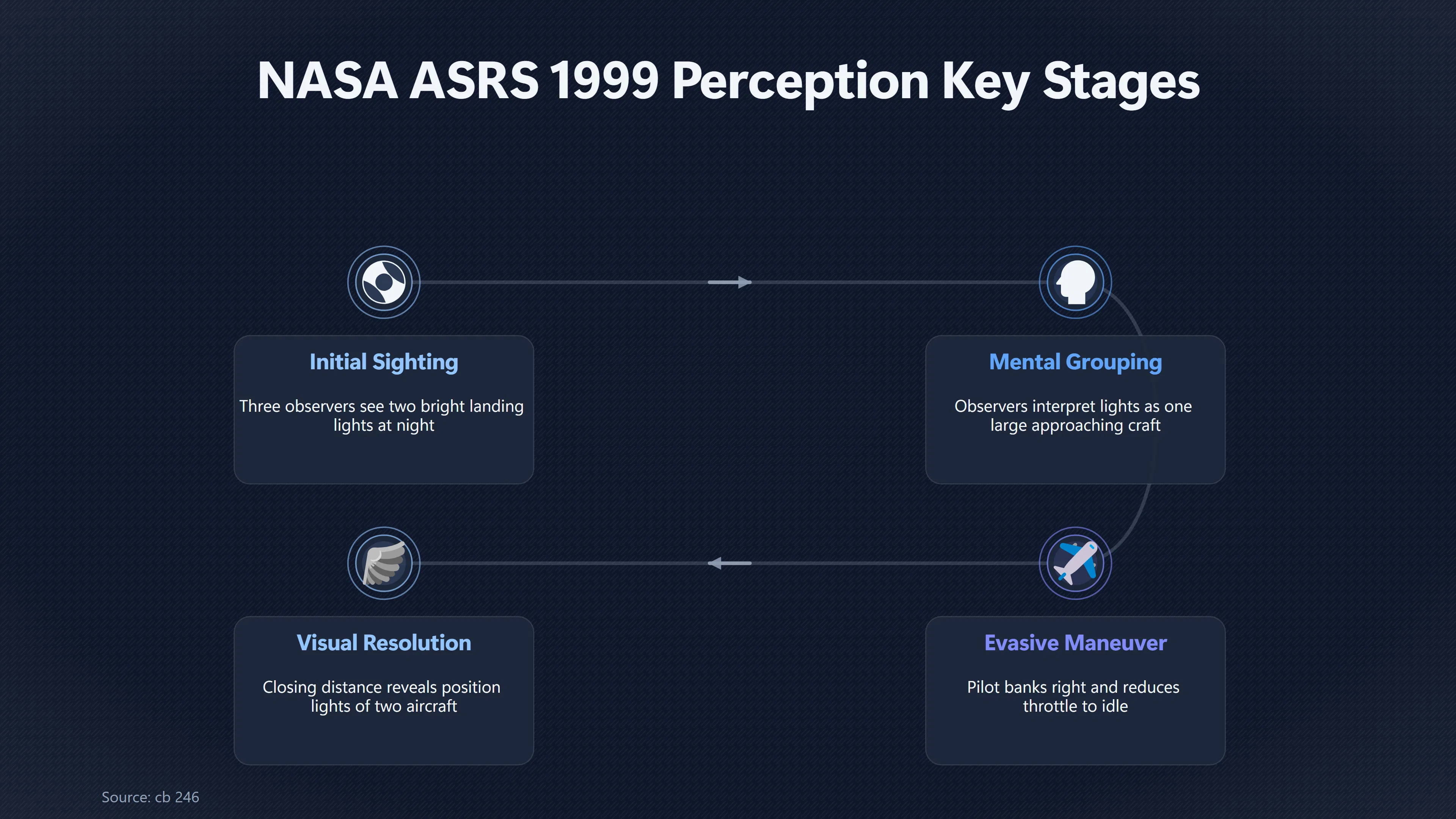
A NASA aviation-safety report provides a particularly clean example of how several ordinary lights can be perceived as one enormous night-time craft. Three people in a general-aviation cockpit saw two bright landing lights off their left side and interpreted them as belonging to a single large aircraft approaching very rapidly. They manoeuvred to avoid what seemed to be an imminent collision. Only later, when the lights drew close enough for additional aircraft lighting to become visible, did the apparent giant vehicle resolve into two separate aircraft.[Aviation Safety Reporting System]nasa.govcb 246Aviation Safety Reporting SystemCALLBACK 246December 1, 1999
The case matters for UFO and UAP interpretation because the observers were not merely confused about an aircraft’s type. Their visual system had assigned two real lights to the wrong physical arrangement. With distance and depth information largely absent, separate objects became the apparent extremities of one much larger object. The illusion disappeared when new visual information revealed that the lights belonged to different aircraft.
The moonless over-water encounter
The account appeared in the December 1999 issue of CALLBACK, the safety bulletin of NASA’s Aviation Safety Reporting System (ASRS). ASRS collects voluntary reports of aviation incidents and hazards and uses them to identify safety lessons; its published narratives are therefore incident reports rather than controlled reconstructions of everything that occurred.[Aviation Safety Reporting System]nasa.govcb 246Aviation Safety Reporting SystemCALLBACK 246December 1, 1999
In this report, three people were in the cockpit, one of them a non-pilot, as their aircraft flew northbound over a peninsula. All three looked towards the nine-o’clock position and saw two landing lights. Instead of seeing two aircraft, they perceived the lights as belonging to one large aircraft, apparently closing on them at high speed.[Aviation Safety Reporting System]nasa.govcb 246Aviation Safety Reporting SystemCALLBACK 246December 1, 1999
Their interpretation was convincing enough to prompt immediate action. The pilot banked right and reduced the throttle to idle in an effort to avoid the apparent collision. After returning to level flight, the observers could still see the supposed aircraft approaching from the same direction and apparently much closer. Only after watching it for longer did they realise that the two bright points were the landing lights of separate aircraft approaching from the west.[Aviation Safety Reporting System]nasa.govcb 246Aviation Safety Reporting SystemCALLBACK 246December 1, 1999
The most important detail is the setting. The reporter described a very dark night without moonlight, close to the ocean, where there were few surface lights or features. NASA presented those conditions as contributors to the visual illusion.[Aviation Safety Reporting System]nasa.govcb 246Aviation Safety Reporting SystemCALLBACK 246December 1, 1999
That makes this more informative than a generic observation that aircraft lights can be mistaken for UFOs. The witnesses already knew they were looking at something resembling aviation lighting. What they got wrong was the number and scale of the objects carrying those lights.
Which depth cues the observers lacked
Two bright points do not contain enough information, by themselves, to specify the three-dimensional arrangement that produced them. They could be two lights mounted on one nearby aircraft, lights on one much larger and more distant aircraft, or lights belonging to two separate aircraft at different positions and distances. The retina records angular positions; determining the physical arrangement requires additional cues.
Night flying can remove many of those cues at once. The US Federal Aviation Administration (FAA) explicitly warns that an absence of ground features — particularly over water or darkened terrain — can produce serious errors in judging height and distance. Its guidance also notes that aircraft are harder to see under dim illumination unless their navigation lights are visible.[Federal Aviation Administration]faa.govFederal Aviation Administration Chapter 8. Medical Facts for PilotsFederal Aviation AdministrationChapter 8. Medical Facts for PilotsJanuary 8, 2015…
Experimental aviation research reinforces the point. FAA research into night approaches has found large visual errors when normal environmental information is reduced. A 1978 study investigated relative motion parallax — differences in apparent movement that can help reveal spatial relationships — and found evidence that its reduced effectiveness contributes to night-time perceptual problems. Later FAA experiments likewise examined how sparse lighting affects pilots’ judgements of spatial geometry.[Federal Aviation Administration]faa.govFederal Aviation AdministrationOffice of Aerospace Medicine Technical Reports | Federal Aviation AdministrationMarch 1, 1978…
The circumstances of the NASA incident stripped away several potentially useful discriminators:
- No illuminated landscape beneath the lights. Buildings, roads and terrain can provide scale, horizon and motion references. The dark ocean provided little of that information.
- No moonlit horizon or surface detail. A moonless environment further reduced the surrounding visual framework against which movement could be judged.
- Bright lights dominated the view. Initially, the observers had the conspicuous landing lights without enough visible aircraft structure to assign each light to its own airframe.
- Angular proximity encouraged a single-object interpretation. From the observers’ particular viewpoint, the two aircraft projected into a configuration consistent with the lights of one large approaching aircraft.
The related aviation phenomenon often called the black-hole illusion occurs during night approaches over dark water or unlighted terrain. It is not identical to the two-aircraft incident, but its relevance is specific: aviation authorities recognise that featureless darkness deprives observers of peripheral and depth/distance information that would normally constrain spatial judgement. US Air Force guidance describes poor peripheral cues and missing information for relative size and depth or distance as central to such night-time errors.[E-Publishing]static.e-publishing.af.milpam11 417E-PublishingAIR FORCE PAMPHLET 11-417April 9, 2015…
In other words, darkness did not simply make the aircraft difficult to see. It removed much of the evidence needed to decide what spatial arrangement the visible lights represented.
Why one enormous craft seemed plausible
The apparent size of the perceived aircraft followed from the assumption that both lights belonged to the same object. Once two separated lights are mentally assigned to one vehicle, their angular separation becomes, in effect, the apparent width of that vehicle.
That creates an important ambiguity. Without a reliable distance estimate, angular size cannot establish physical size. A particular separation between two lights in the visual field could correspond to lights close together on a nearby object or much farther apart on a more distant one. In this case there was an additional possibility: the lights did not share an airframe at all.
NASA discussed the episode under the heading of the parallax effect, describing situations in which observer movement and impoverished night-time references can produce misleading impressions of an object’s position and motion in three-dimensional space. The same bulletin gives another striking aviation example in which the red and green lights of an aircraft and a bright white star were perceived together as the lighting configuration of a threatening aircraft. One supposed component of that “aircraft” was therefore astronomically distant from the others.[Aviation Safety Reporting System]nasa.govcb 246Aviation Safety Reporting SystemCALLBACK 246December 1, 1999
That neighbouring example helps clarify what happened in the two-aircraft case. A convincing arrangement of lights in the visual field does not demonstrate that those lights occupy the same distance plane or belong to one physical structure. The visual system has to infer that connection.
This is especially important when interpreting reports of very large night craft defined mainly by lights. If witnesses describe lights separated by a large apparent distance and infer a dark body between them, the apparent dimensions depend critically on whether the lights really are attached to one object. The NASA case demonstrates a more basic failure mode: even experienced observers can temporarily combine lights from two independently moving aircraft into one coherent, threatening vehicle.
What finally revealed two separate aircraft
The illusion did not end because the observers reasoned themselves out of it. It ended when the scene supplied better evidence.
According to the ASRS account, the decisive information appeared when the approaching aircraft became close enough for their position lights to be seen. At that point the observers could distinguish one aircraft from the other.[Aviation Safety Reporting System]nasa.govcb 246Aviation Safety Reporting SystemCALLBACK 246December 1, 1999
Aircraft position lights are valuable precisely because their configuration carries information that isolated bright landing lights do not. Once more of each aircraft’s lighting pattern became resolvable, the original two-point image could no longer be interpreted convincingly as the lighting of a single enormous airframe.
The sequence is therefore unusually instructive:
- Two conspicuous lights appeared in an otherwise impoverished scene.
- The observers grouped them into one large approaching aircraft.
- That interpretation implied an immediate collision threat and prompted evasive action.
- Closing distance exposed additional lights and spatial structure.
- The apparent single craft separated perceptually into two ordinary aircraft. Aviation Safety Reporting System
This progression also explains why the initial observation should not simply be dismissed as careless seeing. All three people reportedly shared the interpretation. The visual information available at first supported an incorrect but coherent model; later information supported a better one.
What this case establishes — and what it does not
The NASA report is strong evidence for one narrowly defined proposition: at night, lights from separate aircraft can align closely enough in an observer’s view to be perceived as the lights of one much larger aircraft. It documents the mistaken interpretation, the evasive response, the environmental conditions that favoured the error and, crucially, the later observation that resolved the ambiguity. Aviation Safety Reporting System
It is not evidence that every report of a huge triangular, V-shaped or otherwise light-defined UFO has this explanation. The report does not provide the detailed flight tracks, angular measurements or photogrammetry that would allow the encounter to be reconstructed quantitatively. Nor does an aviation safety narrative establish a universal explanation for superficially similar sightings.
Its value is instead diagnostic. It identifies a concrete question investigators should ask whenever a reported object’s apparent structure comes mainly from several lights against a dark sky: what independent evidence shows that those lights were physically connected?
If the answer is merely that they maintained a suggestive arrangement for some period, the inference can remain uncertain. Aircraft on different trajectories can briefly produce compatible lines of sight, while darkness can conceal the information that would reveal their separation. FAA guidance and research show more generally that sparse night-time environments degrade the visual references used for distance, height and spatial judgement. Federal Aviation Administration
The strongest evidence for a single giant craft would therefore be information that survives this ambiguity: a visible continuous structure, independently established ranges placing the lights at the same distance, multiple viewpoints permitting triangulation, sensor tracks demonstrating common motion, or imagery resolving the lights as parts of one body. Conversely, evidence that individual lights develop different navigation-light patterns, trajectories or apparent motions would favour multiple objects.
The 1999 ASRS encounter is memorable because that test happened naturally. At first there were only two lights and a compelling interpretation. Then the geometry became sufficiently revealing to show what the darkness had hidden: there had never been one enormous approaching aircraft. There were two.
Amazon book picks
Further Reading
Books and field guides related to When Two Aircraft Look Like One Huge Craft. Use these as the next step if you want deeper reading beyond the article.
Sensation and Perception
. Bruce Goldstein's SENSATION AND PERCEPTION, the best-seller which has helped over 150,000 students understand the ties between how we s...
Human Factors in Aviation
Since the 1950s, a number of specialized books dealing with human factors has been published, but very little in aviation. Human Factors...
Visual Intelligence: How We Create What We See
A unique, illustrated popular study reveals the way the human eye acts on the visual world not just to represent but to create the things...
The UFO Handbook: A Guide to Investigating, Evaluating, and R...
An explanation of the usual reasons for confusing IFOs (identified flying objects) with UFOs and a survey of the tools used to investigat...
eBay marketplace picks
Marketplace Samples
Live-tested eBay searches with available results related to this page.
Selected fromUFO poster oneBay.co.uk.

Current eBay listing
I Want To Believe UFO Poster Giclée Fine Art Heavyweight Print
Current eBay listing
VINTAGE UFO FLYING SAUCERS COMIC ADVERTISING A2 POSTER PRINT

Endnotes
2.
Source: asrs.arc.nasa.gov
Title: cb 246
Link:https://asrs.arc.nasa.gov/docs/cb/cb_246.pdf
Source snippet
Aviation Safety Reporting SystemCALLBACK Issue # 246—December 1999...
Published: December 1999
3.
Source: asrs.arc.nasa.gov
Title: Aviation Safety Reporting System ASRS
Link:https://asrs.arc.nasa.gov/search/dbol/aboutdata.html
Source snippet
Aviation Safety Reporting SystemASRS - Aviation Safety Reporting System - About ASRS Data...
4.
Source: faa.gov
Title: Federal Aviation Administration Chapter 8. Medical Facts for Pilots
Link:https://www.faa.gov/air_traffic/publications/atpubs/aim/aim0801.html
Source snippet
Federal Aviation AdministrationChapter 8. Medical Facts for PilotsJanuary 8, 2015...
Published: January 8, 2015
5.
Source: faa.gov
Title: Federal Aviation Administration Chapter 8. Medical Facts for Pilots
Link:https://www.faa.gov/Air_traffic/publications/atpubs/aim_html/chap8_section_1.html
6.
Source: faa.gov
Link:https://www.faa.gov/data_research/research/med_humanfacs/oamtechreports/1970s/1978/197815
Source snippet
Federal Aviation AdministrationOffice of Aerospace Medicine Technical Reports | Federal Aviation AdministrationMarch 1, 1978...
Published: March 1, 1978
7.
Source: faa.gov
Link:https://www.faa.gov/data_research/research/med_humanfacs/oamtechreports/1980s/1982/198206
8.
Source: faasafety.gov
Link:https://www.faasafety.gov/gslac/ALC/libview_chapter.aspx?chapter=Illusions+-+Have+I+Considered+Them%3F&id=6580
Source snippet
Resources - Learning Center Library Contents - FAA - FAASTeam - FAASafety.gov...
9.
Source: nasa.gov
Title: Aviation Safety Reporting System Overview
Link:https://www.nasa.gov/human-systems-integration-division/aviation-safety-reporting-system-overview/
10.
Source: nasa.gov
Title: Attention Management and Prospective Memory
Link:https://www.nasa.gov/human-systems-integration-division/attention-management-and-prospective-memory/
11.
Source: faa.gov
Title: Airman Education Programs | Federal Aviation Administration
Link:https://www.faa.gov/pilots/training/airman_education/topics_of_interest/spatial_disorientation
12.
Source: faa.gov
Title: Pilot’s Handbook of Aeronautical Knowledge | Federal Aviation Administration
Link:https://www.faa.gov/regulations_policies/handbooks_manuals/aviation/phak
13.
Source: faa.gov
Title: Handbooks & Manuals | Federal Aviation Administration
Link:https://www.faa.gov/regulations_policies/handbooks_manuals
14.
Source: asrs.arc.nasa.gov
Title: cb 449
Link:https://asrs.arc.nasa.gov/publications/callback/cb_449.html
15.
Source: faa.gov
Title: pilots handbook aeronautical knowledge faa h 8083 25b
Link:https://www.faa.gov/aviation/phak/pilots-handbook-aeronautical-knowledge-faa-h-8083-25b
16.
Source: nasa.gov
Title: ‘Thinking Obliquely’ Tells Story of NASA’s Scissors Wing Airplane
Link:https://www.nasa.gov/aeronautics/thinking-obliquely-tells-story-of-nasas-scissors-wing-airplane/
17.
Source: ntrs.nasa.gov
Link:https://ntrs.nasa.gov/citations/19800034854
18.
Source: faa.gov
Link:https://www.faa.gov/data_research/research/med_humanfacs/oamtechreports/1970s/1977/197712
19.
Source: faa.gov
Link:https://www.faa.gov/air_traffic/publications/atpubs/aim_html/chap7_section_6.html
20.
Source: faa.gov
Link:https://www.faa.gov/air_traffic/publications/atpubs/aip_html/chap7_section_6.html
21.
Source: faa.gov
Link:https://www.faa.gov/air_traffic/publications/atpubs/atc_html/chap5_section_9.html
22.
Source: asrs.arc.nasa.gov
Title: cb 220
Link:https://asrs.arc.nasa.gov/publications/callback/cb_220.htm
23.
Source: asrs.arc.nasa.gov
Title: cb 418
Link:https://asrs.arc.nasa.gov/publications/callback/cb_418.html
24.
Source: akama.arc.nasa.gov
Title: about data
Link:https://akama.arc.nasa.gov/ASRSDBOnline/about_data.htm
25.
Source: asrs.arc.nasa.gov
Title: cb 380
Link:https://asrs.arc.nasa.gov/publications/callback/cb_380.html
26.
Source: asrs.arc.nasa.gov
Title: cb 407
Link:https://asrs.arc.nasa.gov/publications/callback/cb_407.html
27.
Source: asrs.arc.nasa.gov
Title: cb 321
Link:https://asrs.arc.nasa.gov/publications/callback/cb_321.htm
28.
Source: asrs.arc.nasa.gov
Title: cb 271
Link:https://asrs.arc.nasa.gov/publications/callback/cb_271.htm
29.
Source: asrs.arc.nasa.gov
Title: cb 247
Link:https://asrs.arc.nasa.gov/publications/callback/cb_247.htm
30.
Source: asrs.arc.nasa.gov
Title: cb 390
Link:https://asrs.arc.nasa.gov/publications/callback/cb_390.html
31.
Source: asrs.arc.nasa.gov
Title: cb 333
Link:https://asrs.arc.nasa.gov/publications/callback/cb_333.htm
32.
Source: asrs.arc.nasa.gov
Title: cb 420
Link:https://asrs.arc.nasa.gov/publications/callback/cb_420.html
33.
Source: asrs.arc.nasa.gov
Title: cb 199
Link:https://asrs.arc.nasa.gov/publications/callback/cb_199.htm
34.
Source: asrs.arc.nasa.gov
Title: cb 473
Link:https://asrs.arc.nasa.gov/publications/callback/cb_473.html
35.
Source: asrs.arc.nasa.gov
Title: cb 198
Link:https://asrs.arc.nasa.gov/publications/callback/cb_198.htm
36.
Source: asrs.arc.nasa.gov
Title: cb 265
Link:https://asrs.arc.nasa.gov/publications/callback/cb_265.htm
37.
Source: static.e-publishing.af.mil
Title: pam11 417
Link:https://static.e-publishing.af.mil/production/1/af_a3_5/publication/afpam11-417/afpam11-417.pdf
Source snippet
E-PublishingAIR FORCE PAMPHLET 11-417April 9, 2015...
Published: April 9, 2015
38.
Source: betterworldbooks.com
Link:https://www.betterworldbooks.com/product/detail/pilot-s-handbook-of-aeronautical-knowledge-2026-faa-h-8083-25c-9781644253465/new
39.
Source: trid.trb.org
Link:https://trid.trb.org/View/1392184
40.
Source: trid.trb.org
Link:https://trid.trb.org/View/1322618
41.
Source: trid.trb.org
Link:https://trid.trb.org/View/1780988
42.
Source: atsb.gov.au
Link:https://www.atsb.gov.au/investigations/199601209
43.
Source: atsb.gov.au
Link:https://www.atsb.gov.au/taxonomy/term/353
44.
Source: reviews.ipmsusa.org
Link:https://reviews.ipmsusa.org/review-archive/2019/all?items_per_page=All
Additional References
45.
Source: youtube.com
Title: Spatial Disorientation Explained: Deadly Flight Illusions Every Pilot Must Know
Link:https://www.youtube.com/watch?v=6BD9fyyIJzY
Source snippet
Illusions In Flight Spaitial Disorientation MzeroA com...
46.
Source: youtube.com
Title: Illusions In Flight Spaitial Disorientation Mzero A com
Link:https://www.youtube.com/watch?v=fIZpxEOsTg0
Source snippet
UFO mistaken identity aircraft lights night UFOs Mistaken Identities...
47.
Source: youtube.com
Title: Night Illusions (Private Pilot Lesson 15d)
Link:https://www.youtube.com/watch?v=y_HvgmQ3NJs
Source snippet
Spatial Disorientation Explained: Deadly Flight Illusions Every Pilot Must Know...
48.
Source: researchgate.net
Link:https://www.researchgate.net/publication/372284105Black_Hole_Illusion_In_Aviation-_A_Simulator_Experiment_to_examine_Predominant_Criteria_in_a_Real-Life_Environment
49.
Source: scribd.com
Link:https://www.scribd.com/document/199062735/1-Avionics
50.
Source: eepistula.com
Link:https://eepistula.com/faa/aim/chapter-7/section-7-6-14.html
51.
Source: faraim.org
Link:https://www.faraim.org/faa/aim/chapter-8/section-8-1-5.html
52.
Source: studylib.net
Link:https://studylib.net/doc/26975098/chapter-13-aircraft-landing-gear-systems
53.
Source: sweetstudy.com
Link:https://www.sweetstudy.com/files/suzannek-kearns-fundamentalsofinternationalaviation2018routledge-libgen-lc-pdf
54.
Source: chinook-helicopter.com
Link:https://www.chinook-helicopter.com/standards/Illusions/Visual_Illusions.html