Within Reconstruction
Was That UFO Actually a Satellite?
Precise sky calculations can test whether a steady or suddenly bright UFO report matches a known satellite pass or sunlight reflection.
On this page
- Matching sighting time and direction to orbital predictions
- Why satellites can brighten or vanish abruptly
- How Starlink flares complicate modern UFO reports
Page outline Jump by section
Introduction
A mysterious light that moves steadily across the night sky is often testable rather than permanently mysterious. Once investigators have a reliable observation time, location and viewing direction, they can calculate where known satellites should have appeared and compare those predictions with the witness account, photograph or video. Modern tracking services can provide pass times, azimuth, elevation and predicted brightness; orbital data can support much more detailed reconstructions.[Heavens-Above]heavens-above.comfor Mobile DevicesHeavens-Above for Mobile Devices…
The comparison is especially valuable because satellites do not always look like the familiar, steadily moving pinpoints many observers expect. Sunlight can make one brighten dramatically, fade away as it enters Earth’s shadow, or flash briefly when a reflective surface reaches the right angle. Large constellations such as Starlink have added another complication: many satellites can illuminate successively in the same region of sky, creating patterns that pilots and other witnesses have reported as unusual moving lights. The US All-domain Anomaly Resolution Office (AARO) now explicitly uses satellite-flare geometry when assessing UAP reports.[AARO]aaro.milCorrelations of Starlink Satellite Flaring with UAP ObservationsCorrelations of Starlink Satellite Flaring with UAP ObservationsJanuary 24, 2025…
Matching a sighting to an orbit
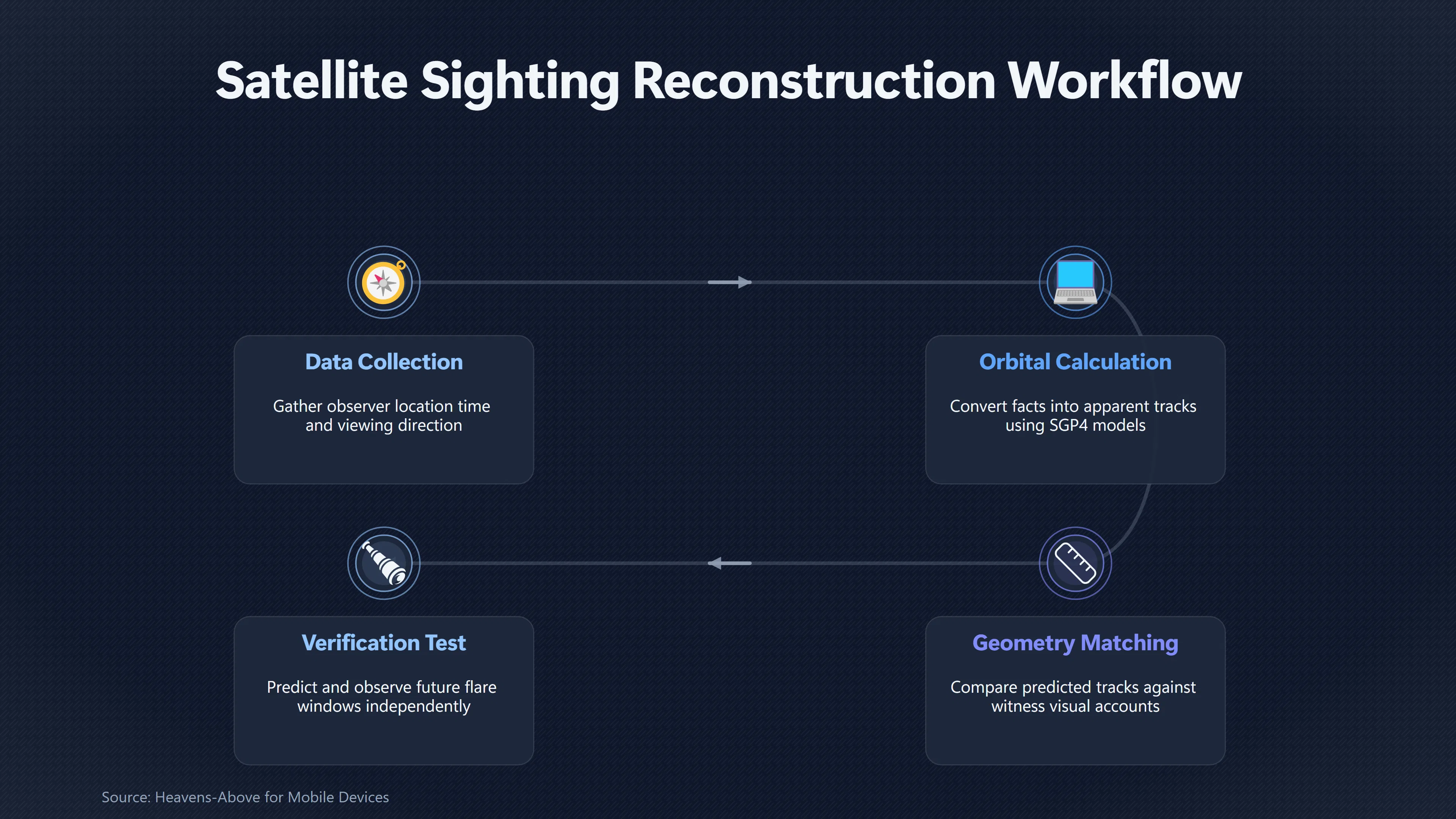
A satellite check begins with the same details that make any UFO reconstruction useful: where was the observer, when did the event happen, and where in the sky were they looking? Orbital predictions convert those facts into something testable. For a given observer position and time, software can calculate a satellite’s apparent track across the sky, including its azimuth — compass direction — and elevation above the horizon. Services such as Heavens-Above provide start, maximum-altitude and end positions for predicted visible passes and can also calculate historical passes.[Heavens-Above]heavens-above.comfor Mobile DevicesHeavens-Above for Mobile Devices…
Behind such calculations are orbital data commonly distributed as general perturbations data, historically in the familiar two-line element or TLE format. These elements describe an object’s orbit in a form designed to be propagated with models such as SGP4. CelesTrak explains that the underlying data are fitted from observations made by the US Space Surveillance Network; operator-supplied supplemental elements can sometimes reduce latency and improve positional accuracy.[CelesTrak]celestrak.orgOpen source on celestrak.org.
For an investigation, a convincing satellite match therefore involves more than discovering that some satellite was above the horizon. The predicted object should agree with the important observational constraints:
- its pass should occur at the reported time;
- its track should cross the reported part of the sky in the correct direction;
- its angular speed and duration should be reasonably compatible with the observation;
- the satellite should be illuminated by the Sun if the witness saw reflected light;
- any reported brightening or disappearance should be compatible with illumination geometry;
- for photographs or video, its calculated position should agree with identifiable stars, planets or landmarks in the frame.
The accuracy required depends on the phenomenon. Heavens-Above notes that a location accurate to roughly 10 kilometres is normally adequate for ordinary satellite observing, whereas the historically famous Iridium flares were sufficiently sensitive to viewing geometry that an observer position accurate to about one kilometre was preferable.[Heavens-Above]heavens-above.comFrequently asked questions (FAQFrequently asked questions (FAQ)…
Orbital predictions are not perfect, either. Their accuracy varies with the quality and age of the orbital elements, the object’s orbit and changes in the space environment. Manoeuvring satellites are a particular complication because an element set produced before a manoeuvre may no longer describe the subsequent trajectory accurately. CelesTrak consequently warns against treating orbital elements as error-free coordinates.[CelesTrak]celestrak.orgOpen source on celestrak.org.
That limitation cuts both ways in UFO investigation. A close positional and temporal match can be powerful positive evidence for identification, but failure to find a match in one catalogue is not automatically evidence that the light was something extraordinary. The catalogue or historical elements may be incomplete, stale or insufficiently precise for the event being reconstructed.
Why a satellite can suddenly blaze or disappear
The crucial fact is that most satellites visible to the naked eye are reflecting sunlight rather than producing their own visible light. That means their appearance depends on a three-dimensional relationship between the Sun, satellite and observer.
A diffusely reflecting surface scatters sunlight across a broad range of directions. That can make a satellite visible as a relatively steady moving point for seconds or minutes. A smooth surface can instead produce a much narrower specular reflection, comparable to a glint from a distant mirror. When that narrow reflected beam sweeps across an observer, the satellite can brighten sharply and then fade. AARO calls these short, bright events satellite flares or glints.[AARO]aaro.milCorrelations of Starlink Satellite Flaring with UAP ObservationsCorrelations of Starlink Satellite Flaring with UAP ObservationsJanuary 24, 2025…
This behaviour has a long history. The original Iridium communications satellites became famous among skywatchers because their highly reflective antenna surfaces could generate brilliant, accurately predicted flares. Heavens-Above’s historical documentation describes how the flare depended critically on satellite attitude and Sun-satellite-observer geometry; even an orientation difference of around a tenth of a degree could substantially change the observed brightness.[Heavens-Above]heavens-above.comFrequently asked questions (FAQFrequently asked questions (FAQ)…
Tumbling spacecraft introduce another visual effect. As different surfaces repeatedly face the Sun and observer, the brightness can pulse or flash, with intervals ranging from fractions of a second to much longer cycles. To someone who expects satellites to remain at constant brightness, such repeated flashes can look less like an orbiting spacecraft than a light switching on and off.[Heavens-Above]heavens-above.comFrequently asked questions (FAQFrequently asked questions (FAQ)…
A disappearance can be still simpler. A satellite may remain physically above the observer’s horizon while passing into Earth’s shadow. Once direct sunlight no longer reaches it, the reflected point can fade rapidly from naked-eye visibility. This is why satellite observing is especially productive after sunset and before sunrise: the observer can already be in darkness while spacecraft hundreds of kilometres overhead remain illuminated.[Heavens-Above]heavens-above.comFrequently asked questions (FAQFrequently asked questions (FAQ)…
The result is an important investigative distinction. A report that a UFO “vanished instantly” does not by itself imply that an object accelerated away or ceased to exist. Investigators can calculate whether the reported disappearance coincides with an expected shadow crossing or whether changing reflection geometry provides a plausible alternative.
Starlink changed what a satellite sighting can look like
The familiar mental picture of a satellite — one dim point crossing the sky — has become increasingly incomplete. Starlink introduced both an unusually recognisable phenomenon and a much less intuitive one.
Shortly after launch, dozens of Starlink spacecraft can remain relatively close together while raising their orbits. They may consequently appear as a line or “train” of lights moving across the sky. AARO distinguishes these trains from the behaviour of operational satellites: once Starlink spacecraft reach their working orbits and assume their operational orientation, surfaces on the satellite bus can produce strong specular reflections under suitable illumination geometry.[AARO]aaro.milCorrelations of Starlink Satellite Flaring with UAP ObservationsCorrelations of Starlink Satellite Flaring with UAP Observations…
Those operational flares can be far more confusing than a train. AARO’s modelling indicates that, for the Starlink configurations it examined at roughly 540–570 kilometres altitude, strong flare geometry tends to concentrate observations near the horizon when the Sun is well below it. Multiple satellites travelling on different orbital tracks can pass through the same favourable reflection region. Each may brighten briefly and disappear, followed by another satellite taking its place.[AARO]aaro.milCorrelations of Starlink Satellite Flaring with UAP ObservationsCorrelations of Starlink Satellite Flaring with UAP Observations…
From the observer’s perspective, that sequence does not necessarily resemble a procession of satellites. AARO notes that simultaneous or successive flares can look like glowing objects appearing and disappearing, moving in different directions or briefly forming apparent geometric arrangements.[AARO]aaro.milCorrelations of Starlink Satellite Flaring with UAP ObservationsCorrelations of Starlink Satellite Flaring with UAP Observations…
The distinction also explains why recognising a conventional Starlink train is not enough to rule out Starlink. A witness familiar with the famous straight line of recently launched satellites may encounter operational Starlink flares years later and quite reasonably say, “That wasn’t Starlink” because the appearance is completely different. The underlying spacecraft can be the same constellation while the illumination regime is not.
The ‘racetrack’ reports show how reconstruction works
A particularly instructive modern example came from commercial aviation. From 2022 onwards, pilots reported bright lights that appeared and disappeared near the horizon, sometimes seeming to circle or trace a “racetrack” pattern. Because pilots could see several lights at different moments and apparent positions, the phenomenon could give the impression of objects manoeuvring rather than satellites travelling on predictable orbital paths. Contemporary reporting documented observations by multiple aircrews over the Pacific and elsewhere.[The Debrief]thedebrief.orgThe DebriefOctober 19, 2022…
A 2024 case study examined an incident on 10 August 2022 involving reports from five pilots aboard two commercial flights over the Pacific. Researchers combined the aircraft’s Automatic Dependent Surveillance–Broadcast (ADS-B) trajectory with supplemental orbital elements for a recently launched Starlink group. Reconstructing the view from the aircraft showed that the Starlink satellites provided a coherent explanation for the photographed and filmed phenomenon. The important point was methodological: neither the pilot reports nor the satellite catalogue was considered in isolation. Aircraft position, observation geometry, time and orbital tracks were brought into the same reconstruction.[arXiv]arxiv.orgOpen source on arxiv.org.
Research into Starlink brightness independently supports the physical mechanism. Photometric measurements have documented substantial variations between Starlink designs and observing circumstances, while a separate analysis of extreme Starlink flaring found that intense specular reflections could reproduce the brightness of an event reported as UAP by commercial pilots.[arXiv]arxiv.orgOpen source on arxiv.org.
AARO subsequently formalised essentially the same type of check. Its satellite-flaring paper describes an FAA report from an eastbound airline near Gallup, New Mexico, at about 03:50 local time on 9 October 2022. The pilot reported multiple lights moving in different directions to the left of the constellation Leo. AARO reconstructed the aircraft’s effective observing geometry, calculated the expected flare region and compared it with the reported sky position. Numerous Starlink satellites crossed the relevant region, and the calculated flare window closely matched the estimated location of the lights. AARO assessed the reported lights as very likely Starlink and other satellite flares.[AARO]aaro.milCorrelations of Starlink Satellite Flaring with UAP ObservationsCorrelations of Starlink Satellite Flaring with UAP Observations…
This is stronger than simply saying “there are lots of Starlink satellites”. It generates a prediction that can fail: the phenomenon should occur in a particular part of the sky under a particular solar geometry. If the sighting occurs somewhere incompatible with that prediction, the satellite-flare explanation becomes weaker.
Predictions can be tested before the UFO appears
One of the strongest features of a satellite explanation is repeatability. If the proposed mechanism and calculations are correct, investigators should sometimes be able to predict where the phenomenon will occur and then observe it deliberately.
AARO did exactly that in Nebraska in March 2024. Using the expected Sun-satellite-observer geometry, its personnel estimated when Starlink flares should become visible near the horizon. For the evening of 10 March, the predicted window extended from approximately 22:22 to 23:20 local time as the relevant azimuth shifted from about 305° to 322°. A flare photographed at 22:38 appeared at an azimuth of 309.6° and an elevation of 3.2°, inside the expected region.[AARO]aaro.milCorrelations of Starlink Satellite Flaring with UAP ObservationsCorrelations of Starlink Satellite Flaring with UAP Observations…
The team repeated the exercise before sunrise on 11 March. Its calculated window ran approximately from 02:44 to 03:43; a measured flare at 03:13 appeared at an azimuth of 47.4° and an elevation of 3.7°. Again, the observation fell within the predicted geometry.[AARO]aaro.milCorrelations of Starlink Satellite Flaring with UAP ObservationsCorrelations of Starlink Satellite Flaring with UAP Observations…
That before-the-fact test is particularly useful in UAP analysis because it moves the explanation beyond visual resemblance. Saying that an unidentified light “looks like a satellite” is subjective. Predicting that satellite reflections should occur within a defined region of sky and time interval, then photographing them there, tests the mechanism against independent observations.
Why aircraft observers need special treatment
Satellite calculations become more complicated when the witness is aboard an aircraft. A pilot at 35,000 feet has a much more distant horizon than an observer standing on the ground, while the aircraft itself may be travelling hundreds of knots. The relevant observer coordinates therefore change throughout a prolonged sighting.
AARO notes another consequence: an aircraft flying towards the direction of the Sun after sunset, or towards it before sunrise under the opposite travel geometry, can remain favourably positioned relative to a satellite flare region for longer than a stationary observer. This helps explain why some cockpit observations persist far longer than an individual satellite’s brief flare. The witness may not be watching one luminous object for an hour; the aircraft may remain positioned to see many different satellites illuminate successively.[AARO]aaro.milCorrelations of Starlink Satellite Flaring with UAP ObservationsCorrelations of Starlink Satellite Flaring with UAP Observations…
For a serious reconstruction, investigators therefore need the aircraft’s actual track, altitude and preferably accurate timestamps for photographs or video. ADS-B records can supply the changing aircraft position, while orbital elements supply satellite trajectories. The August 2022 Pacific reconstruction demonstrates the value of combining the two datasets rather than treating a pilot’s approximate location as fixed.[arXiv]arxiv.orgOpen source on arxiv.org.
This also illustrates why eyewitness descriptions such as “it paced us” require caution. A distant flare region can remain in roughly the same apparent direction as an aircraft travels even though each visible light belongs to a different satellite hundreds or thousands of kilometres away. The perceived behaviour must be tested against reconstructed geometry before being interpreted as the physical manoeuvre of a single object.
What counts as a strong satellite identification?
Satellite prediction is most persuasive when several independent features converge. A predicted pass at approximately the right time is useful; agreement in time, sky position, direction of travel and illumination behaviour is considerably stronger. A timestamped image containing identifiable stars can make the comparison stronger still because the camera’s field of view can be mapped onto celestial coordinates.
Conversely, investigators should avoid turning “satellite” into a catch-all explanation. Orbital data have uncertainties, brightness is harder to predict than position, spacecraft can manoeuvre, and specular reflections depend on orientation as well as orbital location. Even the famously predictable Iridium flares sometimes differed from forecasts because small attitude deviations changed where the reflected beam fell.[Heavens-Above]heavens-above.comFrequently asked questions (FAQFrequently asked questions (FAQ)…
That makes the evidential hierarchy important. A satellite merely being above the horizon is weak evidence. A satellite crossing the witness’s reported line of sight at the correct second is better. A matching track plus the correct illumination and shadow behaviour is stronger. A reconstruction that also reproduces successive flashes or can predict the same phenomenon independently is stronger again.
For UFO and UAP investigation, this is the real value of satellite checks. They convert one of the commonest classes of mysterious moving lights from a matter of visual interpretation into a quantitative hypothesis. When the necessary time, position and direction data survive, the sky at the moment of a sighting can often be reconstructed closely enough to ask a precise question: was a known artificial object predicted to make that particular light, in that particular place, at that particular time?[AARO]aaro.milUAP RecordsAARO UAP Records…
Amazon book picks
Further Reading
Books and field guides related to Was That UFO Actually a Satellite?. Use these as the next step if you want deeper reading beyond the article.
The Backyard Astronomer's Guide
Discusses the practical aspects of stargazing, including how to choose appropriate equipment, contending with light pollution, taking suc...
Turn Left at Orion
With over 100,000 copies sold since first publication, this is one of the most popular astronomy books of all time. It is a unique guideb...
NightWatch: A Practical Guide to Viewing the Universe
A practical guide to viewing the universe.
Satellite Orbits: Models, Methods and Applications
Satellite Orbits -Models, Methods, and Applications has been written as a compre hensive textbook that guides the reader through the theo...
eBay marketplace picks
Marketplace Samples
Live-tested eBay searches with available results related to this page.
Selected fromUFO poster oneBay.co.uk.



Current eBay listing
VINTAGE UFO FLYING SAUCERS COMIC ADVERTISING A2 POSTER PRINT

Current eBay listing
I Want To Believe UFO Poster Giclée Fine Art Heavyweight Print
Endnotes
1.
Source: heavens-above.com
Title: for Mobile Devices
Link:https://heavens-above.com/Mobile.aspx
Source snippet
Heavens-Above for Mobile Devices...
2.
Source: celestrak.org
Link:https://www.celestrak.org/NORAD/documentation/gp-data-formats.php
3.
Source: aaro.mil
Title: Correlations of Starlink Satellite Flaring with UAP Observations
Link:https://www.aaro.mil/Portals/136/PDFs/Information%20Papers/AARO_Satellite_Flaring_Paper.pdf
Source snippet
Correlations of Starlink Satellite Flaring with UAP ObservationsJanuary 24, 2025...
Published: January 24, 2025
4.
Source: aaro.mil
Title: UAP Records
Link:https://www.aaro.mil/UAP-Records/
Source snippet
AARO UAP Records...
5.
Source: heavens-above.com
Title: Frequently asked questions (FAQ)
Link:https://www.heavens-above.com/FAQ.aspx?alt=0&cul=en&lat=0&lng=0&loc=Unspecified&tz=UCT
Source snippet
Frequently asked questions (FAQ)...
6.
Source: celestrak.org
Link:https://celestrak.org/NORAD/elements/supplemental/index.php?FORMAT=tle
7.
Source: celestrak.org
Link:https://www.celestrak.org/columns/v04n05/
8.
Source: aaro.mil
Title: Correlations of Starlink Satellite Flaring with UAP Observations
Link:https://www.aaro.mil/Portals/136/PDFs/Information%20Papers/AARO_Satellite_Flaring_Paper_508_FINAL_04222025.pdf
Source snippet
Correlations of Starlink Satellite Flaring with UAP Observations...
9.
Source: arxiv.org
Link:https://arxiv.org/abs/2003.07446
10.
Source: arxiv.org
Link:https://arxiv.org/abs/2403.08155
11.
Source: arxiv.org
Link:https://arxiv.org/abs/2208.03226
12.
Source: arxiv.org
Title: arXiv Extreme Flaring of Starlink Satellites
Link:https://arxiv.org/abs/2405.13091
13.
Source: celestrak.org
Title: Celes Trak: Satellite-Based Augmentation System (WAAS/EGNOS/MSAS)
Link:https://celestrak.org/norad/elements/table.php?FORMAT=2le&GROUP=sbas
14.
Source: celestrak.org
Title: Celes Trak: [Tracking]({{ ‘tracking/’ | relative_url }}) and Data Relay Satellite System (TDRSS)
Link:https://celestrak.org/norad/elements/table.php?FORMAT=tle&GROUP=tdrss
15.
Source: celestrak.org
Title: Celes Trak: Current Supplemental GP Element Sets
Link:https://www.celestrak.org/NORAD/elements/supplemental/index.php?FORMAT=2le
16.
Source: faa.gov
Title: FA A Statement on 5G | Federal Aviation Administration
Link:https://www.faa.gov/newsroom/faa-statement-5g
17.
Source: faa.gov
Title: FA A General Statements | Federal Aviation Administration
Link:https://www.faa.gov/newsroom/statements/general-statements
18.
Source: aaro.mil
Link:https://www.aaro.mil/Next-AARO-Home-redesign/Next-Parent/Next-AARO-UAP-Imagery-Acc-Table/
19.
Source: aaro.mil
Link:https://www.aaro.mil/Next-AARO-Home-redesign/Next-Parent/Next-UAP-Report-Documents/
20.
Source: aaro.mil
Link:https://www.aaro.mil/Next-AARO-Home-redesign/Next-Parent/Next-UAP-Report-Documents/poster/
21.
Source: fly.faa.gov
Title: adv otherdis
Link:https://www.fly.faa.gov/adv/adv_otherdis?adv_date=09032025&advn=26&facId=ATCSCC&title=ATCSCC+ADVZY+DCC%2F03%2F2025+OPERATIONS+PLAN&titleDate=09%2F03%2F2025
22.
Source: faa.gov
Title: Space Weather | Federal Aviation Administration
Link:https://www.faa.gov/nextgen/programs/weather/awrp/space-weather
23.
Source: celestrak.org
Title: Celes Trak: SGP4 Software Tutorial
Link:https://www.celestrak.org/software/tutorials/sgp4.php
24.
Source: celestrak.org
Title: Celes Trak: Orbital Mechanics Software Tutorials
Link:https://www.celestrak.org/software/tutorials/
25.
Source: celestrak.org
Title: Celes Trak: SOCRATES Plus
Link:https://celestrak.org/SOCRATES/
26.
Source: space.com
Title: X [launches]({{ ‘launches/’ | relative_url }}) 46 Starlink satellites, lands rocket at sea | Space
Link:https://www.space.com/spacex-starlink-group-3-4-launch-rocket-landing
27.
Source: space.com
Title: X launches 46 Starlink satellites, lands rocket on drone ship | Space
Link:https://www.space.com/spacex-starlink-group-3-3-launch-satellites
28.
Source: space.com
Title: X launches 52 Starlink satellites, lands rocket at sea | Space
Link:https://www.space.com/spacex-starlink-group-4-26-launch-rocket-landing
29.
Source: space.com
Title: X Starlink satellites face Russia space debris ‘squalls’ | Space
Link:https://www.space.com/spacex-starlink-russia-space-debris-squalls
30.
Source: celestrak.org
Title: Celes Trak: Documentation
Link:https://celestrak.org/NORAD/documentation/
32.
Source: celestrak.org
Title: Celes Trak: Publications [AAS 13-373]
Link:https://celestrak.org/publications/AAS/13-373/
33.
Source: celestrak.org
Link:https://celestrak.org/publications/AIAA/2008-6770/
34.
Source: celestrak.org
Title: Celes Trak: Publications [AAS 07-127]
Link:https://celestrak.org/publications/AAS/07-127/
35.
Source: celestrak.org
Link:https://celestrak.org/publications/AIAA/2006-6753/
36.
Source: celestrak.org
Title: Celes Trak: Publications [AAS 05-406]
Link:https://celestrak.org/publications/AAS/05-406/
37.
Source: celestrak.org
Link:https://www.celestrak.org/columns/v01n06/
38.
Source: aaro.mil
Title: AAR O UAP Trends All-domain Anomaly Resolution Office UAP REPORTING TRENDS
Link:https://www.aaro.mil/UAP-Cases/UAP-Reporting-Trends/
39.
Source: aaro.mil
Link:https://www.aaro.mil/Next-AARO-Home-redesign/Next-Parent/Next-AARO-UAP-Trends/
40.
Source: aaro.mil
Link:https://www.aaro.mil/Next-AARO-Home-redesign/Inactive-Parent/Next-AARO-UAP-DT-Records/
41.
Source: aaro.mil
Link:https://www.aaro.mil/UAP-Cases/Official-UAP-Imagery/4/
42.
Source: aaro.mil
Link:https://www.aaro.mil/Next-AARO-Home-redesign/Next-Parent/Next-UAP-Case-RR-Data-Table/
43.
Source: aaro.mil
Link:https://www.aaro.mil/Resources/Historical-Record-Reports/Volume-II/
44.
Source: aaro.mil
Link:https://www.aaro.mil/Next-AARO-Home-redesign/Bruce-working/Next-AARO-UAP-Trends-Charts/
45.
Source: aaro.mil
Title: AAR O UAP Trends All-domain Anomaly Resolution Office UAP REPORTING TRENDS
Link:https://www.aaro.mil/UAP-Cases/UAP-Reporting-Trends/quot/
46.
Source: aaro.mil
Title: Congressional Press Products
Link:https://www.aaro.mil/Congressional-Press-Products/
47.
Source: aaro.mil
Link:https://www.aaro.mil/Next-AARO-Home-redesign/Next-Parent/Next-AARO-Congressional-Press-Products/
48.
Source: aaro.mil
Title: Congressional Tab DT
Link:https://www.aaro.mil/Next-AARO-Home-redesign/Next-Parent/AARO-Congressional-Tab-DT/
49.
Source: aaro.mil
Link:https://www.aaro.mil/Next-AARO-Home-redesign/Inactive-Parent/Next-Congressional-Press-Products/
50.
Source: aaro.mil
Link:https://www.aaro.mil/Next-AARO-Home-redesign/Inactive-Parent/AARO-Records-Tabs/
51.
Source: aaro.mil
Link:https://www.aaro.mil/UAP-Records/-1/
52.
Source: heavens-above.com
Title: All Sats.aspx
Link:https://www.heavens-above.com/AllSats.aspx
54.
Source: heavens-above.com
Title: All Sats.aspx
Link:https://heavens-above.com/AllSats.aspx?alt=304.0&cul=en&lat=42.85275&lng=-83.4076166667&loc=Heavens+View+Observatory&tz=EST
55.
Source: faa.gov
Link:https://www.faa.gov/air_traffic/publications/atpubs/aim_html/chap11_section_8.html
56.
Source: faa.gov
Link:https://www.faa.gov/Air_traffic/publications/atpubs/aim_html/chap7_section_6.html
57.
Source: thedebrief.org
Link:https://thedebrief.org/any-idea-what-they-are-american-pilots-report-multiple-encounters-with-unusual-racetrack-uap-in-recent-weeks/
Source snippet
The DebriefOctober 19, 2022...
Published: October 19, 2022
58.
Source: nuforc.org
Link:https://nuforc.org/sighting/?id=196319
59.
Source: nuforc.org
Link:https://nuforc.org/sighting/?id=188250
60.
Source: nuforc.org
Link:https://nuforc.org/sighting/?id=187516
61.
Source: thedebrief.org
Link:https://thedebrief.org/spacex-starlink-extreme-flaring-increases-reported-uap-sightings-and-poses-aviation-risks-new-research-finds/
62.
Source: nuforc.org
Link:https://nuforc.org/sighting/?id=173783
63.
Source: thedebrief.org
Title: Recent Pilot UAP Sightings Point to Aviation Safety Challenges, Experts Say
Link:https://thedebrief.org/recent-pilot-uap-sightings-point-to-aviation-safety-challenges-experts-say/
64.
Source: imagine.gsfc.nasa.gov
Title: night sky
Link:https://imagine.gsfc.nasa.gov/ask_astro/night_sky.html
65.
Source: space-track.org
Link:https://www.space-track.org/documentation?source=post_page—————————
66.
Source: assa.org.au
Title: Iridium Flares
Link:https://www.assa.org.au/iridium
67.
Source: pub.dev
Link:https://pub.dev/packages/celestrak
68.
Source: docs.basekick.net
Link:https://docs.basekick.net/arc/integrations/tle/
Additional References
69.
Source: youtube.com
Title: What are these STRANGE CHAINS OF LIGHTS in the Sky?
Link:https://www.youtube.com/watch?v=4h6OXRDhS4c
Source snippet
This collection of videos features discussions from scientific and governmental investigators (such as AARO) alongside practical tutorial...
70.
Source: youtube.com
Link:https://www.youtube.com/watch?v=mvsU4p0Gsas
Source snippet
The UFO 'cookbook': How the American government investigates the unexplainable...
71.
Source: youtube.com
Title: The UFO ‘cookbook’: How the American government investigates the unexplainable
Link:https://www.youtube.com/watch?v=6NrAQbco7dQ
Source snippet
Pilot gives insight on mysterious lights over Oregon...
72.
Source: defense.gov
Link:https://www.defense.gov/News/News-Stories/Article/Article/3701297/dod-report-discounts-sightings-of-extraterrestrial-technology/
73.
Source: defense.gov
Link:https://www.defense.gov/News/Releases/Release/Article/3964824/department-of-defense-releases-the-annual-report-on-unidentified-anomalous-phen/
74.
Source: theblackvault.com
Link:https://www.theblackvault.com/documentarchive/aaro-releases-document-and-video-explaining-satellite-flares-as-a-uap-misidentification-source/
75.
Source: ufopress.com
Link:https://www.ufopress.com/articles/aaro-releases-four-information-papers-on-uap-classification-satellite-flaring-se/
76.
Source: uap-archive.org
Link:https://uap-archive.org/uap/records/aaro-historical-record-report-vol1/
77.
Source: skyandtelescope.org
Link:https://skyandtelescope.org/astronomy-news/page/31/
78.
Source: aanda.org
Link:https://www.aanda.org/articles/aa/abs/2024/09/aa51856-24/aa51856-24.html