Within Planets
Was Venus Actually Where the UFO Appeared?
Venus is a strong UFO candidate only when its calculated position matches the witness's direction, time and horizon geometry.
On this page
- Why Venus stays close to the Sun
- Matching witness direction to planetary position
- When sky geometry rules Venus out
Page outline Jump by section
Introduction
Venus is bright enough to generate convincing UFO reports, but brightness alone is not a good identification. The decisive question is geometric: was Venus actually in the part of the sky where the witness saw the unidentified light, at the reported time and location? Its position can be calculated, often to far greater precision than a witness can estimate a bearing. NASA notes that Venus remains relatively close to the Sun in our sky, normally appearing around sunrise or sunset rather than wandering freely through the night.[NASA Science]science.nasa.govScience Skywatching FAQNASA ScienceSkywatching FAQ - NASA Science…
That makes Venus unusually testable as an identified flying object, or IFO, explanation. Given a location, date and sufficiently accurate time, an ephemeris can calculate Venus’s azimuth — its compass direction — and altitude above the astronomical horizon. Those numbers can then be compared with the witness’s account, photographs, landmarks and sight lines. A close match can turn an initially extraordinary report into a strong planetary identification. A serious mismatch can rule Venus out.
Why Venus stays close to the Sun
Venus orbits the Sun inside Earth’s orbit. Seen from Earth, it therefore never reaches the opposite side of the sky from the Sun in the way that an outer planet such as Jupiter can. NASA describes Venus and Mercury as planets that always remain relatively near the Sun in the sky, with Venus lingering for a few hours after sunset or appearing before sunrise when its geometry is favourable.[NASA Science]science.nasa.govScience Skywatching FAQNASA ScienceSkywatching FAQ - NASA Science…
This immediately places limits on plausible Venus explanations. During an evening appearance, Venus is on the Sun’s eastern side in the sky and is seen after sunset, generally towards the western horizon as the evening progresses. During a morning appearance it lies on the other side of the Sun and rises before it, appearing in the eastern part of the sky. The exact compass bearing and height depend on the date, latitude and orbital geometry, so rules such as “Venus is always due west” are too crude for case investigation.
The relevant astronomical quantity is elongation: the angular separation between Venus and the Sun as viewed from Earth. NASA calls the point at which Venus appears farthest from the Sun its greatest elongation.[NASA Science]science.nasa.govScience Skywatching FAQNASA ScienceSkywatching FAQ - NASA Science… Venus’s maximum elongation is about 47 degrees, although its actual angular separation varies continuously as Earth and Venus move around their orbits.[Sky at Night Magazine]skyatnightmagazine.comSky at Night MagazineWhy Venus is called the morning star or the evening star | BBC Sky at Night MagazineSeptember 15, 2025…
That restriction gives investigators an important negative test. If a report places a supposed Venus-like light in a region of the sky that Venus could not occupy at that date and time, its brightness or superficial resemblance does not rescue the hypothesis. The planet cannot simply be moved to wherever an unidentified light happened to appear.
There is one caution to simplistic time-of-night rules. “Venus cannot be seen at midnight” is usually a useful shorthand at ordinary mid-latitudes, but unusual combinations of high latitude, summer twilight, longitude within a time zone and atmospheric refraction can complicate clock-time statements. A documented example from south-west Scotland photographed Venus around 00:02 GMT in June 2023.[Sky at Night Magazine]skyatnightmagazine.comSky at Night MagazineHarry Potter was right: you can see Venus at midnight | BBC Sky at Night MagazineJune 9, 2023… For investigation, therefore, a calculated position for the actual place and time is safer than relying on a slogan about what Venus “always” does.
Matching the witness direction to Venus
A proper Venus check reconstructs the sky from the observer’s position. Astronomers normally express a local sky position through two horizon coordinates:
- Azimuth gives the compass bearing around the horizon, conventionally measured clockwise from north: 0 degrees north, 90 degrees east, 180 degrees south and 270 degrees west.
- Altitude, or elevation, gives the angle above the horizon. Zero degrees is the astronomical horizon and 90 degrees is directly overhead.
The US Naval Observatory explains that these horizon coordinates depend on the observer’s latitude and longitude as well as the celestial object’s position and the time. Its astronomical services can calculate altitude and azimuth for celestial bodies from a specified place and time.[US Naval Observatory]aa.usno.navy.milOpen source on navy.mil.
NASA’s Jet Propulsion Laboratory provides an even more powerful implementation through its Horizons ephemeris system. For an observer at a specified point on Earth, Horizons can generate topocentric positions — positions referred to the observer rather than merely to the centre of Earth. Its output includes apparent azimuth and elevation and can optionally account approximately for atmospheric refraction near the horizon.[JPL Solar System Dynamics]ssd.jpl.nasa.govJPL Solar System Dynamics Horizons SystemJPL Solar System Dynamics Horizons System
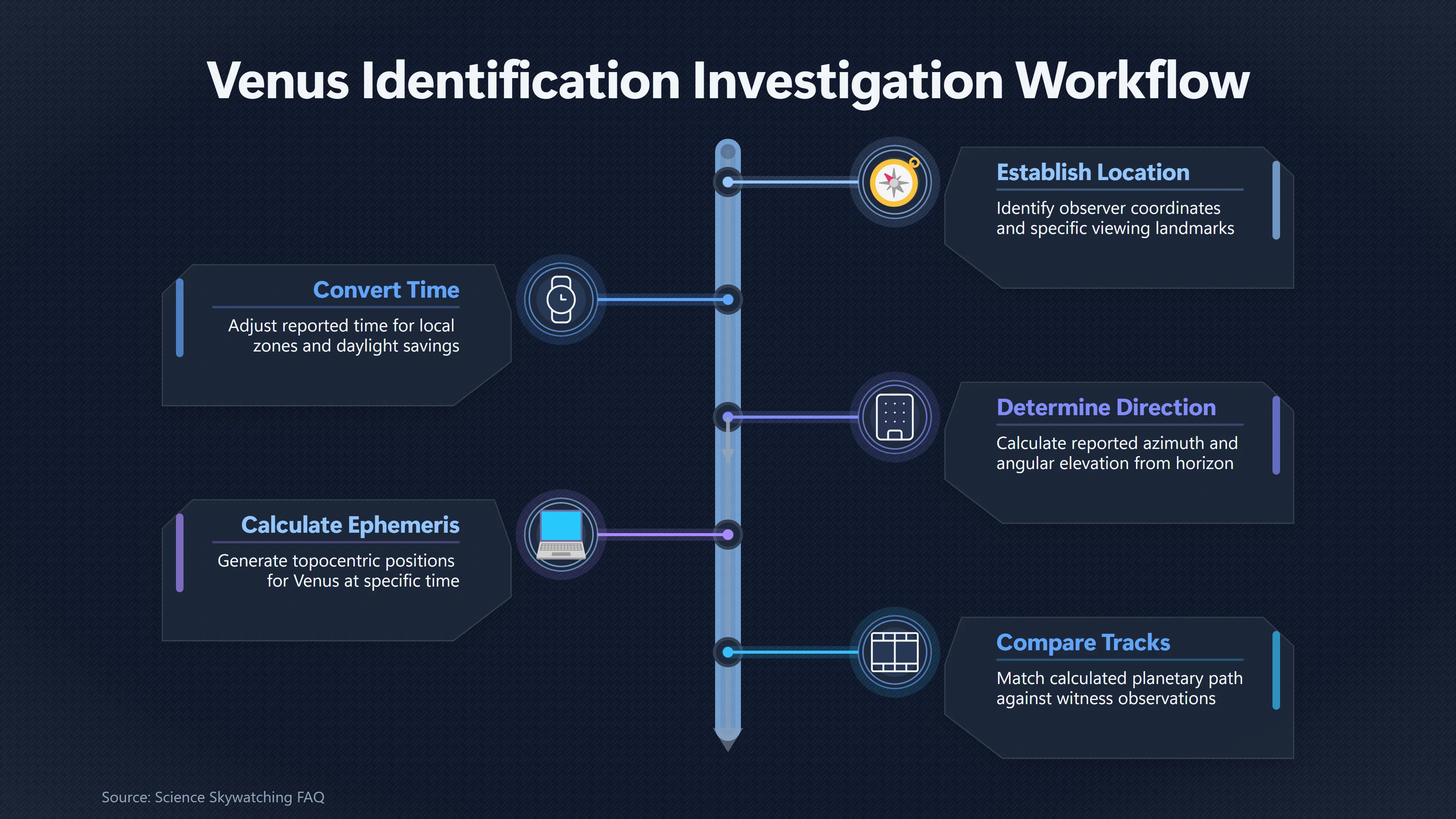
This changes a UFO investigation from resemblance to prediction. Instead of asking “Could a bright light have been Venus?”, the useful sequence is:
- establish the observer’s location as closely as the evidence allows;
- convert the reported time correctly, including the applicable time zone and daylight-saving rules;
- determine the reported viewing direction from compass information, landmarks, road alignment or imagery;
- estimate the light’s angular elevation from the horizon;
- calculate Venus’s azimuth and elevation for that place and time;
- compare the calculated track with the observation over its full duration.
NASA’s Night Sky Network similarly advises recording the exact time, observing location, duration and direction when trying to identify an unfamiliar light. It specifically notes that Venus shining brightly near the horizon has repeatedly been reported as a UFO.[Night Sky]nightsky.jpl.nasa.govOpen source on nasa.gov.
The quality of the comparison depends heavily on the quality of the original report. “There was a bright object somewhere in the west after dinner” leaves a large error box. “At 21:17 it was just above the church tower, viewed from this road junction” may permit a much tighter reconstruction. Photographs containing a recognisable horizon can be especially valuable because buildings, hills, pylons or other fixed features can provide a geometrical reference that memory alone cannot.
Witness compass bearings should not be treated as exact unless there is evidence they were actually measured. A person who says “south-west” may mean a sizeable sector of sky, whereas a measured bearing of 231 degrees is much more restrictive. The same applies to elevation. NASA notes that a little finger held at arm’s length spans roughly one degree and a fist about ten degrees, illustrating both how angular height can be estimated and how approximate unaided estimates normally are.[NASA Science]science.nasa.govScience Skywatching FAQNASA ScienceSkywatching FAQ - NASA Science…
A strong match does more than show Venus was visible
The strongest Venus identifications do not merely establish that the planet was above the horizon. They show that it occupied the relevant line of sight.
A particularly instructive historical example occurred during a Thor-Agena launch from Vandenberg Air Force Base on 5 December 1963. Tracking film showed a bright, star-like object apparently passing near the rocket. Because the event involved instrumentation rather than only witness recollection, investigators could compare the film with predicted rocket coordinates and the known position of Venus.[files.ncas.org]files.ncas.orgCondon Report, Case 51: Vandenberg AFBCondon Report, Case 51: Vandenberg AFB
The reconstruction found that the rocket should have passed within about two degrees of Venus within seconds of the moment when the unidentified image appeared. Venus was therefore inside the camera’s field of view at precisely the relevant time. The object’s photographic characteristics were also those expected of Venus. The Condon investigation concluded that this combination constituted compelling evidence that the recorded “UFO” was the planet.[files.ncas.org]files.ncas.orgCondon Report, Case 51: Vandenberg AFBCondon Report, Case 51: Vandenberg AFB
That case illustrates an important evidential distinction. Saying “Venus was up that afternoon” would have been weak. Showing that Venus lay inside the relevant camera field at the correct moment, while the independently predicted rocket track passed almost directly beside it, was a much stronger identification.
The same principle applies to less instrumented cases. A reported light that repeatedly occupies Venus’s calculated direction, changes position through the sky at the expected celestial rate and disappears when Venus sets presents a cumulative geometric match. None of those features depends on deciding whether the witness “should have recognised” the planet.
The police chases show why position matters
One of the clearest examples comes from Case 37 of the University of Colorado’s Condon investigation. During several mornings in 1967, police and other observers in a group of communities reported luminous objects with much more dramatic behaviour than a simple stationary “star”. Officers described chasing lights, being followed by them and seeing changes of apparent colour, size and movement. A light aircraft was even sent after one of the objects.[files.ncas.org]files.ncas.orgCondon Report, Case 37: Planets Venus & JupiterCondon Report, Case 37: Planets Venus & Jupiter
Yet the astronomical circumstances were highly specific. Venus was exceptionally bright, at about magnitude −4.2, and rose at roughly 02:50 local standard time during the period concerned; Jupiter rose somewhat earlier. Investigators also established that mist or haze was present during the early-morning observations.[files.ncas.org]files.ncas.orgCondon Report, Case 37: Planets Venus & JupiterCondon Report, Case 37: Planets Venus & Jupiter
Most importantly for identification, the lights eventually settled into positions that corresponded to the known positions of Venus and Jupiter. Investigators subsequently showed Venus to police observers in daylight, when it could be found because its precise position was known. The observers agreed that it resembled the object they had watched after sunrise. The investigation concluded that the reports were misinterpretations of planets, particularly Venus.[files.ncas.org]files.ncas.orgCondon Report, Case 37: Planets Venus & JupiterCondon Report, Case 37: Planets Venus & Jupiter
The lesson is not that dramatic witness descriptions should automatically be dismissed whenever Venus is visible. It is almost the opposite: apparently dramatic behaviour does not eliminate a planetary hypothesis if the underlying line of sight continues to match the planet. Perceived pursuit, changing apparent size or colour and uncertain estimates of distance may all be secondary interpretations. The sky position provides an independent constraint against which those impressions can be tested.
When sky geometry rules Venus out
The same method that can identify Venus can eliminate it. This is essential because “probably Venus” is not a scientific explanation unless the planet’s predicted position is compatible with the observation.
A Venus explanation becomes weak or impossible when there is a substantial, well-established discrepancy such as these:
- Venus was below the observer’s horizon at the reported time.
- The witness looked in a reliably established direction far from Venus’s calculated azimuth.
- A photograph with identifiable stars or landmarks places the unknown light somewhere else in the sky.
- The reported object remained in a region where Venus could not have remained during the documented interval.
- Simultaneous observations from known locations establish a trajectory incompatible with a distant astronomical source.
The qualification well-established matters. A ten-degree discrepancy between a calculated ephemeris and a witness’s rough recollection that they were looking “west-ish” may tell investigators very little. A comparable discrepancy derived from a calibrated camera, known landmarks and an accurately timed image is much harder to dismiss.
Nor should investigators quietly alter uncertain evidence to make Venus fit. If the calculated planet is in the south-west but the contemporary report unambiguously says north-east, the mismatch is evidence against Venus. If resolving that discrepancy requires assuming that the witness reversed directions, recorded the wrong time and misidentified the observation site, the explanation has accumulated assumptions rather than explanatory power.
Conversely, a very close positional match is not necessarily sufficient by itself if other securely measured properties contradict an astronomical source. Modern UAP research stresses the value of multiple independent observables — positional tracking, imaging and other sensor measurements — precisely because several measurements can distinguish a real moving object from optical or perceptual effects.[arXiv]arxiv.orgThe Scientific Investigation of Unidentified Aerial Phenomena (UAP) Using Multimodal Ground-Based ObservatoriesMay 29, 2023…
Horizon geometry can be the deciding detail
Reports near the horizon deserve particular care because “the horizon” in astronomical calculations and the visible local horizon are not always the same thing.
An ephemeris may say Venus is three degrees above the ideal astronomical horizon, yet a hill rising five degrees in that direction would conceal it from a ground observer. A building, mountain ridge or tree line can therefore rule out direct visibility even when a computer says the planet was technically above zero altitude. Conversely, an observer on a hill, aircraft or elevated platform may have a much clearer low-altitude sight line than somebody at street level.
Atmospheric refraction introduces another small but potentially relevant effect close to the horizon. JPL Horizons distinguishes between airless apparent coordinates and coordinates with an approximate refraction correction for Earth-based observers.[JPL Solar System Dynamics]ssd.jpl.nasa.govJPL Solar System Dynamics Horizons SystemJPL Solar System Dynamics Horizons System Refraction can make a celestial body appear slightly higher than its purely geometric position, with the effect becoming most important near the horizon.
For most casual UFO reports, uncertainties in witness direction and elevation will be much larger than these fine astronomical corrections. They matter, however, when someone claims that Venus was “just below the horizon” or “only a fraction of a degree away”. Near a boundary, an investigator should specify whether the quoted altitude is geometric or refracted and whether terrain has been taken into account.
The local horizon also provides an excellent reality check for photographs. If a frame contains a recognisable skyline, investigators can determine where the camera was pointing and approximately how high the unidentified light appeared. A claimed Venus identification can then be tested against a predicted azimuth and elevation rather than judged by the appearance of a bright blob.
Position is stronger evidence than appearance
Venus can look remarkably strange under unfavourable observing conditions, and current US government UAP guidance still lists bright planets such as Venus and Jupiter among celestial objects that can be perceived as hovering or manoeuvring.[AARO]aaro.milOpen source on aaro.mil. But those perceptual possibilities should come after, not instead of, the positional test.
An out-of-focus light that pulsates, changes colour or appears unusually large may resemble many things. Its appearance by itself does not establish Venus. By contrast, the predicted position of Venus is not subjective. Astronomical ephemerides can determine where it should have appeared from a particular location at a particular time, and historical cases can be reconstructed using the same principle.[US Naval Observatory]aa.usno.navy.milUS Naval Observatory Celestial Navigation Data for Assumed Position and TimeUS Naval Observatory Celestial Navigation Data for Assumed Position and Time
That asymmetry is what makes Venus especially useful in UFO analysis. It is simultaneously a frequent source of unusual-looking lights and an object whose location is tightly constrained. Investigators therefore do not have to choose between automatically accepting a UFO interpretation and automatically dismissing the report as a planet.
The productive question is narrower: does the reported line of sight intersect Venus’s calculated position within the uncertainties of the evidence? If it does — particularly across multiple observations or frames — Venus becomes a strong identification. If it does not, Venus should be removed from consideration. In either direction, the geometry does real investigative work.
Amazon book picks
Further Reading
Books and field guides related to Was Venus Actually Where the UFO Appeared?. Use these as the next step if you want deeper reading beyond the article.
The UFO Handbook: A Guide to Investigating, Evaluating, and R...
An explanation of the usual reasons for confusing IFOs (identified flying objects) with UFOs and a survey of the tools used to investigat...
NightWatch: A Practical Guide to Viewing the Universe
A practical guide to viewing the universe.
The Backyard Astronomer's Guide
Discusses the practical aspects of stargazing, including how to choose appropriate equipment, contending with light pollution, taking suc...
Turn Left at Orion
With over 100,000 copies sold since first publication, this is one of the most popular astronomy books of all time. It is a unique guideb...
eBay marketplace picks
Marketplace Samples
Live-tested eBay searches with available results related to this page.
Selected fromUFO poster oneBay.co.uk.
Current eBay listing
I Want To Believe UFO Poster Giclée Fine Art Heavyweight Print
Current eBay listing
VINTAGE UFO FLYING SAUCERS COMIC ADVERTISING A2 POSTER PRINT
Endnotes
1.
Source: science.nasa.gov
Title: Science Skywatching FAQ
Link:https://science.nasa.gov/skywatching/faq/
Source snippet
NASA ScienceSkywatching FAQ - NASA Science...
2.
Source: ssd.jpl.nasa.gov
Title: JPL Solar System Dynamics Horizons System
Link:https://ssd.jpl.nasa.gov/horizons/manual.html
3.
Source: nightsky.jpl.nasa.gov
Link:https://nightsky.jpl.nasa.gov/news/39/
4.
Source: files.ncas.org
Title: Condon Report, Case 51: Vandenberg AFB
Link:https://files.ncas.org/condon/text/case51.htm
5.
Source: files.ncas.org
Title: Condon Report, Case 37: Planets Venus & Jupiter
Link:https://files.ncas.org/condon/text/case37.htm
6.
Source: arxiv.org
Link:https://arxiv.org/abs/2305.18566
Source snippet
The Scientific Investigation of Unidentified Aerial Phenomena (UAP) Using Multimodal Ground-Based ObservatoriesMay 29, 2023...
Published: May 29, 2023
7.
Source: aaro.mil
Link:https://www.aaro.mil/FAQ/
8.
Source: science.nasa.gov
Title: venus facts
Link:https://science.nasa.gov/venus/venus-facts/
9.
Source: ssd.jpl.nasa.gov
Link:https://ssd.jpl.nasa.gov/horizons/news.html
10.
Source: science.nasa.gov
Link:https://science.nasa.gov/uap/faqs/
11.
Source: aaro.mil
Link:https://www.aaro.mil/Next-AARO-Home-redesign/Next-Parent/Next-AARO-UAP-Imagery-Acc-Table/
12.
Source: in-the-sky.org
Title: Venus (Planet)
Link:https://in-the-sky.org/data/object.php?id=P2
13.
Source: in-the-sky.org
Title: Venus (Planet)
Link:https://in-the-sky.org/data/object.php?id=5
14.
Source: science.nasa.gov
Link:https://science.nasa.gov/author/mhbelleville/
15.
Source: science.nasa.gov
Title: pj venus
Link:https://science.nasa.gov/photojournal/galleries/pj-venus/
16.
Source: science.nasa.gov
Link:https://science.nasa.gov/author/lamohon/
17.
Source: science.nasa.gov
Link:https://science.nasa.gov/author/cgohd/
18.
Source: science.nasa.gov
Link:https://science.nasa.gov/author/hpbrennan/
19.
Source: science.nasa.gov
Link:https://science.nasa.gov/author/emahoney/
20.
Source: science.nasa.gov
Link:https://science.nasa.gov/author/khhansen/
21.
Source: science.nasa.gov
Link:https://science.nasa.gov/author/bmattson/
22.
Source: science.nasa.gov
Link:https://science.nasa.gov/author/kovelev/
23.
Source: science.nasa.gov
Title: charles henri b matteijpl nasa gov
Link:https://science.nasa.gov/author/charles-henri-b-matteijpl-nasa-gov/
24.
Source: science.nasa.gov
Title: fact sheet
Link:https://science.nasa.gov/mission/voyager/fact-sheet/
25.
Source: science.nasa.gov
Title: whats up april 2026 skywatching tips from nasa
Link:https://science.nasa.gov/solar-system/whats-up-april-2026-skywatching-tips-from-nasa/
Published: april 2026
26.
Source: in-the-sky.org
Title: Venus (Planet)
Link:https://in-the-sky.org/data/object.php?id=venus
27.
Source: in-the-sky.org
Title: Venus (Planet)
Link:https://in-the-sky.org/data/object.php?amp=1&id=P2
28.
Source: science.nasa.gov
Title: planetary alignments and planet parades
Link:https://science.nasa.gov/solar-system/skywatching/planetary-alignments-and-planet-parades/
29.
Source: science.nasa.gov
Title: chapter1 2
Link:https://science.nasa.gov/learn/basics-of-space-flight/chapter1-2/
30.
Source: science.nasa.gov
Title: the next full moon will be the last of four consecutive supermoons
Link:https://science.nasa.gov/solar-system/skywatching/the-next-full-moon-will-be-the-last-of-four-consecutive-supermoons/
31.
Source: nightsky.jpl.nasa.gov
Link:https://nightsky.jpl.nasa.gov/news/190/
32.
Source: naif.jpl.nasa.gov
Link:https://naif.jpl.nasa.gov/pub/naif/toolkit_docs/IDL/icy/cspice_recazl.html
33.
Source: naif.jpl.nasa.gov
Link:https://naif.jpl.nasa.gov/pub/naif/toolkit_docs/FORTRAN/spicelib/recazl.html
34.
Source: apod.nasa.gov
Link:https://apod.nasa.gov/apod/ap200521.html
35.
Source: apod.nasa.gov
Link:https://apod.nasa.gov/apod/ap170317.html
36.
Source: science.nasa.gov
Title: identifying ufos and uaps
Link:https://science.nasa.gov/solar-system/skywatching/night-sky-network/identifying-ufos-and-uaps/
37.
Source: eclipse.gsfc.nasa.gov
Link:https://eclipse.gsfc.nasa.gov/transit/catalog/Visible.html
38.
Source: pwg.gsfc.nasa.gov
Link:https://pwg.gsfc.nasa.gov/stargaze/Skepler3%28op%29.htm
39.
Source: science.nasa.gov
Title: venus possible remnants of a meteoroid in lakshmi region
Link:https://science.nasa.gov/photojournal/venus-possible-remnants-of-a-meteoroid-in-lakshmi-region/
40.
Source: jpl.nasa.gov
Title: pia00477 venus possible remnants of a meteoroid in lakshmi region
Link:https://www.jpl.nasa.gov/images/pia00477-venus-possible-remnants-of-a-meteoroid-in-lakshmi-region/
41.
Source: science.nasa.gov
Title: venus system of lava flows and ridge belt
Link:https://science.nasa.gov/photojournal/venus-system-of-lava-flows-and-ridge-belt/
42.
Source: jpl.nasa.gov
Title: pia00486 venus system of lava flows and ridge belt
Link:https://www.jpl.nasa.gov/images/pia00486-venus-system-of-lava-flows-and-ridge-belt/
43.
Source: science.nasa.gov
Title: system of lava flows and ridge belt
Link:https://science.nasa.gov/resource/system-of-lava-flows-and-ridge-belt/
44.
Source: ssd-api.jpl.nasa.gov
Link:https://ssd-api.jpl.nasa.gov/doc/horizons.html
45.
Source: ssd.jpl.nasa.gov
Link:https://ssd.jpl.nasa.gov/horizons/tutorial.html
46.
Source: ssd.jpl.nasa.gov
Link:https://ssd.jpl.nasa.gov/faq.html
47.
Source: ssd.jpl.nasa.gov
Link:https://ssd.jpl.nasa.gov/horizons/app.html
48.
Source: ssd-api.jpl.nasa.gov
Title: horizons file
Link:https://ssd-api.jpl.nasa.gov/doc/horizons_file.html
49.
Source: ssd.jpl.nasa.gov
Link:https://ssd.jpl.nasa.gov/horizons/
50.
Source: pds.nasa.gov
Link:https://pds.nasa.gov/services/search/search?f.facet_pds_model_version.facet.prefix=2%2Cpds4%2C&f.facet_type.facet.prefix=2%2Ctarget%2C&fq=facet_pds_model_version%3A%221%2Cpds4%22&fq=facet_type%3A%221%2Ctarget%22&q=easy+way+to+get+coins+fc+Visit+Buyfc26coins.com+for+latest+FC+coins+news..m6uD
51.
Source: pds.nasa.gov
Link:https://pds.nasa.gov/services/search/search?f.facet_pds_model_version.facet.prefix=2%2Cpds4%2C&f.facet_type.facet.prefix=2%2Ctarget%2C&fq=facet_pds_model_version%3A%221%2Cpds4%22&fq=facet_type%3A%221%2Ctarget%22&q=Cheap+fc+coins+Buyfc26coins.com+has+the+perfect+answer+%3A+How+much+should+I+invest+vs+keep+for+trading+with+FC+Coins%3F.yGEU
52.
Source: pds.nasa.gov
Link:https://pds.nasa.gov/services/search/search?f.facet_target.facet.prefix=&f.facet_type.facet.prefix=2%2Ctarget%2C&fq=&fq=facet_type%3A%221%2Ctarget%22&q=hack+my+eyes+only+password%2C%E3%80%902024+TelegramChannel%3AKunghac%E3%80%91snapchat+hacking+github%2Csnapchat+account+hacker+version%2Csnapchat+ss+hack%2Chack+my+eyes+only+password%2Csnapchat+hacks+for+photos%2Csnap+hacks%2Csnapchat+cheats+iphone%2Csnapchat+hack+reddit%2Chack+snapchat+pics%2Csnapchat+hack+v2%2C….26a5
53.
Source: pds.nasa.gov
Link:https://pds.nasa.gov/services/search/search?f.facet_target.facet.prefix=&f.facet_type.facet.prefix=2%2Ctarget%2C&fq=&fq=facet_type%3A%221%2Ctarget%22&q=free+snapscore+hack%2C%E3%80%902024+TelegramChannel%3AKunghac%E3%80%91snapchat+got+hacked%2Csnapchat+my+eyes+only+hacked%2Csnapchat+best+friends+hack%2Csnapchat+password+brute+force%2Cwebsites+to+hack+snapchat%2Csnaphackv3%2Csnapchathacktool%2Csnapchat+2fa+hack%2Chack+snapchat+photos%2Csnapchat+premium+hack%2C….a3ba
54.
Source: pds.nasa.gov
Link:https://pds.nasa.gov/services/search/search?f.facet_agency.facet.prefix=2%2Cnasa%2C&f.facet_type.facet.prefix=2%2Ctarget%2C&fq=facet_agency%3A%221%2Cnasa%22&fq=facet_type%3A%221%2Ctarget%22&q=Cheap+fc+coins+Buyfc26coins.com+has+the+perfect+answer+%3A+What+are+the+most+common++audit+findings+for+FC+Coins%3F.ao5k
55.
Source: pds.nasa.gov
Link:https://pds.nasa.gov/services/search/search?f.facet_pds_model_version.facet.prefix=2%2Cpds4%2C&f.facet_type.facet.prefix=2%2Ctarget%2C&fq=facet_pds_model_version%3A%221%2Cpds4%22&fq=facet_type%3A%221%2Ctarget%22&q=Visit+twitter.com%2Fdcdgame+This+site+is+trustable+en+fast+when+you+buy++fifa+sell+coins+in+MALDIVES%21..++3bjr
56.
Source: pds.nasa.gov
Link:https://pds.nasa.gov/services/search/search?f.facet_instrument.facet.prefix=3%2Cspectrometer%2Cnear+infrared+spectrometer%2C&f.facet_investigation.facet.prefix=2%2Cmagellan%2C&f.facet_pds_model_version.facet.prefix=2%2Cpds4%2C&fq=facet_pds_model_version%3A%221%2Cpds4%22&q=&start=5300
57.
Source: pds.nasa.gov
Link:https://pds.nasa.gov/services/search/search?f.facet_investigation.facet.prefix=2%2Cmars_global_surveyor%2C&f.facet_type.facet.prefix=2%2Ctarget%2C&fq=facet_type%3A%221%2Ctarget%22&q=&start=1300
58.
Source: pds.nasa.gov
Link:https://pds.nasa.gov/services/search/search?f.facet_instrument.facet.prefix=3%2Caccelerometer%2Caccelerometer%2C&f.facet_investigation.facet.prefix=&f.facet_target.facet.prefix=&f.facet_type.facet.prefix=2%2Ctarget%2C&fq=facet_type%3A%221%2Ctarget%22&q=&start=600
59.
Source: ssd.jpl.nasa.gov
Link:https://ssd.jpl.nasa.gov/ov/index.html
60.
Source: giss.nasa.gov
Link:https://www.giss.nasa.gov/pubs/abs/ha02410v.html
61.
Source: aaro.mil
Link:https://www.aaro.mil/
62.
Source: aaro.mil
Link:https://www.aaro.mil/UAP-Cases/Official-UAP-Imagery/4/
63.
Source: files.ncas.org
Link:https://files.ncas.org/condon/text/sec-i.htm
64.
Source: files.ncas.org
Link:https://files.ncas.org/condon/text/s3chap05.htm
65.
Source: files.ncas.org
Title: sec ii
Link:https://files.ncas.org/condon/text/sec-ii.htm
66.
Source: files.ncas.org
Link:https://files.ncas.org/condon/text/s3chap02.htm
67.
Source: condon.ncas.org
Link:https://condon.ncas.org/text/intro.htm
68.
Source: files.ncas.org
Link:https://files.ncas.org/condon/text/s3chap01.htm
69.
Source: clock.global
Link:https://clock.global/concepts/twilight
70.
Source: colorado.edu
Link:https://www.colorado.edu/sbo/facultystudent-resources/astronomy-info
71.
Source: files.ncas.org
Link:https://files.ncas.org/condon/text/s5chap02.htm
72.
Source: skyatnightmagazine.com
Link:https://www.skyatnightmagazine.com/space-science/venus-morning-star-evening-star
Source snippet
Sky at Night MagazineWhy Venus is called the morning star or the evening star | BBC Sky at Night MagazineSeptember 15, 2025...
Published: September 15, 2025
73.
Source: skyatnightmagazine.com
Link:https://www.skyatnightmagazine.com/advice/harry-potter-venus-midnight
Source snippet
Sky at Night MagazineHarry Potter was right: you can see Venus at midnight | BBC Sky at Night MagazineJune 9, 2023...
Published: June 9, 2023
74.
Source: aa.usno.navy.mil
Link:https://aa.usno.navy.mil/faq/alt_az
75.
Source: aa.usno.navy.mil
Title: US Naval Observatory Celestial Navigation Data for Assumed Position and Time
Link:https://aa.usno.navy.mil/data/celnav
76.
Source: petra.gov.jo
Title: Moon, Venus to Appear Side by Side in Friday Night Sky
Link:https://www.petra.gov.jo/en/news/moon-venus-to-appear-side-by-side-in-friday-night-sky
77.
Source: fireballs.imo.net
Link:https://fireballs.imo.net/members/imo_view/event/2026/1948
78.
Source: fireball.imo.net
Link:https://fireball.imo.net/imo_view/event/2026/90
79.
Source: aa.usno.navy.mil
Title: mil Rise/Set/Transit Times for Major Solar System Bodies and [Bright Stars]({{ ‘bright-stars/’ | relative_url }})
Link:https://aa.usno.navy.mil/calculated/mrst?body=2&date=2025-08-08&height=0&label=New+York%2C+NY&lat=40.73&lon=-73.92&reps=5&submit=Get+Data&tz=5&tz_sign=-1
80.
Source: aa.usno.navy.mil
Title: mil Celestial Navigation Data for Assumed Position and Time
Link:https://aa.usno.navy.mil/calculated/celnav?ID=AA&date=2025-05-04&label=&lat=-36.3352&lon=121.7511&submit=Get+Data&time=13%3A00%3A00.000
81.
Source: aa.usno.navy.mil
Title: mil Celestial Navigation Data for Assumed Position and Time
Link:https://aa.usno.navy.mil/calculated/celnav?ID=AA&date=2023-02-17&lat=30&lon=-130&submit=Get+Data&time=04%3A00%3A00.000
82.
Source: wfyi.org
Link:https://www.wfyi.org/show/weekend-sky-report/2026-03-30/venus
83.
Source: media.nationalarchives.gov.uk
Title: nationalarchives.gov.uk The Cold War and UFOs | The National Archives
Link:https://media.nationalarchives.gov.uk/index.php/cold-war-ufos/
84.
Source: aa.usno.navy.mil
Title: mil Celestial Navigation Data for Assumed Position and Time
Link:https://aa.usno.navy.mil/calculated/celnav?ID=AA&date=2018-09-30&lat=-27.5&lon=143.2&submit=Get+Data&time=07%3A16%3A50.000
85.
Source: cloudynights.com
Title: Venus and?
Link:https://www.cloudynights.com/forums/topic/613831-venus-and/
86.
Source: space.com
Title: See Venus and the Moon Pair Up Saturday Night | Space
Link:https://www.space.com/34891-venus-moon-pair-up-saturday.html
87.
Source: space.com
Title: Not a UFO: Venus Dominates the Evening Sky | Space
Link:https://www.space.com/3685-ufo-venus-dominates-evening-sky.html
88.
Source: aa.usno.navy.mil
Link:https://aa.usno.navy.mil/data/AltAz
89.
Source: aa.usno.navy.mil
Link:https://aa.usno.navy.mil/calculated/mrst?body=2&date=2025-08-23&height=0&label=New+York%2C+NY&lat=40.73&lon=-73.92&reps=5&submit=Get+Data&tz=4&tz_sign=-1
90.
Source: aa.usno.navy.mil
Link:https://aa.usno.navy.mil/data/ssconf
91.
Source: aa.usno.navy.mil
Link:https://aa.usno.navy.mil/data/topocentric
92.
Source: aa.usno.navy.mil
Link:https://aa.usno.navy.mil/data/Transit
93.
Source: aa.usno.navy.mil
Link:https://aa.usno.navy.mil/data/
94.
Source: cnmoc.usff.navy.mil
Link:https://www.cnmoc.usff.navy.mil/usno/
95.
Source: aa.usno.navy.mil
Link:https://aa.usno.navy.mil/faq/celnav
96.
Source: aa.usno.navy.mil
Link:https://aa.usno.navy.mil/publications/aira
97.
Source: aa.usno.navy.mil
Title: asa glossary
Link:https://aa.usno.navy.mil/faq/asa_glossary
98.
Source: aa.usno.navy.mil
Link:https://aa.usno.navy.mil/data/api
99.
Source: aa.usno.navy.mil
Link:https://aa.usno.navy.mil/faq/eqtime
100.
Source: aa.usno.navy.mil
Link:https://aa.usno.navy.mil/publications/na
101.
Source: aa.usno.navy.mil
Link:https://aa.usno.navy.mil/data/mrst
102.
Source: aa.usno.navy.mil
Link:https://aa.usno.navy.mil/data/siderealtime
103.
Source: aa.usno.navy.mil
Link:https://aa.usno.navy.mil/data/geocentric
104.
Source: aa.usno.navy.mil
Link:https://aa.usno.navy.mil/faq/RST_defs
105.
Source: aa.usno.navy.mil
Link:https://aa.usno.navy.mil/faq/TT
106.
Source: handprint.com
Link:https://www.handprint.com/UFO/UFO.html
107.
Source: obliquity.com
Link:https://www.obliquity.com/skyeye/archive/2026/venus.html
108.
Source: aa.usno.navy.mil
Title: mil Celestial Navigation Data for Assumed Position and Time
Link:https://aa.usno.navy.mil/calculated/celnav?ID=AA&date=1860-04-04&lat=-25.1333&lon=139.9000&submit=Get+Data&time=14%3A00%3A10.000
Additional References
109.
Source: youtube.com
Title: Venus -the Morning Star and Evening Star
Link:https://www.youtube.com/watch?v=Ov3fYgGwy60
Source snippet
This video features skeptic Michael Shermer discussing how common celestial objects like Venus and Starlink [satellites]({{ 'satellites/' | relative_url }}) are frequently mis...
110.
Source: youtube.com
Title: Michael Shermer: 95% of UFO Sightings Have Boring Explanations
Link:https://www.youtube.com/watch?v=cR2WVOVuq_I
Source snippet
Mick West: UFOs DEBUNKED! Brian Keating's INTO THE IMPOSSIBLE Podcast (#154)...
111.
Source: youtube.com
Title: Mick West: UFOs DEBUNKED! Brian Keating’s INTO THE IMPOSSIBLE Podcast (#154)
Link:https://www.youtube.com/watch?v=HJtTgIKDUZw
Source snippet
The truth about UFO footage: What pilots already know...
112.
Source: youtube.com
Title: The truth about UFO footage: What pilots already know
Link:https://www.youtube.com/watch?v=XxHUk7uHuv0
Source snippet
The Bible and Science (34) What Are UFOs? A Biblical Perspective on Aliens...
113.
Source: youtube.com
Title: The Bible and Science (34) What Are UFOs? A Biblical Perspective on Aliens
Link:https://www.youtube.com/watch?v=tal2hccR0Os
Source snippet
Venus -the Morning Star and Evening Star...
114.
Source: cia.gov
Link:https://www.cia.gov/readingroom/document/cia-rdp81r00560r000100070028-5
115.
Source: defense.gov
Link:https://www.defense.gov/News/News-Stories/Article/Article/3965403/dod-examining-unidentified-anomalous-phenomena/
116.
Source: archives.gov
Link:https://www.archives.gov/news/articles/project-blue-book-50th-anniversary
117.
Source: text-message.blogs.archives.gov
Link:https://text-message.blogs.archives.gov/2017/07/05/see-something-say-something-ufo-reporting-requirements-office-of-military-government-for-bavaria-germany-may-1948/
Published: may 1948
118.
Source: cia.gov
Link:https://www.cia.gov/readingroom/document/cia-rdp94-01222r001000870046-8