Within Meteors
Why a breaking fireball can look like a changing UFO
Flares, colour shifts and glowing fragments can make a seconds-long meteor look like a structured object breaking apart or changing form.
On this page
- How flares and fragmentation unfold in seconds
- Why green and other colours can mislead witnesses
- How persistent trains create smoke like aftermaths
Page outline Jump by section
Introduction
A fragmenting fireball can look much more complicated than a simple “shooting star”. In only a few seconds, one bright head can flare dramatically, change colour, split into several luminous points, shed sparkling material and then disappear while a glowing or smoke-like train remains behind. To an unprepared witness, that sequence can resemble a structured UFO or UAP changing shape, switching lights or releasing smaller objects.
The crucial point is that these apparent transformations are expected consequences of meteoroid disruption. Researchers routinely use sudden changes in a fireball’s light curve — its brightness over time — together with directly observed fragments to study how an incoming body breaks apart. Fragmentation can expose and rapidly ablate new material, producing sharp flares and several separately visible pieces.[arXiv]arxiv.orgTwo Strengths of Ordinary Chondritic Meteoroids as Derived from their Atmospheric Fragmentation ModelingJune 12, 2020…
Colour and aftermath can make the sighting still more misleading. Meteor light can include emissions from both meteoric material and the atmosphere, while persistent trains can remain after the moving object has vanished and become distorted by high-altitude winds. The result is a natural event whose apparent “configuration” may change several times before a witness has even finished looking up.[imo.net]imo.netInternational Meteor Organization Glossary | IMOInternational Meteor Organization Glossary | IMO
How flares and fragmentation unfold in seconds
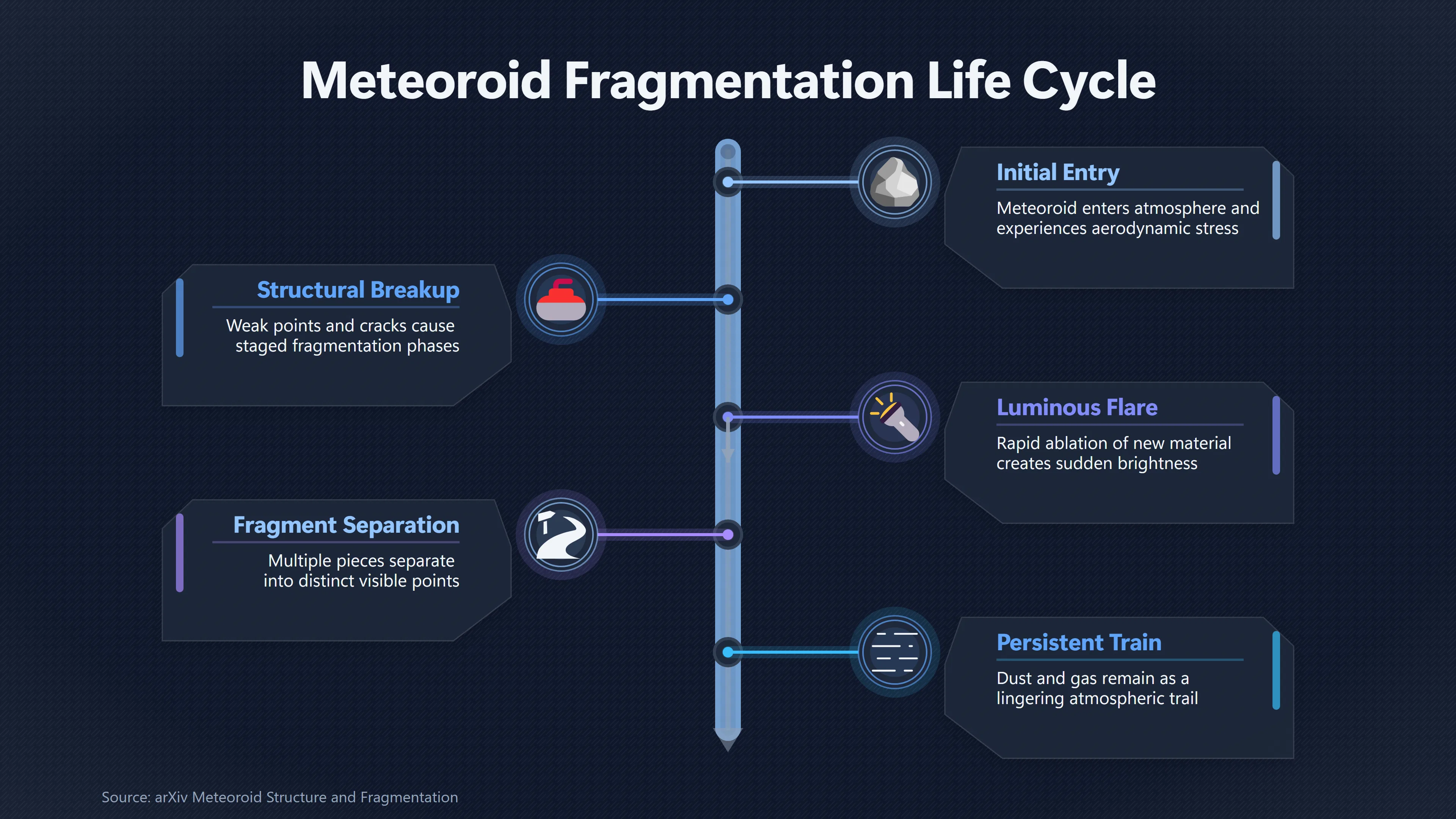
A meteoroid entering the atmosphere does not necessarily remain one coherent lump until it fades. Increasing aerodynamic stresses can exploit cracks, weakly bound components and other structural weaknesses. Research using European Fireball Network observations has reconstructed fragmentation from detailed light curves, deceleration measurements and, in some events, video showing individual fragments. In a study of ordinary chondritic meteoroids, Jiří Borovička and colleagues found evidence for distinct fragmentation phases at different dynamic pressures, illustrating that atmospheric breakup can be a staged process rather than one instantaneous explosion.[arXiv]arxiv.orgTwo Strengths of Ordinary Chondritic Meteoroids as Derived from their Atmospheric Fragmentation ModelingJune 12, 2020…
For the eye, that physics can produce a remarkably quick succession of appearances. A relatively compact luminous head may brighten gradually, flare abruptly when substantial fragmentation occurs, develop several points or streaks as pieces separate, and then fade unevenly as those fragments ablate. A meteor flare is therefore not merely a decorative change in brightness: sharp increases in luminosity can carry physical information about fragmentation and energy deposition. Fireball researchers explicitly analyse peaks and other structure in light curves to identify such events.[arXiv]arxiv.orgBLADE: An Automated Framework for Classifying Light Curves from the Center for Near-Earth Object Studies (CNEOS) Fireball DatabaseJu…
Fragmentation need not even produce several clean, easily resolved “balls”. Many small pieces can be released almost simultaneously. In the studied PF131010 Ciechanów fireball, for example, researchers recorded a sudden increase of about five magnitudes within several tenths of a second. They concluded that the flare and subsequent bright portion of the light curve may have resulted from a large number of small fragments separating from the main body and rapidly ablating, even though distinct fragments were not clearly resolved in the video.[OUP Academic]academic.oup.comOUP AcademicPF131010 Ciechanów fireball: the body possibly related to near earth asteroids 2010 TB54 and 2010 SX11 | Monthly Notices of t…
That distinction matters for UFO interpretation. A witness may describe an object that “expanded”, “lit up”, “sprouted lights” or became an elongated glowing mass even when the camera cannot resolve the individual physical pieces responsible. At great distance, several nearby fragments, their wakes and an overexposed bright head can visually merge into one changing patch of light.
When fragments are resolved, the resemblance to a changing formation can be stronger. A recent European event provides a particularly clear example. On 8 March 2026, a very bright fireball was seen from Belgium, France, Germany, Luxembourg and the Netherlands. ESA reported that it glowed for roughly six seconds, left a visible trail and then fractured into pieces; dedicated meteor cameras, mobile phones and other cameras recorded the event.[European Space Agency]esa.intEuropean Space Agency ESAEuropean Space AgencyESA - Fireball over Europe, 8 March 2026March 9, 2026…
Individual eyewitness reports associated with fireballs show how strange the same process can sound in ordinary language. One American Meteor Society report from May 2026 described a bright glow expanding as the meteor separated into two lights before disappearing; another report described sparkling fragments trailing behind the main object and progressively fading from white or yellow towards orange. These are subjective witness descriptions rather than scientific measurements, but that is precisely why they are useful here: they demonstrate how normal fireball fragmentation can generate descriptions resembling multiple lights or an object changing configuration.[American Meteor Society]fireball.amsmeteors.orgAmerican Meteor Society Fireball reportAmerican Meteor SocietyFireball reportMay 9, 2026…
Why green and other colours can mislead witnesses
Colour is one of the most memorable features in UFO reports, yet a coloured fireball is not intrinsically anomalous. Meteor spectra contain radiation from both the incoming material and the atmosphere through which it is travelling. Detailed spectral studies detect strong atmospheric oxygen emission as well as important meteor-related sodium and magnesium lines, with the relative contribution changing with such factors as velocity and altitude.[arXiv]arxiv.orgOpen source on arxiv.org.
Green is particularly striking because people do not usually associate an intense emerald or green-white moving light with an ordinary meteor. NASA has documented green meteor emission associated with excited atmospheric oxygen. A Perseid travelling at roughly 60 kilometres per second, for example, can excite green oxygen emission high in the atmosphere.[Astronomy Picture of the Day]apod.nasa.govOpen source on nasa.gov.
The common shortcut that a meteor’s apparent colour directly identifies one particular chemical element is therefore too simple. Spectra are mixtures: atmospheric emissions, meteoric elements, continuum radiation, entry speed, altitude and the changing physical state of the event all matter. Modern fireball spectroscopy finds that oxygen emission behaves differently with velocity and altitude, while sodium and magnesium emissions also contribute to meteor spectra.[arXiv]arxiv.orgOpen source on arxiv.org.
Fragmentation makes colour descriptions still harder to interpret. Different phases of a rapidly evolving event need not have identical brightness or spectra. Newly exposed and rapidly ablating material, changing atmospheric conditions along the trajectory and the declining brightness of fragments can alter the balance of light reaching the observer. A short event may consequently be remembered as a sequence — perhaps white, then green, then orange or red — rather than as one fixed colour.
Actual fireball reports show precisely this kind of complexity. An American Meteor Society report from April 2026 recorded perceived colours ranging from blue and green to orange, together with a bright pulse and subsequent fading train. Another 2026 report described a fireball as flashing bright green, returning to red and then splitting into three fragments. Such reports cannot by themselves establish the physical origin of each perceived colour, but they show why “it changed colour and then separated into several lights” is not, on its own, strong evidence against a meteor explanation.[American Meteor Society]fireball.amsmeteors.orgAmerican Meteor Society Fireball reportAmerican Meteor Society Fireball report
Colour estimates also deserve caution because they are eyewitness measurements made during very brief events. The International Meteor Organization places colour and persistent-train observations below such information as path, brightness and angular velocity in its guidance to meteor observers. That does not make colour useless; it means colour should be interpreted as one part of the evidence rather than treated as a fingerprint for an unusual object.[International Meteor Organization]imo.netInternational Meteor Organization Frequently Asked Questions | IMOInternational Meteor Organization Frequently Asked Questions | IMO

How persistent trains create smoke-like aftermaths
The fireball itself can vanish while something apparently remains in the sky. This is where a seconds-long meteor can generate a much longer and stranger-looking aftermath.
The International Meteor Organization defines a persistent train as a remaining glow associated with the meteor’s passage through the upper atmosphere. It also distinguishes luminous persistent trains from non-luminous “smoke trains” containing material deposited along the trajectory. In twilight, such material may still be illuminated by sunlight even when the sky below has darkened.[International Meteor Organization]imo.netInternational Meteor Organization Glossary | IMOInternational Meteor Organization Glossary | IMO
These trains do not have to stay straight. High-altitude winds act on them after the fast-moving meteoroid has gone. The IMO notes that strong winds can change their form over relatively short periods, while NASA imagery and observations show persistent trains drifting, expanding and twisting.[International Meteor Organization]imo.netInternational Meteor Organization Observations of Fireballs | IMOInternational Meteor Organization Observations of Fireballs | IMO
A particularly useful case occurred over the western United States in December 2018. NASA reported that the fireball itself survived for only about a second, yet its persistent train lasted for minutes. Dust left as the meteoroid broke apart reflected sunlight, and winds subsequently distorted the trail into a curved, corkscrew-like shape. Thus a stationary or slowly deforming structure seen after a brilliant moving light can belong to the same meteor event even though it no longer resembles the original object.[NASA]nasa.govFireball Leaves Persistent Train over Western SkiesFireball Leaves Persistent Train over Western Skies - NASA…
Some trains last much longer. A NASA Astronomy Picture of the Day record of a Perseid notes that faint remnants of its persistent train could still be traced after an hour, by which point the structure had expanded across more than 80 degrees of sky. A 2024 observational study likewise found hundreds of persistent trains in a sample cross-matched with Global Meteor Network detections and notes that such self-emitting phenomena can linger for extended periods after their parent meteors.[Astronomy Picture of the Day]apod.nasa.govOpen source on nasa.gov.
This aftermath can easily complicate retrospective accounts. Someone concentrating on the brilliant moving object may only afterwards notice a twisted luminous streak or cloud where it passed. The two phases move differently: the meteor races across the sky, whereas the residual train evolves with upper-atmospheric winds. Without that context, a witness could reasonably remember a fast object that stopped, left a stationary shape, or transformed into a cloud.
Chelyabinsk provides an extreme and unusually well documented illustration. The large 2013 fireball underwent major disruption near maximum brightness, and its evolving atmospheric train remained conspicuous afterwards. NASA imagery shows the long cloud still visible 18 minutes after the event. Chelyabinsk was vastly more energetic than the ordinary fireballs responsible for most sightings, but the sequence — brilliant body, fragmentation and an enduring atmospheric trace — makes the distinction between the moving meteor and its aftermath exceptionally clear.[NASA Jet Propulsion Laboratory]jpl.nasa.govOpen source on nasa.gov.
When “changing shape” supports a fireball explanation
A changing appearance is sometimes treated as evidence that a sighting cannot have been a meteor: meteors are imagined as simple streaks that remain visually unchanged until they disappear. Observational meteor science shows why that test is unreliable.
For a brief sighting, the more useful question is how the appearance changed. A sequence consisting of rapid movement along one general trajectory, one or more sudden flares, separation into trailing luminous pieces and extinction over a few seconds fits documented fragmentation behaviour well. A lingering train that subsequently twists or spreads can also fit, because its later motion is controlled by the upper atmosphere rather than by the vanished meteoroid.[arxiv.org]arxiv.orgTwo Strengths of Ordinary Chondritic Meteoroids as Derived from their Atmospheric Fragmentation ModelingJune 12, 2020…
That does not mean every report of multiple lights or shape-changing objects should automatically be labelled a fireball. Duration and motion remain important discriminators. Fragmentation explains lights separating from a rapidly moving meteor and continuing broadly along the same atmospheric path; it does not, by itself, explain prolonged hovering, repeated controlled turns, a formation persisting for many minutes, or fragments independently reversing direction. Those features would require examination of other explanations or better observational evidence.
Nor should apparent colour be given excessive diagnostic weight. Green, orange, blue-white and changing hues all occur in meteor observations, and the physical spectrum can combine atmospheric and meteoric emissions. Likewise, a smoke-like remnant does not necessarily contradict the meteor hypothesis: luminous and dust trains are established consequences of atmospheric passage and can be distorted after the fireball is gone.[nasa.gov]science.nasa.govScience Meteors Great and SmallScience Meteors Great and Small
The strongest identification therefore comes from the whole temporal pattern rather than any single spectacular detail. A witness may sincerely see something that appears to transform from one bright object into several lights and then into a twisting cloud. In a fragmenting fireball, those apparently different phenomena can be consecutive stages of one physical event: flare, breakup, fragment ablation, extinction and an evolving atmospheric train. That rapid transformation is exactly what makes fragmenting fireballs capable of producing some of the most visually persuasive — yet naturally explicable — brief UFO and UAP reports.
Amazon book picks
Further Reading
Books and field guides related to Why a breaking fireball can look like a changing UFO. Use these as the next step if you want deeper reading beyond the article.
Meteorites: The Story of Our Solar System
Meteorite tells the fascinating story of the stones from outer space scattered across our planet. From the impact that finished off the d...
The Meteorite Hunters: On the Trail of Extraterrestrial Treas...
Want to join the ultimate cosmic treasure hunt? 'They fall from the sky, and tell us about the universe: a passionate story of the excite...
The Heavens on Fire: The Great Leonid Meteor Storms
Highly readable account of meteors, especially the spectacular Leonid showers, due in mid-November.
Observing Comets, Asteroids, Meteors, and the Zodiacal Light
When can you see fireballs and who should you contact if you spot one? When is it best to hunt for comets and meteors and whereabouts? Ho...
eBay marketplace picks
Marketplace Samples
Live-tested eBay searches with available results related to this page.
Selected fromfireball art print oneBay.co.uk.



Endnotes
1.
Source: arxiv.org
Link:https://arxiv.org/abs/2006.07080
Source snippet
Two Strengths of Ordinary Chondritic Meteoroids as Derived from their Atmospheric Fragmentation ModelingJune 12, 2020...
Published: June 12, 2020
2.
Source: arxiv.org
Title: arXiv Meteoroid Structure and Fragmentation
Link:https://arxiv.org/abs/1903.06572
3.
Source: academic.oup.com
Link:https://academic.oup.com/mnras/article/454/3/2965/1193039
Source snippet
OUP AcademicPF131010 Ciechanów fireball: the body possibly related to near earth asteroids 2010 TB54 and 2010 SX11 | Monthly Notices of t...
4.
Source: imo.net
Title: International Meteor Organization Glossary | IMO
Link:https://www.imo.net/resources/glossary/
5.
Source: nasa.gov
Title: Fireball Leaves Persistent Train over Western Skies
Link:https://www.nasa.gov/blogs/watch-the-skies/2018/12/20/fireball-leaves-persistent-train-over-western-skies/
Source snippet
Fireball Leaves Persistent Train over Western Skies - NASA...
6.
Source: arxiv.org
Link:https://arxiv.org/abs/2211.15793
7.
Source: arxiv.org
Link:https://arxiv.org/abs/2506.16099
Source snippet
BLADE: An Automated Framework for Classifying Light Curves from the Center for Near-Earth Object Studies (CNEOS) Fireball DatabaseJu...
8.
Source: esa.int
Title: European Space Agency ESA
Link:https://www.esa.int/ESA_Multimedia/Videos/2026/03/Fireball_over_Europe_8_March_2026/%28lang%29/en
Source snippet
European Space AgencyESA - Fireball over Europe, 8 March 2026March 9, 2026...
Published: March 9, 2026
9.
Source: apod.nasa.gov
Link:https://apod.nasa.gov/apod/ap180817.html
10.
Source: science.nasa.gov
Title: Science Meteors Great and Small
Link:https://science.nasa.gov/earth/earth-observatory/meteors-great-and-small-148692/
11.
Source: fireball.imo.net
Link:https://fireball.imo.net/members/imo_view/report/424129
12.
Source: imo.net
Title: International Meteor Organization Frequently Asked Questions | IMO
Link:https://www.imo.net/resources/faq/
13.
Source: imo.net
Title: International Meteor Organization Observations of Fireballs | IMO
Link:https://www.imo.net/observations/fireballs/observations/
14.
Source: apod.nasa.gov
Title: Astronomy Picture of the Day APOD
Link:https://apod.nasa.gov/rjn/apod/ap981127.html
15.
Source: fireballs.ndc.nasa.gov
Link:https://fireballs.ndc.nasa.gov/skyfalls/events/20181220-013502
16.
Source: arxiv.org
Title: arXiv Not So Fast: A New Catalog of Meteor Persistent Trains
Link:https://arxiv.org/abs/2407.18344
17.
Source: jpl.nasa.gov
Link:https://www.jpl.nasa.gov/news/additional-details-on-the-large-feb-15-fireball-over-russia/
18.
Source: apod.nasa.gov
Link:https://apod.nasa.gov/apod/ap130302.html
19.
Source: esa.int
Link:https://www.esa.int/Space_Safety/Planetary_Defence/Weather_[satellites
20.
Source: neo.ssa.esa.int
Title: int News Details
Link:https://neo.ssa.esa.int/en/news-details
21.
Source: neo.ssa.esa.int
Title: int News Details
Link:https://neo.ssa.esa.int/news-details
22.
Source: neo.ssa.esa.int
Title: int E U-ESA Workshop on Meteor Observations for Planetary Defence
Link:https://neo.ssa.esa.int/en/-/eu-esa-workshop-on-meteor-observations-for-planetary-defence
23.
Source: fireballs.imo.net
Link:https://fireballs.imo.net/members/imo_view/report/430764
24.
Source: fireball.imo.net
Link:https://fireball.imo.net/members/imo_view/report/422886
25.
Source: esa.int
Link:https://www.esa.int/ESA_Multimedia/Images/2026/05/MTG-LI_Gulf_of_Aden_fireball_detection
26.
Source: esa.int
Link:https://www.esa.int/Space_Safety/Fireballs_and_lightning_very_very_frightening_or_not
27.
Source: fireball.imo.net
Link:https://fireball.imo.net/members/imo_view/report/418703
28.
Source: fireball.imo.net
Link:https://fireball.imo.net/members/imo_view/report/417975
29.
Source: fireballs.imo.net
Link:https://fireballs.imo.net/members/imo_view/report/417015
30.
Source: academic.oup.com
Link:https://academic.oup.com/mnras/article/548/2/stag570/8551341
31.
Source: nasa.gov
Title: It’s Fireball Season! Answering Your Meteor Questions
Link:https://www.nasa.gov/blogs/watch-the-skies/2026/03/26/its-fireball-season-answering-your-meteor-questions/
32.
Source: science.nasa.gov
Title: fragmentation of comet c 2025 k1
Link:https://science.nasa.gov/asset/hubble/fragmentation-of-comet-c-2025-k1/
33.
Source: science.nasa.gov
Title: s hubble unexpectedly catches comet breaking up
Link:https://science.nasa.gov/missions/hubble/nasas-hubble-unexpectedly-catches-comet-breaking-up/
34.
Source: esa.int
Title: ES A Television
Link:https://www.esa.int/esatv/Videos/2026/03/Fireball_over_Europe_8_March_2026
35.
Source: esa.int
Link:https://www.esa.int/Space_Safety/Planetary_Defence/ESA_analysing_fireball_over_Europe_on_8_March_2026?searchtext=ruchi%3Futm_source%3Darticle_title_click
36.
Source: fireball.imo.net
Link:https://fireball.imo.net/members/imo_view/report/409872
37.
Source: fireball.imo.net
Link:https://fireball.imo.net/members/imo_view/report/405588
38.
Source: fireball.imo.net
Link:https://fireball.imo.net/members/imo_view/report/403482
39.
Source: fireball.imo.net
Link:https://fireball.imo.net/members/imo_view/report/403094
40.
Source: imo.net
Title: viewing the 2026 quadrantid meteor shower
Link:https://www.imo.net/viewing-the-2026-quadrantid-meteor-shower/
41.
Source: imo.net
Title: meteor activity outlook for 20 26 december 2025
Link:https://www.imo.net/meteor-activity-outlook-for-20-26-december-2025/
Published: december 2025
42.
Source: imo.net
Title: wgn issue 53 4 august 2025 2
Link:https://www.imo.net/wgn-issue-53-4-august-2025-2/
Published: august 2025
43.
Source: fireballs.imo.net
Link:https://fireballs.imo.net/members/imo_view/report/393721
44.
Source: esa.int
Link:https://www.esa.int/ESA_Multimedia/Videos/2025/11/Bright_fireball_spotted_by_ESA_s_meteor_detection_station_in_Caceres_Spain
45.
Source: apod.nasa.gov
Link:https://apod.nasa.gov/rjn/apod/ap250816.html
46.
Source: science.nasa.gov
Title: s guide to finding and photographing [auroras]({{ ‘auroras/’ | relative_url }})
Link:https://science.nasa.gov/feature/nasas-guide-to-finding-and-photographing-auroras/
47.
Source: science.nasa.gov
Title: observes first visible light auroras at mars
Link:https://science.nasa.gov/solar-system/planets/mars/nasa-observes-first-visible-light-auroras-at-mars/
48.
Source: science.nasa.gov
Link:https://science.nasa.gov/sun/auroras/
49.
Source: nasa.gov
Title: Season Two, Episode 1
Link:https://www.nasa.gov/podcasts/on-a-mission/season-two-episode-1-the-sky-is-falling
50.
Source: apod.nasa.gov
Link:https://apod.nasa.gov/rjn/apod/ap230916.html
51.
Source: apod.nasa.gov
Link:https://apod.nasa.gov/rjn/apod/ap230724.html
52.
Source: imo.net
Title: meteor activity outlook for 22 28 july 2023
Link:https://www.imo.net/meteor-activity-outlook-for-22-28-july-2023/
Published: july 2023
53.
Source: indico.esa.int
Link:https://indico.esa.int/event/394/sessions/1360/
54.
Source: indico.esa.int
Link:https://indico.esa.int/event/394/timetable/?print=1&view=standard_numbered
55.
Source: academic.oup.com
Link:https://academic.oup.com/mnras/article/508/4/5716/6400106
56.
Source: esa.int
Link:https://www.esa.int/ESA_Multimedia/Videos/2021/09/Fireball_streams_over_Southern_Germany
57.
Source: esa.int
Link:https://www.esa.int/ESA_Multimedia/Videos/2021/09/Fireball_streams_over_Southern_Germany/%28lang%29/en
58.
Source: esa.int
Title: ES A Television
Link:https://www.esa.int/esatv/Videos/2021/09/Fireball_streams_over_Southern_Germany
59.
Source: academic.oup.com
Link:https://academic.oup.com/mnras/article/503/3/3337/6155056
60.
Source: apod.nasa.gov
Link:https://apod.nasa.gov/rjn/apod/ap210202.html
61.
Source: apod.nasa.gov
Link:https://apod.nasa.gov/apod/ap210202.html
62.
Source: academic.oup.com
Link:https://academic.oup.com/mnras/article/501/1/1215/5998250
63.
Source: academic.oup.com
Link:https://academic.oup.com/mnras/article/494/1/1018/5816862
64.
Source: esa.int
Link:https://www.esa.int/ESA_Multimedia/Images/2020/01/Cosmic_caller_goes_out_with_a_bang
65.
Source: jpl.nasa.gov
Title: episode 1 the sky is falling
Link:https://www.jpl.nasa.gov/podcasts/on-a-mission-season-1/season-2-asteroids/episode-1-the-sky-is-falling/
66.
Source: fragmentation.esoc.esa.int
Title: int ES A’s fragmentation database
Link:https://fragmentation.esoc.esa.int/events
67.
Source: indico.esa.int
Link:https://indico.esa.int/event/272/contributions/4426/
68.
Source: indico.esa.int
Link:https://indico.esa.int/event/272/sessions/1006/
69.
Source: indico.esa.int
Link:https://indico.esa.int/event/272/contributions/
70.
Source: jpl.nasa.gov
Title: instruments image fireball over bering sea
Link:https://www.jpl.nasa.gov/news/nasa-instruments-image-fireball-over-bering-sea/
71.
Source: academic.oup.com
Link:https://academic.oup.com/mnras/article/485/1/1121/5318648
72.
Source: science.nasa.gov
Title: enjoying the geminids from above and below
Link:https://science.nasa.gov/science-research/planetary-science/enjoying-the-geminids-from-above-and-below/
73.
Source: science.nasa.gov
Title: earth awash in lights of the night 92912
Link:https://science.nasa.gov/earth/earth-observatory/earth-awash-in-lights-of-the-night-92912/
74.
Source: esa.int
Link:https://www.esa.int/ESA_Multimedia/Images/2018/06/Fireball_Moon_Venus
75.
Source: nasa.gov
Title: Five Years after the Chelyabinsk Meteor: NASA Leads Efforts in Planetary Defense
Link:https://www.nasa.gov/solar-system/five-years-after-the-chelyabinsk-meteor-nasa-leads-efforts-in-planetary-defense/
76.
Source: science.nasa.gov
Title: the subtle colors of eros
Link:https://science.nasa.gov/resource/the-subtle-colors-of-eros/
77.
Source: science.nasa.gov
Title: lights on and over the southern horizon 90507
Link:https://science.nasa.gov/earth/earth-observatory/lights-on-and-over-the-southern-horizon-90507/
78.
Source: nas.nasa.gov
Title: feature asteroid simulations
Link:https://nas.nasa.gov/pubs/stories/2017/feature_asteroid_simulations.html
79.
Source: academic.oup.com
Link:https://academic.oup.com/mnras/article/464/4/4399/2417422
80.
Source: apod.nasa.gov
Link:https://apod.nasa.gov/rjn/apod/ap160819.html
81.
Source: academic.oup.com
Link:https://academic.oup.com/mnras/article/460/1/917/2608821
82.
Source: science.nasa.gov
Title: aurora colors skies over northern europe 87646
Link:https://science.nasa.gov/earth/earth-observatory/aurora-colors-skies-over-northern-europe-87646/
83.
Source: academic.oup.com
Link:https://academic.oup.com/mnras/article/457/2/1759/969707
84.
Source: academic.oup.com
Link:https://academic.oup.com/mnras/article/457/2/1289/967237
85.
Source: apod.nasa.gov
Link:https://apod.nasa.gov/apod/ap151116.html
86.
Source: science.nasa.gov
Title: comet meteor shower put magnesium and iron into martian atmosphere
Link:https://science.nasa.gov/resource/comet-meteor-shower-put-magnesium-and-iron-into-martian-atmosphere/
87.
Source: nasa.gov
Title: NAS A and International Researchers Obtain Crucial Data from Meteoroid Impact
Link:https://www.nasa.gov/news-release/nasa-and-international-researchers-obtain-crucial-data-from-meteoroid-impact/
88.
Source: science.nasa.gov
Title: [tracking]({{ ‘tracking/’ | relative_url }}) the chelyabinsk meteor plume 81844
Link:https://science.nasa.gov/earth/earth-observatory/tracking-the-chelyabinsk-meteor-plume-81844/
89.
Source: science.nasa.gov
Title: 15aug russianmeteorplume
Link:https://science.nasa.gov/science-research/earth-science/15aug_russianmeteorplume/
90.
Source: nasa.gov
Title: Around the World in Four Days: NASA Tracks Chelyabinsk Meteor Plume
Link:https://www.nasa.gov/solar-system/around-the-world-in-four-days-nasa-tracks-chelyabinsk-meteor-plume/
91.
Source: neo.ssa.esa.int
Title: int After Chelyabinsk: European experts assess asteroid options
Link:https://neo.ssa.esa.int/en/-/after-chelyabinsk-european-experts-assess-asteroid-options
92.
Source: cneos.jpl.nasa.gov
Title: fireball 130301
Link:https://cneos.jpl.nasa.gov/news/fireball_130301.html
93.
Source: apod.nasa.gov
Link:https://apod.nasa.gov/apod/ap130223.html
94.
Source: neo.ssa.esa.int
Title: int Fireball over Russia
Link:https://neo.ssa.esa.int/en/-/fireball-over-russia
95.
Source: nasa.gov
Title: Orbit of the Russian Meteor
Link:https://www.nasa.gov/blogs/watch-the-skies/2013/02/16/orbit-of-the-russian-meteor/
96.
Source: science.nasa.gov
Title: fireball streaking over russia
Link:https://science.nasa.gov/photojournal/fireball-streaking-over-russia/
97.
Source: science.nasa.gov
Title: fireball flash over russia
Link:https://science.nasa.gov/photojournal/fireball-flash-over-russia/
98.
Source: science.nasa.gov
Title: meteor fragments blaze over the ural mountains
Link:https://science.nasa.gov/blogs/earth-matters/2013/02/15/meteor-fragments-blaze-over-the-ural-mountains/
99.
Source: jpl.nasa.gov
Title: meteor likely cause of southwest us light show
Link:https://www.jpl.nasa.gov/news/meteor-likely-cause-of-southwest-us-light-show/
100.
Source: science.nasa.gov
Title: aurora australis observed from the international space station 44348
Link:https://science.nasa.gov/earth/earth-observatory/aurora-australis-observed-from-the-international-space-station-44348/
101.
Source: academic.oup.com
Link:https://academic.oup.com/mnras/article/355/1/111/3101488
102.
Source: science.nasa.gov
Title: auroras dancing in the night
Link:https://science.nasa.gov/earth/earth-observatory/auroras-dancing-in-the-night/
103.
Source: ntrs.nasa.gov
Link:https://ntrs.nasa.gov/citations/20010003444
104.
Source: ntrs.nasa.gov
Link:https://ntrs.nasa.gov/search.jsp?R=20010004104
105.
Source: academic.oup.com
Link:https://academic.oup.com/mnras/article-abstract/173/3/497/971360
106.
Source: imo.net
Link:https://www.imo.net/observations/methods/visual-observation/major/observation/
107.
Source: imo.net
Link:https://www.imo.net/observations/methods/video-observation/examples/
108.
Source: imo.net
Link:https://www.imo.net/observations/methods/telescopic-observation/form/
109.
Source: imo.net
Link:https://www.imo.net/observations/methods/visual-observation/minor/
110.
Source: imo.net
Link:https://www.imo.net/observations/methods/visual-observation/observation-of-exceptionally-high-activity/
111.
Source: imo.net
Link:https://www.imo.net/observations/methods/visual-observation/
112.
Source: academic.oup.com
Link:https://academic.oup.com/view-large/figure/16401457/326-3-937-fig004.jpeg
113.
Source: apod.nasa.gov
Title: apod search
Link:https://apod.nasa.gov/cgi-bin/apod/apod_search?tquery=Meteor
114.
Source: cneos.jpl.nasa.gov
Link:https://cneos.jpl.nasa.gov/fireballs/lc/
115.
Source: cneos.jpl.nasa.gov
Link:https://cneos.jpl.nasa.gov/fireballs/
116.
Source: leonid.arc.nasa.gov
Link:https://leonid.arc.nasa.gov/what.html
117.
Source: neo.ssa.esa.int
Title: int Fireballs
Link:https://neo.ssa.esa.int/en/search-for-fireballs
118.
Source: fireball.amsmeteors.org
Title: American Meteor Society Fireball report
Link:https://fireball.amsmeteors.org/members/imo_view/report/422629
Source snippet
American Meteor SocietyFireball reportMay 9, 2026...
Published: May 9, 2026
119.
Source: fireball.amsmeteors.org
Title: American Meteor Society Fireball report
Link:https://fireball.amsmeteors.org/members/imo_view/report/422886
120.
Source: fireball.amsmeteors.org
Title: American Meteor Society Fireball report
Link:https://fireball.amsmeteors.org/members/imo_view/report/419521
121.
Source: amsmeteors.org
Title: Fireball report
Link:https://amsmeteors.org/members/imo_view/report/425728
122.
Source: fireball.amsmeteors.org
Link:https://fireball.amsmeteors.org/members/imo_view/report/423940
123.
Source: fireballs.amsmeteors.org
Link:https://fireballs.amsmeteors.org/members/imo_view/report/422531
124.
Source: fireballs.amsmeteors.org
Link:https://fireballs.amsmeteors.org/members/imo_view/report/422526
125.
Source: fireball.amsmeteors.org
Link:https://fireball.amsmeteors.org/members/imo_view/report/423749
126.
Source: amsmeteors.org
Title: viewing the lyrids in 2026
Link:https://amsmeteors.org/2026/04/viewing-the-lyrids-in-2026/
127.
Source: amsmeteors.org
Title: Fireball report
Link:https://amsmeteors.org/members/imo_view/report/420684
128.
Source: fireball.amsmeteors.org
Link:https://fireball.amsmeteors.org/members/imo_view/report/418055
129.
Source: fireball.amsmeteors.org
Link:https://fireball.amsmeteors.org/members/imo_view/report/418070
130.
Source: fireball.amsmeteors.org
Link:https://fireball.amsmeteors.org/members/imo_view/report/417015
131.
Source: fireball.amsmeteors.org
Link:https://fireball.amsmeteors.org/members/imo_view/report/414241
132.
Source: fireball.amsmeteors.org
Link:https://fireball.amsmeteors.org/members/imo_view/report/406556
133.
Source: fireball.amsmeteors.org
Link:https://fireball.amsmeteors.org/members/imo_view/report/381541
134.
Source: fireball.amsmeteors.org
Link:https://fireball.amsmeteors.org/members/imo_view/report/380982
135.
Source: fireball.amsmeteors.org
Link:https://fireball.amsmeteors.org/members/imo_view/report/366740
136.
Source: amsmeteors.org
Title: meteor activity outlook for november 18 24 2023
Link:https://amsmeteors.org/2023/11/meteor-activity-outlook-for-november-18-24-2023/
137.
Source: amsmeteors.org
Title: meteor activity outlook for september 23 29 2023
Link:https://amsmeteors.org/2023/09/meteor-activity-outlook-for-september-23-29-2023/
138.
Source: fireballs.amsmeteors.org
Link:https://fireballs.amsmeteors.org/members/imo_view/report/292542
139.
Source: amsmeteors.org
Title: Videos: American Meteor Society
Link:https://www.amsmeteors.org/videos/?video_id=4425
140.
Source: ouci.dntb.gov.ua
Link:https://ouci.dntb.gov.ua/en/works/4yVgOLxl/
141.
Source: amsmeteors.org
Title: Fireball Over Kansas & Missouri
Link:https://amsmeteors.org/2011/06/fireball-over-kansas-missouri-june-3-2011/
142.
Source: amsmeteors.org
Link:https://amsmeteors.org/resources/glossary/
Additional References
143.
Source: nature.com
Link:https://www.nature.com/articles/nature12741
144.
Source: nature.com
Link:https://www.nature.com/articles/s43247-022-00373-1
145.
Source: nature.com
Link:https://www.nature.com/articles/s41598-018-31655-4
146.
Source: nature.com
Link:https://www.nature.com/articles/srep05033
147.
Source: nature.com
Link:https://www.nature.com/articles/s43247-022-00469-8
148.
Source: nature.com
Link:https://www.nature.com/articles/nature12671.pdf
149.
Source: osti.gov
Link:https://www.osti.gov/pages/biblio/2585564
150.
Source: nature.com
Title: Anomalies in the Light Curves of Meteors resulting from Fragmentation | Nature
Link:https://www.nature.com/articles/190896a0
151.
Source: researchgate.net
Link:https://www.researchgate.net/publication/230912568_Detection_of_the_FORMULAFRMNRMSUPSUPINF2INFFFORMULA_First_Negative_System_in_a_Bright_Leonid_Fireball
152.
Source: researchgate.net
Link:https://www.researchgate.net/publication/253633295Extensive_meteoroid_fragmentation_in_VUHF[radar