Within UFO Identifications
What Modern UAP Cases Are Being Resolved As
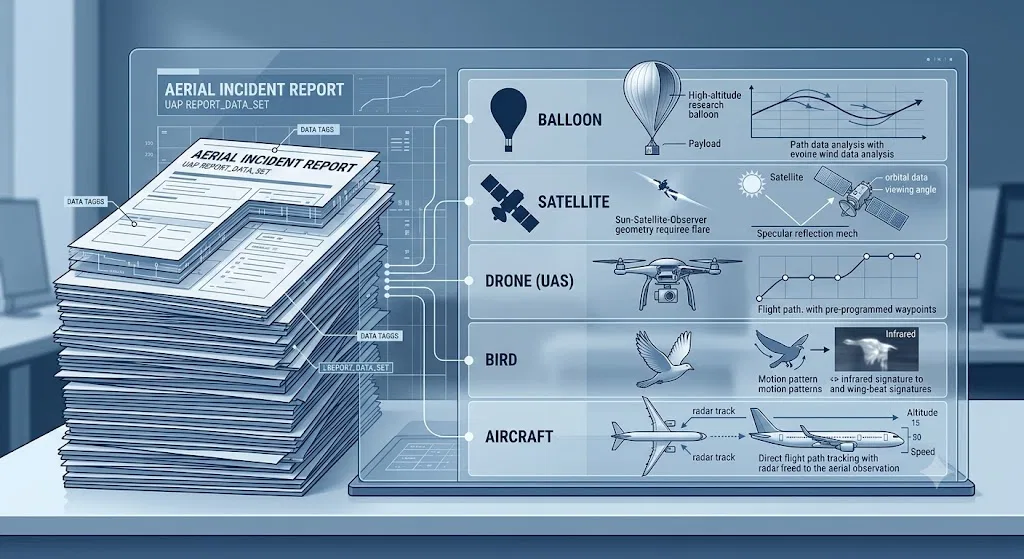
AARO's closed cases show balloons and satellites dominating resolved reports, with drones, birds and aircraft also recurring.
On this page
- The leading categories among closed cases
- Why modern technology changes the mix
- What unresolved cases still lack
Page outline Jump by section
Introduction
The clearest modern evidence about what reported UAP become after investigation comes from the US Department of Defense’s All-domain Anomaly Resolution Office (AARO). Its latest annual results do not show a single dominant exotic mystery. They show a changing mixture of ordinary objects in which balloons and satellites now account for most resolved reports, with aircraft, unmanned aerial systems, birds and occasional unusual but conventional technologies making up the remainder. In AARO’s FY2025 closed-case chart, 60 of 114 newly resolved reports were balloons and 44 were satellites; the other ten were four aircraft, two birds, two unmanned aerial systems, one rocket or missile launch and one manned jetpack.[AARO]aaro.milOpen source on aaro.mil.
The striking change is the rise of satellites. A year earlier, balloons represented 70 per cent of AARO’s closed cases while satellites were only 4 per cent. Improved modelling of satellite reflections has since allowed AARO to revisit large numbers of older reports, illustrating an important point about UAP datasets: what gets identified depends not only on what is in the sky, but also on what data and analytical tools investigators possess.[Archive DNI]dni.govOpen source on dni.gov.

The leading categories among closed cases
AARO’s FY2024 and FY2025 figures provide unusually concrete evidence for the causes behind modern US military and aviation UAP reports. The two reporting periods are not perfectly interchangeable—the intake, backlog and closure procedures changed—but together they reveal a stable core of conventional explanations and a rapidly growing satellite component.
In the FY2024 report, AARO initially resolved 118 cases during the reporting period and subsequently finalised another 174 that had been awaiting approval. All were attributed to ordinary objects: balloons, birds, unmanned aerial systems, satellites or aircraft. The published closed-case chart for that period was dominated by balloons at 70 per cent, followed by UAS at 16 per cent, birds at 8 per cent, satellites at 4 per cent and aircraft at 2 per cent.[Archive DNI]dni.govOpen source on dni.gov.
The FY2025 picture shifted dramatically. AARO received 319 reports and resolved 114 of them. Its corresponding chart gives actual counts:
- Balloons: 60
- Satellites: 44
- Aircraft: 4
- Unmanned aerial systems: 2
- Birds: 2
- Rocket or missile launch: 1
- Manned jetpack: 1
That makes balloons and satellites 104 of the 114 cases represented in the chart—more than nine out of ten.[AARO]aaro.milOpen source on aaro.mil.
Those 114 cases do not capture the full scale of AARO’s work that year. The office also resolved 256 reports inherited from earlier periods, taking its total number of resolutions during the FY2025 reporting period to 370. AARO states that all of those resolutions were attributable to prosaic objects or activities. Crucially, a newly introduced modelling capability enabled analysts to resolve 238 reports as satellite flaring, including cases from the backlog.[AARO]aaro.milOpen source on aaro.mil.
That distinction matters when interpreting claims such as “satellites now dominate AARO resolutions”. Among the 114 newly closed cases shown in the FY2025 category chart, balloons were still the largest single category. Across the broader body of old and new cases resolved using the new analytical capability, however, satellite flaring became a major driver of closures. The dataset therefore records both a real feature of the modern visual environment and a change in investigators’ ability to recognise it.[AARO]aaro.milOpen source on aaro.mil.
AARO’s individual published cases show how these broad categories arise. Several European infrared recordings from 2022 were assessed with high confidence as balloons because the objects’ appearance and motion matched lighter-than-air objects drifting with the measured wind. A 2024 Middle East recording was similarly attributed to a consumer-grade reflective foil balloon. Other releases identify migratory birds by their formation, flight behaviour and infrared pulsation consistent with wing beats.[AARO]aaro.milOpen source on aaro.mil.
Aircraft can become equally unrecognisable at long range. In AARO’s “Western U.S. Objects” case, three small points visible in infrared footage were matched with commercial-aircraft radar tracks; distance had reduced ordinary aeroplanes to apparently featureless dots. The resolution depended not simply on examining the picture, but on combining it with independent flight information.[AARO]aaro.milOpen source on aaro.mil.
These examples make the category statistics more useful than a simple list of labels. “Balloon”, “bird” or “aircraft” is often the endpoint of a reconstruction using wind, flight tracks, sensor behaviour, viewing geometry or other contextual evidence that was not obvious to the original observer.

Why modern technology changes the mix
Satellites are the most important new ingredient in AARO’s resolution statistics. In FY2024, the office was already reporting growing numbers of cases associated with the Starlink constellation. One commercial pilot had reported white flashing lights without usable imagery or altitude information; AARO found that the observation correlated geographically and temporally with a Starlink launch roughly an hour earlier. At that stage the office said it was examining whether more unresolved cases could be explained by the expansion of Starlink and other large low-Earth-orbit constellations.[Archive DNI]dni.govOpen source on dni.gov.
By FY2025 this had developed into a systematic analytical capability. AARO says it uses all-source analysis and three-dimensional modelling to test whether the Sun-satellite-observer geometry can produce the reported lights. Forty-four reports occurring within the FY2025 reporting period were resolved as satellite flaring, while application of the new capability to the wider case holdings produced 238 satellite-flare resolutions.[AARO]aaro.milOpen source on aaro.mil.
Satellite flares occur when sunlight reflects from a spacecraft towards an observer at a favourable angle. To a pilot at night, the result need not resemble the familiar steady movement of a satellite crossing the sky. AARO notes reports of intense or coloured “orbs” appearing and disappearing, sometimes at apparently very high altitude. Independent astronomical research has likewise demonstrated that Starlink spacecraft can produce unusually bright specular reflections and has reconstructed cases in which commercial pilots reported satellite trains or flares as UAP.[aaro.mil]aaro.milOpen source on aaro.mil.
This creates a distinctly modern source of IFOs. The sky now contains large constellations whose apparent brightness varies with spacecraft orientation, orbital geometry, the Sun’s position and the observer’s own motion. A phenomenon that may look unlike a conventional satellite to an experienced pilot can nevertheless be predictable once accurate time, location, viewing direction and orbital data are brought together.[arXiv]arxiv.orgOpen source on arxiv.org.
Technology also changes how older familiar objects look. Infrared and electro-optical systems do not reproduce the scene exactly as the human eye would see it. AARO’s FY2024 report notes that compression, pixelation and sensor glare can turn birds into amorphous blobs or apparently spherical objects, while changing infrared returns from flapping wings can produce a conspicuous flickering signature.[Archive DNI]dni.govOpen source on dni.gov.
Some of AARO’s best-known case resolutions depend heavily on viewing geometry. In the 2013 Aguadilla, Puerto Rico footage, an object appeared to move rapidly, split in two and enter the sea. AARO’s reconstruction concluded instead that the video showed two nearby objects travelling in a straight line at roughly wind speed, without entering the water. Its Mount Etna analysis similarly concluded that atmospheric optical effects made a distant balloon appear to pass through the volcano’s hot ash plume when it was actually about 170 kilometres from the caldera.[AARO]aaro.milOpen source on aaro.mil.
The broader lesson is that “modern” UAP causes are not simply a list of newly invented objects. They also include new ways for ordinary objects to acquire misleading appearances: long-range infrared imaging, digital compression, large satellite constellations, automated cameras and observers moving rapidly relative to distant targets.
What unresolved cases still lack
AARO’s statistics do not support treating every unresolved report as evidence of an extraordinary object. In FY2025, it placed 191 of the 319 incoming reports into its “active archive” because the available information was insufficient to determine whether the event was consistent with natural phenomena or known technology. Nine more reports were referred for additional intelligence-community or scientific and technical analysis.[AARO]aaro.milOpen source on aaro.mil.
That pattern closely resembles FY2024, when 444 cases lacked sufficient data for analysis and were placed in the active archive. AARO explicitly identified the recurring problem as a shortage of timely, actionable sensor information.[Archive DNI]dni.govOpen source on dni.gov.
Published examples show what “insufficient data” can mean in practice. Some infrared clips depict a genuine-looking area of thermal contrast, yet lack the telemetry or independent sensor observations needed to determine whether it represents a physical object, reflected heat, an environmental temperature difference or a sensor/display artefact. In other cases AARO can say that an object behaves like a conventional aircraft without having enough information to identify its precise type or origin.[AARO]aaro.milOpen source on aaro.mil.
This distinction is central to reading the dataset correctly. A case can therefore end in several different states: identified as a specific ordinary source; judged non-anomalous without exact identification; retained for specialised analysis; or archived because the evidence is too poor for a defensible conclusion. “Unresolved” is consequently a statement about the state of the evidence, not a positive attribution to an unknown technology.
NASA’s independent UAP study reached a closely related conclusion about the underlying research problem. It found that UAP analysis is generally hindered by missing sensor calibration, lack of simultaneous independent measurements, inadequate metadata and poor baseline information. Better-calibrated, multi-sensor observations would make both conventional identifications and genuinely anomalous cases easier to distinguish.[NASA Science]nasa.govOpen source on nasa.gov.
That creates a governance problem as much as a scientific one. AARO is responsible for collecting reports produced by military units, intelligence partners and increasingly civilian aviation channels, but the usefulness of any later investigation depends on what those organisations record at the moment of observation. In FY2025, Federal Aviation Administration reports from civilian aviators accounted for 21 per cent of incoming reporting; AARO said these reports were generally less data-rich than Department of Defense cases, although sufficiently detailed narratives could still permit high-confidence satellite-flare identifications.[AARO]aaro.milOpen source on aaro.mil.
Public scrutiny adds another limitation. AARO publishes annual totals, selected imagery, calculations and some detailed case resolutions, but the public release is not a case-by-case evidentiary archive for every closure. Congressional hearings have included criticism from witnesses who argue that UAP records and analytical processes should be more transparent, while other witnesses have emphasised the need for standardised reporting that preserves sensor settings, range information and recordings for later review. Those governance debates do not overturn AARO’s published balloon or satellite identifications, but they do matter when deciding how independently the public can audit aggregate resolution statistics.[aaro.mil]aaro.milOpen source on aaro.mil.

What AARO’s results say about modern UAP reports
The strongest conclusion from the modern AARO dataset is not that every UAP has been explained. It is that the cases which can be resolved repeatedly collapse into familiar categories, and the relative importance of those categories changes with the technological environment and analytical tools available.
Balloons remain exceptionally productive UAP generators because they can be small, reflective, nearly featureless in infrared and carried passively by winds in ways that are difficult to judge without range information. Satellites have now become comparably important because large constellations produce lighting geometries unfamiliar even to professional aviators. Birds, drones and conventional aircraft recur at lower levels, while occasional cases involve less common but entirely human technology such as rocket launches or jetpacks.[AARO]aaro.milOpen source on aaro.mil.
The year-to-year change is particularly revealing. FY2024’s closed-case chart was 70 per cent balloons and only 4 per cent satellites. By FY2025, 60 of 114 newly closed cases were balloons and 44 were satellites, while retrospective analysis resolved hundreds more reports through satellite-flare modelling. That does not mean the skies abruptly became more mysterious and then less so. It shows how the composition of an “unidentified” dataset responds to new technology, new reporting streams and new identification methods.[dni.gov]dni.govOpen source on dni.gov.
For understanding the causes of UFO and UAP reports, that is arguably the most useful feature of AARO’s modern work. A UAP catalogue is not a fixed inventory of unexplained objects. It is a queue of identification problems. Some become balloons as wind data are checked, some become aircraft when flight tracks are recovered, some become birds when sensor behaviour is understood, and an increasingly large group becomes satellites once orbital geometry can be reconstructed. The cases left behind are a mixture of reports awaiting better analysis and reports for which the decisive information was never collected in the first place.[AARO]aaro.milOpen source on aaro.mil.
Amazon book picks
Further Reading
Books and field guides related to What Modern UAP Cases Are Being Resolved As. Use these as the next step if you want deeper reading beyond the article.
The UFO Experience: A Scientific Inquiry
Cited by the New York Review of Books as "the best brief for visitation," this classic study presents an analysis of UFO reports and conc...
UFO: The Inside Story of the US Government's Search for Alien...
"The full story of our national obsession with UFOs--and the covert, decades-long search by scientists, the United States military, and t...
UFOs: Generals, Pilots, and Government Officials Go on the Re...
NEW YORK TIMES BESTSELLER • Impeccably researched, this riveting journalistic investigation separates fact from fiction, and documents th...
UFOs and Government: A Historical Inquiry
Governments around the world have had to deal with the UFO phenomenon for a good part of a century. How and why they did so is the subjec...
eBay marketplace picks
Marketplace Samples
Live-tested eBay searches with available results related to this page.
Selected fromUFO poster oneBay.co.uk.

Current eBay listing
VINTAGE UFO FLYING SAUCERS COMIC ADVERTISING A2 POSTER PRINT


Current eBay listing
I Want To Believe UFO Poster Giclée Fine Art Heavyweight Print

Endnotes
1.
Source: media.defense.gov
Title: FY24 CONSOLIDATED ANNUAL REPORT ON UAP 508
Link:https://media.defense.gov/2024/Nov/14/2003583603/-1/-1/0/FY24-CONSOLIDATED-ANNUAL-REPORT-ON-UAP-508.PDF
2.
Source: aaro.mil
Link:https://www.aaro.mil/UAP-Cases/Official-UAP-Imagery/4/
Additional References
3.
Source: youtube.com
Link:https://www.youtube.com/watch?v=bi0H_mkwTW0
Source snippet
Breaking Down UAP Footage with the Head of The Pentagon's UAP Taskforce, Dr. Jon Kosloski...
4.
Source: youtube.com
Link:https://www.youtube.com/watch?v=_6HHz55Py-g
Source snippet
Full Uncut [Tracking]({{ 'tracking/' | relative_url }}) Video of the Infamous 'Jellyfish' UAP over Iraq...
5.
Source: youtube.com
Title: UAP FILES
Link:https://www.youtube.com/watch?v=TCLKbR_jbkA
Source snippet
Breaking Down UAP Footage with the Head of The Pentagon's UAP Taskforce, Dr. Jon Kosloski...
6.
Source: youtube.com
Title: Full Uncut Tracking Video of the Infamous ‘Jellyfish’ UAP over Iraq
Link:https://www.youtube.com/watch?v=nb45rXZX6Yw
Source snippet
UAP FILES - Footage Released of Object Tracked over Europe in 2022...
7.
Source: cia.gov
Link:https://www.cia.gov/stories/story/how-to-investigate-a-flying-saucer/