Within Helicopters
Why Hovering Helicopter Lights Seem to Change Shape
A helicopter turning in place can reveal and hide different red, green and white lights without moving across the sky.
On this page
- How red, green and white navigation lights are arranged
- What changes when a helicopter yaws in a hover
- Why strobes can make the light pattern seem fragmented
Page outline Jump by section
Introduction
A hovering helicopter can appear to change shape at night without changing shape at all. The key is yaw: a helicopter can rotate about its vertical axis while remaining over roughly the same point on the ground. As it turns, the observer moves through the viewing sectors of its red left-side, green right-side and white rear position lights. One colour may fade from view, another may appear, and the apparent spacing between visible lights can expand, contract or collapse into a single bright point.[Federal Aviation Administration]faa.govA hovering helicopter can appear to change shape at night without changing shape at all. The key is yaw: a helicopter can rotate about it…
That matters when assessing UFO or UAP reports describing a stationary object whose lights seem to rearrange themselves. Unlike an aeroplane that normally changes position as its heading changes, a helicopter can perform a hovering turn with very little translation. The light pattern can therefore rotate while the centre of the apparent object stays nearly fixed. Flashing anti-collision lights can make the transformation look even less continuous, because the observer receives intermittent bright snapshots rather than an uninterrupted view of the airframe.[Federal Aviation Administration]faa.govThat matters when assessing UFO or UAP reports describing a stationary object whose lights seem to rearrange themselves. Unlike an aeropl…
How red, green and white lights define the helicopter
Aircraft position lights are deliberately directional. Under US certification rules for normal-category rotorcraft, the forward position lights consist of a red light on the left and a green light on the right, mounted forward and spaced laterally as far apart as practicable. A white position light is mounted as far aft as practicable. European Aviation Safety Agency (EASA) standards use the same basic arrangement.[Legal Information Institute]law.cornell.eduAircraft position lights are deliberately directional. Under US certification rules for normal-category rotorcraft, the forward position…
These lights are not simply three coloured bulbs intended to shine equally in every direction. Their fields of visibility are specified in angular sectors. For small rotorcraft, the left red and right green sectors each extend through 110 degrees from the aircraft’s longitudinal direction, while the aft white sector covers the rear region bounded 70 degrees to either side of the aft axis. The regulations also control the intensities where neighbouring beams overlap.[Legal Information Institute]law.cornell.eduThese lights are not simply three coloured bulbs intended to shine equally in every direction. Their fields of visibility are specified i…
That geometry is important because position lights are intended to communicate orientation, not to outline the aircraft like decorative lighting. The FAA’s helicopter guidance explicitly illustrates how pilots can use combinations of red, green and white position lights to infer whether another aircraft is approaching or departing. EASA guidance likewise notes that aircraft lights help reveal where an aircraft is and the direction in which it is aligned.[Federal Aviation Administration]faa.govThat geometry is important because position lights are intended to communicate orientation, not to outline the aircraft like decorative l…
At close range in good visibility, the airframe supplies the missing context. At considerable distance on a dark night, however, the fuselage, tail boom and rotor can disappear visually while the lights remain conspicuous. What reaches the observer is then not a recognisable helicopter silhouette but a changing set of luminous points. The observer is effectively trying to reconstruct a three-dimensional aircraft from the same directional lighting system that was designed to indicate its orientation.
What changes when a helicopter yaws in a hover
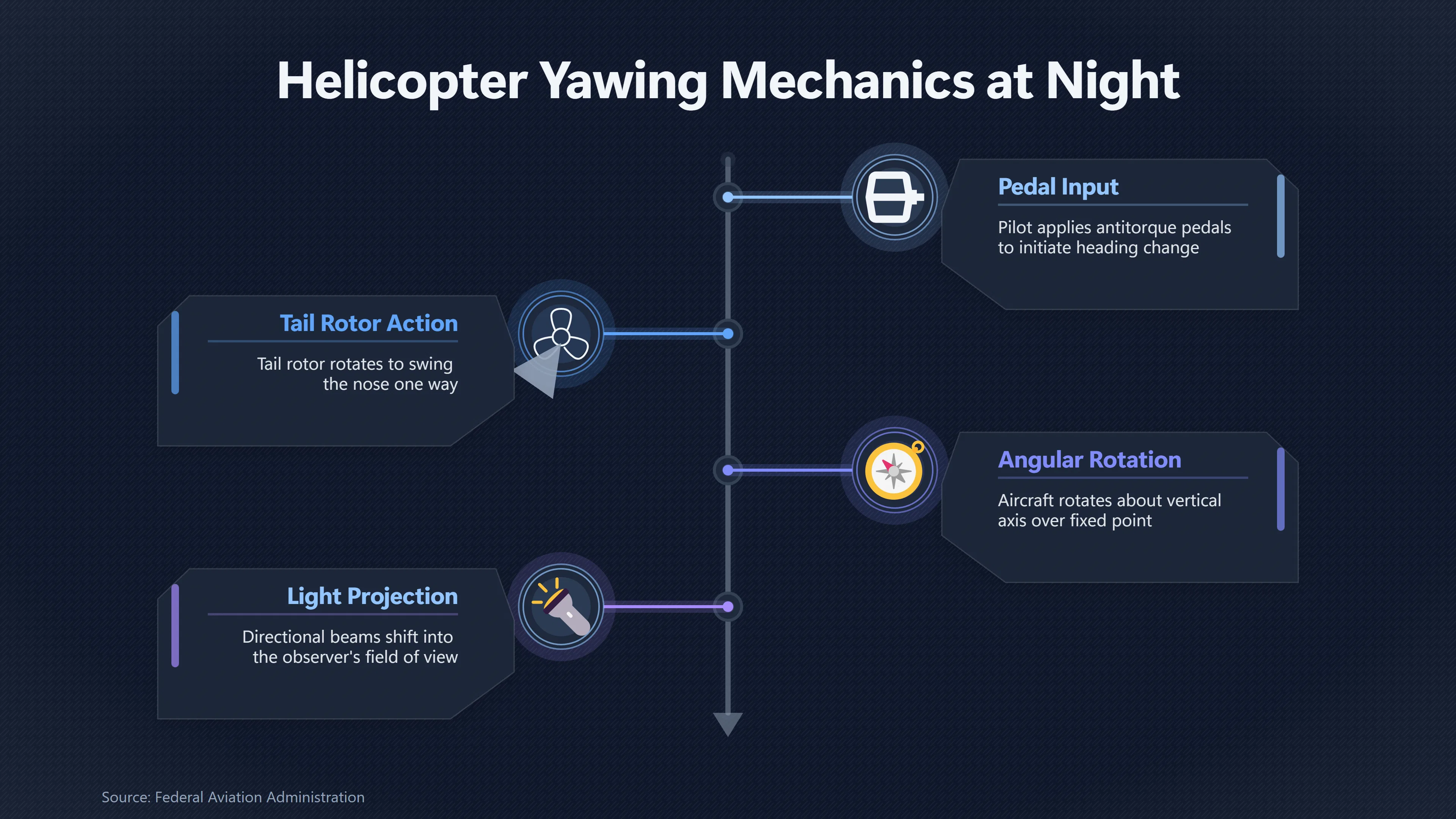
Yaw is especially significant because helicopters do not need substantial forward movement to change heading. The FAA describes the tail rotor as controlling heading during hovering and hovering turns, which are commonly called pedal turns. Applying pedal can yaw the nose one way while the tail swings the other. FAA instructor guidance describes a hovering turn as using the antitorque pedals while keeping the helicopter over a designated spot at a constant altitude.[Federal Aviation Administration]faa.govThat matters when assessing UFO or UAP reports describing a stationary object whose lights seem to rearrange themselves. Unlike an aeropl…
Consider a simplified night sighting in which the helicopter begins broadly side-on to an observer. One coloured forward position light may be particularly conspicuous, while the rear white light is displaced some distance from it. The two visible points can suggest a horizontal object with lights at its ends.
As the helicopter slowly yaws, several things can happen together:
- The apparent separation changes. Lights mounted at different positions on the airframe are being projected onto the observer’s two-dimensional field of view. As the aircraft rotates, their angular separation can shrink or grow even though their physical separation is constant.
- Colours enter and leave useful viewing angles. Because the red, green and white position lights have prescribed directional fields rather than identical all-round emission, yaw changes which beams are directed towards the observer.[Legal Information Institute]law.cornell.eduThese lights are not simply three coloured bulbs intended to shine equally in every direction. Their fields of visibility are specified i…
- The order of visible points can change. A pattern dominated by a coloured side light and white tail light can give way to a different combination as the nose swings round.
- Several lights can nearly align. From some angles, lights separated along the helicopter’s length or width project close together in the observer’s line of sight. At sufficient range they may no longer be resolved as separate points, producing what looks like one brighter light.
- The apparent object can expand again. Continued yaw separates the projected positions, making a single-looking source become a pair or cluster once more.
This creates an unusual observational combination: large changes in apparent configuration with little change in sky position. That is much easier for a hovering helicopter to produce than for a conventional fixed-wing aircraft because changing helicopter heading does not require a wide turn through the sky.
The mechanism also explains why a witness may report that an object “turned” even though no solid outline was visible. The changing colour and geometry of navigation lights genuinely contain information about heading. The interpretation becomes unreliable only when those lights are mistaken for the physical edges or corners of the object carrying them.
Why the lights can look like a changing shape
The crucial distinction is between the geometry of the aircraft and the geometry of the visible lights. At night, observers may have access only to the second.
Suppose three visible points seem to form a triangle. It is tempting to infer a triangular craft whose corners coincide with those lights. But helicopter lighting standards do not make that inference safe: the lights occupy different locations on a three-dimensional airframe and have different directional coverage. Rotation can change their projected arrangement without moving the fixtures themselves.[Legal Information Institute]law.cornell.eduAircraft position lights are deliberately directional. Under US certification rules for normal-category rotorcraft, the forward position…
Perspective can therefore generate a sequence that sounds much stranger in words than it is mechanically. A helicopter could appear first as two separated lights, then as a tighter cluster, then primarily as one bright source, and later as a differently oriented pair. Nothing has detached, moved along the fuselage or changed the helicopter’s physical dimensions. The aircraft has simply presented different aspects to the observer.
This is also why colour changes deserve careful treatment in UAP reports. A sequence such as red → white → green, or red accompanied by white followed later by green accompanied by white, need not mean that one luminous object literally changed colour. It may mean that different fixed lights became dominant as the helicopter’s heading changed. Standard rotorcraft lighting provides exactly the red-left, green-right and white-aft geometry required for that possibility.[EASA]easa.europa.euThis is also why colour changes deserve careful treatment in UAP reports. A sequence such as red → white → green, or red accompanied by w…
There are limits to this explanation. Navigation lights cannot account for every reported shape change, and exact visibility depends on aircraft type, installation, viewing elevation, range and additional lighting. A useful identification therefore asks whether the sequence of changes is compatible with a rotating conventional lighting arrangement rather than treating any red, green or white light as proof of a helicopter.
Why strobes make the pattern look fragmented
Position lights are only part of the night-time display. Aircraft may also carry anti-collision lighting. FAA operational guidance says an anti-collision system can employ one or more rotating beacons and/or strobes, coloured red or white, and notes that many aircraft carry both beacon and strobe systems. US rotorcraft certification standards require an anti-collision system for certification for night operation and specify coverage around the aircraft.[FAR/AIM]faraim.orgPosition lights are only part of the night-time display. Aircraft may also carry anti-collision lighting. FAA operational guidance says a…
These flashes can dominate what a distant observer notices. Research conducted for the FAA on aircraft conspicuity reports that white strobe lighting can be highly effective at attracting attention at night, while brightness strongly affects conspicuity. FAA research has also investigated how observers distinguish closely spaced flashes under night conditions, illustrating that aviation strobes are inherently a time-dependent visual stimulus rather than a steady outline.[Federal Aviation Administration]faa.govThese flashes can dominate what a distant observer notices. Research conducted for the FAA on aircraft conspicuity reports that white str…
Now combine flashing with a hovering turn. Between one conspicuous flash and the next, the helicopter can yaw slightly. A witness may consequently perceive something like:
bright white flash → darkness or faint coloured light → white flash in a shifted position → red point → another flash → green point
The actual motion can be smooth. The visible record is discontinuous.
This effect is particularly relevant to phone video. A bright anti-collision flash may register far more strongly than the dimmer airframe or steady lights, leaving a sequence of isolated luminous events from which viewers try to infer a solid shape. The resulting apparent “jump” of a bright point does not by itself establish that a physical light moved across the aircraft; the next flash may simply reveal a different viewing geometry after further yaw.
Strobes can also temporarily overpower nearby weaker lights to the eye or camera. A pattern that looks like several coloured points can therefore periodically collapse into one brilliant white source and then re-emerge after the flash. In a dark sky, where there is no visible fuselage joining those points, the result can resemble an object repeatedly changing configuration.
The strongest clue is the sequence, not one frame
A single still image is poorly suited to testing this explanation because the mechanism is fundamentally about orientation changing over time. The most useful evidence is a continuous sequence showing how colour, spacing and brightness evolve.
A helicopter interpretation becomes more persuasive when several features occur together: the apparent centre remains roughly fixed; the light pattern changes progressively rather than through physically impossible translations; red, green and white recur in combinations compatible with different aircraft aspects; and conspicuous flashes repeat while the underlying configuration slowly rotates. FAA guidance confirms both that helicopters can control heading while hovering and that aircraft position-light combinations convey orientation.[Federal Aviation Administration]faa.govThat matters when assessing UFO or UAP reports describing a stationary object whose lights seem to rearrange themselves. Unlike an aeropl…
Conversely, claims that the craft itself changed shape require more evidence than the lights merely adopting a different pattern. The visible points are not necessarily vertices on a solid object. Their separation on the retina or camera sensor is a projection of fixtures positioned around an aircraft whose heading may be changing.
There is an additional caution for naked-eye observations. The FAA describes autokinesis, in which a static light stared at against a dark background can appear to move. That is a separate perceptual effect rather than the cause of the navigation-light changes, but it can complicate an already ambiguous observation by adding apparent motion to individual points.[Federal Aviation Administration]faa.govThere is an additional caution for naked-eye observations. The FAA describes autokinesis, in which a static light stared at against a dar…
For UFO/UAP assessment, the most diagnostic question is therefore not simply “Did its lights change?” but “Did the pattern change in the way fixed aircraft lights would change as the object rotated?” A hovering helicopter offers an unusually strong conventional mechanism for exactly that combination: little translational movement, substantial heading change, directional red-green-white lighting and intermittent anti-collision flashes. Together they can turn one ordinary airframe into several very different-looking arrangements of light over the course of a single observation.
Amazon book picks
Further Reading
Books and field guides related to Why Hovering Helicopter Lights Seem to Change Shape. Use these as the next step if you want deeper reading beyond the article.
UFOs Explained
Analyzing several UFO cases, the author exposes the myth of extraterrestrial visitors to earth.
The UFO Handbook: A Guide to Investigating, Evaluating, and R...
An explanation of the usual reasons for confusing IFOs (identified flying objects) with UFOs and a survey of the tools used to investigat...
The Report on Unidentified Flying Objects
Edward J. Ruppelt's "The Report on Unidentified Flying Objects" serves as a pivotal text in the study of UFO phenomena, blending personal...
Principles of Helicopter Aerodynamics
An internationally recognized expert explains the aerodynamic principles of helicopters and other rotating-wing vertical lift aircraft. B...
eBay marketplace picks
Marketplace Samples
Live-tested eBay searches with available results related to this page.
Selected fromhelicopter model oneBay.co.uk.
Endnotes
1.
Source: faa.gov
Title: Federal Aviation Administration
Link:https://www.faa.gov/sites/faa.gov/files/regulations_policies/handbooks_manuals/aviation/FAA-H-8083-4.pdf
Source snippet
A hovering helicopter can appear to change shape at night without changing shape at all. The key is yaw: a helicopter can rotate about it...
2.
Source: faa.gov
Title: Federal Aviation Administration
Link:https://www.faa.gov/sites/faa.gov/files/helicopter_flying_handbook.pdf
Source snippet
That matters when assessing UFO or UAP reports describing a stationary object whose lights seem to rearrange themselves. Unlike an aeropl...
3.
Source: law.cornell.edu
Title: Legal Information Institute
Link:https://www.law.cornell.edu/cfr/text/14/27.1385
Source snippet
Aircraft position lights are deliberately directional. Under US certification rules for normal-category rotorcraft, the forward position...
4.
Source: law.cornell.edu
Title: Legal Information Institute
Link:https://www.law.cornell.edu/cfr/text/14/27.1387
Source snippet
These lights are not simply three coloured bulbs intended to shine equally in every direction. Their fields of visibility are specified i...
5.
Source: faa.gov
Title: Federal Aviation Administration
Link:https://www.faa.gov/sites/faa.gov/files/regulations_policies/handbooks_manuals/aviation/faa-h-8083-21.pdf
Source snippet
That geometry is important because position lights are intended to communicate orientation, not to outline the aircraft like decorative l...
6.
Source: easa.europa.eu
Link:https://www.easa.europa.eu/da/document-library/easy-access-rules/online-publications/easy-access-rules-small-rotorcraft-cs-27-0?page=40
Source snippet
This is also why colour changes deserve careful treatment in UAP reports. A sequence such as red → white → green, or red accompanied by w...
7.
Source: faraim.org
Link:https://www.faraim.org/faa/aim/chapter-4/section-4-3-24.html
Source snippet
Position lights are only part of the night-time display. Aircraft may also carry anti-collision lighting. FAA operational guidance says a...
8.
Source: faa.gov
Title: Federal Aviation Administration
Link:https://www.faa.gov/data_research/research/med_humanfacs/oamtechreports/media/Investigation%20of%20Lighting%20Schemes%20to%20Improve%20sUAS%20Conspicuity%20.pdf
Source snippet
These flashes can dominate what a distant observer notices. Research conducted for the FAA on aircraft conspicuity reports that white str...
9.
Source: faa.gov
Title: Federal Aviation Administration
Link:https://www.faa.gov/Air_traffic/publications/atpubs/aim_html/chap8_section_1.html
Source snippet
There is an additional caution for naked-eye observations. The FAA describes autokinesis, in which a static light stared at against a dar...
Additional References
10.
Source: youtube.com
Title: Illusions In Flight Spatial Disorientation
Link:http://www.youtube.com/watch?v=fIZpxEOsTg0
Source snippet
Helicopter position lights rotation yaw night R44 full down autorotation #helicopter #aviation #pilot #flying...
11.
Source: youtube.com
Title: Helicopter Flight Controls: Anti-Torque Pedals
Link:http://www.youtube.com/watch?v=ohU6LssRgLY
Source snippet
Illusions In Flight Spatial Disorientation...
12.
Source: youtube.com
Title: Visual Illusions Every Pilot Should Know
Link:http://www.youtube.com/watch?v=4gG9RlbPb5Q
Source snippet
Helicopter Flight Controls: Anti-Torque Pedals...
13.
Source: youtube.com
Title: Aircraft Lights: Red and Green Airplane Light Meaning
Link:http://www.youtube.com/watch?v=3yfEYmyH-Ro
Source snippet
Aircraft Navigation Lights Explained...