Within Starlink
Why Starlink Satellites Brighten and Dim After Launch
Starlink brightness can change sharply during orbit raising as spacecraft altitude, orientation and reflective geometry evolve.
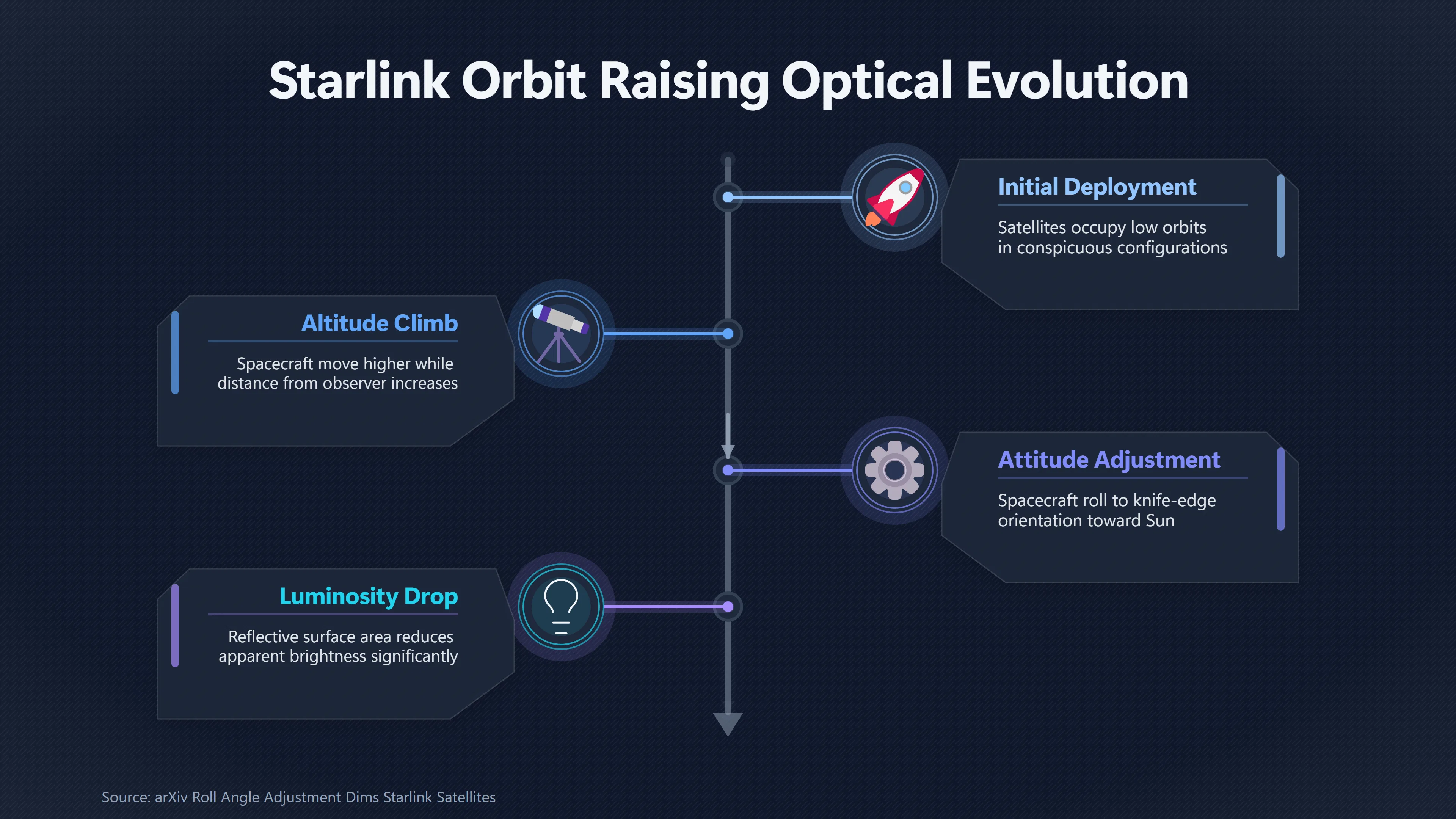
On this page
- How spacecraft orientation affects reflected sunlight
- What brightness measurements found during orbit raising
- Why distance alone cannot explain changing visibility
Page outline Jump by section
Introduction
Starlink satellites do not have one fixed brightness after launch. During orbit raising, the same basic spacecraft can change from an obvious naked-eye object to something difficult or impossible to see because its altitude, attitude and illumination geometry are all changing. The most important variable is often not simply how far away the satellite is, but how its broad reflective surfaces are oriented towards the Sun and the observer.
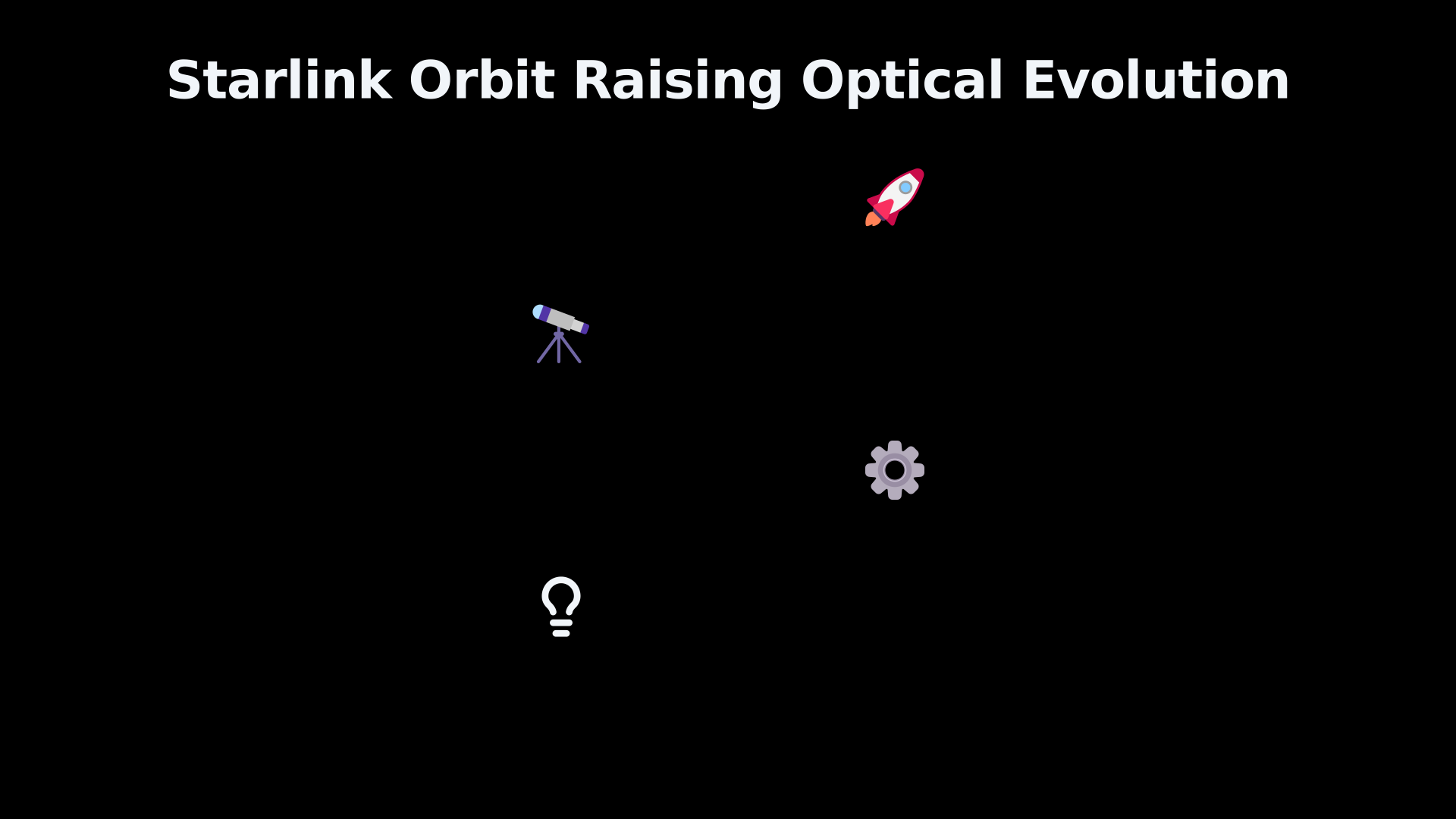
Measurements make that effect unusually clear. First-generation Starlinks became about 90% fainter at a standardised distance after SpaceX introduced an orbit-raising roll adjustment. Later observations of Starlink V2 Mini spacecraft found another striking division: satellites below about 357 kilometres were much brighter than those above it, even after researchers corrected for distance.[arXiv]arxiv.orgarXiv Roll Angle Adjustment Dims Starlink SatellitesRoll Angle Adjustment Dims Starlink SatellitesMarch 2, 2023…
That changing appearance matters when interpreting unusual lights. A recently launched Starlink train may therefore look conspicuous on one pass and dramatically fainter later in its climb without anything anomalous having happened.
How orientation controls reflected sunlight
Starlink satellites are visible principally because they reflect sunlight. That makes apparent brightness a geometric problem: sunlight must strike a reflective part of the spacecraft and enough of the reflected light must then travel towards the observer. Early modelling of Starlink’s flat-panel geometry showed that brightness depends on the angles between the Sun, spacecraft and observer as well as on range. Under some geometries, the side visible from Earth receives little useful illumination and the satellite can become extremely faint.[arXiv]arxiv.orgA Flat-Panel Brightness Model for the Starlink Satellites and Measurement of their Absolute Visual MagnitudeMarch 17, 2020…
This is especially important during orbit raising because spacecraft attitude is an operational variable. SpaceX and astronomers developed what became known as a knife-edge configuration for first-generation satellites. Instead of presenting a large illuminated surface in a direction that could strongly reflect towards Earth, the spacecraft was rolled so that the Sun lay approximately in the plane of its flat surfaces. The aim was to minimise the projected area available to reflect sunlight towards observers. A NOIRLab technical account describes the orbit-raising mitigation as rolling the spacecraft edge-on to the Sun to reduce the illuminated projected area.[NOIRLab]noirlab.eduAppendices to “Impact of SatelliteAppendices to “Impact of SatelliteOctober 18, 2025…
That distinction also explains why brightness mitigation developed for one phase of a Starlink mission cannot automatically be assumed to work identically during another. A sunshade, reflective treatment or attitude useful at operational altitude does not necessarily address the geometry encountered while a spacecraft is climbing. A review of Starlink mitigation techniques notes that the VisorSat sunshade reduced brightness at operational altitude, whereas the knife-edge attitude was the important measure applied to VisorSat and later first-generation spacecraft during orbit raising.[arXiv]arxiv.orgarXiv Assessment of Brightness Mitigation Practices for Starlink SatellitesAssessment of Brightness Mitigation Practices for Starlink SatellitesSeptember 25, 2023…
For a witness, the consequence is simple but potentially confusing: satellite brightness is not a reliable proxy for satellite size or even altitude alone. A large, nearby Starlink can become relatively inconspicuous when its reflective geometry is unfavourable, while another configuration can make a satellite in essentially the same deployment sequence much more obvious.
The 2020 change showed how powerful attitude could be
The transition in first-generation Starlink operations provides a useful before-and-after experiment. Mallama and Respler examined brightness measurements from the parking and orbit-raising phases before and after SpaceX changed the satellites’ roll orientation in 2020. Before the adjustment, their sample had a mean apparent magnitude of 3.90; afterwards, the mean was 5.69. On the astronomical magnitude scale, larger numbers mean fainter objects.[arXiv]arxiv.orgarXiv Roll Angle Adjustment Dims Starlink SatellitesRoll Angle Adjustment Dims Starlink SatellitesMarch 2, 2023…
Raw apparent magnitude does not provide a completely fair comparison because the satellites were observed at different ranges. The researchers therefore normalised the observations to a common distance of 1,000 kilometres. The corresponding means were magnitude 4.86 before the orientation change and 7.31 afterwards. From that difference, they calculated that the roll-adjusted spacecraft were about 90% fainter than the earlier orbit-raising satellites at equivalent distance.[arXiv]arxiv.orgarXiv Roll Angle Adjustment Dims Starlink SatellitesRoll Angle Adjustment Dims Starlink SatellitesMarch 2, 2023…
That result is particularly revealing because the adjusted satellites were actually observed at a smaller mean range in the underlying dataset — about 301 kilometres compared with 417 kilometres for the unadjusted group. Proximity was therefore working in the opposite direction, tending to make the mitigated spacecraft look brighter. Once range was corrected, the effectiveness of changing attitude became clearer.[ResearchGate]researchgate.netResearch Gate(PDF) Roll Angle Adjustment Dims Starlink SatellitesResearch Gate(PDF) Roll Angle Adjustment Dims Starlink Satellites
The brightness change also depended on viewing geometry. The study’s fitted phase functions indicated that knife-edge orientation was particularly effective at intermediate phase angles, which commonly occur when satellites appear higher in the sky. At more extreme phase angles, when a spacecraft is seen lower towards or away from the Sun, the brightness behaviour of mitigated and unmitigated satellites could converge.[ResearchGate]researchgate.netResearch Gate(PDF) Roll Angle Adjustment Dims Starlink SatellitesResearch Gate(PDF) Roll Angle Adjustment Dims Starlink Satellites
So there was never a simple rule that an orbit-raising Starlink had become uniformly faint. The mitigation changed the probability and geometry of strong reflections rather than making the spacecraft optically disappear under every observing condition.
V2 Mini satellites revealed an abrupt brightness shift
The larger Starlink V2 Mini generation provided an even clearer example of brightness changing during the climb. Initial observations found that Minis in their early mission phases were conspicuous despite later becoming much fainter. An early photometric study measured a mean apparent magnitude of 3.07 for spacecraft in early mission phases, compared with 7.06 for Minis observed in brightness-mitigation mode. After correcting both groups to 1,000 kilometres, their means were magnitude 5.08 and 7.87 respectively — a factor-of-12 difference in luminosity.[arXiv]arxiv.orgarXiv Starlink Generation 2 Mini Satellites: Photometric CharacterizationStarlink Generation 2 Mini Satellites: Photometric CharacterizationJune 11, 2023…
More detailed observations of Minis specifically during orbit raising subsequently revealed something more interesting than gradual fading with altitude. Their magnitude distribution was strongly bimodal: there was a bright population and a much fainter population rather than one smooth sequence becoming steadily dimmer as the spacecraft climbed.[ResearchGate]researchgate.netOpen source on researchgate.net.
Researchers traced that split to a height of approximately 357 kilometres. Below the threshold, the satellites had a mean apparent magnitude of 2.68. Above it, the mean was 6.46. That is a very large visual difference: under suitable conditions the lower-altitude population could be plainly conspicuous, while the higher group was around the normal naked-eye visibility boundary or fainter.[arXiv]arxiv.orgarXiv The Brightness of Starlink Mini Satellites During Orbit-RaisingarXiv The Brightness of Starlink Mini Satellites During Orbit-Raising
The researchers interpreted the transition as evidence that SpaceX was applying an additional brightness-mitigation configuration once Minis reached roughly that altitude. They cautioned that height was probably acting as a marker for a change in spacecraft configuration rather than producing the dimming by itself. Below the threshold, higher atmospheric drag may impose different attitude requirements, creating an operational reason for the spacecraft to be configured differently.[ResearchGate]researchgate.netOpen source on researchgate.net.
This makes orbit raising a sequence of optical states, not merely a journey from a low orbit to a high one.

Why distance alone cannot explain the fading
It is tempting to explain the change by saying that Starlinks simply get fainter because they move farther from Earth. Distance certainly matters: reflected light decreases as the observer’s range from the satellite increases. But the measurements allow that effect to be separated from changes in the spacecraft itself.
For V2 Minis, researchers converted observations above and below the 357-kilometre threshold to the same hypothetical distance of 1,000 kilometres. The low-altitude group then averaged magnitude 4.58, while the higher group averaged 7.52. Because the distance variable had been normalised, the remaining difference of 2.94 magnitudes could not be explained simply by the spacecraft moving farther away. The authors calculated that the change represented roughly 93% dimming.[arXiv]arxiv.orgarXiv The Brightness of Starlink Mini Satellites During Orbit-RaisingarXiv The Brightness of Starlink Mini Satellites During Orbit-Raising
The comparison is useful because it separates two processes that occur simultaneously during orbit raising:
- Range changes: as the orbit rises, the spacecraft is generally farther from an observer, which tends to make it fainter.
- Attitude and configuration change: different orientations alter how much illuminated surface can reflect towards Earth, potentially producing a much larger brightness shift.
- Illumination geometry changes: the Sun-satellite-observer angle changes continuously during a pass and from one orbit to another, altering the amount and direction of reflected light.
- Earth’s shadow matters: a satellite produces no ordinary sunlight reflection while eclipsed by Earth, and lower-orbit spacecraft spend different fractions of their trajectories illuminated compared with higher satellites.[arXiv]arxiv.orgA Flat-Panel Brightness Model for the Starlink Satellites and Measurement of their Absolute Visual MagnitudeMarch 17, 2020…
This is why two Starlinks at comparable distances need not have comparable apparent magnitudes. Later work on Direct-to-Cell Starlink Minis reinforces the point: researchers found those spacecraft substantially brighter than other Minis at a common standardised distance, but could not cleanly separate the contributions of antenna design, different attitude modes and the state of brightness mitigation.[arXiv]arxiv.orgarXiv Brightness Characterization for Starlink Direct-to-Cell SatellitesarXiv Brightness Characterization for Starlink Direct-to-Cell Satellites
Altitude therefore helps establish where a satellite is in its deployment sequence, but it does not by itself predict what an observer will see.
Brightness can change within the same deployment
The practical result is that a Starlink train has an optical evolution as well as an orbital one. Immediately after deployment, many satellites can occupy similar low orbits and present configurations that make them conspicuous. As orbit raising proceeds, their attitudes and solar-array configurations can change, their distances increase, their spacing grows and their illumination conditions diverge.
Consequently, descriptions such as “Starlink satellites are bright” or “Starlink satellites are too faint to see” are both overly broad. The relevant question is which Starlink design, at which mission stage, in which attitude, viewed under which Sun-satellite-observer geometry?
The historical comparison demonstrates how large those differences can be. First-generation orbit-raising spacecraft were reduced to roughly one-tenth their former distance-adjusted luminosity after the knife-edge roll strategy was introduced. V2 Minis later displayed a roughly 93% distance-adjusted brightness reduction across their inferred orbit-raising mitigation threshold.[arXiv]arxiv.orgarXiv Roll Angle Adjustment Dims Starlink SatellitesRoll Angle Adjustment Dims Starlink SatellitesMarch 2, 2023…
Even those averages hide considerable variation. Starlink phase functions show that reflective geometry can produce much brighter or fainter observations than a mean value would suggest, and measurements of V2 Minis have documented brightness surges or flares as well as the underlying brightness distributions.[arXiv]arxiv.orgarXiv Starlink Mini Satellite Brightness Distributions Across the SkyarXiv Starlink Mini Satellite Brightness Distributions Across the Sky
For visual identification, this means the appearance of a train can evolve much faster than someone unfamiliar with satellite operations might expect.
Why the brightness shift matters for UFO and UAP reports
The orbit-raising effect is particularly relevant to identified-object analysis because it undermines an intuitive objection sometimes made to satellite explanations: “I have seen Starlink before, and it did not look like this.”
That observation can be perfectly sincere without ruling Starlink out. Someone may previously have seen older satellites, spacecraft at operational altitude, a mitigated orbit-raising train or simply a pass with different illumination geometry. A newly deployed group in a brighter configuration can look dramatically different. Conversely, a train obvious soon after launch may become difficult to see as its members climb and change attitude.
The brightest part of this sequence is disproportionately likely to attract attention. The 2024 orbit-raising study noted that unmitigated low-altitude Mini spacecraft travelling close together could occasionally flare to magnitude 0 or brighter. The authors also connected the conspicuous early-mission population with public sightings and noted that airline pilots had reported bright Starlink observations as unidentified aerial phenomena.[ResearchGate]researchgate.netOpen source on researchgate.net.
This does not mean every unusual sequence of lights is Starlink. It means brightness should be treated as a dynamic identification clue, not a fixed property. When assessing a suspected Starlink sighting, an investigator needs more than the constellation name or nominal orbital altitude. The launch date, spacecraft generation, orbital height at the time, deployment stage, predicted track and solar geometry can all help establish whether the satellites should have been conspicuous.
The central lesson from the measurements is unusually strong: during orbit raising, Starlink satellites can dim by around an order of magnitude in luminosity because their reflective configuration changes. Distance contributes to the changing appearance, but controlled distance comparisons show that it cannot account for the largest shifts. What looks from the ground like an inexplicable transformation in a procession of lights can therefore be an expected consequence of spacecraft changing orientation as they climb towards their working orbits.[arXiv]arxiv.orgarXiv Roll Angle Adjustment Dims Starlink SatellitesRoll Angle Adjustment Dims Starlink SatellitesMarch 2, 2023…
Amazon book picks
Further Reading
Books and field guides related to Why Starlink Satellites Brighten and Dim After Launch. Use these as the next step if you want deeper reading beyond the article.
Celestial Objects for Modern Telescopes
Based on field notes made by the author during his own career as an amateur astronomer, this unique guide covers both the traditional and...
NightWatch: A Practical Guide to Viewing the Universe
A practical guide to viewing the universe.
Satellite Orbits: Models, Methods and Applications
Satellite Orbits -Models, Methods, and Applications has been written as a compre hensive textbook that guides the reader through the theo...
The Backyard Astronomer's Guide
Discusses the practical aspects of stargazing, including how to choose appropriate equipment, contending with light pollution, taking suc...
eBay marketplace picks
Marketplace Samples
Live-tested eBay searches with available results related to this page.
Selected fromStarlink satellite model oneBay.co.uk.
Endnotes
1.
Source: arxiv.org
Title: arXiv Roll Angle Adjustment Dims Starlink Satellites
Link:https://arxiv.org/abs/2303.01431
Source snippet
Roll Angle Adjustment Dims Starlink SatellitesMarch 2, 2023...
Published: March 2, 2023
2.
Source: arxiv.org
Title: arXiv The Brightness of Starlink Mini Satellites During Orbit-Raising
Link:https://arxiv.org/abs/2405.12007
3.
Source: arxiv.org
Link:https://arxiv.org/abs/2003.07805
Source snippet
A Flat-Panel Brightness Model for the Starlink Satellites and Measurement of their Absolute Visual MagnitudeMarch 17, 2020...
Published: March 17, 2020
4.
Source: noirlab.edu
Title: Appendices to “Impact of Satellite
Link:https://noirlab.edu/public/media/archives/techdocs/pdf/techdoc004.pdf
Source snippet
Appendices to “Impact of SatelliteOctober 18, 2025...
Published: October 18, 2025
5.
Source: arxiv.org
Title: arXiv Assessment of Brightness Mitigation Practices for Starlink Satellites
Link:https://arxiv.org/abs/2309.14152
Source snippet
Assessment of Brightness Mitigation Practices for Starlink SatellitesSeptember 25, 2023...
Published: September 25, 2023
6.
Source: researchgate.net
Title: Research Gate(PDF) Roll Angle Adjustment Dims Starlink Satellites
Link:https://www.researchgate.net/publication/368935763_Roll_Angle_Adjustment_Dims_Starlink_Satellites
7.
Source: arxiv.org
Title: arXiv Starlink Generation 2 Mini Satellites: Photometric Characterization
Link:https://arxiv.org/abs/2306.06657
Source snippet
Starlink Generation 2 Mini Satellites: Photometric CharacterizationJune 11, 2023...
Published: June 11, 2023
8.
Source: researchgate.net
Link:https://www.researchgate.net/publication/371506553_Starlink_Generation_2_Mini_Satellites_Photometric_Characterization?_tp=eyJjb250ZXh0Ijp7InBhZ2UiOiJzY2llbnRpZmljQ29udHJpYnV0aW9ucyIsInByZXZpb3VzUGFnZSI6bnVsbCwic3ViUGFnZSI6bnVsbH19
9.
Source: researchgate.net
Link:https://www.researchgate.net/figure/Apparent-magnitudes-reveal-a-bimodal-distribution-for-orbit-raising-spacecraft_fig1_380731215
10.
Source: researchgate.net
Link:https://www.researchgate.net/publication/380731215_The_Brightness_of_Starlink_Mini_Satellites_During_Orbit-Raising
11.
Source: researchgate.net
Link:https://www.researchgate.net/figure/Mini-satellites-above-357-km-are-generally-fainter-than-those-below-This-plot-contains_fig3_380731215
12.
Source: arxiv.org
Title: arXiv Brightness Characterization for Starlink Direct-to-Cell Satellites
Link:https://arxiv.org/abs/2407.03092
13.
Source: arxiv.org
Title: arXiv Starlink Mini Satellite Brightness Distributions Across the Sky
Link:https://arxiv.org/abs/2401.01546
14.
Source: spacex.com
Title: Space X
Link:https://www.spacex.com/[launches
15.
Source: spacex.com
Title: Space X
Link:https://www.spacex.com/launches/sl
16.
Source: spacex.com
Title: Space X
Link:https://www.spacex.com/launches/sl
17.
Source: spacex.com
Title: Space X
Link:https://www.spacex.com/launches/sl
18.
Source: spacex.com
Title: Space X
Link:https://www.spacex.com/launches/sl
19.
Source: spacex.com
Title: Space X
Link:https://www.spacex.com/launches/sl
20.
Source: spacex.com
Title: Space X
Link:https://www.spacex.com/launches/sl
21.
Source: spacex.com
Title: Space X
Link:https://www.spacex.com/launches/sl
22.
Source: spacex.com
Title: Space X
Link:https://www.spacex.com/launches/sl
23.
Source: spacex.com
Title: Space X
Link:https://www.spacex.com/launches/sl
24.
Source: spacex.com
Title: Space X
Link:https://www.spacex.com/launches/sl
25.
Source: noirlab.edu
Link:https://noirlab.edu/public/videos/noirlab2418c/?lang=en
26.
Source: spacex.com
Title: Space X
Link:https://www.spacex.com/launches/sl
27.
Source: researchgate.net
Title: (PDF) Brightness Characterization for Starlink Direct-to-Cell Satellites
Link:https://www.researchgate.net/publication/381960407_Brightness_Characterization_for_Starlink_Direct-to-Cell_Satellites
28.
Source: researchgate.net
Title: (PDF) The Brightness of Starlink Mini Satellites During Orbit-Raising
Link:https://www.researchgate.net/publication/380731215_The_Brightness_of_Starlink_Mini_Satellites_During_Orbit-Raising?_tp=eyJjb250ZXh0Ijp7InBhZ2UiOiJzY2llbnRpZmljQ29udHJpYnV0aW9ucyIsInByZXZpb3VzUGFnZSI6bnVsbCwic3ViUGFnZSI6bnVsbH19
29.
Source: researchgate.net
Title: (PDF) Assessment of Brightness Mitigation Practices for Starlink Satellites
Link:https://www.researchgate.net/publication/386360036_Assessment_of_Brightness_Mitigation_Practices_for_Starlink_Satellites
30.
Source: researchgate.net
Title: (PDF) Assessment of Brightness Mitigation Practices for Starlink Satellites
Link:https://www.researchgate.net/publication/386360036_Assessment_of_Brightness_Mitigation_Practices_for_Starlink_Satellites?_tp=eyJjb250ZXh0Ijp7InBhZ2UiOiJzY2llbnRpZmljQ29udHJpYnV0aW9ucyIsInByZXZpb3VzUGFnZSI6bnVsbCwic3ViUGFnZSI6bnVsbH19
31.
Source: cps.iau.noirlab.edu
Title: the iau cps launches satcons 101
Link:https://cps.iau.noirlab.edu/news/the-iau-cps-launches-satcons-101/
32.
Source: researchgate.net
Title: (PDF) Satellite Optical Brightness
Link:https://www.researchgate.net/publication/372361470_Satellite_Optical_Brightness
33.
Source: researchgate.net
Title: (PDF) Starlink Generation 2 Mini Satellites: Photometric Characterization
Link:https://www.researchgate.net/publication/371506553_Starlink_Generation_2_Mini_Satellites_Photometric_Characterization
34.
Source: researchgate.net
Link:https://www.researchgate.net/publication/369402793_Aggregate_effects_of_proliferating_low-Earth-orbit_objects_and_implications_for_astronomical_data_lost_in_the_noise
35.
Source: noirlab.edu
Link:https://noirlab.edu/public/announcements/ann23004/?lang=es
36.
Source: noirlab.edu
Title: Trails made by Starlink satellites | NOIRLab
Link:https://noirlab.edu/public/images/iau-ann19035a/?lang=es
37.
Source: noirlab.edu
Link:https://noirlab.edu/public/es/announcements/ann22016/
38.
Source: researchgate.net
Title: (PDF) A Sky Brightness Model for the Starlink ‘Visorsat’ Spacecraft
Link:https://www.researchgate.net/publication/353233959A_Sky_Brightness_Model_for_the_Starlink%27Visorsat%27_Spacecraft
39.
Source: researchgate.net
Title: (PDF) The Brightness of Visor Sat-Design Starlink Satellites
Link:https://www.researchgate.net/publication/348212500_The_Brightness_of_VisorSat-Design_Starlink_Satellites
40.
Source: noirlab.edu
Link:https://noirlab.edu/public/products/techdocs/techdoc003/
41.
Source: noirlab.edu
Title: Corrected absolute brightness against supernova redshift | NOIRLab
Link:https://noirlab.edu/public/images/geminiann11014b/?lang=en
42.
Source: researchgate.net
Link:https://www.researchgate.net/scientific-contributions/Anthony-Mallama-72546103/publications/2
43.
Source: researchgate.net
Link:https://www.researchgate.net/profile/Aaron-Worley-2
44.
Source: space-safety.starlink.com
Title: constellation altitudes
Link:https://space-safety.starlink.com/docs/space-safety-articles/constellation_altitudes/
45.
Source: noirlab.edu
Link:https://noirlab.edu/public/es/announcements/archive/program/rubin/page/10/?lang=en&nocache=true
46.
Source: datalab.noirlab.edu
Link:https://datalab.noirlab.edu/docs/manual/UsingTheNOAODataLab/DataAccessInterfaces/CatalogDataAccessTAPSCS/CatalogDataAccessTAPSCS.html
47.
Source: datalab.noirlab.edu
Link:https://datalab.noirlab.edu/docs/manual/UsingAstroDataLab/DataAccessInterfaces/CatalogDataAccessTAPSCS/CatalogDataAccessTAPSCS.html
48.
Source: noirlab.edu
Link:https://noirlab.edu/public/about/light-pollution/work-with-the-iau/?lang=es
49.
Source: noirlab.edu
Link:https://noirlab.edu/public/announcements/archive/program/kpno/page/2/
50.
Source: arxivlens.com
Link:https://arxivlens.com/paperview/details/satellite-constellations-exceed-the-limits-of-acceptable-brightness-established-by-the-iau-6100-4bdf384a
51.
Source: orbitalradar.com
Link:https://orbitalradar.com/satellite/62090
52.
Source: orbitalradar.com
Link:https://orbitalradar.com/satellite/64123
53.
Source: orbitalradar.com
Link:https://orbitalradar.com/satellite/62472
54.
Source: orbitalradar.com
Link:https://orbitalradar.com/satellite/64064
Additional References
55.
Source: youtube.com
Link:https://www.youtube.com/watch?v=nbgDbj42FbI
Source snippet
The Satellite Flaring Phenomenon Explained...
56.
Source: youtube.com
Title: How Space X is continuing to reduce brightness of UFO like satellites
Link:https://www.youtube.com/watch?v=vHW3clIokqk
Source snippet
What happened with STARLINK 9 Statellites Train? Missing Satellites...
57.
Source: nature.com
Title: Satellite megaconstellations will threaten space-based astronomy | Nature
Link:https://www.nature.com/articles/s41586-025-09759-5
58.
Source: youtube.com
Link:https://www.youtube.com/watch?v=dzwk33CQWeo
Source snippet
Spectacular Starlink 4-11 train over London (27.01.2022) + 2 days observation comparison...
59.
Source: satobs.org
Link:https://www.satobs.org/seesat/Mar-2020/0109.html
60.
Source: aas.org
Link:https://aas.org/form/aas-survey-on-satellite-constell
61.
Source: aaro.mil
Link:https://www.aaro.mil/FAQ/
62.
Source: aaro.mil
Link:https://www.aaro.mil/Next-AARO-Home-redesign/Inactive-Parent/AARO-Records-Tabs/
63.
Source: aaro.mil
Link:https://www.aaro.mil/Resources/Historical-Record-Reports/Volume-II/
64.
Source: aaro.mil
Link:https://www.aaro.mil/Next-AARO-Home-redesign/Next-Parent/Next-UAP-Case-RR-Data-Table/