Within Planets
How One Dramatic UFO Chase Matched Bright Planets
Investigators matched repeated sightings to Venus and Jupiter while checking pilot testimony, radar claims and the objects' reported return positions.
On this page
- What police and the pilot reported
- How Venus and Jupiter matched the observations
- Why the case required more than a brightness guess
Page outline Jump by section
Introduction
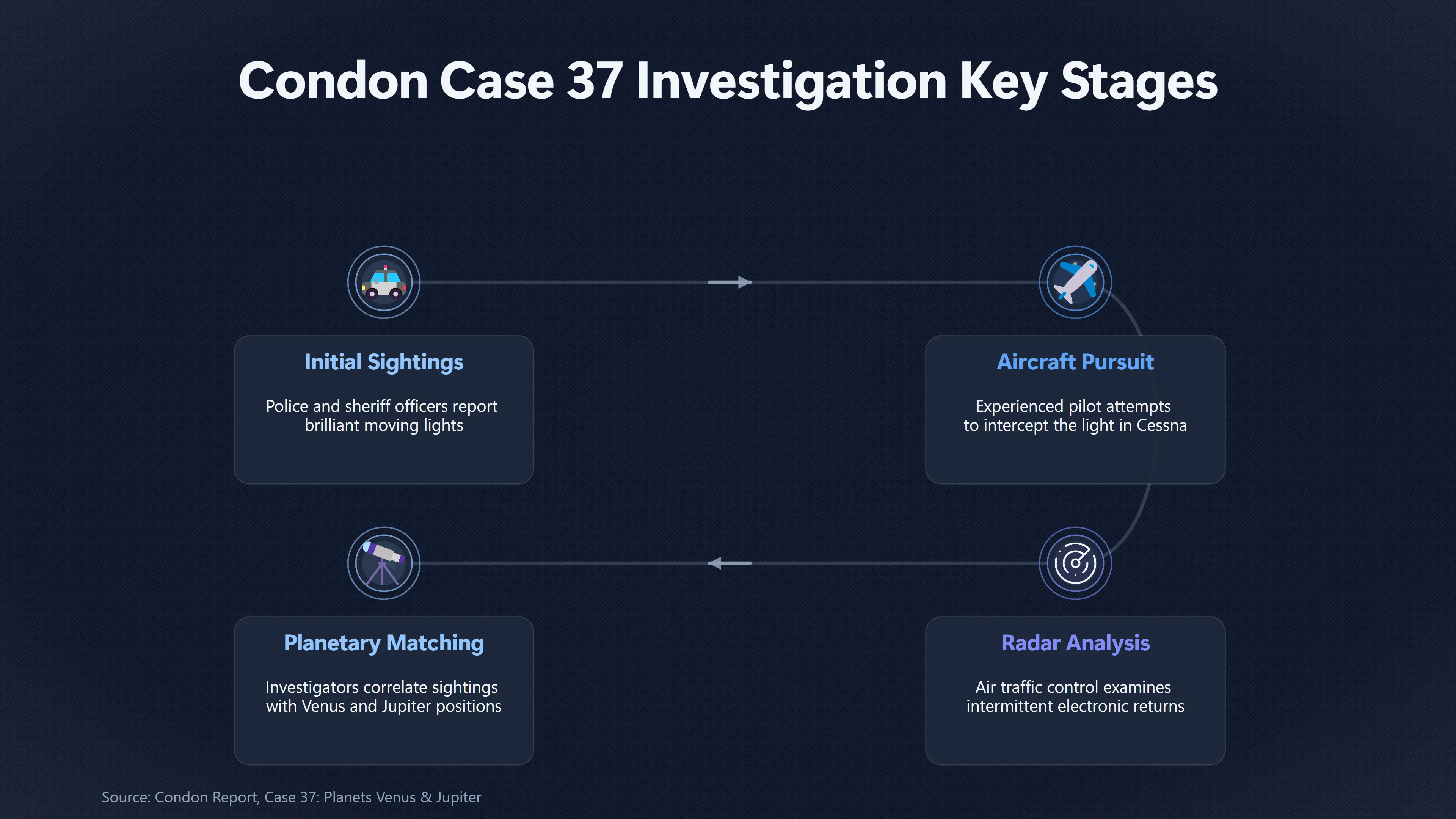
Condon Case 37 is unusually useful in the history of UFO investigation because the proposed planetary explanation was tested against a complicated body of witness claims rather than inferred from brightness alone. During several early mornings in autumn 1967, police officers in multiple communities reported brilliant objects that seemed to hover, change shape, flee from pursuing cars and even return to chase them. A pilot with thousands of flying hours took a Cessna up in pursuit, while an air-traffic-control radar report initially appeared to provide independent confirmation.[files.ncas.org]files.ncas.orgCondon Report, Case 37: Planets Venus & JupiterCondon Report, Case 37: Planets Venus & Jupiter
The University of Colorado’s Condon project ultimately concluded that the principal object was Venus, with Jupiter accounting for some of the two-object observations. The important part of Case 37 is how investigators reached that conclusion: the sightings recurred at astronomically meaningful times, the objects’ eventual positions matched the planets, the supposedly corroborating radar evidence weakened under examination, and witnesses themselves recognised Venus when shown it in the relevant part of the daylight sky.[files.ncas.org]files.ncas.orgCondon Report, Case 37: Planets Venus & JupiterCondon Report, Case 37: Planets Venus & Jupiter
What police and the pilot reported
The original information reaching the Colorado project sounded considerably harder to explain than a simple report of a bright stationary light. Case 37 involved police, sheriff’s officers and highway patrol officers across numerous communities, sometimes communicating by radio while observations were under way. The central series occurred during the early morning on several successive days.[files.ncas.org]files.ncas.orgCondon Report, Case 37: Planets Venus & JupiterCondon Report, Case 37: Planets Venus & Jupiter
One police lieutenant gave investigators a particularly detailed account. On the first morning, beginning at about 4:36 a.m., he and another officer noticed what initially seemed like an unfamiliar street light. As their car approached, however, they thought the light moved away. They pursued it for roughly eight miles. It was described as bright red, football-shaped and apparently about as large as the Moon.[files.ncas.org]files.ncas.orgCondon Report, Case 37: Planets Venus & JupiterCondon Report, Case 37: Planets Venus & Jupiter
The officers subsequently believed the object had returned behind their car. The lieutenant estimated it at only about 500 feet away and 500–600 feet high, although he explicitly characterised those figures as rough guesses. He reported enough illumination around the vehicle to see a wristwatch, followed by changes in colour from red through orange to white and an apparent transformation from a round light into something resembling a four-leaf clover. Yet the same account also contains a less dramatic observation that became important to the investigation: the object eventually climbed, appeared star-like and remained visible when the officer went off duty at 7 a.m.[files.ncas.org]files.ncas.orgCondon Report, Case 37: Planets Venus & JupiterCondon Report, Case 37: Planets Venus & Jupiter
On another morning, two objects were reported. The lieutenant described a lower object and another apparently thousands of feet above it. They seemed to remain at roughly the same separation, and both were still visible after sunrise. The lower one was perceived as flattened and bent, while the upper object appeared round and stationary. On the morning of the aircraft pursuit, witnesses again saw two lights, one emerging into view through trees below and to the left of the other.[files.ncas.org]files.ncas.orgCondon Report, Case 37: Planets Venus & JupiterCondon Report, Case 37: Planets Venus & Jupiter
These descriptions are important because they show why merely saying “Venus is bright” would not have been an adequate investigation. The testimony contained estimates of distance and altitude, apparent motion, shape changes, multiple objects, an aircraft pursuit and supposed radar support. A planetary hypothesis had to account for that larger pattern.

The aircraft chase sounded stronger than it was
The most dramatic element was the attempt to intercept the object from the air. The pilot flew patrols for the county forestry commission and had accumulated about 4,000 flying hours. He and a companion took off in a Cessna shortly after 5 a.m., communicating with people on the ground and with air-traffic control.[files.ncas.org]files.ncas.orgCondon Report, Case 37: Planets Venus & JupiterCondon Report, Case 37: Planets Venus & Jupiter
According to the early version of events, the pilot had actually watched the unidentified object rise from the river or swamp below before pursuing it. That would have been difficult to reconcile with Venus: a planet cannot rise from a nearby landscape and accelerate away from an aeroplane.
Investigators therefore questioned the pilot specifically about this point. They found that he had not personally observed the object rising from the river. He had repeated what people on the ground were reporting. Initially, he and his companion had been searching near the ground; one candidate light turned out to be an ordinary yard light. Ground observers then told them that they had passed the UFO and directed them to look above themselves. A light they had previously treated as a star then became the object they pursued.[files.ncas.org]files.ncas.orgCondon Report, Case 37: Planets Venus & JupiterCondon Report, Case 37: Planets Venus & Jupiter
Once the chase began, the pilot experienced exactly the sort of geometry that can make a very distant astronomical object seem evasive. Flying towards the light did not bring him appreciably closer. He thought it receded and became smaller as the aircraft climbed; when he abandoned the chase and returned, it seemed to move back towards its original position. Ground witnesses, meanwhile, thought the aircraft was flying beneath the object.[files.ncas.org]files.ncas.orgCondon Report, Case 37: Planets Venus & JupiterCondon Report, Case 37: Planets Venus & Jupiter
That discrepancy is revealing. If the light had been a nearby craft with an identifiable position in three-dimensional space, the ground and airborne observers should in principle have been able to establish some meaningful relationship between it and the Cessna. A planet, by contrast, is effectively at infinity for such a pursuit. Changing the aircraft’s position by a few miles produces no useful approach to the planet, even though the pilot’s own motion and changing foreground can create a compelling impression of pursuit or retreat.
The radar confirmation largely disappeared
Radar initially appeared to make Case 37 substantially stronger. During the aircraft chase, an air-traffic-control operator reported a steady target assumed to be the Cessna and, for roughly a minute, a second intermittent return. Because the pilot was heading towards the supposed UFO, that second return was naturally interpreted as possible confirmation of the object.[files.ncas.org]files.ncas.orgCondon Report, Case 37: Planets Venus & JupiterCondon Report, Case 37: Planets Venus & Jupiter
The follow-up produced a much weaker result. The radar operator later told investigators that he had never securely identified even the aircraft target, much less an independent UFO. He recalled one steady target that he presumed was the Cessna because it disappeared when the pilot reported descending or returning towards the airport. The supposed second object appeared on only two sweeps during roughly a minute on an ASR-5 radar making about ten or twelve sweeps per minute.[files.ncas.org]files.ncas.orgCondon Report, Case 37: Planets Venus & JupiterCondon Report, Case 37: Planets Venus & Jupiter
The operator himself emphasised that this intermittent return was not a good radar “paint” and could have been a ghost return. He also acknowledged being tired during the early-morning episode. The Condon investigators therefore judged the claimed radar corroboration essentially nonexistent.[files.ncas.org]files.ncas.orgCondon Report, Case 37: Planets Venus & JupiterCondon Report, Case 37: Planets Venus & Jupiter
This distinction matters. The case was not resolved by asserting that radar is unreliable whenever it conflicts with an astronomical explanation. Instead, investigators went back to what the operator had actually detected and what he was prepared to claim afterwards. The stronger popular version — radar simultaneously tracking the aeroplane and the mysterious craft — was not supported by the operator’s considered account.
How Venus and Jupiter matched the observations
The strongest astronomical evidence came from the repeated timing and position of the objects. During the relevant period, the Condon report calculated Venus at magnitude −4.2 and Jupiter at −1.5. Venus rose at about 2:50 a.m. local standard time, while Jupiter rose roughly 40 minutes earlier, with small day-to-day changes. Both were therefore conspicuous objects in the eastern pre-dawn sky during the hours when the repeated UFO reports were occurring.[files.ncas.org]files.ncas.orgCondon Report, Case 37: Planets Venus & JupiterCondon Report, Case 37: Planets Venus & Jupiter
Investigators regarded the daily recurrence itself as an important clue. A genuinely local object repeatedly appearing in approximately the same part of the sky during the same early-morning period would require an explanation for that schedule. Celestial objects naturally reproduce such a pattern because Earth’s rotation carries them through predictable positions from one day to the next. The report noted that most of the relevant observations placed the unexplained lights towards the east, consistent with the positions of Venus and Jupiter.[files.ncas.org]files.ncas.orgCondon Report, Case 37: Planets Venus & JupiterCondon Report, Case 37: Planets Venus & Jupiter
More significantly, witnesses repeatedly described the mysterious objects eventually ceasing their dramatic behaviour and settling into apparently stationary, star-like positions. Investigators compared those reported final positions with the sky and found them to be the positions occupied by Venus and Jupiter. In other words, the identification was tied not merely to the existence of bright planets that morning but to where the reported objects ultimately appeared to remain.[files.ncas.org]files.ncas.orgCondon Report, Case 37: Planets Venus & JupiterCondon Report, Case 37: Planets Venus & Jupiter
The two-object reports also make more sense in this context. Jupiter was present along with the much brighter Venus, giving observers two conspicuous planetary lights. Case 37’s formal abstract therefore identified Venus as the pursued object while stating that Jupiter was involved in some of the other reports.[files.ncas.org]files.ncas.orgCondon Report, Case 37: Planets Venus & JupiterCondon Report, Case 37: Planets Venus & Jupiter
There was also an unusually direct witness check. Venus remained visible after sunrise during this period if an observer knew exactly where to look. Investigators showed the police observers Venus in the late-morning sky. According to the case report, the officers agreed that it looked like their UFO after the mysterious object had reached its final position following the early-morning activity. The project’s broader field-studies chapter later highlighted their surprise that Venus could remain visible in daylight near the location occupied by the reported UFO.[files.ncas.org]files.ncas.orgCondon Report, Case 37: Planets Venus & JupiterCondon Report, Case 37: Planets Venus & Jupiter
That does not mean every colourful or geometrical detail was literally produced by the planetary disc. Rather, it establishes a strong anchor: the recurring lights ended up where the relevant planets were, and observers could recognise the appearance of Venus when it was deliberately pointed out.
Why apparent manoeuvres did not rule out a planet
The hardest part of Case 37 is the gap between the astronomical match and the extraordinary motion descriptions. Witnesses did not merely report stationary stars. They reported objects retreating from cars, returning towards them, climbing, changing apparent size and apparently following observers.
The Condon investigators treated observer motion as part of the explanation. A nearby object changes its bearing noticeably as an observer moves; a planet does not. Without reliable distance cues at night, however, a brilliant distant point can be mentally placed among nearby terrain or clouds. Motion of the observer then changes the relationship between the light and foreground objects, encouraging an impression that the light itself is keeping pace, retreating or following. The final Case 37 discussion explicitly cited the apparent motion of stationary distant objects caused by observer movement as one of the phenomena illustrated by the episode.[files.ncas.org]files.ncas.orgCondon Report, Case 37: Planets Venus & JupiterCondon Report, Case 37: Planets Venus & Jupiter
Atmospheric conditions supplied another potentially important ingredient. Reports indicated heavy mist or haze over the river area during the relevant mornings. The investigators proposed that scattering in the haze could enlarge the luminous patch surrounding a bright planet near the horizon. As the Cessna climbed above more of that haze, the glare could diminish, helping explain why the pilot thought the object had dramatically shrunk as it “receded”.[files.ncas.org]files.ncas.orgCondon Report, Case 37: Planets Venus & JupiterCondon Report, Case 37: Planets Venus & Jupiter
The report also invoked near-horizon scintillation — rapid fluctuations caused as light passes through turbulent layers of atmosphere — in explaining changes in appearance. These effects do not transform Venus physically into a football or four-leaf clover. They help explain why a brilliant unresolved light, viewed through haze and atmospheric turbulence without dependable distance cues, can acquire unstable apparent colour, shape and size.[files.ncas.org]files.ncas.orgCondon Report, Case 37: Planets Venus & JupiterCondon Report, Case 37: Planets Venus & Jupiter
Why the case required more than a brightness guess
Case 37 is strongest as an identification case because several initially independent-looking strands were checked separately.
The timing matched. The activity repeatedly occurred during the early-morning interval when Venus and Jupiter were prominent.[files.ncas.org]files.ncas.orgCondon Report, Case 37: Planets Venus & JupiterCondon Report, Case 37: Planets Venus & Jupiter
The direction matched. Most of the relevant reports placed the lights towards the east, where the planets were appearing.[files.ncas.org]files.ncas.orgCondon Report, Case 37: Planets Venus & JupiterCondon Report, Case 37: Planets Venus & Jupiter
The return positions matched. After their supposed manoeuvres, the lights became star-like and remained in positions the investigators identified with Venus and Jupiter.[files.ncas.org]files.ncas.orgCondon Report, Case 37: Planets Venus & JupiterCondon Report, Case 37: Planets Venus & Jupiter
The aircraft testimony changed under detailed questioning. The crucial claim that the pilot had personally seen the UFO rise from the river turned out to have been relayed from ground witnesses rather than directly observed.[files.ncas.org]files.ncas.orgCondon Report Section III, Chapter 1: Field StudiesCondon Report Section III, Chapter 1: Field Studies
The radar evidence weakened rather than corroborating the extraordinary interpretation. The operator did not stand behind the claim of two securely identified simultaneous targets, and the intermittent second return consisted of only two weak paints that he considered potentially spurious.[files.ncas.org]files.ncas.orgCondon Report, Case 37: Planets Venus & JupiterCondon Report, Case 37: Planets Venus & Jupiter
The witnesses could be shown the proposed object. When investigators pointed out Venus in daylight, the police observers recognised its appearance as matching the UFO after it had settled into its later position.[files.ncas.org]files.ncas.orgCondon Report, Case 37: Planets Venus & JupiterCondon Report, Case 37: Planets Venus & Jupiter
The photographs did not overturn this reconstruction. Pictures from one pre-dawn pursuit showed a light near the eastern horizon. A separate pair of photographs depicting an apparently solid, sombrero-like object had been taken in daylight by a 13-year-old boy hunting for UFOs in the woods. William K. Hartmann’s photographic examination found those images too poor for meaningful quantitative estimates of the object’s size or distance, and the investigators considered them unrelated to the recurring pre-dawn phenomenon.[files.ncas.org]files.ncas.orgCondon Report, Case 37: Planets Venus & JupiterCondon Report, Case 37: Planets Venus & Jupiter
What Case 37 demonstrates about witness claims
The significance of Case 37 is not that police officers or pilots are inherently unreliable observers. It is that occupational experience does not supply information the visual scene itself lacks. A police officer can accurately report that a brilliant light was visible while being unable to determine whether it was hundreds of metres away or tens of millions of kilometres away. A highly experienced pilot can accurately report that flying towards a light failed to close the distance without thereby demonstrating that the light accelerated away.
Case 37 also shows why apparently independent corroboration has to be decomposed carefully. At first glance, the case contained police witnesses in multiple communities, an experienced pilot, ground-to-air coordination, radar confirmation and photographs. After investigation, those elements were not all measuring the same alleged object independently. The pilot’s dramatic “rise from the river” claim traced back to information from people on the ground; the radar operator could not confirm a robust second target; and the daylight photographs were too poor for quantitative analysis and probably unrelated.[files.ncas.org]files.ncas.orgCondon Report, Case 37: Planets Venus & JupiterCondon Report, Case 37: Planets Venus & Jupiter
That process is why Case 37 remains a particularly instructive example within the broader category of bright planets mistaken for UFOs. The Condon report’s conclusion was emphatic: the principal UFO activity was caused by Venus, with Jupiter contributing to the reports of a second object. Whether or not one accepts every perceptual mechanism proposed in the report, the planetary identification rests on more than resemblance. It joins repeated timing, known celestial positions, the objects’ reported final locations, the weakening of supposed radar corroboration and a direct comparison in which witnesses recognised Venus themselves.[files.ncas.org]files.ncas.orgCondon Report, Case 37: Planets Venus & JupiterCondon Report, Case 37: Planets Venus & Jupiter
Amazon book picks
Further Reading
Books and field guides related to How One Dramatic UFO Chase Matched Bright Planets. Use these as the next step if you want deeper reading beyond the article.
The UFO Handbook: A Guide to Investigating, Evaluating, and R...
An explanation of the usual reasons for confusing IFOs (identified flying objects) with UFOs and a survey of the tools used to investigat...
The UFO Experience: A Scientific Inquiry
The author belives that a number of UFO siting are still to be explained.
NightWatch: A Practical Guide to Viewing the Universe
A practical guide to viewing the universe.
The Backyard Astronomer's Guide
Discusses the practical aspects of stargazing, including how to choose appropriate equipment, contending with light pollution, taking suc...
eBay marketplace picks
Marketplace Samples
Live-tested eBay searches with available results related to this page.
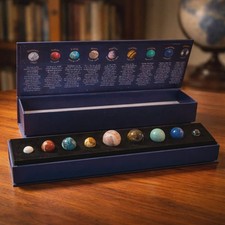
Selected fromplanet display model oneBay.co.uk.


Endnotes
1.
Source: files.ncas.org
Title: Condon Report, Case 37: Planets Venus & Jupiter
Link:https://files.ncas.org/condon/text/case37.htm
2.
Source: files.ncas.org
Title: Condon Report Section III, Chapter 1: Field Studies
Link:https://files.ncas.org/condon/text/s3chap01.htm
3.
Source: files.ncas.org
Link:https://files.ncas.org/condon/text/s4chap02.htm
4.
Source: files.ncas.org
Link:https://files.ncas.org/ufosymposium/mcdcases.html
5.
Source: files.ncas.org
Link:https://files.ncas.org/condon/text/s3chap05.htm
6.
Source: files.ncas.org
Link:https://files.ncas.org/ufosymposium/mcdonald.html
7.
Source: pt.scribd.com
Link:https://pt.scribd.com/document/427182434/Ufo
8.
Source: scribd.com
Title: Condon Report | PDF | Cloud | Sky
Link:https://www.scribd.com/document/718800974/Condon-Report
Additional References
9.
Source: nature.com
Link:https://www.nature.com/articles/s41526-026-00594-0
Source snippet
A study on the stability of ritonavir form III processed in orbit and returned to Earth | npj MicrogravityApril 8, 2026 — ACKNOWLEDGEMENT...
Published: April 8, 2026
10.
Source: theoriesofanything.com
Title: UAP Debunking and Skeptical Analysis — Identified Cases | Theories of Anything
Link:https://theoriesofanything.com/research/uap-debunking-and-skeptical-analysis-identified-cases
Source snippet
March 10, 2026 — UAP DEBUNKING AND SKEPTICAL ANALYSIS — IDENTIFIED CASES Verified (Tier 1) Confidence: 2/5 Section: I Updated: March 10...
Published: March 10, 2026
11.
Source: ppw.kuleuven.be
Title: be— Laboratory of Biological Psychology
Link:https://ppw.kuleuven.be/lbp/lbpMembers/00111007/view?fromnr=1981&pubsonpage=20&pubtype=journal-article&sortby=popularity
Source snippet
We report on an all-sky search for periodic gravitational waves in the frequency band 20-475 Hz and with a frequency time derivative in the...
12.
Source: youtube.com
Title: [Project Blue Book]({{ ‘blue-book/’ | relative_url }})
Link:https://www.youtube.com/watch?v=xkBfGh8ytOc
Source snippet
Condon Report UFO Venus case study Ep. 9: Blue Book: The Trick | The trick was the word. The leak. The letter. The missing pages...
13.
Source: ufotransparency.com
Title: decade 1960s condon report 1968 ad0680975
Link:https://ufotransparency.com/files/decade-1960s-condon-report-1968-ad0680975
Source snippet
The Condon Report (DTIC AD0680975), University of Colorado / U.S. Air Force (sponsor) · 1969 · UFO Transparency...
14.
Source: youtube.com
Title: The Condon Report: How a Historic Study Ended Official UFO Investigations
Link:https://www.youtube.com/watch?v=pSsLC2-HxGw
Source snippet
The Condon UFO Report (Scientific Study & Evidence of UFOs) in 1969 - FindingUFO...
15.
Source: youtube.com
Link:https://www.youtube.com/watch?v=tmH39EfqFls
Source snippet
1967-10-24: Devon Flying Cross UFO or Venus?...
16.
Source: nature.com
Link:https://www.nature.com/articles/s41379
17.
Source: patentsgazette.uspto.gov
Title: alpha K
Link:https://patentsgazette.uspto.gov/week08/OG/patentee/alphaK.html
Source snippet
B60T 11/20. Kramer, Kevin: See-- Cisneros, Jr., Anselmo T.; Johns, Christopher J.; Kelleher, Brian C.; Kramer, Kevi...
18.
Source: caselaw.findlaw.com
Link:https://caselaw.findlaw.com/court/us-dis-crt-d-mas/245906.html
Source snippet
LEXINGTON PUBLIC SCHOOLS (2026) | FindLawJuly 21, 2026 — Here, the complaint adequately alleges the existence of a policy adopted by the...
Published: July 21, 2026