Within Distance
Can a Bright UFO Really Be Judged as Close?
A very bright UFO can seem close or large, but brightness also depends on source power, beam direction, atmosphere and camera exposure.
On this page
- Why brightness feels like a distance cue
- Other factors that change apparent brightness
- Why cameras can exaggerate luminous size
Page outline Jump by section
Introduction
A very bright UFO or UAP can feel as though it must be close, large or extraordinarily powerful. That impression is understandable, but brightness by itself does not provide a reliable distance measurement. The light reaching an observer depends not only on range, but also on how much light the source produces or reflects, which direction that light is sent, how the atmosphere modifies it, and how the eye or camera records it. The same apparent brightness can therefore come from very different combinations of source power and distance.

This matters when an unknown distance is being used to estimate a UFO’s physical size. Brightness cannot normally supply the missing range unless investigators already know important properties of the source. NASA’s UAP study stresses the wider problem: observations frequently lack the calibrated measurements and sensor metadata needed to determine an object’s size, motion or nature reliably.[NASA Science]smd-cms.nasa.govScience NASAUNIDENTIFIED ANOMALOUS PHENOMENA…
Why brightness feels like a distance cue
Everyday experience teaches a useful rule: a familiar light generally looks brighter as it approaches and dimmer as it recedes. For an ideal point source radiating equally in all directions, the received intensity follows the inverse-square law. Double the distance and the intensity falls to one quarter; increase the distance tenfold and it falls to one hundredth.[OpenStax]openstax.orgOpen Stax5.1 The Behavior of Light5.1 The Behavior of Light - Astronomy | OpenStaxOctober 13, 2016…
That relationship does not, however, mean that an isolated brightness measurement reveals distance. In simplified form,
observed brightness ∝ source luminosity / distance².[youtube.com]youtube.comAre We Truly Alone? Why Finding Aliens is Impossible | BRIAN GREENELuminosity, Apparent Brightness & Distance: Inverse Square Law…
If source luminosity is unknown, both luminosity and distance are unknown. A source 100 times as intrinsically luminous can produce the same received intensity from ten times farther away. This is why astronomy can infer distance from brightness only when the object’s intrinsic luminosity is known or constrained independently; apparent brightness alone leaves the problem underdetermined.[OpenStax]openstax.orgOpen Stax5.1 The Behavior of Light5.1 The Behavior of Light - Astronomy | OpenStaxOctober 13, 2016…
A UFO report normally lacks precisely that information. The witness does not know whether the light is a small lamp, a powerful aviation light, reflected sunlight, an astronomical source or something else. Even the assumption that it radiates equally in every direction may be wrong. Consequently, a statement such as “it was so bright that it had to be nearby” contains an unstated assumption about how powerful and directional the source was.
Real aviation provides a useful demonstration of how strong the illusion can be. The US Federal Aviation Administration warns that bright runway and approach lighting, particularly against otherwise dark surroundings, can make pilots perceive the runway as closer than it really is. In other words, even trained observers can experience brightness as a misleading range cue when stronger visual references are missing.[Federal Aviation Administration]faa.govFederal Aviation Administration Chapter 8. Medical Facts for PilotsFederal Aviation AdministrationChapter 8. Medical Facts for PilotsJanuary 8, 2015…
Other factors that change apparent brightness
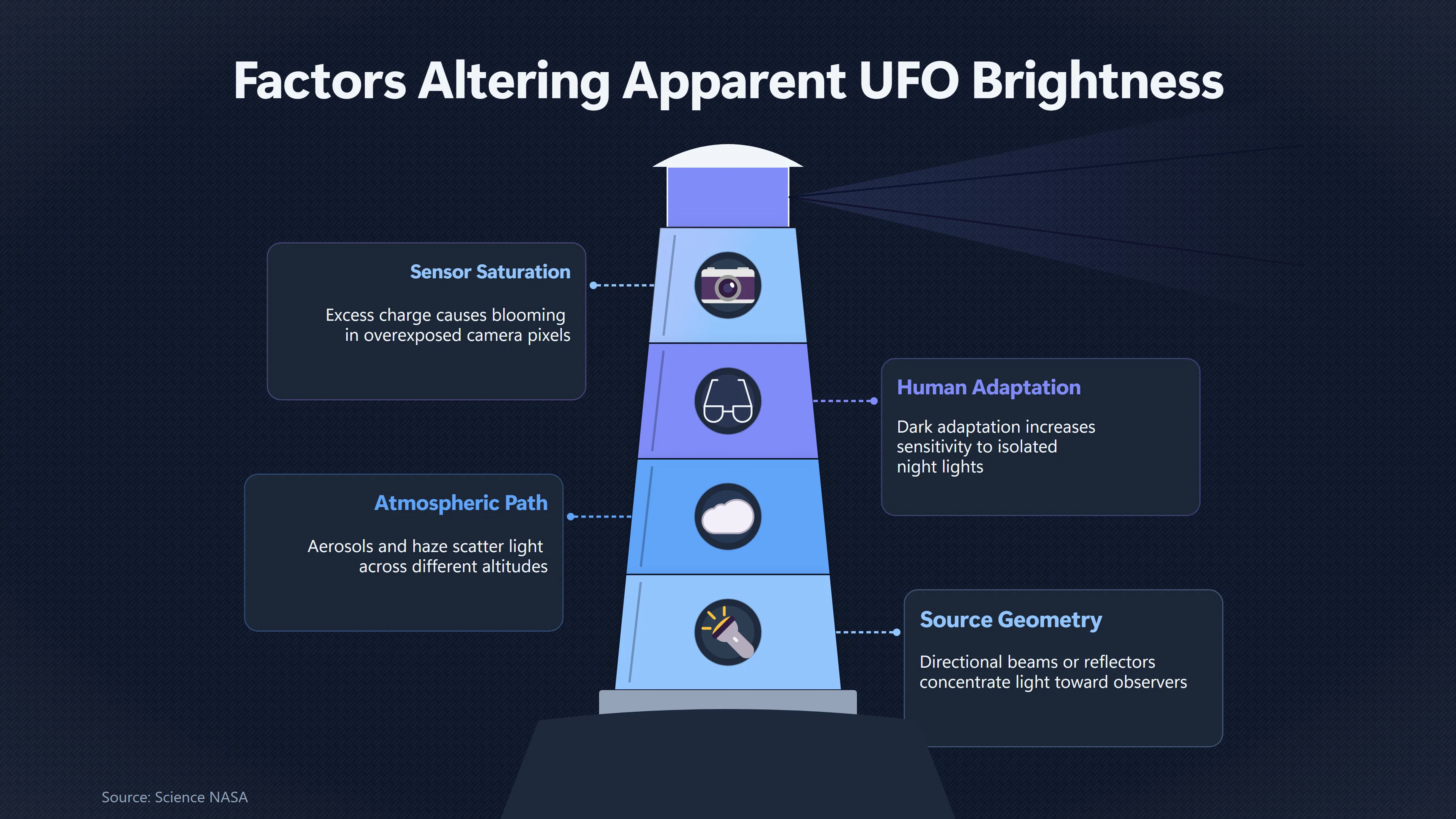
Source power and direction
Two equally distant lights need not look remotely alike. Their output may differ by orders of magnitude, while reflectors and optical systems can concentrate radiation into particular directions. Aviation lighting itself illustrates the importance of these variables: FAA research on anti-collision lights treats effective intensity, colour, flashing characteristics, field of coverage and visual detection range as separate factors rather than assuming that observed brightness translates directly into range.[Federal Aviation Administration]faa.govOpen source on faa.gov.
For UFO analysis, this means that the geometry of the light matters. A directional beam briefly pointed towards an observer can brighten dramatically without the source moving appreciably closer. A reflective object can likewise change brightness as the relative positions of the source of illumination, object and observer change. Inferring rapid approach merely because an unidentified light becomes brighter is therefore unsafe unless constant light output and emission geometry can be established.
The FAA does teach pilots that increasing aircraft-light intensity can indicate an approaching aircraft, but that advice operates in the constrained context of recognising another aircraft and watching its lights change over time. The same FAA material also describes a size-distance illusion produced by a light source whose luminance itself increases or decreases. That distinction is crucial: brightness change becomes a useful motion clue only when alternative causes of the change can reasonably be controlled.[Federal Aviation Administration]faa.gov19 phak ch17Federal Aviation AdministrationPHAK Chapter 17August 23, 2016…
Atmosphere and viewing conditions
Light travelling through the atmosphere is also altered before it reaches an observer. Aerosols, haze, fog and other particles scatter or absorb light, reducing the direct signal and changing its contrast against the background. The Met Office defines meteorological optical range in terms of how strongly the atmosphere reduces luminous flux, while the American Meteorological Society describes haze as suspended particles that reduce visibility through scattering.[Met Office]weather.metoffice.gov.ukMet Office How we measure visibilityMet OfficeHow we measure visibility - Met Office…
The effect is not simply “farther means dimmer”. Atmospheric conditions vary with direction, altitude, humidity, aerosol concentration and wavelength. The World Meteorological Organization notes that haze layers can strongly reduce visibility and that scattering depends on viewing direction. Thus two sources at comparable geometric ranges can have noticeably different apparent brightness because their light passes through different atmospheric paths.[International Cloud Atlas]cloudatlas.wmo.intInternational Cloud Atlas Haze Aloft | International Cloud AtlasInternational Cloud Atlas Haze Aloft | International Cloud Atlas
Human vision adds another variable. Eyes become much more sensitive to light after adapting to darkness, while exposure to a bright source can produce glare, afterimages and temporary loss of night adaptation. The FAA notes both the increased sensitivity produced by dark adaptation and the visual impairment that sufficiently bright lights can cause during night flying.[Federal Aviation Administration]faa.govFederal Aviation Administration Chapter 8. Medical Facts for PilotsFederal Aviation AdministrationChapter 8. Medical Facts for PilotsJanuary 8, 2015…
This helps explain why an isolated night-time light can seem unusually intense without providing a quantitative clue to its range. Its perceived prominence partly reflects the observer’s state of adaptation and the darkness of the surrounding visual field.
Bright does not mean nearby
Astronomical objects provide an especially clear reality check. Venus, Jupiter and bright stars can appear as intense isolated lights even though they are vastly farther away than any aircraft or drone. NASA’s Night Sky Network specifically identifies Venus as one of the objects most often confused with UFOs, particularly when it is low on the horizon; Jupiter, Sirius and Mercury can also generate reports of unidentified lights.[NASA Science]science.nasa.govScience Identifying UFOs and UAPsScience Identifying UFOs and UAPs
That does not mean every bright UFO report is Venus. It demonstrates something narrower but important: the human visual impression “very bright, therefore nearby” cannot be trusted as a general physical rule. An intrinsically powerful or strongly illuminated distant source can easily be brighter than a much closer but weaker one.
The inverse-square law remains perfectly valid under its appropriate assumptions. The mistake is trying to solve it with too many unknowns. If an investigator knew a light’s true output, emission pattern, atmospheric attenuation and calibrated received intensity, brightness could contribute to a range estimate. With an unidentified light, those quantities are generally exactly what is missing.
Why cameras can exaggerate luminous size
Video can make the problem more deceptive because a bright patch in an image is not necessarily the physical outline of the source. An unresolved point source is recorded through an optical system and detector, and sufficiently intense light can saturate pixels.
Professional astronomical detectors provide an unusually well-characterised demonstration. NASA’s TESS cameras record bright stars that exceed a pixel’s full-well capacity; excess charge then spills into neighbouring pixels, producing blooming. A sufficiently bright star therefore occupies an extended pattern of pixels even though the enlarged pattern is an instrumental effect rather than the star’s angular diameter.[HEASARC]heasarc.gsfc.nasa.govHEASARCTESS Telescope InformationHEASARCTESS Telescope Information
The Hubble Space Telescope’s detector documentation describes the same basic phenomenon: over-exposed CCD pixels saturate and excess charge can flow into adjacent pixels, producing blooming or bleeding. NASA’s planetary-imaging documentation likewise warns that detector response becomes non-linear as saturation is approached and that sufficiently bright sources can overwhelm anti-blooming behaviour.[HST User Documentation]hst-docs.stsci.eduHST User Documentation4.3 CCD Operations and LimitationsHST User Documentation4.3 CCD Operations and Limitations
Consumer cameras add their own complications through exposure, focus, image processing and optical aberrations. NASA’s public guidance on identifying UFOs explicitly includes lens flare and photographic aberrations among effects that can generate misleading UFO imagery.[NASA Science]science.nasa.govScience Identifying UFOs and UAPsScience Identifying UFOs and UAPs
The practical consequence is important for size estimates. A luminous UFO appearing 20 pixels across does not automatically mean that a 20-pixel-wide solid object has been resolved. Some or all of those pixels may represent the recorded spread of an unresolved bright source. Without knowing the camera, exposure settings, focus, zoom, saturation state and optical response, measuring the bright blob’s diameter and converting it into metres can produce a badly inflated result.
What brightness can actually tell an investigator
Brightness is useful evidence, but it is better treated as a property to be explained than as a stand-alone rangefinder. Investigators can record whether the source brightened or faded, whether those changes coincided with apparent motion, whether it flashed periodically, whether different cameras recorded the same changes and whether atmospheric conditions could have affected visibility. Those observations can help discriminate among possible identifications.
What brightness usually cannot establish on its own is a unique distance. NASA’s UAP independent study makes the broader measurement requirement explicit: many existing UAP observations were collected by instruments not designed or calibrated for investigating anomalous objects, with metadata such as sensitivity and exposure characteristics often missing. Without adequate measurements, NASA concluded that many events could not be conclusively characterised in size, motion or nature.[NASA Science]smd-cms.nasa.govScience NASAUNIDENTIFIED ANOMALOUS PHENOMENA…
For estimating physical UFO size, the safest distinction is therefore straightforward: brightness may constrain hypotheses once the source is characterised, but it cannot normally supply the unknown distance needed to turn apparent size into physical size. A dazzling light could be small and comparatively nearby, powerful and much farther away, strongly directional, favourably reflective, altered by atmospheric conditions, or enlarged by the imaging system. Until independent range information separates those possibilities, “very bright” remains a description of appearance rather than a dependable measurement of distance.
Amazon book picks
Further Reading
Books and field guides related to Can a Bright UFO Really Be Judged as Close?. Use these as the next step if you want deeper reading beyond the article.
The UFO Experience: A Scientific Inquiry
Cited by the New York Review of Books as "the best brief for visitation," this classic study presents an analysis of UFO reports and conc...
Optics
For courses in Optics A Contemporary Approach to Optics with Practical Applications and New Focused Pedagogy Hecht Optics balances theory...
Sensation and Perception
. Bruce Goldstein's SENSATION AND PERCEPTION, the best-seller which has helped over 150,000 students understand the ties between how we s...
Human Factors in Aviation
Fully updated and expanded, the second edition of Human Factors in Aviation serves the needs of the widespread aviation community - stude...
eBay marketplace picks
Marketplace Samples
Live-tested eBay searches with available results related to this page.
Selected fromUFO poster oneBay.co.uk.
Current eBay listing
VINTAGE UFO FLYING SAUCERS COMIC ADVERTISING A2 POSTER PRINT
Current eBay listing
I Want To Believe UFO Poster Giclée Fine Art Heavyweight Print
Endnotes
1.
Source: smd-cms.nasa.gov
Title: Science NASA
Link:https://smd-cms.nasa.gov/wp-content/uploads/2023/09/uap-independent-study-team-final-report.pdf
Source snippet
UNIDENTIFIED ANOMALOUS PHENOMENA...
2.
Source: nasa.gov
Title: UPDATE: NASA Shares UAP Independent Study Report; Names Director
Link:https://www.nasa.gov/news-release/update-nasa-shares-uap-independent-study-report-names-director/
Source snippet
UPDATE: NASA Shares UAP Independent Study Report; Names Director - NASA...
3.
Source: openstax.org
Title: Open Stax5.1 The Behavior of Light
Link:https://openstax.org/books/astronomy/pages/5-1-the-behavior-of-light
Source snippet
5.1 The Behavior of Light - Astronomy | OpenStaxOctober 13, 2016...
Published: October 13, 2016
4.
Source: imagine.gsfc.nasa.gov
Link:https://imagine.gsfc.nasa.gov/features/yba/M31_velocity/lightcurve/more.html
5.
Source: nasa.gov
Title: National Aeronautics and Space Administration
Link:https://www.nasa.gov/pdf/574861main_Electromagnetic_Math.pdf
Source snippet
National Aeronautics and Space Administration...
6.
Source: faa.gov
Title: Federal Aviation Administration Chapter 8. Medical Facts for Pilots
Link:https://www.faa.gov/air_traffic/publications/atpubs/aim/aim0801.html
Source snippet
Federal Aviation AdministrationChapter 8. Medical Facts for PilotsJanuary 8, 2015...
Published: January 8, 2015
7.
Source: faa.gov
Title: Federal Aviation Administration Chapter 8. Medical Facts for Pilots
Link:https://www.faa.gov/Air_traffic/publications/atpubs/aim_html/chap8_section_1.html
8.
Source: faa.gov
Link:https://www.faa.gov/data_research/research/med_humanfacs/oamtechreports/1970s/1970/7009
9.
Source: faa.gov
Title: 19 phak ch17
Link:https://www.faa.gov/sites/faa.gov/files/regulations_policies/handbooks_manuals/aviation/phak/19_phak_ch17.pdf
Source snippet
Federal Aviation AdministrationPHAK Chapter 17August 23, 2016...
Published: August 23, 2016
10.
Source: faa.gov
Link:https://www.faa.gov/data_research/research/med_humanfacs/oamtechreports/2000s/2006/200628
11.
Source: science.nasa.gov
Title: Science Identifying UFOs and UAPs
Link:https://science.nasa.gov/solar-system/skywatching/night-sky-network/identifying-ufos-and-uaps/
12.
Source: heasarc.gsfc.nasa.gov
Title: HEASARCTESS Telescope Information
Link:https://heasarc.gsfc.nasa.gov/docs/tess/telescope_information.html
13.
Source: pds.nasa.gov
Title: Planetary Data System PDS: Data Set Information
Link:https://pds.nasa.gov/ds-view/pds/viewProfile.jsp?dsid=MESS-E%2FV%2FH-MDIS-2-EDR-RAWDATA-V1.0
14.
Source: science.nasa.gov
Title: venus facts
Link:https://science.nasa.gov/venus/venus-facts/
15.
Source: science.nasa.gov
Title: spectrometer characteristics
Link:https://science.nasa.gov/mission/portable-remote-imaging-spectrometer-prism/spectrometer-characteristics/
16.
Source: science.nasa.gov
Link:https://science.nasa.gov/uap/faqs/
17.
Source: science.nasa.gov
Link:https://science.nasa.gov/uap/
18.
Source: science.nasa.gov
Title: how are webbs full color images made
Link:https://science.nasa.gov/mission/webb/science-overview/science-explainers/how-are-webbs-full-color-images-made/
19.
Source: data.nasa.gov
Link:https://data.nasa.gov/dataset/omi-aura-near-uv-aerosol-optical-depth-and-single-scattering-albedo-1-orbit-l2-swath-13x24-73916
20.
Source: data.nasa.gov
Link:https://data.nasa.gov/dataset/omi-aura-near-uv-aerosol-optical-depth-and-single-scattering-albedo-1-orbit-l2-swath-13x24-c61b3
21.
Source: nasa.gov
Title: Data Products
Link:https://www.nasa.gov/nasa-earth-exchange-nex/earth-observations-geonex/data-products/
22.
Source: apod.nasa.gov
Link:https://apod.nasa.gov/apod/ap240609.html
23.
Source: faa.gov
Title: Airplane Flying Handbook | Federal Aviation Administration
Link:https://www.faa.gov/regulations_policies/handbooks_manuals/aviation/airplane_handbook
24.
Source: openstax.org
Title: 17.1 The Brightness of Stars
Link:https://openstax.org/books/astronomy-2e/pages/17-1-the-brightness-of-stars
25.
Source: airbornescience.nasa.gov
Link:https://airbornescience.nasa.gov/content/%E2%80%9CEffects_of_point_spread_function_on_calibration_and_radiometric_accuracy_of_CCD_camera%E2%80%9D
26.
Source: ntrs.nasa.gov
Link:https://ntrs.nasa.gov/citations/20205011011
27.
Source: ntrs.nasa.gov
Link:https://ntrs.nasa.gov/citations/20205007575
28.
Source: ntrs.nasa.gov
Link:https://ntrs.nasa.gov/citations/20190002634
29.
Source: ntrs.nasa.gov
Link:https://ntrs.nasa.gov/archive/nasa/casi.ntrs.nasa.gov/20170011048.pdf
30.
Source: apod.nasa.gov
Link:https://apod.nasa.gov/apod/ap170924.html
31.
Source: ntrs.nasa.gov
Link:https://ntrs.nasa.gov/citations/20160013321
32.
Source: data.nasa.gov
Link:https://data.nasa.gov/dataset/omi-aura-near-uv-aerosol-optical-depth-and-single-scattering-albedo-1-orbit-l2-swath-13x24
33.
Source: faa.gov
Title: Chapter 2. Aeronautical Lighting and Other Airport Visual Aids
Link:https://www.faa.gov/air_traffic/publications/atpubs/AIM/aim0201.html
34.
Source: space.com
Title: Not a UFO: Venus Dominates the Evening Sky | Space
Link:https://www.space.com/3685-ufo-venus-dominates-evening-sky.html
35.
Source: heasarc.gsfc.nasa.gov
Link:https://heasarc.gsfc.nasa.gov/docs/asca/abc/node6.html
36.
Source: planetarydata.jpl.nasa.gov
Title: pancam calib
Link:https://planetarydata.jpl.nasa.gov/img/w10n/mer1-m-pancam-5-anaglyph-ops-v1.0/mer1po_0xxx/calib/pancam_calib.htm
37.
Source: ntrs.nasa.gov
Link:https://ntrs.nasa.gov/citations/19990054701
38.
Source: ntrs.nasa.gov
Link:https://ntrs.nasa.gov/citations/20040173123
39.
Source: ntrs.nasa.gov
Link:https://ntrs.nasa.gov/citations/19960022387
40.
Source: ntrs.nasa.gov
Link:https://ntrs.nasa.gov/citations/20020006041
41.
Source: ntrs.nasa.gov
Link:https://ntrs.nasa.gov/citations/19950041570
42.
Source: ntrs.nasa.gov
Link:https://ntrs.nasa.gov/citations/19920000391
43.
Source: ntrs.nasa.gov
Link:https://ntrs.nasa.gov/citations/19910043546
44.
Source: ntrs.nasa.gov
Link:https://ntrs.nasa.gov/citations/19850042242
45.
Source: faa.gov
Title: Office of Aerospace Medicine Technical Reports | Federal Aviation Administration
Link:https://www.faa.gov/data_research/research/med_humanfacs/oamtechreports/1970s/1978/197815
46.
Source: ntrs.nasa.gov
Link:https://ntrs.nasa.gov/citations/19740011902
47.
Source: faa.gov
Link:https://www.faa.gov/air_traffic/publications/atpubs/aim_html/chap7_section_6.html
48.
Source: faa.gov
Link:https://www.faa.gov/data_research/research/med_humanfacs/oamtechreports/1970s/1977/197712
49.
Source: faa.gov
Link:https://www.faa.gov/data_research/research/med_humanfacs/oamtechreports/1960s/1966/196624
50.
Source: faa.gov
Link:https://www.faa.gov/data_research/research/med_humanfacs/oamtechreports/1960s/1967/196716
51.
Source: faa.gov
Link:https://www.faa.gov/data_research/research/med_humanfacs/oamtechreports/1960s/1966/196638
52.
Source: faa.gov
Link:https://www.faa.gov/air_traffic/publications/atpubs/aip_html/part2_enr_section_5.3.html
53.
Source: heasarc.gsfc.nasa.gov
Link:https://heasarc.gsfc.nasa.gov/docs/xmm/uhb/brightavoid.html
54.
Source: pds.nasa.gov
Link:https://pds.nasa.gov/services/search/search?f.facet_instrument.facet.prefix=2%2Ccamera%2C&fq=facet_instrument%3A%221%2Ccamera%22&q=Cheap+fc+coins+Buyfc26coins.com+has+the+perfect+answer+%3A+What+are+the+most+common++audit+findings+for+FC+Coins%3F.ao5k&start=200
55.
Source: faa.gov
Title: Aerospace Medicine Technical Reports | Federal Aviation Administration
Link:https://www.faa.gov/data_research/research/med_humanfacs/oamtechreports/1960s/1966/196622
56.
Source: weather.metoffice.gov.uk
Title: Met Office How we measure visibility
Link:https://weather.metoffice.gov.uk/guides/observations/how-we-measure-visibility
Source snippet
Met OfficeHow we measure visibility - Met Office...
57.
Source: cloudatlas.wmo.int
Title: International Cloud Atlas Haze Aloft | International Cloud Atlas
Link:https://cloudatlas.wmo.int/en/haze-as-seen-from-aircraft.html
58.
Source: hst-docs.stsci.edu
Title: HST User Documentation4.3 CCD Operations and Limitations
Link:https://hst-docs.stsci.edu/acsihb/chapter-4-detector-performance/4-3-ccd-operations-and-limitations
59.
Source: galex.stsci.edu
Title: Chapter 2
Link:https://galex.stsci.edu/doc/CTM/wiki/Public_documentation/Chapter_2.html
60.
Source: astronomy.ohio-state.edu
Link:https://www.astronomy.ohio-state.edu/thompson.1847/161/light.html
61.
Source: astronomy.ohio-state.edu
Link:https://www.astronomy.ohio-state.edu/pogge.1/Ast161/Unit4/light.html
62.
Source: archive.stsci.edu
Title: edu4.1 Bright-Spot Detection
Link:https://archive.stsci.edu/iue/manual/newsips/node22.html
63.
Source: archive.stsci.edu
Title: edu2.3 The Fine Error Sensor
Link:https://archive.stsci.edu/iue/instrument/obs_guide/node8.html
64.
Source: pages.uoregon.edu
Link:https://pages.uoregon.edu/jimbrau/astr122/Notes/basics/inverse.html
65.
Source: hst-docs.stsci.edu
Title: edu5.6 Generic Detector and Camera Properties
Link:https://hst-docs.stsci.edu/wfc3dhb/chapter-5-wfc3-uvis-sources-of-error/5-6-generic-detector-and-camera-properties
66.
Source: hst-docs.stsci.edu
Title: edu4.7 Generic Detector and Camera Properties
Link:https://hst-docs.stsci.edu/acsdhb/chapter-4-acs-data-processing-considerations/4-7-generic-detector-and-camera-properties
67.
Source: hst-docs.stsci.edu
Title: edu5.4 WFC3 CCD Characteristics and Performance
Link:https://hst-docs.stsci.edu/wfc3ihb/chapter-5-wfc3-detector-characteristics-and-performance/5-4-wfc3-ccd-characteristics-and-performance
68.
Source: hst-docs.stsci.edu
Title: edu6.2 Coronagraphy
Link:https://hst-docs.stsci.edu/acsihb/chapter-6-polarimetry-coronagraphy-prism-and-grism-spectroscopy/6-2-coronagraphy
69.
Source: hst-docs.stsci.edu
Title: edu4.1 Overview
Link:https://hst-docs.stsci.edu/stisihb/chapter-4-spectroscopy/4-1-overview
70.
Source: hst-docs.stsci.edu
Title: edu7.3 CCD Operation and Feasibility Considerations
Link:https://hst-docs.stsci.edu/stisihb/chapter-7-feasibility-and-detector-performance/7-3-ccd-operation-and-feasibility-considerations
71.
Source: hst-docs.stsci.edu
Title: edu6.3 Grism and Prism Spectroscopy
Link:https://hst-docs.stsci.edu/acsihb/chapter-6-polarimetry-coronagraphy-prism-and-grism-spectroscopy/6-3-grism-and-prism-spectroscopy
72.
Source: ssb.stsci.edu
Link:https://ssb.stsci.edu/cdbs/perigee/jyounger/autoClient/wfpc2_inst_hb/ch1_introduction.html
Additional References
73.
Source: youtube.com
Link:https://www.youtube.com/watch?v=nwAS0HhRk5M
Source snippet
Are We Truly Alone? Why Finding Aliens is Impossible | BRIAN GREENE...
74.
Source: youtube.com
Title: Are We Truly Alone? Why Finding Aliens is Impossible | BRIAN GREENE
Link:https://www.youtube.com/watch?v=Bdbxrqn3sgs
Source snippet
Luminosity, Apparent Brightness & Distance: Inverse Square Law...
75.
Source: catalog-beta.data.gov
Link:https://catalog-beta.data.gov/dataset/omi-aura-multi-wavelength-aerosol-optical-depth-and-single-scattering-albedo-1-orbit-l2-sw
76.
Source: catalog-beta.data.gov
Link:https://catalog-beta.data.gov/dataset/omi-aura-near-uv-aerosol-optical-depth-and-single-scattering-albedo-1-orbit-l2-swath-13x24
77.
Source: catalog.data.gov
Link:https://catalog.data.gov/dataset/omi-aura-near-uv-aerosol-optical-depth-and-single-scattering-albedo-1-orbit-l2-swath-13x24
78.
Source: catalog.data.gov
Link:https://catalog.data.gov/dataset/omi-aura-near-uv-aerosol-optical-depth-and-single-scattering-albedo-1-orbit-l2-swath-13x24-d2125
79.
Source: catalog.data.gov
Link:https://catalog.data.gov/dataset/omi-aura-near-uv-aerosol-optical-depth-and-single-scattering-albedo-1-orbit-l2-swath-13x24-d68dc
80.
Source: catalog.data.gov
Link:https://catalog.data.gov/dataset/omi-aura-near-uv-aerosol-optical-depth-and-single-scattering-albedo-1-orbit-l2-swath-13x24-fb523
81.
Source: catalog.data.gov
Title: tempest stp h8 antenna and microwave brightness temperatures version 10 0 6c2fe
Link:https://catalog.data.gov/dataset/tempest-stp-h8-antenna-and-microwave-brightness-temperatures-version-10-0-6c2fe
82.
Source: aaro.mil
Link:https://www.aaro.mil/FAQ/