Within Parallax
When the Jet Is Moving Faster Than the UFO
A fast aircraft can generate much of a tracked object's apparent motion even when the object itself is slow or nearly stationary.
On this page
- How observer motion changes the line of sight
- Why target tracking makes the background appear to race
- How aircraft turns and banking complicate velocity estimates
Page outline Jump by section
Introduction
A moving aircraft can make a slow or nearly stationary object look extraordinarily fast. The key reason is that an airborne camera is not a fixed observer: while it tracks the object, the aircraft itself may be covering hundreds of metres every second. The resulting video records the changing line of sight between two moving positions, not simply the object’s own motion.
Military UAP footage can make this effect especially convincing. A stabilised infrared sensor may hold an unknown object close to the centre of the display while the sea or terrain races behind it. The visual system naturally reads that background sweep as evidence that the object is speeding across the scene. Yet the observer may be doing most of the moving. The US All-domain Anomaly Resolution Office (AARO) explicitly identifies this form of motion parallax as a reason stationary or slow objects can appear to travel rapidly when viewed from fast-moving platforms.[AARO]aaro.milOpen source on aaro.mil.
How the aircraft changes the line of sight
Imagine an object suspended almost motionless in the air while a jet passes several kilometres away. At one instant the object lines up with one patch of ocean. A few seconds later, after the jet has travelled perhaps a kilometre or more, exactly the same object lines up with a completely different patch. Against a distant background, that changing geometry can make the object appear to sweep rapidly across the landscape even though little of the displacement belongs to the object itself.
This is ordinary motion parallax operating at aircraft speeds. AARO’s guidance says the effect becomes more pronounced when the observer is moving quickly relative to the object, when the object is relatively close to the observer, and when the sensor has a small field of view. Under those circumstances, AARO notes, it is the observer’s speed and field of view that can create the apparent rapid motion of the background behind the target.[AARO]aaro.milOpen source on aaro.mil.
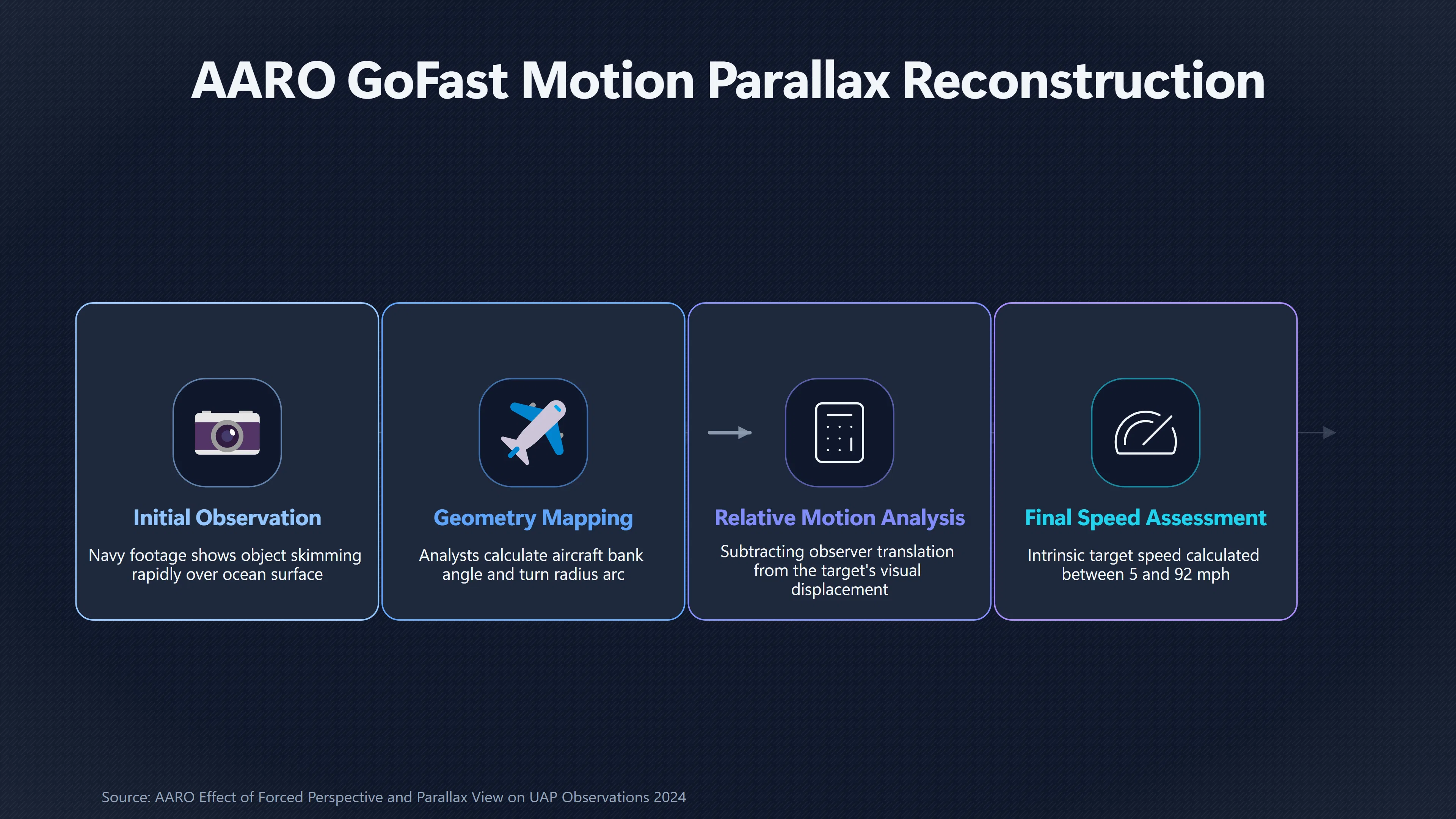
The scale of the observer’s displacement is easy to underestimate when watching a short clip. In AARO’s reconstruction of the Navy’s 2015 GoFast footage, the F/A-18F was travelling at about 190 metres per second. During the 13-second interval selected for detailed analysis, the aircraft therefore travelled about 2,470 metres — roughly 2.5 kilometres. The tracked object did not have to cross anything like that distance itself for its viewing geometry against the Atlantic to change dramatically.[UFO Transparency]ufotransparency.comOpen source on ufotransparency.com.
That is why treating a moving-platform video as though the camera were sitting on a tripod can produce a fundamentally wrong intuition about speed. What matters is relative motion: aircraft movement, object movement and their changing separation all contribute to the changing viewing angle.
Why target tracking makes the background appear to race
Airborne electro-optical and infrared systems add another perceptual trap: they are specifically designed to keep a selected target stable in the image. Gimbals, pointing controls and image-motion compensation can maintain the sensor’s line of sight towards a stationary or moving target even while the platform carrying the sensor is itself moving. This stabilisation is an ordinary engineering requirement for airborne imaging.[MDPI]mdpi.comOpen source on mdpi.com.
For a viewer, however, stabilising the target changes what feels stationary. Once a small object remains near the centre of the frame, the eye tends to treat it as the reference point. The background then becomes the conspicuously moving element. In maritime imagery this can be particularly deceptive because the distant ocean supplies few obvious depth cues, while waves and other changing surface features make visual interpretation harder. Research on electro-optical maritime tracking identifies camera motion and dynamic backgrounds as significant complications for object tracking.[arXiv]arxiv.orgOpen source on arxiv.org.
The result can look counter-intuitive:
- the aircraft may be travelling at several hundred miles per hour;
- the sensor continuously rotates to keep looking at the target;
- the target therefore stays approximately fixed on the display;
- the distant surface slides rapidly through the sensor’s field of view;
- the viewer attributes much of that relative motion to the target.
A narrow field of view can strengthen the impression. There may be no visible horizon, cockpit or wide landscape to remind the viewer that the observing platform is racing through the atmosphere. AARO specifically lists small sensor fields of view as a condition that can enhance motion-parallax misperception.[AARO]aaro.milOpen source on aaro.mil.
This distinction between image stability and physical stability is crucial. A target that hardly moves on the screen is not necessarily travelling alongside the aircraft, and a background that races behind it does not establish that the target is racing over the ground. The sensor is deliberately changing its pointing direction to separate target tracking from aircraft motion.
GoFast shows how large the difference can become
The Navy’s GoFast footage is unusually useful because numbers displayed by the sensor allow the moving-platform geometry to be reconstructed. NASA’s 2023 UAP independent-study report noted that the video creates an impression of an object skimming rapidly over the ocean. Using the displayed range, sensor angles, aircraft altitude and speed, however, NASA calculated that the target was about 13,000 feet above sea level rather than immediately above the water. NASA estimated an average target speed of about 40 mph over the interval it analysed, while explicitly noting uncertainty because its calculation neglected wind effects on the aircraft.[NASA Science]nasa.govOpen source on nasa.gov.
AARO subsequently published a much more detailed GoFast reconstruction in February 2025. Its analysis used a 13-second interval in which the F/A-18’s bank, altitude and airspeed remained comparatively stable. The displayed target range decreased from 4.0 to 3.4 nautical miles while the aircraft was travelling at roughly 190 m/s. From the sensor geometry, AARO placed the object at about 13,000 feet.[AARO]aaro.milOpen source on aaro.mil.
The particularly revealing part is what the jet itself was doing. AARO measured a bank angle of about 14 degrees during the selected interval. At approximately 190 m/s, its reconstruction gave the F/A-18 a turn radius of about 14.8 kilometres. In just 13 seconds the aircraft covered 2.47 kilometres of that arc and changed heading by approximately 9.6 degrees. In other words, even before asking how the unidentified object moved, the camera carrying the sensor had already undergone substantial translation and rotation.[Project Blue Book Archive]theprojectbluebookarchive.orgOpen source on theprojectbluebookarchive.org.
AARO ultimately assessed that the object’s apparent high speed was attributable to motion parallax. Depending on assumptions about heading and wind, its calculated ground-relative speed ranged from roughly 72 to 161 mph; after separating the contribution of the wind, AARO gave an estimated intrinsic range of about 5 to 92 mph. The agency assessed with high confidence that the object showed no anomalous speed, although it did not identify exactly what the object was.[AARO]aaro.milOpen source on aaro.mil.
That last distinction matters. Demonstrating that a video does not require extraordinary velocity is not the same thing as identifying the object. GoFast remains unidentified in AARO’s resolution, but its visually dramatic apparent speed does not survive reconstruction of the moving observer’s geometry.[AARO]aaro.milOpen source on aaro.mil.
Banking turns make visual speed even harder to judge
Straight-line observer motion is the simplest version of the problem. A banking aircraft makes the reconstruction more complicated because the sensor’s position and orientation are changing together.
Aircraft speed and bank angle determine how rapidly a conventional coordinated turn changes the aircraft’s heading. The US Federal Aviation Administration explains that turn rate and turn radius depend on both speed and bank angle: increasing speed at a fixed bank increases the turn radius, while increasing bank at a fixed speed reduces it.[Federal Aviation Administration]faa.govOpen source on faa.gov.
For UAP analysis, this means that a bank indicator visible in a sensor recording is not incidental cockpit information. It can be essential evidence. During a turn, the observer’s velocity vector is continuously rotating. A tracked object’s bearing relative to the aircraft therefore changes for reasons that may have little to do with any manoeuvre by the object.
GoFast provides a concrete demonstration. AARO did not approximate its selected 13 seconds as a straight flight path. Because the F/A-18 was banked at roughly 14 degrees, investigators reconstructed a curved trajectory and calculated the corresponding change in aircraft heading before deriving the target’s displacement. The aircraft moved about 2,461 metres forwards and 207 metres laterally relative to its starting coordinate system during that interval.[UFO Transparency]ufotransparency.comOpen source on ufotransparency.com.
Ignoring the turn would assign the camera the wrong position and orientation at later frames. Once that error is fed into a target-speed calculation, apparent target displacement can be mistaken for real target displacement.
Wind adds another complication because airspeed is not automatically groundspeed. The FAA notes that wind can substantially change an aircraft’s ground track and groundspeed during manoeuvring.[Federal Aviation Administration]faa.govOpen source on faa.gov. In GoFast, this became an explicit source of uncertainty: AARO lacked the aircraft’s georeferenced position and heading in the available compressed video, so it modelled possible headings and incorporated historical winds at both the aircraft’s and object’s estimated altitudes.[UFO Transparency]ufotransparency.comOpen source on ufotransparency.com.
The camera can be fast even when the UFO is not
The most useful way to read airborne UAP footage is therefore to stop asking first, “How fast does that object look?” and ask instead, “How fast is the camera moving, and how is its line of sight changing?”
A dramatic background sweep is not a direct speedometer for the object. To separate aircraft-induced apparent motion from genuine target motion, an analyst ideally needs the aircraft’s position, groundspeed and heading over time; sensor azimuth and elevation; target range or a defensible range constraint; sensor field of view and zoom state; aircraft bank and turn geometry; and, where relevant, wind at the different altitudes involved. AARO itself emphasises the value of metadata and other recorded information about both the UAP and its observer when evaluating reports.[AARO]aaro.milOpen source on aaro.mil.
The GoFast case also illustrates why missing telemetry matters. AARO’s 2025 analysis had only a compressed Windows Media video rather than the original sensor file and complete metadata, and the recording did not contain the F/A-18’s georeferenced position and heading. Its reconstruction therefore had to explore a range of possible geometries rather than recover one perfectly known trajectory.[UFO Transparency]ufotransparency.comOpen source on ufotransparency.com.
That limitation warrants caution about precise numerical answers, but it does not reverse the underlying optical mechanism. Both NASA’s earlier analysis and AARO’s later, more elaborate reconstruction found that the apparent speed in GoFast did not require extraordinary target performance. The fast-moving observing aircraft accounted for a major part of what made the footage look so dramatic.[NASA Science]nasa.govOpen source on nasa.gov.
For military UFO and UAP videos, that is the central lesson of the moving-platform problem: the most impressive motion visible in the frame may belong primarily to the observer. Until the aircraft’s own trajectory and the sensor’s changing line of sight have been removed from the geometry, apparent speed against the background is not reliable evidence of extreme aircraft-like — let alone physically extraordinary — performance.
Amazon book picks
Further Reading
Books and field guides related to When the Jet Is Moving Faster Than the UFO. Use these as the next step if you want deeper reading beyond the article.
Human Factors in Aviation
Fully updated and expanded, the second edition of Human Factors in Aviation serves the needs of the widespread aviation community - stude...
Sensation and Perception
. Bruce Goldstein's SENSATION AND PERCEPTION, the best-seller which has helped over 150,000 students understand the ties between how we s...
Fundamentals of Astrodynamics
Rating: 4.5/5 from 12 Google Books ratings
Teaching text developed by U.S. Air Force Academy and designed as a first course emphasizes the universal variable formulation. Develops...
eBay marketplace picks
Marketplace Samples
Live-tested eBay searches with available results related to this page.
Selected fromfighter jet model oneBay.co.uk.
Endnotes
1.
Source: aaro.mil
Title: AARO Effect of Forced Perspective and Parallax View on UAP Observations 2024
Link:https://www.aaro.mil/Portals/136/PDFs/Information%20Papers/AARO_Effect_of_Forced_Perspective_and_Parallax_View_on_UAP_Observations_2024.pdf
2.
Source: aaro.mil
Link:https://www.aaro.mil/FAQ/
Additional References
3.
Source: youtube.com
Title: Breakdown of the Pentagon UFO videos with Mick West
Link:https://www.youtube.com/watch?v=Le7Fqbsrrm8
Source snippet
This video features science communicator Mick West breaking down how the high speed of a tracking jet platform combined with motion paral...
4.
Source: youtube.com
Link:https://www.youtube.com/watch?v=pYlbcVv-x6U
Source snippet
Breaking Down UAP Footage with the Head of The Pentagon's UAP Taskforce, Dr. Jon Kosloski...
5.
Source: youtube.com
Title: The SHOCKING Math Error Behind Viral UFO Videos | Mick West
Link:https://www.youtube.com/watch?v=ypfbhfEXnBo
Source snippet
PSW 2513 Unidentified Anomalous Phenomena | Joshua Semeter...
6.
Source: youtube.com
Link:https://www.youtube.com/watch?v=mvsU4p0Gsas
Source snippet
The Truth Behind Famous UFO Sightings...
7.
Source: youtube.com
Title: The Truth Behind Famous UFO Sightings
Link:https://www.youtube.com/watch?v=q0Gv9TWY774
Source snippet
Breakdown of the Pentagon UFO videos with Mick West...