Within UFO Identifications
Why a Bright Star Can Look Like a UFO
Bright stars near the horizon can flicker, change color and appear displaced by atmospheric turbulence or passing cloud.
On this page
- Twinkling, color shifts and atmospheric turbulence
- Cloud movement and false apparent motion
- Checking star positions for the sighting time
Page outline Jump by section
Introduction
A bright star low in the sky can look surprisingly unlike a star. It may seem to hover above the horizon, pulse in brightness, flash red, blue or green, wobble from side to side, or even make short apparent movements. Under thin cloud or haze it can repeatedly fade and return. Those effects are strong enough that astronomical objects have long formed a recognised class of identified UFO reports: Project Blue Book specifically listed bright stars and planets among common astronomical sources, especially when seen through haze, fog, moving cloud or other unusual viewing conditions.[ESD]esd.whs.milproj b1proj b1
The important point is that several mechanisms can operate at once. Atmospheric turbulence changes the star’s apparent brightness, colour and position; cloud alters its visibility and provides misleading motion cues; and a dark, featureless sky deprives the eye of reference points. A distant point of light can therefore acquire many of the visual characteristics people associate with a hovering aerial object without the star itself behaving unusually.[Royal Museums Greenwich]rmg.co.ukFor example, in winter in Britain Sirius is…Read more…
Why low stars can flash, change colour and seem to wobble
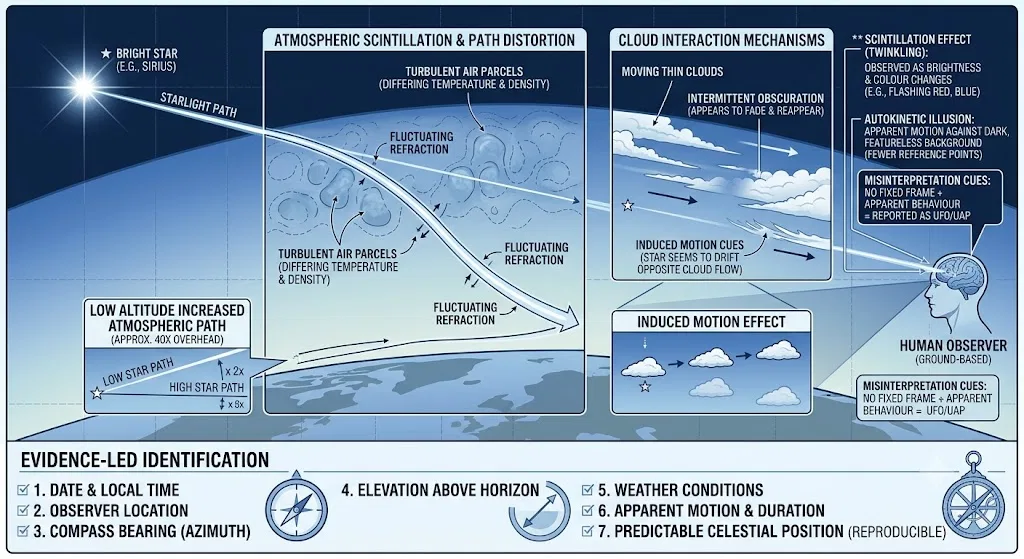
The familiar twinkling of stars is technically called scintillation. Starlight must cross the Earth’s atmosphere before reaching an observer. Turbulent parcels of air have slightly different temperatures and densities, and therefore different refractive properties. As those parcels move, they continually alter the path taken by the incoming light. To an observer, a point-like star can consequently brighten, dim and shift slightly from moment to moment.[ADS Abs]adsabs.harvard.eduADS AbsWhy do Stars Twinkle?by MW Ellison · 1952 · Cited by 6 — Scintillation consists of very rapid changes in the apparent brightness o…
The effect becomes particularly conspicuous near the horizon. Light from a low star passes obliquely through a much longer atmospheric path than light from the same star when it is high overhead. NASA’s StarChild astronomy material explicitly notes that stars close to the horizon twinkle more because there is substantially more atmosphere between observer and star.[StarChild]starchild.gsfc.nasa.govStar Child Why do stars twinkle?Why do stars twinkle? - StarChild - NASAThis is because there is a lot more atmosphere between you and a star near the horizon t…
That is one reason Sirius is such a convincing source of unusual-light reports. It is the brightest star in the night sky, and when low it can display conspicuous flashes of colour. The Royal Observatory Greenwich advises that a bright object which twinkles and appears to change colour is probably a star, giving Sirius as a specific example that can appear to flash blue and red, among other colours.[Royal Museums Greenwich]rmg.co.ukFor example, in winter in Britain Sirius is…Read more…
Those colours do not imply that Sirius is rapidly changing its intrinsic output. Turbulence and refraction momentarily direct different portions of its light towards the observer. The same atmosphere that makes the intensity fluctuate can also make the unresolved point image wander. Research on atmospheric scintillation treats these effects as a measurable limitation on high-precision ground-based astronomy, rather than merely a subjective impression.[arXiv]arxiv.orgarXiv Atmospheric Scintillation in Astronomical PhotometryarXiv Atmospheric Scintillation in Astronomical Photometry
This combination has obvious consequences for UFO interpretation. At night, without an obvious scale, a witness may not know whether a brilliant point is kilometres away or effectively at astronomical distance. A colour-flashing, apparently stationary light can therefore be interpreted as an aircraft, drone or hovering object whose coloured lamps are changing, even though no nearby object exists.
Historical investigators were well aware of the problem. A Project Blue Book explanatory document described astronomical sightings as the most common type of UFO report and specifically included bright stars and planets. It also noted that haze, light fog and moving clouds could make planets such as Venus, Jupiter and Mars appear unusual enough to be reported as unidentified objects.[ESD]esd.whs.milproj b1proj b1
The historical record also provides a caution, however: identifying a bright light as a star or planet should be demonstrated rather than asserted. Some Project Blue Book astronomical explanations became controversial precisely because critics argued that the proposed celestial body was not actually in the reported direction or otherwise failed to fit the observations. The lesson for present-day assessment is procedural: “probably a star” is a hypothesis to test against time, place and bearing, not a catch-all dismissal.[Wikipedia]WikipediaProject Blue BookProject Blue Book
Why a stationary star can appear to move
Atmospheric image motion is only one source of apparent manoeuvring. Human vision itself can make an unmoving light seem mobile when there are too few surrounding reference points.
The Federal Aviation Administration describes the autokinetic illusion as the apparent movement of a stationary point of light viewed against a dark, featureless background. A star is one of its explicit examples. After an observer fixates on the light for several seconds, it may seem to move, potentially even giving a pilot the impression that the light is approaching or lies on a collision course.[FAASafety]faasafety.govYour Senses In The ShadowsYour Senses in the Shadows. Nighttime Visual Illusions and Spatial… | by FAA Safety Briefing Magazine | Jan, 2025 | Medium…
This is directly relevant to reports of a “hovering object that suddenly started drifting”. In a black sky there may be no nearby frame against which the brain can reliably judge the point’s position. Small changes associated with fixation and visual processing can then be attributed to the light rather than to the observer’s perceptual system. FAA guidance recommends avoiding prolonged fixation and instead using a systematic visual scan — practical acknowledgement that visual confidence alone does not establish whether the light physically moved.[FAASafety]faasafety.govYour Senses In The ShadowsYour Senses in the Shadows. Nighttime Visual Illusions and Spatial… | by FAA Safety Briefing Magazine | Jan, 2025 | Medium…
The effect can be particularly persuasive when a witness is already trying to decide whether an unfamiliar light is an aircraft. Apparent motion may then seem to confirm that interpretation, even though the motion was the very perceptual effect that required checking.
A second mechanism becomes important when clouds are present. Psychologists call it induced motion: movement in a surrounding or background pattern can make a stationary target appear to move in the opposite direction. Experimental research describes induced motion as illusory target motion produced by movement of the visual background.[PubMed Central (PMC)]pmc.ncbi.nlm.nih.govOpen source on nih.gov.
The classic everyday example is the Moon apparently sailing through moving clouds. The same geometry can affect a bright star seen through gaps in a cloud deck. If the observer unconsciously treats the cloud field as the stable frame, the star may seem to slide or dart relative to it.[Isle]isle.hanover.eduOpen source on hanover.edu.
Cloud can make the effect more complicated still. A star passing behind thinner and thicker portions may brighten, fade, vanish and reappear while the cloud itself moves. That sequence can resemble a light accelerating, blinking or changing direction because the observer sees only intermittent samples of a fixed astronomical source. Project Blue Book’s explicit reference to moving clouds and obscuration in astronomical UFO reports shows that this was not merely a theoretical possibility but a recurring investigative consideration.[ESD]esd.whs.milproj b1proj b1
“It followed us” can be a geometry problem
A very distant light also behaves differently from a nearby object when the observer moves. Someone travelling along a road can see a bright star remain in roughly the same direction for a long period, while trees, buildings and lamp posts sweep rapidly past. Without a reliable sense of astronomical distance, that persistence can create the impression that the light is keeping pace with the vehicle.
The underlying reason is straightforward. A lateral movement of tens or hundreds of metres radically changes the viewing angle to nearby scenery but produces an immeasurably small directional change to a star many light-years away. Its apparent bearing therefore seems almost fixed over short journeys.
That apparent constancy should not be confused with the genuine nightly motion of the sky. Stars gradually change altitude and azimuth as the Earth rotates, and celestial objects visibly move across the sky over the course of an evening.[The Open University]open.eduOpen source on open.edu. A report lasting a minute or two may therefore describe something that “hovered”, while a longer observation should show a slow progression consistent with the surrounding celestial sphere.
For investigation, this distinction is useful. A light which appears to maintain a fixed place among the stars while foreground scenery changes is strongly suggestive of an astronomical source. A nearby aircraft or drone should ordinarily exhibit movement relative to the stellar background unless its geometry happens to keep it nearly on the observer’s line of sight.
How to check whether the “UFO” was a star
Astronomical identification is unusually testable because the sky can be reconstructed for a known location and time. Unlike an aircraft whose historical track may be unavailable, a sufficiently bright star has a predictable celestial position.
The minimum useful sighting record therefore needs more than a description such as “bright flashing object in the west”. Investigators should preserve:
- the date and local time, preferably with the time zone;
- the observer’s location;
- the direction, ideally a compass bearing or azimuth;
- the object’s elevation above the horizon;
- the duration of observation;
- weather, especially haze, cloud and visibility;
- whether the witness or viewing platform was moving;
- surrounding landmarks or stars that provide a positional reference.
This is not a modern refinement invented for UAP analysis. Project Blue Book documentation treated date, time, location, position in the sky and weather as information essential to evaluation; reports missing such elements could fall into an “insufficient data” category rather than being positively identified.[ESD]esd.whs.milproj b1proj b1
Once those data exist, the proposed astronomical object can be tested quantitatively. The US Naval Observatory provides celestial-navigation calculations giving the computed altitude and azimuth of celestial bodies for a specified place and time. Its services also calculate rise, set and transit times for selected bright stars and major Solar System bodies.[US Naval Observatory]aa.usno.navy.milOpen source on navy.mil.
That allows a strong identification to be framed as a positional match rather than an impression. For example, if a witness reports a brilliant scintillating light about 15 degrees above the south-eastern horizon at 22:10, an investigator can ask whether Sirius or another bright star actually occupied approximately that altitude and azimuth at that location and minute.
Several additional checks make the comparison stronger:
Does the reported direction fit? A candidate star many tens of degrees away from the reported bearing is not a satisfactory explanation simply because it was bright that night.
Does its elevation fit? Low elevation strengthens the expectation of strong scintillation and colour flashing because the light travels through more atmosphere.[StarChild]starchild.gsfc.nasa.govStar Child Why do stars twinkle?Why do stars twinkle? - StarChild - NASAThis is because there is a lot more atmosphere between you and a star near the horizon t…
Did it move at the celestial rate? Over a longer recording, a star should maintain its relationship to neighbouring stars while the whole field moves together.
Do disappearance events match cloud? Intermittent obscuration by moving cloud supports an astronomical source more readily than genuine rapid extinguishing and reappearance at unrelated positions.
Does the image include fixed references? An unzoomed frame containing rooftops, poles or the horizon is usually more diagnostically useful for apparent motion than a tightly zoomed video containing only a luminous dot.
Why video can make a star look less astronomical
A phone recording does not automatically resolve the ambiguity. A bright unresolved point recorded at high digital zoom can become a large blurred or saturated patch. Camera shake then makes it travel around the frame, autofocus changes its apparent size, and exposure adjustments can exaggerate variations in brightness. The absence of a horizon or fixed foreground object removes exactly the references needed to distinguish camera motion from target motion.
Atmospheric effects remain present as well. A video may therefore faithfully record real scintillation while simultaneously adding image-processing and hand-held movement. A luminous dot that rapidly changes colour on screen is not, by itself, evidence that the source carries coloured lights.
This is why positional corroboration matters more than the visual strangeness of a magnified point. The most informative recording is not necessarily the largest image of the light; it is often the one that preserves enough surrounding sky and landscape to establish where the light actually was.
The strongest conclusion comes from matching, not dismissing
Bright stars are a well-established source of UFO-like observations because the atmosphere and human visual system can transform a physically stable celestial point into something that seems active. Near the horizon, scintillation can produce rapid brightness and colour changes; turbulence can shift the apparent image; cloud can alternately obscure it and induce false motion; and fixation on an isolated light can generate autokinesis.[arxiv.org]arxiv.orgarXiv Atmospheric Scintillation in Astronomical PhotometryarXiv Atmospheric Scintillation in Astronomical Photometry
Those mechanisms explain why a sincere observer may report behaviour that sounds much more dramatic than “I saw a star”. They also show why witness credibility and object identification are separate questions: a person can accurately describe what the light appeared to do while being mistaken about the distance and physical source of that appearance.
For UAP governance and case assessment, the practical standard should therefore be reproducibility. An astronomical explanation becomes persuasive when a named star was demonstrably at the reported azimuth and elevation, under conditions capable of producing the reported scintillation or false motion. If the time, location or direction is missing, investigators should resist converting a plausible explanation into a definitive one. The same disciplined distinction between identified, insufficient data and genuinely unresolved reports that appeared in Project Blue Book remains useful here: the aim is not to label every stationary light a star, but to test whether the sky at that exact time and place already contained the object the witness described.[ESD]esd.whs.milproj b1proj b1
Amazon book picks
Further Reading
Books and field guides related to Why a Bright Star Can Look Like a UFO. Use these as the next step if you want deeper reading beyond the article.
NightWatch: A Practical Guide to Viewing the Universe
A practical guide to viewing the universe.
Turn Left at Orion
With over 100,000 copies sold since first publication, this is one of the most popular astronomy books of all time. It is a unique guideb...
The Stars: A New Way to See Them
Written with the primary purpose of enabling everyone to gain more pleasure from stargazing.
The Backyard Astronomer's Guide
Discusses the practical aspects of stargazing, including how to choose appropriate equipment, contending with light pollution, taking suc...
eBay marketplace picks
Marketplace Samples
Live-tested eBay searches with available results related to this page.
Selected fromUFO poster oneBay.co.uk.
Current eBay listing
VINTAGE UFO FLYING SAUCERS COMIC ADVERTISING A2 POSTER PRINT
Current eBay listing
I Want To Believe UFO Poster Giclée Fine Art Heavyweight Print
Endnotes
1.
Source: esd.whs.mil
Title: proj b1
Link:https://www.esd.whs.mil/Portals/54/Documents/FOID/Reading%20Room/UFOsandUAPs/proj_b1.pdf?ver=2017-05-22-113513-837
2.
Source: faasafety.gov
Title: Your Senses In The Shadows
Link:https://www.faasafety.gov/files/events/SO/SO15/2024/SO15134204/YourSensesInTheShadows.pdf
Source snippet
Your Senses in the Shadows. Nighttime Visual Illusions and Spatial… | by FAA Safety Briefing Magazine | Jan, 2025 | Medium...
3.
Source: arxiv.org
Title: arXiv Atmospheric Scintillation in Astronomical Photometry
Link:https://arxiv.org/abs/1506.06921
4.
Source: starchild.gsfc.nasa.gov
Title: Star Child Why do stars twinkle?
Link:https://starchild.gsfc.nasa.gov/docs/StarChild/questions/question26.html
Source snippet
Why do stars twinkle? - StarChild - NASAThis is because there is a lot more atmosphere between you and a star near the horizon t...
5.
Source: Wikipedia
Title: Project Blue Book
Link:https://en.wikipedia.org/wiki/Project_Blue_Book
6.
Source: faa.gov
Title: Federal Aviation Administration Spatial Disorientation
Link:https://www.faa.gov/sites/faa.gov/files/2022-01/Spatial%20Disorientation.pdf
7.
Source: open.edu
Link:https://www.open.edu/openlearn/ocw/mod/oucontent/view.php?id=114762§ion=2
8.
Source: Wikipedia
Link:https://en.wikipedia.org/wiki/Starlight
9.
Source: Wikipedia
Link:https://en.wikipedia.org/wiki/Twinkling
10.
Source: Wikipedia
Link:https://pt.wikipedia.org/wiki/Star
11.
Source: Wikipedia
Title: List of reported UFO sightings
Link:https://en.wikipedia.org/wiki/List_of_reported_UFO_sightings
12.
Source: Wikipedia
Title: Autokinetic effect
Link:https://en.wikipedia.org/wiki/Autokinetic_effect
13.
Source: Wikipedia
Title: Sensory illusions in aviation
Link:https://en.wikipedia.org/wiki/Sensory_illusions_in_aviation
14.
Source: Wikipedia
Title: Induced movement
Link:https://en.wikipedia.org/wiki/Induced_movement
15.
Source: arxiv.org
Link:https://arxiv.org/html/2411.02401v1
16.
Source: svs.gsfc.nasa.gov
Link:https://svs.gsfc.nasa.gov/
17.
Source: astronomy.com
Title: simply scintillating
Link:https://www.astronomy.com/science/simply-scintillating/
18.
Source: rmg.co.uk
Link:https://www.rmg.co.uk/stories/space-astronomy/what-was-bright-object-i-saw-sky-last-night
Source snippet
For example, in winter in Britain Sirius is...Read more...
19.
Source: adsabs.harvard.edu
Link:https://adsabs.harvard.edu/full/1952IrAJ….2….5E
Source snippet
ADS AbsWhy do Stars Twinkle?by MW Ellison · 1952 · Cited by 6 — Scintillation consists of very rapid changes in the apparent brightness o...
20.
Source: pmc.ncbi.nlm.nih.gov
Link:https://pmc.ncbi.nlm.nih.gov/articles/PMC9459461/
21.
Source: isle.hanover.edu
Link:https://isle.hanover.edu/Ch08Motion/Ch08InducedMotion.html
22.
Source: aa.usno.navy.mil
Link:https://aa.usno.navy.mil/data/celnav
23.
Source: aa.usno.navy.mil
Link:https://aa.usno.navy.mil/data/mrst
24.
Source: pubmed.ncbi.nlm.nih.gov
Link:https://pubmed.ncbi.nlm.nih.gov/7870529/
25.
Source: aa.usno.navy.mil
Link:https://aa.usno.navy.mil/data/AltAz
26.
Source: rmg.co.uk
Link:https://www.rmg.co.uk/stories/space-astronomy/astronomy-naked-eye
27.
Source: rmg.co.uk
Link:https://www.rmg.co.uk/schools-communities/teacher-resources/story-stars
28.
Source: acsu.buffalo.edu
Title: 8 Motion
Link:https://www.acsu.buffalo.edu/~jsawusch/PSY343/8-Motion.pdf
29.
Source: space.com
Title: why do stars twinkle
Link:https://www.space.com/why-do-stars-twinkle
30.
Source: space.com
Title: best stargazing apps
Link:https://www.space.com/best-stargazing-apps
Additional References
31.
Source: cia.gov
Link:https://www.cia.gov/readingroom/document/cia-rdp81r00560r000100010002-9
32.
Source: cia.gov
Link:https://www.cia.gov/readingroom/docs/CIA-RDP81R00560R000100010002-9.pdf
33.
Source: cia.gov
Link:https://www.cia.gov/readingroom/document/cia-rdp81r00560r000100010001-0
34.
Source: youtube.com
Title: The Celestial Bodies to Blame for Many UFO Sightings
Link:https://www.youtube.com/watch?v=KGawp7wBogk
Source snippet
Jupiter and Venus 'could be mistaken for UFOs'...
35.
Source: skybrary.aero
Link:https://skybrary.aero/articles/autokinetic-effect
36.
Source: instagram.com
Link:https://www.instagram.com/p/DUT_V0PE7v5/
37.
Source: reddit.com
Link:https://www.reddit.com/r/askastronomy/comments/1km43gs/can_anyone_prove_that_the_moons_movement_is/
38.
Source: ebsco.com
Link:https://www.ebsco.com/research-starters/health-and-medicine/depth-and-motion-perception
39.
Source: opencpn-manuals.github.io
Link:https://opencpn-manuals.github.io/main/celestial_navigation/_attachments/cel_nav_determining_the_position_and_motion_of_a_vessel_fr.pdf
40.
Source: instagram.com
Link:https://www.instagram.com/reel/C9uhzGJuRjr/?hl=en