Within UFO Identifications
When Drones Look More Mysterious Than Aircraft
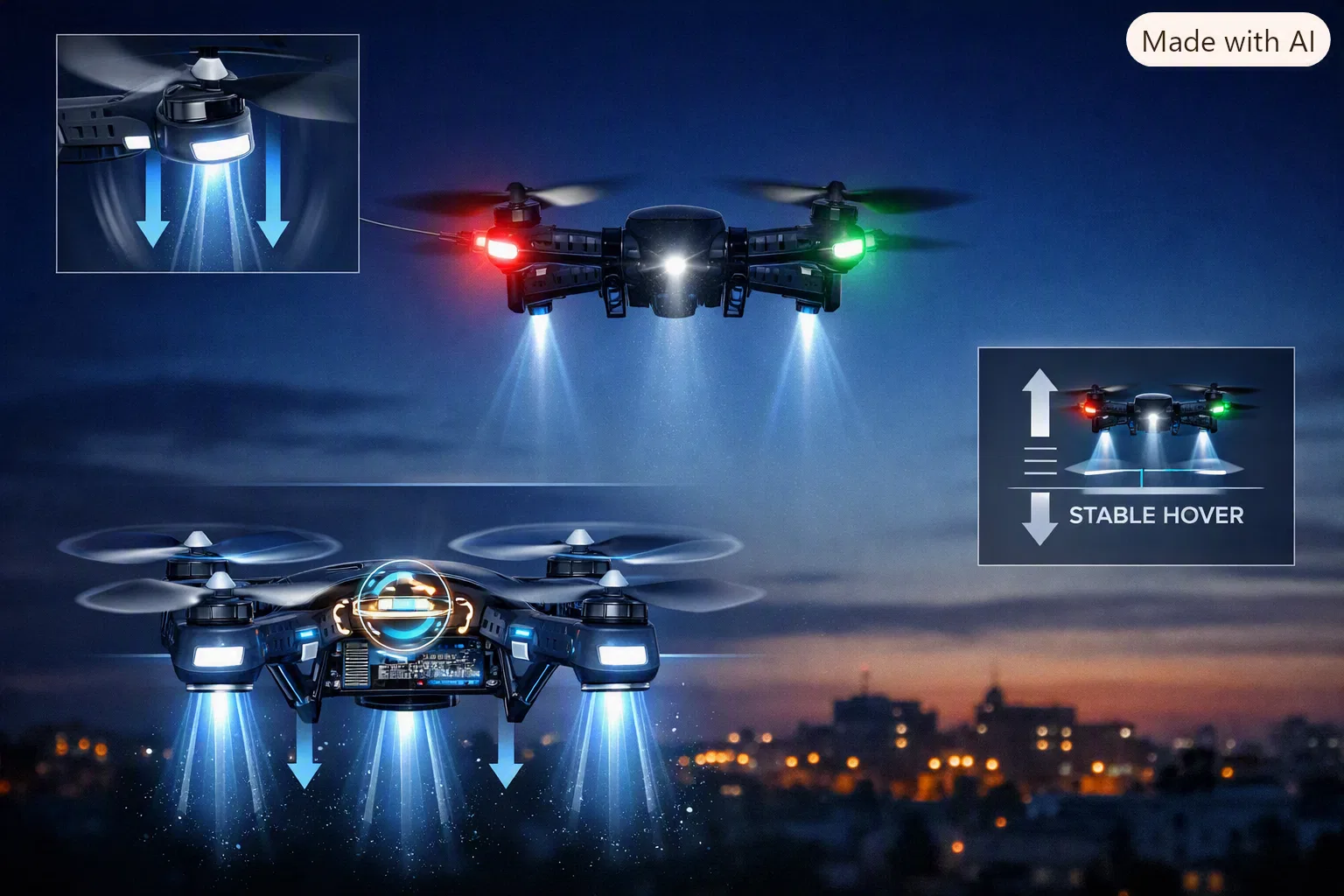
Small drones can hover, change direction abruptly and carry lights that obscure their true size and shape.
On this page
- Why drones are difficult to judge at distance
- Hovering lights and abrupt maneuvers
- Separating drone behavior from genuinely unknown motion
Page outline Jump by section
Introduction
Small drones can reproduce several behaviours that witnesses commonly describe as “UFO-like”: they can hover in one place, move sideways without a conventional turn, stop abruptly, reverse direction and carry lights bright enough to hide the aircraft’s actual outline. At night, a drone may therefore be perceived not as a recognisable machine but simply as a luminous point executing movements that ordinary aeroplanes cannot easily perform. Multirotor drones really can make unusually abrupt manoeuvres; experimental quadcopters have demonstrated high accelerations and complex three-dimensional trajectories.[arXiv]arxiv.orgAccurate Tracking of Aggressive Quadrotor Trajectories using Incremental Nonlinear Dynamic Inversion and Differential FlatnessSeptem…
The harder problem is judging what those movements mean. A distant light gives the eye few reliable clues to size, range or altitude. Without range, an observer cannot convert apparent angular motion into a trustworthy speed, and without a visible body there may be no scale reference at all. That combination makes drones a particularly important source of potentially misleading UFO/UAP reports — while also making it risky to assume that every strange light must be a drone.
Recent official data confirms that unmanned aerial systems are not merely a hypothetical explanation. In its FY2025 report, the US All-domain Anomaly Resolution Office (AARO) said that unmanned aerial systems were among the ordinary objects identified in resolved UAP cases. At the same time, AARO retained many other reports because there was insufficient information to determine what had happened.[AARO]aaro.milFY25 Consolidated Annual Report on UAPAARO FY25 Consolidated Annual Report on UAP…
Why drones are difficult to judge at distance
The basic difficulty is that seeing a drone and identifying a drone are two different tasks. A small multirotor that is obvious at close range rapidly becomes a featureless speck with increasing distance. A field study of small-drone visibility found that the probability of detection declined substantially with distance, illustrating how quickly a compact aircraft approaches the limits of useful human visual observation.[MDPI]mdpi.comDistance and Visual Angle of Line-of-Sight of a Small Droneby KW Li · 2020 · Cited by 19 — The purpose of this study is to determine… Related work cited in human-drone perception research found that, under favourable conditions, small consumer drones could become difficult for many observers to detect at distances of only a few hundred metres.[National Science Foundation]par.nsf.govNational Science FoundationExamining Distance in UAV Gesture Perception*by K Jelonek · 2022 · Cited by 1 — The study found that 245 m was…
At night the mismatch can be even greater: the airframe disappears before its lights do. US rules for many commercial night operations require small drones to carry anti-collision lighting visible from at least three statute miles.[Federal Aviation Administration]faa.govOpen source on faa.gov. That means a witness may see the light from much farther away than they could ever resolve the drone producing it.
This creates several perceptual traps.
The apparent object can seem much larger than the real aircraft. A bright light does not reveal the dimensions of the body carrying it. If a witness assumes that an unresolved light is kilometres away when it is actually hundreds of metres away, any inferred physical size will be greatly exaggerated.
Distance and speed become entangled. What the eye directly observes is a change in direction across the field of view. The same angular movement could represent a nearby object moving modestly or a faraway object travelling very quickly. Without an independent range measurement, an apparently astonishing speed may simply be an artefact of the assumed distance.
Brightness can obscure structure. A small, intense source spreads across neighbouring pixels in a camera and may also produce glare to the naked eye. The recorded object can consequently look like a glowing orb rather than a drone with arms, propellers and a fuselage.
Sound is not a reliable rescue clue. Multirotors produce a characteristic high-pitched propeller noise at close range, but that sound becomes harder to distinguish as distance increases or where wind, traffic or other ambient noise is present. Experts consulted by the Associated Press during the 2024 US drone-sighting wave similarly cautioned that a distant nighttime light may provide too little information to distinguish a drone confidently from an aeroplane or another object.[AP News]apnews.comOpen source on apnews.com.
A particularly revealing feature of that episode was the gap between reports of drones and confirmed drones. In December 2024, the FBI and Department of Homeland Security said investigators were still determining whether reported New Jersey objects were actually drones, crewed aircraft or inaccurate identifications.[FBI]fbi.govjoint dhs fbi statement on reports of drones in new jerseyjoint dhs fbi statement on reports of drones in new jersey A subsequent joint statement from the FBI, DHS, FAA and Department of Defense stressed that large numbers of lawful commercial, recreational and law-enforcement drones were operating in US airspace, adding a genuine drone population to an already complicated visual environment.[FBI]fbi.govDHS, FBI, FAA, and Do D Joint Statement on OngoingDHS, FBI, FAA, and Do D Joint Statement on Ongoing
That distinction matters for UFO investigation. Sometimes a drone is mistaken for something exotic. In other cases, an ordinary aircraft or astronomical source is first mistaken for a drone, after which the “drone” label itself acquires mysterious characteristics as reports accumulate.

Hovering lights and abrupt manoeuvres
Multirotor drones do something fixed-wing aircraft generally cannot: they can generate thrust while maintaining essentially the same position over the ground. Hovering is an ordinary design capability rather than evidence of exotic propulsion. Research on multirotor control treats sustained hover as a fundamental operating mode, including work specifically aimed at improving quadrotor stability while hovering.[MDPI]mdpi.comOpen source on mdpi.com.
The same flight architecture permits sharp changes of direction. A quadcopter alters the speed of individual rotors to change attitude and thrust direction. It does not need a long banking turn of the kind expected from a conventional aeroplane. From a witness’s perspective, it can therefore appear to stop, pivot, move laterally or reverse in a manner that feels aerodynamically “wrong” if the observer is mentally comparing it with an aeroplane.
This is not merely a qualitative difference. Researchers developing high-performance quadrotor controllers have demonstrated flight at up to 12.9 metres per second with accelerations reaching about 2.1 g while following complex trajectories.[arXiv]arxiv.orgAccurate Tracking of Aggressive Quadrotor Trajectories using Incremental Nonlinear Dynamic Inversion and Differential FlatnessSeptem… Such laboratory performance should not be treated as representative of every consumer drone, but it illustrates why “it changed direction too quickly to be an aircraft” is not, by itself, a strong argument against a small unmanned aircraft.
Lights make these manoeuvres harder to interpret. Consider a drone travelling towards an observer at night. With little sideways motion against the background, its bright forward-facing light may appear almost stationary. If it then turns sideways, its angular displacement suddenly becomes obvious. To the witness, a light that had been “hovering” can seem to shoot away without warning even though the drone simply changed its course relative to the line of sight.
Several other ordinary flight patterns can produce striking reports:
- Hover, then departure: station-keeping followed by ordinary forward flight can resemble an instantaneous transition from stationary to rapid motion if the range is badly estimated.
- Sideways translation: multirotors can move laterally without first rotating their entire body in the conspicuous way an observer might expect.
- Rapid yaw: the drone can rotate about its vertical axis while remaining in roughly the same place. If different lights face different directions, this may look like lights appearing, vanishing or changing colour.
- Several drones together: independently controlled aircraft can form lines, triangles or loose clusters. Their spacing may appear geometrically precise when viewed from one angle, especially when the airframes themselves are invisible.
- A light abruptly “going out”: a drone need not have disappeared or accelerated away. Its brightest lamp may simply have turned away from the observer, been obscured by the airframe or fallen below the camera’s detection threshold.
Real-world drone incidents show that prolonged nighttime activity and groups of aircraft are entirely feasible without invoking anomalous technology. AARO’s FY2025 report recorded 50 unmanned-aircraft incidents supplied by US nuclear-security authorities. Thirty-three involved a single UAS and the remainder involved between two and seven; 47 of the 50 occurred between 17:00 and 05:00, and some lasted an hour or more. Quadcopters were the most frequently reported form. Importantly, AARO explicitly said these particular incidents were reported as UAS incidents rather than UAP.[AARO]aaro.milFY25 Consolidated Annual Report on UAPAARO FY25 Consolidated Annual Report on UAP…
That last point is useful precisely because the events were not mysterious. Multiple drones, flying at night near sensitive locations for extended periods, are an observed operational reality. Similar behaviour in a setting where observers lack identifying information can readily become the raw material of a UFO report.
Camera geometry can manufacture extraordinary motion
Drones are especially vulnerable to misinterpretation when the camera itself is moving. The key effect is motion parallax: relative movement between the observer, background and target can make a slow nearby object appear to cross the scene far faster than it actually travels.
AARO’s analysis of the well-known 2013 Aguadilla, Puerto Rico infrared recording provides a useful demonstration of the mechanism, even though AARO ultimately assessed the objects as probable sky lanterns rather than drones. The video appeared to show objects moving rapidly around an airport, separating and seemingly interacting with the sea. By reconstructing the aircraft’s own flight path and the infrared sensor’s viewing geometry, AARO calculated that the objects were actually drifting at roughly wind speed. It attributed their apparent high velocity to motion parallax combined with the aircraft’s movement, sensor zoom and changing line of sight.[AARO]aaro.milPuerto Rico UAP Case ResolutionPuerto Rico UAP Case Resolution
The lesson transfers directly to drone reports. A video can show dramatic image-plane motion without establishing dramatic physical acceleration. Before concluding that a drone-sized light performed an extraordinary manoeuvre, an investigator needs to know whether the apparent change might instead have resulted from:
Camera movement. A small pan or rotation can shift an unresolved target rapidly across the frame.
Observer movement. Footage recorded from a car, aircraft or other moving platform adds another velocity vector that must be separated from the target’s own motion.
Zoom changes. Digital or optical zoom can alter the apparent rate of motion and make small hand movements look much larger.
Unknown range. Angular velocity alone does not establish linear velocity. A trustworthy calculation needs a defensible estimate of distance.
Loss of visual contact. A light disappearing between frames is not evidence that an object physically vanished. It may have dimmed, rotated, entered cloud, passed behind an obstruction or fallen below the sensor’s sensitivity.
AARO’s recent reporting reflects how decisive such missing measurements can be. Of 319 reports covered by its FY2025 annual assessment, 191 were transferred to an active archive because corroborating information was insufficient to establish whether their performance was ordinary or genuinely outside known technological limits. AARO explicitly identified the continuing lack of timely, actionable sensor data as a constraint on case resolution.[AARO]aaro.milFY25 Consolidated Annual Report on UAPAARO FY25 Consolidated Annual Report on UAP…
That is why the most dramatic phrase in a witness report — “instant acceleration”, for example — is better treated as a proposition to be tested than as a measured property of the object.

Separating drone behaviour from genuinely unknown motion
A drone hypothesis becomes stronger when several independent observations fit together. Hovering by itself is weak evidence; hovering combined with low altitude, multirotor-like directional changes, intermittent nearby buzzing, lighting compatible with a small aircraft and a plausible operating location is much more informative. Conversely, declaring an object a drone simply because it behaves strangely is circular reasoning.
The strongest investigations therefore try to replace impressions with measurable quantities.
Establish the observation geometry first. Investigators need the observer’s position, viewing direction, elevation angle and, wherever possible, target range. Buildings, ridgelines, clouds and mapped landmarks can sometimes provide useful distance constraints.
Preserve the original recording. Cropped, stabilised, recompressed or slowed social-media footage can remove metadata and conceal camera movements. The full sequence before and after the interesting manoeuvre is often more valuable than a dramatic excerpt.
Compare against local aviation activity. Conventional aircraft must remain in the candidate set because distant aeroplanes seen almost head-on can also look stationary. During the 2024 US sightings, aviation specialists repeatedly stressed how difficult it was to classify isolated nighttime lights from appearance alone.[AP News]apnews.comOpen source on apnews.com.
Look for actual multirotor signatures rather than generic strangeness. Sharp lateral translation, station-keeping and abrupt changes between hover and movement are consistent with multirotor operation. They do not prove it, but they are more diagnostic than simply describing something as “fast” or “silent”.
Demand better evidence before accepting extraordinary performance. A claim that a light crossed kilometres in a second requires the kilometres to have been measured, not inferred from an assumed object size. Likewise, an apparent right-angle turn is not a physically quantified acceleration unless frame timing, range and trajectory are known.
This evidential discipline cuts both ways. It prevents ordinary drones from being upgraded into apparently impossible craft, but it also prevents “drone” from becoming a catch-all explanation applied to every unresolved report. AARO’s FY2025 findings illustrate the distinction: it resolved hundreds of cases as ordinary objects, including UAS, yet still retained reports for further analysis or archival review when the necessary data were absent.[AARO]aaro.milFY25 Consolidated Annual Report on UAPAARO FY25 Consolidated Annual Report on UAP…
The practical takeaway
Drones deserve particular attention in modern UFO/UAP investigations because their real capabilities overlap unusually well with behaviours that can seem anomalous to a distant observer. Hovering, lateral movement, abrupt stops, reversals, formation flight and conspicuous lighting are all technologically ordinary for the relevant classes of unmanned aircraft. Their small physical size also means the body can disappear from view while a bright light remains visible, stripping away the visual clues normally used to estimate distance and speed.[Federal Aviation Administration]faa.govOpen source on faa.gov.
But the useful conclusion is not that strange aerial behaviour is “probably a drone” in every case. It is that drone-like explanations should be tested quantitatively before unusual motion is treated as genuinely anomalous. Recent AARO reporting demonstrates both sides of that standard: unmanned aircraft continue to appear among resolved UAP cases, while cases lacking sufficient sensor data are not automatically assigned an ordinary explanation.[AARO]aaro.milFY25 Consolidated Annual Report on UAPAARO FY25 Consolidated Annual Report on UAP…
For a distant nighttime sighting, the decisive question is therefore rarely whether the light looked extraordinary. It is whether the observation contains enough independent information to establish the object’s range, trajectory and acceleration. Until those quantities are constrained, a small hovering drone carrying a bright light can look far more mysterious than its actual flight performance warrants.

Amazon book picks
Further Reading
Books and field guides related to When Drones Look More Mysterious Than Aircraft. Use these as the next step if you want deeper reading beyond the article.
Make: Drones: Teach an Arduino to Fly
Make: Drones will help the widest possible audience understand how drones work by providing several DIY drone projects based on the world...
Introduction to UAV Systems
Unmanned aerial vehicles (UAVs) have been widely adopted in the military world over the last decade and the success of these military app...
Small Unmanned Aircraft: Theory and Practice
Includes bibliographical references (p. [291]-298) and index.
The Drone Pilot's Handbook
The perfect companion for anyone buying (or thinking of buying) a drone, whether it's just for fun, to race against friends, or to give t...
eBay marketplace picks
Marketplace Samples
Live-tested eBay searches with available results related to this page.
Selected fromUFO poster oneBay.co.uk.

Current eBay listing
VINTAGE UFO FLYING SAUCERS COMIC ADVERTISING A2 POSTER PRINT

Current eBay listing
I Want To Believe UFO Poster Giclée Fine Art Heavyweight Print

Endnotes
1.
Source: arxiv.org
Link:https://arxiv.org/abs/1809.04048
Source snippet
Accurate [Tracking]({{ 'tracking/' | relative_url }}) of Aggressive Quadrotor Trajectories using Incremental Nonlinear Dynamic Inversion and Differential FlatnessSeptem...
2.
Source: aaro.mil
Title: FY25 Consolidated Annual Report on UAP
Link:https://www.aaro.mil/Portals/136/PDFs/FY25%20UAP%20Annual%20Report/AARO_FY2025_Consolidated_Annual_Report_on_UAP.pdf
Source snippet
AARO FY25 Consolidated Annual Report on UAP...
3.
Source: mdpi.com
Link:https://www.mdpi.com/2076-3417/10/16/5501
Source snippet
Distance and Visual Angle of Line-of-Sight of a Small Droneby KW Li · 2020 · Cited by 19 — The purpose of this study is to determine...
4.
Source: faa.gov
Link:https://www.faa.gov/uas/commercial_operators/operations_over_people
5.
Source: fbi.gov
Title: joint dhs fbi statement on reports of drones in new jersey
Link:https://www.fbi.gov/news/press-releases/joint-dhs-fbi-statement-on-reports-of-drones-in-new-jersey
6.
Source: fbi.gov
Title: DHS, FBI, FAA, and Do D Joint Statement on Ongoing
Link:https://www.fbi.gov/news/press-releases/dhs-fbi-faa-and-dod-joint-statement-on-ongoing-response-to-reported-drone-sightings
7.
Source: mdpi.com
Link:https://www.mdpi.com/2504-3110/8/11/634
8.
Source: aaro.mil
Title: Puerto Rico UAP Case Resolution
Link:https://www.aaro.mil/Portals/136/PDFs/case_resolution_reports/AARO_Puerto_Rico_UAP_Case_Resolution.pdf
9.
Source: aaro.mil
Link:https://www.aaro.mil/UAP-Cases/Official-UAP-Imagery/
10.
Source: aaro.mil
Link:https://www.aaro.mil/
11.
Source: aaro.mil
Title: AARO Historical Record Report Vol 1 2024
Link:https://www.aaro.mil/Portals/136/PDFs/AARO_Historical_Record_Report_Vol_1_2024.pdf
12.
Source: aaro.mil
Link:https://www.aaro.mil/Submit-A-Report/
13.
Source: aaro.mil
Title: Case Resolution of Eglin UAP 2 508
Link:https://www.aaro.mil/portals/136/PDFs/case_resolution_reports/Case_Resolution_of_Eglin_UAP_2508.pdf
14.
Source: aaro.mil
Link:https://www.aaro.mil/FAQ/
15.
Source: aaro.mil
Link:https://www.aaro.mil/Portals/136/PDFs/AARO_Mission_Brief_2025.pdf
16.
Source: aaro.mil
Title: Next UAP Report Documents
Link:https://www.aaro.mil/Next-AARO-Home-redesign/Next-Parent/Next-UAP-Report-Documents/
17.
Source: aaro.mil
Link:https://www.aaro.mil/UAP-Cases/UAP-Case-Resolution-Reports/
18.
Source: media.defense.gov
Title: FY24 CONSOLIDATED ANNUAL REPORT ON UAP 508
Link:https://media.defense.gov/2024/Nov/14/2003583603/-1/-1/0/FY24-CONSOLIDATED-ANNUAL-REPORT-ON-UAP-508.PDF
19.
Source: defense.gov
Title: department of defense releases the annual report on unidentified anomalous phen
Link:https://www.defense.gov/News/Releases/Release/Article/3964824/department-of-defense-releases-the-annual-report-on-unidentified-anomalous-phen/
20.
Source: media.defense.gov
Title: DOPSR 2024 0263 AARO HISTORICAL RECORD REPORT VOLUME 1 2024
Link:https://media.defense.gov/2024/Mar/08/2003409233/-1/-1/0/DOPSR-2024-0263-AARO-HISTORICAL-RECORD-REPORT-VOLUME-1-2024.PDF
21.
Source: defense.gov
Title: dod report discounts sightings of extraterrestrial technology
Link:https://www.defense.gov/News/News-Stories/Article/Article/3701297/dod-report-discounts-sightings-of-extraterrestrial-technology/
22.
Source: defense.gov
Title: dod examining unidentified anomalous phenomena
Link:https://www.defense.gov/News/News-Stories/Article/Article/3965403/dod-examining-unidentified-anomalous-phenomena/
23.
Source: defense.gov
Link:https://www.defense.gov/
24.
Source: media.defense.gov
Title: DOD OIG FY2023 FOIA LOG (REDACTED)
Link:https://media.defense.gov/2025/Mar/20/2003673001/-1/-1/1/DOD%20OIG%20FY2023%20FOIA%20LOG%20%28REDACTED%29.PDF
25.
Source: defense.gov
Title: media engagement with acting aaro director tim phillips on the historical recor
Link:https://www.defense.gov/News/Transcripts/Transcript/Article/3702219/media-engagement-with-acting-aaro-director-tim-phillips-on-the-historical-recor/
26.
Source: defense.gov
Link:https://www.defense.gov/About/Biographies/Biography/Article/3884328/dr-jon-t-kosloski/
27.
Source: defense.gov
Title: statement by pentagon press secretary maj gen pat ryder on the historical recor
Link:https://www.defense.gov/News/Releases/Release/Article/3700894/statement-by-pentagon-press-secretary-maj-gen-pat-ryder-on-the-historical-recor/
28.
Source: defense.gov
Link:https://www.defense.gov/News/Tag/246580/uap/
29.
Source: media.defense.gov
Title: FOIA LOG
Link:https://media.defense.gov/2025/May/30/2003728332/-1/-1/0/FOIA%20LOG%20OCTOBER%201%2C%202024%20-%20DECEMBER%2031%2C%202024%20REDACTED.PDF
Published: October 1, 2024
30.
Source: media.defense.gov
Title: FOIA LOG
Link:https://media.defense.gov/2025/May/30/2003728335/-1/-1/0/FOIA%20LOG%20JANUARY%201%2C%202025%20-%20MARCH%2031%2C%202025%20REDACTED.PDF
Published: January 1, 2025
31.
Source: fbi.gov
Title: FB I Newark Seeks Information on Drone Sightings
Link:https://www.fbi.gov/contact-us/field-offices/newark/news/fbi-newark-seeks-information-on-drone-sightings
32.
Source: fbi.gov
Link:https://www.fbi.gov/feeds/email-alerts/newark-news/RSS
33.
Source: fbi.gov
Link:https://www.fbi.gov/feeds/national-press-releases/RSS
34.
Source: fbi.gov
Link:https://www.fbi.gov/news/atom.xml
35.
Source: faa.gov
Link:https://www.faa.gov/faq/beyond-visual-line-sight-bvlos-operations-are-anti-collision-lights-required
36.
Source: faa.gov
Title: getting started
Link:https://www.faa.gov/uas/getting_started
37.
Source: faa.gov
Title: small unmanned aircraft systems uas regulations part 107
Link:https://www.faa.gov/newsroom/small-unmanned-aircraft-systems-uas-regulations-part-107
38.
Source: faa.gov
Title: part 107 waivers
Link:https://www.faa.gov/uas/commercial_operators/part_107_waivers
39.
Source: faa.gov
Title: 107 WSEGs and GQs
Link:https://www.faa.gov/sites/faa.gov/files/107WSEGsandGQs-06-23-2023-TOC.pdf
40.
Source: faa.gov
Link:https://www.faa.gov/media/93506
41.
Source: faa.gov
Link:https://www.faa.gov/documentLibrary/media/Advisory_Circular/Editorial_Update_AC_107-2A.pdf
42.
Source: faa.gov
Link:https://www.faa.gov/newsroom/BVLOS_NPRM_website_version.pdf
43.
Source: faa.gov
Link:https://www.faa.gov/sites/faa.gov/files/data_research/research/med_humanfacs/oamtechreports/201409.pdf
44.
Source: faa.gov
Link:https://www.faa.gov/regulations_policies/rulemaking/committees/documents/media/UAS_BVLOS_ARC_FINAL_REPORT_03102022.pdf
45.
Source: faa.gov
Link:https://www.faa.gov/media/91976
46.
Source: mdpi.com
Link:https://www.mdpi.com/2226-4310/11/12/994
47.
Source: arxiv.org
Link:https://arxiv.org/html/2607.10605v1
48.
Source: par.nsf.gov
Link:https://par.nsf.gov/servlets/purl/10416936
Source snippet
National Science FoundationExamining Distance in UAV Gesture Perception*by K Jelonek · 2022 · Cited by 1 — The study found that 245 m was...
49.
Source: apnews.com
Link:https://apnews.com/article/57a0d051a2a94d21787089ceaf47b175
50.
Source: uapcompany.com
Link:https://www.uapcompany.com/about
Additional References
51.
Source: war.gov
Link:https://www.war.gov/ufo/
52.
Source: youtube.com
Title: Drone swarm mystery and new UAP revelations | UFO Mysteries
Link:https://www.youtube.com/watch?v=JXB39hZ60RE
Source snippet
UFO Or Drone? Demonstration Of Consumer Drones Flying At Night...
53.
Source: youtube.com
Title: UFO Videos Explained: Mick West’s Expert Analysis
Link:https://www.youtube.com/watch?v=-_4QF__92q0
Source snippet
Drone swarm mystery and new UAP revelations | UFO Mysteries...
54.
Source: researchgate.net
Link:https://www.researchgate.net/publication/373281880_Comprehensive_review_of_various_control_strategies_for_quadrotor_unmanned_aerial_vehicles
55.
Source: zenatech.com
Link:https://www.zenatech.com/drone-night-flying-guide/
56.
Source: researchgate.net
Link:https://www.researchgate.net/publication/343553000_Distance_and_Visual_Angle_of_Line-of-Sight_of_a_Small_Drone
57.
Source: betalight-tactical.com
Link:https://betalight-tactical.com/product/anti-collision-drone-lights
58.
Source: ebay.com
Link:https://www.ebay.com/itm/397693343362?mkevt=1&mkcid=1&mkrid=710-53481-19255-0&campid=5339151051&customid=endnote-source&toolid=10001
59.
Source: facebook.com
Link:https://www.facebook.com/groups/mcphersoncommunity/posts/26468647042837904/
60.
Source: jrupprechtlaw.com
Link:https://jrupprechtlaw.com/section-107-29-operations-at-night/