Within Reflections
Why Lens Ghosts Can Look Like Solid UFOs
Internal camera reflections can produce discs, rings, polygons or colored patches that resemble distinct objects in the sky.
On this page
- How internal reflections create secondary images
- Why ghost shapes differ from their light source
- What repeated ghosts across video frames really prove
Page outline Jump by section
Introduction
A lens ghost can look much more like a manufactured object than the phrase “lens flare” suggests. Instead of a vague wash of glare, internal reflections in a camera can produce a sharply bounded disc, ring, hexagon, coloured patch or even a recognisable duplicate of a bright source. The sensor records that shape as real image data even though no corresponding object occupies that part of the sky. Optical engineers call these unwanted secondary images “ghosts”, and manufacturers deliberately design lenses and coatings to suppress them.[edmundoptics.co.uk]edmundoptics.co.ukEdmund OpticsVideo Tutorial: What are Ghost Images?Iris and Aperture Mounts; Shutters. Accessories. View All; Tools… Most imaging lens…
That distinction matters when assessing UFO or UAP photographs. A geometric outline, stable colour and repeated appearance across several frames do not by themselves establish that the camera photographed a solid airborne object. Those properties can arise naturally from the fixed geometry of the camera’s own optical system. The useful question is therefore not simply whether the shape looks structured, but whether its position, shape and behaviour are tied to a bright source and the camera.
How internal reflections create secondary images
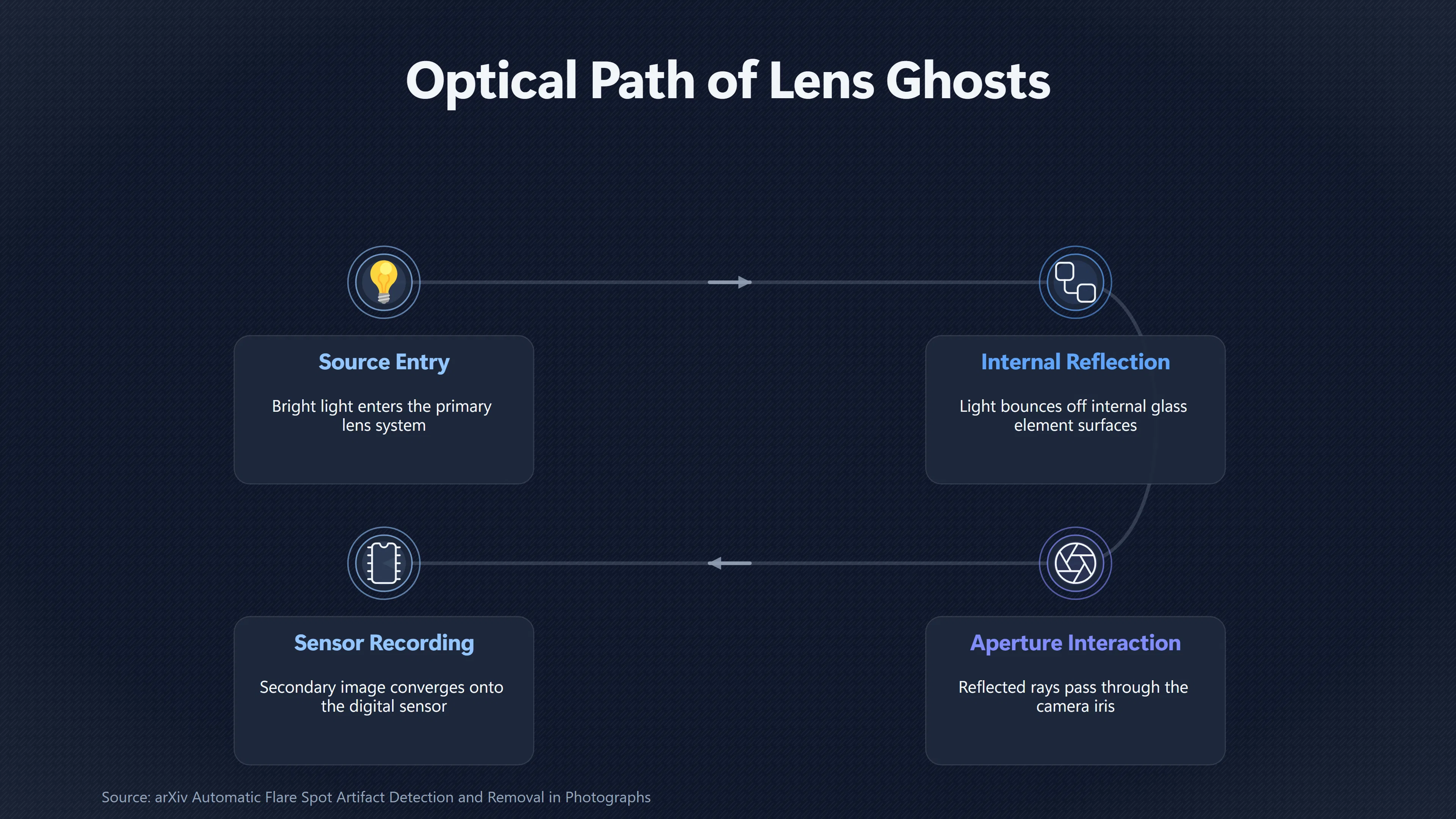
A photographic lens is not a single piece of glass. Modern lenses contain multiple elements, each with surfaces where most incoming light is transmitted but a small fraction can be reflected. A sufficiently bright source — the Sun, a street lamp, vehicle headlight or intense spotlight, for example — can therefore send light along unintended paths through the optical system.
One common route involves light reaching the sensor or another reflective surface, travelling back towards the lens and then being reflected towards the sensor again. Edmund Optics defines an optical ghost as a faint secondary image caused by reflections within an optical component and specifically describes reflected light being redirected and focused back onto the camera sensor.[Edmund Optics]edmundoptics.comEdmund Optics Video Tutorial: What are Ghost Images? | Edmund OpticsEdmund Optics Video Tutorial: What are Ghost Images? | Edmund Optics
The important point is that the second arrival is not necessarily an amorphous glow. The reflected rays still pass through an image-forming optical system. They can consequently converge into a localised secondary image. Photographic optics literature has described such repeated internal reflections producing “flare spots” or ghost images for many decades, while modern computer-vision research treats reflective ghosts as a distinct, measurable camera artefact.[optica.org]opg.optica.orgOptica Publishing GroupThe Development of the Photographic Objective 1by R Kingslake · 1934 · Cited by 16 — Sometimes, too, these repeate…
Multiple reflecting surfaces also mean multiple possible paths. A complicated lens may therefore produce several ghosts from one intense source, sometimes forming a sequence of coloured discs or polygons. This is one reason that counting the apparent “objects” in an image is unsafe until the camera optics have been considered: several recorded lights need not represent several external objects.
Anti-reflection coatings reduce the amount of light available for these unwanted paths, but do not make lenses immune. Nikon describes its coatings in terms of reducing internal lens-element reflections and ghosting, while Sigma and other manufacturers similarly advertise coatings and lens hoods as measures for suppressing flare and ghost images.[nikonimgsupport.com]nikonimgsupport.comNikon Image Support Glossary of NIKKOR Lens TermsNikon Image SupportGlossary of NIKKOR Lens Terms - Support Articles15 Jan 2019 — It virtually eliminates internal lens element reflection…
Why ghost shapes can look engineered
The surprisingly geometric appearance of some ghosts is not evidence that something geometric was flying in front of the camera. In particular, a ghost can reproduce the geometry of the lens aperture.
Panasonic’s technical explanation of flare and ghosting states that when the relevant reflections occur on opposite sides of the aperture, the resulting ghost takes the aperture’s shape.[Panasonic Support]av.jpn.support.panasonic.comPanasonic SupportLens Characteristics: Flare, Ghosting and Aberration | Digital Camera Know-Hows | Digital Camera | Digital AV | Support… This provides a straightforward route to apparently artificial forms. An iris made from several blades can have a polygonal opening rather than a perfect circle, so its optical ghost may appear as a hexagon or another many-sided figure.
Optical modelling demonstrates the same principle more explicitly. When an optical system is given a hexagonal aperture, internally reflected stray light can generate faint hexagonal parasite images of that aperture.[System & Optics]systemandoptics.comOpen source on systemandoptics.com. The apparent “craft outline” is therefore telling the observer something about the camera rather than necessarily revealing the silhouette of an object.
Other reflection paths produce different structures. Depending on the camera and shooting conditions, ghosts may be:
- filled or hollow discs;
- rings or concentric patches;
- sharply bounded polygons;
- translucent coloured blobs;
- repeated copies of a bright source;
- strings of several differently sized flare spots;
- patterned ghosts containing features inherited from the source or imaging system.
The colour can be particularly misleading. Ghosts need not have the same colour as the light that created them. Classical optical work notes that different ghost images can have different colours, while modern flare research likewise treats colour and spectral variation as characteristic properties of flare. Coatings, sensor response and wavelength-dependent reflection all influence what finally reaches the recorded image.[Optica Publishing Group]opg.optica.orgOpen source on optica.org.
A green or purple “orb” beside a white street light is therefore not necessarily a second, differently coloured source in the sky.
A ghost may contain genuine-looking detail
Perhaps the most counter-intuitive feature of lens ghosts is that some contain internal detail. That can make them especially persuasive as purported UFO photographs because observers reasonably associate detail with a physical object.
Yet the detail itself may be optical information.
A bright source can be reproduced sufficiently faithfully for its structure to survive in the secondary image. Smartphone examples have produced patterned flare spots associated with sensor architecture, while other examples reproduce features lying across the original bright source. Documented tests include ghost images of the Sun containing patterns associated with phase-detection autofocus pixels and another phone-camera ghost in which tree branches crossing the real Sun were reproduced in the reflected image.[Metabunk]metabunk.orgOrbs with DotsOrbs with Dots
This changes how features such as “windows”, dots or panels should be interpreted. Regular internal markings do not automatically strengthen an extraterrestrial or aircraft interpretation. If they repeat the structure of the original light, aperture or sensor, their regularity can instead strengthen the optical explanation.
Large illuminated objects can also generate something closer to a duplicate image than a simple orb. In such circumstances, the ghost may be inverted or displaced relative to the original source. The result can resemble a luminous structure floating in an otherwise empty region of sky.
Position relative to the bright source is a powerful clue
Reflective flare is constrained by optical geometry. That makes the location of a suspicious object within the frame more informative than its resemblance to a familiar UFO shape.
Research on smartphone reflective-flare removal has exploited a particularly useful relationship: the bright source and its reflective ghost tend to lie symmetrically around the camera’s optical centre. Dai and colleagues used this “optical centre symmetry prior” specifically to identify reflective flare in night-time smartphone photographs.[arXiv]arxiv.orgOpen source on arxiv.org. Other modern flare-removal research likewise models the characteristic symmetric behaviour of reflected ghosts.[arXiv]arxiv.orgarXiv Toward Real Flare Removal: A Comprehensive Pipeline and A New BenchmarkarXiv Toward Real Flare Removal: A Comprehensive Pipeline and A New Benchmark
In a simple case, draw an imaginary line from a bright lamp through the optical centre of the image. A suspicious green disc on roughly the continuation of that line, on the opposite side of the frame, deserves immediate scrutiny as a ghost.
The relationship need not look mathematically perfect in every processed photograph. Real camera systems contain many optical surfaces, lenses are not all simple symmetric systems, and smartphones apply stabilisation and computational processing. Different reflection paths can also generate several flare features simultaneously. The symmetry test is therefore a diagnostic clue rather than a universal rule.
But when several clues coincide — an intense source, an opposite-side ghost, matching camera motion and disappearance when the source is blocked — the combined optical explanation becomes substantially stronger than an argument based merely on the object’s visual appearance.
Why the ghost can differ dramatically from its source
A frequent objection to a lens-ghost explanation is that the supposed UFO “doesn’t look anything like the light”. Optically, that is not surprising.
The ordinary image and the ghost travel along different paths. The normal image follows the path the lens was designed to focus. Ghost light may bounce between two or more surfaces, interact with the aperture and reach the sensor substantially defocused. Its brightness, colour, scale and sharpness can therefore differ from those of the source that generated it. Research into flare removal has to accommodate precisely this diversity: flare can manifest as halos, streaks, haze, coloured regions and reflective ghosts rather than as one standard visual template.[arXiv]arxiv.orgarXiv How to Train Neural Networks for Flare RemovalarXiv How to Train Neural Networks for Flare Removal
This is why a tiny white lamp can correspond to a large translucent green disc, or why the Sun can generate a small polygon far from the overwhelmingly bright solar image. The ghost’s apparent dimensions are dimensions on the sensor, governed by the optical reflection path. They do not provide a straightforward angular size for a separate object in the distant scene.
That point is crucial for UFO interpretation. Treating a ghost as though it were an ordinary distant target and then estimating its physical diameter from an assumed range builds a size calculation on a false premise. If the feature originates inside the imaging system, it has no external range to estimate.
What repeated ghosts across video frames really prove
Video often makes an optical artefact seem more convincing because it persists. A disc that survives for ten seconds, retains its outline and moves smoothly can feel more “real” than an isolated photographic anomaly.
But persistence is exactly what a stable optical system can produce.
As long as the bright source continues entering the lens along a suitable path, essentially the same internal surfaces can generate the same family of ghosts from frame to frame. A fixed aperture geometry can repeatedly produce the same polygon. A particular reflection path can repeatedly produce the same ring. Stable appearance therefore establishes that the camera repeatedly recorded a pattern; it does not, by itself, establish that the pattern was an independent external object.
A useful real-world illustration comes from International Space Station imagery discussed in an analysis of a ring-like “donut UFO”. The feature appeared repeatedly under similar lighting conditions, with its occurrence tracking other flare behaviour and a bright reflection on spacecraft structure. The repetition supported an optical explanation rather than requiring a repeatedly appearing object outside the station.[Metabunk]metabunk.orgISS "Donut UFOISS "Donut UFO
Frame-to-frame motion can be even more diagnostic. If the camera pans, the source’s location relative to the optical axis changes and the corresponding ghost should respond according to that optical geometry. A ghost can therefore glide across the sky, reverse direction relative to the scene or appear to accelerate when the camera moves.
This is why the right comparison is not simply “does the UFO move?” but “how does its motion relate to the camera, optical centre and candidate source?”
Structured appearance is weaker evidence than structured behaviour
Lens ghosts illustrate a broader problem in interpreting UFO imagery: visual complexity is not the same as independent physical existence.
A feature can be genuinely present in the digital file and still not have been present at that apparent location in the outside world. No compositing or deliberate manipulation is necessary. Optical research has even demonstrated that lens-flare and ghost mechanisms can introduce spurious patterns capable of confusing automated camera-based object-recognition systems, underscoring that the phenomenon is physical at the camera level rather than merely a subjective visual illusion.[arXiv]arxiv.orgOpen source on arxiv.org.
For practical analysis, several relationships are therefore more valuable than asking whether a feature “looks like a craft”:
Look for the energy source. Search the entire frame for the Sun, Moon, lamps, headlights, floodlights or intense reflections. Remember that a source just outside the frame can also introduce flare; lens manufacturers specifically warn that bright illumination outside the photographed area can generate flare and ghost images.[Sigma Global]sigma-global.comSigma Global20mm F1.4 DG DN | ArtSigma Global20mm F1.4 DG DN | Art
Check the optical centre. A source and suspicious spot arranged approximately on opposite sides of the image centre are characteristic of common reflective-flare geometry.[arXiv]arxiv.orgOpen source on arxiv.org.
Compare motion rather than appearance. In video, determine whether the alleged object responds predictably when the camera pans, tilts or rotates. Correlated movement can expose a camera-centred phenomenon.
Look for aperture geometry. A remarkably regular polygon may be less mysterious, not more, if its outline corresponds to the lens’s aperture.[Panasonic Support]av.jpn.support.panasonic.comPanasonic SupportLens Characteristics: Flare, Ghosting and Aberration | Digital Camera Know-Hows | Digital Camera | Digital AV | Support…
Test whether the ghost depends on the source. When circumstances permit controlled reproduction, moving or blocking the bright source, changing the camera angle, shading the lens or repeating the shot with another camera can be highly informative. A distant aircraft should not vanish merely because a street lamp is shielded from the camera lens.
These tests are stronger when applied together. None requires assuming in advance that every unusual photograph is lens flare.
What a camera recording can and cannot establish
NASA’s UAP study has stressed the importance of calibrated observations, multiple measurements and complete sensor metadata because isolated imagery often lacks enough information for firm scientific conclusions.[NASA]nasa.govUPDATE: NASA Shares UAP Independent Study Report; Names DirectorUPDATE: NASA Shares UAP Independent Study Report; Names Director Lens ghosts show exactly why that caution is necessary.
A photograph can establish that a particular pattern reached the sensor. It cannot automatically establish the distance of that pattern, nor even that the feature occupied the apparent direction in the outside scene. Before interpreting a disc, ring or polygon as a physical UFO, analysis has to exclude the possibility that the camera itself generated it.
This does not mean every geometrically structured UAP image is a lens ghost. The explanation has to fit the actual optics and observations. A credible identification should account for the candidate light source, the ghost’s location, its movement through successive frames and, where possible, reproduction with the same camera or comparable equipment.
The central lesson is narrower but important: shape alone is particularly poor evidence against a lens-ghost explanation. Internal reflections are fully capable of producing shapes that look bounded, symmetrical, coloured and engineered. In some circumstances, their very regularity — a perfect polygon, repeated ring or mirror-positioned coloured disc — is not evidence of a solid craft at all. It is the optical fingerprint that reveals where the “object” was really made: inside the camera.[panasonic.com]av.jpn.support.panasonic.comPanasonic SupportLens Characteristics: Flare, Ghosting and Aberration | Digital Camera Know-Hows | Digital Camera | Digital AV | Support…
Amazon book picks
Further Reading
Books and field guides related to Why Lens Ghosts Can Look Like Solid UFOs. Use these as the next step if you want deeper reading beyond the article.
Optics
For courses in Optics A Contemporary Approach to Optics with Practical Applications and New Focused Pedagogy Hecht Optics balances theory...
Applied Photographic Optics
Selected by the American Library Association's 'Choice' magazine as "best technical book", the first edition of this book soon establishe...
Understanding Exposure
Rating: 4.5/5 from 19 Google Books ratings
Provides detailed lessons on the elements of exposure and how each relates to depth of field, freezing and blurring action, and shooting...
The Science of Imaging
A genuine introduction to the subject, The Science of Imaging: An Introduction keeps the mathematics to a minimum and is copiously litter...
eBay marketplace picks
Marketplace Samples
Live-tested eBay searches with available results related to this page.
Selected fromUFO poster oneBay.co.uk.

Current eBay listing
VINTAGE UFO FLYING SAUCERS COMIC ADVERTISING A2 POSTER PRINT



Current eBay listing
I Want To Believe UFO Poster Giclée Fine Art Heavyweight Print
Endnotes
1.
Source: av.jpn.support.panasonic.com
Link:https://av.jpn.support.panasonic.com/support/global/cs/dsc/knowhow/knowhow15.html
Source snippet
Panasonic SupportLens Characteristics: Flare, Ghosting and Aberration | Digital Camera Know-Hows | Digital Camera | Digital AV | Support...
2.
Source: opg.optica.org
Link:https://opg.optica.org/fulltext.cfm?uri=josa
Source snippet
Optica Publishing GroupThe Development of the Photographic Objective 1by R Kingslake · 1934 · Cited by 16 — Sometimes, too, these repeate...
3.
Source: arxiv.org
Title: arXiv Automatic Flare Spot Artifact Detection and Removal in Photographs
Link:https://arxiv.org/abs/2103.04384
4.
Source: arxiv.org
Title: arXiv Toward Real Flare Removal: A Comprehensive Pipeline and A New Benchmark
Link:https://arxiv.org/abs/2306.15884
5.
Source: sigma-global.com
Title: Sigma Global18-50mm F2.8 DC DN | LENSES
Link:https://www.sigma-global.com/en/lenses/c021_18_50_28/
Source snippet
SigmaSuper Multi-Layer Coating suppresses flare and ghosting by preventing reflections with in the lens. A large F2.8 aperture zoom lens...
6.
Source: sigma-global.com
Title: Sigma Global20mm F1.4 DG DN | Art
Link:https://www.sigma-global.com/en/support/download/20_14_dg_dn_a022_users.pdf
7.
Source: opg.optica.org
Link:https://opg.optica.org/ao/viewmedia.cfm?seq=0&uri=ao
8.
Source: arxiv.org
Title: arXiv Toward Flare-Free Images: A Survey
Link:https://arxiv.org/abs/2310.14354
9.
Source: metabunk.org
Title: Orbs with Dots
Link:https://www.metabunk.org/orbs-with-dots-pdaf-focus-pixels-in-sun-reflection-lens-flare.t8872/
10.
Source: arxiv.org
Link:https://arxiv.org/abs/2303.15046
11.
Source: arxiv.org
Title: arXiv How to Train Neural Networks for Flare Removal
Link:https://arxiv.org/abs/2011.12485
12.
Source: metabunk.org
Title: ISS “Donut UFO”
Link:https://www.metabunk.org/threads/iss-donut-ufo-lens-flare.8350/
13.
Source: arxiv.org
Link:https://arxiv.org/abs/2001.07792
14.
Source: sigma-global.com
Link:https://www.sigma-global.com/en/support/download/105mm_F28_DG_DN_MACRO_A020.pdf
15.
Source: nasa.gov
Title: UPDATE: NASA Shares UAP Independent Study Report; Names Director
Link:https://www.nasa.gov/news-release/update-nasa-shares-uap-independent-study-report-names-director/
16.
Source: science.nasa.gov
Title: Science UAP FAQs
Link:https://science.nasa.gov/uap/faqs/
17.
Source: nasa.gov
Title: Small Steps, Giant Leaps: Episode 176: Calibrating Satellite Image Data
Link:https://www.nasa.gov/podcasts/small-steps-giant-leaps/small-steps-giant-leaps-episode-176-calibrating-satellite-image-data/
18.
Source: science.nasa.gov
Title: calibration overview
Link:https://science.nasa.gov/mission/clarreo-pathfinder/calibration-overview/
19.
Source: science.nasa.gov
Link:https://science.nasa.gov/uap/
20.
Source: metabunk.org
Link:https://www.metabunk.org/threads/what-is-that-glowing-white-object-that-flew-past-in-the-video-location-nanyuki-kenya.13897/
21.
Source: metabunk.org
Title: Instantaneous Acceleration
Link:https://www.metabunk.org/threads/instantaneous-acceleration-wedding-photographer-toledo-drone-footage-lens-flare.13702/page-2
22.
Source: ntrs.nasa.gov
Link:https://ntrs.nasa.gov/citations/20240006234
23.
Source: metabunk.org
Title: Lens Flares explained | Metabunk
Link:https://www.metabunk.org/threads/lens-flares-explained.13280/
24.
Source: apod.nasa.gov
Link:https://apod.nasa.gov/rjn/apod/ap231030.html
25.
Source: ntrs.nasa.gov
Link:https://ntrs.nasa.gov/citations/20230015735
26.
Source: stereo-ssc.nascom.nasa.gov
Title: artifacts reflections.shtml
Link:https://stereo-ssc.nascom.nasa.gov/artifacts/artifacts_reflections.shtml
27.
Source: metabunk.org
Title: Examples of lens reflections confused with UFOs in media photos. | Metabunk
Link:https://www.metabunk.org/threads/ex…-with-ufos-in-media-photos.12418/
28.
Source: stereo-ssc.nascom.nasa.gov
Title: artifacts camera.shtml
Link:https://stereo-ssc.nascom.nasa.gov/artifacts/artifacts_camera.shtml
29.
Source: ntrs.nasa.gov
Link:https://ntrs.nasa.gov/citations/20210000676
30.
Source: nikon.com
Link:https://www.nikon.com/company/technology/stories/2002_nanocrystalcoat/
31.
Source: metabunk.org
Title: How to Fake a UFO | Metabunk
Link:https://www.metabunk.org/threads/how-to-fake-a-ufo.10753/
32.
Source: metabunk.org
Title: The Shape and Size of Glare Around Bright Lights or IR Heat Sources | Metabunk
Link:https://www.metabunk.org/threads/the-shape-and-size-of-glare-around-bright-lights-or-ir-heat-sources.10596/
33.
Source: nasa.gov
Title: Parker Solar Probe Looks Back at Home
Link:https://www.nasa.gov/solar-system/parker-solar-probe-looks-back-at-home/
34.
Source: science.nasa.gov
Title: landsat 8 thermal data ghost free after stray light exorcism
Link:https://science.nasa.gov/missions/landsat/landsat-8-thermal-data-ghost-free-after-stray-light-exorcism/
35.
Source: science.nasa.gov
Title: landsat 8 thermal data ghost free after stray light exorcism
Link:https://science.nasa.gov/blogs/earth-matters/2017/11/08/landsat-8-thermal-data-ghost-free-after-stray-light-exorcism
36.
Source: ntrs.nasa.gov
Link:https://ntrs.nasa.gov/citations/20210007905
37.
Source: nasa.gov
Title: NAS A’s EPIC View Spots Flashes on Earth
Link:https://www.nasa.gov/science-research/earth-science/nasas-epic-view-spots-flashes-on-earth/
38.
Source: science.nasa.gov
Title: landsat ghostbusters how the landsat calibration team caught a ghost
Link:https://science.nasa.gov/missions/landsat/landsat-ghostbusters-how-the-landsat-calibration-team-caught-a-ghost/
39.
Source: ntrs.nasa.gov
Link:https://ntrs.nasa.gov/citations/20150008277
40.
Source: ntrs.nasa.gov
Link:https://ntrs.nasa.gov/citations/20150006834
41.
Source: svs.gsfc.nasa.gov
Link:https://svs.gsfc.nasa.gov/4066/
42.
Source: science.nasa.gov
Title: identifying ufos and uaps
Link:https://science.nasa.gov/solar-system/skywatching/night-sky-network/identifying-ufos-and-uaps/
43.
Source: opg.optica.org
Link:https://opg.optica.org/ao/abstract.cfm?uri=ao
44.
Source: ntrs.nasa.gov
Link:https://ntrs.nasa.gov/citations/20110015826
45.
Source: opg.optica.org
Link:https://opg.optica.org/ao/abstract.cfm?uri=ao
46.
Source: opg.optica.org
Link:https://opg.optica.org/abstract.cfm?uri=IODC-2010-JMB31
47.
Source: library.imaging.org
Link:https://library.imaging.org/cic/articles/17/1/art00032
48.
Source: ntrs.nasa.gov
Link:https://ntrs.nasa.gov/citations/20070035123
49.
Source: ntrs.nasa.gov
Link:https://ntrs.nasa.gov/citations/20070013727
50.
Source: ntrs.nasa.gov
Link:https://ntrs.nasa.gov/citations/20060024737
51.
Source: ntrs.nasa.gov
Link:https://ntrs.nasa.gov/citations/20020016078
52.
Source: science.nasa.gov
Title: ghostly reflections in the pleiades
Link:https://science.nasa.gov/missions/hubble/ghostly-reflections-in-the-pleiades/
54.
Source: science.nasa.gov
Title: zoom in to the pleiades
Link:https://science.nasa.gov/asset/hubble/zoom-in-to-the-pleiades/
55.
Source: apod.nasa.gov
Link:https://apod.nasa.gov/apod/ap980402.html
56.
Source: ntrs.nasa.gov
Link:https://ntrs.nasa.gov/citations/19920037774
57.
Source: ntrs.nasa.gov
Link:https://ntrs.nasa.gov/citations/19830007521
58.
Source: ntrs.nasa.gov
Link:https://ntrs.nasa.gov/citations/19730024634
59.
Source: metabunk.org
Link:https://www.metabunk.org/tags/lens-reflection/
60.
Source: metabunk.org
Link:https://www.metabunk.org/tags/reflection/
61.
Source: lambda.gsfc.nasa.gov
Link:https://lambda.gsfc.nasa.gov/product/iras/docs/exp.sup/ch4/C.html
62.
Source: sigma-global.com
Title: LEN S CATALOGUE
Link:https://www.sigma-global.com/en/support/download/SIGMA_LensCatalogue_22Autumn_EN.pdf
63.
Source: sigma-global.com
Title: SIGMA Iseries2023 catalog ENG230328
Link:https://www.sigma-global.com/en/support/download/SIGMA_Iseries2023_catalog_ENG230328.pdf
64.
Source: sigma-global.com
Link:https://www.sigma-global.com/en/support/download/SD15_2010_Catalog_EN_PrinterRes.pdf
65.
Source: sigma-global.com
Link:https://www.sigma-global.com/en/support/download/14mm_F18_DG_HSM_A017.pdf
66.
Source: sigma-global.com
Title: 50 14 dgdn a023 users
Link:https://www.sigma-global.com/en/support/download/50_14_dgdn_a023_users.pdf
67.
Source: sigma-global.com
Link:https://www.sigma-global.com/en/support/download/35mm_F12_DG_DN_A019.pdf
68.
Source: sigma-global.com
Link:https://www.sigma-global.com/jp/support/download/24_70mm_F28_DG_DN_A019.pdf
69.
Source: opg.optica.org
Link:https://opg.optica.org/ao/fulltext.cfm?uri=ao
70.
Source: opg.optica.org
Link:https://opg.optica.org/viewmedia.cfm?html=true&seq=0&uri=josa
71.
Source: opg.optica.org
Link:https://opg.optica.org/abstract.cfm?uri=oe-29-23-37639
72.
Source: opg.optica.org
Link:https://opg.optica.org/ao/fulltext.cfm?uri=ao
73.
Source: opg.optica.org
Link:https://opg.optica.org/ao/fulltext.cfm?uri=ao
74.
Source: opg.optica.org
Title: upcoming pdf.cfm
Link:https://opg.optica.org/ao/upcoming_pdf.cfm?id=128347
75.
Source: opg.optica.org
Link:https://opg.optica.org/aop/fulltext.cfm?uri=ao
76.
Source: opg.optica.org
Link:https://opg.optica.org/viewmedia.cfm?uri=ao
77.
Source: opg.optica.org
Link:https://opg.optica.org/josa/abstract.cfm?uri=josa
78.
Source: edmundoptics.co.uk
Link:https://www.edmundoptics.co.uk/knowledge-center/video/tutorials/what-are-ghost-images/
Source snippet
Edmund OpticsVideo Tutorial: What are Ghost Images?Iris and Aperture Mounts; Shutters. Accessories. View All; Tools... Most imaging lens...
79.
Source: nikonimgsupport.com
Title: Nikon Image Support Glossary of NIKKOR Lens Terms
Link:https://www.nikonimgsupport.com/eu/BV_article?articleNo=000044909&configured=1&ctry=gb&lang=en_GB&setRedirect=true
Source snippet
Nikon Image SupportGlossary of NIKKOR Lens Terms - Support Articles15 Jan 2019 — It virtually eliminates internal lens element reflection...
80.
Source: edmundoptics.com
Title: Edmund Optics Video Tutorial: What are Ghost Images? | Edmund Optics
Link:https://www.edmundoptics.com/knowledge-center/video/tutorials/what-are-ghost-images/
81.
Source: systemandoptics.com
Link:https://systemandoptics.com/blog/optics/aperture-shape-ghosts-the-really-scary-ghosts-in-imaging-systems/
82.
Source: imaginated.com
Title: Lens flare
Link:https://www.imaginated.com/photography/gear/lens/flare/
83.
Source: nikonimgsupport.com
Title: BV article
Link:https://www.nikonimgsupport.com/eu/BV_article?articleNo=000048921&configured=1&lang=en_GB
84.
Source: proceedings.spiedigitallibrary.org
Link:https://proceedings.spiedigitallibrary.org/proceedings/Download?downloadType=proceedings+article&isResultClick=True&urlId=10.1117%2F12.826615
85.
Source: nanophotonics.spiedigitallibrary.org
Link:https://nanophotonics.spiedigitallibrary.org/proceedings/Download?urlId=10.1117%2F12.45817
86.
Source: edmundoptics.com
Link:https://www.edmundoptics.com/p/35mm-dia-x-3mm-high-efficiency-window/56031/
87.
Source: edmundoptics.com
Link:https://www.edmundoptics.com/p/visible-plate-beamsplitter-kit-25mm-diameter/26534/
88.
Source: edmundoptics.com
Link:https://www.edmundoptics.com/p/50x50mm-half-mirror-coaxial-light-blue/48010/
89.
Source: edmundoptics.com
Link:https://www.edmundoptics.com/p/100x100mm-half-mirror-coaxial-light-white/48011/
90.
Source: edmundoptics.com
Link:https://www.edmundoptics.com/p/27x27mm-half-mirror-coaxial-light-blue/48004/
91.
Source: edmundoptics.com
Link:https://www.edmundoptics.com/p/near-infrared-plate-beamsplitter-kit-25mm-diameter/27057/
92.
Source: edmundoptics.com
Link:https://www.edmundoptics.com/knowledge-center/?Filters=video&Query=Microscope+Systems
93.
Source: edmundoptics.com
Link:https://www.edmundoptics.com/p/508-x-508-x-3mm-high-efficiency-window/6579/
94.
Source: edmundoptics.com
Link:https://www.edmundoptics.com/p/27x27mm-half-mirror-coaxial-light-white/48003/
95.
Source: edmundoptics.com
Link:https://www.edmundoptics.com/p/27x27mm-half-mirror-coaxial-light-red/48002/
96.
Source: edmundoptics.com
Link:https://www.edmundoptics.com/p/20mm-dia-x-3mm-high-efficiency-window/56027/
Additional References
97.
Source: odni.gov
Link:https://www.odni.gov/index.php/newsroom/reports-publications/reports-publications-2022/3591-complementary-efforts-on-anomalous-health-incidents
98.
Source: defense.gov
Link:https://www.defense.gov/News/News-Stories/Article/Article/3965403/dod-examining-unidentified-anomalous-phenomena/
99.
Source: defense.gov
Link:https://www.defense.gov/News/News-Stories/Article/Article/3701297/dod-report-discounts-sightings-of-extraterrestrial-technology/
100.
Source: defense.gov
Link:https://www.defense.gov/News/News-Stories/Article/article/3368109/dod-working-to-better-understand-resolve-anomalous-phenomena/
101.
Source: defense.gov
Link:https://www.defense.gov/News/Releases/Release/Article/3964824/department-of-defense-releases-the-annual-report-on-unidentified-anomalous-phen/
102.
Source: odni.gov
Link:https://www.odni.gov/index.php/newsroom/press-releases/press-releases-2023/3668-odni-releases-annual-report-on-unidentified-aerial-phenomena
103.
Source: odni.gov
Link:https://www.odni.gov/index.php/newsroom/reports-publications/reports-publications-2021/3550-preliminary-assessment-unidentified-aerial-phenomena
104.
Source: defense.gov
Link:https://www.defense.gov/News/Releases/Release/Article/3266229/statement-by-pentagon-press-secretary-air-force-brig-gen-pat-ryder-on-the-annua/
105.
Source: defense.gov
Link:https://www.defense.gov/News/Releases/Release/Article/3561843/statement-by-pentagon-press-secretary-brig-gen-pat-ryder-on-the-annual-report-o/
106.
Source: defense.gov
Link:https://www.defense.gov/News/Releases/Release/Article/3700894/statement-by-pentagon-press-secretary-maj-gen-pat-ryder-on-the-historical-recor/