Within Auroras
Could a Smooth Red Sky Band Be a SAR Arc?
Stable auroral red arcs can appear as smooth, persistent red bands and may be easier to detect in photographs than by eye.
On this page
- What stable auroral red arcs look like
- How SAR arcs differ from ordinary auroral curtains
- Why faint red bands can confuse eyewitness and camera evidence
Page outline Jump by section
Introduction
A smooth red band crossing the night sky can look far stranger than the familiar green curtains of the northern or southern lights. One well-established explanation is a stable auroral red arc, usually shortened to SAR arc: a storm-time upper-atmospheric emission that forms on the equatorward side of the main auroral region. It can stretch roughly east–west for hundreds or thousands of kilometres, remain comparatively unchanged for hours, and appear where an observer may not expect any auroral phenomenon at all.[DOI]doi.orgSAR arcs we have seen: Evidence for variability in stable auroral red arcsSAR arcs we have seen: Evidence for variability in stable auroral red arcs - Mendillo - 2016 - Journal of Geophysical Research: Space…

That combination makes SAR arcs particularly relevant when assessing reports of unexplained red sky bands. They are usually faint — often below naked-eye visibility — yet modern cameras can record them as conspicuous red ribbons. They can also occur well away from the obvious auroral display. A photograph may therefore reveal an apparently isolated, sharply recognisable band that the photographer barely noticed, or did not see at all, while taking the picture.[ANGEO]angeo.copernicus.orgA very bright SAR arc: implications for extreme magnetosphere-ionosphere couplingJanuary 2, 2007…
The important identification lesson is not that every unexplained red band is a SAR arc. Rather, a persistent, broad red arc photographed during geomagnetic activity has a specific natural mechanism that should be tested before treating its unusual appearance as evidence for an unidentified object.
What does a stable auroral red arc look like?
The classic SAR arc is a diffuse, predominantly red, elongated band in the subauroral sky. Research observations commonly place its principal atomic-oxygen emission at 630.0 nanometres, with the emitting region typically treated as being around 400 kilometres above Earth. The structure may extend approximately east–west while remaining comparatively steady in position and shape.[AGU Publications]agupubs.onlinelibrary.wiley.comAGU PublicationsMulti‐Event Conjugate Measurements of the SAR Arc Detachment From the Auroral Oval Using DMSP Satellites and an All‐Sky C…
That geometry can be impressive from the ground. A SAR arc is not necessarily a little red streak near the horizon: depending on its position relative to the observer, it may extend from one side of the sky to the other or pass high overhead. NASA’s Astronomy Picture of the Day documented a November 2023 event over northern France in which a broad red SAR arc extended towards the zenith during an intense geomagnetic storm. Another NASA example from New Zealand shows a red arc surrounding more familiar auroral emissions.[Astronomy Picture of the Day]apod.nasa.govAstronomy Picture of the DayAPOD: 2023 November 11 - The SAR Arc and the Milky WayNovember 11, 2023…
Its scale also distinguishes it from the intuitive idea of a discrete aerial object. A typical SAR arc can be roughly 1°–3° wide in latitude and persist through much of a night, while its longitudinal extent can be enormous. Satellite observations have detected a narrow 630-nanometre band extending across the nightside of Earth during a storm.[DOI]doi.orgSAR arcs we have seen: Evidence for variability in stable auroral red arcsSAR arcs we have seen: Evidence for variability in stable auroral red arcs - Mendillo - 2016 - Journal of Geophysical Research: Space…
The word “stable”, however, should not be taken literally. It describes the phenomenon’s relative persistence compared with rapidly changing auroral structures, not perfect immobility. Scientific observations have found variations in SAR-arc position, brightness and structure. An especially useful 2017 case observed over Finland showed an east–west elongated 630-nanometre feature with only minor spatial and temporal variations — a good example of what “stable” means observationally.[AGU Publications]agupubs.onlinelibrary.wiley.comAGU PublicationsPlasma and Field Observations in the Magnetospheric Source Region of a Stable Auroral Red (SAR) Arc by the Arase Satellit…
For a witness unfamiliar with space-weather phenomena, this appearance creates an understandable identification problem. A long, coherent band that does not behave like a cloud, aircraft trail or dancing auroral curtain may be described simply as a mysterious “red beam”, “stripe”, “arc” or luminous structure across the sky.
Why SAR arcs form away from ordinary auroras
The name “stable auroral red arc” is historically awkward because a SAR arc is not simply an ordinary red auroral curtain. Its underlying energy transfer is different.
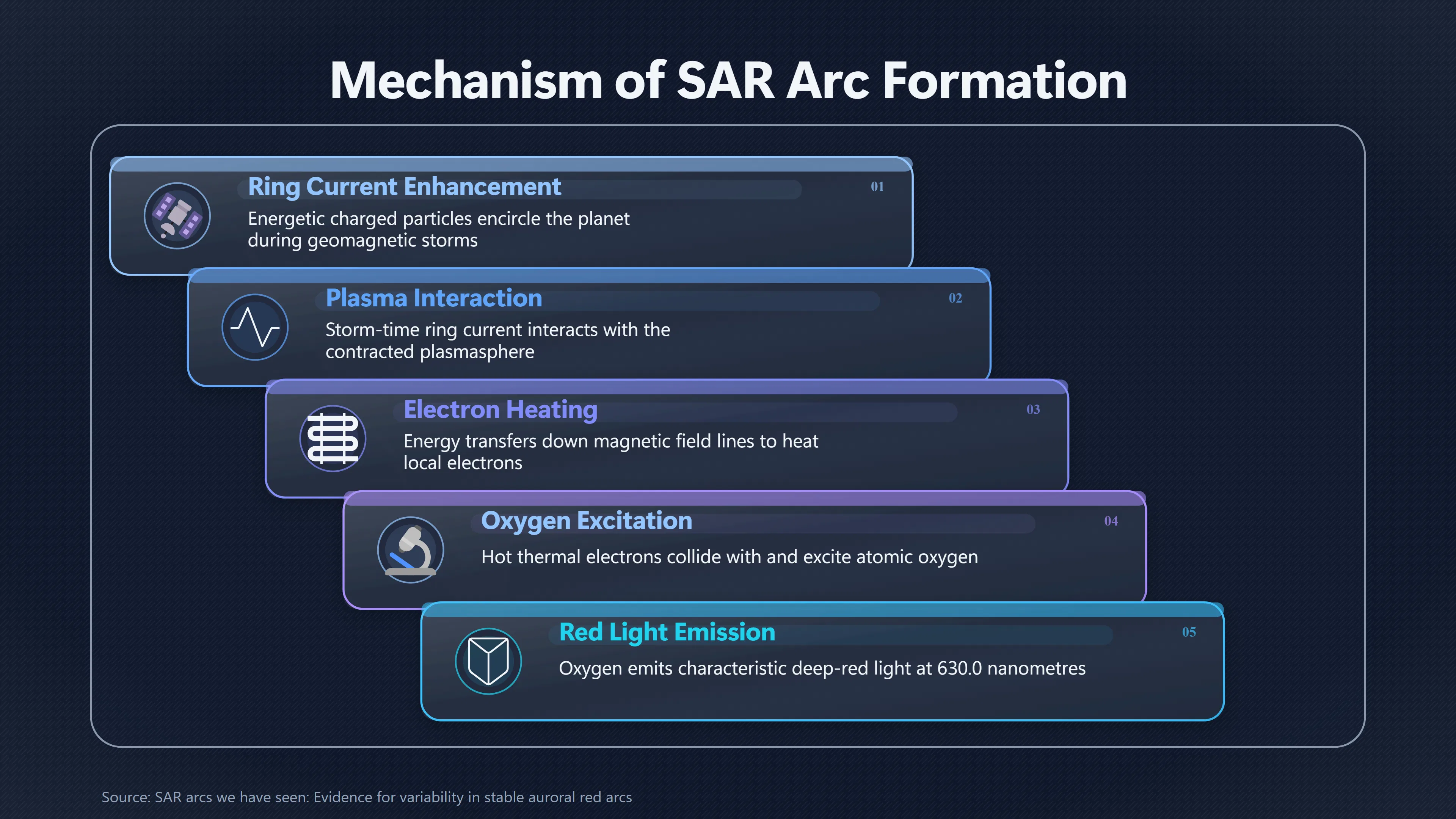
During geomagnetic disturbances, Earth’s ring current — a population of energetic charged particles encircling the planet within the magnetosphere — becomes enhanced. SAR arcs are associated with the region where the storm-time ring current interacts with the contracted plasmasphere. Energy can be transferred down magnetic field lines into the upper ionosphere, heating the local electron population.[DOI]doi.orgSAR arcs we have seen: Evidence for variability in stable auroral red arcsSAR arcs we have seen: Evidence for variability in stable auroral red arcs - Mendillo - 2016 - Journal of Geophysical Research: Space…
When sufficiently heated thermal electrons collide with atomic oxygen, they can excite oxygen into a state that subsequently emits the characteristic deep-red light at about 630.0 nanometres. Measurements from the Dynamics Explorer spacecraft during a SAR-arc event on 23 October 1981 supported this mechanism, finding that hot ionospheric thermal electrons were responsible for exciting the oxygen state producing the red emission.[NASA Technical Reports Server]ntrs.nasa.govTechnical Reports Server Characteristics of a stable auroral red arc eventTechnical Reports Server Characteristics of a stable auroral red arc event
This mechanism matters for identification because SAR arcs form in the subauroral region, equatorward of the main auroral oval. During storms, the relevant magnetospheric boundaries move towards lower magnetic latitudes, allowing the red emission to appear significantly farther from the poles than a casual observer might associate with auroral activity.[DOI]doi.orgSAR arcs we have seen: Evidence for variability in stable auroral red arcsSAR arcs we have seen: Evidence for variability in stable auroral red arcs - Mendillo - 2016 - Journal of Geophysical Research: Space…
That can produce an apparently contradictory scene: the spectacular auroral curtains may be concentrated towards the poleward horizon while a separate, smoother red arc lies overhead or on the opposite side of the observer. The apparent separation is therefore evidence worth examining rather than a reason to dismiss a SAR-arc explanation.
Why it does not look like an ordinary auroral curtain
Ordinary auroras often provide their own visual clue to identification: green curtains, vertical rays, folds and rapidly changing structures are widely recognised. A classic SAR arc removes many of those clues.
Instead of an obviously active curtain, it can present a relatively featureless red band. Research summarising typical SAR arcs gives brightness around 500 rayleighs, more than ten times fainter than auroral emissions readily visible to the unaided eye. The 2026 Aurora Handbook for Citizen Science likewise characterises them as diffuse red arcs that are generally too dim for naked-eye observation, broader than STEVE and capable of lasting for many hours.[DOI]doi.orgSAR arcs we have seen: Evidence for variability in stable auroral red arcsSAR arcs we have seen: Evidence for variability in stable auroral red arcs - Mendillo - 2016 - Journal of Geophysical Research: Space…
The contrast is therefore useful when evaluating an unusual-sky report:
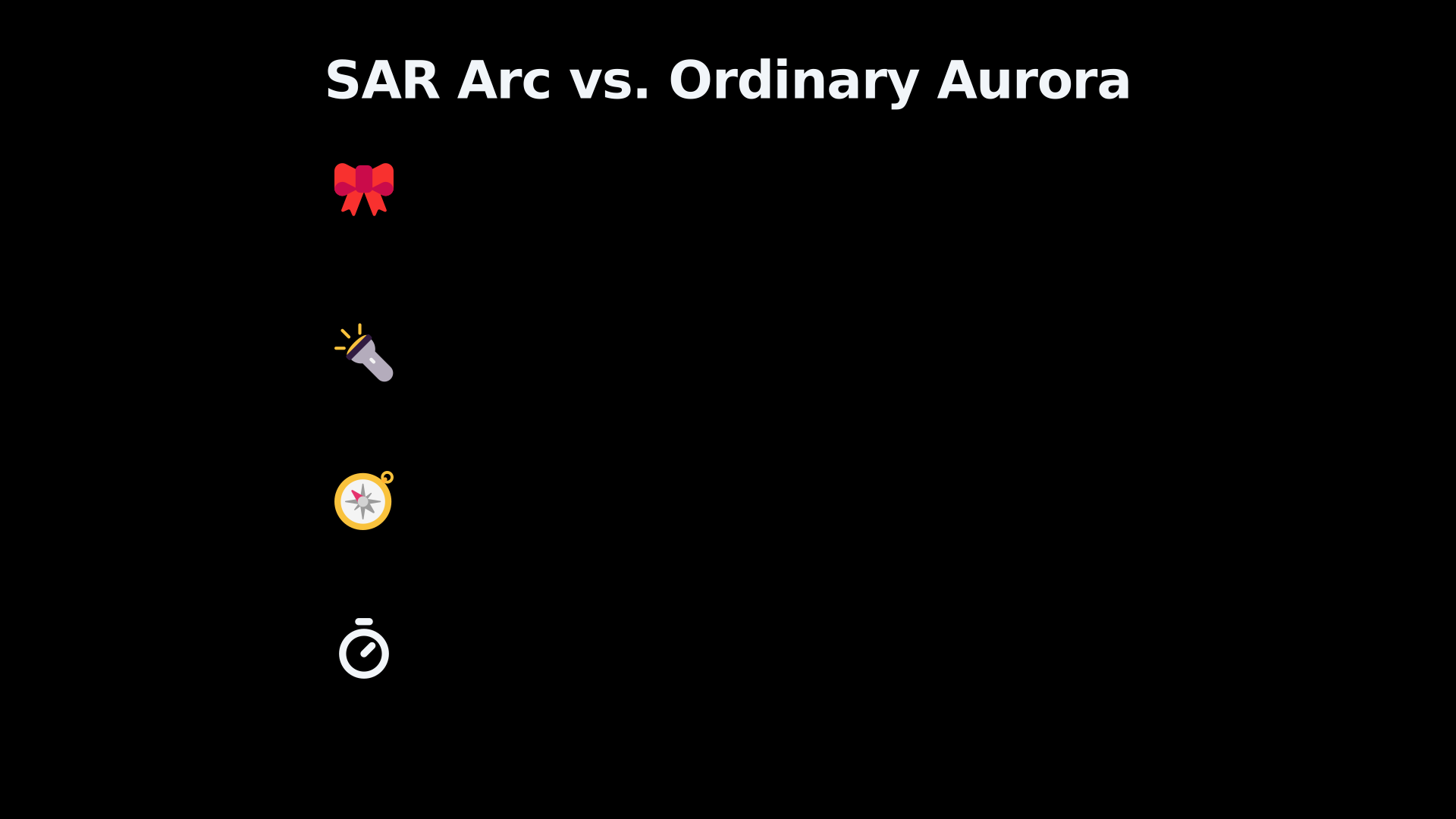
- SAR arc: normally broad, diffuse, red, comparatively persistent and equatorward of the main auroral oval.
- Typical active aurora: more likely to display rapidly changing curtains, rays and complex colour or structure.
- STEVE: generally a much narrower white-to-mauve or purple structure; research has placed STEVE around 225–275 kilometres altitude in one well-observed event, compared with roughly 300–350 kilometres for the accompanying SAR arc.[AGU Publications]agupubs.onlinelibrary.wiley.comOpen source on wiley.com.
Those distinctions are useful but not absolute. Nature does not always produce textbook examples. Researchers using citizen-scientist photographs have observed interactions between proton aurora and SAR arcs, including red arcs with ray structure, while another well-documented event showed a SAR arc evolving into STEVE.[AGU Publications]agupubs.onlinelibrary.wiley.comOpen source on wiley.com.
That is a reason for caution in both directions. An unusual feature should not be rejected as a SAR arc merely because it contains some structure, but neither should every elongated red or purple feature automatically be labelled one.
Why cameras can make the band seem more mysterious
The largest practical trap is the difference between what a camera records and what a person actually sees.
Typical SAR arcs are subvisual. Boston University researchers describe their imaging work as detecting emissions below naked-eye thresholds, while a study of an exceptionally bright 1991 SAR arc explicitly notes that naked-eye-visible events are very rare. That event reached about 13 kilorayleighs — dramatically brighter than an ordinary SAR arc.[Boston University]bu.eduOpen source on bu.edu.
Modern night photography changes the observational situation. A camera can integrate incoming light during a multi-second exposure, and its sensor can register colour differently from dark-adapted human vision. Consequently, a weak atmospheric emission that presents little or no obvious colour to an observer can become a substantial red ribbon in the resulting photograph.
This creates several risks when photographs are interpreted as UFO or UAP evidence.
First, the photograph may contain more information than the eyewitness report. Someone may remember seeing a weak glow, then discover a striking red arc while reviewing the images. The vivid photographed feature should not retrospectively be assumed to have looked equally vivid to the eye.
Second, colour saturation is not a measure of physical solidity. A clean red band can seem object-like precisely because the camera has isolated and strengthened a faint emission against a dark background. Scientific SAR-arc instruments exploit the same principle deliberately, using sensitive cameras and narrow filters centred on the 630.0-nanometre oxygen line.[AGU Publications]agupubs.onlinelibrary.wiley.comAGU PublicationsMulti‐Event Conjugate Measurements of the SAR Arc Detachment From the Auroral Oval Using DMSP Satellites and an All‐Sky C…
Third, an observer may photograph a SAR arc without recognising it at the time. That possibility is not merely theoretical: SAR arcs became scientifically accessible because sensitive optical equipment could detect emissions ordinarily difficult for human vision. Their comparatively late recognition in the 1950s reflects how inconspicuous the normal phenomenon can be.[ANGEO]angeo.copernicus.orgA very bright SAR arc: implications for extreme magnetosphere-ionosphere couplingJanuary 2, 2007…
A striking digital image is therefore not automatically evidence that an equally striking object occupied the observer’s visual field.
Bright SAR arcs are the important exception
“Usually invisible” should not be simplified into “never visible”. Exceptionally bright SAR arcs have been documented scientifically.
On 29 October 1991, instruments near Millstone Hill, Massachusetts, measured an extraordinarily bright SAR arc of about 13 kilorayleighs. Researchers described naked-eye-visible SAR arcs as very rare, making this event a valuable demonstration that the phenomenon can cross the threshold from instrument-detected emission into conspicuous visual display.[ANGEO]angeo.copernicus.orgA very bright SAR arc: implications for extreme magnetosphere-ionosphere couplingJanuary 2, 2007…
An equally instructive case occurred over New Zealand during the geomagnetic storm of 17 March 2015. Observers near Dunedin recorded a broad east–west red SAR arc equatorward of the main auroral display. Researchers reported that it was unusually bright and visible to the naked eye. An all-sky instrument measured a peak 630.0-nanometre intensity of roughly 6 kilorayleighs before the feature evolved into the narrower phenomenon known as STEVE.[AGU Publications]agupubs.onlinelibrary.wiley.comOpen source on wiley.com.
These cases prevent an overly rigid debunking rule. A witness who reports actually seeing a red arc has not thereby ruled out a SAR arc. The better question is whether the reported brightness, position, duration and timing are consistent with an unusually strong example.
Real storms show how easily red arcs stand apart
Recent geomagnetic storms have made the identification problem particularly visible because ordinary photographers have captured subauroral structures alongside more familiar auroras.
During the 5 November 2023 geomagnetic storm, a SAR arc was photographed over northern France as a broad red band extending towards the zenith. NASA noted that similar SAR phenomena were detected at unusually low latitudes around the world during the storm. The image is a useful model for the kind of report that can initially sound anomalous: a broad, smooth red structure crossing a sky where such a feature is not normally present.[Astronomy Picture of the Day]apod.nasa.govAstronomy Picture of the DayAPOD: 2023 November 11 - The SAR Arc and the Milky WayNovember 11, 2023…
The extreme 10 May 2024 Gannon geomagnetic storm produced another large citizen-science record. A study of observations submitted during the storm found ten reports explicitly identifying SAR arcs. The authors cautioned that the distribution was not comprehensive and that the individual classifications could not all be systematically validated, but the reports demonstrate how these specialised subauroral forms enter ordinary photographic records during major space-weather events.[Copernicus]gc.copernicus.orgOpen source on copernicus.org.
There is a further lesson in who recognised them. The Gannon-storm researchers found reports concentrated in areas with organised aurora-chasing communities and suggested that people already familiar with specialised forms such as SAR arcs were more likely to identify and report them correctly.[Copernicus]gc.copernicus.orgOpen source on copernicus.org.
In other words, unfamiliarity itself is part of the misidentification mechanism. The same red band can be an identifiable space-weather feature to an experienced observer and an apparently inexplicable sky structure to someone seeing one for the first time.
A red band is not enough to prove the identification
SAR arcs provide a strong natural candidate for a particular class of unexplained observations, but appearance alone is insufficient. Other atmospheric and subauroral emissions can overlap in colour and geometry.
Even specialists distinguish SAR arcs using more than a photograph. Scientific studies combine all-sky imagery with spectral measurements, satellite observations, electron temperature and density measurements, geomagnetic conditions and the feature’s position relative to the auroral oval. Research into proton aurora, SAR arcs and STEVE has shown that apparently similar bands can coexist, interact or even evolve from one optical state into another.[AGU Publications]agupubs.onlinelibrary.wiley.comOpen source on wiley.com.
For a historical UFO report, much of that instrumentation may be unavailable. Investigators can nevertheless ask several discriminating questions. Was there a significant geomagnetic disturbance at the reported time? Did the feature form a broad, smooth arc rather than a compact point or clearly bounded object? Was it predominantly red? Did it persist much longer than a transient meteor or moving aircraft? Was it situated equatorward of other auroral activity? Did photographs show it more clearly than witnesses remembered seeing it?
The answers should be considered together. A smooth red band during a documented geomagnetic storm, lasting for an extended period and recorded much more strongly by a camera than by eye, is a substantially better SAR-arc candidate than an isolated red light moving rapidly across the stars.
What a SAR arc explanation can — and cannot — establish
A credible SAR-arc identification explains several otherwise puzzling elements of an unexplained sky-band report at once: the enormous apparent extent, deep red colour, relative lack of motion, persistence, unusual latitude and disproportionate visibility in photographs. Those characteristics follow naturally from a large-scale upper-atmospheric emission rather than requiring a discrete object travelling through the lower atmosphere.[DOI]doi.orgSAR arcs we have seen: Evidence for variability in stable auroral red arcsSAR arcs we have seen: Evidence for variability in stable auroral red arcs - Mendillo - 2016 - Journal of Geophysical Research: Space…
It also explains why a witness might sincerely regard the phenomenon as unprecedented. SAR arcs are normally faint, comparatively rare, poorly known outside specialist and aurora-watching communities, and visually different from the green curtains most people recognise as aurora.
But the label should remain an evidence-based identification rather than a catch-all explanation. The strongest cases are those in which the geometry, colour and persistence of the band coincide with independently established geomagnetic activity. Where timing is uncertain, no space-weather information survives, or the reported phenomenon behaves unlike an extended atmospheric emission, the SAR-arc hypothesis becomes correspondingly weaker.
For UFO and UAP assessment, that is the central value of recognising SAR arcs. A smooth, persistent red band can genuinely be extraordinary to the observer while still belonging to a measured class of natural geospace phenomena. The task is not to decide whether it “looks strange”, but to test whether the strange appearance matches the distinctive physical and observational signature of a stable auroral red arc.
Amazon book picks
Further Reading
Books and field guides related to Could a Smooth Red Sky Band Be a SAR Arc?. Use these as the next step if you want deeper reading beyond the article.
Aurora: In Search of the Northern Lights
The beautiful aurorae, or northern lights, are the stuff of legends. The ancient stories of the Sami people warn that if you mock the lig...
Northern Lights: The definitive guide to auroras
The perfect gift for anyone looking to explore the wonder of the Northern Lights. Discover the incomparable beauty of nature's lightshow...
Aurora: Observing and Recording Nature's Spectacular Light Show
This new book addresses a gap in the literature, offering an explanation of the aurora's causes, how the occurrence of major events may n...
The Sun Kings: The Unexpected Tragedy of Richard Carrington a...
In September of 1859, the entire Earth was engulfed in a gigantic cloud of seething gas, and a blood-red aurora erupted across the planet...
eBay marketplace picks
Marketplace Samples
Live-tested eBay searches with available results related to this page.
Selected fromastronomy poster oneBay.co.uk.
Endnotes
1.
Source: doi.org
Title: SAR arcs we have seen: Evidence for variability in stable auroral red arcs
Link:https://doi.org/10.1002/2015JA021722
Source snippet
SAR arcs we have seen: Evidence for variability in stable auroral red arcs - Mendillo - 2016 - Journal of Geophysical Research: Space...
2.
Source: angeo.copernicus.org
Link:https://angeo.copernicus.org/articles/25/2593/2007/angeo-25-2593-2007.html
Source snippet
A very bright SAR arc: implications for extreme magnetosphere-ionosphere couplingJanuary 2, 2007...
Published: January 2, 2007
3.
Source: apod.nasa.gov
Link:https://apod.nasa.gov/apod/ap231111.html
Source snippet
Astronomy Picture of the DayAPOD: 2023 November 11 - The SAR Arc and the Milky WayNovember 11, 2023...
Published: November 11, 2023
4.
Source: apod.nasa.gov
Title: Astronomy Picture of the Day
Link:https://apod.nasa.gov/apod/ap240103.html
5.
Source: ntrs.nasa.gov
Title: Technical Reports Server Global observations of a SAR arc
Link:https://ntrs.nasa.gov/citations/19820061303
Source snippet
NASA Technical Reports ServerGlobal observations of a SAR arc - NASA Technical Reports Server (NTRS)...
6.
Source: ntrs.nasa.gov
Title: Technical Reports Server Characteristics of a stable auroral red arc event
Link:https://ntrs.nasa.gov/citations/19820061306
7.
Source: gc.copernicus.org
Link:https://gc.copernicus.org/articles/7/297/2024/
8.
Source: egusphere.copernicus.org
Title: egusphere 2025 5536
Link:https://egusphere.copernicus.org/preprints/2025/egusphere-2025-5536/
9.
Source: apod.nasa.gov
Link:https://apod.nasa.gov/apod/ap250107.html
10.
Source: gc.copernicus.org
Link:https://gc.copernicus.org/articles/7/297/2024/gc-7-297-2024-relations.html
11.
Source: gc.copernicus.org
Link:https://gc.copernicus.org/articles/7/297/2024/gc-7-297-2024-discussion.html
12.
Source: space.com
Link:https://www.space.com/perseid-meteor-shower-northern-lights-sar-arc-once-in-a-lifetime-photo
13.
Source: doi.org
Link:https://doi.org/10.1029/2020JA029080
14.
Source: angeo.copernicus.org
Title: angeo 17 770 1999 metrics
Link:https://angeo.copernicus.org/articles/17/770/1999/angeo-17-770-1999-metrics.html
15.
Source: ntrs.nasa.gov
Link:https://ntrs.nasa.gov/citations/19950059022
16.
Source: ntrs.nasa.gov
Link:https://ntrs.nasa.gov/citations/19930060113
17.
Source: ntrs.nasa.gov
Link:https://ntrs.nasa.gov/citations/19870060951
18.
Source: ntrs.nasa.gov
Link:https://ntrs.nasa.gov/citations/19880035627
19.
Source: ntrs.nasa.gov
Link:https://ntrs.nasa.gov/citations/19870047217
20.
Source: ntrs.nasa.gov
Link:https://ntrs.nasa.gov/citations/19760039130
21.
Source: ntrs.nasa.gov
Link:https://ntrs.nasa.gov/citations/19720027227
22.
Source: science.gsfc.nasa.gov
Link:https://science.gsfc.nasa.gov/sed/bio/beatriz.i.gallardolacourt
23.
Source: angeo.copernicus.org
Link:https://angeo.copernicus.org/articles/25/2593/2007/angeo-25-2593-2007.pdf
24.
Source: bu.edu
Link:https://www.bu.edu/cas/bu-astronomers-record-evidence-of-new-solar-activity/
25.
Source: agupubs.onlinelibrary.wiley.com
Link:https://agupubs.onlinelibrary.wiley.com/doi/full/10.1029/2022JA030544
Source snippet
AGU PublicationsMulti‐Event Conjugate Measurements of the SAR Arc Detachment From the Auroral Oval Using DMSP [Satellites]({{ 'satellites/' | relative_url }}) and an All‐Sky C...
26.
Source: agupubs.onlinelibrary.wiley.com
Link:https://agupubs.onlinelibrary.wiley.com/doi/full/10.1029/2020JA028068
Source snippet
AGU PublicationsPlasma and Field Observations in the Magnetospheric Source Region of a Stable Auroral Red (SAR) Arc by the Arase Satellit...
27.
Source: agupubs.onlinelibrary.wiley.com
Link:https://agupubs.onlinelibrary.wiley.com/doi/full/10.1029/2020GL092169
28.
Source: agupubs.onlinelibrary.wiley.com
Link:https://agupubs.onlinelibrary.wiley.com/doi/10.1029/2022JA030570
29.
Source: agupubs.onlinelibrary.wiley.com
Link:https://agupubs.onlinelibrary.wiley.com/doi/10.1029/2022GL098511
30.
Source: agupubs.onlinelibrary.wiley.com
Link:https://agupubs.onlinelibrary.wiley.com/doi/full/10.1029/2025AV001881
31.
Source: agupubs.onlinelibrary.wiley.com
Link:https://agupubs.onlinelibrary.wiley.com/doi/abs/10.1029/2025AV001881
32.
Source: agupubs.onlinelibrary.wiley.com
Link:https://agupubs.onlinelibrary.wiley.com/doi/10.1029/2024JA032893
33.
Source: agupubs.onlinelibrary.wiley.com
Link:https://agupubs.onlinelibrary.wiley.com/doi/full/10.1029/2024JA032893
34.
Source: agupubs.onlinelibrary.wiley.com
Link:https://agupubs.onlinelibrary.wiley.com/doi/abs/10.1029/2024JA032694
35.
Source: agupubs.onlinelibrary.wiley.com
Link:https://agupubs.onlinelibrary.wiley.com/doi/full/10.1029/2024JA032694
36.
Source: agupubs.onlinelibrary.wiley.com
Link:https://agupubs.onlinelibrary.wiley.com/doi/full/10.1029/2024JA032552
37.
Source: agupubs.onlinelibrary.wiley.com
Link:https://agupubs.onlinelibrary.wiley.com/doi/abs/10.1029%2F2023GL106292
38.
Source: agupubs.onlinelibrary.wiley.com
Link:https://agupubs.onlinelibrary.wiley.com/doi/abs/10.1029/2023GL106292
39.
Source: agupubs.onlinelibrary.wiley.com
Link:https://agupubs.onlinelibrary.wiley.com/doi/full/10.1029/2023JA032196
40.
Source: spaceweathergallery2.com
Link:https://spaceweathergallery2.com/next_upload.php?upload_id=201480
41.
Source: agupubs.onlinelibrary.wiley.com
Link:https://agupubs.onlinelibrary.wiley.com/doi/10.1029/2022GL101205
42.
Source: agupubs.onlinelibrary.wiley.com
Link:https://agupubs.onlinelibrary.wiley.com/doi/full/10.1029/2022GL101205
43.
Source: agupubs.onlinelibrary.wiley.com
Link:https://agupubs.onlinelibrary.wiley.com/doi/10.1029/2021JA029856
44.
Source: agupubs.onlinelibrary.wiley.com
Link:https://agupubs.onlinelibrary.wiley.com/doi/abs/10.1029/2022JA030570
45.
Source: agupubs.onlinelibrary.wiley.com
Link:https://agupubs.onlinelibrary.wiley.com/doi/full/10.1029/2022JA030570
46.
Source: agupubs.onlinelibrary.wiley.com
Link:https://agupubs.onlinelibrary.wiley.com/doi/abs/10.1029/2022GL098511
47.
Source: agupubs.onlinelibrary.wiley.com
Link:https://agupubs.onlinelibrary.wiley.com/doi/abs/10.1029/2020GL092169
48.
Source: agupubs.onlinelibrary.wiley.com
Link:https://agupubs.onlinelibrary.wiley.com/doi/abs/10.1029/2020ja029081
49.
Source: agupubs.onlinelibrary.wiley.com
Link:https://agupubs.onlinelibrary.wiley.com/doi/full/10.1029/2020JA029081
50.
Source: agupubs.onlinelibrary.wiley.com
Link:https://agupubs.onlinelibrary.wiley.com/doi/full/10.1029/2019JA027321
51.
Source: agupubs.onlinelibrary.wiley.com
Link:https://agupubs.onlinelibrary.wiley.com/doi/full/10.1029/2018JA026017
52.
Source: agupubs.onlinelibrary.wiley.com
Link:https://agupubs.onlinelibrary.wiley.com/doi/full/10.1002/2015JA021722
53.
Source: agupubs.onlinelibrary.wiley.com
Link:https://agupubs.onlinelibrary.wiley.com/doi/10.1002/2015JA021722
54.
Source: agupubs.onlinelibrary.wiley.com
Link:https://agupubs.onlinelibrary.wiley.com/doi/full/10.1002/2013JA019267
55.
Source: agupubs.onlinelibrary.wiley.com
Link:https://agupubs.onlinelibrary.wiley.com/doi/full/10.1029/2002JA009423
Additional References
56.
Source: youtube.com
Link:https://www.youtube.com/watch?v=ROIQvDbKeXE
Source snippet
This video directly addresses the prompt by explaining how stable auroral red (SAR) arcs create diffuse, stationary red bands across the...
57.
Source: livescience.com
Link:https://www.livescience.com/space/astronomy/once-in-a-lifetime-photo-perseid-[meteors
58.
Source: researchgate.net
Link:https://www.researchgate.net/publication/228611951_Excitation_of_tall_auroral_rays_by_ohmic_heating_in_field-aligned_current_filaments_at_F_region_heights
59.
Source: researchgate.net
Link:https://www.researchgate.net/publication/350030166_Multi-Event_Analysis_of_Plasma_and_Field_Variations_in_Source_of_Stable_Auroral_Red_SAR_Arcs_in_Inner_Magnetosphere_During_Non-Storm-Time_Substorms
60.
Source: researchgate.net
Link:https://www.researchgate.net/publication/347488301_Plasma_and_Field_Observations_in_the_Magnetospheric_Source_Region_of_a_Stable_Auroral_Red_SAR_Arc_by_the_Arase_Satellite_on_28_March_2017
61.
Source: researchgate.net
Link:https://www.researchgate.net/publication/361732880_Interaction_between_Proton_Aurora_and_Stable_Auroral_Red_Arcs_Unveiled_by_Citizen_Scientist_Photographs
62.
Source: researchgate.net
Link:https://www.researchgate.net/publication/387266202_The_Gannon_Storm_citizen_science_observations_during_the_geomagnetic_superstorm_of_10_May_2024
Published: May 2024
63.
Source: researchgate.net
Link:https://www.researchgate.net/publication/387266202_The_Gannon_Storm_citizen_science_observations_during_the_geomagnetic_superstorm_of_10_May_2024?_tp=eyJjb250ZXh0Ijp7InBhZ2UiOiJzY2llbnRpZmljQ29udHJpYnV0aW9ucyIsInByZXZpb3VzUGFnZSI6bnVsbCwic3ViUGFnZSI6bnVsbH19
Published: May 2024
64.
Source: researchgate.net
Link:https://www.researchgate.net/publication/390330075_Auroras_during_extreme_geomagnetic_storms_Visual_observations_of_the_SAR_arc_in_Irkutsk_during_the_1859_Carrington_event
65.
Source: researchgate.net
Link:https://www.researchgate.net/publication/403015668_Equatorward_expansion_of_the_auroral_oval_during_the_May_2024_geomagnetic_storm_observed_over_Europe_by_FRIPON_all-sky_cameras_and_satellites
Published: May 2024